Kia introduced its “drive wise” intelligent safety technologies vision and roadmap for the fully autonomous vehicle earlier this year.
Drive wise is a $2 billion investment program over the next two years that will enable Kia to introduce intelligent safety technologies to its future model range, help to eliminate potential dangers and, for many, eradicate the boredom of driving.
The car manufacturer plans to introduce partially-autonomous driving technologies by 2020, with the arrival of fully-autonomous vehicles targeted by 2030. Nevada has already granted license to Kia to test the autonomous Kia Soul EV on public roads.
“Kia is undergoing a very promising and gradual process of introducing partially and fully autonomous technologies to its vehicles,” said Tae-Won Lim, Hyundai Motor Group’s senior vice president of central advanced research and engineering institute. “Although the first marketable fully-autonomous car from Kia will not be available in the immediate future, the work our (research and development) teams are currently doing to develop our range of drive wise technologies is already improving on-road safety and driver assistance.”
Henry Bzeih, Kia’s chief technology strategist, joined [a]listdaily to talk about autonomous driving vehicles, how Kia is alleviating concerns behind it and how they reach their consumers.
How are you marketing to consumers who have safety concerns with autonomous driving vehicles?
We would not put a product on the road that we don’t feel confident and comfortable about. That’s No. 1. You could imagine the amount of rigorous testing and development that goes into making a product and putting it on the road, including simulation. From the marketing standpoint, that’s just the machine that helps them send the message. Obviously, having the ability to have customers engaged early is important. There is a demographic element that we need to think about, too. Some demographics like millennialsand digital natives are open-minded to this type of technology than others. It’s going to take a generational change, which is why we’re looking at 2025 and 2030 as realistic dates for these types of vehicles to cement this technology in the minds of people who haven’t accepted it. We’re not going to sit here and say ‘everybody wants it.’ But we certainly anticipate the acceptance.
What are specific strategies you’ll be using to execute that 10-to-15-year plan?
Any large company that wants to be in business has to have some level of plan. It’s not something we just came up with. We do have a very solid plan on how we’re going to get there.
How are you garnering the attention of the millennials and digital natives?
It’s definitely about disruption at its finest. You can’t communicate the classic way, but the new way. So we have a whole team at headquarters using our networks to communicate the strategy with customers.
What are some new ways you’re trying to reach your audience?
We did our first press conference at CES. We also did “ride and drives.” This is definitely our first step into communicating more and making our plans more knowledgeable.
How is Kia using virtual and augmented reality moving forward?
At CES, we had a station purely centered around VR integrating the autonomous technology into the experience with the Oculus gear. I can not comment specifically on what we’re doing, but I can tell you that both VR and AR are two important elements as part of our strategy today, and moving forward. Down the road, though, keep your eyes open for some announcements.
Gaijin Entertainment is offering something that rival Wargaming cannot to eSports fans – a World War II experience that combines ground and air combat with War Thunder. Thunder League is in full swing with the top eight teams battling on land and in the air, in the same match.
The total cash prize purse is $56,000 and continues to grow thanks to player contributions through in-game micro-transactions. Anton Yudintsev, CEO of Gaijin Entertainment, explains his company’s plans for eSports in this exclusive interview.
Why did you decide to enter the eSports arena with War Thunder?
War Thunder has always possessed strong eSports potential. We began analyzing other eSports leagues and eventually created our own based what we learned. It took us some time to create regulations for Thunder League. Gladiators system for aircraft tournaments were great, but with the addition of ground forces to War Thunder, we had to rework the regulations and make them fit combined battles, meaning battles would take place in the air as well as on the ground. Total warfare. Combined total warfare provides many interesting tactical opportunities for teams. In addition, it creates better visual streams for fans.
What types of modifications did you need to make to the game to accommodate eSports competition?
We have not made any specific modifications for Thunder League because War Thunder itself provided us with everything we need. War Thunder is a competitive game to begin with. Whether on PS4, PC or in VR, War Thunder players can easily set up a custom battle in the game, managing almost all the conditions: number of players to a team, vehicles they can use, game mode and even weather. As we prepared to launch Thunder League, we added an auto-tournament mode to last year to show the players what eSports could look like, allowing them to form teams and prepare them for upcoming championships.
What’s the structure for the league and how is it broken up across regions?
Thunder League is not just a one-more tournament, but an ecosystem created around a series of international championships in order to engage more players with eSports and let them become a part of League. The structure of the championship started with a number of test regional tournaments. The best teams from each region entered the first Thunder League championship. We have analyzed the results, chosen the best teams from all over the world and invited them to take part in this championship. The world’s 10 best War Thunder teams, comprised of ground forces and air forces, representing Europe, North America, Russia, and CIS are now competing in Thunder League.
How are you using fan-funded prizing for this league?
Players set the prize fund. They can purchase Thunder League dog tags, which let them join different activities and get exclusive League items and unique vehicles. Twenty-five percent of the revenue from the purchase of dog tags contributes to the overall prize fund. Each time the prize fund reaches a next prize stage ($10,000, $15,000 and upward) players unlock more opportunities to win prizes, rare items, and vehicles.
The championship started with a $5,000 prize fund and now it is over $56,000 now. Players have already unlocked new game modes, received decals, boosters and special three-color aerobatic smoke. The $50,000 stage provided fans with a Panther T-V and Messerschmitt BF 1 09-E7/U2.
What have you been able to learn from Wargaming, Riot, and others in the eSports arena that you have applied to this endeavor?
We wanted to ensure eSports was right for War Thunder and that we created events that were target right for our players. We did not want to emulate others. We analyzed different eSports events in order to understand what works best for War Thunder. We then formulated our League system, taking into account what players enjoy most about War Thunder and how best to operate in the War Thunder ecosystem. We wanted to create something familiar, yet unique to War Thunder.
What impact have you seen the Thunder League have on engagement with your audience?
Players enjoy the competition of Thunder League. They have participated in all the activities and events. Thunder League has increased engagement. We have seen many first time eSport players participate in Thunder League. In Thunder League’s very beginning, many joined in order to earn unique vehicles, but the competitive and fun nature of Thunder League has increased their engagement. They are starting checking the news and updates, share information with other players, consuming streams, earning more vehicles. ESports is not just a competitive event, but also a new gaming culture.
How popular is eSports in North America for Thunder League?
Thunder League is very popular among our players in North America. We had one team – Cube – from the USA in the international championship and we have seen great support from US players. Cube received a lot of support from North American War Thunder players. Streams of their matches had many viewers, even those that took place in the evening European time, which is early morning in the US. To celebrate the strong response from US players, we created an exclusive Thunder League item for them – Miss America camouflage for Mustangs.
How much learning and experimenting is going on with this first eSports endeavor?
The first season of the League is an experiment for us. We have been testing and analyzing everything, repeatedly to ensure amazing experiences for anyone who wants to participate. The most important thing is the feedback we receive and then implementing against it. Our ongoing analyzing tied in with player feedback will ensure that future seasons will be even better. For example, next season we want to make League activities universal, so more players can take part in it, no matter what level they have and what vehicles they prefer.
What are your longer-term eSports goals?
We want to make Thunder League a regular event, involve more players, and transform it into an essential part of the War Thunder experience, so every new player has the opportunity and ability to become an eSports star.
Ever since its initial announcement during Ubisoft’s pre-E3 press conference in 2013, Tom Clancy’s The Division has been highly anticipated across the gaming community. With a promising combination of third-person shooting action, role-playing elements, multiplayer team balancing and a huge, devastated world to explore, the game is far from your usual military experience.
Now, as the game inches closer to its March 8th release date, Ubisoft has begun ramping up the promotions for The Division. Here’s a breakdown of everything it’s done so far, although we’re sure to see more (TV advertising, print advertisements) leading into the weeks ahead…
Ubisoft has announced the launch of a multiplayer beta, which kicks off tomorrow and runs through January 31st. It’s meant to test out the servers for the game, although it will give players a taste of what to expect. Expected to launch across Xbox One, PlayStation 4 and PC, the beta will be open to those who preordered the game.
In an effort to show just how effective money is when it comes to the devastation caused in the world of The Division, Ubisoft has launched a “cash contagion” website that shows just what kind of downfall can come from money being used the wrong way. It’s a unique shake-up that will give players more details in terms of what they can expect from the game.
On another Division devoted page on Ubisoft’s website, players can drop into the city of Manhattan, using a Google StreetView-like feature to get a good look at the harrowing world, as well as some locations where battles are expected to take place. Only a pair of locations, Madison Field Hospital and Dark Zone Wall, are available at the moment, but more are expected to be revealed over the next few weeks.
Ubisoft teamed up with Amazon to produce an original The Division series for its Prime members. Titled Agent Origins, the short film tells the story of agents involved in the fight against rogue soldiers, as a tie-in with events that happen within the game.
At PAX South in San Antonio this weekend, Ubisoft’s The Division will be a big part of Twitch’s plans for the event. It will take center stage in Turtle Beach’s Broadcaster Zone, where a number of top streaming personalities will take part in a multiplayer demonstration for the game. The events will be broadcasted on Twitch’s streaming channel as well, so viewers can tune in and learn what to expect from the forthcoming game – if they don’t have access to the beta already, that is.
Over the next few weeks, promotion for The Division is likely to pick up steam with more TV and print advertisements, similar to what occurred with Tom Clancy’s Rainbow Six Siege last December, where actor Idris Elba took part in the action.
The game arrives on March 8th for Xbox One, PlayStation 4 and PC. Judging by its pre-release buzz (and the popularity of the forthcoming beta), it’s likely to be a huge hit.
Envision Entertainment is just over 2 years old, but its roots go back farther than that. The studio was originally Phenomic [founded in 1997], and later became EA Phenomic, creators of browser-based massively multiplayer strategy games like BattleForge and Command & Conquer: Tiberium Alliances [2012]. The latter of which is still in operation.
The company decided to bring its longtime experience to develop a strategy game called Path of War, which released today for mobile devices. In it, players must all make their way across 1:1 scale map of the United States (derived from real world geographic data), from the West Coast to Washington DC to take down a despotic leader. All the while, players build up their forces, make alliances and compete with each other for resources.
Martin Löhlein, Senior Producer at Envision Entertainment speaks to [a]listdaily about developing a game that fits in with Nexon’s vision of publishing games with a 10-year service expectation while tearing a path of destruction across the United States.
Tell us a little about Path of War
Path of War is a tactical asynchronous real-time battle game, kind of like Clash of Clans (but with a completely different combat system), and it takes place on a synchronous MMO map, like in Game of War. Each world [server] supports 50,000 players on a 1:1 scale map of the United States, meaning that each game square is equal to one square mile of real space.
Once you really get engaged, and alliances battle each other, you could do some real long term planning. You could be plotting for two or three days before the attack of a key city. Some people have described it as chess-like, because you can make use of the strengths and weaknesses of different units in addition to forcing defenders into unfavorable positions using their movement rules.
As players progress and move across the world, they trigger story events that feed back into gameplay changes, like everyone getting powerful tanks for a period of time.
After so long in PC development, what made mobile the ideal platform?
The availability of these devices is just perfect for these types of games; ones where you engage with a lot of players over a long period of time. As your alliance moves across the US and focuses on different locations in real-time, so there’s always something happening in the world. Everything unfolds over a period of weeks or months.
With a PC, you sit down, dedicate a set period of time, and you’re out. If you’re not in front of your computer while your alliance is having a planning discussion, then you’re left out. With mobile, we have designed the game for players to drop in and out while still being able to keep track of what’s going on using an in-game messenger system that’s similar to Whatsapp, Google Hangouts, or Facebook Messenger — because that’s how people communicate using mobile — with option push notifications from individual channels. That way, you can follow conversations even when not in-game.
Then, if you have time, you can fire up the game within seconds to be part of the action or spectate.
As the game continues to grow, will new players have trouble getting in?
The game is based on a constant progression of players moving forward towards Washington DC Rewards from the area become less valuable the longer you stay in one place, which encourages you to move further east. The challenge is in how fast you can move across the map.
You’ll never be stuck, because whoever is in front of you will either move forward if he’s active, or you’ll become strong enough to defeat him and move past if he’s not. Plus, you can move south or north to find another way to break through.
Assuming you’re going at a swift pace, about how long does it take to reach DC?
From the testing we’ve done, and the way we’ve engineered the game, it should take roughly six months.
Mobile games are generally known for quick gameplay sessions, but Path of Warseems very involved. How do you reconcile that?
That is a common perception, and there is some truth to it, but with a twist. Mobile is indeed a platform where a lot of the sessions are meant to just kill a few minutes of time. But that doesn’t mean they’re exclusively played in that manner.
What we’ve seen in our tests is that players want to have some distraction, and not think too much if they only have a few minutes, but they also want to invest more time and thought into games they like. The most important thing is that whatever you do, whether it’s a quick session or not, it needs to contribute to some sort of overarching, persistent, progress.
There are different ways you can challenge yourself while playing Path of War. If you can do some resource raids if you just have a few minutes to kill, and still make a contribution to your alliance and overall progress. If you have a little more time to get involved, that’s when you dive in to expand your territory and take on more challenging targets. We’ve made sure that the game doesn’t require an extreme time investment to play competitively with others.
In our previous experience, we found that the most valuable players — those that keep alliances together, set goals for others, and make the game more enjoyable in general — are people who are successful in real life. They usually have a family and a job, which means they can’t spend an infinite amount of time in the game. So, you can still be competitive even if you play a few brief sessions a day, and keep up with those who can play for much longer periods.
In what ways does Path of War fit into Nexon’s plan for releasing games with a 10 year service expectation?
I don’t want to describe what happens after you reach Washington DC, but what I’d like to point to our history, especially the browser games. Command & Conquer: Tiberium Alliances is still running, and still has players from its first weeks.
The important thing for us is to listen to the community to see what the game needs and how we can extend the gameplay. A core thing for us is creating systems and mechanics that can be extended for quite a while and to quite some depth. Our units, their upgrade options, and the fact that we’re using real world data instead of designing levels opens up a lot of options.
The interesting thing will be releasing the game worldwide, connecting with players, and seeing where we can take the game in the long run, especially through the social components. We’ve seen that people who engage in this kind of alliance gameplay tend to form strong bonds that endure over a long period of time.
With eSports growing and Twitch streamers hitting 1.7 million streamers and 100 million viewers on a monthly basis, there’s an explosion of content coming out of the Amazon-owned but independently-operated video platform. Plays.tv is one of the key ways that streamers capture and share their best moments of fiero, glitches or epic fails with the Twitch community. While streamers can gain massive followings, much of their content is shared through curators that compile ‘best of’ videos. Yet these compilations don’t always credit the person behind the controller when these highlight-worthy moments happen.
That’s where the new Chrome Extension for Plays.tv intends to help. Announced today, this new feature for Plays.tv helps ensure that great eSports and other video game content found on the platform is properly credited and tagged before it is shared by the creator or other users.
Plays.tv CEO Dennis Fong, one of the first pro gamers ever (Thresh) and founder of many successful platforms (including Raptr), wanted to help these streamers by creating a plugin that ensured credit for their work. [a]listdaily caught up with Dennis to hear more about how he’s resolving this issue with this new feature.
Can you tell us a bit about Plays.tv and its role in Twitch streaming?
Plays.tv captures gameplay and video for Twitch streamers so it can be shared. For users, it’s become kind of like an Instagram for gamers and is very popular with people who follow eSports. Users get a stream of content from their favorite players and they can capture those moments for sharing in their own compilations, too.
Why did you want to build this new tool and what does it do?
The streamers that use Plays.tv asked us to do this. We had bookmarking but our community wanted a simple way to capture their best moments and ensure they got credit for what they created when other users share it. So we created this plugin (really, a Chrome Extension) to answer that request.
And it does this capture in a frictionless way – when a streamer does something amazing, they can hit a hotkey to capture the last thirty seconds of gameplay. It’s like an Instant Replay in sports broadcasts – we capture what happened and then provide it so users can easily edit it, add a headline and then get it out to their subscribers.
So this is available for both streamers and also users to edit and share?
Right. For the streamer, information about the game played and other relevant tags are added to the clip. It’s all ready to go for sharing. No combing through hours of their content to find that awesome moment they really want people to see. Most streamers have their own live content running on a PC nearby so they can just capture it right there. Then they can put it into their own highlights reel or other users can add it to their own compilations with proper credits.
We’re kind of creating an NFL Red Zone for eSports by making it easy to compile, view and share the best streaming video game content out there, while also making sure creators get their due. We think this can be huge for live broadcasts of eSports events, too.
What else does Plays.tv have in store for the future?
This is just the first release of the Chrome Extension to help solve a problem for these streamers. We have more planned that will help them monetize, expand to other platforms, and reduce the friction to get their content out there. We certainly aren’t done coming up with ways to support our community of streamers and users. This is just a starting point.
Have you ever been in the middle of an intense workout, only to be deprived of water, a protein shake or a much needed post-run snack because you left your bulky wallet behind? Well, you’ll soon be able to consider those conundrums a problem of year’s past.
MasterCard is helping customers kiss the cash and pesky plastic cards goodbye by turning any gadget, accessory or wearable into a payment device.
The New York-based financial institution is working toward delivering consumers with safe and convenient payment alternatives through it’s “Commerce For Every Device” program. The company formed a partnership with Coin that will power payments through fitness bands, smart watches and other wearable devices, Sherri Haymond, MasterCard’s senior vice president of digital channels in emerging payments, told [a]listdaily.
“People do not wake up in the morning and say, ‘I want to make a payment today,’” Haymond says. “What we’re doing is trying to make the process super seamless like it’s supposed to be, and also enable experiences before and after the payment to enrich the customer’s lives.”
The idea behind MasterCard’s shift is to simplify functionality for both consumers and device manufacturers from a technological and operational standpoint. “You’re going to start seeing these things become very real,” she says. “We’re going to make it super easy. All different kinds of devices will be enabled for payments.”
Haymond says that paying through wearables was problematic in the past because chips were too big, and Bluetooth consumed too much battery. Enter Coin, who’s provided MasterCard a tech solution by shrinking the chip size to a super-thin pinky nail, yet, still enabled it with an NFC chip and Bluetooth that drains little battery. Coin will provide hardware and software technology that is integrated with the MasterCard Digital Enablement Service and can be embedded into devices to enable manufacturers to implement payment functionality into their products.
“Coin’s Payment of Things platform is a turnkey solution to enable payments for the wearable/IoT industry. Leveraging Coin’s technology, device manufacturers will benefit from significantly reduced costs and time to market,” said Kanishk Parashar, CEO and co-founder of Coin. “MasterCard is our essential partner as we team up to enable the wearable domain that is projected to grow to an astounding $53 billion by 2019.”
Wearable companies like Moov, Omate and Atlas Wearables have already jumped on board, and many more partners are currently in the works, Haymond notes. “There aren’t enough hours in the day to respond to the companies interested in participating. We have a huge pipeline.”
Haymond says the success of mobile wallets like Apple Pay, Samsung Pay and Android Pay throughout the years have alleviated any security concerns. “Consumers aren’t skeptical of this at all,” Haymond assures. “It’s extremely safe and secure. With all of these devices, consumers will get transaction notifications through their issuer. … It actually fosters a closer connection between the customer and their bank. Our research shows that customers strongly prefer to have financial interactions with their banks rather than a third party.”
The novelty of wearables will wear off over time, but brands like MasterCard are jumping into the picture to inject some life into the sector – not to mention some yet to be imagined categories.
“We’re putting forth these ideas, and enabling an entire ecosysytem, and trying to be a leader in the space to spur a movement,” says Haymond. “We’ll measure success based on the number of transactions in one respect, whether consumers are using it, and if our issuers are happy about it. We expect for it to become a part of the consumer’s daily lives.”
Pretty soon you’ll be able to make payments with a simple wave of the wrist in front of the payment terminal. The cashier will be amazed, and everyone around you will think its magic, and so will you – until you review the next statement.
One of the fastest-growing competitive online gaming platforms continues to have one helluva month to begin 2016. FaceIt has secured a $15 million Series A funding, Niccolò Maisto, founder and CEO of the London-based eSports startup, told [a]listdaily.
Fresh from enjoying a partnership with Turner Sports and WME | IMG in which they hosted qualifying rounds for the Counter-Strike: Global Offensive Championship – specifically under the bright lights of the Consumer Electronics Show – the platform announced it’s received venture-capital funding from firms Anthos Capital, Index Ventures and United Ventures.
Maisto said the company will use the money to add game titles to the platform, build out the technology and expand operations with the opening of U.S. headquarters in Santa Monica, California.
“The key to FaceIt is the community and technology we’ve developed, and to keep supporting it with additional game integrations, features and the reliability that’s expected,” Maisto said. “We have benefits to players to make it easier for them to compete, and that speaks to the user experience we offer.”
FaceIt allows gamers to play in leagues for prizes through automated tournament management and matchmaking technology. Their software development kit allows game creators to integrate tournaments into their eSports titles. They previously received a $2 million seed funding last summer.
“With an extremely strong, passionate and driven team led by Niccolò, a rapidly growing community of players and tournament organizers, robust technology and deep relationships throughout the industry, FaceIt is well-positioned to be the definitive platform across competitive gaming,” said Alex Birns of the private equity firm Anthos Capital. “The eSports market is expected to undergo massive growth over the next several years, and FaceIt has the potential to shape how developers, players and brands participate in and experience the industry.”
Ben Holmes of Index Ventures says FaceIt has been successful in building partnerships with game publishers, media companies and other industry leaders. “The company is helping developers engage more deeply with their player base by offering an easy to integrate competitive layer into their games. FaceIt is emerging as a major player in the competitive gaming ecosystem.”
Niccolò Maisto joined [a]listdaily for an exclusive interview to discuss the growing eSports industry, and a FaceIt platform that boasts hundreds of tournament organizers and over 3.5 million users.
What were the opportunities, challenges and learning experiences with partnering with Turner at CES?
Having companies like Turner and WME | IMG that come from traditional industries and enter the eSports ecosystem is great. It’s going to help the growth. It validates our concept of having a mix of eSports capability and professionalism, which is something that eSports has been lacking because it’s very community driven. With our blend of people coming from eSports and traditional industries, that’s very much in our DNA.
How will big-name corporations enable and empower eSports moving forward?
It’s something that helps a lot in order to get mainstream attention, and from brands. If you look at the industry in the last couple of years, it has grown a lot, but it came from a place where it was a cheap industry. There weren’t any financial resources to use. Today, it’s changed quite a bit. I think it’s mutually beneficial for the ecosystem as long as it’s done in a respectful way, because we have to remember that the community is the most important piece to the puzzle. It’s important for brands themselves. It’s a fast-growing target, and very hard to reach. It can not only open an additional acquisition and advertising channel, but they can also start targeting this demographic and vertical as a completely different one with its own special needs.
Why is it important to be connected to your community?
Community is the key of eSports, and what differentiates it from traditional sports – eSports is something that was born by community. It’s about taking a game beyond the session, and making it part of a lifestyle, building social connections, interactions and friendships. That’s how eSports basically grows. If you look at if from a game publisher or developer point of view, this is extremely important because it’s something that increases retention. Additionally, it’s an acquisition channel for them. ESports events are easy ways to attract large user bases.
How would do you describe the FaceIt community?
We’re very much a global company. Europe and North America are our two main regions. Europe is slightly more dominant, but North America is the fastest growing. Our demographic is ages 16-to-32, it really depends on the game. I would describe it as a hard-to-access demographic because they tend to not watch TV. They spend their time either playing games, or watching streams or digital platforms.
How is FaceIt differentiating itself from other similar tournament platforms?
The first thing is the user experience we offer, and the scale we’re at. If we compare ourselves to competitive platforms, there is no one else that ever managed and engaged the user base at scale. We have over 3.5 million people visiting FaceIt every month and that’s because we’ve managed to create what I call our ‘secret sauce’ around how to engage and how to target the players, and how to make sure they spend time in the competitions. One way is by offering brands ‘branded competitions.’ Our case studies show there is a consistent, 30 percent-plus uplift in brand awareness. If you compare it to traditional advertising, this format is less intrusive; gamers are not blinded. We’ve previously done this with Red Bull, the movie John Wick and a few European betting companies.
How can traditional brands leverage eSports to reach their target audiences?
They don’t necessarily need to change their business model, or change their products. But they should start treating it as a separate vertical. There are not many ways to reach this audience, and it’s only beginning. We’re one of them. So is Twitch. Running coordinating campaigns between eSports events, advertising on streaming platforms and branded competitions, for example, could be a good way to target the audience.
Your background is in investment banking. What drew you into eSports?
The first thing I needed to understand was that I needed to be humble enough to accept the fact that things were different. I was looking for someone that understood gaming better than myself. Co-founder Alessandro Avallone was introduced to me as a professional championship gamer. He’s been invaluable to the business since Day 1. … Getting in touch with the community is extremely important because it’s not that easy. For me, I went from dealing and advising on $1 billion deals to suddenly talking to a 16-year-old kid complaining about Internet connection.
How can investors capitalize on the eSports market?
It really depends on what you’re looking at, and what kind of investor you are. If you’re looking for technology, it’s really hard to find that in eSports. If you look at media, there are quite a few opportunities. Or the relevant teams that play themselves.
What kind of marketing and partnership opportunities does this afford for brands?
Growth is definitely one opportunity. It’s an industry that’s went from being a niche to becoming a mainstream trend. Brands need to be properly positioned in order to know how to exploit it. But it’s not easy because it’s not a structured vertical. As this is happening, whoever jumps into the pool first is going to have the best opportunities.
Unravel introduces players to Yarny, a three-inch figure made completely out of wire and yarn. In the context of the game, the yarn represents the thread of love that connects people together. Yarny must use it to make his way through a larger than life world and solve puzzles without diminishing himself too much.
EA is best known for high-adrenaline games like the Battlefield series, the recently releasedStar War Battlefront, and Need for Speed in addition to its sports games, but Unravel stands out using its own touching charm; created by a unique character and beautifully peaceful setting inspired by the real world.
Brian Austin, product marketing manager at EA, spoke to [a]listdaily about Unravel, and getting the world to love playing with Yarny when the game releases on Feb. 9 — just before Valentine’s Day.
In what ways does Unravel stand out from other puzzle games?
Unravel is unique in that our hero, Yarny, uses the combination of Yarny’s own device, yarn, and the logistics of the environments to navigate through the game. While the tools may be simple, they have the ability to accomplish complex puzzles.
The physics-based elements of the game allow Yarny to use momentum to swing from a tree branch or jump from a yarn bridge. There is another element, however, to traversing Unravel that makes it different than any other game of its kind – the element of Yarn economy. This gameplay strategy requires players to be mindful of how much yarn they have to work with in order to get Yarny safely through each level and keep Yarny from unraveling.
What is it about Yarny that makes him such an appealing character?
Yarny is tiny in size, but huge in heart. In spite of Yarny’s size, there is no obstacle too great that can’t be overcome through perseverance, ingenuity, and bravery. A positive force in a sometimes dark world, Yarny has a charm and kind-hearted spirit that evokes joy in its simplest form. Wonder, curiosity, and courage are infused into the fabric, or in this case yarn, of Yarny’s being and are fundamental to the essence of Unravel.
Is it difficult to convey a story of love and connection when the main character doesn’t speak?
So much of Unravel speaks to the audience, even with the absence of spoken words. The original score, composed by local Swedish musicians, sets an emotive soundtrack to Yarny’s adventure, capturing both heart-breaking and heart-warming moments alike. The rich environments, inspired by Scandinavia’s natural landscape, are more than just a setting, they’re part of the story. They transform players into a visually stunning world that celebrates the beauty in the ordinary and forms the physical foundation of Yarny’s adventure. The emotional foundation of Yarny’s adventure is deeply rooted in the character’s endearing and sincere nature. There is a powerful, unspoken bond to Yarny – a character that says nothing, and everything, all at the same time through an emotional and expressive journey.
How have you been promoting Unravel?
We first introduced Unravel at E3, presented by Coldwood Interactive’s Creative Director Martin Sahlin. Following E3, we brought Unravel to Gamescom where Martin gave attendees a first look at a level called, “The Sea.” Martin shared the inspiration behind Yarny’s story, the level and how that impacts the gameplay experience.
Since Unravel and Yarny have been introduced to the world, fans around the world have created their own Yarnys, sharing them across social channels. To keep fans connected and inspired by Unravel, Martin has given fans direction on how to create Yarny, just like he did, while camping on the coast Northern Sweden. Plus, Coldwood has released several development diaries over the past several months across Unravel’s digital footprint. These videos, narrated by Martin, invite fans into Coldwood to learn about the inspiration and story behind some of Unravel’s most fundamental elements.
What are some of the challenges in promoting a new game that’s not based on an existing IP?
The world of beloved and iconic characters is vast and hard to permeate. These characters carry a built-in affinity and perceived identity – admiration from the masses. With a new IP, there’s white space, a blank canvas to paint a picture of who a character is, who a character will become, and what that evolution means to those that play the game. It’s an opportunity to build a relationship, meaningful and new, with each person who connects with Yarny through Unravel.
Father Time is undefeated. It’s a popular slogan preached in sports whenever a superstar athlete with divine skills begins to toil as a shell of his former self. Kobe Bryant and Peyton Manning are two icons recently bitten by this crippling disease, but the catchphrase especially rings true for a sport whose abbreviation also doubles as “Not For Long.”
Cowboys quarterback Tony Romo’s age-35 season was lost to two separate left shoulder injuries.
Although the Cowboys arguably have the league’s most talented offensive line, Romo caught a case of bad luck last season and couldn’t stay upright as Dallas limped to a 4-12 finish. The four games he played were the fewest of his 13-year career. His underwhelming stat line of 5 touchdowns, 7 interceptions and a career-low 55.8 passer rating was perhaps a precursor of a potential demise.
Romo is trying to fight Father Time and extend the lease on his aching body because he has plans of playing till he’s knocking on the doors of age 40.
“I am the old man, but I’m getting younger,” Romo told [a]listdaily. “I still have a lot of time left to play, and I’m pretty excited about it going forward.”
He’s still undergoing rehab treatment for the collarbone, and is not 100 percent yet, he says. However, Romo is “close” and assures he’ll be ready by offseason training activities.
Romo can’t control the punishing hits his body absorbs, so he’s doing his best to prevent it and regain 2014 form – his best season to date. One way is by embracing technology and subtly changing daily habits and the way he maintains his body.
“We’re always searching for answers. Detail is what I want,” Romo says. “I want to have more knowledge and facts to back up (technology). I’ve learned through trial and error and experience through most of my career.”
Romo signed an endorsement deal with Under Armour last August, and he’s enjoying the spoils of that partnership this offseason through the HealthBox, a kit equipped with an activity-tracking wristband, a chest-based heart rate strap and a scale; all of the health data saves in the UA app. The company has turned into a marketing monster in recent years, spending close to a half billion dollars as they try and soften Nike’s stronghold on sports. UA has inked such stars as Tom Brady, Cam Newton and Julio Jones to command attention in the much-coveted football market. NFL draft prospects are decked out in UA apparel during the scouting combine for years to come, and their “protect this house” promos get you more pumped up than a Ray Lewis motivational speech. Now, Romo is subscribing to the company’s “make athletes better” motto with the clothes-to-technology philosophy change.
“For me, I just want data. The more data I can get, the better I can be day-in, and day-out,” Romo says. “When you look at it closely, the HealthBox is really different from anything I’ve ever experienced. I’ve been using it, and it’s fantastic. It’s very unique in the sense of how easy it is. It’s a special thing I’ve learned to love it and it’s helping me get back from injury and be ready for next year.”
Romo’s paid to promote the product – his wife Candice has called him a “grandpa” when it comes to technology – but he’s also adapting to UA’s pillars of sleep, fitness, activity and nutrition in order to add some lines to the last stanza of his career.
Even though the perennial Pro Bowl signal-caller is under contract until 2019, all signs point to the Cowboys either drafting or trading for Romo’s future successor this offseason in case he bites the injury bug again. The first two names that immediately enter the equation in Big D is Robert Griffin III and Johnny Manziel – two embattled quarterbacks with ties to Texas likely headed for new beginnings elsewhere.
When asked if the Cowboys will pull the trigger on acquiring a new quarterback, Romo says “the evaluation has just started,” and complimented current backup Kellen Moore. Romo knows that if he can stay on the field, he could make the Cowboys immediate contenders again in the paltry NFC East.
“I think you’re going to see a good football team next year,” he says. “The season didn’t turn out the way we liked. It was a tough season for everybody in the organization, and for Cowboys fans. I wish I could have been out there more to help. … I’m going to do everything in my power to make sure it doesn’t happen again.”
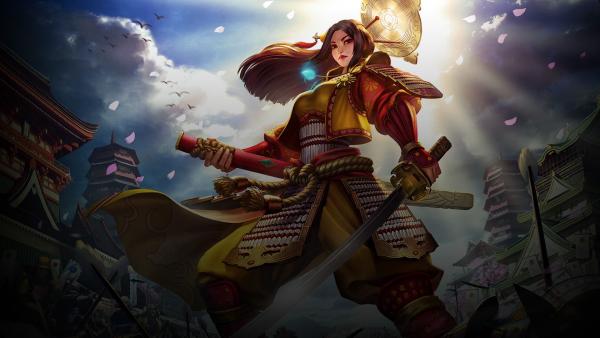
Hi-Rez Studios, creators of the hit competitive online game Smite, has been keeping busy these past months. Smite, a game where players go head-to-head as deities from a variety of mythological pantheons, released as a free-to-play game on the Xbox One last summer. That’s in addition to how the PC version, launched in 2014, surpassed 10 million total players last July.
Even as a relatively new game, Smite became one of the biggest eSport games around. The recently concluded Smite World Championship 2016 featured two different platforms, with a prize pool of $1,000,000 for the PC World Championship and $150,000 for the Xbox One Invitational. This year’s championship also saw special announcements regarding other Hi-Rez Studios games, including an upcoming shooter called Paladins and the free-to-play mobile game, Jetpack Fighter.
Todd Harris, Hi-Rez Studios co-founder and Chief Operating Officer, talks to [a]listdaily about using godly might to host the Smite World Championships, developing a new shooter, and breaking into the mobile market.
What sets Smite apart from other competitive eSports games?
Well, Smite is the only MOBA where you actually have to aim.
Being a MOBA, there are plenty of similarities with other great MOBA eSports titles. Our core competitive game mode is 5 versus 5 and played on a three-lane map, players specialize in a particular role like jungle or support or solo, there are many different characters to master, and at the competitive level the game requires a ton of teamwork and strategy.
But the big difference comes from the fact that thatSmite’s core combat uses the camera angle and controls of a third-person shooter. You directly control your character and almost all of your attacks are aimed and the enemy can dodge many of them.
This makes competitive Smite very action-oriented in addition to being strategic.
In what ways has Smite grown and changed since it first launched almost two years ago?
The game is almost unrecognizable from the early Beta and Launch versions. Since launching we’ve tried to work closely with both the competitive and casual player community to continually improve the game. We started with 9 playable god characters and now we have more than 70. Along the way almost every year one god character and every map have received a visual upgrade if not entirely new models. And last year, we more than doubled the player base to over 13 million registered players. So, lots and lots of change.
Likewise we’ve been blown away by the rise of the eSports competitive scene. I think it has grown way faster than any game franchise to date. For example – last year we joined the top game ranks in terms of eSports prizing. In fact in the history of eSports only one game has awarded a larger tournament prize pool than Smite and that is Dota2.
Tell us about this year’s Smite World Championship.
This year’s World Championship was a great event for our community. The event was held in the Cobb Performing Arts Center in Atlanta and sold out for all 4 days of the tournament. For the PC Championship we hosted teams participating from North America, Europe, Latin America, China, and Australia.
The big additions from last year’s event were: adding an extra day, adding Oceania as a new qualified region, adding an entirely new platform with Smite Xbox One, and also showing off some up and coming games from Hi-Rez.
What are the challenges in promoting two concurrent tournaments across the PC and Xbox One?
There were a bunch of scheduling and logistics challenges and ultimately that is what caused us to expand from 3 days to 4 days this year. With that 4 day format we were able to get all of the PC matches plus all the key Xbox One matches on the main stage and covered by our primary broadcast. In this way we made it easy for our PC audience to watch the Xbox One games and vice-versa.
How has the game grown since its launch on the Xbox One?
I think there was some external skepticism around how a MOBA would perform on console, but that argument has been settled. Players dig it. Smite has been the top free-to-play game on Xbox One almost every week since it launched, and that is against some other very high quality titles available on the platform.
How have you been promoting the Smite World Championship to get the word out?
We promote directly to our community through the game client itself, social channels, e-mail and so on. This year we saw many repeat attendees from last year and we had 85% of the attendees travel from outside of the state to attend. The event sold out well in advance so promotion was actually a lot easier in year two.
Tell us about Paladins.
Paladins is Hi-Rez Studios’ latest multiplayer game currently in Closed Beta. It is a team based shooter with character progression using collectable cards.
There are a great many competitive shooters on the market. How will Paladins stand out?
In Paladins, players collect and build decks of cards which they get to draw from as their character levels up in a match. The cards affect the shooter gameplay in many interesting ways. Our goal is for the card system to create a lot of interesting deck-building strategies, especially at the competitive level.
How are you promoting the Paladins beta?
Very well thank you. [laughs]
We showed off Paladins at Gamescom and Twitchcon. Even with that limited promotion, we have seen over a half a million players sign for beta access on the web site. But we are intentionally keeping the Closed Beta quite small at this point while we work with that community to shape the core game.
What inspired Hi-Rez to develop Jetpack Fighter, a free-to-play platforming gaming for mobile?
The dev team was inspired by classic 80s arcade games and 80s platformers, and wanted to built that type of game but designed around the strengths of the mobile platform – so swiping is the main input mechanic.
We’re pretty optimistic that it will find an audience since the core game loop is so different from any other mobile game out there.
It is funny because we were originally one of the first studios to bring the free-to-play business model to a core gaming audience on PC and console – we launched the very first f2p game on Steam [Global Agenda], and now with Smite, we have the top f2p game on Xbox One.
Now we are going the other way by bringing a very core game genre to a platform, mobile, already known for free-to-play.
Mobile is the primary computing and gaming platform that kids are growing up with today, so it makes sense for us to experiment there. We prototyped three different games and Jetpack Fighter was the concept that drew tremendous excitement internally and externally.
We were fortunate to be featured by Apple as a Top New Game and the early user feedback has been very, very positive.
What are some of the challenges in promoting a mobile game, compared to one on the PC or console?
Our approach is actually the same regardless of platform: get our playable game into the hands of end users as early as possible and then work with that passionate community to make the game even better with each ongoing updates. That is how we feel the best games are made.

 Tell us a little about Path of War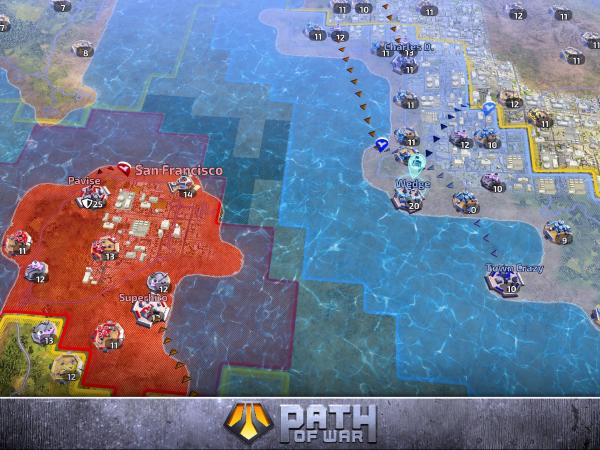
 Can you tell us a bit about Plays.tv and its role in Twitch streaming?

 In what ways does Unravel stand out from other puzzle games?
 What sets Smite apart from other competitive eSports games?