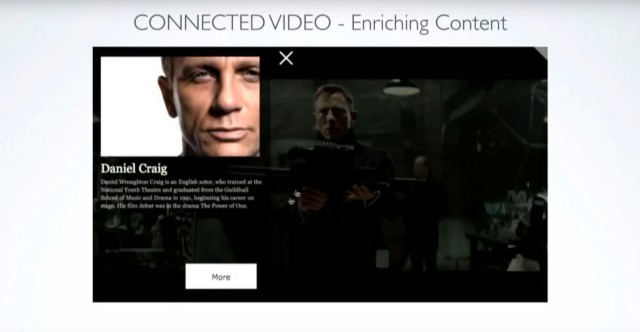
360 video is connected video… or at least it can be. Imagine what you could accomplish by allowing your customers to react and explore your products in real-time.
“If you create any other digital asset that’s a dead end for consumers or for people, you’d lose your job, right?” smirked Wirewax CEO, Steve Callanan, as the audience laughed at today’s [a]list summit. “But with video it’s just acceptable. With this, you get to continue the conversation. Whether you want someone to go through and buy something or book a car for a test drive, you can do that with interactive video. You can’t do that with a plain old video.”
Wirewax is the world’s first interactive video platform, adding clickable hotspots, or “tags,” to any moving person or object in a video. This technology can be used for facial recognition, learning more about a piece of art or clicking on a video of food to get a recipe. The small company typically works with traditional video, re-purposing TV ads, for example, and breathing new, interactive life into them. As 360 videos grow in popularity, the small company has found itself going from 2-3 requests a quarter in 2015 to 2-3 requests a day.
“In the same way that we’re adding value to traditional, non-interactive video, people are looking to us to add value to 360 video, as well,” said Callanan. “360 video, as it turns out, is a bit tricky when it comes to adding interactive content.” The Wirewax team of engineers had to build their own 360 video player, reposition their Javascript from a 2D space to 3D and account for different 360 video formats, gyroscopes and accelerometers across different devices.
“About a month ago, we started working on this. We pretty much got everyone on it for a couple of weeks—we cracked it,” Callanan announced. All that hard work was for a good reason, as co-founder, Dan Garraway explained.
“We’re actually working with Ayzenberg to launch the first interactive 360 thing we’ve ever done and first in the world actually, as part of a new drama series,” announced Garraway. Although details cannot be shared at this time, the series will launch on July 1.
The Advantage Of Interactive Video
When it comes to marketing through interactive video, 65 percent of audiences will not only interact at least once, but an average of 3 times according to Wirewax. People also spend 3.5 times longer on a Wirewax video than with a video without interactivity. With a 16-48 percent click through rate and availability across all media devices, there are three main reasons why interactive video works.
Video publishing is a noisy space: make your content stand out.
Return on investment (ROI): Wirewax clients see five- to ten-percent return. One interactive ad for Ted Baker earned over $100 thousand in sales its first week.
Continue the conversation: get people talking about your brand.
By putting the user in control of how they explore a video, this allows impulse to make purchases rather than rely on the usual conversion funnel (Awareness, Interest, Desire, Action). Now you can see it, click on it, buy it.
Doing 360 Video Right
Although impulse actions are great for allowing your customers to make purchases, creators should not create 360 video based on impulse alone.
“360 is a thing that needs to be creative,” warns Dan Garraway. “It needs to be thought about as much as [when] you’re making a normal video. A lot of the problem with technology when it applies to creative industries [is that] people get very excited about the technology but lose the creative. So one of the reasons why this 360 interactive project we’re launching with Ayzenberg is so important is that the guys have been thinking about it from concept outwards. It’s about using the narrative and actually making a point for making it 360. There is interaction which adds to the narrative of the story.”
“The big point we’re trying to make about the whole 360 thing here is… do it for a reason and then make an action with it.”
When a well-planned, interactive 360 campaign is executed, Garraway believes that brands will reach audiences in a lasting way.
“They’re going to interact, they’re going to understand, they’re going to nurture, they’re going to get the message, they’re going to get something out of it and they are going to remember your brand.”
For more information on Wirewax and their interactive video platform, visit Wirewax.com.
While virtual reality is still one of today’s hottest tech trends, a new study indicates that its rise may have hit a slight bump.
SuperData Research has released a new report, which provides a revised forecast on virtual reality revenue for 2016. The numbers have dropped a little bit from earlier estimates, going down 22 percent to $2.9 billion in combined sales for hardware and software.
The company made these revisions based on new data, including how device shipments have not met demand (both Oculus Rift and HTC Vive have a months-long backlog of orders to fulfill), and how a huge portion of the market is still unaware of virtual reality technology.
That said, the report is still optimistic that VR will still meet previous sales forecasts, which is set to reach $22.86 billion by 2019, and then doubling to $40.24 billion by 2020. Hardware is also expected to slightly increase over the next few years, from just under $5 billion in 2016 all the way to just over $15 billion in five years’ time.
“The general public are mostly unaware of Virtual Reality with 50 percent of Americans showing no interest in or knowledge of VR,” says Stephanie Llamas, director of research and head of VR/AR strategy at SuperData. “Broad consumer adoption relies on building awareness, but today nearly 80 percent of consumers only occasionally or never hear about VR.”
Following that, Llamas, speaking with [a]listdaily, said, “If someone hasn’t had a positive experience with VR they are more likely to dismiss news about it. The only way to understand VR is by experiencing it so driving awareness is going to require enticing people to try it first hand as much as possible.”
Llamas also noted that early adopters play a big part in the success of these units, as they’re likely to share with friends and family, as well as posting their impressions across social media. But, again, production has been an issue with these companies, with more than 13 million Americans saying they intend to purchase some form of virtual reality headset, but only 7.2 million are ready to ship.
Regarding the hardware shipping delays, Llamas noted, “It is not going to have a long-term impact, but it will cause a bottleneck early on. Enough major players have thrown their weight behind it that there is no reason it won’t skyrocket—just a little later.”
Meanwhile, some companies are benefitting from promotions surrounding VR. For instance, Samsung provided a free Gear VR headset to those that pre-ordered its Galaxy S7 and S7 Edge devices, bringing a total of 3.5 million VR devices shipping to consumers. It too is hitting its fair share of delays, but that won’t stop it from keeping the lead, according to Llamas. “Samsung will have the largest share of the market until another mobile device beats them out, but mobile devices will always have the widest adoption.
“Samsung’s devices are on back order for the next couple months so it’s not that they haven’t thrown enough weight behind it, it’s that it worked too well and they can’t meet the demand. The mobile device is also still very much a novelty. What’s most promising about VR is how much you can do with high-end devices. It’s fun to get a taste of that with a mobile device, but it will take time before a smartphone can power a VR device the way it needs to be.”
Sony also has a say in the VR race, with projections that its PlayStation VR headset will ship 2.6 million units when it ships in October. That’s a larger number than the 1.1 million combined units that both Oculus and HTC will sell, although there’s some question as to whether PS4 hardware will be ready for the hardware. There have been rumors that the company is looking into releasing an upgraded model that will be more “VR ready,” but nothing has been confirmed yet. That said, Llamas was quick to point out how it would be a hit with kids. “Yes, it [PlayStation VR] is already the most well-known headset among Americans. It will be a major device around the holidays and new year when parents are willing to spend $400 on a gift and adults get their bonuses,” she said.
The Google Cardboard offers a simple alternative to virtual reality, but Llamas doesn’t think it counts. “Google Cardboards don’t convert people into VR fans; they just give someone a new but fleeting experience. And because mobile is still a novelty, people use it knowing it’s still the on the lower end of experiences.”
Other findings in the report are as follows:
Just 28 percent of Americans have heard of PlayStation VR versus 22 percent for Oculus Rift, 21 percent for Samsung Gear VR and just 5 percent for the HTC Vive
Gamers will be key to initial consumer adoption, accounting for 78 percent of sales in 2016, however, by 2020, gaming will fall to 28 percent of overall spend
26 percent of VR-aware consumers say headsets are too expensive, providing a significant barrier to adoption
Mobile adoption of VR is expected to be slower than initial estimates due to the lack of premium headsets for non-Samsung smartphones, with majority of growth coming in 2018 and beyond, and a projected year over year gain of 175 percent
By 2020, nearly 41 percent of sales from VR headsets, software and peripherals will be driven by PC usage
So, it appears that virtual reality will still make a big splash this year, but probably won’t take off in the consumer market until both supply and promotion pick up.
Art, entertainment and technology converge at events like the Tribeca Film Festival, where creators find new ways to tell stories and communicate with each other. This year, the Festival features a number of virtual reality exhibits that range from experiencing “sight” as described by the audio diaries of a blind person (Notes on Blindness: Into Darkness) to the premiere of a humorous animated short film called Invasion! This takes interactive virtual reality exhibits even further with the debut of the VR Arcade, which launched earlier this week. These experiments give attendees a glimpse of what’s possible in the future, as use of the technology becomes more refined.
To get a deeper understanding of how VR technology is impacting the world of entertainment, [a]listdaily spoke to Opeyemi Olukemi, senior director of Interactive Programs at the Tribeca Film Institute. She explains that the immersion of VR could just be the start of something greater.
How has VR become such an integral part of Tribeca Film Festival?
Loren Hammonds has a good deal to say on this. I think that people are really inspired by what can be achieved in terms of immersion and losing yourself to story. Our founder, Jane Rosenthal, is a huge proponent of things that advance the way people connect and tell stories. And I think we’re just investigating, seeing what we like, playing with the public and keeping the pulse on culture. But I don’t think VR is the end-all, be-all. I think it’s the beginning of a much larger landscape of media and technology combined.
In what ways do you think the technology will grow in the future and impact entertainment and the way we communicate?
I always advocate that story should come first. Whenever you think of tech and then figure out it’s going to connect, things turn out a little bit iffy. I think technology will continue to evolve, in the same way a bicycle or pen might have once been considered very forward-thinking, but now it’s commonplace. It’s not necessarily that these new technologies are available, it’s the fact that the technologies that we have now allow us to connect at a greater capacity beyond our usual network.
What are some of the big exhibits that can be seen at the Tribeca Film Festival?
I have to give credit to my colleague, Ingrid Kopp. She has done fantastic work around Storyscapes, which are large-scale installations. My other colleague, Loren Hammonds, is launching the VR Arcade here at the Festival for the first time. I’m really excited to see that. Then we have TFI Interactive, which has the Playground that shows eighteen truly diverse tech focused and story ranging projects.
We keep growing. We started our platform about five years ago and expanded from one day to about eight now. So, we’re really proud of what we’ve accomplished and the community that has supported us.
With the immersion that VR offers right now, where do you think interactive technology has left to go?
Is drone racing the next big sport? Fresh off striking a multi-year, international media distribution deal with ESPN last week, Dr. Scot Refsland came to [a]list summit at the W Hotel in Seattle on Wednesday thinking it will be.
Refsland, chairman of the International Drone Racing Association who was instrumental in signing the deal, has caught lightning in a bottle in what may be the next newest sport—a mixed, multi-reality one that combines pilots competing head-to-head with small flying drones while wearing first-person-view goggles.
“Drone racing is the fastest sport and technology I’ve ever seen,” Refsland said. “It’s an intense activity. You have to (be there mentally), or else you’re going to crash. … Anybody can fly a drone, and be a superhero. You don’t have to be six-feet tall. I’m curious to see where the next celebrity will come out of.”
The fast-growing extreme sport has been around as a semi-professional one for the last two years—it’s currently on a quest to become America’s next big sport. Having celebrity backers like Miami Dolphins owner Stephen Ross and his $1 million investment into the space doesn’t hurt, either. Drone racing’s perception has largely been shaped by social media, as it went from backyard to major broadcast. In short order, however, ESPN quickly bought in and is ready to unleash it a wider audience. The IDRA will be producing the content for ESPN, which will debut on ESPN with the U.S. National Drone Racing Championships beginning August 5 in New York.
Refsland’s believes he’s landed at a new threshold of what a sport can do and also sees a future in the sport where the audience can impact the race. As for his goals, when he first dived into the space, he had two of them: Getting a deal done with ESPN, and Red Bull. His work is halfway done on that front.
“It leverages all of the new technologies really well,” said Refsland. “We’re at a new threshold of what a sport can do.”
It’s Saturday night, and the quintessential question that proves to be the backbone of any thriving and coexisting relationship suddenly strikes: What should we do tonight?
There are the usual suspects of bars, restaurants, movies, video game arcades, and the like, but people ultimately want to have new, special and engaging experiences—and share them, too. That is the impetus of Two Bit Circus, a venture-backed circus that has a fine eye on old-school showbiz paired with contemporary immersive experiences.
“Consumers now want to have an experience unlike anything they’ve seen, or had before,” said Eric Gradman, co-founder and chief technology officer at Two Bit Circus. “They want new and novel experiences. And they want to have a social media takeaway to share with their friends.”
Gradman, a self-professed nerd who spent his ‘20s wearing every hat in a travelling circus, is now combining his creative juices to blend physical and digital play, the interactive artist told attendees at the [a]list summit at the W Hotel in Seattle on Wednesday.
With an eye toward searching for opportunities to share everywhere, Gradman and company came up with the social immersion game Story Room, which was introduced at the Dave & Busters the Great America in the Mall in San Jose, California. The in-real-life-installation brings six-to-eight players together to experience something that’s a TV episode, video game and interactive theater experience.
Two Bit Circus, which secured $6.5 in funding last year and has already been named as a top startup to watch, is also proving to be a full-service pipeline in virtual reality with haptic platforms via Steam Carnival.
Two Bit Circus has been instrumental for such VR showcases for IndyCar and showing users what it’s like to drive really fast, as well as 360-degree projects with the NBA and Samsung and the U.S. Olympics Committee’s “Road to Rio” series. They were also front-and-center at Super Bowl XXLV last year in Arizona by presenting over 30,000 attendees a full immersive experience of what its like for an NFL player to ply their trade on the gridiron.
“We’re building stuff no one has ever seen before,” said Gradman. “Bringing those experiences to people is my dream. We want to give them another choice.”
This marked the twelfth installment of the [a]list summit, which emphasized a frontline marketing approach. The summit featured keynotes from Paul Peterman, global marketing solutions for Facebook, Activision Blizzard Media Network senior vice president and MLG co-founder Mike Sepso, and Ruth Yomtoubian, director of AT&T Foundry.
Video game soundtracks have come a long way since the ‘beeps and boops’ of the arcade era. As 8-bit graphics gave way to hyper-realistic worlds, electronic sound effects evolved into epic scores worthy of the big screen. A memorable soundtrack can be as powerful a marketing tool as compelling characters when it comes to the legacy of an intellectual property (IP), and publishers have recognized this.
Last month, Capcom debuted an international concert series called Capcom LIVE, which combines rock music with a live orchestra to celebrate the music from its many franchises. Meanwhile, developer diaries take fans behind-the-scenes of the next big game, and they not only showcase gameplay, but the soundtracks as well. For example, to promote the game Bloodborne, PlayStation shared video footage of various orchestral recording sessions.
As games earn respect as an interactive art form, video game composers are being recognized for their talents. In 2012, Austin Wintory’s score for Journey received the very first Grammy nomination for a video game, an honor that was finally won by Christopher Tin for Civilization IV. Studios are allocating larger budgets for renowned composers like Hans Zimmer (Call of Duty: Modern Warfare 2) and the soundtracks are being recorded internationally at studios usually reserved for film scores.
Even casual games like King Digital’s Candy Crush: Soda Saga are going big with soundtracks by recording them from the historic Abbey Road Studios in London:
Music publishers are finding video games to be a new and potentially successful way to market artists or albums. Utilized to evoke an emotional response, a strategically-placed song in a trailer or dramatic gameplay moment can be beneficial to both video game and music publisher. Microsoft has traditionally used this technique to promote its Gears of War franchise with songs like the Gary Jules cover of Mad World and most recently, the Disturbed cover of The Sound of Silence.
“In recent years, the video game industry has been the fastest growing area of the entertainment business,” writes Todd Brabec, ASCAP Executive VP of Membership, “And music is a major part of many of these games. For songwriters, recording artists (new or old), film and television composers, music publishers and record companies, the video game industry represents a new and valuable source of income.”
From the iconic, Gregorian chants of Halo to featuring the music of First Aid Kit in The Walking Dead: Michonne, music and video games are marketing their products in new and interesting ways. Prior to the release of Halo 5, Microsoft made the soundtrack by Kazuma Jinnouchi available for streaming on Soundcloud. Just after the launch of Bioshock, Irrational Games released the soundtrack for free to their fans so “you can take the world of Bioshock with you wherever you go.” With scores like these, it’s no wonder that publishers announce the availability of their game soundtracks on iTunes as enthusiastically as the games themselves.
It has been almost a year since Star Fox Zero was first announced, and Nintendo has been putting a lot of promotional push behind the forthcoming action shooter, which is expected to be one of the Wii U’s biggest titles to date.
Despite a slight delay from the original November 2015 release, fans are thrilled to be getting back into the pilot’s seat with Fox McCloud and company, as they take to the skies (and the ground) in an effort to stop the evil Andross and his army of minions.
The game made a memorable debut during last year’s Nintendo Direct special prior to the Electronic Entertainment Expo, where the late Satoru Iwata, alongside Nintendo of America president Reggie Fils-Aime and producer Shigeru Miyamoto were represented by puppets designed by Jim Henson Productions. They later transformed into StarFox characters before revealing the game. Fans were thrilled with the presentation, which continues to get a lot of attention.
These puppets recently made a return in a StarFox Zero television commercial. In it, McCloud and his fellow pilots take on enemies in a lighthearted manner, and the lead pilot provides his own narration, complete with mention of the word “foxy,” which his fellow pilots find amusing.
https://www.youtube.com/watch?v=lAn5AgdPkCo
The commercial has gotten very good response, but Nintendo’s latest move could very well skyrocket StarFox Zero to new heights. The publisher has announced a special event taking place on April 20, where it will debut the first episode of an online animated series titled StarFox Zero: The Battle Begins, starting at 3 PM PDT on Nintendo’s webpage. Following that, Nintendo will host a special Treehouse event, where it will showcase new gameplay from Zero alongside its supplementary game, StarFox Guard, which will be included free of charge with both physical and digital editions.
https://www.youtube.com/watch?v=7cNp80bDRwQ
Even though the company has been hard at work promoting its incredibly popular mobile release, Miitomo, and is possibly making plans to unveil the rumored NX game console sometime later this year, it hasn’t forgotten about the many fans who grew up on StarFox games. Most recently, the hit shooter StarFox 64 (which originally released on the Nintendo 64) was ported to the Nintendo 3DS.
Look for Zero to “do a barrel roll!” on the market when it arrives this Friday on the Wii U.
Invasion!, a six-minute animated comedy created by Eric Darnell, the director of Madagascar, experiments with using virtual reality technology as both a storytelling method and a means of creating empathy. Featuring the voice of Ethan Hawke and the talents of numerous animation and film industry veterans, Invasion! provides a first-look at the potential impact VR brings to entertainment. While it is funny story about a pair of aliens with the desire to conquer the Earth, but not the skill to overcome two cute bunnies, it is also a means for audiences to engage with a viewing experience like never before.
As Eric Darnell explains at the film’s premiere at the Tribeca Film Festival, virtual reality can really be regarded as empathy machines. Audiences are transported to another world when they put on their VR headsets, and the film goes a step further than just letting audiences look around in a 360-degree world. The characters, like your bunny friend, are programmed to take head-tracking into account, and that means little touches with a big impact—like the bunny’s eyes following your movements as you look around at your environment.
Invasion! can be seen now at the Tribeca Film Festival VR Arcade, and will release for the public later this spring.
Maureen Fan, CEO of Baobab Studios, the VR animation studio (co-founded by Eric Darnell) that created Invasion!, speaks to [a]listdaily from the film’s Tribeca premiere about bringing the short film to life and preparing audiences for a new era of entertainment.
What is Invasion! about?
Invasion is about these two menacing aliens that come from outer space to invade Earth. They have superior technology, so you think they’re going to win, but they’re thwarted by Earth’s citizens—citizens who are, instead of being human, two adorable little white, fluffy bunnies—and you are one of them.
So, when you look down, you’ll see that you have a little bunny body that moves around with you. You and your bunny friend defeat these aliens who don’t seem to have their act together enough to invade the Earth like they want to.
By the way, Ethan Hawke stars in the film, and he plays the voice of the cosmos.
What inspired the creation of Invasion!?
Eric Darnell is our co-founder, and he was the director and writer for Madagascar and all its sequels. He was also the director of Ants, Dreamworks’ first full-length animated film. He originally had this thought of having aliens invade Earth, but wanted to do a different take on it. Instead of Earth being spread with a virus or having underground bunkers full of people scheming to overthrow aliens, he said, “wouldn’t it be funny if, instead of being thwarted by humans, they’re thwarted by the most innocent of creatures?”
And the humans wouldn’t even know that these little woodland creatures are saving their planet. He thought that would be a fun twist.
How have you been promoting this VR experience?
The entire experience is made for VR. On March 11, Samsung launched its Galaxy S7 smartphone and gave away a free Gear VR with each purchase, and our Invasion! trailer was a top promoted piece. Also, with the Oculus Rift that just launched a few weeks ago, there are only three non-gaming titles on the homepage, and our trailer is one of them. So, we were very honored to be a part of that.
Invasion! can be viewed across a number of different VR headsets. Our premiere is being shown on the HTC Vive, Samsung Gear VR and Oculus Rift. So, we are platform agnostic.
How will audiences be able to experience Invasion! after the premiere?
We will be releasing it at some point after the Tribeca Film Festival premiere. We don’t have an exact date yet, but we’re looking at sometime in May. It’s ready, but we want to be smart about when we actually put it out. It’ll be available for all the headsets I mentioned earlier and Sony’s PlayStation VR when it launches.
How do you think VR is impacting entertainment?
It’s completely changing it. I think it’s slow to do it, because a lot of Hollywood is still seeing it as a marketing opportunity, but we’re hoping that more people are willing to create original IP for VR and build the medium from the ground up.
The storytelling is completely different, because now instead of the director having complete control over the shot and forcing the audience to see exactly what they want, the audience can look wherever they want. They control composition. So, the director’s job is much more difficult in trying to inspire the audience to look where they want and compose the same shots they would have wanted to.
You give up some control, but with it, you get all this amazing stuff. For example, in our film, your bunny friend hides behind you when the aliens come to attack, and you feel like you’re responsible for saving this bunny. That’s something you wouldn’t have been able to get in a rectangular projection screen in a theater today.
Where do you think VR will take entertainment in the future?
I think it will change more than entertainment. I think it will also change healthcare and education, but entertainment is the easiest and most obvious industry right now. For you to be able to go to a completely different world and feel like you’re really there is very exciting for entertainment, because entertainment is about taking you to places you wouldn’t have imagined, or to meet people you wouldn’t have in real life. To make that feel real is very powerful, so I think it will change storytelling for all of entertainment.
That being said, it doesn’t mean that normal theaters are dead. Just because movies are available, it doesn’t mean nobody watches TV, or that nobody reads books anymore, or that people don’t watch plays anymore. I think there will still be other forms of entertainment, and this is yet another set of tools for a creative person who wants to tell a story to play inside and tell their stories in a different way.
With all these headsets, how quickly do you think we’ll see mass adoption of VR?
At earliest, I think the end of this year, but I feel like it will be more like mid-to-late next year. While there are a lot of headsets out there, there’s not enough content. People will purchase these headsets, but there needs to be enough content for them to keep coming back to watch more. So, I hope more people create that content.
What’s your favorite scene from Invasion!?
My favorite part is when the alien ship comes over you and your bunny friend. It’s awesome because it’s so loud, and you see your bunny friend cower. She’s afraid, but she’s just so adorable. I think our animators did such an amazing job of making her cute. Glen Keane is one of our advisors, and he was the main animator for Aladdin, Beauty and the Beast, The Little Mermaid and all the great Disney films. He supervised a lot of animation and helped us make the bunny as cute as can be.
It still makes me smile every time I see it and cry, “I want that bunny!”
Insomniac Games may still be fresh from a very successful launch of a new Ratchet & Clank game, but it’s not sitting back to rest on its laurels. In fact, the company has become a major player in virtual reality, as it has recently announced two new games coming to the Oculus Rift this fall: Feral Rites and The Unspoken. These are in addition to the horror adventure game, Edge of Nowhere, which releases on June 6.
With three all-new games being published by Oculus this year, Insomniac is now one of the leading studios creating and pioneering VR content. With Feral Rites, players have a chance to unleash their inner beast in all-out brawling action, while The Unspoken takes them to an underground world of magic, where they must learn to fight with magic. Both are set to release this fall, and the latter game will make full use of the upcoming Oculus Touch motion controllers.
[a]listdaily talks to Cameron Christian, lead designer on Feral Rites, studio director Chad Dezern for The Unspoken, and Brian Allgeier, the creative director of Edge of Nowhere. They provide insight into partnering with Oculus to dive into virtual reality, where a lot of fighting, magic and mind-bending horror await.
What is Feral Rites about?
Cameron: Feral Rites is a third-person adventure brawler. It’s a game that combines Legend of Zelda-style exploration and puzzles with the savage brawling from a game like God of War. The game takes place on an exotic jungle island. You’re the son of a slain chieftain, searching for your father’s killer. This takes you through lush jungle environments as you try to track down your father’s murderer.
Players will come across dangerous wildlife and various enemy tribes along their journey, and as they explore the island, they’ll learn about their tribe’s history and unlock the ancient power of the Jaguar Beast. This is a human jaguar hybrid that the player can transform into to aid in combat. Kind of like a new-age Altered Beast.
Combat focuses on melee brawling in both human and beast forms. The combat system encourages weaving these forms together to create dynamic combo strings, which will result in epic finishing moves. Players will be able to unlock new human and beast form abilities, as well as purchase and equip new gear that will modify or alter their existing abilities. Quests and other treasures will pull players deeper into the island, and the deeper they go, the more dangerous it gets.
One of the big pushes for us in doing this game in VR is that it really shows the potential of Insomniac’s stunning worlds in the most immersive way possible. VR gives players a 360-degree view of the lush jungle, which really makes you feel like you’re in it—having the canopy overhead and the wildlife nearby. VR allows us to have some unique adventure mechanics, such as “look at” teleporting puzzles, which allow you to look in a direction to teleport to a spot. Combining that with lock and key mechanics makes for some very interesting puzzles.
Finally, VR lets us show our up-close and brutal combat in both finishers and high-action moments that really showcase the hero and enemies in high-fidelity.
What inspired Feral Rites?
Cameron: The creative director and I had just come off of Sunset Overdrive, so we wanted to look into doing something different. And, like I said before, we make great worlds here at Insomniac. So, we were looking at the VR technology and wondering how we could push it and really showcase the worlds. Plus, what could we add to flip it around? That’s when we started thinking about a third-person brawler. Things like The Island of Doctor Moreau were inspirations for the savageness and craziness of this jungle.
Does the fast action of Feral Rites come out with the Oculus hardware?
Cameron: Definitely. It’s been a challenge for us, since this is the first game where we had to push out 90 frames-per-second while keeping that high fidelity, but when you look at the game, we’re definitely capturing that very immersive world. Part of it is our choice in camera style. It’s a fixed camera that lets us have high-action fast brawler combat while reducing much of the motion sickness you might get with a standard follow-cam, or a first-person view, when you’re moving around as much as you do in our game. We have a lot of backtracking and an open-world feel. Our camera is a lot like Resident Evil, in a way.
How does a fixed third-person camera work in VR, and maintain a sense of mystery, when players can still look around and see everything around them?
Cameron: It’s definitely a challenge, but we knew that we wanted every camera position and shot to not have any dead ends. If you look 360, you see the world expand and continue on. It just took a lot of planning and thought.
What is The Unspoken about?
Chad: The Unspoken is about the fantasy of magic in the real world. It’s a VR first-person action game that’s all about PvP [player vs. player] spellcasting. You use the Touch controller to cast spells with your bare hands. We’re out to give you the feeling that you’re using real magic. You’re discovering what you can do as you play, and not thinking about the controllers at all. Rather, you’re using your hands and natural gestures to make amazing things happen around you.
Story-wise, you fall into a hidden world of ancient cabals and organized crime, and you duel powerful magicians to rise through the ranks and rule the city street-by-street. You learn that you have an affinity for spellcraft, which starts out with just parlor tricks, but as you progress and your powers grow, you can summon golems and shoot off blinding fireworks displays of arcane energy.
This game’s particular flavor of magic is about harnessing the unseen forces of the city itself, and manipulating objects from the world around you. So, it’s very much in the urban magic genre. In fact, your entry point is an urban magician’s fight club. You fight in pocket-dimensions around the city of Chicago, from fighting in a war for control in Pulaski Park, to a hidden rooftop garden on the Gold Coast, and you’ll find the great buildings of the 1893 Chicago World’s Fair perfectly preserved underneath the stockyards.
The battles are PvP turf wars. We think of the play style as a marriage between the physical action of a fighting game with the dynamic battlefield of an arena shooter. Physical action is about skill-based casting. Timing is important, and so are the nuances of your gestures. If you really get into the flow, you’ll cast better spells than you would just flailing around. The battlefield space is also important. There’s cover and strategic high ground. You teleport through the space, so you really have to be aware of the full 360 VR battlefield around you to understand where you can get the biggest advantage.
The duels are like dances, with back-and-forth attack and avoidance spellcasting, where it’s about selecting a spell and countering what your opponent is doing. The combination culminates into the environment around you crashing down. One important thing to know is that you face-off against another human, and you can see that person’s tracked head and hands. If you’ve ever experienced tracked head and hands in VR, you know that that really does give you a sense of presence where you can see all the little ticks of human motion and feel like you’re interacting with another person. You want to see the other person and what kind of spell they’re casting so you can cast a counter or avoid it.
How much floor space do you need to play The Unspoken?
Chad: We designed it as a standing experience, but you don’t need a room dedicated to it. There’s a little bit of sideways movement to get behind cover, but the mechanics are such so that you don’t need to cover a whole lot of ground. You can stay within a two-foot or less space with your trackers.
How do you promote a VR game that relies so heavily on multiplayer?
Chad: The best thing we can do is let people play it. Once you have the experience and really understand what it means to be in an arena with another person and gesturing—that makes the biggest impact. We supplement that with visuals like screenshots and videos, including 360 assets. All of these things help get the flavor of it. We’ll also talk about world backstories and set the tone for it. I think when you hear “spellcasting with Touch,” you probably have an image in your head, and a lot of the things we found players wanted they actually can do in the game. All that plays into getting a picture of what the experience is like.
What can you tell us about Edge of Nowhere?
Brian: Edge of Nowhere is a third-person horror adventure set in Antarctica, circa 1932. You play as Victor Howard, who is searching for a lost expedition. He follows a trail of clues and is led into a monstrous underworld. As he ventures further along, searching for his old mentor, Simon Edwards, and fiancée Ava Thorne, the world starts to warp, twist around and become more surreal. It begins to question what is real and what is not.
This is our opportunity to play with players’ perceptions and to create creepy and unsettling moments. As I’ve found with VR, you immediately feel a little vulnerable when you put that headset on, and I like that aspect of it. Certainly, it’s very easy to go the jump-scare route, and while we do have a few scares here and there, what’s really great about VR is that we have the ability to build tension and the underlying suspense it grows. Whether it’s a monster attacking or sneaking by a giant creature, you really feel that tension.
How did the idea for Edge of Nowhere come together?
Brian: Edge of Nowhere started out back in October 2014, when we were first approached by Oculus. Jason Rubin came to the studio and said that he really wanted to tackle the moving camera problem, because it’s something a lot of games are struggling with. Most people think that a VR game is going to be first-person and that first-person shooters make a lot of sense, but with all that moving, strafing and shooting, people get sick because there’s a whole inner-ear problem. So we decided to start experimenting with third-person controls and a moving camera. That way, you can have the hero move in a lot of different directions and do the crazy motions while the camera glides along a smooth path and people don’t feel uncomfortable.
The result is a very immersive experience as you travel through these dark ice caves, and look around as you deal with these monsters.
How has developing an adventure game for VR been different from traditional platforms?
Brian: We developed this entire game from the ground up, so we had to rethink how we did all of our levels. The way the camera works is that all the rotation is based on the player’s head. So, you don’t rotate a virtual camera.
We had this one situation where we had a bunch of dead bodies that we wanted Victor to walk up to, but when they’re lying on the ground, they’re in front of the hero, so you don’t really get a good view of them. So, we decided to hang them from the ceiling so that you can look up at these dead bodies as you walk under them. That’s something that you don’t typically see in 2D games, because you always want put all the action in front of the player. But with VR, you can look all around.
Has there been any thought given to adding Oculus Touch support to Edge of Nowhere or Feral Rites in the future?
Brian: No, we’ve been developing both games with the controller in mind, and it really works well with the style of game we’re creating—which is less physically active. We see people playing Edge of Nowhere for 2-4 hours straight, sitting back in their chair with the controller, and it’s not as physically active. I think it’ll be very interesting to see where VR will go, and I think there will always be a place for controller-based games.
Cameron: For us, we’re making a hardcore brawler, and I think the amount of button input we’re doing would exhaust players if it were active motion. So, we’re sticking with the controller.
How has Insomniac been working with Oculus to bring these games to life?
Chad: It’s a great situation in that we experiment, frequently play the games with them, and share thoughts about the way things are headed. It feels like a true partnership and collaboration to getting the best possible game we can make. Nothing but great things to say about the relationship.
What convinced Insomniac to work on so many VR projects for Oculus?
Chad: We’re big VR enthusiasts, and we have really liked working with Oculus as a publisher because we feel like we’re in this new experimental situation where we’re learning new mechanics just as the hardware is coming online. There’s a spirit of working together to figure it out and see what we can do with this new technology.
What will be some of the biggest challenges in promoting these VR games?
Chad: I really feel that the biggest challenge we face is getting the experience across to players. A screenshot or video doesn’t really do the experience justice. It turns into a “you have to be in there” situation. We’re doing our best to figure out what tools we have at our disposal and get the feel of the games across, but it’s always going to be a “you need to get the headset” situation.
It’s always great to see small video game studios see big success, such as with the surprise hit Rocket League, which has rocketed to the top of the charts with millions of copies sold. This week, another mega-hit has been added to the best-selling list: Yacht Club Games’ old-school adventure Shovel Knight.
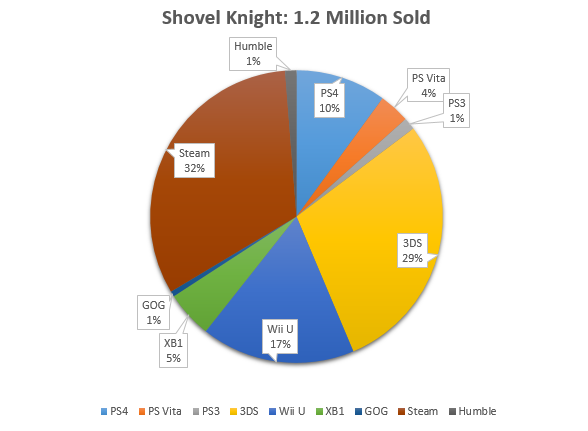
The developer posted on its blog, boasting about the huge success of the Kickstarter-funded game, which has sold over 1.2 million copies since its release—with one million alone coming from digital sales. It reached this success without a major advertising campaign, and instead relied heavily on social media buzz and word-of-mouth recommendations.
“We couldn’t be happier that Shovel Knight is still loved and played years after its release,” said the post.
A majority of the game’s sales came from both Steam and Nintendo 3DS platforms, although other systems, like the Wii U, PlayStation 4 and Xbox One, also accounted for a good chunk of them.
Ever since its initial release on Nintendo platforms a couple of years ago, the game has become a huge cult hit, even getting to the point that Nintendo allowed the creation of a special Shovel Knight Amiibo figurine, which has since sold 180,000 units to date.
The company certainly knew how to cater Shovel Knight to every gamer’s taste. The Wii U and 3DS releases generated lots of attention, and the game has also benefitted from the release of free downloadable content such as the Plague of Shadows expansion. Meanwhile, both the PlayStation 4/3/Vita and Xbox One versions of the game got exclusive levels featuring original franchises, including the Knight’s scuffle with God of War‘s Kratos in the PlayStation versions, and a run-in with the Battletoads on XB1.
Speaking with Gamasutra, programmer David D’Angelo couldn’t help but be surprised by Shovel Knight‘s sales. “We’re still in a bit of shock here! Previously, a successful game in our portfolio would barely break (50,000) copies sold.”
And the game isn’t done yet. Yacht Club Games is already hard at work on additional (free) content for the game, as well as a hardcover art book for its most devoted Kickstarter investors.
“We hope to finally conclude Shovel Knight‘s long development journey at the end of this year,” D’Angelo added. “It’s been a really fun few years, and we couldn’t be more grateful that you’ve all supported us through this time.”
Now comes the inevitable question of “What’s next?” for the team, although a Shovel Knight sequel may not be out of the question.
 How has VR become such an integral part of Tribeca Film Festival?
 What is Invasion! about?