Rick Fox Is Running A Fast Break Into ESports

Madison Square Garden is synonymous with a cavalcade of sport’s biggest moments: the Willis Reed Game, the Fight of the Century, WrestleMania I, Michael Jordan’s double-nickel—et al. The World’s Most Famous Arena always brings out the best in athletes and entertainers.

For former Celtics and Lakers star Rick Fox, you can add one more event on top of that list: the North American League of Legends Championship.

Fox played a mountain of meaningful New York minutes at the Mecca of Basketball for 13 years as a bitter rival of the Knicks. His life on the hardwood is defined by winning three championships as a central piece to Shaq and Kobe’s Lakers dynasty. But it wasn’t until last August when Fox walked into a sold out arena at MSG for a different kind of five-on-five game that made him run a fast break into what he calls the next generation of professional athletes—eSports.

1b4009dc45c1b757636dc4ad647f8110 (1)

In a career that’s had more acts than a Broadway show—Fox has made an off-court killing using his made-for-TV looks to act, model, dance and serve as a basketball analyst—video games is the next big thing tickling his senses. In December, he paid $1 million to purchase Gravity Gaming, which has since been rebranded into Echo Fox in the League of Legends Championship Series (LCS).

“The deciding factor [to invest into eSports] was cellular,” Fox told [a]listdaily in an exclusive interview. “Once I walked into a sold out crowd at Madison Square Garden, everything in those two days spoke to me as a professional athlete. I knew it was the next generation.”

Fox’s fascination with video games didn’t happen overnight—he’s been an avid gamer since he was 12 years old playing Atari—nor is it another case of “retired athlete invests in hot trend.” The 46-year-old studied the eSports industry for three years, highlighted through an up-close-and-personal look at Riot Games, before he felt safe about pulling the trigger on owning a team. He’d also been a partner at Twin Galaxies, the official video game world-record and player-ranking authority.

In three whirlwind months since his purchase, he’s learned eSports “moves at a warp speed.” Echo Fox has already expanded into the ELeague and Counter-Strike: Global Offensive with plans to add additional teams. He says that in the first year, they’re “looking to total four teams, with representation in the fighting community as well.”

The recent wave of momentum made Fox proclaim that eSports will “be on par with the NHL” in two years. In comparison, the League of Legends World Championship final was watched by over 36 million people; the NHL Stanley Cup Finals reached around 38 million.

10277391_845395255490205_7551639293006804058_n

His bold prediction is not a knock on hockey; it’s just how he currently feels about the blue-chipped industry—and basketball gets some of that shade, too. He’s donated his three championship rings to the fundraiser #Right2Game, a campaign that seeks to promote positive perceptions of gaming. But would he actually trade winning the NBA title only if Echo Fox wins a world championship and is recognized as the best eSports team in the globe?

“Yes,” Fox says. “I would trade one as I would still be left with two others.”

And if he has two tickets for both an NBA Finals game, and the LOL World Championship, fuhgettaboutit. “For me having experienced the NBA Finals on and off the court 10-plus times, I would have to say the LOL Finals with Echo Fox competing would be a first.”

Fox has always had a soft spot for video games. When the former-first round pick out North Carolina left the Boston Celtics and signed with Los Angeles Lakers prior to the 1997 season, it meant leaving his family behind in the East Coast. Although the move signaled a stretch of winning basketball and newfound opportunities in Hollywood, a 10-month NBA season and a coast-to-coast relationship with his son Kyle led to what Fox calls a broken home.

One way he was able to combat that and forge a better bond with Kyle during his formative years was through sessions of World of Warcraft and League of Legends where Fox would teach him life skills through the characters they’d create. Video games quickly became to be the fabric that wove their relationship together.

Now, Kyle is a sophomore in college and a professional video gamer with a desire to pursue a career in the industry. Considering the sizable cash flow eSports is promising—Newzoo is projecting $463 million in revenue this year—jumping into uncharted waters was made a lot easier for Fox knowing that his son has a vested interest, too.

“It didn’t hurt when I decided to invest,” Fox says. “The passion for video games was passed down to my son as a shared love throughout his childhood all the way up to present day. It was and still is how we share father and son time together.”

Screen Shot 2016-03-29 at 12.13.44 PM

The eSports market is currently worth $747 million, according to SuperData Research, and it’s expected to grow 150 percent by 2018. And there won’t be a shortage of funds anytime soon. Leading brands like Nissan, Intel, Pepsi, Coca Cola and Red Bull will be pouring roughly $325 million into the space this year, per Newzoo.

In addition to the corporate clout, a recent wave of people in pro sports are rushing to get a slice of the eSports pie. Earlier this month, Shaq, Alex Rodriguez and Jimmy Rollins invested into NRG eSports, the team owned by the minority partners of the Sacramento Kings, Andy Miller and Mark Mastrov. Miller and the Kings are so high on eSports that their new basketball arena was designed for it. On the other hand, Mavericks owner Mark Cuban invested $7 million into Unikrn, which lets consumers bet real money on the outcomes of video game competitions.

“Professional athletes and owners admire and appreciate the talent, dedication, discipline and mastery of their crafts,” says Fox. “As a business model, eSports mirrors traditional sports with rapid growth.”

The Bahamian-Canadian Fox, who currently works as a basketball analyst periodically dropping video game knowledge on NBA TV, is a big believer that eSports players mirror “athletes” too, likening it to how a doctor or actor would recognize a peer as an equivalent.

“The same disciplines that go into the mastery of a craft are present—talent, attitude and skill aligned with unparalleled repetition that leads to mastery can only be attained through an unwavering focus, dedication and discipline,” says Fox. “Athletes compete with their entire mind body and spirit. Ranking and debating which sport uses a greater percentage of the three is irrelevant. In the end there is no denying the best in each field separate themselves from the average to become the top of their field. Professional gamers are athletes and deserve a seat at the table.”

Screen Shot 2016-03-29 at 11.50.20 AM

Although Fox has filled an IMDb page just as well as the back of a basketball card, the sentiment should not appear as scripted soliloquy. A who’s who list of athletes, including Utah Jazz star Gordon Hayward and UFC champion Demetrious Johnson, back his sentiment: pro gamers are athletes.

As an eSports team owner Fox has already experienced the highs of an inaugural victory on the opening day of the season and the lows of forfeiting a game when his squad didn’t have enough eligible players available to compete.

His mission is to eventually return to the court of which he was coronated on—the 2016 League of Legends World Championship will be held at the Staples Center in Los Angeles this October.

Whether or not he’ll have his Jerry Buss moment remains to be seen.

Follow Manouk Akopyan on Twitter @Manouk_Akopyan
The Inexorable Expansion Of ESports

While there was major attention focused on virtual reality at this year’s Game Developers Conference, the continuing evolution of eSports was another important trend, and it’s one that’s raking in millions of dollars right now. An entire day of sessions was devoted to eSports, and there was plenty of news, data and opinions to ponder. ESports continues to be an ever-more-important force in the games industry, and changes are under way that should help encourage that growth.

This March is an exceptional one for eSports fans, with a number of big tournaments under way from the Halo World Championships to Heroes of the Dorm to the World of Tanks Grand Finals. That’s showing the popular appeal of eSports, while GDC offered a look at what the insiders think about the current and future state of eSports.

Rocket League is one game that has really taken off in popularity, both as a game and as an eSport. Twitch has partnered with Psyonix to launch the Rocket League World Championships, and the announcement of cross-platform play has created quite a stir. The prospect of widespread cross-platform play could have an impact on other eSports that have console and PC clients, expanding the potential audience by tens of millions.

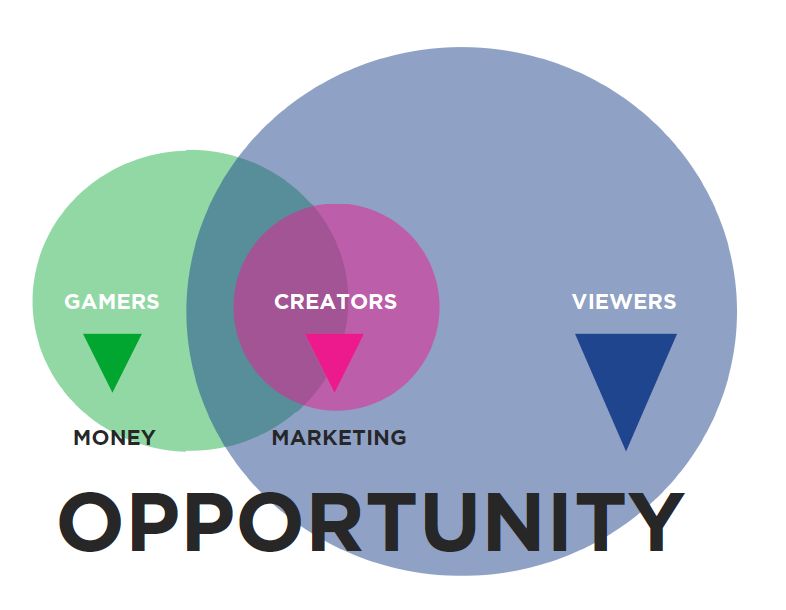
eSports Diagram

Rocket League announced that Basketball mode is coming for April, showing the potential to continue the game’s growth, and Psyonix design director Cory Davis promises that it will be difficult. “That’s a concern for us,” Davis said when Techradar questioned him. “It’s a lot harder than hockey to pick up and score, and it’s kind of a test in terms of, like, is a more hardcore mode going to be received well or not?”

Davis gave a well-received talk at GDC about the factors that made Rocket League into a success, which provided some important insights for publishers and marketers looking to turn their game into an eSport. First off, it’s important to note that Rocket League was based on a 2008 PlayStation Network game (for the PS3), which never achieved great success due to a number of factors. The current Rocket League is a result of realizing that the initial game had some dedicated fans, and polishing the game to make the experience more broadly embraced.

Some of the important changes to Rocket League include product-focused changes like creating dedicated servers, achieving a steady 60 frames-per-second and polishing the matchmaking and physics. However, it’s important to note some of the key features were marketing or business-oriented, such as going premium (abandoning the idea of free-to-play), “creating a highly GIF-able experience” that made it more shareable on social media, and making the game part of the PlayStation Plus program so it was free for the PlayStation 4 launch. As a result, Davis said, “We spent zero dollars on traditional marketing.”

Wargaming CEO Victor Kislyi, in an interview with GamesBeat at GDC, spoke about the state of eSports for World of Tanks and the market in general. “It’s good. It’s an inevitably upward trajectory now. Twitch and Kamcord and ESPN–these are all good signs. It’s been a bit like the wild west. Not every move companies are making is the right one. We might not be making all the right moves. But the eSports avalanche is coming no matter what. We’re not yet perfect, but every year we’ll learn more and more.”

The hugely popular League of Legends was the subject of a talk by Riot Games vice president of eSports Dustin Beck, who noted that the 2015 World Championships averaged 4.2 million concurrent viewers throughout the four weeks of the tournament, and the Grand Final had over 36 million concurrent viewers—figures that compare favorably with traditional sports. Still, Beck believes that League of Legends is still growing as an eSport, and nowhere near its peak.

While these talks were important, nothing beats a heaping helping of useful statistics for marketers, and Newzoo’s latest report on the state of the eSports market delivered, showing the growing value that eSports has for marketers. “Brands will spend $325 million on direct eSports advertising and sponsoring this year, 49 percent more than in 2015,” the report noted. Newzoo estimates that the audience will grow over 13 percent this year to 256 million worldwide, with more than half (131 million) being enthusiasts, and 44 percent of that total from Asia-Pacific.

The revenue growth of eSports is even more impressive. This figure that Newzoo calculates includes media rights, merchandise and tickets, online advertising, brand partnerships, and additional game publisher investment. That total will reach $463 million in 2016, a year-over-year growth of over 42 percent. As noted above, $325 million of that comes from brand advertising and marketing. That’s really an excellent deal for marketers, considering the broad reach of the audience.

The upward potential for eSports remains large, as Newzoo’s report points out. For one thing, the average revenue per eSports fan is $3.50, while the average revenue per NBA basketball fan is $20, and the average revenue per NFL fan is $60.

Meanwhile, event numbers and revenues are rising, with North America hosting 42 major events in 2015 (there were 112 globally), and a worldwide total of $21 million in ticket revenues. Prizes for tournaments skyrocketed by 70 percent, reaching a combined $61 million in 2015. The biggest was Dota 2′s The International, with a prize pool of $18 million (of which only $1.6 million came from game publisher, Valve).

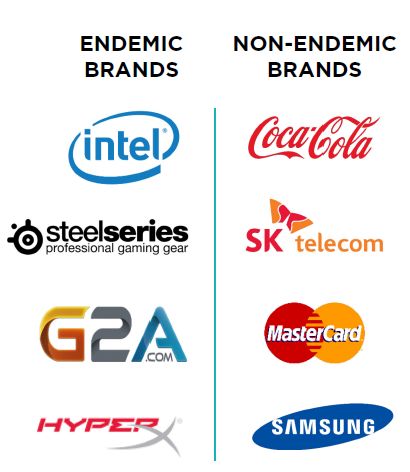
Marketers are finding this a very attractive market, and the demographics explain why. Enthusiasts aged 21-35 account for 54 percent of the eSports audience, a group that’s more difficult to reach than ever through traditional advertising. These enthusiasts are more likely to have a full-time, high-paying job than the general population. Brands like Coca-Cola, Sk Telecom, MasterCard and Samsung are already sponsoring eSports, and more are expected as the industry continues its growth.

eSports Marketing Brands

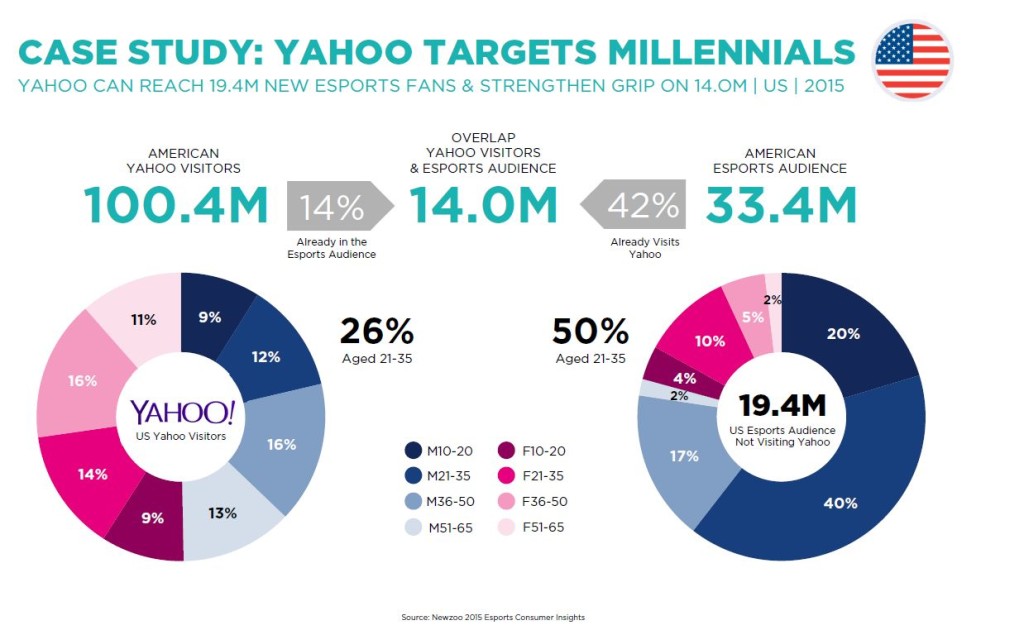
Newzoo’s report highlighted a case study of Yahoo, showing how the site is using eSports to reach 19.4 million new eSports fans and strengthen its grip on 14 million fans that already visit Yahoo. This clearly shows how non-gaming brands are finding great value in eSports, and that this is continuing to make inroads into a much wider audience of brand marketers.

Yahoo eSports

The impact of eSports on the games industry, and the broader brand marketing business, is undeniable. While existing eSports already reach a very large audience, there’s no signs growth will be slowing down in the near future. New games will undoubtedly establish themselves in the eSports landscape, while current games seek to expand the existing audience. Right now, eSports is almost entirely about PC games, but efforts by Activision and Electronic Arts in setting up new eSports divisions make it easy to believe that console games will be getting a much bigger eSports audience. Meanwhile, mobile is already demonstrating the possibilities for eSports with an avid and growing audience for Vainglory and Hearthstone.

VR may have gotten the lion’s share of the attention at GDC, but eSports is already grabbing a considerable share of the hearts, minds, and wallets from gaming enthusiasts.

Paid Media Spending Seeing Slow Increase

Although spending on advertising will continue to be high in the U.S., there’s a struggle that needs to be overcome.

eMarketer recently reported that paid media spending will see a 5.1 percent growth, and while that’s still progress, it’s a little slow compared to what advertisers spend on routine media formats such as radio and television. Overall spending for U.S. media is expected to reach $192 billion for the year, driven behind such events as the presidential election and the Rio Olympics this summer.

The report, titled U.S. Ad Spending: eMarketer’s Estimates for 2016, indicates that conditions for economic growth aren’t as strong as they used to be, leading to smaller estimates than most companies expected. That said, there’s still room for the digital market to show growth.


Chart

Digital media will see the biggest growth in ad spending share over the next few years, going from 32.6 percent this past year to 44.9 percent by 2020. TV will see a slight drop by five percent in this time frame, while print will follow closely behind with about a four percent drop.

Chart 2

While TV continues to be the leader of total media ad spending at the moment, digital is quickly gaining, and coming very close to overlapping it for this year. We’ll see it overtake completely by 2017, and it’ll have a near $40 billion advantage by 2020, powered by entertainment services like Netflix and Hulu.

However, the bigger picture here is how media ad spending will increase overall, as the total is expected to jump from $192.02 billion for this year, up to $234.25 billion by 2020. So even though the numbers may be seeing a slight lull at the moment, the future appears wide open.

Image Source

Oculus Rift’s Marketing: From Kickstarter Beginnings To Facebook Triumph

The Oculus Rift ships today to both pre-order buyers and early adopters from its initial Kickstarter campaign. It’s taken a while for the virtual reality headset to make its way to market, but many consider it’s worth the wait once they step into its immersive possibilities. It’s been a long road, with humble beginnings, but the Oculus Rift could mark a major change in entertainment.

The Oculus Rift initially got its start in 2012, when Oculus VR (then an independent company) showcased a unit to various members of the public and press, prior to the launch of its Kickstarter campaign. Though it was based on very early marketing buzz, the project was endorsed by personalities like Cliff Bleszinski from Epic Games, Gabe Newell from Valve (who later partnered with HTC to develop the Vive), and John Carmack, who eventually left id Software to become CTO at Oculus. The crowdfunding campaign was a massive success, earning over $2.4 million and far surpassing its $250,000 goal.

Since that time, Oculus continued to improve the technology through a number of pre-production models, including the DK1 in late 2012 and the DK2 in mid-2014, both of which were provided to developers in the hopes of making the most out of the technology. They were also used extensively at events like the Game Developers Conference, the Electronic Entertainment Expo, and Oculus Connect to showcase the possibilities of virtual reality.

Although these demonstrations were relatively small, Oculus was growing a reputation and legitimizing the technology. By March 2014, that was more than enough to get the interest of a potential investor: Facebook.

Mark Zuckerberg, founder and CEO of Facebook, announced a then-unheard-of $2 billion purchase of the company, stating that it would put the social network in a “position where we can start focusing on what platforms will come next to enable even more useful, entertaining and personal experiences.” This put Oculus on a whole new level, and is often seen as the point where enthusiasm for virtual reality really took off, as competitors like the HTC Vive and the PlayStation VR, were later announced.

With funding from the social media giant, Oculus took a bold leap forward with promoting its forthcoming Rift headset, including a full-on presentation last year prior to E3, where it introduced a number of new games in development, a partnership with Microsoft, and showed-off the Oculus Touch controllers.

https://www.youtube.com/watch?v=mRuCPFvvbjw

The company also went to great lengths to introduce new partners for game development with the headset, including Insomniac Games with its survival adventure game Edge of Nowhere; the fast-paced racing game Blaze Rush; and modified versions of EVE: Valkyrie and Elite: Dangerous.

But Oculus got a surprising social media push when creator Palmer Luckey ended up on the cover of Time Magazine, wearing the Oculus device while apparently standing on a beach. While the image became fodder for a number of humorous memes, it also created positive awareness of virtual reality in general.

Time

Before the release of its own headset, Oculus partnered with Samsung for the more affordable Gear VR, which became a surprising hit when it launched last year. While it did introduce a sort of competitor to the market, it gave users a taste of what to expect from premium virtual reality experiences.

As Oculus VR came closer to completion, Facebook opened up more on the possibilities that the headset would provide, and not just to gaming. The social media experience will be a vital part of the device as its release becomes more widespread, and Zuckerberg was even quick to note how it could recreate “you were there” moments with friends and family. “Hopefully within a year Max will be taking her first steps, and when I took my first step, my mom wrote down the date in a book,” Zuckerberg stated at this year’s annual Friends Day gathering. “I want to take a 360 video of it, so that way even if my parents aren’t there, my grandparents aren’t there, they can experience it, they can actually be in the scene.” This is in line with how Facebook began supporting 360-degree videos (and VR advertising) last year.

Pre-orders began on January 6 with the $600 price tag, and some wondered how the high price point would impact consumer adoption. Even so, the first wave of orders sold out within 15 minutes. This year’s Game Developers Conference was the biggest showcase for the headset to date. Its booth was one of the biggest on the floor, a far cry from its simple set-up at the show a few years prior. It showed just how devoted the company had become in promoting the Oculus as a full-scale gaming platform, although it serves other entertainment purposes as well.

Oculus has come a long way from being a small project in creator Palmer Luckey’s garage, to becoming one of the biggest entertainment devices for 2016. Its pre-orders have sold out over the next few months, and the company should have an even bigger plan for the holidays.

Samsung Gear VR Takes The ‘Bait!’ From Resolution Games

While much of the buzz from GDC centered around high-end VR hardware like Oculus Rift, HTC Vive and PlayStation VR, it’s clear that mobile VR is where the vast majority of the market will be in the near term. SuperData Research has estimated that the VR market this year will reach $5.1 billion in sales, with most of that coming from mobile VR.

That market potential has attracted some of the best talent, and not surprisingly, some of the top mobile game developers have taken up mobile VR. Resolution Games is one of those studios, co-founded by veteran designer Tommy Palm (one of the developers behind Candy Crush Saga), and has launched its free-to-play VR fishing game, Bait!, on the Oculus VR Store for Samsung Gear VR.

“Like all of our games, the aim of Bait! is to provide perfect content for those new to VR while also providing the sort of compelling and quality gameplay that keeps the most avid gamers, VR enthusiasts and in this case, anglers, hooked for hours,” said Palm, the CEO of Resolution Games. “The Resolution Games team are not only seasoned games industry veterans, but also passionate fishing enthusiasts. And, fishing is something everyone can connect with, which is why Bait! made so much sense to be our first major game project.”

No controllers are needed to enjoy Bait!, which Resolution Games considers of vital importance to VR gaming. This project was designed with the Samsung Gear VR touchpad in mind, making gameplay more accessible and allowing for immediate immersion. “It’s amazing. Bait! had an almost instantaneous relaxation effect. Once you get started and cast your first line, everything else in life disappears and you’re truly in the moment—I bet my pulse even went down,” said Maarten Noyons, founder of IMGA (International Mobile Gaming Awards). “I got the game within minutes, and could have spent hours chasing down all the different species and experiencing the different lakes.”

Tommy PalmSitting down with Tommy Palm at GDC, [a]listdaily got to experience Bait! firsthand using the Samsung Gear VR. One of the great features of VR is that the immersion into a game is immediate, unlike any other platform. That’s especially important with a game like Bait!, where the sense of relaxation is palpable. The game’s simple interface lets you get into fishing right away, and enjoy the relaxing tropical vistas while reeling in some very unusual fish. “A lot of people like to use games as a means to relax, come home from a stressful day and quickly get into a different pulse,” said Palm. “I definitely feel this VR title can be great at doing that.”

The business models for mobile VR have yet to be established. There’s plenty of options to choose from right now, and Resolution Games has chosen to go a familiar route. “This title is a free title and it has in-app purchase,” said Palm. “It’s actually the first VR game to have in-app purchase, outside of Oculus’ own software. I’m very interested in making accessible games, so I really like the fact that people can download something for free and check it out. If we can deliver on that promise of having appealing content that engages them, then we have the opportunity to sell something to them within the game that makes sense.”

Palm isn’t convinced that premium-priced games are the best solution for the VR market. “Even if you do that—ask for $50 up front—they’re not going to know what they’re getting until they bought it,” Palm said. “I think for the consumer, it’s a much better alternative if they can actually go into the game and understand what it is before they make a purchase decision.”

Palm feels there’s room for multiple monetization models. “What business model makes the most sense for the developer depends very much on the game or app,” Palm noted. “Free-to-play has a little bit of a bad rap, especially with hardcore gamers, because they’ve seen a lot of really aggressive monetization. There are definitely great examples of developers having a balanced experience; Hearthstone is a great example.”

The potential for mobile VR seems great, but the exact course ahead is hazy. For now, Samsung’s Gear VR shows just how simple and inexpensive mobile VR can be, while still delivering an engaging experience. Samsung is making a strong effort to help Gear VR become successful by including one for free to everyone who pre-orders a Galaxy S7 smartphone. “To me, I think the Gear really shows how powerful mobile VR can be, but I definitely think there’s room for other players,” Palm said. “This is only for Samsung phones, and the world consists of more phones than that. There is room for more hardware initiatives on mobile VR. We’ll see a lot of interesting players coming into that market. Personally, I’m very curious about what Apple is brewing behind their walls.”

Bait screen

Being one of the first mobile VR games to ship is a useful advantage, but there’s much more to look forward to in mobile VR. “At this point, everybody who’s working VR just wants it to take off and start getting interesting applications out there,” Palm said. “I think games are going to be one of those applications that will help drive the market.”

However, Palm does believe it will take a while for VR games to start turning a profit for publishers. “For us, it’s kind of a long-term bet,” Palm acknowledged. “One of the reasons I’m very interested in mobile VR is that I think that AR is going to be a very interesting technology as well, it’s just a little bit further away. I would say that in order for VR to be mass market it might be three years, and for AR to be big it’s going to be five years or even more.”

SuperData: February Digital Game Strong, Despite Fewer New Game Releases

SuperData has released its latest sales numbers for the month of February 2016, and once again, digital game releases continue to be at the forefront.

The report noted an increase of digital game sales by ten percent for the month, totaling $6.2 billion. “Digital console sees the fastest growth of any segment for both revenue (up 34 percent year-over-year) and audience (up 27 percent year-over-year),” said Joost van Dreunen, CEO for SuperData. “Last month had fewer major new releases than the same month last year, leading to a decline of 180,000 in new game sales. Additional content purchases, however, were strong and resulted in a positive revenue figure. Growth for both revenue and monthly active users for mobile continued as the industry moves its focus to emerging markets.”

Call of Duty: Black Ops III continued as the big sales leader, followed by FIFA 16, Grand Theft Auto V, Madden NFL 16 and Fallout 4, which released a new expansion this month. Ubisoft’s recently released Tom Clancy’s The Division should make quite a dent in sales numbers next month.

Meanwhile, Chinese companies are making some big moves, according to van Dreunen. “Chinese companies will scoop up one to two Western publishers a month from here on. The lesson to be drawn from Chinese mining company Shandong Hongda in talks to buy RuneScape developer Jagex for $300 million is that it will happen again.”

The reason being, “China’s industrial firms are aggressively diversifying as the country’s economic growth slows. Western firms like Jagex allow Chinese companies to expand into new industries and regions. While the 15-year-old RuneScape does not have the mindshare it once did, remaining players continue to spend, and the browser-based MMO earned $6.2 million last month.” Van Dreunen also noted the popularity of Chronicle: RuneScape Legends, following the launch of its beta earlier this year.

Counter-Strike: Global Offensive continues to top PC retail sales, while League of Legends is still the number one free-to-play game, and World of Warcraft still has a huge draw with the pay-to-play audience.

The report also notes that Ubisoft is more than ready to jump into virtual reality, with the release of forthcoming games such as Eagle Flight and Werewolves Within, as well as its recently announced Assassin’s Creed Experience, which should launch alongside the film later this year. “Ubisoft’s strategy contrasts with other major publishers such as Take-Two Interactive, which have been vocal about not devoting substantial resources to the new platform before sustainable consumer demand has been proven,” noted van Dreunen. “This year, we forecast game software on mobile, PC and console to earn a combined $410 million, and expect revenue to jump to $6.9 billion by 2020. Publishers that have not already invested in virtual reality development will likely need to acquire smaller VR-focused studios to enter the fast-growing market.”

On the mobile side, Clash of Clans continued to be the number one game for the month, and van Dreunen noted big things on the horizon for Apple following this week’s announcement of the iPhone SE. “The iPhone SE represents a key strategic asset in catering to markets like China and India, where Android dominates. Currently, Android claims 75 percent of China’s mobile games and 71 percent of the country’s mobile game revenue.

“Android’s share of the Indian market is larger still. Mobile games revenue in India will nearly double from $648 million in 2016 to $1.2 billion by 2018. With the new iPhone SE scheduled to launch in 100 countries by May this year, Apple’s strategy is clearly to cater to a wide, global audience with its devices, and build up its competitive strengths in markets where cheaper smartphone alternatives have so far dominated.”

6 Games That Blur The Line Between Video And Game Entertainment

Video games have often seen great promotion through spectacular trailers that some might say are movie quality. Sometimes a franchise will actually be turned into a movie or television series. However, there are some games that take cross-media to all-new heights, and these are the ones doing it this year.

Assassin’s Creed

There are a large number of Ubisoft games that translate well to film, but the most prominent is the Assassin’s Creed series, which has a big-budget movie starring Michael Fassbender premiering in December. However, it won’t be the first time Assassin’s Creed has been translated to other media. Assassin’s Creed: Lineage, a web series comprised of three live-action shorts, released in 2009. They followed the exploits of Giovanni Auditore, the father of Ezio–the series’ most popular character to date–and likely helped pave the way for the full movie to be made. In 2011, Ezio’s fate was detailed in an animated short called Assassin’s Creed: Embers, which was created and produced by Ubiworkshop to expand the game’s world and help promote a special editions of Assassin’s Creed: Revelations.

df-01952_r_crop

Tom Clancy’s The Division

Ubisoft clearly learned a big lesson from those Assassin’s Creed promotions, and applied them to Tom Clancy’s The Division. The online multiplayer game, where players try to help (or at least survive) in quarantined areas of New York City in the wake of a biological attack, saw a variety of promotions leading up to its launch. One of the least expected was a short live-action film called The Division: Agent Origins, which premiered on Amazon Prime Video. It tells the stories four agents who are called to action amidst New York’s decline.

The movie seemed to help do the trick, as The Division ended up selling more copies in its first 24-hours than any other game in Ubisoft’s history.

Overwatch

Every Blizzard fan knows that the developer is as good at producing cinematic video as it is at making video games. However, Pixar and Dreamworks might actually have something to be worried about with the series of Overwatch animated shorts, created as a lead-in to the game’s launch in May.

The first episode, which premiered earlier this week, tells the story of a genetically engineered ape named Winston (who also happens to be a brilliant scientist, inventor, and superhero), who longs for the old days of heroism. Later episodes will presumably focus on other heroes as they answer the call-to-action, and help build up the desire to be part of this world.

Battleborn

Gearbox Software is taking a decidedly unique approach with its sci-fi action game, Battleborn. Similar to episodic games made by Telltale Games (The Walking Dead, Game of Thrones), Battleborn‘s story is structured similarly to television shows. There’s an overarching plot comprised of eight episodes (and a prologue), each telling a self-contained story. In fact, the developer describes the game’s launch on May 3rd as the start of the first season. The trick is, the dialogue in each episode changes according to which of the 25 different characters you use, and reveals a bit more of the bigger picture. So, replaying an episode is never quite the same. Plus, Gearbox will be adding additional heroes and stories after the game’s launch, so players shouldn’t worry about getting bored with reruns.

Additionally, there’s a Battleborn motion comic that details the events leading up to the fight for Solus, the last star in the universe.

Ratchet and Clank

We end up with an interesting “chicken or the egg” scenario when it comes to the upcoming Ratchet and Clank movie and game. The original game released for the PlayStation 2 in 2002, which is the inspiration for the movie that premieres on April 29th. The movie then inspired Insomniac Games to remake the original, but in a “re-imagined” way that matches how the movie plays out. That might seem a little dizzying, but kind of fitting for the sci-fi action comedy franchise.

Angry Birds

Alfred Hitchcock’s The Birds seems almost prophetic in a way. Angry Birds are everywhere. On smartphones, computers, gaming consoles, and they even have a cereal brand. The Angry Birds franchise began airing the ongoing battle between the birds and pigs on an animated TV show years ago, but the biggest release will certainly be the Angry Birds movie coming to theaters on May 20th.

Although the puzzle game series already has millions of fans worldwide, and its sequel released last summer, the premiere of a family friendly movie is almost certain to keep the franchise’s momentum going for the foreseeable future. As a way to help boost box office numbers, there’s an online trailer created in partnership with AMC Theatres to encourage audiences to go out and see the movie instead of waiting for it to come to home video.

Sonic Boom

It’s no secret that Sonic Boom: Rise of Lyric for Wii U did not do well commercially or critically, which led Sega to rethink its brand strategy. However, the game launched alongside the Sonic Boom animated TV series on Cartoon Network, which turned out to be a fantastic show. Although it’s not the first time Sonic the Hedgehog has had a television show, this one helped the blue speedster resurge with a newfound success on mobile by introducing Sonic and his friends to a new generation of gamers. So, just as it seemed as though the iconic character was falling down, it picked up an extra life thanks to television.

https://www.youtube.com/watch?v=DChLLCwPOEM

Skylanders

The Skylanders series is crediting for starting the trend of toys-to-life games like Disney Infinity, Lego Dimensions, and the Nintendo Amiibo collection of figures. It has remained a large part of Activision’s annual release line-up for five years, with the most recent game being last fall’s Skylanders Superchargers. And although the franchise is already incredibly popular with kids, and it’s bound to grow even further with the upcoming television series, Skylanders Academy.

The show was revealed last year with the announcement of Activision Blizzard Studios–a division dedicated to bringing the publisher’s large library of popular games to other media. Although not much has been revealed about the show since announcement, it’s being headed by Futurama writer Eric Rogers and stars Justin Long as the voice of Spyro the Dragon, Ashley Tisdale as Stealth Elm and comedian Norm McDonald, as Glumshanks. It’s also expected to premiere later this year, so more news should be coming soon.

One thing is for sure: once kids get hooked on the show and the game, parents should plan on picking up a boatload of Skylanders toys.

Skylanders-Academy

‘Batman v Superman’ Promotions Are Having Fun With The Epic Showdown

This weekend’s premiere of Batman v Superman: Dawn of Justice can be seen as many things. First and foremost, it is the follow-up to 2013’s Man of Steel (starring Henry Cavill), which introduced the world to a more flawed version of Superman. In Dawn of Justice, he goes toe-to-toe with Batman (played by Ben Affleck) in a clash of fists and ideology. Second, the inclusion of Wonder Woman (Gal Gadot) brings the big “Trinity” of the DC Comics universe to a live-action film, and sets the stage for an upcoming Justice League movie to take on the fantastically successful Avengers franchise. Third, and perhaps most important, it addresses the age-old comic book geek question of whether Batman can actually defeat Superman in a fight.

Fans got their first look at the movie during the 2015 San Diego Comic-Con, where the debut trailer gained a standing ovation. Hype and promotion continued to build over the following months, and although the movie’s promotion doesn’t have the same crazy, off-the-wall style of Deadpool, it does manage to have some fun while keeping to its dark man-versus-demigod theme. One of the more prominent promotions includes a Jimmy Kimmel Live sketch, which was shown after the Academy Awards, where the talk show host appeared in a “deleted” version of the confrontation scene between Clark Kent and Bruce Wayne.

In a slightly more serious promotion, Warner Bros. partnered with Turkish Airlines to produce a pair of themed commercials that aired during Super Bowl 50, which treated both Gotham City and Metropolis as fantastic real-life destinations thanks to wealthy benefactors like Bruce Wayne and Lex Luthor.

https://www.youtube.com/watch?v=qpk8eSpRBnY


https://www.youtube.com/watch?v=TReIozZ1b10

However, the heroes don’t get all the fun. Lex Luthor (played by Jesse Eisenberg) was featured in some promotions of his own. The fictional character spoke in a couple of in-depth (fake) interviews on Wired Insider and Fortune. His company, LexCorp, has its own website where you can sign-up to become a Lex/OS beta tester. The genius mastermind even posted on a personal Twitter account for a while.

Food and soft drink brands were also quick to take advantage of the movie’s iconic heroes. Dr Pepper released a limited edition set of soda cans that feature the five main characters. Purchasing them can get $5 toward the purchase of a movie ticket, while scanning the Dawn of Justice-branded 20-oz. bottles with the Blippar app unlocks exclusive prequel comic books. Doritos joined the action with a sweepstakes, giving contestants a chance to choose between winning a Batman-or-Superman-themed prize. Choosing Batman could win you a trip to Barcelona where you can drive a Porsche Boxster, Lamborghini and Ferrari around the Montmeló national circuit or training track. Going with Superman gets you a “birds-eye view” helicopter ride around New York City. Meanwhile, Cold Stone Creamery is offering some hero-inspired ice cream treats with a toy topper, that also included a sweepstakes where winners are flown out to the movie’s red carpet premiere.

DSG_Lineup_1

Considering how successful Batman: Arkham Knight was when it released last summer, it would be a big miss if Warner Bros. didn’t use its video game division to promote the movie. Arkham Knight added the Dawn of Justice Batman costume and Batmobile last fall. Similarly, new versions of the heroes were added to the Injustice: Gods Among Us mobile game earlier this month. Furthermore, Warner Bros. partnered with Psyonix for the Batmobile to appear in the hit game Rocket League. Now we can find out how well the iconic car fares in an epic soccer battle.

ArkhamKnight-DawnofJustice

Speaking of cars, Fiat Chrysler revealed the 2016 Jeep Renegade Dawn of Justice Special Edition, which features all black, or black and granite versions. It probably doesn’t have any special armor or gadgetry outside of what you might expect from any other SUV, but you might feel sort of heroic while driving it.

https://www.youtube.com/watch?v=hS3T16JJeRU

On Monday, Warner Bros. hosted a 24-hour Batman v Superman Snapchat Discover channel, where fans could watch video clips featuring the movie’s actors and director. It also showcased artwork that DC Comics produced for the film, in addition to videos on the new Batmobile and Batwing. The Discover channel came after a four-day sponsored selfie campaign, where fans could take a picture of themselves dressed up as their favorite hero using a Batman, Superman or Wonder Woman lens.

Lastly, Amazon unexpectedly joined in the Batman v Superman fun with its iPhone app, and the company seems to be choosing a side. The Amazon app has a little Easter egg programmed into it, and using the “visual search” function on a “face-off” movie poster will summon a 3D augmented reality bat signal. Unfortunately, Android users can’t call the Dark Knight, but it’s a fun addition to help build up to the movie’s premiere on Friday.


How Capcom Is Celebrating 20 Years of ‘Resident Evil’

It’s almost hard to imagine a time before Resident Evil existed. The game franchise, often credited for popularizing the survival horror genre, was originally released for the PlayStation system 20 years ago, and it introduced players to the S.T.A.R.S. team as it uncovered the mystery behind a zombie-infested mansion. Capcom is celebrating its legacy the best way it knows how.

The best-selling series, which has had several sequels and spin-offs over the years–along with a popular movie series starring actress Milla Jovovich—will see plenty of exposure from the publisher, starting with a series of developer interviews posted to its official Resident Evil YouTube channel over the next few weeks. The first video, an interview with series producer Hiroyuki Kobayashi, has already been posted—and this is just the start of a year-long celebration.

So, what has kept the zombie series going for two decades? In spite of current games like Resident Evil 6 taking a more action-based approach, the “horror” aspect has been its biggest draw. This has been especially true in one of the series’ biggest sellers: Resident Evil 4. It became the Nintendo GameCube’s biggest seller when it first released in 2005, and went on to be re-released on a variety of consoles and PC, doing admirably well each time. In keeping with the celebration, the game is coming to Xbox One and PlayStation 4 this fall.

Capcom’s not through yet. The company has already announced a number of re-releases from the series. Last year, a remake of the original Resident Evil launched for modern gaming systems to great success. Resident Evil Zero, a game that helped plant roots for the franchise, was recently given a high-definition makeover for PlayStation 4, Xbox One and PC. Finally, Resident Evil 6 releases next week for Xbox One and PlayStation 4 with the full collection of content, and Resident Evil 5 will follow suit sometime this summer.

Remakes are nice, but fans want Capcom to finally announce Resident Evil 7. The publisher has already promised that the celebration for Resident Evil will “continue over the next year” and that the team is “already hard at work to deliver some amazing new surprises.” There’s a good chance we’ll finally see the game’s reveal in just a few months’ time, when the Electronic Entertainment Expo (E3) rolls around. Coincidentally, the last Resident Evil movie, The Final Chapter, releases early next year. In the meantime, a new game called Umbrella Corps, which focuses on competitive multiplayer, arrives on Xbox One, PS4 and PC later this year.

That’s all on top of the other marketing campaigns Capcom has in mind for the game. The company continues to offer exclusive Resident Evil-themed products through both its online store and at game expos. It’s even going to introduce a limited edition T-Virus Perfume, with the Umbrella Corporation logo featured on the front. The perfume will go on sale at the Capcom Café in Japan starting next week, followed by a Resident Evil-themed deodorant spray. But given how fast it spreads, we could see wider release.

Congratulations to Capcom for reaching such a high benchmark with its iconic horror series. Here’s hoping for 20 more years of zombie dogs jumping through the windows.

‘Hitman’ Promotions Take Aim At Celebrity Targets

The Hitman game has been rolling with creative promotions since the first episode released earlier this month, including one where YouTube gamers were able to guide a live actor playing the role of Agent 47, and the a chance to kill an ad with one simple click. Now the game is offering a chance to take the fake assassination contract theme to the next level.

The Choose Your Hit site is open for business, and gives fans the opportunity to choose between one of two forthcoming contract missions that will be added to the game sometime this summer. The catch? They’re both famous actors named Gary.

Gary Busey (Lethal Weapon, original Point Break) and Gary Cole (Office Space, Tallageda Nights: The Ballad of Ricky Bobby) are the stars that could be added to the game, depending on how the audience votes.

Both actors plead their case in terms of why they deserve to be taken out by the game’s star, Agent 47, with lines like, “I clip my nails in public transportation.” Over the next few weeks, Choose Your Hit will be updated with more videos from both stars, who will plead their cases and explain why their adversary is an unworthy target. For now, the video above is posted, along with details on each star.

This latest promotion for Hitman might be the best one yet, adding some familiar faces to the mix with a whimsical sense, instead of the seriousness of, “Hey, this guy could actually kill me.” Busey and Cole both look like they’re having fun with it, and as the weeks go on, fans are likely to become more involved.

The first episode of Hitman is available now for PC, Xbox One and PlayStation 4. More episodes and content will be released over the course of the year.