Virtual reality has a huge multitude of applications, from transporting people far-off exotic locations without leaving their homes (or even when they’re already on vacation), to playing video games that take them to brave new worlds. However, the automakers at BMW are looking to use its technology for a whole new purpose: making better cars.
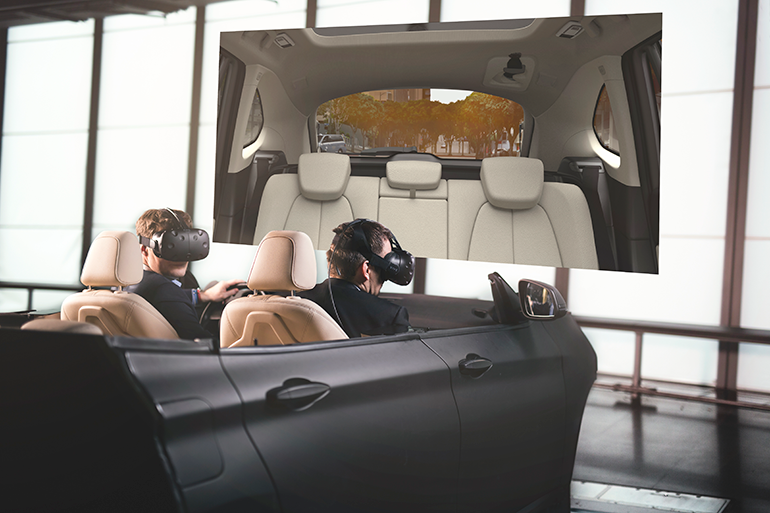
BMW has announced today that it is using HTC Vive virtual reality headsets and mixed-reality to help develop new vehicle models. By utilizing computer imagery instead of the usual draft models that the company has come to rely on, many improvements are expected, including greater flexibility, lower costs and faster results.
“The adoption of this computer system makes it possible to save a great deal of time and effort, especially during the early stages of development,” the press release states. “VR investigations could previously only be conducted at costly specialized facilities. By incorporating consumer electronics, the developers gain an unprecedented degree of flexibility, because any modifications can be implemented and tested very quickly.
“In addition to this, developers around the globe will be able to take part in the decision-making process from their own office without having to travel too far. Only once the draft designs have been approved with the help of the 3D headsets will they actually be built for further testing.”
BMW is no stranger to VR technology, having utilized it through the development process since the 1990s, but this is the first time it’s being fully implemented into the creation of new vehicles. The company is also using Epic Games’ Unreal Engine 4 technology to power the tech, which creates a rendering of photo-realistic quality when it comes to creating the right kind of vehicle. Given how Epic Games is making a big name for itself in virtual reality development, and the fact that McLaren will also be using Unreal Engine 4 to design its high-performance sports cars, this shouldn’t be too big of a surprise.
There’s no word on which models this new design process will impact, but given the efficiency of the HTC Vive technology, we wouldn’t be surprised if BMW began announcing virtually designed models sometime this year.
From partnering for a Rocket League championship to creating a new mobile gaming league with Vainglory, Twitch has been making big moves in eSports. Now it’s taking things even further with an all-new league.
The company announced today that it has partnered with Faceit, one of the world’s biggest gaming platforms, to launch a new initiative known as the eSports Championship Series, or ECS. The first tournament for this league features the popular multiplayer shooter Counter-Strike, but what makes this event unique is that teams will be allowed to become co-owners—a first in eSports history.
The first competition kicks off today, with a tournament that will offer a whopping $3.5 million payout in prizes.
“Players and teams are the heart of the eSports community and deserve the opportunity to reap the rewards of their hard work and dedication to grow eSports into a mainstream phenomenon,” said Michael Attisani, co-founder of Faceit. “We make the community our first priority and as such, we’re excited to support the first eSports league that positions teams as co-owners.”
Both partners will assure fairness across both player treatment and payments, in the hopes that the ECS will continue with more popular tournaments across a variety of games. In addition, those that become co-owners will help decide and enforce certain parts of the league, including framework, integrity and other factors to assure players are treated properly.
“A major part of Twitch’s success is built around our relationship with the eSports community, from the players and organizations who have made it a leading form of entertainment, to our own staff with deep roots in the scene,” said Stuart Saw, director of eSports strategy for Twitch. “We’ve listened to what the teams and players are looking for, which is to have a bigger voice in the movement, and it inspired us to partner with Faceit to launch the ECS. This will mark a significant and welcome change to the sport, and will lead to a wider impact across the industry.”
Twitch is making a smart move with its investment in eSports. A recent Newzoo report found that eSports drives nearly 22 percent of Twitch’s general viewership. Furthermore, the report indicates that 475.5 million hours of content were watched across all eSports franchises, averaging over 79 million hours a month. It also pointed out that viewing hours per franchise varies widely across eSports-related and regular streams. Games like Hearthstone have high non-eSports viewerships, with only 12.7 percent tuning in for eSport competitions. Comparatively, 51.9 percent of Dota2 fans watch its eSports content.
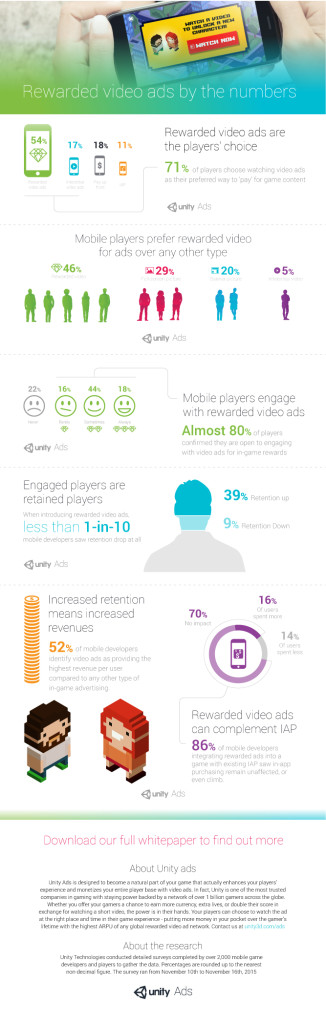
Video ads often appear in free-to-play games, and while some may dislike them, a lot of players benefit from viewing them, according to a new report from Unity Technologies titled, In-Game Advertising the Right Way.
The company took a closer look at video ads as a potential tool for mobile developers use for monetizing their games and gaining greater user engagement. The survey asked over 2,000 game developers and players about the relationship between video ads and how they relate to player revenue. The findings are definitely something mobile developers will want to look into.
Highlights from the report include:
52 percent of mobile game developers identify video ads as providing the highest revenue per user compared to any other type of in-game advertising.
71 percent of players prefer to watch video ads as their way to “pay” for game content (compared to in-app purchases), while 54 percent of players go with rewarded video.
Nearly 80 percent of players admitted they’re fine with viewing video ads if it leads to rewards in the game itself.
Less than one in ten developers polled by Unity indicated there was a retention drop after introducing rewarded video ads.
86 percent of developers who used integrated rewarded video ads actually saw increased in-app purchasing.
“Rewarded video ads are a key monetization and engagement method quickly growing in popularity with today’s mobile game developer community,” said Jarkko Rajamaki, director of ads for Unity Technologies. “When properly integrated into gameplay, video ads, especially rewarded video ads, have a positive impact on the player’s experience and can help developers monetize their games and increase player engagement.”
Look for this trend of video ads to continue being added to many forthcoming mobile games.
Battlezone is regarded by many as one of the first games to offer a glimpse of what virtual reality might look like. In fact, the original arcade machine had players looking through a “periscope” viewfinder that could be compared to some of today’s high-end VR headsets. Although we’ve come a long way from the 1980s wireframe graphics, the spirit of the game—where the player controls a tank against waves of enemies—lives on. Due to its first-person perspective and quasi-3D graphics, some consider Battlezone as a precursor to modern shooters.
Despite being around for over 35 years, Battlezone is a franchise that has been revived to fit into the technology of the era. A version that included strategic elements was published by Activision in 1998, which was followed by a sequel in 1999. The franchise later made its way onto the PlayStation Portable in 2006. Finally, a version that supported HD graphics and surround sound released on Xbox Live Arcade in 2008.
In 2013, the rights to Battlezone were purchased by Rebellion Studios, which will be bringing the franchise to the platform it was always meant to be on: virtual reality. The game is set to launch for PlayStation VR in the fall, with other platforms to follow. As an added bonus, Rebellion is remastering the games from the ’90s and will be releasing them on Steam as Battlezone 98 Redux this spring.
Rebellion co-founder and CEO, Jason Kingsley, speaks to [a]listdaily about what it takes to bring the classic arcade game into an all-new era of technology.
What convinced Rebellion to make Battlezone as its first VR game?
Battlezone has always been an important game to my brother (and Rebellion co-founder) Chris and I, ever since our childhood days playing it in arcades, peering into the cabinet’s VR-like visor that put you in that wireframe world. Likewise, we’ve always believed in virtual reality, and that it would make a return someday. So, when Battlezone went up for auction, we knew it made good business sense to acquire the property, but we had a feeling the time was right to bring it back as a VR game.
How does virtual reality enhance a game like Battlezone?
It’s much more than enhancement. It’s as a big a shift, if not bigger, than when games moved into 3D space. I imagine people might look at Battlezone and think, “I’ve played a tank game before, so I know what being inside a combat vehicle is like,” but even if it’s a huge cliché, you really have to put the headset on and experience it for yourself.
In terms of marketing, as an industry we’ve kind of backed ourselves into a corner by describing video games as “immersive” since the ’80s, but a traditional combat game simply can’t give you the sense of presence, peripheral vision and battlefield awareness that Battlezone does.
We’ve done hundreds—if not thousands—of public demos with Battlezone, and the most telling thing is that people just love looking around the cockpit, let alone starting to pilot the tank! Others drive around the game maps ignoring enemies because they want to take in these awesome sci-fi environments. This is the power of VR. It’s the difference between, say, playing racing games as a teenager, and then actually learning to drive in person.
With the Battlezone franchise, we’ve seen VR envisioned in the 80s and 90s. How would you say those compare with the real thing?
That’s interesting because the original Battlezone was clearly influential on Tron. We’ve seen many people say our Battlezone is Tron-like, but it’s Tron that’s really Battlezone-like! In many ways, films like Tron and The Matrix have shaped our imagined view of virtual reality, but what we’re seeing in this new wave of VR is a number of different titles and lots of variety.
And this is just the beginning. Who’s to say what VR might be in one, five or ten years’ time? As a developer, I’m excited that gaming is leading this new generation of VR, but games will eventually just be a small part of a wider VR ecosystem. There is just so much potential.
What convinced Rebellion to bring Battlezone to PlayStation VR first?
Sony has been really great to work with, and the company has done an amazing job supporting independent developers like Rebellion making their first VR titles. I think it’s a mutually beneficial relationship, of course, but we’re very excited to be able to say we’ll be there when PlayStation VR launches, day one. Naturally, we believe that Battlezone will be one of the essential launch titles, and with such a high install base for PS4, we’re confident PlayStation VR—and Battlezone—will do well.
How do you promote a game like Battlezone when the majority of people haven’t been able to try VR yet?
I think the thing we’re trying to remember is not to rush things. “Triple-A” titles, like our Sniper Elite games, require a certain timeline and lead-time for marketing, but as you rightly point out, it’s not that easy to actually try VR right now if you’re a member of the public, even if you’re interested in it.
This means we need to work with PlayStation so that Battlezone is at as many public shows as possible before launch, but also really leverage the community once PlayStation VR is in the wild, because it’s going to win a lot of converts very quickly, and they’re the guys and girls who will make VR a success via word-of-mouth.
No one is really sure what will happen when the VR platforms launch. How will VR ads work? Will YouTubers have the same success with VR games as they do traditional Lets Plays? Will we need to return to guerrilla hardware marketing like the original PlayStation days? These are the kind of questions we’ll be answering soon enough!
Apart from the VR features, what sets Battlezone apart from other tank-based shooting games?
Battlezone is far from a lumbering tank sim. It offers sleek, arcade, first-person shooting, so it has a lot in common with arena shooters, not just tank games.
The world we’ve created full of neon-coated wastelands and looming futuristic structures makes for a breathtaking landscape that you won’t see in many other combat games, and that’s just for starters. There are things like the license itself and all the nostalgia value that comes with it. We’ll have more than few treats for Battlezone fans!
What also makes Battlezone stick out as a VR game is the procedurally generated campaign map, in which dozens of environments, missions and levels will be mixed together across the single-player campaign. That means no two campaign playthroughs will ever be the same, and that should make Battlezone highly replayable.
What is it about the Battlezone brand that stands the test of time?
I think for a certain generation of gamers, the 1980 Battlezone sparked imaginations because it represented the cutting edge, the future of games at that time, so it’s remembered fondly for that. But for many gamers of the PlayStation 4 era, Battlezone will effectively be a new IP and their first gateway into VR. So it’s the best of both worlds!
Hardcore Henry is an action-adventure film shot entirely in first-person, using a GoPro camera rig. The effect is that of a video game in which we, the audience, play Henry—a silent but powerful protagonist. Given the overall feel of the title, it’s no surprise that STX Entertainment has unleashed the awesome marketing power of video game fans, for which punching, shooting and tossing grenades is all in a day’s work.
The first Hardcore Henry trailer debuted exclusively during a two-hour event on Twitch, and was watched by over one million fans. YouTube views across all trailers have exceeded 28 million.
The STX marketing team has since partnered with game developer, Starbreeze Studios, to drop Hardcore Henry‘s on-screen ally, Jimmy, into their video game, Payday 2. “Coke Jimmy,” portrayed in the film by Sharlto Copley, is now a playable character with two new heists created just for him: Hardcore: The Boiling Point Heist and Hardcore: The Murky Station Heist.
While video game adaptation films like Warcraftand Assassin’s Creedadvertise to a broader audience, video game fans are an obvious choice for Hardcore Henry marketing, tapping into a $91.95 billion market primed by first-person games like Call of Duty and Halo. STX even hosted a GoPro camera giveaway promotion, tapping into another obvious demographic choice for the film.
Directed by Russian filmmaker, Ilya Naishuller, Hardcore Henry (originally titled just Hardcore) was successfully crowdfunded on Indiegogo in 2014. The film is experimental in itself, utilizing a custom, over-the-face GoPro camera rig and carefully choreographed stunts. After a well-received showing at the Toronto International Film Festival in 2015, STX Entertainment picked up the worldwide rights to the film for $10 million.
Armed with rave reviews from critics and attendees of SXSW, Hardcore Henry, the world’s first feature-length, entirely-POV motion picture, explodes into theaters worldwide on April 8.
Need to promote monsters the right way? Who better to call on than Andy Samberg?
The comedian, who has appeared on shows like Saturday Night Live and Brooklyn Nine-Nine, is part of a new promotion with mixi to help push its smash mobile game, Monster Strike. Eight new commercials featuring Samberg and his monstrous company were released on the company’s official product site and its YouTube channel. Plus, viewers are invited to get in on the fun.
https://www.youtube.com/watch?v=XxQyVD2dJYs
In these humorous ads, Samberg plays a coach whose job involves bringing people together to play Monster Strike, only to test them for distractions, including everything from pizza-related texts to parents reading texts. Of course, the game maintains their undivided attention, making Samberg and his programming buddy, Cthulhu, big successes.
The team at mixi is asking fans to vote for their favorite ads, which will earn them big rewards. By “Liking” videos, they can unlock rewards within Monster Strike. For example, after the videos cumulatively reached 1,000 Likes, a five-Orb bonus (in-game currency) was awarded, and many more are waiting to be unlocked.
That’s not all. One lucky participant will be picked at random and provided with a pizza party, complete with a food truck that will deliver lunch to that person’s school, office or other affiliated organization.
The campaign is running through next Monday, so viewers still have plenty of time to check out the videos and vote for their favorites in the hopes of winning prizes.
Monster Strike is available now for iOS and Android.
As the May launch date for Uncharted 4: A Thief’s End approaches, video game developer, Naughty Dog has the bittersweet task of bringing their award-winning franchise to a satisfying end. In a five-part series of developer diary videos, key players in the Uncharted series, from programmers to character actors, share what it means to have worked on the project—and how it feels to say goodbye to Nathan Drake.
“You’re with this character for years,” reflects creative director Neil Druckmann,”and you’re with this world for years, and you go home on the weekends and you’re eating dinner with your family and you’re thinking about those characters and that world and it’s such a part of you that to walk away is very hard.”
Since the first game in 2007, Uncharted has sold over 21 million copies worldwide and has been recognized with numerous honors, including over 50 Game of the Year awards for Uncharted 2. Nathan Drake is now one of the most iconic adventure heroes in the gaming world.
When a franchise is this successful, it’s hard to imagine that any developer would want to walk away; but Naughty Dog realizes that our wise-cracking treasure hunter isn’t getting any younger, and it shows in his character design.
As the first in the franchise to launch on PlayStation 4, fans will get to see more detail than in graphics alone. Uncharted 4 promises to be the most intimate look at Nathan Drake’s motivations to date, as conveyed in PlayStation’s Man Behind the Treasure TV spot. The Naughty Dog team was greatly influenced by their experience creating The Last of Us, which was far more emotional of a subject matter than they were used to. This newfound knowledge, together with what they hope to be a fitting conclusion to Nathan Drake’s adventure, is what shapes the upcoming game. Fans need not worry about losing that grand sense of adventure, however, as Teagan Morrison, Naughty Dog’s technical director explains:
“Uncharted 4, as a result, is gonna be the best balance of of bombastic and over-the-top and exciting adventure, and these smaller moments—these small, intimate moments that end up meaning just as much—that end up sticking with us just as long.”
Uncharted has been a memorable journey for developers, actors and fans alike, and Naughty Dog hopes to end the series on a high, if not emotional note.
“As you play through the series,” says lead artist, Tate Mosesian, “you do sort of develop an affinity for the characters and an understanding of what motivates them and I hope that this game kinda brings that all to a nice crescendo. I hope that people cry when they play it; I hope that they laugh when they play it.”
Uncharted 4 is scheduled to launch exclusively on PlayStation 4 May 10, 2016.
Virtual reality has officially become a competitive market, with the HTC Vive launching today while the Oculus Rift has been shipping its pre-orders since last week. But understandably, some are still unsure about virtual reality technology and what it can do. Well, Vive’s publishing partner, Valve, has just the solution.
Valve has released a series of videos on its Steam VR website that demonstrate some of the amazing things virtual reality technology can do. These include everything from petting a robotic dog, to turning a room into a star-filled galaxy, or making your way across the Arizona desert while shooting zombies. Additionally, the site showcases all the fantastic features the HTC Vive has to offer, like Roomscale, which can track movements across a 15×15 ft room.
All these games are either available now or are coming to the Steam VR store. The galaxy-based experience, Irrational Exuberance, is free-to-play. Others, like The Blu, cancost $9.99 or more, but they provide enthralling experiences that make exceptional use of the Vive’s technology.
The HTC Vive, priced at $799, comes with a handful of downloadable games that include Fantastic Contraption, Job Simulator and Tilt Brush, but Valve wants consumers to know that there’s a whole world of experiences waiting for them in Steam VR. The store isn’t limited to Vive users, as plenty of games also support the Oculus Rift.
Today marks the official launch of the HTC Vive, and a strong library of games and experiences to go with it. One game in particular, The Gallery: Call of the Starseed, stands out with both its beauty and ambition. Inspired by ’80s fantasy movies, not only is The Gallery a puzzle adventure game that is designed to take advantage of full-room motion tracking, but developer Cloudhead Games intends to make it an episodic series. That makes Call of the Starseed the start of an ongoing virtual reality adventure, filled with mystery.
Mike Wilson, narrative director at Cloudhead Games, talked to [a]listdaily about bringing fantasy to life using the HTC Vive (other VR platforms will eventually be supported), traveling to all-new worlds, and always preparing for what the future might hold for The Gallery.
What is The Gallery: Call of the Starseed about?
The Gallery: Call of the Starseed is a fantasy adventure VR game that lets you escape to another world and become a hero in search of your lost sister. Call of the Starseed is full of intricate details, clever puzzles, quirky characters and mystery. Along the way, you will be assisted by a helpful yet unhinged Professor who may harbor ulterior motives of his own. You will search for your sister, Elsie, and this journey will lead you to a cosmic machine which wields incredible power and will test your will against the forces of a shadowy figure who resides within it. The Gallery is a game, yes, but it is also an experience.
The Gallery is said to be inspired by dark ’80s fantasy films. What are some of the biggest influences, and how did they impact the story?
We wanted to create an edgy, dark experience, all the while assuring the player that they will always be safe, a trait we loved in ’80s fantasy films. As a team, we all love movies such as The Goonies and the beloved Labyrinth. They’re scary films, but at the same time, tender and reassuring. That reassurance is what we want the player to feel while playing The Gallery. As the story arc progresses, you will get a sense of this push and pull; the give and take between skirting the edge of danger, and reassurance. The feeling of nostalgia that we try to evoke also serves to make you feel at home in a very unfamiliar environment.
What convinced you to develop the game for HTC Vive at launch?
We were developing for the Vive before it was even called the Vive—using surrogate motion-control technology and aiming for a standing VR experience. Our view of VR is that, at its best, it can transport you from your living room to another place. It can truly be other-worldly. Virtual reality can transport you to a magical place, that you have (until now) only seen in your imagination. To achieve this transportative effect, we believe that the more realistic movement and input the player has, the better.
In what ways does full-room motion tracking play into the experience?
Lighthouse tracking allows the player to truly explore a new space. That physicality transcends a purely seated experience and convinces your brain that you are somewhere special. You see something that interests you? Walk over to that object, pick it up, examine it, use that item and then discard it by dropping it. These actions are so human and fundamental that it takes very little to decipher between your intent and your actions. Meaning, there is no longer an abstract action in between your desires and your actions in room scale; you simply behave like a human would in that space. Beyond this innate ability to interact with the game world, lighthouse tracking allows for a fidelity that is currently unmatched, and that precise tracking is directly tied to the deepest levels of immersion possible in VR.
Why was The Gallery created as an episodic game? How does the format enhance the experience?
The Gallery was turned into an episodic release for a few reasons: one, episodic releases allow us to create a denser storyline. We are counting on the player to explore as much as they would like to discover the narrative in The Gallery. We want to cut up these chunks of exploration as to not fatigue the player.
Two, it gave us the time to really nail the detail in the story and in the art. Look anywhere around you in The Gallery, and you’ll see layers of detail that silently pull you further into the fantasy. Virtual reality simply requires more development time than a normal release.
Three, we are now able to create a product that evolves with the medium. We will learn from what the audiences responded to in previous episodes, and what other experiences are bringing to the table. We can then use this hindsight to build our future episodes into more engaging, technologically advanced, experiences that we would not have been privy to if we were a single-release game. To put it bluntly, The Gallery aims to be the latest and greatest in VR tech, and to do that, we need a tighter dev cycle.
How do you promote a game that is both episodic and made for an emerging technology like VR?
The same way you would with any other episodic game: you make the experience worth coming back to. We will prove, with each episode of The Gallery, that we are not settling for what we have accomplished, but are constantly striving for the next-best experience.
What has been the most important thing to keep in mind while developing and promoting The Gallery?
The newness of the medium. There’s a lot that’s going on for a user in VR, and right now the landscape is a totally foreign frontier. The VR landscape can be a bit overwhelming, with so many tech choices, and ideas of what VR should mean to the consumer. The Gallery was intentionally designed to just let users explore at their own pace, and to take in the experience at their individual comfort level. Most players come out of The Gallery with this “VR-shock” look on their face—a somewhat dazed, somewhat confused look which expresses so perfectly what we wanted them to feel. ‘Where did I just go?’—that look is what we love to see.
If you love classic arcade games, you might recall Marble Madness, where you had to navigate a ball through a world of brain-teasing obstacles. More recent takes on the gameplay style include the Super Monkey Ball series, where players tilt the entire level around to get the ball (and the energetic monkey inside) to its goal. It’s a game style that never really goes out of fashion, and the developers at Lightning Rock (based out of Canberra, Australia) are looking to bring that sense of old-school nostalgia to virtual reality with the game Marble Mountain, which releases April 5 on Steam.
Designed for both normal monitors and high-end VR headsets like the Oculus Rift and HTC Vive, Marble Mountain challenges players to guide a marble across gigantic, animated, 3D environments as if it were an Indiana Jones-style adventure.
Shannon Pickles, CEO of Lightning Rock, talked to [a]listdaily about bringing a little old-school gameplay to new technology, and how to avoid losing your marbles.
What inspired you to make a puzzle game for VR?
The company is basically a group of mates in our mid-thirties that grew up with a love and passion for playing computer games. One of the best experiences we all remembered from our childhood was playing Marble Madness, either on our Amigas or down in the local takeaway store on an arcade machine.
So, when we decided to move into making games ourselves it seemed a natural fit to try and see if we could take that classic retro arcade fun and blend it with modern graphics and technology.
The other real factor though is we really felt that more could be done with VR. Back when we started development the vast majority of VR demos coming out were limited to First Person Shooters or Simulators, and we felt there was definitely a market for third-person-view puzzle titles like Marble Mountain.
What convinced you to develop for Oculus VR and Vive, as opposed to mobile VR (Gear VR and Google Cardboard)?
To be honest we did try to make the game work at one stage on mobile devices, and it just didn’t work well. While still fun, the accelerometer controls couldn’t quite offer the gameplay feel we were after, and the limitations on the processing power of mobile devices meant we really couldn’t go with the art style and graphics we were looking for.
How does VR enhance the experience, compared to a normal monitor?
To me, the primary difference of VR from normal monitor play is just the elimination of your peripheral vision. You just don’t realize until you start playing in VR how much your awareness is split by having peripheral vision outside the monitor. All of a sudden, when that is taken away you are really just fully in the game, and it’s an amazing feeling. Everything seems more real and vibrant.
It also allows us to do some interesting things with our level design; for example we created a section of one level where the camera sits just outside of a waterfall, and to see the hidden alcove the player actually has to stretch their head forward and through the flowing water.
Have you used different approaches to promote Marble Mountain as a normal game, as opposed to as a VR game?
Not so much. However, we have been very lucky in that we have had an overwhelming amount of interest from media so far given the timing of VR. It is very important for us, however, that we make sure people know the game is in no way compromised for a non-VR player. I still personally really enjoy kicking back on the couch at home and playing the game through my Steam Link every now and then.
Now that the Oculus Rift has officially released, do you feel that there’s a rush to have games listed on the Oculus store? Or is Steam still the ideal platform for promoting and selling VR games?
I don’t feel there is a rush at all. Steam still has the vast majority of the games market share, and I can’t see that changing anytime soon. For us as well, Steam has the advantage that you can use it to play the game using Rift, Vive, PC, Mac, Linux with the single purchase. Don’t get me wrong, we will still look to use the Oculus store. I think the more options, choices and mediums players have for their purchases the better.
How quickly do you think we’ll see mass adoption of VR?
I suppose that depends on what you consider mass adoption. I think we have already seen a larger adoption of VR than at any other point when it’s been tried in the past, and I think the momentum has sufficiently built with enough large companies now on board that it’s not going away.
One of the key stages, is probably going to be the launch of PlayStation VR, given the large player base waiting there with compatible hardware. The next big step will be when Oculus and HTC figure out ways to lower their production costs while maintaining a reasonable level of quality for a lower market level entry option for consumers.

 What convinced Rebellion to make Battlezone as its first VR game?

 What is The Gallery: Call of the Starseed about?
 What inspired you to make a puzzle game for VR?


