Unless you’ve been living in a cave, you’ve heard about Beyoncé’s Lemonade—a stunning visual album that touches socio-political topics both head-on and via heavy use of symbolism. Even though the album was teased only a day before the release with a mysterious and brief video, it has already become a memorable blip on the pop culture timeline, namely because it stoked rumors of infidelity around music’s most powerful couple. Controversy or not, the album’s release is yet another stroke of marketing genius for Beyoncé and our first story this week on [a]listdaily Weekly.
Also this week, [a]list summit brought together marketers from all corners to discuss the evolving nature of Frontline Marketing. Virtual and augmented reality, livestreaming and eSports were key topics at the Seattle event. The event included a memorable keynote from Facebook and Instagram’s head of industry, Paul Peterman. Coming off the company’s F8 conference, Peterman went into greater detail about the marketing application of Facebook Messenger and why Facebook is the frontline of mobile video.
Paula Batson, VP of PR and communication at livestreaming platform YouNow, discussed why livestreaming is resonating with millennials and Gen Z, due to the interactive elements and immediacy of the medium. Although you may be more familiar with Facebook Live and Twitch, YouNow sees over 100 million user sessions each month and 50,000 hours of new content livestreamed each day. Beyond that, YouNow is one of the first livestreaming platforms to help its creators directly monetize from their audience.
With video being a central interest for marketers, it follows that livestreaming is going to become a huge part of that as we segue from this period of exploration to a better fundamental understanding of how to best leverage live content. You can watch both YouNow and Facebook’s [a]list summit sessions and many more in full on our YouTube channel.
Have a topic to suggest? Hit us up on Twitter @alistdaily.
Electronic Arts has been looking to promote its franchises in innovative and exciting ways, and now sci-fi fans can look forward to the greatest attraction to date.
After partnering with Cedar Fair Entertainment to introduce the Plants vs. Zombies Garden Warfare: 3Z Arena in Charlotte, NC earlier this month, the two are ready to launch in even bigger attraction at California’s Great America park in Santa Clara, and this one is built around the much-loved science fiction series Mass Effect.
The Mass Effect: New Earth 4D holographic theater experience is set to open on May 18, and promises to immerse fans into the video game franchise like never before. Using characters, events and environments taken from best-selling games like Mass Effect 3, the ride promises an innovative experience that takes attendees on a thrill ride that includes wind, water and “poking” effects along with live performances to make them feel like they’re in the reaches of space.
Christian Dieckmann, corporate vice president of strategic growth at Cedar Fair Entertainment, (speaking with Fortune) explained how vital it was that the nature of the ride matches with the mantra of the series. “It’s very important that we create an attraction that fits seamlessly in the world of Mass Effect, while including the elements we know are critical to making a good amusement park experience,” he noted. “We want to ensure that dedicated fans and park-goers being introduced to the franchise alike walk away thrilled and excited.”
The ride utilizes a custom-built 60-foot 3D LED screen to make the theater experience truly immersive. “3D LED is like a live VR experience,” said 3D Live co-founder and CEO Nathan Huber, in charge of the technology. “We have a performer (playing the captain of the ship) interacting on stage with the holographic screen. The 80-seat theater feels like you’re in a spaceship thanks to motion seats with wind, water, leg pokers and neck ticklers with 80-channel atmospheric surround sound arrays. It’s a full sensory bombardment.”
The Mass Effect amusement park attraction is timed perfectly to promote the video game series, as a new chapter, Mass Effect: Andromeda, is currently in development and is expected to arrive sometime next year. EA intends to give the game primary focus at its EA Play presentation during E3 week in June.
Sony Interactive Entertainment has released a series of recruitment videos for its Santa Monica, California studio that manages to inspire both potential recruits and video game fans alike. The four-part video series titled, Santa Monica Studio Creatives takes viewers behind the scenes with the message, “Quality is everything, and creativity rules.”
[a]listdaily spoke with Santa Monica Studio head, Shannon Studstill about how creating a recruitment video became a passion project that hopes to inspire confidence in both potential job applicants and fans looking forward to the next game. To make the latest PlayStation 4 project a reality, Santa Monica Studio is “hiring in a major way.”
“Looking for the best talent can be a bit daunting,” said Studstill. “That’s why we wanted to do something profound to cut through the noise. A job and salary on paper may attract someone, but at the end of the day, it’s all about the people. We believe it’s the company culture that will win the day. That’s how Santa Monica Studio Creatives was born.”
Each of the four videos focuses on a member of the team from art to programming to management, detailing the journey of how they came to work at the game studio. “Raf, Bart, Rich and Shannon all unearthed incredible stories about what this studio means to them,” added Studstill, “It’s our hope these stories connect with people who want to join our team.”
Although promoting company culture is important to any recruiting effort, Santa Monica Studio Creatives highlights the company’s diversity—from personality to country of origin.
“When we started exploring ideas for the series,” Studstill explained, “We wanted to shine a light on the fact that all of our team members have an interesting story to tell. As a studio, we greatly value different perspectives, so we tried to convey that through the team members’ stories, which include their individual life experiences, different upbringings and motivations for their career paths. We are constantly looking for ways to celebrate our differences, and we encourage the sharing of ideas at every level. Our diversity is one of the things that makes our creative culture so special.”
While Shannon Studstill calls their marketing campaign “a resounding success thus far,” she was delighted to learn that their efforts touched viewers at a more personal level. “The response to the series thus far has been heartwarming and uplifting,” she told us. “It has allowed us to connect with our various audiences.”
Those audiences range from game development hopefuls to YouTube users demanding God of War 4. We asked Studstill what kind of message they want to convey to everyone who watches the videos. “We hope that anyone who watches the series comes away with a true sense of the studio and our philosophy: Quality is everything, and creativity rules. In short, we like to have fun creating fun!”
“The player experience is what matters most and, as developers, we are constantly faced with creative decisions that impact our fans. There is something to be said for how carefully we select only the most passionate, talented and inspiring people to make those decisions. We hope that builds confidence in our products and, ultimately, in our brand.” – Shannon Studstill
https://www.youtube.com/watch?v=YFj3f8emjPY
As for marketing Sony’s brand within the company, Studstill hopes that their video series will have a similar, positive impact on existing development teams.
“While the themes of the videos (imagination, connection and teamwork) won’t come as a surprise to anyone in our group,” she told us, “There is a clear message that we all bring something unique to the table. Hopefully, this also reminds our team that inspiration has a ripple effect. In watching these stories about the people they collaborate with on a daily basis, it might make them reflect on their own strengths, their approach to work and their ability to inspire others. There is definitely a sense of pride here. Watching the PlayStation Santa Monica Studio Creatives series is a reminder that we are all part of the same family and working toward a common goal.”
To learn more about PlayStation’s Santa Monica Studio, please visit their site at sms.playstation.com.
TinyBuild started as an independent game developer that created No Time To Explain, but has since grown into a publisher that helps other startup developers succeed. It has released a multitude of games with a unique sense of humor for PC and mobile, including Punch Club (which sold over 300,000 copies when it released last month), a shooter called Lovely Planet, and a furniture eating simulator called Not the Robots. As a sign of the company’s growth, TinyBuild hosted “Four-nification Week” last January, where it announced a new game every 24 hours—with four titles in total.
Then there’s SpeedRunners (a kind of superhero-themed on-foot racing game with power-ups and weapons), which reached $1 million in sales when it hit Early Access in 2013, and continued to build on that success after it officially released earlier this month. Promotion for games like SpeedRunners relied heavily on Twitch streaming and partnering with popular YouTube broadcasters to help get the word out about the game—all in addition to making some fantastic animated gifs.
Now the company is preparing to enter into virtual reality gaming with Stage Presence, which was announced live from the Twitch stage at PAX East over the weekend, and attendees were the first to give the game a try. The game, which is expected to release for Oculus Rift and PC this summer, simulates one of the worst possible scenarios a musician can end up in, and players must use their voices to entertain a restless crowd that’s prone to throwing items and heckling the player.
Mike Rose, producer for Stage Presence, talks to [a]listdaily about promoting TinyBuild’s first VR game and how to overcome stage fright.
What is Stage Presence about and how does it work?
Stage Presence is essentially about the ultimate virtual stage fright experience. You’re on stage playing a gig, and it’s all going great… then the electricity on stage blows, and the only equipment now working is your microphone. You then have to keep the crowd happy for a few minutes with just the power of your voice, using that microphone. The game has full VR support, so you really feel like you’ve been dropped in the deep end.
How does Stage Presence differ from current music and rhythm games?
Stage Presence honestly isn’t really comparable to any music game out there. You can sing, rap, shout, talk or rile up the crowd any way you want, but the crowd is going to constantly want something different from you each time you play. Working out exactly what that is is part of the challenge.
How will Twitch be integrated into the VR game?
There’s tons of Twitch integration in there, and plenty more on the way. The Twitch chat will appear as a lyrics sheet in front of you, and the chat will be able to type in commands to take over people in the crowd and throw bottles of piss at you. There’s plenty of stupid Twitch stuff in there, as you’d expect from a TinyBuild game.
What convinced TinyBuild to offer Stage Presence as its first VR game?
TinyBuild has been experimenting in-house with VR for a while now, so when we saw Stage Presence, signing the game was a no-brainer. The feeling of helplessness you get from the experience is super immersive, and everything we were looking for in a first VR experience from our company.
How will you be getting the word out about Stage Presence?
In terms of getting the word out, I’m sure you’re aware of the crazy stuff we come up with when it comes to marketing our games. Much of the shouting about the game will revolve around Twitch, gifs of people playing, and general silliness. It’s worked for us for a long time, so I’m sure it’ll work wonders here too. We’ve also been in talks with Oculus about features on its storefront, so that will no doubt be useful too.
What are the challenges in promoting an independently developed game for emerging technology like VR?
Obviously, when it comes to VR games, it’s quite a niche right now. The hope is that when PlayStation VR comes out, the VR space will really go mainstream and be adopted by as many people as possible. Fortunately, Stage Presence is perfectly playable without VR, although it does lose some of its edge, as you might expect.
Has any consideration been given to developing Stage Presence for mobile VR?
We haven’t currently explored mobile VR, but it’s definitely a possibility once the game has been released for PC.
The Game of Thrones season 6 premiere was a fantastic success, setting a new record with 10.7 million viewers tuning in Sunday night, when counting the encore and streaming broadcasts. But reaching that kind of success with episodes that air once a week has been a monumental project in building a brand—one that almost rivals the pursuit for the Iron Throne itself—especially at a time when binge watching through streaming services is more common than ever. However, HBO’s approach toward creating an effective social media campaign has paid off immensely, and the numbers speak for themselves.
Social media data reported by Spredfast (via Adweek) shows 829,000 Twitter mentions using the terms “HBO,” “Game of Thrones” (or #GOT), “HBO Go” and “HBO Now” from Friday through Sunday. The #GOT hashtag was used 602,000 times, although some of the HBO comments (which earned 248,000 mentions) may have been negative, since the streaming app malfunctioned during the broadcast, as it has been known to do during season premieres.
Talkwalker dove even deeper into the numbers, and reported that the show generated over 1.5 million social posts over the week leading up to the premiere, with nearly 200,000 interactions happening during the one-hour program. What were people mainly talking about? Jon Snow, of course. Mentions of him rose 205 percent, while other popular characters followed. Daenerys Targaryen rose 180.2 percent, and Melisandre became the new trending topic at the episode’s conclusion.
Interactions weren’t limited to the episode, according to Talkwalker. The music streaming service Spotify managed to generate a ton of conversation with its Game of Thrones integration, dubbed #SpotifyGameOfThrones, which determined which character each user was most similar to based on their playlists. This is in addition to a different promotion from last week, where HBO invited artists to recreate pivotal scenes from the show to promote its sixth season.
https://www.youtube.com/watch?v=mbJlCEv_oFg
In addition to being an excellent show, the Game of Throne‘s social media success owes a lot to HBO’s multichannel strategy. The show can be viewed online, through the HBO Go or HBO Now apps, or through plain old cable television. Creating awareness for the show meant creating a lot of buzz. Part of the reason so many people knew the phrase, “Winter is coming,” before the show even premiered is because it was commonly seen on show posters and advertisements.
Other promotional efforts included how HBO hired celebrity chef, Tom Colicchio, to create a Game of Thrones-themed menu that was served from branded food trucks in New York and Los Angeles. Customers were encouraged to share their meals via social media, and the campaign gained 120 million impressions. These and other campaigns helped form the foundation for a loyal fan base that HBO has worked to stay engaged with, even during the gaps between seasons. HBO even invited fans to participate in a social media comedy roast of the show’s most hated character, Joffrey, by posting “roasts” on Twitter.
From Westeros To Silicon Valley
With Game of Thrones now in its sixth season, some attention should be given to how HBO is promoting younger shows like Silicon Valley, which is radically different in both tone and content. The comedy, which premiered its third season on Sunday, is about a group of people who found a startup in Silicon Valley and discover that “the people most qualified to succeed are the least capable of handling success.”
HBO took a decidedly different approach toward engaging an audience for the tech-themed show, which has included a Q&A livestream between the show’s stars and the community via Twitch to promote its second season. The stream also had them playing video games, in addition to debuting clips from the upcoming season, and showing the pilot episode.
Sabrina Caluori, HBO vice president of digital and social media, commented in a press release that, “There is an authentic connection between Silicon Valley and the Twitch audience, and this unique event is a great way to build upon that. Twitch offers a unique opportunity to provide exclusive content and a highly social experience to this influential community.”
HBO decided to take things a few steps further last year with the launch of the official Pied Piper website, which offers fake products and services from the fictional company featured in the show. The campaign has since been supported with fake company posters, job opening ads, and other faux content for fans to engage with.
Google is even allowing fake news reports, based on the events from the show (like an unexpected CEO change at Pied Piper), to show up when the terms “Silicon Valley” or “HBO Silicon Valley” are input into the search bar. However, it should be noted that this isn’t being done as a promotional partnership. Instead, Silicon Valley‘s content is being published through a new tool called Posts, which debuted in January and is a platform that Google is still experimenting with. So, leave it to a show about a tech firm to take advantage of the latest online developments and features.
When all taken together, HBO’s strategy to engage with audiences in bold ways remains a solid one, and helps the channel maintain success at a time when cord cutting and binge watching is on the rise.
When it released earlier this year, Deadpool had some fantastic promotion, which included humorous trailers that made the action-packed film look like a love story and theater standees that allowed patrons to sit on the lap of the movie’s main character. Now, Apple is getting in on the action, just in time for the hit film’s digital release.
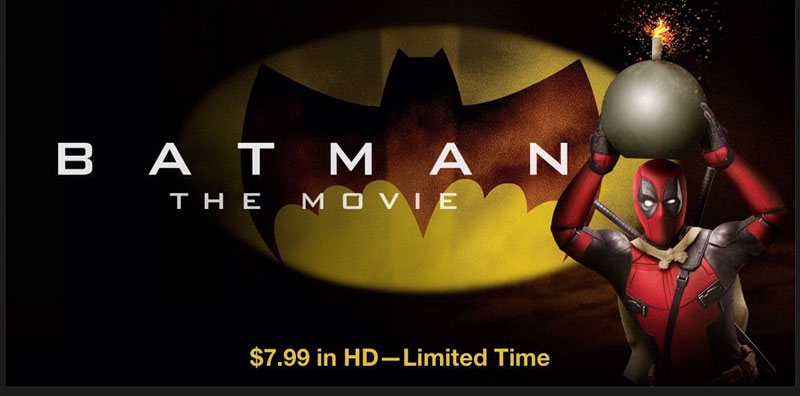
Deadpool is available now on digital video, and fans will have a chance to take Marvel’s “merc with a mouth” (played by Ryan Reynolds) home. To help celebrate the release, Apple has plastered the hero in a number of promo tiles for other 20th Century Fox releases like Taken and The Wolverine.
They’re quite humorous, and the poses tie-in with the respective films in a tongue-in-cheek fashion, as expected from the character’s sense of humor. The image above, where Deadpool is carrying a large bomb, pays homage to the scene from the classic 1966 film Batman: The Movie, where Adam West’s character was stuck trying to get rid of a similarly ridiculous bomb before it exploded. Other examples include holding up the stereo from Say Anything, carrying around a decapitated arm in 127 Hours, and trying to feed a xenomorph from Alien Deadpool’s favorite dish—the chimichanga.
https://www.youtube.com/watch?v=atlNlfToE4E
It’s a brilliant promotion by 20th Century Fox and Apple, and one that’s certainly bound to get the attention of fans while drawing attention to classic films. Deadpool saw tremendous success with a $58 million production budget (and more for marketing) by bringing in over $760 million worldwide, and gained critical acclaim despite its R-rating and adult-oriented nature. 20th Century Fox recently confirmed that Reynolds and director Tim Miller would return for a sequel that’s expected to release sometime in 2017.
For a limited time, fans can revel in how Deadpool is promoting Liam Neeson’s Taken with a water pistol while downloading or streaming the movie. Those that want to pick up the physical edition can do so when it hits retail on May 10.
With online video on the rise, companies are seeing a lot more “cord cutters,” as consumers opt out of cable services in favor of streaming options such as Netflix and Hulu. Think With Googlerecently posted a report that takes a closer look at online video options and just how effective they’re becoming with audiences.
The first part of the report explained how consumers may be watching less television, but overall video consumption remains as high as ever. It noted that by 2025, half of viewers under the age of 32 won’t have any sort of subscription to a pay-TV service, and will view video online instead. In fact, six out of ten people currently prefer to watch their content through online video platforms instead of live television.
As far as where they’re going online for content, YouTube remains a big destination. During an average month, approximately eight out of ten viewers between the ages of 18-49 tune in to YouTube. That same age group spent more time on YouTube last year, leading to a 74 percent viewership increase over 2014, while (at the same time) conventional television dropped four percent.
Think With Google also broke down viewership across different screens, indicating that YouTube wasn’t just watched on computer monitors–in fact, mobile viewing has been on the rise as of late. It has managed to reach more 18-49-year-olds than any broadcast or cable television network.
Millennials also make up a big part of this viewing audience, with two-thirds of those with YouTube accounts watching premium online video across various devices, including smartphones and tablets. But mobile doesn’t deserve all the attention, since viewership has spiked across the board, and more people are watching YouTube on their televisions than ever. The number has doubled year-over-year, based on data gathered by the company in Q4 2015.
Conventional television continues to drop as online video finds more of an audience, with YouTube is at the center of much of it. As such, Google continues to work with the preferences of an online viewing audience, even going as far as introducing a new six-second bumper ad system for brands to work with.
Zach Lupei, product manager for video ads over at Google, explained how these new ads will be effective and keep viewers tuned in. “Bumper ads are ideal for driving incremental reach and frequency, especially on mobile, where ‘snackable videos’ perform well. Given the succinct nature of the format, we’ve seen Bumper ads work best when combined with a TrueView or Google Preferred campaign. In early tests, Bumpers drove strong lift in upper funnel metrics like recall, awareness and consideration. We also see that Bumpers work well to drive incremental reach and frequency when paired with a TrueView campaign.
“We like to think of Bumper ads as little haikus of video ads–and we’re excited to see what the creative community will do with them,” he explained.
A sample was also provided, featuring performance artist Ed Sheeran’s latest single, “Lay It All On Me.”
A new study from Fluent (via Social Times) shows that mobile gaming is still as popular as it’s ever been, except when it comes to consumers making purchases with them.
The customer acquisition platform reported that results from the survey show that, out of the more than 1,000 gamers surveyed, about 77 percent play mobile games multiple times per week, while 46 percent partake in some form of gaming on a daily basis. Fluent also pointed out that nearly half (49 percent) of those polled play mobile games more than they did a year ago, while 24 percent actually play them less.
Mobile games remain quite addictive, as 21 percent of those polled said they’re hooked on mobile games, while 35 percent have admitted they played these games during an “inappropriate time,” like when they were at work.
However, a growing audience doesn’t mean everyone is paying for their mobile experiences. According to the report, 50 percent of respondents indicated they never paid a cent towards a gaming application, while 38 percent have spent money to upgrade to an ad-free experience. Meanwhile, 30 percent said they paid to get extra features or levels in a game, while 29 percent paid for some form of premium currency or accessories commonly offered in free-to-play titles.
Broken down even further, 38 percent of respondents said they made at least one in-app purchase through their smartphones, while a nearly equal 37 percent indicated that they’ve never made a purchase.
Jordan Cohen, CMO of Fluent, made further comments on the report, explaining the following:
“Mobile gaming has experienced explosive growth, and it is now a $29 billion industry. We have witnessed this first hand at Fluent, with a rapidly growing roster of app publisher clients that are using our platform to promote their apps and drive installs via cost-per-install ad campaigns (i.e., they only pay when a consumer who sees their ad actually downloads their app(s)).
“The most interesting finding, to me at least, has been how mainstream mobile gaming has become, with nearly one-half of all consumers saying they play games on their smartphones or tablets on a daily basis. It is also incredible to see that smartphones are far and away the dominant devices for gaming and have completely upended the gaming industry, with 42 percent saying they most frequently play games on their smartphones, compared to just 13 percent who say gaming consoles.
“For marketers of gaming apps, the most interesting stats will probably be around the percentage of mobile gamers who are willing to spend money on their apps. Even with an abundance of free games available for download, 50 percent of consumers say they have spent money to purchase a mobile game, and large numbers are willing to pay to unlock features or levels in mobile games (30 percent) or for digital currency and premium in-app accessories (29 percent).”
Mobile game, Clash of Kings, although not officially related to George R. R. Martin’s novel of the same name, is nonetheless riding the Game of Thrones premiere hype today. Elex Tech has created an ad campaign strategically timed with the season 6 premiere of HBO’s viral television sensation, which was broadcasted in the UK by Sky Atlantic. It started with a television ad to promote Clash of Kings, which aired during the Game of Thrones broadcast, but the marketing campaign doesn’t end there.
Promotions will continue through Game of Thrones fan sites in the hours and days following the TV spot, using hype from the show’s season 6 premiere to attract new game downloads and purchases. The results are then monitored in real-time to gauge new user acquisition along with in-game behaviors.
Clash of Kings is a real-time fantasy strategy war game for mobile devices, but it can also be played on Facebook. Named Facebook’s Game of the Year in 2015, Elex’s pocket-sized battle for kingdom domination shares similar themes to Game of Thrones, making the season premier hype a prime location to attract new fans. It is also considered a mid-core title for its required time investment and strategy. The game placed number twelve on NewZoo’s chart for top iOS games in March 2016 by downloads and revenue.
Game of Thrones was created with viral content in mind, with HBO creating a social media strategy a year-and-a-half prior to the show’s premiere, and even turning to fans for casting suggestions. The show was the most-talked about television program on Facebook in 2015, and attracted 20.2 million viewers per episode in 2015 on all platforms in the U.S.
While Game of Thrones fans digest what they’ve seen on the season 6 premiere, Elex is digesting the response from their Clash of Kings TV spot. The game already boasts over 10 million registered users, so now it’s up to the publisher to evaluate how many in-game purchases are being made as a result of the campaign.
Facebook Live launched initially in August of 2015 as a way for celebrities to broadcast video to their fans via Facebook pages. Early this year, the tool became available on Facebook’s mobile app. Now, Live Video is replacing the Messenger icon in the Facebook app on both iOS and Android.
Facebook is already getting some major market share with Live Video. Take a look at the numbers: Twitter launched its Periscope live video app nine months before Facebook did on mobile, and Twitter’s installed base is just a small fraction of Facebook’s (305 million monthly active users (MAU) compared to 1.44 billion MAU).
Why should Facebook be engaged in this effort? “People now expect communication that’s immediate, expressive and immersive,” said Paul Peterman, head of industry, global marketing solutions, Facebook & Instagram, speaking the [a]list summit. He went on to note that 1.4 billion people are using messaging apps, and over two billion will by 2018. Six of the 10 most used apps globally are messaging apps. “From a brand perspective, we have to live up to the expectation that there is immediate communication and what is that value that we can bring,” Peterman added.
Facebook Live Video is a logical place for advertising, and if Facebook can create a regular, large, dedicated audience for video, advertisers will stand up and take notice.
“Mobile isn’t just an emerging video platform, mobile is the video platform,” Peterman said. He pointed out a 616 percent growth in mobile videos from 2012 to 2015, and that almost half (45 percent) of global video views are now on mobile devices. Facebook sees eight billion daily video views and 100 million hours of video viewed daily, but those were on the News Feed which can be scrolled past easily. What if Facebook video was more like TV? Now you’re talking some real advertising potential.
How Facebook Is Driving Live Video
Facebook is paying some large publishers (like Vox Media) to create live video broadcasts for Facebook, which is one way to jumpstart the growth of Facebook Live Video. Participants include The New York Times, Buzzfeed, Huffington Post, and others, according to Re/code. Tastemade, the video network focused on food and travel content, is providing 100 live, exclusive videos per month.
Now that Facebook has opened up its News Feed to publishers, we can expect similar open arms for video content as well. “Facebook Live is an extremely sticky way to broadcast live video,” Peterman noted. “We’re early days, but we’re very excited about it.”
The Advertising Future for Facebook Live Video
The important part for both Facebook and publishers is the prospect not only of increased audience, but of deriving revenue from that audience—through advertising. Publishers can’t wait for this to happen, though Facebook is proceeding cautiously for now. “It’s tough for us to be patient because in the end all of these [broadcast windows] need dedicated resources,” said Mark Lopez, executive vice president of Univision Digital, speaking to Re/code. “If we use resources for Facebook Live that means those resources are not working on something else. So for us it’s pretty urgent that we can find paths to monetization.”
The consensus among publishers is that they expect Facebook to use interstitial ads rather than a pre-roll. That wouldn’t seem logical for short videos, but it makes perfect sense for a longer video—which is the bulk of what is being planned here.
Interactive Video Ads
Vast possibilities lie ahead for Facebook Live Video and advertising, and Facebook isn’t rushing ahead just yet. But other companies are moving forward, testing the waters—like Innovid, which is trying out online rollover ads with Facebook and Instagram.
Early tests have had some good results, like the campaign British tea and coffee brand Taylors of Harrogate ran last December. The 30-second spot featured a button in the corner of the screen, and if you pointed the mouse at it you’d have the chance to take quizzes, sign up for emails or buy products. The test showed that the format brought a 35 percent engagement rate with 4,400 likes, more than 250 comments and 400 shares.
“This is the first step in transforming social viewers into active participants,” said Tal Chalozin, Innovid’s co-founder and chief technology officer. “Facebook was a natural stepping stone for us because they’ve done an amazing job building a sophisticated ad platform that is continually reinventing itself. We are currently exploring other social platforms to see where interactive video experiences might also integrate well.”
Facebook is firmly committed to making video a key part of its experience, and it’s also looking to bring in publishers and content creators for all sorts of content—video, live video, as well as text. The advertising possibilities have yet to be detailed, but Facebook is no doubt hard at work in this area. The company has already demonstrated great strength in mobile advertising, and it seems like a good bet that Facebook will be among the leaders in bringing mobile advertising to the revenue levels that its audience deserves. Marketers of all types of products should be ready to jump in when advertising opportunities present themselves in Facebook Live Video.
 What is Stage Presence about and how does it work?