‘Exploding Kittens’ Makes KickStarter History

Projects on KickStarter can vary when it comes to success or failure, depending on the idea that’s being funded. For instance, an ambitious robot project can easily fail, while Rifftrax’s recent The Crappening event, where the comedic crew rips apart “classics” like The Room and Miami Connection via live audience, reaches its funding in just a single day’s time. However, there’s no success that can quite match up to the card game Exploding Kittens, which just set a new funding record for the site.

VentureBeat has reported that the popular card game has managed to produce a whopping funding total of over $8 million, with 200,000 funders on board. That’s a long way from the original $10,000 goal that co-creator (and comic writer) Matthew Inman originally envisioned, alongside Elan Lee and Shane Small.

By reaching this total, Exploding Kittens has become the most popular project on KickStarter in terms of supporters. It beats out LeVar Burton’s Reading Rainbow project, which raised $5.4 million from 105,000 backers) and Kristen Bell’s Veronica Mars film, which reached $5.7 million from 91,000 backers).

It’s kind of amazing to see such a small project gain a big total, but most of it is due to the outreach of the campaign across social media, as users told their friends about the game, where you randomly draw cards and attempt to “defuse” exploding kitten cards before it’s too late. Of course, any explanation of the game’s popularity has to start with Inman’s audience of several million devoted fans, rather than the simple game itself.

“Production of the game is simple: it’s just a card game, so other than building the box it’s a relatively straightforward product to make,” explained the listing on the KickStarter page. “The biggest challenge for us would actually be if you blow us out of the water.” Which, of course, the funders clearly did.

Still, the team posted a thank you message on the page, and indicated that those who missed out on buying the game can still register to be notified when it goes on sale through the official Exploding Kittens page.

It’s amazing to see such a small project reach such heights – although Exploding Kittens isn’t the first card game to do so. The vulgar yet hilarious Cards Against Humanity has gained a massive following in just a few years’ time, with hundreds of thousands of fans subscribing to its many programs – including a recent Black Friday deal where they bought actual bull poop. (The promotion ended up raising quite a bit of money, with 250,000 customers buying it. The Cards team, in turn, donated the proceeds to the Sunlight Foundation.)

Exploding Kittens could easily lead a new wave of card games for the market. Even if it does have, you know, exploding kittens.
Analyst: PS4 Will Outsell Xbox One 40% By 2018

The video game console battle is quite an interesting one, as both Sony’s PlayStation 4 and Microsoft’s Xbox One have generated big numbers thus far. The latest tally appears to be 18.5 million PS4’s shipped within its first year alone, while Xbox Live is close behind with 12.4 million systems shipped. However, according to Strategy Analytics, it won’t be long before we see a winner in the console wars.

As reported by GamesIndustry International, the analyst team believes that the PlayStation 4 will be the overall winner in this console generation, as it believes that Sony’s system will move 80 million consoles by 2019, compared to the Xbox One’s 57 million units. Those certainly aren’t shabby numbers for either company, but Sony will still have an advantage when it comes to its outreach to a larger audience.

With its Connected Home Devices Report, the company believes that the PlayStation 4 “is on path to reproduce the success of the PlayStation 2 and Nintendo Wii.”

With 80 million PS4’s in homes, Sony would have a 40 percent edge over its competition, although Microsoft would no doubt fight back with a number of big exclusives, such as its forthcoming Halo 5: Guardians, which arrives this fall.

The PlayStation 4 sales numbers, if they stick, would actually put Sony more on pace with its success of the PlayStation 2, which sold 20.1 million units in its first year of sales – a huge leap over how the PlayStation 3 performed in its first year, with only 10.5 million units sold.

Microsoft’s Xbox One has played quite a game of catch-up over the past year to earn its 12.4 million units sold, especially considering the system first launched with a higher price point and what some feel was an unnecessary bundling-in of its Kinect motion peripheral. Since introducing “budgetable” bundles that didn’t include the device – and price drops over the holiday season – sales have soared.

Not included in this current battle for first place in the console wars is the Wii U, although Strategy Analytics reported that things are on the rise for Nintendo’s latest system. Although it only sold 5.9 million units in its first year, it’s been “staging a modest comeback” as of late, thanks to hit titles like Super Smash Bros. and Mario Kart 8. And 2015 could be even bigger, thanks to franchises like StarFox and The Legend of Zelda‘s new entries, as well as original properties like Splatoon. However, Strategy Analytics only sees somewhere in the vicinity of 15 million Wii U’s installed by 2018, which would make it the least popular Nintendo console in the company’s history.

No matter which choice is made, the video game industry is still thriving with sales. “Despite reports to the contrary, the game console market is not dead,” said Strategy Analytics senior analyst Eric Smith. “Core gamers have moved faster to this current generation than in any previous generation. The main difference in this generation is that casual gamers who bought a Wii are remaining largely on the sidelines as free-to-play casual games and midcore games on tablets and smartphones have captured this segment of consumers.”

Mobile Game Revenues Leap 16.5% To Lead The Mobile Content Market

Don’t question the continuing strength of the mobile game market, because it continues to outpace other parts of the app and mobile content business.

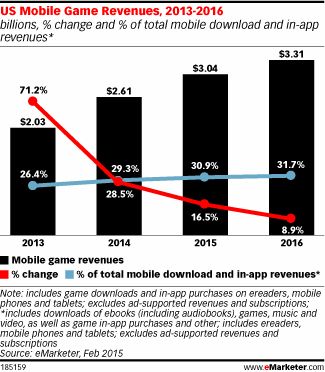
A report from eMarketer shows that US mobile game revenues will grow substantially this year, showing an increase of 16.5 percent up to an estimated $3.04 billion. With that, mobile games now account for 30.9 percent of the US mobile content market, a slight increase from the 29.3 percent reported last year.

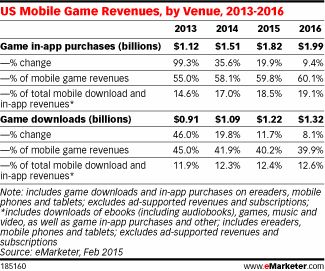
While direct purchases are doing well, in-app purchases through free-to-play games are leading the charge. Revenues are expected to top $1.82 billion for the year, which accounts for more than half of all mobile game revenues. That number will grow even more to $2 billion next year, making its market share just over 60 percent.

Mobile content revenues in all are still quite healthy in the U.S., as these services, including eBooks and music, will total $9.82 billion by the end of this year, a 10.3 percent rise from 2014’s numbers. Mobile content revenues will also pick up an estimated 6.3 percent by next year, reaching over $10 billion and accounting for just over ten percent of all retail revenues for smartphones and tablets.

That said, not everything is thriving, as mobile content purchases have dropped a little bit. It hasn’t gotten to the point of saturation, though.

“Since mobile content is native to the devices, it’s often new mobile users’ first introduction to mCommerce,” said Martin Utreras, senior forecasting analyst for eMarketer. “As the US mobile user base matures, mobile content revenues are taking a smaller share of the overall mCommerce market as consumers become more comfortable buying physical retail items and making more expensive purchases from their devices.”

eBooks aren’t doing too shabby themselves, with sales expected to reach $4.25 billion this year, an estimated 43.3 percent of total mobile downloads and in-app revenues for the U.S. this year. Video download revenues will also pick up, showing an increase of 13.8 percent this year. And that’s likely to grow with services like HBO Go offering even more expansive services.

CMO’s Are Looking To Increase Their Marketing Budgets

Mobile ads continue to be quite effective in the market – and if new research numbers are to be believed, we’re going to see quite a bit more of it.

Adweek is reporting that brands will allot 11.7 percent of their overall marketing budgets for analytics in just a few years’ time, up from its current 6.4 percent. By 2018, that’s almost double the amount for spending.

“We observe that companies under-utilize the marketing analytics that they’ve requested and have available for decision making,” said Christine Moorman, professor at Duke’s Fuqua School of Business, and director of this latest research. “It’s clear that using marketing analytics remains a distinct challenge for companies – beyond the production of this sophisticated data.”

Mobile advertising current takes up over three percent of marketing budgets, but is expected to grow as well – to almost triple that amount, at nine percent.

Other predictions made by the team include the increase of digital marketing dollars, which will rise by 14.7 percent over the next year; brands dropping their traditional advertising budgets by 1.1 percent over the next year; and social media accounts getting 9.9 percent of spending, but expecting to rise to 22.4 percent over the next five years.

In addition, Moorman’s team also states that only 13 percent of marketers said they can measure social media effectively enough, although 61 percent feel that they experience pressure from their bosses when it comes to that – so it isn’t all necessarily on them.

Brand marketers also have more optimism when it comes to the economy, with an outlook indicating a 22.2 percent increase from six years prior, back when the recession set in.

Finally, marketing budgets overall are expected to rise 8.7 percent over the next year, marking the biggest year-over-year growth since 2012. “Compare that to the .5 percent growth that they expected in February 2009, and their confidence in markets is very clear,” said Moorman.

The video below showcases more of the data from Moorman’s study, so be sure to check it out. It could be news that’s right up a marketer’s alley.


Rovio Turns To Chinese Developer

Angry Birds has become a big phenomenon in mobile over the years, especially with tie-ins with popular brands like Star Wars and Transformers. What players may not realize, though, is that it’s not just popular on our shores – it’s making a huge impact worldwide.

Ibtimes has reported that Rovio’s hit game has seen over half a billion downloads in China, an unprecedented record considering China’s usual tastes in free-to-play games. Now Rovio has decided to improve its business in that country, not only promising to open nine Angry Birds-oriented theme parks by 2018, but also teaming up with a Chinese developer to give the game a more regional taste.

The company has partnered with Beijing Kunlun to work its own magic on the Angry Birds franchise, hoping to make it more “market friendly” to Chinese game players – even though it appears that the game has no problem being accepted as it is. “China is an extremely important market for us and we’re consntatnly looking for ways to provide innovative fan experiences by bridging the digital with the physical,” said Pekka Rantala, chief commercial officer at Rovio Entertainment, back when the theme parks were announced.

“Through this partnership, we not only achieve that, but we set a strong foot in one of the world’s fastest growing theme park markets with a key player in the industry,” Pekka continued. “We are delighted at the prospect of bringing Angry Birds closer to our fans in China, in spaces where all members of the family can engage.”

The country is considered a “massively important market” to Rovio, as the “mobile games industry is growing at a very significant pace.”

In regards to the localization efforts, Rantala added, “Angry Birds has been downloaded close to half a billion times in China. Forming a strategic partnership with Kunlun is an important step that helps Rovio establish an even stronger presence in China’s game market with localized content.”

This could help the company prosper again, especially after laying off over 100 employees back in December.

Regionalizing the game is certainly a big deal, as Rovio is the type of company that can easily adapt Angry Birds to fit with any given theme or franchise. Along with Transformers and Star Wars, the company has proven that new ideas work with the series, including the artistic Angry Birds Stella and the kart-racing game Angry Birds Go!

Universal: Digital Music Needs More Experimentation, Less Ads

With a number of services now leaning more on the digital side (like Pandora and Spotify), the music industry needs to experiment with some new ideas in order to bring in a big audience again. That advice comes from Universal Music Group CEO Lucian Grainge, who spoke at the Code/Media conference this week in California.

According to Re/Code, Grainge doesn’t believe that the ad-based services of such sites as Pandora and YouTube can’t bring in the audience alone – more experimentation is needed. “We want to accelerate paid subscription,” he explained.

With that, new ideas must be explored. One example Grainge brought up was the new deal with Jason Kilar’s Vessel site, offering a three-day exclusivity window for some videos as part of the site’s subscription service, which is currently undergoing testing in beta phase.

“Ad-funded on-demand is not going to sustain the entire ecosystem of the creators as well as the investors,” said Grainge.

Some big companies need to make moves, although Grainge isn’t quite sure what the likes of Apple and other have in mind for music. But he thinks the company could be in for great things. “I think Apple has been a fantastic partner to all of the content industries,” he explained. “They have been around for a long time. They have done phenomenally well with music. They ended up with a tremendous share of the pie.” (Its recent investment in Beats Music is likely to increase that hold as well.)

What Grainge is saying makes sense. Companies shouldn’t hold back on not having any advertising services on its sites, but that doesn’t mean they need to be the primary focus. Instead, new ideas, such as exclusive offers and special deals on subscription plans, could lead the way to a stronger customer base. That said, some, like Spotify, feel that an emotional connection with brands is the key.

You can catch the interview with Grainge below.

SuperData: VR Will Reach 11 Million By 2016

Virtual Reality is poised to get real, a new study from SuperData says. The market intelligence firm says that the total addressable market for virtual reality is forecast to reach 10.6 million consumers by 2016. In addition to Facebook’s acquisition, another 18 VR-focused companies received $590 million in investments. All told, that was $2.6 billion invested in VR during 2014, and this year we’ll start to see what that brings.

“Facebook has effectively revitalized the decades-old dream of virtual reality and triggered a frenzy of investments,” according to Joost van Dreunen, SuperData’s CEO. “Currently there are over 200 developers working on VR projects and we counted no less than 15 different hardware devices at varying stages of completion. We anticipate a first wave of PC-based devices to launch mid-2015.”

With full-length video still several years out, all eyes are turning towards game studios to provide the content that will popularize the new platform. Big market players have been placing bets, following Facebook’s acquisition of Oculus Rift, and now companies like Sony, Microsoft, Apple and Google are trying figure out how to bring this technology to market. Most recently, Google announced a partnership with toymaker Mattel in an effort to develop virtual reality content for the children’s market.

“Traditional publishers of interactive entertainment simply cannot afford to just jump in at such an early stage of a new platform. It is financially far too risky for them. Small studios and independents, however, have an opportunity to make a name for themselves. The question everyone is looking to answer is “Who will be the Angry Birds for virtual reality devices ”” said van Dreunen.

The report, Virtual Reality Market Brief 2015, is part of a larger research effort by SuperData to map out the emerging market for playable media and games. “In recent years the way in which digital consumers engage with entertainment has changed dramatically. Interactive entertainment now incorporates many more devices, vastly more and different types of content and a host of on- and offline streaming events. And so we’ve started offering our customers a comprehensive overview of the entertainment market, including virtual reality, streaming media and eSports,” said van Dreunen.

Key findings of the report include:

  • Virtual reality will reach 10.8 million users by the end of 2016E.
  • Games make up three-quarters (76 percent) of all currently available VR content.
  • Small studios and indie developers are best positioned as VR comes to market.
  • In 2014 overall investments in virtual and augmented reality reached $2.6 billion.

Virtual Reality Apps On The Move

With virtual reality devices set to launch in just a few months time, including Sony’s Project Morpheus and Facebook’s long-anticipated Oculus Rift, it won’t be long before we start seeing a number of virtual reality-supported applications to come out alongside them.

Re/code has reported that Facebook chief product officer Chris Cox, speaking at the Code/Media conference in California earlier this week, believes that there are plenty of virtual-based ambitions in play for his company. “I mean, virtual reality is pretty cool,” he explains. “We’re working on apps for VR.” And he’s not the only one, as several other companies also have plans.

Of course, there’s plenty of appeal behind creating original virtual reality experiences. “Have you used some of the film demons inside of VR ” Cox asked. “You realize, when you’re in it, that you’re looking at the future, and it’s going to be awesome. When you’re in Facebook, you’re just sending around these bits of experience – a photo, a video, a thought.” With VR, you could easily be “sending a fuller picture,” according to Cox.

He also believes that the rise of applications will also bring more user-related content. “Totally,” said Cox. “You’ll do it, Beyoncé will do it.”

Facebook’s growing video community could indicate a possible growth for the company’s virtual reality interest, which would easily explain its $2 billion investment in the Oculus Rift technology last year. Cox says it’s growing “at a record pace,” and with the VR content, it could get even bigger.

Cox didn’t give a timeframe as to when these VR-based apps would be put in place, but it probably won’t be “for a while. We’re probably a long way from everyone having these headsets.”

You can check out the interview in full below. The virtual possibilities are endless with such apps, but you never know where they’ll go next. We’re totally down for an interactive movie with the Oculus, though.


Talking Toys Are On The Move

Talking toys have always had some sort of appeal to kids, whether it was Teddy Ruxpin telling stories to children in the 80’s or Tickle Me Elmo wishing kids would give him a cuddle. Lately, though, “smart” talking toys have appeared to be making a move in the market, and they’re picking up in popularity.

First up is CogniToys’ Watson, which can actually have a conversation with its owners, instead of using pre-recorded software to interact with them. The toy, which is currently going through KickStarter, is the latest project from CogniToys, put together by New York start-up Elemental Path. So far, it’s already been a massive success, already surpassing its $50,000 funding goal and pushing well past $70,000, with four weeks still left to go in the campaign.

The toy, which resembles a green dinosaur with a cute little grin, uses IBM’s artificial intelligence technology, Watson, when it comes to answering questions posed by kids, who ask by pressing a blue button located on its stomach. From there, it utilizes an online knowledge database to produce an answer.

“You can ask it a plain-English question and get a plain-English answer,” said Elemental Path co-founder JP Benini about the project. That’s a far cry from Teddy Ruxpin’s limitations.

And he’s not the only one making a change to the toy scene. I4U reports that Mattel is hard at work on an innovative new doll in its Barbie line, Hello Barbie, which it recently introduced at the New York Toy Fair. It also utilizes speech recognition software, so that she will respond to questions posed by kids, using Wi-Fi based technology to come up with the best answers. In addition, Hello Barbie will also be able to play games with kids, and make all-ages friendly jokes as well.

The doll, priced at $74.99, will be released sometime this year, and comes with rechargeable batteries, as children will still be able to play with her while she recharges. You can check out the doll in action below.


‘World of Tanks’ Exploding Onto Xbox One

For the most part, the team over at Wargaming, with several offices around the world, focuses on the “hardcore” PC gaming crowd, as such competitive efforts like World of Tanks and World of Warplanes manage to reach out to millions of players looking to fight one another in virtual battlefield action. Lately, though, we’ve seen an interesting shift with the company – moving towards consoles.

A year ago, the publisher introduced the free-to-play World of Tanks to the Xbox 360, amassing an audience of thousand of players while implementing a new control scheme that console players could easily get into. It’s considered one of the best “freemium” games for the system – and that heightened Wargaming’s interest in bringing the experience to yet another console.

The team has just announced that World of Tanks will be moving to the Xbox One this year, introducing the franchise to the current-generation console scene for the first time, according to The Geek Culture. Like its Xbox 360 counterpart, the game will feature online play, as well as a variety of tanks and other goods that players can purchase optionally – although the core free-to-play experience will remain perfectly intact.

In addition, the game will provide cross-platform support, so players who stick with the Xbox 360 version will still be able to compete with others on the Xbox One. Wargaming has also assured that the new version will also support the same content updates and community features as the previous one. In-game progress will also be carried over to the Xbox One version of the game, if players choose to port it over.

So what does this mean for the World of Tanks model It shows that Wargaming is starting to get more serious when it comes to having a presence in the console gaming community, and not just PC. That’s not to say we’ll see World of Warships and World of Warplanes make an immediate jump, but the possibilities are wide open that they’ll eventually make their way over.

Plus, with the impressive sales of the PlayStation 4 over the past couple of years, there’s also a chance that World of Tanks, or other franchises, could make their way to that system as well. For the time being, the deal appears to be an exclusive with Microsoft, but that could certainly change in the future – and provide even better opportunities for Wargaming down the road.

For now, the team will solely work on making World of Tanks just as much of a hit on the Xbox One as it has become on the Xbox 360. But down the road Don’t be surprised if the team gives “tanks” to even more console players. After all, action this good deserves to be spread around.