China Dominates As World’s Largest Mobile Games Market

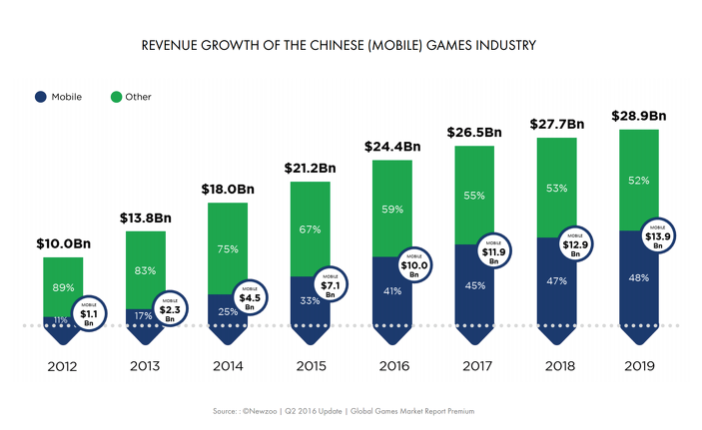
A new report from Newzoo, with data compiled by TalkingData, indicates that China has become the definitive leader in mobile gaming, with $7.1 billion in annual revenue for this past year. But that’s child’s play compared to where this year’s numbers will go.

The report, titled Mobile Advertising & User Acquisition In China, shows that China will continue to flourish with mobile games, as it is expected to top $10 billion in 2016, and eventually reach $13.9 billion by 2019. This is a great leap forward compared to 2014, when the market made a much smaller $4.5 billion.

As a result, the overall games market is slowly being dominated by mobile efforts, which will grow from 33 percent in 2015 to 48 percent by 2019.

Screen Shot 2016-05-03 at 11.23.21 AM

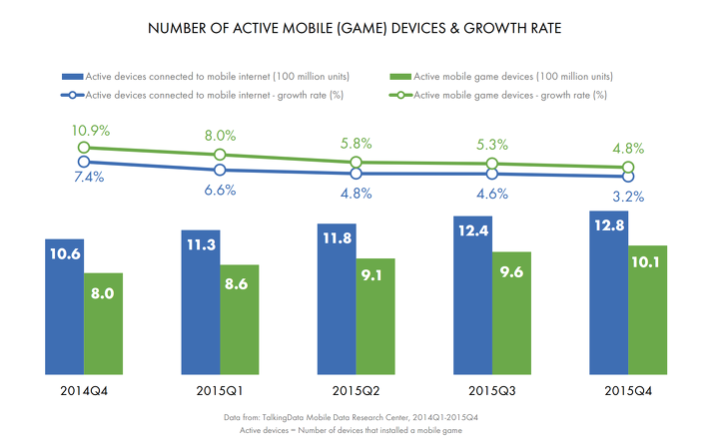
MAUs also increased year-over-year, rising by 80.4 percent on Android and 21.7 percent on iOS between the end of 2014 and 2015. Meanwhile, the number of active mobile game devices grew to over one billion in Q4 2015, a major increase from the 800 million reported for 2014.

Newzoo does point out a slight note of concern with growth rate. Even with a 25 percent increase in active mobile game devices for the year, the quarter-over-quarter rate did see a slight drop-off by 4.8 percent.

NetEase’s Tom van Dam spoke to GamesIndustry International about the drop-off, explaining, “Direct user acquisition isn’t very successful in China. You can’t buy users like you can in the West,” he said. “For example, we did a UA campaign, spending $100,000 to buy users. I can’t recall exactly, but I think we got $2,000 back. Those users don’t monetize, and they can cost up to €50 [$57.5 USD] a user.”

Screen Shot 2016-05-03 at 11.26.55 AM

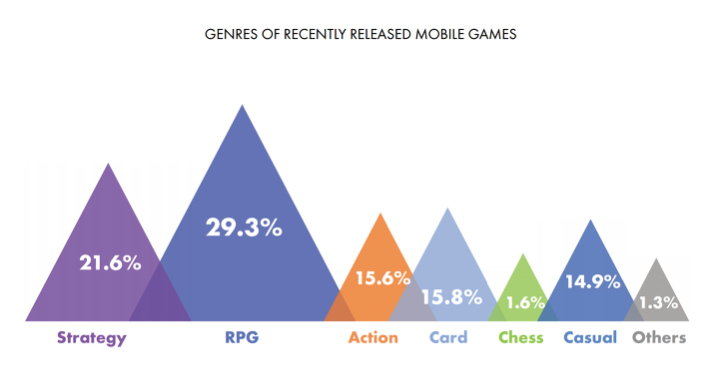
Still, there was plenty of selection, as the market saw 16,500 mobile games across various Chinese app stores, with 50 percent in the casual and card genres. As for new launches over the year, role-playing and strategy games ruled the roost, and are likely to overlap these categories by the end of this year.

Screen Shot 2016-05-03 at 11.28.07 AM

As supported by other recent reports, things will continue to rise for the Chinese gaming market, although the new user growth may be some cause for concern. Fortunately, with so many games to choose from, and many Western developers trying to get in on the action, there should be something that draws them in.

Ikea’s Virtual Reality Experience Heightened By Meatballs

There are a few reasons why people love going to Ikea. Affordable furniture, knick-knacks that they didn’t even know they needed, and of course, those delectable meatballs served up in the cafeteria. Now, fans can appreciate the dish in virtual reality.

Earlier this month, the company announced the debut of a Virtual Reality Kitchen Experience for the HTC Vive headset. With it, consumers can try out various activities in their own virtual kitchen while making a few meatballs in real-time.

“Virtual reality is developing quickly and in five-to-ten years it will be an integrated part of people’s lives,” said Jesper Brodin, managing director at Ikea of Sweden and Range and Supply Manager for Ikea Group. “We see that virtual reality will play a major role in the future of our customers. For instance, someday, it could be used to enable customers to try out a variety of home furnishing solutions before buying them.”

The company escalated its meatball game in VR by introducing a mini-game where consumers could wolf down as many as they could get their hands on, which went on to be a big hit. The video below provides a better idea of what this experience is like.

Feedback has been strong with the app and mini-game. One Redditor stated, “The reviews for the game make me want to visit the fantastical wonderland that is Ikea more than the actual game does.” Meanwhile, another proclaimed, “I’ve been looking for the ultimate Ikea meatball experience and it’s finally here.”

But users can do more with the app than just eat up meatballs and test kitchen options, according to Martin Enthed, IT Manager for Ikea Communications. “We also see Ikea VR Experience as an opportunity to co-create with people all around the world. We hope that users will contribute to our virtual reality development, by submitting ideas on how to use virtual reality and how to improve the virtual kitchen.”

So far, it’s a big community hit, so expect more implementation of virtual reality ideas from the company, along with many more meatballs.

Livestreaming Platform VREAL Is Like Twitch—But In Virtual Reality

One of the frequently shared sentiments by virtual reality executives and creative minds across the board is that the immersive experiences they offer are incredibly isolating ones.

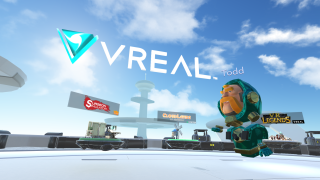
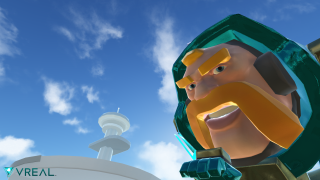
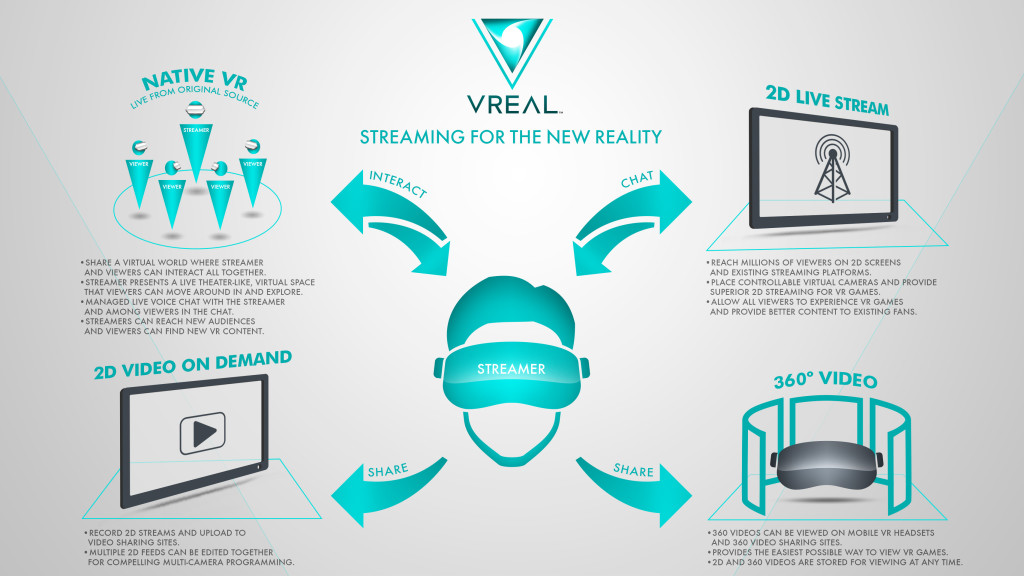
The fast-developing industry received a real shot in the arm Wednesday via VREAL—a new platform that teleports users into the live gameplay through a shared social VR environment, right next to their favorite streamers. Think Twitch, or YouTube, or Azubu. Now inject it with a shot of steroids that lets you and your friends dive deep into the VR worlds of your favorite games where one can watch while placed in the native stream, with full 3D freedom.

The technology comes courtesy of Todd Hooper, VREAL’s creator, founder and CEO who’s introduced an antidote to cure the potentially industry plaguing “anti-social” disease that unites streamers and fans.

VREAL—which stands for Virtual Reality Entertainment and Livestreaming—is hardware-agnostic (Oculus, HTC Vive, Samsung Gear VR) with 360-degree and 2D video viewing on PC and mobile.

The Seattle-based startup received $3.3 million seed funding late last year by a handful of venture capitalist firms. It’s attempting to capitalize on the gargantuan games as entertainment media trend by launching a beta program later this summer.

Todd Hooper is formerly the vice president of online services for Unity Technologies. He joined [a]listdaily at the Silicon Valley Virtual Reality Expo in San Jose, California to talk about his native game streaming and discovery VR system and platform.

2be6ad2

While you were at Unity, at one point did it trigger that “VREAL is where I need to be?”

That’s a good point. I’d seen a number of VR demos over time. Some of them were [Oculus Rift] DK1 and DK2—a lot of people had those. There was a specific demo of the HTC Vive I saw in October 2014 where it was the first time I’d seen a really good headset with really great content from someone like Valve, and they said, ‘we’re launching this in six months.’ I was like ‘Wow. VR is going to be a huge opportunity, and I don’t want to miss it.’ It took a while for the ideas to evolve. Initially, I just immersed myself into VR and found what people were doing. That’s when we started doing some experimenting, and that’s where the VREAL idea came from.

Now that you’ve announced your launch, what’s the next step?

We are laser-focused on getting VREAL out to the hands of gamers and streamers this summer, and seeing what they do with it. We’re working with a lot of developers, which we’ll be announcing in the summer, as well. One thing I’ve learned over the years is ‘you can build something and think people are going to use it in a certain way,’ but I’m pretty confident that by putting VREAL in the hands of streamers, they’re going to blow our minds with the creative things they can do in VR and livestreaming.

What’s your elevator pitch explaining what livestreaming in VR means?

The way I explain it is this: VR is all about the experience. If you as a player have a headset on, and you’re in a virtual world, you want your friends to join you in that virtual world. You want them to literally appear in it. They see you. You see them. And you’re hanging out together while you’re playing a game. We’ve built the ability for people to easily create that in their games, and the ability for the audience to find those games and create those streams. And it doesn’t matter if it’s a desktop, headset, or mobile—regardless of the device, VREAL enables all those people to access some version of the experience.

How do you share a VR story in a non-VR format? How do you overcome that challenge of someone having to actually experience it?

Obviously it is great when we get people to put on a headset. That problem is slowly going away as headsets become more accessible. One of the things VREAL does very well is that we give you this fantastic experience in full VR, but if you have mobile VR, or if you have a web page, we can also give a 2D video experience. That’s something where I think we can add a huge amount of value because that’s been very difficult today—to create a really great, traditional VR video experience. Once we start doing that, it makes VR much more accessible to a wide range of people. It also puts us in an evangelism kind of role, which I love.
Lobby_Todd_1

What are the different ways you plan on bringing the application with VR/AR/MR to the consumer?

Our initial focus is VR, not AR or MR. We’re very focused on VR in gaming. You’ll see a VREAL app that will be available in different places, and that will let you discover the VREAL games that you can stream.

How will you be building out mobile capability?

Samsung GearVR is a great platform for consuming media, so we have a demo on there. We think people will love watching an experience on the GearVR, so we’re focused on that, too.

One of the main problems currently for VR is people don’t have access to headsets. What is your workaround for people who don’t own the gear?

It’s been fine for us. Obviously, Oculus, HTC and Valve have been very good to us over the last year, and it’s great to see products shipping to the hands of consumers. We’re seeing more every day. I have a meeting next week, and I don’t have to pack my own rig because they own it, too. It’s just the beginning, right? In a year, there will be millions of rigs in the field. … It’s very early, still, for VR. Even over the last few months, it’s gotten substantially better in terms of accessibility of hardware, stability of software and drivers and game engines. Going forward, it’s a very early market. We’re finding early adopters, and the ones passionate about VR—enough to put $800 down. Is it going to be a mass market this year? No. But I think it’s on path in a three-to-five year time frame. And that’s really the time frame we’re thinking about building VREAL. We want it to be a platform that represents livestreaming for VR games, and we think that’s a long-term proposition.
Big_Todd_Avatar

What is the feedback from people once they experience VREAL?

It’s been fantastic—we’ve done about 200 demos to date, with 70 at GDC, and it was uniformly, extremely positive. People respond to it immediately. It has an impact of ‘this is extremely engaging and it’s very social.’ I think it’s initially a difficult concept to explain, but we’ve gotten better at it. But nothing beats putting on a headset and showing people. Within five minutes, it’s ‘Oh, I get it now. What you’re doing is mind blowing.’ We love doing demos and getting feedback.

Why are there more people watching than playing video games? Why is that such a phenomenon? What changes when VR enters the picture?

I think it’s a generational thing. When I first saw it, it was young guys in the office using their second screen watching something. That audience has disconnected from traditional broadcast media, and they’re watching 90 minutes of streaming content they’re interested in per day. Twitch and YouTube have capitalized on that very nicely. When you bring VR in, I think there is a whole new angle to that. Video as a medium has been great in the past for traditional games. VR, it’s not really matched. We think there is an opportunity when we build this new technology that lets us re-render the game in realtime. I’m a player. I have my view of the game. You’re watching, and you feel like you’re in the game with me. You get that social interaction, and you also get that experience. If you’re talking about VR games as an experience, then you have to put on the headset. I can’t tell you about it by showing a little flatscreen.

How can entrepreneurs use the current technological flaws in VR to create new media?

VR is a novelty, still. There’s a lot of people that are passionate about it and want to jump into it because of the novelty, but novelty is not going to sustain a long-term marketplace. It is innovation, great new content and people thinking deeply about VR and coming up with something we haven’t seen before. Just bringing genres and sorts of games that we’ve seen directly to VR is probably going to be challenging. It’s an opportunity. There will be a Bungie of VR, and there will be a Riot Games of VR, and it will be one of these new companies that’s experimenting and learning new things, and ready to surprise us with something we haven’t seen coming.

Follow Manouk Akopyan on Twitter @Manouk_Akopyan.
VREAL_INFOGRAPHIC_vF_042616

Snapchat Gets 10 Billion Daily Video Views

We knew Snapchat has had questionable popularity lately, but a new report from Bloomberg suggests that its video traffic has skyrocketed higher than we could have imagined.

The social media channel reports that users are watching 10 billion videos a day, a rise from the eight billion that was reported in February. Snapchat recently reported this news to its investors, confirming its continued success in the social market.

This shouldn’t be a surprise, since a large number of users like to log in and create Stories for people to see, using a combination of quick video snippets and pictures to show the highlights of their day. A tremendous amount of these video views come from this feature alone.

Snapchat stated in its report that the app isn’t just about consuming content, but also creating and broadcasting more of it. Users have the option to immediately share videos with friends, choose where it disappears after viewing, or whether it should go into a Snapchat Story, which can be viewed by a wide audience for 24 hours.

Last February, CEO and founder Evan Spiegel confirmed that the app had more than 100 million daily users, who spent an average of 25 to 30 minutes a day using it, and 60 percent of them were creating custom Stories with photos and videos.

Although Facebook has similar numbers with its growing video business, keep in mind that Snapchat has a much smaller user base at the moment. In addition, Facebook measures its video based on auto-play and views counted after three seconds of viewing time, whereas Snapchat gauges its numbers based on when users start Snaps.

Regardless, these numbers continue to show Snapchat’s immense growth in the social media field, and it isn’t done yet.

How Uber And Totino’s Won Over Gamers At PAX East

PAX East took place at the Boston Convention Center over the weekend, and thousands of fans made their way through the halls to check out the latest and greatest in interactive entertainment. With that, two brands have come away as big winners from the event: Uber and Totino’s.

An on-demand car service and a delicious pizza roll manufacturer might seem like an unlikely pair to come out ahead at a gaming convention, but both teamed up with noteworthy partners to create an impact with gamers without the huge over-branding that some other companies may be known for.

Uber

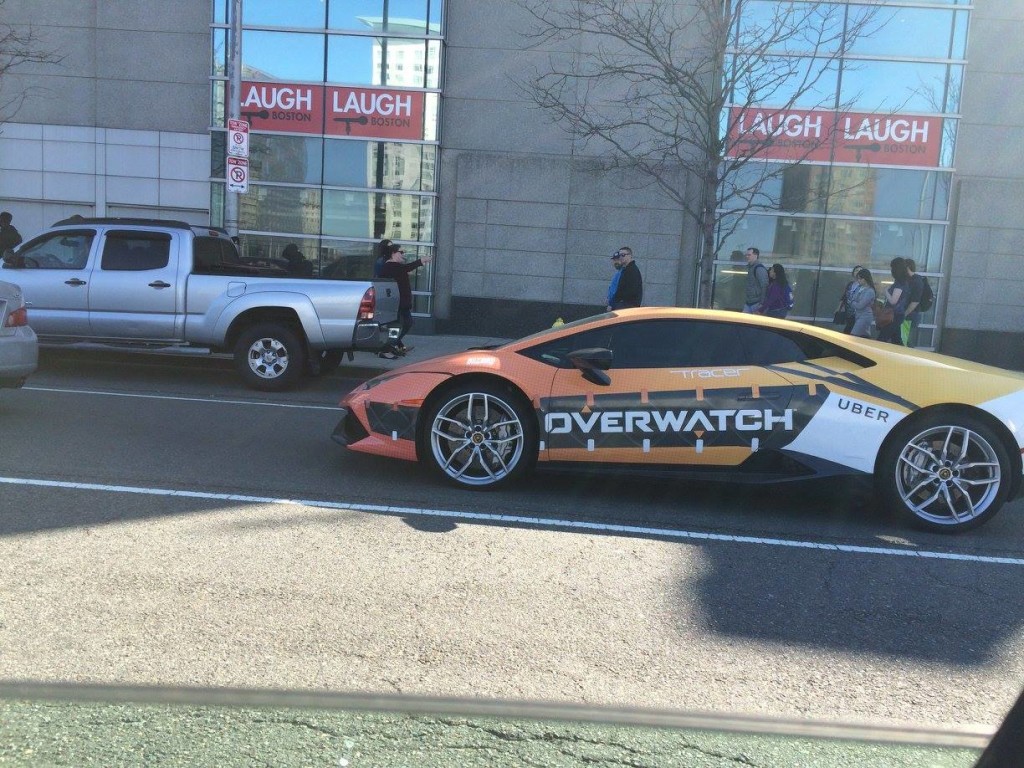
In a tremendous promotion for Blizzard’s upcoming game, Overwatch, the travel company brought a snazzy promotion to PAX East that took attendees all across the city.

Dubbed UberWATCH, the company’s app let riders order special Overwatch-stamped vehicles to drive them around the city. Riders could get a single-seater Lamborghini, a two-seater buggy, or a large multi-passenger truck to bring them around. The vehicles could be seen all across Boston and worked alongside Blizzard’s show floor promotion.

Overwatch

Needless to say, the promotion was a success, and sent thousands of fans over to the official Overwatch booth to get hands-on with the game. Overwatch releases on May 24th for Xbox One, PlayStation 4 and PC.

Totino’s

Meanwhile, Totino’s, makers of wildly popular pizza rolls (which are considered a fond delicacy for many gamers), had its own presence at PAX East. In addition to offering attendees some sample products for nourishment, it also presented a rather peculiar challenge: the Bucking Couch.

Set up like a rodeo bull, the Couch challenged players to sit on it and play Sega’s classic Sega Genesis game Sonic the Hedgehog while struggling to stay on. It became a big hit on social media, with hundreds of attendees partaking in the challenge.

Totino’s partnered with Sega for the promotion, and they also gave fans the chance to play other classic games like Crazy Taxi and Golden Axe while celebrating the 25th anniversary of its iconic hedgehog character.

“PAX East is the perfect place to share our Bucking Couch with the passionate gaming community and give these gamers a unique challenge like they’ve never experienced before,” said Brad Hiranaga, director of marketing for Totino’s. “We are thrilled to be a part of this exciting event and work with top gamers and game developers to bring the ‘Live Free: Couch Hard’ experience to life.”

Others

Old Spice had teamed up with Twitch before on a special promotion, where fans would issue commands to a character in real-time through the “Old Spice Nature Adventure.” It paid off quite well, with 2.65 million views over the three day event.

At PAX East, Old Spice returned, this time offering some sweet-smelling relief to visitors of Twitch’s booth. It offered sample products of both its body wash and deodorant, which turned out to be a huge hit, with thousands of fans picking up the products. It could point to the company’s return at future events, such as the forthcoming TwitchCon, which will take place in San Diego later this year.

Meanwhile, although Lyft‘s promotion wasn’t quite as flashy as Uber, it was on the show floor, giving away prizes to those who spun a wheel. Prizes including vehicle credits, candy bars and little pink mustaches.

The Importance Of Storytelling For The Modern Marketer

When you think of storytelling, films and books come to mind—but what about new platforms like virtual reality or 360 video? Believe it or not, the same basic themes that make Star Wars a modern mythos can create an everlasting legacy, regardless of the medium used. During the [a]list summit, Joey Jones, creative director for Ayzenberg shared some valuable insight into why some stories are forgotten and why others last forever.

Explanation, meaning and ritual

“Myths are public dreams and dreams are private myths” – Joseph Campbell

Joseph Campbell was a mythologist who traveled the world learning about how stories are shared. When ancient societies were spread far apart with little to no contact, it’s amazing to think about how many stories have managed to survive to modern day. The reason these tales endured, it turns out, was because of how they were told.  Campbell realized that the most popular stories offered explanation, meaning and ritual to those listening, and all these tales used the same 20 to 26 beats in their structure.

Dubbed ‘The Hero’s Journey,’ Campbell’s breakdown of successful myth has evolved into what screenwriters call the three act structure. Joey Jones has experience working in Hollywood, even selling a development deal to Disney. His experience through the world of storytelling as a business has provided him with the tools to understand how The Hero’s Journey applies to any successful story, no matter how it’s delivered. Jones breaks down this story progression into six basic beats:

  1. Departure – here we meet our protagonist in their uncomfortable and mundaine environment
  2. Call to adventure that he/she refuses – they don’t think they’re ready for the challenge
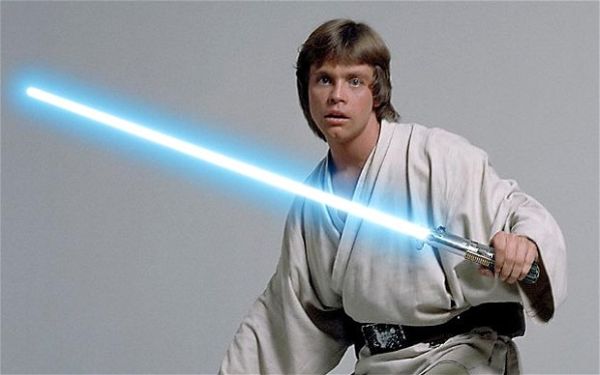
  3. Mentors and allies help the hero prepare – the main character is usually given a ‘talisman’ to help them. Examples include Luke Skywalker’s light saber and Marty McFly’s time-traveling Delorian
  4. Crossing the threshold – our hero takes the first step out of his/her comfort zone and accepts the challenge. (Stepping through the wardrobe in The Chronicles of Narnia, Alice jumps down the rabbit hole, etc.)
  5. Initiation – through trials, travels and temptations, our hero comes back a changed person with treasure, power, wisdom or all three.
  6. Return – armed with these new experiences, the hero returns to where he/she started. The result can be redemption, salvation or destruction.
Luke Skywalker's light saber is a classic example of a talisman in The Hero's Journey.
Luke Skywalker’s light saber is a classic example of a talisman in The Hero’s Journey.

The evolution of storytelling

In Jonah Sachs’ book, Winning the Story Wars, he describes the evolution of storytelling from ancient civilizations to modern day viral videos. This evolution is important to understand because it applies to the open-source nature of today’s content creation.

  1. Oral Tradition – only the best stories survived and no one owned those ideas. Each story evolved through the elaboration or storytelling style of the individual, which allowed for a story or idea to spread freely.
  2. Broadcast Tradition – when the first book was published, it created gatekeepers who determined what ideas could be shared and in what way. This was the dawn of what Sachs refers to as ‘survival of the richest.’ Although you’re free to enjoy the story they are telling you, the idea is controlled by an intellectual property owner and you are not allowed to share it without paying.
  3. Digitoral Era – in the digital age, the best stories once again rise to the top. A great example of this is the idea of a ‘meme,’ or viral video. Although intellectual property still exists, parodies are common.

A brand can either embrace or challenge how the public shares their ‘story’ through parody, social media and the like.

Today and beyond

Stories are finding a new home on VR, AR and 360-degree video and these immersive worlds are creating new, non-linear ways to introduce concepts to modern audiences. Jones is optimistic about the prospect of exploring new mediums, but reminds us that The Hero’s Journey should remain in the forefront of our storytelling strategies.

“If this new advance in technology is here to stay and not a novelty,” says Jones, “It’s gotta talk about these archetypes; the stuff that’s hard wiring us—this myth building which is so important to telling stories. It’s also important to realize that we’re in this digitorial era like, I think Facebook gets it. They’ve put a ton of money into Oculus, they’ve also put out this 360 camera which is open-sourced, that’s pretty ballsy. And we also need to realize that storytelling is communal. The fact that my wife gets mad at me when I watch Breaking Bad episodes without her is a testament that storytelling, even though we’re standing or sitting right next to each other watching the same flat screen and not saying anything, there is a sort of special bond that we have when we’re listening to stories.”

Jones left us with a new way to think of content creation in the digital age, and believes that VR, AR and 360 could take audiences to new worlds in a compelling way, just as the myths of old.

“Transmedia [has been] fighting for its place for many years now.” he concluded. “I think that can really find its nest, its home and really be able to tell stories that cross many different platforms.”


Learning To Measure Earned Media Value

The Frontline marketing approach to creating and sharing brand stories is usually defined by the cyclical Listen, Create and Share process. As part of this, listening-centric analytics are needed to fuel content creation, validate results, and provide benchmarks that help optimize and understand what type of engagement activity is resonating with consumers. However, earned media values (EMV) are remarkably difficult to measure.

That’s why, for the past several years, Ayzenberg’s paid media and social divisions have used earned media as a core metric to validate engagement for content, and the result was the Ayzenberg Earned Media Value Index (AEMVI). Vincent Juarez, principal at Ayzenberg & ION alongside the director of Analytics at Ayzenberg & [a]insights, Robin Boytos, explained how the AEMVI provided deeper insights into measuring earned media at the [a]list summit today.

To provide some context, the launch of the ION Influencer Division further increased reliance on earned media to justify the transition a traditional marketing approach to a more content-centric one. As the reliance on content and influencer marketing increased, so did the need for reliable metrics, and so the AEMVI was created to provide marketers with an evolving benchmark to evaluate campaign ROI.

Although many marketers know what earned media values are, few feel that they have a thorough understanding of what it is. Juarez explains that “earned media values are essentially the value of the extended paid media that happens as a result of those types of actions and the dollar value associated with it. More importantly, they validate the increasing use of high-engagement content marketing and influencer marketing tactics. You can look at this from the perspective of, ‘if all social media activity ceased to exist, what is the what is the media value that’s needed to drive that kind of result?'”

Although we all know that there’s an inherent value to a Facebook Like or Instagram comment, it’s difficult to show that to an upper-level executive. So, in the first step in figuring out how to measure EMV, they evaluated how much it would cost to create the same level of engagement using paid media. It’s important to note that neither Juarez or Boytos originally set out to create a metrics system from the ground up, but searching the internet yielded vague or outdated numbers. There was a clear need in the marketplace for updated values and an industry standard to measure influencer campaigns, which is why Boytos concluded that a new study had to be commissioned.

For sources, the team gathered as many comps as they could find and grouped them into four main categories:

  • Auction based pricing. For this category, they went into social platforms like Facebook and Twitter and set up campaigns on five key verticals (gaming, automotive, beauty/fashion, entertainment and consumer electronics). Then they pulled real-world pricing data for any action that can be bought on a paid media basis.
  • Years of paid media and social data from Ayzenberg. The study took all the resulting actions from these campaigns and derived a cost per every action.
  • Organic social campaigns. Although some may question why organic campaigns were included when they were looking for costs of paid campaigns, Boytos explains that “even if paid media costs don’t apply, there are still managed service fees that go into creating them. Whether you or an agency or company, it costs money to produce this content, so there’s still value to those actions.”
  • Third party publications. Anything that was published on the internet as a rate for each of these action, was included into the index. This creates a normalized view, since the study isn’t solely based on Ayzenberg’s data.

They then tied all the pieces together by evaluating every comp, throwing out any major outliers, and factored in whether these campaigns were engagement focused or funnel focused, then adjusted the comps accordingly.

Juarez presented the results for video view metrics, which were based on a foundation built using data from YouTube, since it has such a long history. Factoring in the premium nature of influencer and content marketing, the study settled on a $0.12  cost-per-view standard as a starting point. A conversion had to be applied when looking at Vine videos, given their short nature. So, it was determined that every five loops equated to one completed view, which makes each loop worth about two-cents.

Snapchat was trickier because there wasn’t a lot of history, and it doesn’t sell on a cost-per-view basis. Videos on the social channel turned out to be lower than YouTube, so the team took a step back and looked at the content being created. That’s when they realized that they had to adjust up, because Snapchat content has an “inherent sense of urgency,” said Juarez. Videos on Snapchat have in-the-moment engagement like a sporting events and livestreams. Audiences are engaged at a different level.

Facebook, Instagram and Twitter initially came out 3-6 times higher than YouTube, but they had to be adjusted down to $0.12 because the data is based on a three second dwell time, which isn’t the same as a completed view.

Boytos presented a look at the cost per action breakdown across social platforms. Actions include cost-per-click (CPC), cost-per-each-engagement (CPE), cost-per-comment (CPCO) and cost-per-page-like (CPPL). Boytos added that CPE data shouldn’t be relied on unless you don’t have visibility into Likes, shares and comments, since “not all engagements are created equal.” Some engagements take more effort than others, so they shouldn’t be all valued the same.

Facebook’s EMV highlights include a CPC value of $0.15 and a CPE of $1.97. The system breaks each engagement down into individual values, and Likes ended up being the least valuable ($0.39), because they’re so easy to do, while comments ($1.75) and shares ($1.93) require more effort. Shares are the most valuable, because shared content is cast to a wider audience, which is extremely valuable. Cost-per-page-likes can be purchased through auction bidding, and the team also factored in organic campaigns. Page likes are especially valuable to organic campaigns, because it’s proof that your campaign did so well that people want to subscribe to it, which can lead to other actions like comments and shares, so that’s why it’s valued at $1.72.

On Twitter, CPE came out to $1.73, replies are worth $1.58 and retweets are $1.67 and favorites are $1.49. Many of the values closely match Facebook, but Twitter’s most valuable action is gaining followers, which are valued at $2.39 each.

Juarez then discussed practical applications for the study. Several large clients across many different verticals were used to put the EMV metrics through a real-world stress test. The first involved a travel series that included five videos and over sixty-six content pieces across YouTube, Instagram and Twitter. Based on calculations, the campaign generated $143 thousand in earned media value.

The second campaign was from the consumer electronics space that revolved around creating slice-of-life brand stories through the lens of the consumer electronics products. There were eleven video pieces and dozens of Instagram and blog posts, which brought in about $248 thousand in earned media.

To conclude the presentation, the final sample included a mobile game based on a top comic book franchises. They worked with top-tier influencers across multiple platforms including YouTube, Instagram, Twitter and Facebook, which generated two-thousand earned media actions, which came out to more than $180 thousand in earned media value.


[a]listdaily Weekly: Bots Overtake Facebook And Brands Take ESports Seriously

With F8 last week, Facebook got marketers everywhere to wonder what bots could do for their business. Still a relatively new technology, the possibilities with branded one-to-one communication with consumers are promising.

We tackled the subject of bots this week as well as pet influencers and brands embracing the stoner image. You won’t want to miss this installment of [a]listdaily Weekly.

Getting To The Heart Of Compelling Social Media Content

Keeping up with social media developments while creating compelling content for brands requires a fast-moving strategy. To help marketers engage with social media platforms, Ayzenberg’s SVP of Social and Digital Media, Rebecca Markarian, sat down with Dennis Todisco, head of digital creator community for Twitter’s Niche platform—which provides social analytics and for creators on a variety of social channels and helps them monetize content—at the [a]list summit presentation titled, “How To Be Creative at the Speed of Conversation.” In it, Todisco offers valuable advice and insight to help brands achieve superior results from their social media campaigns.

In the talk, Markarian asks how brands can move at a fast enough pace to stay relevant with ever-changing trends. Todisco explains that creators are on top of trends, and they know what’s up. A creator won’t make a “Damn, Daniel” video right now. At the same time, they’re also making trends themselves. One example is how a creator recorded a video of himself playing a song while smiling, which turned into a huge trend. Another successful campaign is a sitcom that was put on Snapchat to promote Starbucks Rewards.

But how do companies work with creators so that they don’t damage the brand, or be seen as off-brand? Todisco states that, “when you think of creators as transactional, that’s when you’re not going to get good results.” Niche works with creators as partners, and is a creators-first platform. That vision is explained to brand partners, and many of them are very forward-thinking, so they also regard creators as partners.

As an example, Todisco refers to an Amazon campaign around the Super Bowl and Final Four, where clients were actually in the field, working with creators on the ground, to make sure the content was on-brand but also authentic to the creator. This was described as, “moving at the speed of real-time,” without emails or texts back-and-forth, or having a playbook. “Being in the field makes a world of difference, and the content speaks for itself.”

Markarian also asked about what the best strategy was for engaging with a global audience. Was it better to pick one big global influencer with pull across all channels, or to try to go more micro, creating pockets that are relevant to different cultures?

“The key to success is creating content that’s language agnostic, and creating content that symbolic and universally understood,” said Todisco. As an example, he cited how Coca-Cola did a big campaign in Brazil, and one creator of that content was based out of Whales and the other Minnesota. The content was iconic, since they were both artists, and one of them painted something while the other did an amazing stop-motion piece.

Finally, following the adage of having to listen, create and share—with the key part being listening, and following creators as they make content and trends—Todisco was asked to list three creators to keep a close eye on.

His picks were:

Zack King, who is probably the top magician social media right now, and his campaign for the Comcast Xfinity X1 Box.

Robby Jayala, who did the Bend the Rules campaign for HP, which features a fun Vine where a person breaks a laptop by bending it backwards to turn it into a tablet.

And Clau Marra, who is  a stop-motion artist based out of Mexico. She made an amazing piece for Lancôme using different tones of make-up being applied to a person’s face.


How PAX’s Focus On Community Is Helping Its Events Grow

This year’s Penny Arcade Expo East (PAX East) is right around the corner, taking place on Boston from April 22-24. The event, which has been sold out for months, will feature a number of companies that include Sony, Gungho Online and several others. However, it will also be home to various indie developers who will be showcasing their latest video and board games for thousands of fans to see.

PAX has always had a strong focus on community, and while that draws in a number of big-name companies, these events have also been tremendous opportunities for up-and-coming developers to reach out to audiences.

The original Penny Arcade Expo (which takes place in Seattle, and is now referred to as PAX Prime) first got its start in 2004, with 3,300 people in attendance. That number has grown with each passing year, which has led the convention to expand it to other venues, including PAX East in 2010, followed by a debut of an overseas show, PAX Australia, in 2014, and PAX South, which took place last year in San Antonio, Texas.

With each location, local independent game developers came out to support its fans. For example, Boston is the home of Harmonix, a team that made a big splash last year with the release of Rock Band 4. Meanwhile, Gearbox Studios, based in Texas, found a huge presence in last year’s PAX South event, with thousands of fans attending panels based on the company’s franchises, such as Borderlands and Homeworld.

Each show brought out developers big and small to celebrate its newest projects. Even the smaller booths at the show house up-and-comers that are eager to talk to fans about upcoming projects, such as GalaxyTrail’s side-scrolling platforming game Freedom Planet and Devolver Digital’s line-up, including oddball favorites like OmniBus and Enter the Gungeon.

Essentially, PAX is a convention that appeals to broad groups of fans, instead of focusing on just a single theme. For instance, cosplay fans can come together and celebrate their dressing up as favorite characters, be it from Japanese animation, video game or other entertainment. Board gamers can get together and challenge each other at everything from Dungeons & Dragons to Cards Against Humanity. And then, of course, there are video games, with both AAA releases and indie titles being enjoyed across the board.

In addition to community-driven parties and concerts for fans to enjoy, PAX is also home to panels that both educate and entertain attendees. These run across a range of topics, like how to find a career in the game industry and how to create better online content.

It’s been a viable show for up-and-comers and major game publishers alike, finding key opportunities to connect with people. Anyone who has been a part of the show, no matter which location, has usually come away with a strong connection to its community.

Don’t look for this trend to change. This year’s Seattle event looks to sell out quickly as soon as tickets are available, and plans are already in the works for next year’s show. When it comes to drawing a community together, PAX still looks like the golden ticket.