How Brands Can Make The Most Out Of Snapchat’s Redesign

Snapchat’s popularity has grown significantly over the past few years, and it’s even getting to the point where the app sees more daily usage than Twitter. Its “Stories” section in particular has seen quite a bit of traction, and its latest redesign could help brands make the most out of attracting this large user base.

The company’s latest redesign will help companies put together content that posts directly onto the app, using a number of tools to help attract would-be subscribers, according to the Wall Street Journal, which is one of the 20 publishers ready to use the new feature.

Other publishers, including BuzzFeed, Vice and Cosmopolitan, are already taking part in the program, with images and headlines being put into play to lure in potential fans. There’s also an option to subscribe to these channels, which would put stories from companies into the same area where they get updates from friends.

This content will blend in alongside the “Live Stories” section, as well as the “Discover” section, giving them plenty of opportunity to be found by the millions of daily Snapchat users.

This appears to be part of Snapchat’s process to integrate advertising business into its app, so that users will view more content from its partners. It’s a move that’s likely to make publishers very happy, with the opportunity for better business promotion. Considering how Snapchat’s net worth right now sits at $16 billion (with $500 million raised from investors), it’s a move that will not only appeal to current partners, but also one that could bring in new ones.

With a number of devoted teams (namely at IGN and Snapchat) hard at work on Snapchat content, this could be a move for the better. “With the product change, it takes things to the next level in really allowing us to showcase a little bit of a teaser of the look and feel of what’s to come in that edition,” Oren Katzeff, head of programming at Tastemade, speaking with AdWeek.

“Everything [up until now] has been behind a wall—you have to press the logo to then get taken to the experience,” he said. “What’s exciting about the redesign is that it allows you to take some of the content that’s performed well and showcase it more.”

The redesign is live now, so users can see just how well this content blends in, and how attractive the headlines and images come across.

Gaming Discovery And Social Platform Player.me Goes Mobile

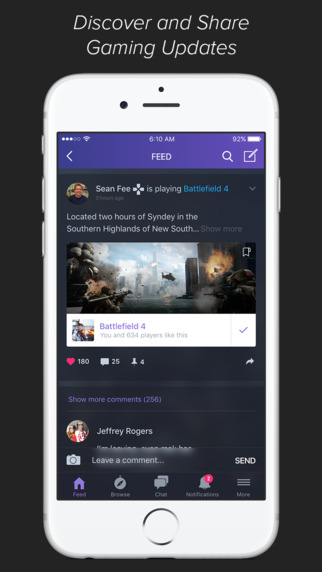
Player.me is looking to connect players, streamers and developers with each other to socialize, discover new content, and show off their favorite games. The social site launched last year with little promotional support, and the community has already grown to include 100,000 members. Now it’s ready to take things even further with today’s launch of the Player.me mobile app, which allows users to share and collaborate while on the go.

[a]listdaily talks to Sean Fee, co-founder and CEO of Player.me, about how the discovery platform will grow to bring gaming enthusiasts together everywhere.

What is Player.me?

Player.me is a social discovery platform for the gaming community. It lets players discover, share, and collaborate with each other, groups, developers, and even popular streamers.

Where would you say Player.me fits in among social media channels such as Facebook, Twitter and Instagram?

We are super focused on games, players, and the gaming community. Where other social media platforms revolve around connecting you to your existing network, we try to focus more discovery or connecting you to the people and games you should know, because your interests are so closely aligned. At the same time, Player.me connects to all of your existing social networks, like Facebook, Twitter and Steam so we also integrate all your gaming friends from multiple platforms into one gaming hub.

How does Player.me connect content creators with potential viewers?

We do it in a few ways; our feed pulls in content updates from YouTube, Twitch, Hitbox and Beam so that your fans know when you’re streaming or a new video has just released. We also have a tab in our feed dedicated to who’s streaming now and we show you streamers that may be of interest to you based off your profile. Creators can also add their video content to game pages to get discovered by fans of a particular game. Finally, by connecting your YouTube account to your profile we automatically pull in all your videos and display them on your profile and if you’re connected to Twitch or other streaming services your stream displays front and centre on your profile when you’re live.

How do the new mobile apps enhance the Player.me experience?

Mobile is obviously a key cornerstone of any social product these days, and whilst a lot of products go mobile first, we decided to really develop the product feature set through the web app and then work to bring all of those features into our mobile apps. I think what we’ve achieved is an incredibly rounded and feature-rich mobile experience that allows players to discover, share and collaborate with other players around the world on the go. It really is the most advanced mobile social platform for the gaming industry out there.

player-me-mobile

What plans do you have to further grow the Player.me community?

We’ve been very pleased with the growth of Player.me, which has a community of nearly 100,000 gamers since we launched in mid-2015. But there are big plans ahead for the platform as well. To date, our growth has been purely word-of-mouth and we haven’t really invested any money in marketing because we felt mobile would be a very important factor. So we plan to work on some fun marketing strategies to supercharge our growth from this point on. We aren’t ready to discuss what’s next from Player.me just yet, but please stay tuned!

What would you say is the best reason for gamers to start using Player.me right now?

With the rapid rise of platforms like Steam, Twitch, YouTube, and more, the gaming community is somewhat fractured when it comes to social interaction and networking. One player may have a group of co-op friends on Steam, social friends on Twitter and Facebook, creators and streamers they enjoy on YouTube and Twitch, but these different networks can be disconnected and don’t always overlap.

Player.me and the new mobile app help bring all of this together into a central hub. We also feel that discovery in gaming is somewhat broken and that it’s hard for players or games to be discovered unless they’re featured on the big platforms. With Player.me, we plan to make discovery seamless and really enhance a players gaming experiences by introducing them to the right people, teams or games at the right time.

Nintendo Launches ‘Miitomo’ Powered ‘The Legend Of Zelda’ E3 Promotion

Nintendo has already confirmed most of its plans for next week’s E3 show, including a major emphasis on its long-awaited The Legend of Zelda game. Both Zelda and the upcoming Pokémon games will be showcased on the live Treehouse broadcast event during E3. However, the company announced a new social media campaign, which includes the highly popular mobile release, Miitomo.

Starting today, the company has launched a special Twitter campaign through its @NintendoAmerica account, where fans can tweet about The Legend of Zelda franchise and possibly earn free in-game Miitomo goodies, including “Link’s new hair wig” and a special in-app gift for all of its users. The company is shooting for 10,000 tweets for the promotion, which will likely happen right away, and also has an escalated award for 20,000 tweets, in which it will offer another “Link wig” for fans to wear in Miitomo.

That’s not all, because Nintendo will offer exclusive The Legend of Zelda goods in Miitomo next week, which gives players a chance to win pieces of Zelda gear and purchase particular items through the shop.

The company also outlined its plans for its Treehouse broadcasts from next week’s show. As expected, Zelda and Pokémon will continue to get a spotlight, but other games will be featured over the course of the broadcast on June 14 and 15, including Monster Hunter Generations, Dragon Quest VII: Fragments of the Forgotten Past and Tokyo Mirage Sessions #FE. Fans can tune in on Nintendo’s official E3 page, as well as its official YouTube and Twitch channels.

As for those that are attending the show next week, Nintendo has already promised a heightened Legend of Zelda experience at its booth, which will recreate locations from the game. Nintendo will also provide hands-on opportunities for the Wii U edition, which is scheduled to release next year. The game has also been confirmed for the NX console, which doesn’t have a release date yet.

Over Half Of Twitter Users Are Gamers

E3 2016 is just around the corner, and Twitter is seeing tremendous buzz about the show. The reason for that is, as it turns out, a good portion of its audience are gamers.

Twitter recently posted on its blog discussing how big its gaming demographic is and explained that nearly 84 million tweets last year were focused on video games, which is approximately 230,000 a day.

“In fact, gaming’s popularity is anything but a game, as 65 percent of Twitter users say they play video games, and 55 percent of those users say they regularly play console games,” wrote Gleana Albritton, industry marketing lead for media & entertainment, who co-authored the blog entry.

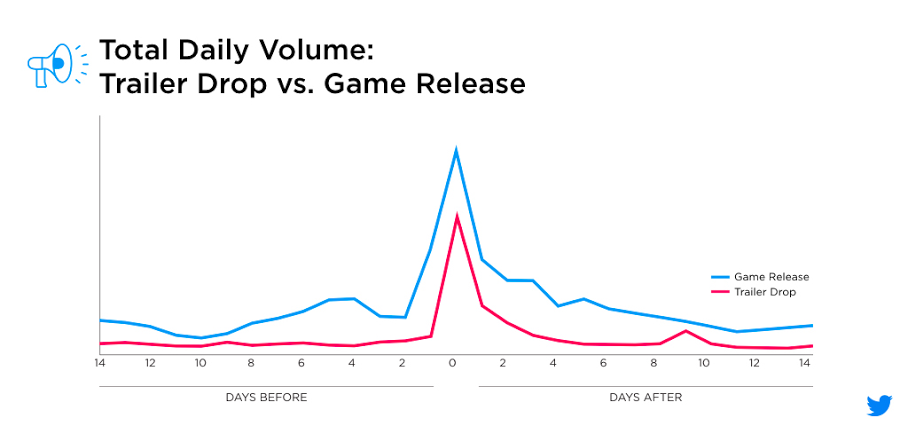
The true high point for game conversation came with the E3 2015 show, in which there were 740,000 tweets a day, reacting to the big reveals and announcements. Most reveals come in the form of trailers, and Twitter users love trailers. The chart below shows the spike in traffic between a game release and a trailer drop. The game launch day is the biggest highlight, but reactions to trailers closely match, and there’s plenty of activity in the days leading to its release and during the days that follow.

Twitter

Twitter also noted that popularity of games on its social site actually translates very well to game sales, as 85 percent of users are likely to spend money on video games, versus 76 percent of non-Twitter gamers.

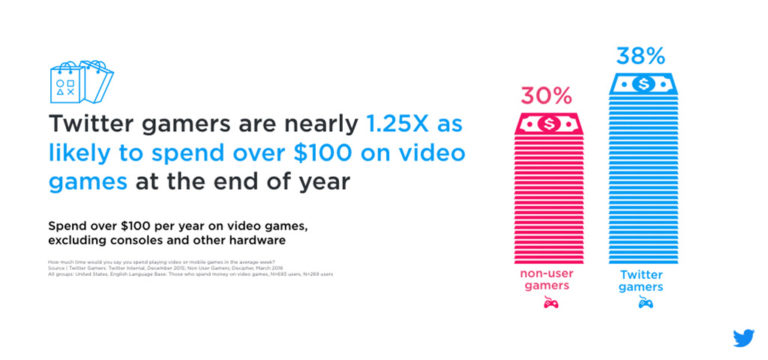
Twitter 2

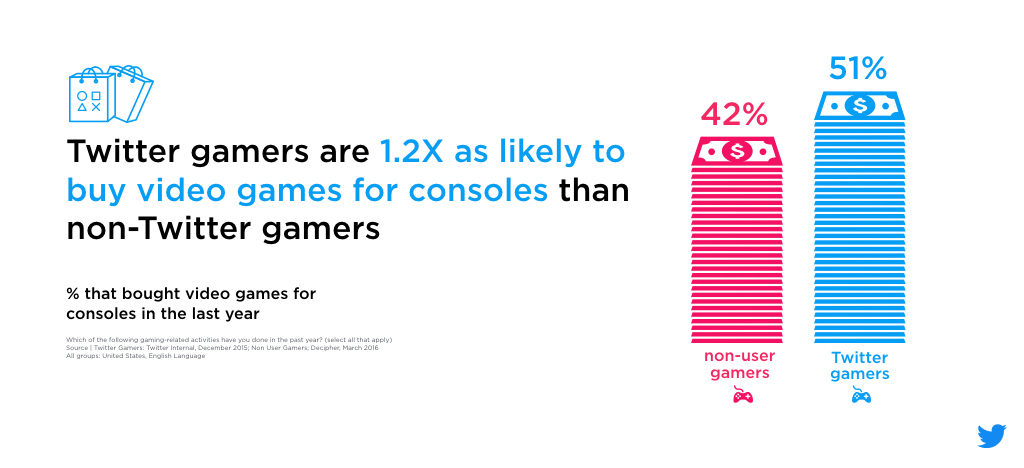
The chart also points out that Twitter gamers are 1.25 times more likely to spend over $100 on video games per year, compared to non-Twitter gamers. A different breakdown also said about the same for consoles, with gamers 1.2 times more likely to buy video games for consoles over non-Twitter gamers.

Twitter 3

“Gaming audiences like to stay up-to-date on all the latest equipment as well, “Albritton noted. “A whopping 78 percent of them researched a game or console as a result of following a gaming handle. Of these followers, 81 percent own a console and 53 percent bought one in the past 12 months. Nearly 40 percent of them intend to buy a gaming console in the next year.”

So, between huge gaming buzz during trade shows, release of games, and general chatter about what’s been announced and what’s coming, video games are getting a ton of traction on Twitter. All the more reason for Twitter to have a devoted gaming channel.

‘Rick and Morty’ Return With First-Ever Instagram Game

Last year, Cartoon Network’s Adult Swim label hit paydirt with its Instagram promotion for Rick and Morty, where players could explore the “Rickstaverse” to find fun little second season factoids by clicking planets and other images tied into the account. Now, the duo is back for more.

A new expansion to the “Rickstaverse” has been introduced on the official Rick and Morty Instagram, titled Interdimensional Cable Adventures. In the game, players can explore 20 new levels across a number of new images, including ones based on episodes of the show. This lets fans check out content based on familiar locations, such as the Plumbus Factory, and pick up collectibles.

For those unfamiliar with the series, Rick and Morty follows the goofball adventures of a drunken scientist and his younger nephew as they explore strange new parts of the universe, from planets hosting an American Idol sing-off to worlds where a sun screams constantly on the horizon. Highlights from the recent second season can be found below.

https://www.youtube.com/watch?v=-F0RqPYiFII

The “Rickstaverse” has been a huge hit with fans since it launched last July, with over 100,000 followers on the account looking to hunt down mini-games, clips and content from the show. Cable Adventures adds to that, with new goodies to find, including a number of Gazorpazorpfield Comics—a favorite of the duo’s from the show.

This is just the beginning of hype for Rick and Morty‘s forthcoming third season, which is expected to debut on Adult Swim later this year. Expect the show to once again have a big presence at the San Diego Comic-Con next month, where attendees will likely see the debut of new footage, along with other surprises. In the meantime, fans can pick up the second season on DVD and Blu-Ray starting tomorrow.

As for Instagram users, the “Rickstaverse” awaits, and it certainly won’t “get schwifty” by itself.

Facebook Exec Explains Why More Game Companies Are Going ‘Live’

While Twitch and Twitter receive a lot more attention when it comes to video game press coverage, Facebook and Instagram remain leading social media platforms for game companies. Starting this month, Blizzard will be integrating Facebook Login and Facebook’s Live API into all its games.

Using their Facebook accounts, players will be able to sign up for and log into games such as World of Warcraft, Heroes of the Storm, Hearthstone, Diablo III, StarCraft II, and Blizzard’s most recent blockbuster release, Overwatch. Adding a Facebook Login will pave the way for new social functionality in Blizzard games.

Blizzard will be incorporating Facebook’s Live API in order to create its own “Go Live” streaming functionality for its games. For the first time, players will be able to livestream their Blizzard gaming sessions directly to their Facebook timelines, and friends will be able to subscribe and be notified when new streams are available.

Leo Olebe, director of global games partnerships at Facebook, explains why Blizzard and other AAA game makers are gravitating to these social media platforms.

How have you seen game developers gravitate towards Facebook?

In 2015, game developers earned over $2.5 billion on our platform by using Facebook tools and services to help build, grow, and monetize their games. Facebook has more than 1.6 billion monthly active users, and that includes more than 650 million people who play games either on Facebook or connected to Facebook every month across desktop, mobile and console. No other platform in the world has this kind of reach. With world-class mobile advertising products, monetization via Audience Network (a unique tool set for building optimized data-driven apps with Facebook Analytics for Apps), and the world’s best social identity and account authentication solution, Facebook Login—we have built products that create true developer value. We also support developers with mentorship and resources via programs like FbStart, as well as our regular meet-ups and hackathons around the world.

Traditionally, Twitch is the go-to service for video game livestreaming. What does Facebook open up to game makers?

We always like to tie our ideas back to our mission. Our mission is to give people the power to share and make the world more open and connected. We want people to be able to share the game content they are most passionate about, with the people they care about. Facebook brings tremendous reach and engagement for streamers as well as social connectivity options that just don’t exist in the livestreaming world today. Also, Facebook has a real identity policy, whereby people are their real selves. As a result, interactions in the community are different than seen on other platforms, and we believe this will improve the overall experience, making it better for both game makers and people.

How big a role does Facebook play for the average gamer?

If you just look at Facebook.com, more than 15 percent of time spent is people playing games. In addition to games played on Facebook.com, mobile game developers use both Facebook Login and friend connections to improve their game experiences: whether that’s to find other Facebook friends, compete against each other on leaderboards, invite others to play, share content to their news feed, join each other’s guilds, and more. On the desktop, we are also connecting people. As you know we just announced that Blizzard is bringing Facebook Login and Facebook Live to all of its games, and we’ve also partnered with Riot to integrate Facebook Login into League of Legends.

With PlayStation and now Microsoft, we’ve also unlocked sharing directly from consoles in screenshot and video format. We recently launched Facebook Friend Finder, available via the Xbox app on Windows 10 and Xbox.com. This new feature lets players add their Facebook friends to their Xbox Live friends list without having to manually search for their name or Gamertag. Today, more than 30 million people have connected their Facebook account to either PSN or Xbox Live.

What type of engagement are you seeing from game companies that have embraced these new features early?

Early game partners that have integrated the Live API have seen engagement increase exponentially compared to other streaming platforms. We’ve seen many different and creative ways developers are choosing to use it, from producer interviews, to tournaments, to high-end productions. Some other partners that have been using the Live API include 2K Sports, Super Evil Mega Corp, EA, Zynga, PlayStation, Activision, PopCap Games, and many others.

How did you work with Blizzard on the Overwatch launch?

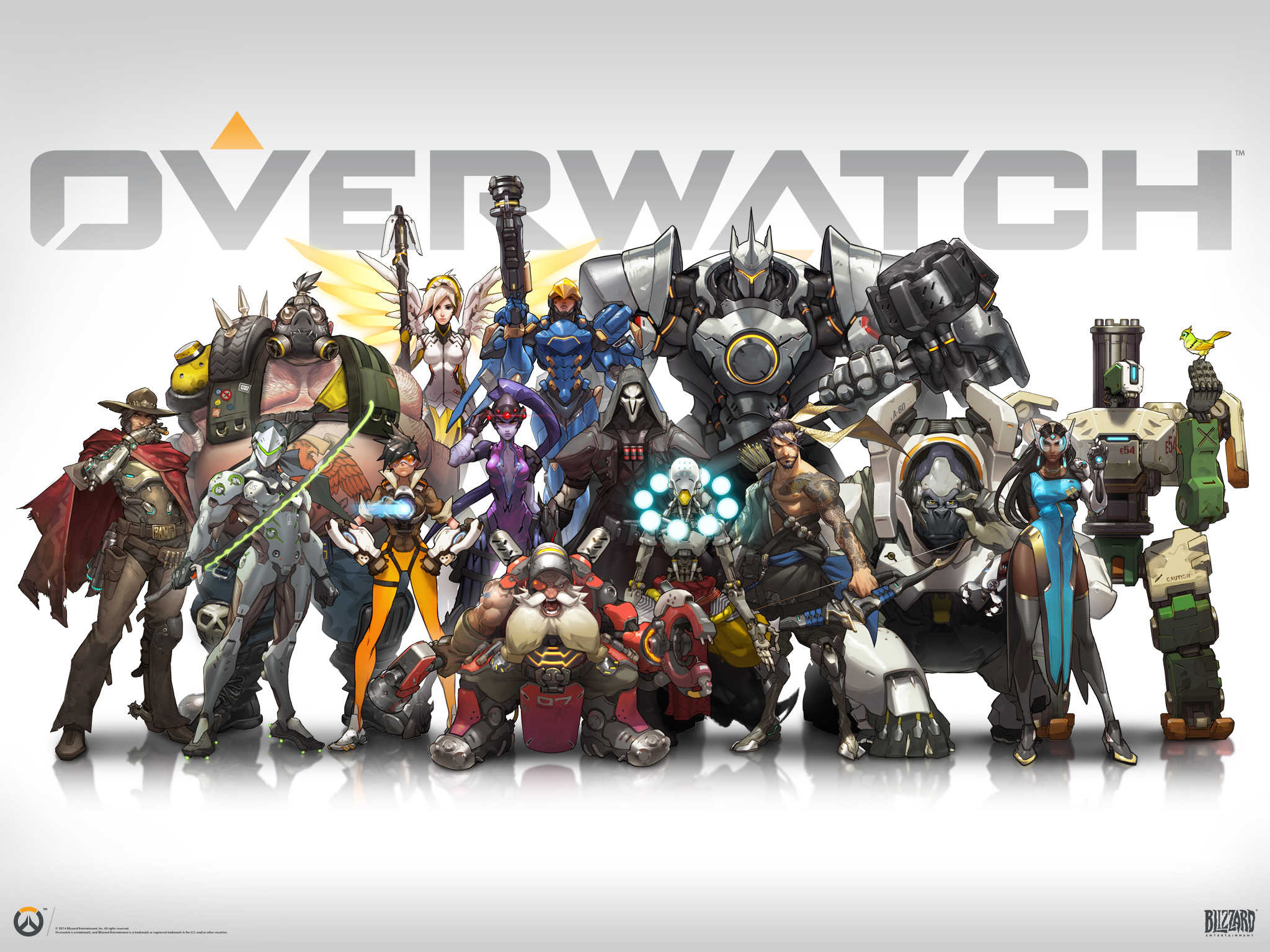
We worked closely together to reach Facebook’s global audience. Blizzard used a mix of Facebook’s marketing solutions, including Carousel ads, Canvas, and Instagram Marquee. Blizzard tapped into Facebook and Instagram’s global audience of 1.65 billion and 400 million people respectively to reach a broad set of gaming and entertainment audiences. Using tools and services such as Facebook Login and Live API will allow Blizzard to reach more gamers around the world through its games.
lineup-standard

How are you blending Facebook with Instagram to reach a larger audience?

With more than 1.65 billion people on Facebook and 400 million people on Instagram every month, games marketers have a huge opportunity to reach gamers across the entire customer lifecycle. Discovery is increasingly difficult in the crowded mobile app ecosystem. To grow brand awareness, marketers can leverage ad formats like video ads, Canvas, carousel, and 360 video while using precise targeting to reach the gamers who matter most to their brand. To acquire users and game downloads, games marketers can leverage mobile app install ads, lead ads, and extend their campaigns using the Audience Network. But engagement and loyalty are what ultimately drives the gaming industry, and games marketers can retain their most valuable players with mobile app engagement ads, leveraging custom and lookalike audiences to reach gamers who are most likely to re-engage with a game.

What does this open up for game publishers and developers?

Our goal is to enable the world’s most creative publishers to tell stories in the most immersive, interactive, and engaging ways. The Live API puts tools in the hands of these publishers that help them connect with their audience in ways they’ve never been able to before. As publishers and developers are now showing us, great production and quality can be extremely interactive and engaging.

What does Facebook Login open for Blizzard fans who already use Battle.net or Twitch?

Using their Facebook account, players will be able to sign up for and log into games and pave the way for new social functionality in Blizzard games while highlighting Facebook as a platform of choice for sharing, viewing, and discussing AAA game content. Also, integrating Facebook Login allows Blizzard’s players to find friends to form teams and coordinate strategy together.

What does Facebook’s Live API open up for eSports?

ESports is just one part of what we call FB Live Game Streaming. If you think about it, eSports is professional, competitive gameplay. There are many creators, people and games that are outside of this mold, and we want to be sure they all have the opportunity to find an audience—whether that’s their closest friends or millions of followers. It’s still the very early days for us in these areas, and we do not have any plans or details to share at this time. We believe the most important thing to think about is building incredible experiences for people to enjoy.

How do you see Facebook’s Live API impacting general fans sharing their in-game exploits with friends?

It’s still early days for us, so we’ll have to see how Live Game Streaming continues to grow on the Facebook platform. We think it’s important that both players and game makers have a great experience.
Facebook Emoji Become More Diversified

Emoji continue to play a pivotal part in users’ day-to-day messaging, and now it looks like they’re starting to grow up.

Facebook has announced that it has begun rolling out a series of new emoji for its Messenger app that lets users customize them to their liking, including changing the color of their skin, as well as diverse types of characters like red-headed emoji and female characters in roles like police officers and doctors.

“Emoji have changed the way we talk to each other—whether it’s a smiley face to show you’re happy, a thumbs up, or a pizza when hungry, emoji are a fun, easy way to express yourself when words just aren’t enough—and people love them! In fact, nearly 10 percent of mobile sends in Messenger include emoji. However, not all platforms have kept up with emoji standards as they’ve evolved—which means sometimes the emoji you wanted to send wasn’t the one that showed up. Nor are they living up to the gender and skin tone diversity that we see in our world everyday,” Facebook stated in a recent post.

The posts aren’t just based on diversity, but also effectiveness, with little technical error. “Messenger is addressing emoji woes by rolling out a new set of standardized emoji so you can be sure you’re sending the right message. No matter what emoji you pick, it will now look the same for all Messenger users, regardless if the recipient is on Android, iOS or another platform. In other words, no more broken-looking black boxes or emoji that just don’t make sense. Our characters are consistent every time you use them, no matter what platform the recipient is on.”

In short, “We’re diversifying the genders to create a more balanced mix that’s more representative of our world,” the company noted.

The emoji are presented in a uniform set, making it easy to select which ones users want to use when it comes to expressing themselves through Facebook’s services.

The popularity of emoji extends beyond Facebook. Motorola recently introduced a new campaign called #ShatteredStories that focuses on saddened characters after they accidentally drop their phones, which is an advertising point for the brand’s Droid Turbo 2, which features a shatter-proof screen.

https://www.youtube.com/watch?v=W4Q5SNcwaBs

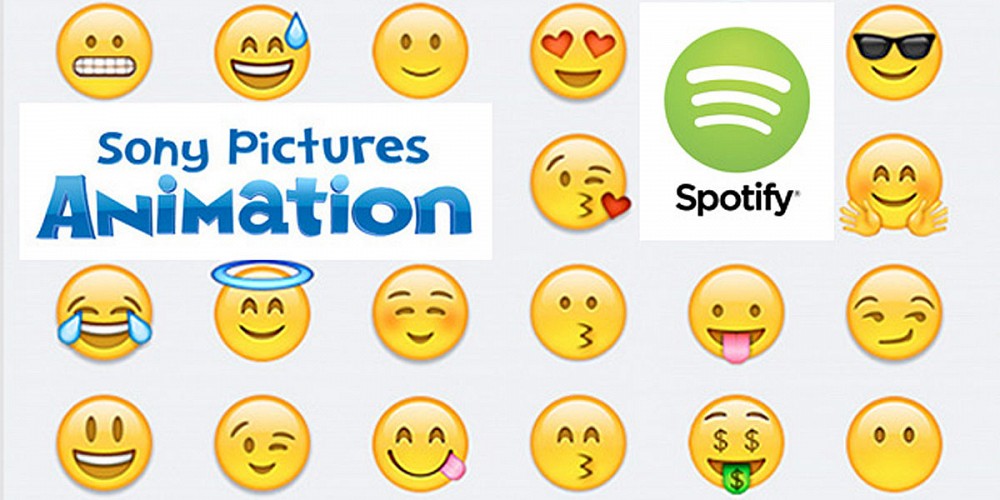
If that weren’t enough, Sony has also introduced The Emoji Movie, set for release sometime next year with a focus on the characters, and Pepsi recently launched a promotion with five-second ads featuring animated emoji on its bottles.

Sony


Snapchat Seeing More Daily Usage Than Twitter

Snapchat has become one of the bigger success stories on the social media front over the past couple of years, with a number of brands supporting the format and millions of viewers utilizing the app. But now, it may have just become more successful than Twitter.

A new report from Bloomberg indicates that Snapchat now has 150 million people that use it each day, which actually eclipses the daily active users that utilize Twitter. This is a huge increase from the 110 million daily users that were tallied back in December — a 40 million increase in a matter of six months.

Twitter currently has 140 million users that interact with its services on a daily basis, based on estimates gathered by Bloomberg. Of course, Facebook still remains a top draw with services like Instagram and Messenger, but the fact that a four-year-old social media app can make that kind of progress in a short amount of time is incredibly impressive.

Even though Snapchat has a high number behind it, Twitter still notes that it has 310 million monthly active users, although it failed to disclose just how many check in on a regular basis.

Snapchat’s audience growth is no accident. Between brand promotions and the introduction of new services like customizable video tools, including Lenses that add everything from puppy dog faces to “rainbow puke,” it’s given users more reason to tinker with the app, even though most of the general content vanishes after a 24-hour time period.

During Re/Code‘s technology conference on Wednesday, Twitter CEO Jack Dorsey acknowledged that Snapchat messaging had become “very modern,” and is working to make Twitter more convenient for its audience to use. That’s not to say it’s losing business, but it needs to make changes when it comes to keeping up with competitors like Facebook and Snapchat.

For the time being, Snapchat is certainly going places, and it could very well crack 200 million viewers by year’s end, based on its rate of growth. Talk about a Live Story worth sharing.

Image Source

Sony Bringing PlayStation E3 Presentation Back To Theaters

Last year, Sony provided an innovative way for fans to catch its pre-E3 PlayStation press conference by partnering with a number of theaters to bring the show to the big screen. The campaign was a huge success, bringing thousands of fans to 75 theaters to watch the show live, and awarding them with exclusive goodies. With that, it’s doing it again for this year’s show.

Sony has announced the 2016 PlayStation E3 Experience, which will be taking place on 85 screens (a ten-screen increase) on Monday, June 13th. Like last year, fans will be able to see what happens as the show unfolds, with breaking announcements and returning favorites, including The Last Guardian and its PlayStation VR headset.

In addition, a number of goodies will once again be given to attendees, including a commemorative E3 Experience cup; a PlayStation collectible card (similar to the trading cards given out during previous PlayStation Experience events in Las Vegas and San Francisco); and a “digital gift basket,” with a number of codes available for redemption.

This is the third year for Sony’s theater campaign for its pre-E3 show, and it continues to grow each time. The company even released a video showcasing just how many people wait in line to see what Sony will be revealing.

The PlayStation Blog has a full listing of theaters taking part, and those interested in getting tickets can do so by visiting this link. Sony has noted that some theaters may already be out of tickets, but fans can add themselves to a waitlist as a “select number” of seats will open up on a first come, first serve basis.

For those that don’t get in, Sony will still stream its pre-E3 press conference live through its PlayStation Blog, as well as other media sites.

How Brands and Music Streaming Networks Are Working Together

Music streaming services such as Apple Music, Spotify and Pandora continue to draw in millions of listeners on a daily basis. With that, brands are getting more involved with them, with marketers finding new ways to become integrated with the networks and make brands more noticeable.

Spotify has launched the latest initiative by announcing that marketers could sponsor the company’s owned-and-operated playlists for millions of followers. With this move, brands now have more options available, aside from curating a Spotify playlist. Now, through marketing, brands can reach out to specific types of audiences, according to Spotify’s VP-global head of sales, Brian Benedik.

These playlists, which range from Monday Morning Commute to Teen Party, have a massive outreach, according to Benedik. More than one billion streams are activated per week, and the top playlist has 8.3 million followers.

But brands have been building up this leverage for some time, partnering with music streaming services for mutual benefits. For instance, Pandora teamed up with Mazda to integrate its application into its latest car models, including the 2016 Mazda CX-3 and CX-9.

Marketers have also become more involved in creating ideal playlists that match up with their brands’ style. Bravo, for example, partnered with Spotify back in 2013 to produce DJ playlists based on shows like The Real Housewives of Atlanta and Thicker Than Water; T-Mobile partnered with Pandora for a Music Genome Project that analyzes songs based on consumer characteristics; and Toyota produced a playlist called Toyota Session on Pandora, complete with interviews and video performances from key artists.

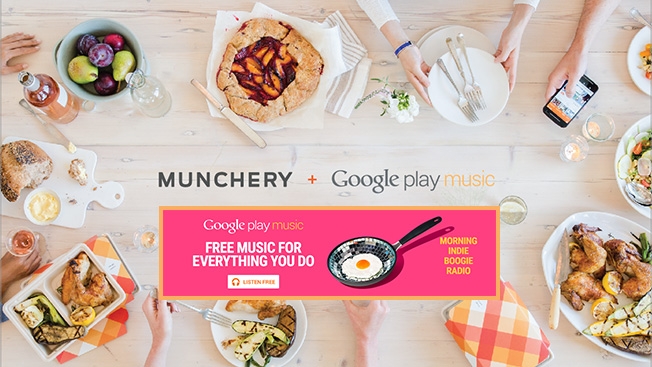
Google also took on music marketing in its own way, working on a number of brand partnerships with its Google Play Music ad-supported player. Through its partnership with Essence, it managed to attract a number of brands, including Munchery and ASOS.

Munchery’s partnership put together playlists by popular chefs based around particular meals or recipes, thus leaving fans literally hungry for more.

Google

As for ASOS, it put together a digital shopping magazine focusing on gatherings and other fun summer events, with Google-curated playlists relating to the activities on each page, adding a personal touch to the content.

While the integration of brands into music services might have some worried that they’ll become ad-laden as a result, Spotify wrote a blog post  to help alleviate those concerns. It noted how music streamers have come to embrace brands, noting, “Streamers are twice as likely as non-streamers to advocate for and feel emotionally connected to brands.” Music playlists go a long way into proving this, but with this new sponsorship announcement, it can get even closer to them.

Spotify also notes the following statistics comparing streamers to non-streamers:

  • Streamers are twice as likely to pay more for brands.
  • 61 percent of streamers are more likely to recommend brands to a friend.
  • 74 percent of streamers are more likely to describe a brand as “the only brand for me.”
  • 70 percent of streamers are more likely to describe a brand as fun and playful.

That’s not to say that brands will be immediately accepted with music services. They have to earn that trust based on the playlists and the right level of sponsorship, and not through pop-up ads that are likely to turn consumers off. Fortunately, music services are presenting a number of options to allow for smoother integration—and that could mean stronger results for all parties involved, including brands, the services themselves, and their listeners.