A new update is now available for both its iOS and Android apps, which adds a new dedicated video tab that highlights popular livestreams and gives users an easier time when looking up videos.
The livestreaming feature is getting a huge upgrade, which gives users the ability to go live in Facebook Groups and Events. This includes sharing an update video with members of a charity group, or news on a forthcoming film for fans. Events will also enable the scheduling of livestreams, including Q&A sessions, presentations and more.
The company has also introduced Live Reactions, which enable users to express their feelings about an event in real-time during a broadcast using Likes and reaction icons from the News Feed. Live filters are also included in the update, so broadcasters can customize their video with a variety of settings.
“Live video on Facebook is truly interactive as broadcasters engage with their commenters and respond to their suggestions and questions,” wrote Fidji Simo, Facebook’s product management director. “In fact, from initial data, we’ve seen that people comment more than ten times more on Facebook Live videos than on regular videos. We want people watching the broadcast after the fact to feel ‘in’ on the action. To achieve this, we will replay comments as they happened during the live broadcast when people watch it later.”
Other social features are also being rolled out, including the option to invite a friend to watch videos with you; creating a dedicated place on the Facebook app to find video based on trends and friend suggestions; and a Facebook Live Map for desktop, which allows broadcasts to be found based on location.
In addition, content creators will also be able to track new metrics based on these features. “We know that understanding live viewership is important to publishers and creators, so today we’re also rolling out two new video metrics: total live viewers during a broadcast, and a new chart showing the number of concurrent live viewers over time during a broadcast,” Simo states in the blog post. “These new metrics follow the updates we announced last month that give page owners a better understanding of when people are watching their videos.”
Facebook rolled out Instant Articles in May of last year as a way for publishers put content in Facebook’s News Feed so users don’t have to click out and wait for websites to load. This was especially important for mobile devices, where heading to external websites can be slow and often annoying, leading users to switch away from that process all too often. Initially, Instant Articles were limited to a few major publishers, and over time Facebook has gradually increased the access. Now the Instant Articles program will be opened up to all publishers on April 12 at Facebook’s F8 conference, and many new features have been added. Marketers—if you haven’t looked at Instant Articles yet, it’s time you did.
Instant Articles, touted by Facebook as “a new way for publishers to create fast, interactive stories on Facebook,” has been judged a success by publishers and Facebook alike.
The impact of Instant Articles on marketers will be seen in several areas, and it’s expected that giving the general public access to the feature could be huge. The expansion of usage will no doubt be followed by changes as Facebook finds out how Instant Articles is used by millions, and what additional features the masses desire. Still, we can predict certain ways that Instant Articles can be of benefit to marketers.
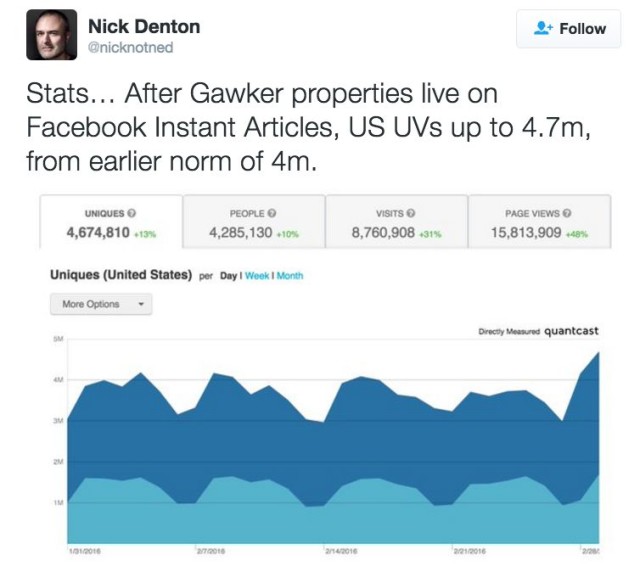
Audience Growth is a key feature of Instant Articles, and one that’s already been seen by publishers. Gawker Media’s Nick Denton tweeted about the growth in Unique Viewers (UVs) after introducing Instant Articles, boosting UVs from 4 million per day to 4.7 million per day. Part of the audience growth comes from the fast loading of the articles, eliminating the lag associated with heading to an external web site. Users can click through to a publisher’s web site if they want, follow your site on Facebook, or share the article—all of which will increase a publisher’s reach.
Gawker Facebook Instant
Big Data is another useful part of Instant Articles, bringing you actionable intelligence that is not normally part of what a publisher gets from a web site. For instance, Facebook lets you know how far down an article is scrolled, an invaluable way to know just how engaging your articles are—and at what point they lose significant readership.
That sort of data can let you fine-tune content to reach desired objectives. Perhaps there’s no point in writing lengthier articles, so writers should be generating more different articles with fewer paragraphs in them. Or maybe the headlines are bringing in people, but the writing isn’t following up on the promise of the headline. In any case, additional data can help adjust the content strategy top better suit your marketing goals.
Monetization has been an area of concern for Instant Articles, with some publishers concerned about the strict rules for the number of ads within articles. Facebook requires that at least 350 words separate ads in articles, and overall ads cannot make up more than 15 percent of the total content. There are ad platforms that can help out by placing ads at optimal points within articles, such as CodeFuel.
However, Facebook understands that this is an issue for publishers and is taking steps to ameliorate concerns. “Ad tech company Polar is extending support for its platform to Instant Articles, which will enable its clients—among them The Washington Post, The Huffington Post and Slate—to run native ads in their articles there, just as they do with display ads,” notes Digiday in an article on the subject.
“We’ve seen publishers’ feedback on Instant to be positive in terms of the user engagement and content,” said Polar CEO Kunal Gupta. “But there are a lot of questions around how they will monetize it, knowing they have less ad positions on Instant. Branded content is typically the highest margin format the publisher has. This lets them get their highest-value formats into this platform.”
One of the major changes to Instant Articles is in Facebook’s advertising policies, which will now enable publishers to place video ads into content they post on the platform, as well as adding one additional ad unit at the bottom of every Instant Article, which could increase ad impressions by more than 20 percent. “In our conversations with publishers, these changes popped up as the biggest steps we could take to make the biggest impact,” said Josh Roberts, Instant Articles product manager at Facebook.
The Wall Street Journalreported that Facebook, as it prepares to open Instant Articles to all publishers, is making these changes to help with monetization. “Publishers will soon be able to place both autoplay and user-initiated video ads within Instant Articles, and to include pre-roll advertising before any editorial video content they publish, Mr. Roberts said. Autoplay video ads must have their sound disabled, however,” the Wall Street Journal noted. “We care about user experience first and foremost, but we know this doesn’t work if publishers can’t monetize their content successfully,” said Roberts.
It’s important to note that publishers can either sell the ads themselves (and keep 100 percent of the revenue), or pass the ad slot on to Facebook to sell, whereupon the social network will keep 30 percent of whatever revenue it acquires from the sale of that slot. However, the downside for users experiencing these ads is that they can either be autoplay or user-initiated—and there’s no doubt that autoplay ads can be annoying, especially on a mobile device where it can run down your battery life. As usual, much will depend on the discretion and good sense of both publishers and advertisers not to let these issues get out of hand.
There may be more monetization news for Instant Articles in the future, Facebook hinted. The inclusion of sponsored content and the ability to allow publishers to collect email addresses are among changes being considered for Instant Articles as time passes.
Ultimately, the future of Instant Articles depends upon its adoption by publishers and the potentially huge adoption ahead as Facebook opens the platform to all. Brand recognition is a huge part of the value of Instant Articles for marketers, as they load automatically in the News Feed rather than requiring a click to access. The articles also keep all the elements you’ve chosen to include, like your brand logo, special fonts or colors, or other parts of the brand identity. The potential for increased impressions is huge if Instant Articles become as widespread as most observers think.
Gawker Media’s Nick Denton, for one, believes Facebook has the right stuff to make Instant Articles popular. “Who is best positioned in this world to target ads against categories of users?” Denton said, speaking to Re/code. “Who knows the most about those users? Who can supply the most relevant ads and in a way that doesn’t degrade the user experience?”
We’ll no doubt find out more about Instant Articles at Facebook’s F8 developer conference on April 12.
Social media continues to blossom across numerous channels like Twitter, Facebook and Snapchat—and when it comes to the number one platform for accessing them, mobile is king.
A new report from comScore titled 2016 U.S. Cross Platform Future In Focus provides a closer look at social media use and explains how accessible it has become on mobile.
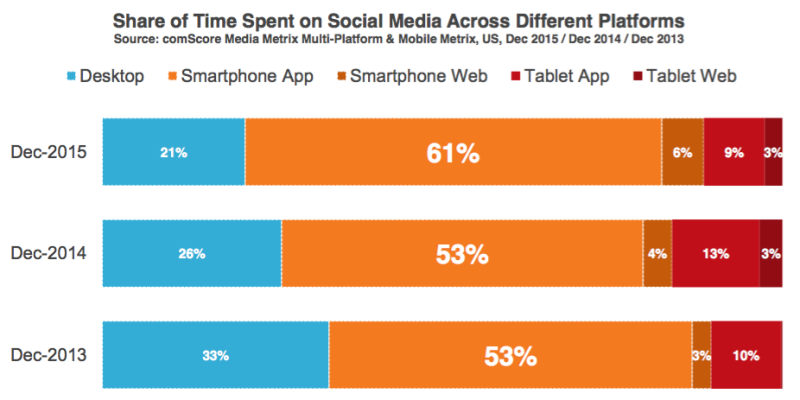
As shown, the use of desktop computers for social media has dwindled over the past couple of years (from 33 percent, down to 21 percent), while smartphones have grown by 8 percent. In 2015, smartphone apps made up 61 percent of the time spent on social media. Tablets, meanwhile, are holding about steady, after seeing a small resurgence in 2014.
The report also reveals that approximately one in five minutes of all digital media time (about 19 percent) is spent on social sites or with social media apps, which exceeds all the other categories in the report. About 80 percent of that usage comes from mobile devices.
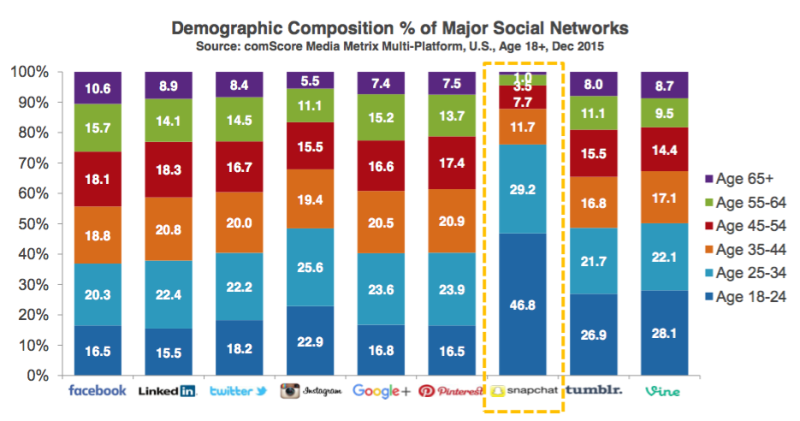
Furthermore, thereport indicates that services like Snapchat, Instagram, Vine and Tumblr seem to have a much younger audience than others, with Snapchat in the lead—76 percent of its users being between the ages of 18-to-34, which could be something that marketers may want to take advantage of.
Other takeaways include:
Consumers made more significant use of their mobile devices when it came to both shopping and purchase activity.
Digital is just about the top advertising medium, even with the rise of ad blocking.
Print publishers are finding growth in the digital field with advertising, making proper use of mobile in an effort to reach out to a bigger audience.
Digital media usage continues to grow, reaching nearly 50 percent within all digital media time spent. Smartphone app usage is a big factor in this.
Today, Ayzenberg and NASA’s Jet Propulsion Laboratory (JPL) have announced a partnership for a pioneering space mission, to launch VR technology and 360-degree video into interplanetary space. The project has been closely guarded—sheathed in tarps to protect it from rain and cordoned off from foot traffic—next to Ayzenberg’s headquarters. Employees of the frontline marketing ad agency were told the project was actually a new building under construction to house the growing agency.
This new space program will bring such innovations as 8.5-second, 4K-360-degree virtual reality livestreaming video that self-destructs after viewing. Ayzenberg’s digital team had been working with Facebook to develop this new tech for 2 years. Both the agency and the social network hope the new platform, Vinestagrambook, will be well-positioned to finally compete with Snapchat.
Vinestagrambook has been the subject of major buzz in the tech world as of late, and is being tested by an elite group of influencers: the Numa Numa guy, the Peanut Butter Jelly Time Banana , Donald Trump and rapper B.o.B, who has joined to prove to us all that the world is indeed flat.
The first mission, set to launch on April 1, 2017 for a trip to Mars, will be a maiden voyage for the spacecraft Minnow. Matt Damon, who has famously been to Mars before, will be joining Ayzenberg’s social media space crew. When asked how he would prepare for the upcoming mission, he commented: “I’m going to bring lots of potatoes. You can never have too many potatoes.”
Other notable astronauts joining the program include Sandra Bullock, Matthew McConaughey, Anne Hathaway and Tom Hanks.
“There’s tons of cool stuff you can do in zero gravity. They’re going to have a great time,” said astronaut Chris Hadfield.
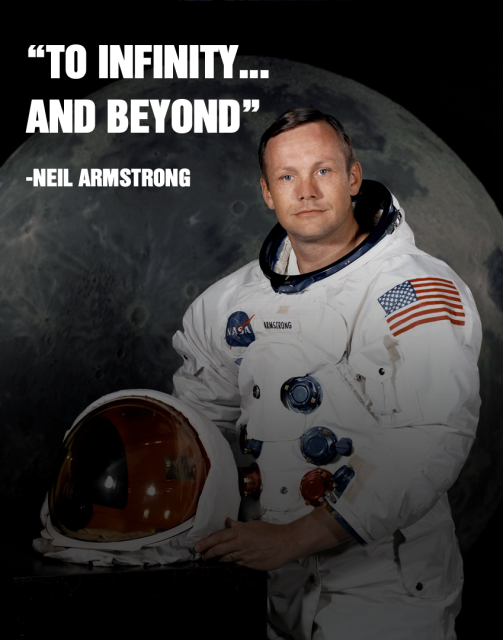
When reached for comment, Eric Ayzenberg, CEO of Ayzenberg, said “As the great Neil Armstrong once said: ‘To infinity, and beyond!’”
Editor’s Note: Lindsey Buchanan is the director of social media at Ayzenberg. [a]listdaily is the editorial arm of Ayzenberg Group.
Earlier this month, Instagram broke the news they would be transitioning from a chronological feed to a more algorithmic experience. They assured that all the posts will still be there (floating around in the Insta-universe), just presented in a different order. Instagram will order posts “based on the likelihood you’ll be interested in the content, your relationship with the person posting, and the timeliness of the post.”
We're listening and we assure you nothing is changing with your feed right now. We promise to let you know when changes roll out broadly.
How do users feel about this exactly? Well, the jury is still out.
In some ways, it makes total sense. It’s become harder and harder for users to keep track of posts. According to Instagram, the average user misses a whopping 70 percent of what’s in their feed. Now that may seem like a large number, but considering how much content is out there, it’s not that surprising. With a chronological feed, you’re somewhat limited to the amount of accounts you can follow before your feed becomes congested.
Introducing the algorithm is an attempt to alleviate this problem by making feeds more relevant and engaging. This will make it less daunting to follow more accounts, which could potentially increase follower count as a side effect. That said, the number of followers one has could become less relevant as people start to pay more attention to actual engagement. In addition, the algorithm could be a bit crippling for up-and-coming artists who won’t exactly have a level playing field now.
What does the algorithm change mean for Instagram’s users?
It means you don’t have to be there—checking your feed and likes—multiple times a day. The sense of immediacy isn’t there. Time is no longer of the essence. By having the most popular posts first, users could be discouraged from posting because their posts may not see as much engagement as in the past.
What does this mean for brands and influencers?
Brands will need to put more dollars behind their social or be *so awesome* that their content trends organically and remains at the top of the feed chain.
Sure, some were upset by the announcement, like the 328,018 who signed the Change.org petition to “Keep Instagram Chronological”. But—let’s be honest—the move was pretty much inevitable, but not all of us adapt well to change. Fortunately, Instagram knows this, which is why they’re approaching it in stages. Just before the announcement, Instagram sneakily moved a post’s time stamp from the top right to the bottom left. One assumes they did this to shift the focus from the time of day so the emphasis is not on how content appears chronologically.
Flash-forward a week later and people are taking matters into their own “handles” by posting personal prompts with the hashtags #turnmeon #letsstaytogether, in the hopes that their followers will be swayed to turn on notifications for all their posts.
People are clearly freaking out over the change, including many brands, celebs and aspiring influencers who don’t want to see their Insta-stock plummet overnight. The panic was all over the internet this week. Like brands, celebrities and influencers want to remain at the top and will do whatever they need to do to stay there, even if it means annoying people with shameless posts.
Or, you could do what this guy did and make fun of it while finding a way to use reverse psychology on his followers. Well done, @Fwiz.
According to Instagram’s blog, they are now offering 60-second video to everyone. Video view numbers are also available. Given Instagram is such a visual platform, it will be interesting to see if the platform’s algorithm will also factor in image recognition technology. For instance, if a user’s behavior shows that they tend to like pictures or videos of food or sunsets, will the algorithm be able to detect that and feed the user more food and sunsets? Time will tell, as we continue to receive more and more updates on the visually-stimulating yet time-sucking platform.
Lindsey Buchanan is the director of social media at Ayzenberg. Her work is a hodgepodge of creative strategy, entertainment marketing and technology, bringing content, brands and audiences together in unique and innovative ways. She enjoys coloring outside the lines and speaking in riddles and rhymes.
With that, a legacy was introduced in 1979 with the 20th Century Fox film Alien, a terrifying thriller where a space exploration team was introduced to a sinister xenomorph.
The film has since created a legacy built behind a number of sequels (namely James Cameron’s action packed 1986 film Aliens), comic books, video games and other memorabilia. Next month, Fox will celebrate that legacy in spades with “Alien Day” featuring events that tie-in with the series.
Based on the planet LV-426 (featured in the first movies), Alien Day is set to take place on April 26 and will have a number of social giveaways that tie in with the official Alien Anthology Twitter account. Fans will be able to take part in the Ultimate Trivia Challenge for the series, which will allow them to win prizes every 42.6 minutes on the social channel. Users can reply with the hashtags #AlienDay426 and #Contest for a chance to win.
That’s just the beginning of the hype surrounding Alien Day, as Reebok has announced that it will release a limited run of shoes worn by characters in Aliens, including Ripley’s infamous Alien Stomper hightops and Android Bishop’s mid-tops. The shoes will be available for purchase starting on the 26th at Reebok.com and retail stores.
Other products are being planned for release to celebrate Ripley’s fight against an alien monster. They include: figures produced by NECA based on Aliens characters Lieutenant Vasquez and Newt; a new series of Dark Horse Comics featuring exclusive covers from the Aliens film; a special 30th anniversary hardcover edition of the original Aliens; an Aliens: Out of the Shadows Audible drama featuring Rutger Hauer and Corey Johnson; a special double feature of the original films being shown at Alamo Drafthouse; a trio of new Alien-themed digital pinball tables for the Pinball FX 2 and Zen Pinball 2 platforms across consoles, PC and mobile devices.
“We noticed that fans of the Alien films were starting to rally around the calendar date of April 26th–given the connection to the planet LV-426,” said Jeffrey Godsik, president of 20th Century Fox Consumer Products. “Quite simply, it gave us the idea to do something special on this day; to officially mark the occasion alongside fans and to build excitement online, in stores and once again, in theaters.”
Fox hopes that the event will catch on similarly to the May the 4th social event for Star Wars, and last year’s Back To the Future day, which was held on October 21–the date Marty McFly and Doc Brown head to in Back To The Future Part II.
Considering the franchise’s fan base, Alien Day is likely to be a big hit, which will be good news for 20th Century Fox as it moves forward on several Alien-related projects, including a sequel to Ridley Scott’s 2012 movie, Prometheus.
Although gamers are usually associated with PCs or consoles like the PlayStation 4 and Xbox One, mobile gaming has had an undeniable impact on the video game industry by bringing in a huge audience of players.
A new report from Greenberg Inc., compiled by Think With Google, explains how a third of mobile gamers in the U.S. are defined as “avid gamers” that spend more than nine hours a week on average playing on their smartphone devices. Not only that, but this mobile group shows no restraint when it comes to sharing their love of gaming online, particularly on YouTube.
The report notes that, “Avid gamers are social influencers who tell friends when they find a game they like. These devoted players also are more likely to make in-app purchases, as well as rate and recommend their purchases.”
Based on the statistics, 64 percent of players share their love of mobile games with others; 83 percent spend some form of money on games (either with initial purchases or in-app goods); and 70 percent feel that mobile games can be intellectually stimulating.
This group also shows heavy engagement on YouTube, as the report noted that they access both their favorite mobile games and Google’s video channel several times a day. The two are connected, as those who look up videos on YouTube spend more time with games. An estimated 90 percent of viewers visit the channel to find tips for their favorite titles, as well as gameplay clips and discovering new games to play.
Turning toward discovery, approximately 64 percent of viewers download a new game to their mobile device after seeing some form of content on YouTube for it, either with a gameplay clip or information relating to the title. Google Search is also a vital tool for finding new games to play, as 71 percent of those who used the page downloaded a game after learning more about it.
In short, the more information there is about a mobile game–either through Google Search details or with YouTube videos–the more likely users are to discover the game and download it to their device. Greater presence on YouTube could definitely benefit mobile game developers or publishers if used properly, and could boost audience numbers, which could lead to more in-app purchases.
As part of its partnership deal with DeNA, Nintendo began laying the groundwork for its mobile debut in Miitomo last month. With a focus on social features using its familiar Mii characters (originally introduced with the best-selling Wii console), the app promised an “entirely new way that transforms communication into a form of play,” according to Scott Moffitt, executive vice president of sales and marketing for Nintendo.
The app recently launched in Japan, and saw immediate success among both casual users and Nintendo fans, gaining over one million downloads within the first three days of availability. On Thursday, the free-to-play program will reach new audiences, as Nintendo is set to launch Miitomo for both Europe and the United States.
Miitomo, which will be available for both iOS and Android devices, promises to inspire conversations between users through questions and topics, making it an ideal social tool for those looking for a way to communicate outside of the usual messenger texts, and Snapchat conversations.
“With Miitomo, Nintendo takes its first step into the world of smart devices,” said Scott Moffitt, Nintendo America’s executive vice president of sales and marketing. “Miitomo brings the special Nintendo charm and polish that people around the world love to an entirely new format and audience.”
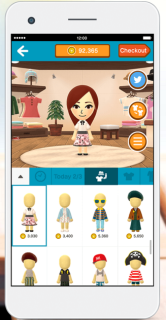
Part of Miitomo‘s relatable experience lies within its Mii characters, which users can customize to their liking, and they’re free to recreate themselves realistically or go “off the wall” with an inventive new approach. From there, they can ask a number of questions, ranging from the weirdest thing they’ve ever eaten to how they would spend $10,000 in a single day. These varying questions, along with other topics Nintendo will update into the app, should help keep the conversation going, and may attract new players.
Also launching tomorrow is the new My Nintendo program, which will reward users that take part in the Miitomo program with Platinum Points. These points can then be redeemed for special Nintendo products. Points can also be earned by purchasing digital versions of games for Wii U and Nintendo 3DS, the company confirmed. My Nintendo is meant to be a replacement to the previous Club Nintendo program, except with a greater focus on earning currency through social means in addition to purchases.
Judging by how well Miitomo has done in Japan, the program should have no trouble drawing a crowd in the other markets. Nintendo has already put its best foot forward in promoting what it can do for players through the official Miitomo site, and additional programs could be introduced over the next few weeks with the hopes of getting newer players involved.
Those interested in Miitomo can pre-register for free, with the official app set to debut tonight. Expect plenty of questions, answers, and the kind of social conversation that could push Nintendo in a bold new direction for mobile.
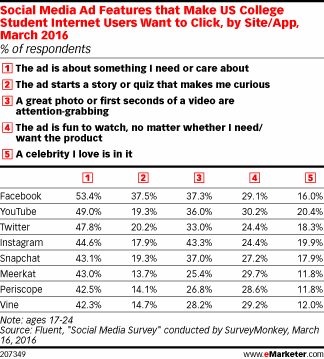
College students will pay attention to ads, provided that they’re targeted for their demographic. A new study by Fluent shows how the relevancy of content and the social platform in which it is places impacts their interest level. Out of the students ages 17 to 24 polled, more than half indicated that they wanted to click on a Facebook ad because it’s something that relates to them. Of all social platforms mentioned in the poll, Facebook scored high marks. YouTube was second to Facebook in terms of ad relevancy, but scored the highest with engaging and fun branded content.
It is clear how important ad relevancy and targeting is to reach younger consumers as those polled cited ads containing “something I need or care about” to be the strongest reason to click. Marketers should also note that the least impactful social ads for the group were ones featuring celebrities.
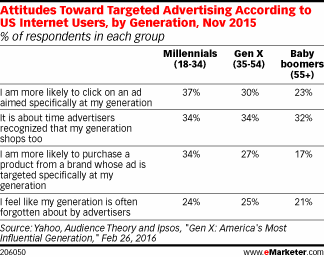
However, ad targeting isn’t just top-of-mind for millennials, either. In fact, both millennials and Gen X audiences alike are more likely to click on ads aimed specifically to their age group.
A report from eMarketer explains that about 37 percent of millennials said they would be more open to clicking on an ad with content that better relates to them, with 34 percent stating that they would even buy a product from a brand that makes effective use of targeting them.
It’s hard to believe that it’s only been a year since Twitter launched its livestreaming service, Periscope, to an eager public. What’s even harder to believe is how popular it has become since its debut on the market.
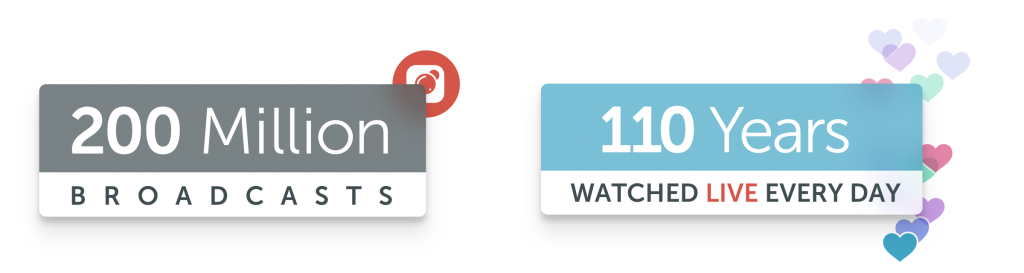
Twitter has revealed its first year stats for the livestreaming app, indicating that 200 million broadcasts have been hosted with it since its debut—100 million of which are from the past three months alone. On top of that, approximately 110 years worth of live video have been watched across both the iOS and Android applications, showing an overall increase of 91 percent since August.
Periscope’s popularity has gotten to the point where other companies have developed their own livestreaming services to keep up, including Facebook’s live video streams and Google’s rumored development of YouTube Connect.
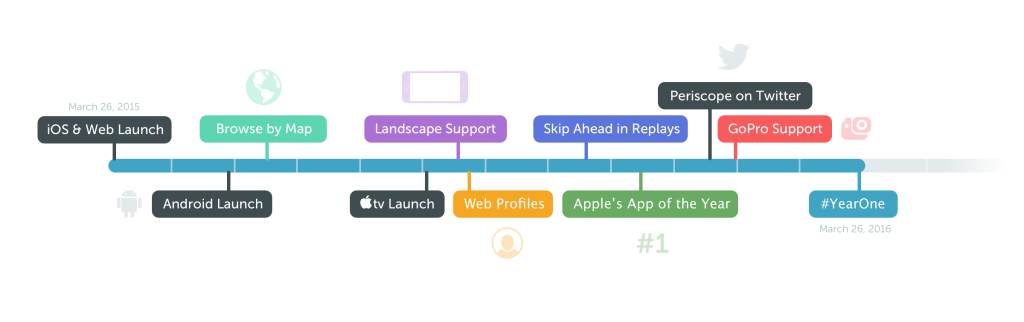
The breakdown below shows how much Periscope has grown over the past year, starting with its initial launch on iOS, its later support of devices like Apple TV and GoPro, and launching Periscope through Twitter. It was even named Apple’s App of the Year before its first year was complete.
As far as where Periscope will go in the coming year, Twitter will make (legal) live events the big focus, as CEO Jack Dorsey explained to Bloomberg that it “still centers around bringing people together to watch live events in the place where information comes the fastest.”
Now the question is if Periscope can help Twitter turn around its stagnant user numbers. The service reported that its user count for the last quarter came in at 320 million that contribute monthly, which is about the same as the previous quarter.
For the time being, the service has really taken off, and it’ll be interesting to see what innovations Twitter will introduce over the next year.