Netflix’s ‘Daredevil’ Encourages Fans To Engage In Hashtag Billboard War

Netflix has been riding high since the release of season two of Marvel’s Daredevil last week, with thousands of fans watching the debut of new characters like The Punisher and Elektra. Now, the promotion is taking things a step further with an interactive billboard in Toronto that will let fans determine who gets the most punishment.

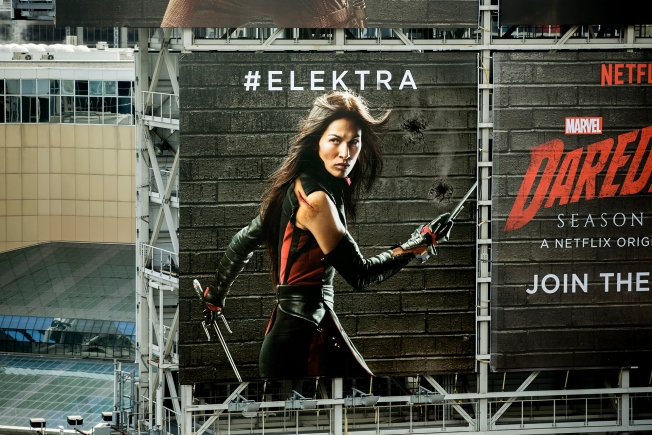
AdWeek reported that a new billboard, located in Toronto’s Dundas Square, features the three pivotal characters from the new season: Daredevil, The Punisher and Elektra. However, there’s also a unique twist. Each image comes with a specific hashtag, and social media users can post messages with said hashtags to support their favorite—a move encouraged by Netflix with a “Join the Fight” message.

Netflix 2

Every 48 hours, the character with the most hashtag mentions will do physical damage to the other boards. For instance, if The Punisher gets the most votes, then the images of Daredevil and Elektra see damaging effects, including slash marks, bruises and bullet holes. The battle can turn around in a matter of days, with one of the characters “getting even” with the other.

It’s a neat innovation, and a great way for Marvel fans to get involved with the show outside of “binging” on the 13-episode run. Here’s hoping there will someday be more billboard installations, and we can’t wait to see who is the last one standing.

https://www.youtube.com/watch?v=m5_A0Wx0jU4

‘Pokémon GO!’ Builds Up Steam With New Reveal

Last month, The Pokémon Company celebrated the 20th anniversary of the best-selling Pokémon franchise in a variety of ways, including new games like Pokken Tournament, a thrilling Super Bowl ad, and in-store promotions to keep fans excited. One thing that’s sure to be a hit for the company this year is the upcoming “real-world gaming” app Pokémon GO!

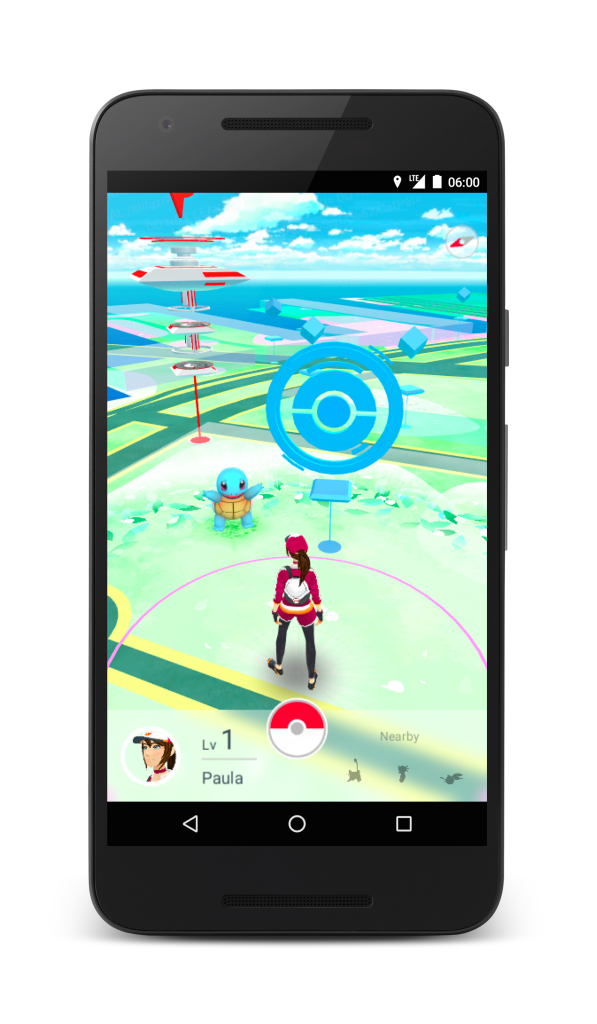
Initially announced last year, Pokémon GO! promises to be an involving experience for players, enabling them to capture Pokémon creatures in real-world environments, making fine use of augmented reality. Today, the team at Niantic Labs revealed an extensive look at the game and how it will work.

“This platform combines mobile location technology and augmented reality to create a unique game experience that motivates players to go outside and explore the world around them,” the development team explained.

But players won’t be able to pick up types of Pokémon from the get-go. Certain ones require exploration. For example, water-based Pokémon (like Squirtle) can only be found near lakes and oceans. Furthermore, players will need to visit PokéStops, found at real-world locations like public art installations and museums, to acquire eggs and special items. Then they’ll need to walk around in order to hatch the eggs in the hopes of acquiring new Pokémon for their collection.

PokemonGO2

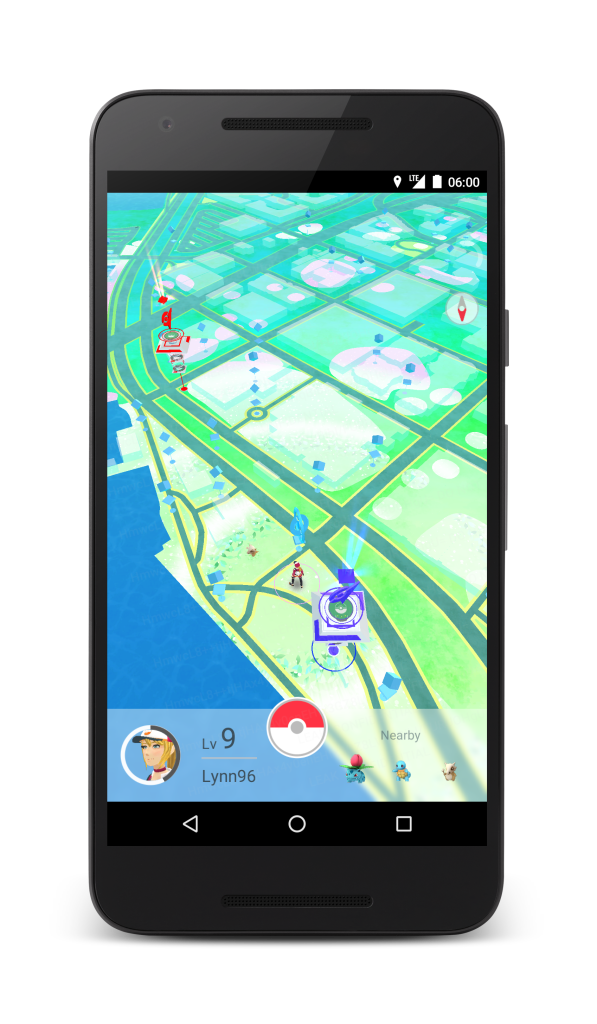
The social aspect of the game, like with previous Pokémon titles, lies in battles. Players will be able to join up with one of three different teams in an effort to compete for ownership of select Gyms. This involves placing one of their characters inside another player’s gym in real world stops, in the hopes of overtaking them.

Players who capture more than one type of Pokémon stand a better chance of having them evolve into more powerful characters so that they can “take over” opposing Gyms. That’s bound to be a big draw for mobile users who want to get the most out of their game by completing their library of Pokémon creatures.

PokemonGO1

Pokémon GO! is looking to become a key aspect in the series’ 20th anniversary celebration, with a social and augmented reality experience that will be right up there with the highly popular Ingress. There’s still no release date for the game, but it is expected to come out sometime this year, for iOS and Android. A test should be taking place around springtime, indicating that the game is nearly ready for launch.

Grubhub Introduces Food-Focused Emoji

All sorts of companies are feeding the need for emoji as of late. Taco Bell ran a branded (and delicious) campaign featuring the images; Star Wars recently employed a successful run of branded emoji on Twitter; and this weekend’s release of Batman v Superman: Dawn of Justice has its own share of images.

Now, Grubhub is getting in on the action, but instead of just creating its own food-related emoji, it’s taking popular eating terms on the web and turning them into images.

The company recently announced that it has teamed up with Snaps to create the Mmmoji keyboard app. There are over 50 different terms available, and they include “hangry,” “hot,” “tasty,” “delish” and “fresh.” In addition, users will be able to share images, such as spicy jalapeños and peppers, over social media.

“Grubhub aims to bring joy to all the moments that matter to our diners, on days of significance and those that are part of the everyday,” said Barbara Martin Coppola, CMO of the company.

This news comes hot on the heels of a new report revealed by VentureBeat, indicating that mobile marketers are heavily into promotion with emoji. The report states that use of the images have increased by nearly eight times (or 775 percent) over the previous year. And it’s not stopping anytime soon, as monthly usage shows a boost by 20 percent since 2016 got started.

Over five billion emoji-used messages came from clients over the past year. That’s a whole lot of happy faces.

So it makes sense that Grubhub wants to get in on the emoji action, and it’s working, because we’re certainly getting “hangry.”

Report: Google Ready To Take On Periscope With YouTube Connect

There’s no questioning the dominance of Twitter’s Periscope livestreaming app. It has been trouncing the competition since its debut last year. Even its closest rival, Meerkat, had to change its business plan because of it. But now, a new competitor could be stepping up, and it may be big enough to overshadow Periscope.

VentureBeat reported that Google has been hard at work on its own livestreaming app called YouTube Connect. The service has the potential to put Periscope in its place, and do the same to Facebook, which has been slowly building its own livestreaming service, Facebook Live.

YouTube Connect reportedly has functionality that’s similar to other livestreaming apps, enabling users to log in with their account and quickly broadcast from wherever they are. The app will also come with social features, such as the ability to tag friends and locations, as well as chat with others. A news feed will also be available, providing the latest clips from friends and the channels users subscribe to, according to a source close with the project.

Google hasn’t confirmed the app as of yet, but it does sound like a promising prospect for its YouTube division, helping the company have a firmer grasp in the growing livestreaming market.

5 Things Marketers Should Know For Adobe Summit 2016

The Adobe Summit 2016 kicks off this week in Las Vegas, with sessions, labs and workshops that focus on the very best in digital marketing. It can be quite a lot to take in, but those attending will come away with a stronger understanding of tools and trends for consumer outreach. Here are five things attendees should keep in mind this week:

There’s something for every kind of marketer

Through its vertical industry sessions, the Adobe Summit will offer something to each kind of marketer. These include a number of distinctive groups, such as high-tech, B2B, financial services, media, entertainment, travel, hospitality, retail and eCommerce.

Each one covers a number of different strategies, such as understanding profiles and audiences, enrollment into digital and mobile media markets, and “super sessions” that cover everything from finding viable content “everywhere all the time” to digital transformation for financial services. There’s plenty to find for almost every specialty.

You don’t have to be there to attend

The Adobe Summit will provide the opportunity to catch most of the sessions online, particularly the two primary keynotes: “Becoming an Experience Business,” which takes place on Tuesday, and “Inspiring Experience Through Creativity” on Wednesday.

Although these sessions run anywhere from two-to-three apiece, they have a huge amount of information, with speakers from both Adobe and other marketing industry circles. Conference sessions will also be available over the course of the week, for those that want to learn more about mastering their trade.

Watch for top guest speakers

The roster of speakers featured at this year’s Adobe Summit have their fair share of experience across a number of fields. Walter Levitt, the chief marketing officer of Comedy Central, has his own take on marketing, unique to that of, say, McDonald’s USA’s chief marketing officer Deborah Wahl.

Even top-notch talent, like actor George Clooney, performer Donny Osmond and actor Thomas Middlehitch are attending to discuss how effective marketing is for their lifestyles. Their presentations should be just as informative as more business-oriented ones.

No matter which sessions users choose to attend, they’ll be provided plenty of information that will be vital when it comes to their own business.

Have fun with it

The Adobe Summit is also an ideal social opportunity. It’s a chance to talk amidst marketing peers to see what they might have learned from the show, or what hot topics they recommend.

There’s no better opportunity to do this than with the Summit Bash, which provides the chance to talk with one another over food and drink before Weezer takes the stage for a performance.

New strategies can easily be adopted

With a summit as big as Adobe’s, there’s often an opportunity to learn something new.

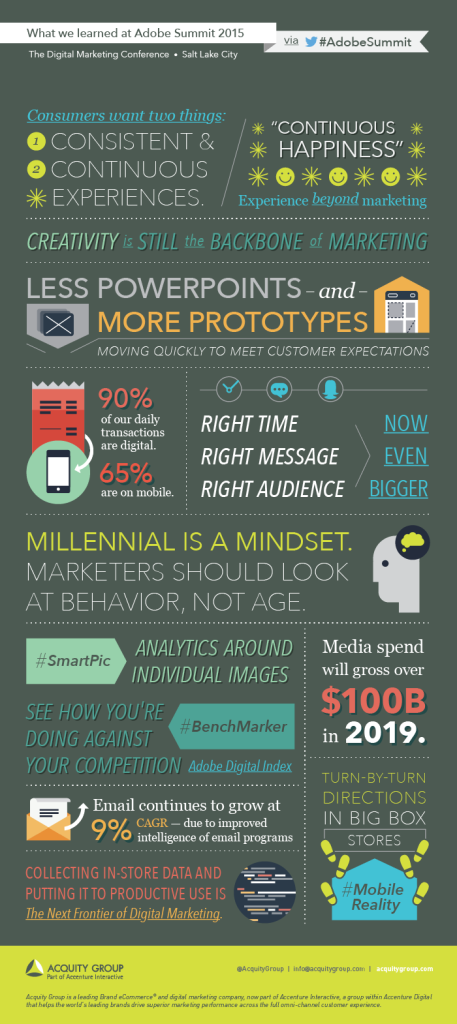
For example, Acquity Group posted a huge infographic based on what it learned at last year’s summit, and it’s quite a bit. The company accepted several facts that have managed to open some eyes in terms of how marketing comes together. For instance, 90 percent of daily transactions are digital, with 65 percent done through mobile devices.


Info

Music Finds Better Connection With Instagram Fans

Sometimes, all it takes for better album sales is a strong marketing campaign and the right kind of social outreach. According to an Instagram-commissioned study by Nielson (via Adweek), which included more than 3,000 Instagram users, the photo and sharing platform is the most popular social network for connecting fans with their favorite bands.

The study also shows that 42 percent of Instagram users are more likely to spend money on music than general consumers. Additionally, those who follow particular bands spend twice as much on music compared to those using other social media apps.

It also noted that users spend an additional 30 percent more time listening to music on a weekly basis, particularly in the categories of R&B, rap, hip hop and pop.

Instagram has become a big portal for performers to connect with their fans, not only by posting pictures from performances, but also video. There’s a deep connection with that, and one that goes beyond just words on other social sites.

But brands shouldn’t immediately follow suit if a performer makes a big splash on Instagram. “It’s important that advertisers form relationships with musicians who are the right fit for their brands,” analyst David Deal said about the study. “Choose wisely. If your brand is edgy, find edgy musicians to work with. If your brand is about being friendly and accessible, find a crowd pleaser. Don’t make the mistake of getting in bed with musicians just because they are popular or cool–you’ll look phony if you do.”

Venues can also benefit greatly from the platform’s popularity, according to Jim Squires, Instagram’s director of market operations. He states an example where the House of Blues ran 13 days of direct-response ads on Instagram in an effort to boost ticket sales for a show. As a result, the campaign managed to draw a 64 percent higher ROI than previous attempts.

“The idea with creative on the platform, especially with music creative, is to communicate that feeling of being at the show,” Squires added.

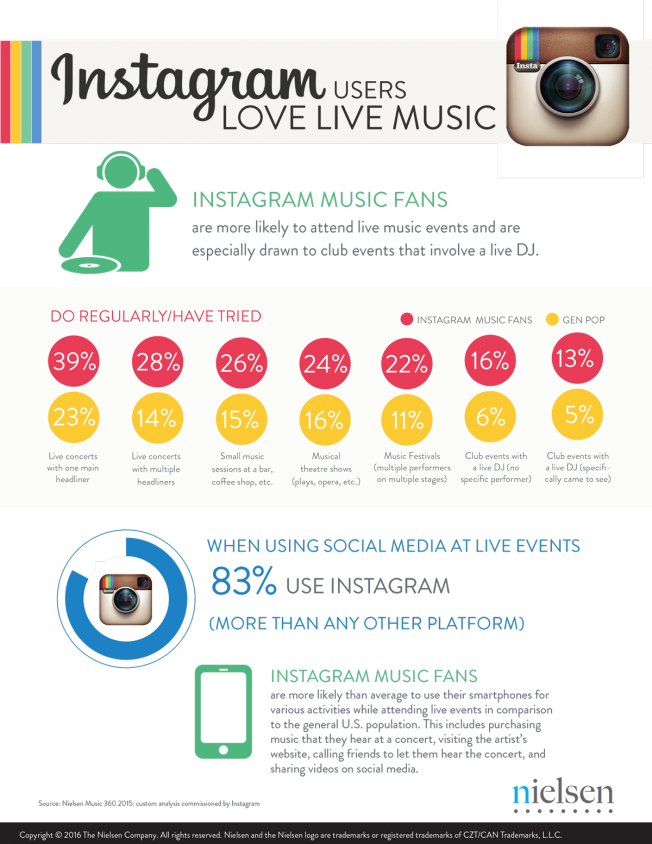
An infographic complemented the study by breaking down additional details from the report. Social media at live events is huge, with 83 percent of users preferring Instagram over other platforms. The report also details how music fans on Instagram have increased across the board compared to general consumers who attend various music activities like live concerts with one main headliner (39 percent compared to 23 percent), going to musical theater/opera shows (24 percent compared to 16 percent) and going to music festivals (22 percent compared to 11 percent).

Info 2

Nintendo Prepares For Push Onto Mobile

Fans have been excitedly awaiting the release of Miitomo ever since Nintendo announced last year that it was partnering with DeNA to debut a new game for mobile devices. Judging from the hype surrounding project Miitomo, it’s more than ready to take on the new challenge.

The company confirmed (in Japanese) via Twitter yesterday that the free-to-play social app, which utilizes the same custom Mii characters that appear in a number of Wii U games, will arrive next week in Japan on March 17, with a worldwide release to follow shortly thereafter. It will enable players to use Mii characters to communicate with others through messages, and will feature a photography mode that will enable sharing through social media.

“Miitomo is a uniquely entertaining mobile experience that only Nintendo can deliver,” said Scott Moffitt, executive vice president of sales and marketing for the company’s American division. “Featuring Mii characters, users will be able to interact with their friends in an entirely new way that transforms communication into a form of play.”

The game also provides an opportunity for Nintendo to utilize its Nintendo Network services in a whole new way, as users can potentially connect through both mobile devices and gaming console systems. The Nintendo Wii, 3DS and Wii U have already made proper use of these online services through games like Mario Kart 8 and Super Smash Bros., and the company’s next console, the rumored NX, is very likely to tie in with it.

But Miitomo also takes advantage of the My Nintendo program, which replaces the now-closed Club Nintendo service. With it, players could earn credits through Miitomo and other services, which could then be turned around for a number of rewards, including digital purchases and possible physical goods. Nintendo hasn’t broken this program down just yet, but we should learn more in the days ahead as the game prepares for its Western release.

It’s a bold business move on Nintendo’s part, but could very well show how it’s ready to evolve in both the console and mobile gaming markets. Miitomo has great potential in terms of finding strong outreach past existing Nintendo console fans, and its free-to-play structure should make it easy to grasp with young and old players alike. Plus, being able to put a personally designed face with a Mii avatar will help it stand out from other social networks.

We’ll see how Miitomo fares when it makes its debut this month. As for the rest of Nintendo’s plans, we should find out in just a few months when E3 rolls around.

Oculus Introduces VR Social Features

Virtual reality lets people play interactive movies, introduces massive gaming environments to explore, and even transports tourists to exotic new locations. The potential for the technology is endless, and starting tomorrow, Samsung’s Gear VR users will be able to use it to take social interactions to the next level.

A new Oculus VR blog post explains the various social features that will be coming to virtual reality. Gear VR owners will be able to create a profile, search for others across the Oculus Social platform, and interact through games and videos.

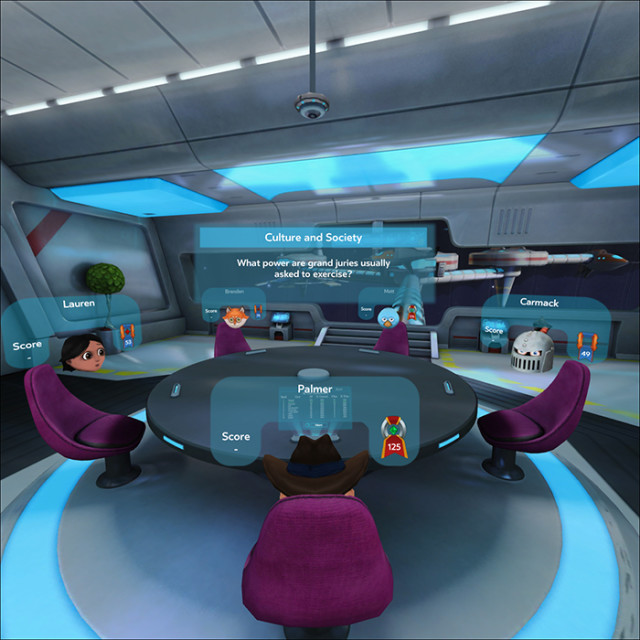
The company has already detailed the first couple of games that will take advantage of social communication. The first is called Social Trivia. As its name implies, the game enables up to four friends to sit down for a good old-fashioned round of trivia, answering questions and earning points.

Trivia

Another game, Herobound: Gladiators, lets players team up in four-player cooperative match to battle against goblins and demons in arena-based battlefields. Both of these games are available now.

On top of that, Oculus Social enables users to communicate with one another through Twitch or Vimeo streams. But this is just the start of the company’s VR video capabilities.

Upcoming features will include a new Facebook tab in its Videos section, enabling users to log into their Facebook account to view personalized 360-degree videos through their device, based on the pages and people that are being followed. Videos will also be shareable through the Gear VR headset, with interaction through comments.

Oculus has also promised to make the headset more accessible with developers, promising to release new tools “that make it even easier to create more incredible social VR games and apps”.

Chances are that Oculus will bring a number of these features, with possible improvements, to the high-end Oculus Rift VR headset when it launches later this spring.

It looks like a great way for more people to get involved with virtual reality, although it’d be neat to see additional games take advantage of the format, such as a first-person shooter or even sports titles.

For now, it’s definitely a good step in the right direction, and helps fulfill the vision Facebook had for virtual reality when it purchased Oculus VR in 2014.

Facebook Developing Software That Detects And Collects Slang

Buzzwords and catchphrases tend to spread like wildfire across social media. Just ask anyone who calls their significant other “bae,” or saying that someone’s hair looks “on fleek.” Now, Facebook wants to identify cool terminology before it manages to catch on.

Business Insider reports that Facebook CEO Mark Zuckerberg says the company has patented software that will enable it to search for emerging terms and nicknames for storage within a “social glossary.”

Filed last month, this patent will take a closer look at posts and messages on Facebook that will seek out neologisms. This consists of new pieces of language that are used by people online, even if they don’t quite fit common terminology. Such words include “oversharer,” “digital detox” and “sick” (in a good way), according to Grammar Monster’s recent examples of neologisms.

The goal of the software is to catch on to these terms so that they’re ready for popularity, even though not all of them may reach the ubiquity of “bae.”

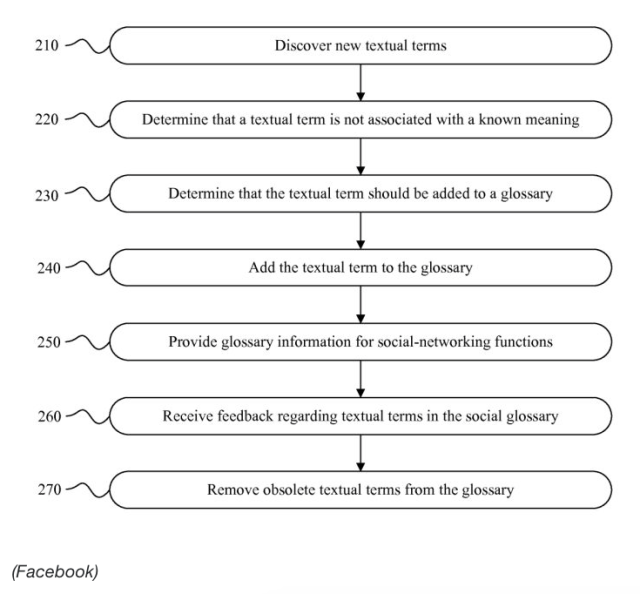
Facebook outlined the process, which starts with discovering new textual terms and ends with removing obsolete ones.

Screen Shot 2016-03-09 at 11.34.43 AM

The process checks for terms that may or may not be already in use, seeking out “slang, terms of art, portmanteaus, syllabic abbreviations, abbreviations, acronyms, names, nicknames, re-purposed words or phrases, or any other type of coined word or phrase.” If popular enough, they become added to the glossary.

Facebook hasn’t revealed how the the social glossary will be used, but it could include words from the glossary as choices for conversation in traditional posts or with its Messenger app.

Image source

Snapchat’s Temporary Content Still Means Big Business

Snapchat has become one of the bigger social media success stories of the past year, with millions of users providing content for others to see, and brands taking part to a much larger degree. Now, new numbers indicate that its success is as strong as ever.

The Wall Street Journal recently posted a video explaining how the company has grown to 100 million monthly users, a new landmark record for a social media application. On top of that, it managed to raise another $175 million in its latest round of funding, although its valuation still remains at $16 billion. Although some behind-the-scenes business types are concerned that the valuation hasn’t risen since last year, there’s no questioning the effectiveness of its business model.

Meanwhile, Bloomberg Business recently explained how Snapchat was able to build a $16-billion dollar business based on a younger viewer demographic, “confusing olds” in the process. It mostly focuses on 40-year-old music producer Khaled Khaled, also known as DJ Khaled, who is rising in the ranks as one of the app’s more popular users, having amassed an audience of over six million followers since last October. “Life is like flowers,” he noted. “You grow. You blossom. You become great.”

Granted, a lot of that success can come from involvement with the right people, like how Khaled worked alongside Ciroc Vodka to produce Snapchat ads, but it still demonstrates that even a service based on temporary content can thrive. “DJ Khaled has completely cracked the platform,” noted Emmanuel Seuge, senior vice president for content at Coca-Cola, which does quite a bit of advertising on the app. “He’s the king of Snapchat.”

Of course, Snapchat isn’t for everyone. It’s built specifically for users to share their stories, instead of simply embarrassing themselves or making a channel without much purpose. “It’s much more for sharing personal moments than it is about this public display,” noted co-founder Evan Spiegel earlier this year.

Elissa Ayadi, vice president of social strategy for Ayzenberg, noted, “Snapchat is building a best friends network. They get confusingly lumped into social networks, but that’s not what they’re trying to be. They’re specializing in one-to-one communication.”

While the revenue for the app is reportedly small–around $200 million annually according to various press reports–its cavalcade of advertisers and business venues make up a steady stream of revenue flow. Partners like Pepsi, Amazon and Budweiser paid over $1 million to feature ads coordinated with Super Bowl coverage–far less than the asking price CBS had for televised advertising during the “big game” itself.

But brands aren’t necessarily encouraged to use the Snapchat app the “normal” way, according to Ayadi. “Snapchat actually doesn’t encourage brands to be on the platform. They encourage them to use their paid options like photo filters or the Discovery channels.”

Khaled also manages to attract a younger demographic and his videos bring in between three to four million viewers each time. Considering how a similar demographic, 3.3 million in the 12-34 age range, watches The Big Bang Theory on CBS, that’s pretty significant.

“Snapchat lends itself well to people like DJ Khaled because it enables that one-to-one communication. He’s creating content that feels personal. It feels like content you can’t get anywhere else and like something you’d send to your best friend. It’s not overly marketed—it’s not overly produced—if he tells you to go get his new single, he’ll do it with his characteristic key emoji,” noted Ayadi.

That same age group also watches Live Stories regularly, with around 41 percent of adults under the age of 35 spending time viewing this content on Snapchat. “Everybody from 14 to 24 in America, it’s either the No. 1 or No. 2 app in their lives” following Instagram, states Gary Vaynerchuk, angel investor and entrepreneur.

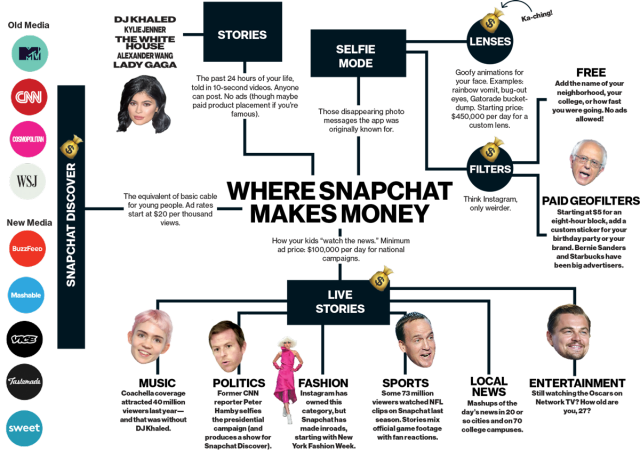
As for where Snapchat finds its value, it mostly lies between Stories, Selfie Mode, its various Filters (which usually find sponsorships) and Live Stories. Out of all of these, Live Stories appears to be the biggest, attracting everything from sports to music.
 

Snapchat

“If brands decide to have an organic presence on Snapchat, they have to create content that is compelling. They have to create content that is within the lens of Snapchat and get a little outside of their brand’s comfort zone. Things like offers or sales and traditional marketing messages are not appropriate for Snapchat,” said Ayadi.

She also noted that the right approach should be used when it comes to creating content. “Snapchat’s content creation can be very involved. It’s meant to be up-to-the-second and because Snapchat’s content is typically captured in the app, it has a certain quality bar that users expect which is actually very low. Trying to do anything super high-concept, super-branded, or in the case of a brand working with an agency, content that requires approvals ahead of time, is almost impossible.”

It’s clear that Snapchat’s success is hardly “flash in the pan,” and superstars like Khaled continue to keep it going strong.

Image source