How Discovery Is Targeting Millennials Through Online Video

There are umpteen-million millennials living in the world today, and Discovery Communications believes it has finally found the content matrix that caters to the finicky demographic’s desires.

The solution comes via video, and by re-introducing their millennial-centric web-native network Seeker brand to deliver more than 250 videos a month on science, world, and exploration.

The videos, which debuted last month with shows like “I left my law career to be a LEGO Artist” and “Why your favorite internet memes should never be forgotten,” feature influencers like Trace Dominguez and Jason Silva dishing out a slate of original short-form documentaries, live online events, and social content. 

Suzanne Kolb, Discovery Digital Networks’ executive vice president and general manager, oversees the company’s portfolio of web-native brands and series, original digital development, Discovery VR, and social partnerships. She joined [a]listdaily to discuss how Seeker will continue to build on its DNews and Seeker Daily programs in addition to debuting new documentaries and series.

Screen-Shot-2016-04-18-at-2.10.43-PM-210x320

What went into selecting the specific slate of programming for Seeker? What’s the strategy you used to come up with the plan?

We started with a distinct advantage: Seeker is built upon a foundation of learning from several highly successful YouTube channels and a wealth of research about our audience. We’re bringing that learning and the Discovery DNA to digital natives with themes of science, world and exploration. We’re focused on reaching a uniquely curious audience of millennial minds that want to apply their curiosity to the world around them through insightful content and first-person experiences. Our editorial approach is to fully embrace that pursuit through personal accounts, explanatory content and web documentaries. At the heart of what we have created is great storytelling, engaging talent and a mindfulness of our audience’s desire to learn and share.

What’s the integrated marketing plan in-store for Seeker? How will you be getting it in front of your target audience?

While we’re delivering great content and have built a wonderful destination in Seeker.com, we’re looking holistically at how we can reach our target audience. The opportunities and levers are many—from collaborations and partnerships with other content creators and like-minded organizations to elevating and showcasing the everyday seeker, to strategic social marketing spends and support from our linear sister networks in the form of an on-air effort. The Seeker brand is more than just content or a single platform, and we’re going to continue to drive awareness and engagement online and off.

How does Seeker’s video strategy complement the larger Discovery brand?

Discovery Communications has led the industry in countless ways for more than 30 years, and digital is a top priority for the company. Today, as an original digital content arm, we’re expanding on our heritage of storytelling and building brands. The platforms, length of content and storytelling approaches may differ, but our Seeker brand is an exciting complement to our linear business. And while our brands are unique, we’ve found great opportunities to work together—from our short-form franchise Science Presents DNews segments (which even drew guest host President Barack Obama) to SourceFed Studios’ take on Discovery’s Naked & Afraid.

How do you plan on leveraging original programming and content on social media? Any specific plans for Snapchat?

We’re rolling out platform-specific strategies and, where it makes sense, original content. In terms of video alone, we’re currently averaging more than 100 million views across our Seeker and SourceFed Studios portfolio on Facebook, a three-times increase over May 2015. Much of that success is due to the original content we’re producing for the platform, and we’re seeing engagement growing as well, with close to two million engagements in April alone for Seeker. Live is also a key component of our strategy—whether Facebook, Snapchat or beyond. We’ll be expanding on our success across Snapchat and other platforms … stay tuned.

How is Discovery reinventing its approach to influencer marketing to further reach millennials?

With Seeker and SourceFed Studios, we’re fortunate to have strong influencers among our talent family, and we’ll be working with some exciting names as a part of our programming, as with our Seeker Sabbaticals series launching later this year. Beyond that, our audience development team has done a fantastic job cultivating relationships with fellow creators to extend the reach of our content and brands, and we’ll continue to reach out to individuals—‘influencer’ or not—who we think will connect with Seeker.

Brands are always trying to reach the finicky millennial demographic. How will you measure success that you’re actually accomplishing this through Seeker?

While Seeker is a brand meant for a millennial audience, we have strategically chosen to focus not just on the demographic but on a psychographic within it, as well. Brands at their best don’t try to be everything to everyone and our success, ultimately, will be measured by the size of our target audience, the engagement we see and our ability to create meaningful opportunities for brands and drive revenue.

What was the most telling tidbit you learned during this process regarding the millennial audience?  

That you can remove a part of your logo and the curious minds you target will see it anyway! This generation is full of driven individuals, and their appetite for enriching content and a quest for knowledge is far from satiated. Seeker fills that void, answers those questions and inspires bright young minds.

Follow Manouk Akopyan on Twitter @Manouk_Akopyan

Comcast Exec Explains Why Xfinity Brand Is Perfect For ESports

With over a billion people aware of professional video gaming globally, Comcast is the latest mainstream company to jump into the eSports space. Comcast’s Xfinity brand is sponsoring the ESL, as well as North American eSports team Evil Geniuses. As part of these new partnerships, Xfinity will have branding opportunities at industry broadcasts, tournaments, and events, and will outfit each of Evil Geniuses’ training facilities with Gigabit Pro Internet service and the company’s flagship video product, Xfinity X1.

As an official ESL partner, Xfinity naming and branding will be integrated immediately in Thursday’s Halo Championship Series: Pro League Season 1 and this weekend’s Heroes of the Storm Live Finals in Los Angeles. In addition, Xfinity will be present at the organization’s high-profile tournaments including the ESL CS: GO Pro League, ESL Arena at PAX Prime, the North American Intel Extreme Masters (IEM) event, and will have involvement in other premium ESL events and products.

As part of these sponsorships, Xfinity will also become the official entertainment partner and the official internet provider of Evil Geniuses. Founded in 1999 by Alexander Garfield, EG fields some of the world’s best squads and players in Dota 2, StarCraft II, Halo 5: Guardians and fighting games.

Evil Geniuses training facilities in Alameda, CA and Urbana, IL will be installed with Xfinity’s Gigabit Pro Internet service, Xfinity X1 and additional technology and equipment to support the team. Xfinity branding will also appear on team jerseys, social channels, during live streams and across all player appearances.

Matt Lederer, executive director of sports marketing at Comcast, explains how these partnerships will help Comcast connect with a hard-to-reach younger demographic in this exclusive interview.

Why are you entering the eSports space now?

We’ve been keeping our eye on eSports for the last 18 to 24 months. We’ve dabbled with some on-site work at a PAX conference and worked on some things with a publisher. But we’re jumping into it in a big way. We’re seeing the trend and the direction the sport is taking, especially here in the U.S.

There are many opportunities provided through ESL and Evil Geniuses. Unlike almost any other partnership, the fact that our internet product is so endemic and natural to how the players and participants play and participate made getting into the space an easy decision.

How do you view eSports compared to a traditional sport?

We’re looking at it as a group of participants and spectators that are an important segment for the future of our company. These are young, diverse people who either play games professionally or watch the competition. To have a sport that leverages the fastest speed Xfinity provides a great opportunity for our company.

Did seeing more mainstream companies enter this space impact your decision?

Yahoo, TBS and ESPN are all in it. We’re in it because of the segment of fans who express enthusiasm about this sport.

This is also a fan base that can be finicky when it comes to direct marketing and not taking the right approach.

Finicky is a solid word to use. We’ll lean heavily on our partners. We want to continue to see eSports grow and evolve. “Authentic” is the buzzword in eSports. Evil Geniuses and ESL will help us be authentic. We are not going into this space assuming we know everything about it. We selected these two well-established partners to start with.

How will you connect with this fan base?

The Xfinity product is so natural and core, you’ll see first a very natural introduction to the sport which follows a lot of other partnerships we’ve done like Taylor Swift or NASCAR. We probably won’t use traditional ads or offer-driven creative. We want to celebrate the gaming community and speak to them in a respectful tone.

Will video content be part of this marketing plan?

Both partners will evolve with video. We’re starting with the internet being the core messaging with the great speed of Xfinity being great for gaming. Over time, we’re expecting to work with partners to create a content offering and lean into that video experience.

How will you tap into the social media reach of the Evil Geniuses pro gamers?

The structure of these partnerships offers us two unique opportunities through reach and passion. We love the fact that we have a game-agnostic ESL relationship. They cover a wide spectrum of games and leagues and they offer a great reach opportunity. Evil Geniuses taps into fans of the team and of specific players. We’ll work with Evil Geniuses players to create social conversations.

When will these partnerships kick off?

June 3 through 5 at the Halo ESL Championship. On ESL you’ll see branding within the analyst desk with both static and digital read-outs from casters. Evil Geniuses will have branding on the uniform jackets and shirts. Over time, you’ll see our branding from the streams they do from their gaming houses in Chicago and Alameda.

Is there any comparison to these early days of eSports to any other sports?

I can’t think of a sport or industry starting off like this. It feels like this has had a lot of traction in Europe and Asia and is now migrating to the U.S. I don’t know if I’ve ever been part of something at its conception. The movement upward is tremendous in where this is headed.

How did working with NASCAR fans help prepare you for eSports fans?

There’s a parallel with NASCAR fans also being finicky. In both spaces, a brand can have success if they come in and speak in an authentic and credible manner. In year one of our NASCAR partnership, our ads were a lot different than we do in the general market. We were touting the drivers and touting the racing experience. We’re entering the eSports space in a similar way. Our product is core to them and it Xfinity offers them an advantage when practicing and playing. It allows us to enter the space in a natural and credible way.

There are participants—spectators, teams, players—that create higher levels of passion. We’ll tap into that passion and drive some strong brand correlation.

Is it getting easier to make the case for eSports with the higher-ups?

The explanations internally about what eSports is are getting less and less. There’s an understanding of what this is, and the importance of the segment and our product’s connection to it, and the growth of it.

What impact do you see the recent success Turner has had with eSports on television having on the entire industry?

Any sort of exposure for eSports is a good thing for brands involved in the space, and it helps the internal explanations as well. We were ready to jump into the space before the TBS and some of the ESPN broadcasts. But the increased exposure is great because Evil Geniuses is trusting Xfinity Internet to be in their gaming houses to help compete and win. Our value and success comes through. The more exposure through increased digital or TV coverage will be a win for all brands who are involved in an authentic way.


McDonald’s Cooks Up Creative Marketing Campaigns

McDonald’s has been hard at work with some rather creative marketing campaigns this year, from farm tours to augmented reality. Whether you’re rolling your eyes or “lovin’ it,” one thing is certain—the world-famous purveyor of hamburgers has the world talking.

Futuristic Fast Food

McDonald’s is entering a new era of brand outreach, embracing new technologies and utilizing social media. Earlier this year, Swedish consumers were treated to virtual reality headsets made out of Happy Meal boxes. During South By Southwest 2016, the company created a virtual experience, where users could recreate the ability to actually be part of a Happy Meal, stepping inside a box and being able to design it however they please.

To promote their partnership with the Angry Birds movie, character-themed Happy Meal boxes included a code for an augmented reality game developed by Blippar.

“For The Angry Birds Movie, it makes sense that this AR mini-game would resonate well with the expected, younger target audience because of the engaging content, but moreover, because the content is delivered on a smart vehicle that has become second nature to younger generations,” said Omaid Hiwaizi, president of global marketing for Blippar. “The challenge for brands in engaging kids, however, is in providing quality content that can compete for the attention on established and powerful game and movie franchises. Nevertheless, just like The Angry Birds Movie brings the popular mobile game to life, this AR experience offers a new way for fans to play.”

Thinking Outside The Happy Meal Box

To celebrate National Hamburger Day on May 25, McDonald’s hosted its first Facebook Live video—an hour-long art show reminiscent of Bob Ross’ The Joy of Painting. Titled The Starving Artist, the mock program featured an improv actor wearing a sweater and fanny pack creating hamburger-inspired artwork. He told viewers that he was going to take the burgers from “mouth-worthy to museum-worthy.” Over the course of the show, three oil paintings were revealed: “The Beefy Gastronaut,” “Burger Brawn” and “Beefy Peaks.” The paintings by artist Adam Holzrichter are to be auctioned on eBay to benefit the Ronald McDonald House charities.

“We’re looking at ways that we can make a big, bold move,” Paul Matson, McDonald’s director of U.S. social engagement told Adweek. “Doing something live is a little bit of a calculated risk. It’s inherently interesting because you don’t know what’s going to happen so we’re trying to take advantage of that and see how that might work for a business that’s 60 years old, such as ourselves. So it’s reinventing ourselves in the way we show our customers our story and Facebook Live happens to be a great way in for us to do that.”

McDonald's celebrated National Hamburger Day with their first Facebook Live stream. The paintings above will be auctioned for their Ronald McDonald House charities. (Source: McDonald's)
The paintings above will be auctioned for their Ronald McDonald House charities. (Source: McDonald’s)

According to McDonald’s the Facebook Live stream reached 884,300 people in 40 minutes, and garnered around 43,200 engagements (likes, comments and shares).

‘Angry’ Burgers

In a publicity stunt that delighted many and horrified others, McDonald’s restaurants in China have been serving red and green hamburger buns as a tie-in to the Angry Birds movie. The brand “rolled” out the brightly-colored sandwiches to mixed reviews. The Naughty Green Pork Burger represents green pigs from the game/film, while the Super Red Burger is a chicken sandwich that matches the angry, feathered protagonist.

The Naughty Green Pork Burger and Super Red Burger, which is actually chicken.

McDonald’s Of The Future

The 75-year-old restaurant chain has survived and thrives due to its ability to adapt. The first McDonald’s was actually a barbecue restaurant, but its founders changed their focus when they realized that 80 percent of sales came from hamburgers. Today, the brand continues to evolve with the times and demand of its audiences, from offering healthy menu items and breakfast all day to educating the public about their farming techniques. As we enter a new age of social media and content creation, McDonald’s is definitely not afraid to try new marketing ideas.

HyperX Exec Details NBA Star Gordon Hayward’s Headset Deal

HyperX, a division of Kingston Technology Company, has added NBA player Gordon Hayward to its roster of champion athletes. The Utah Jazz forward is the first athlete from traditional sports to promote HyperX headphones. Gordon will exclusively use HyperX gaming headsets, will be featured in marketing campaigns, regularly stream gaming sessions, conduct giveaways and make appearances for the brand starting today.

But the former Butler star isn’t a typical NBA star. He’s a huge gamer, having previously played Starcraft II professionally in the IGN Pro League when the NBA players were locked out in 2011, and Halo in pro tournaments prior to attending college.

HyperX currently sponsors hundreds of professional eSports players through its more than 30 organizational partnerships (including Intel Extreme Masters), but Gordon is the beginning of a new expansion for the company—one that echoes eSports’ growth overall—into a more mainstream audience.

Daniel Kelley, director of corporate marketing at HyperX, explains how this new strategy ties into the bigger convergence that’s going on between eSports and traditional sports in this exclusive interview.

Why did you decide to partner with Gordon Hayward?

We’re trying to go to wider audiences. We look at our core DNA in eSports and PC gaming—our lineup of products, from memory to SSDs—and they all work with that customer base.

At E3, the CloudX is our first officially licensed Xbox product, which opens up our audience to console gaming, but is still very rooted in eSports. We’re exploring ways to get into the competitive scene with Gears of War tournaments and talking to eSports teams with console-focused teams.

How do professional athletes tie into the eSports and gaming audience?

More and more people will see eSports over the coming months and years through deals like Turner broadcasting games on TBS. We work with MLG, ESL, and other leagues. As more professional athletes get involved in eSports, we see HyperX as being a crossover company. We see opportunity for traditional sports fans to fall in love with eSports. Gordon represents the ideal personality. He’s a pro basketball player, but he has a history of passionate gaming with League of Legends streams and playing games like Overwatch, Halo, and Call of Duty.

Approximately 90 percent of NBA players are gamers. What separates Gordon from the crowd?

A lot of professional athletes are gamers; some are casual and are some are more into it. Gordon has a unique story in that he was competing in Halo tournaments in high school and had to make sure his basketball coaches at Butler, where he won a scholarship, gave him permission to play. He’s a regular proponent and advocate for eSports and gaming. He has a great personality and likability. And he had some fun with LeBron James a few years ago with his “I’m the best in the world” at League of Legends Tweet and blog post. He’s the epitome of who we’re looking for. He has the respect of the NBA scene and the eSports scene, and a passion for eSports overall.

How do you see former NBA pros like Rick Fox and Shaq and NBA team owners like Andy Miller and Mark Cuban impacting eSports through their teams?

It’s all connected. A lot of the moves we’re making are seeing that bigger picture. We’re the official headset sponsor of Echo Fox and we like what Rick Fox is doing. He’s a strong personality in traditional sports, and he’s doing all the right things in eSports and taking care of young players. His team is coming in May 31st to a boot camp here.

Andy Miller’s NRG is another team we sponsor and they’ll be creating content with us in the next few weeks.

Is this deal with Gordon similar to LeBron James wearing Beats by Dre before an NBA game?

It’s similar to the traditional headphone maker sponsoring an athlete. Our unique take is he’s a professional basketball player and our headsets are versatile and you can take the mic off and use them in your everyday life. He’ll be doing some stuff on social media for us. We’ll be working with him to come to select events to sign autographs and do streaming sessions. We’ll be doing giveaways and contests. We’ll do some cool video content with him. His fans are from traditional sports teams, and he’ll allow us to introduce those fans to what we stand for in terms of quality and focus and dedication to the gaming customer.

How long is the deal?

It’s a year to start. It’s new territory for both of us. We’re looking at it as a long-term engagement, but will explore how to grow the partnership beyond the initial year.

Will the types of promotions we see with Gordon be similar to how you work with pro gamers?

We’ll do a lot of the same stuff we’d do for an eSports athlete, but with Gordon we’re hoping different customers will see this. Hopefully, eSports fans will also enjoy it and respect it and help share it.

Will Gordon be at E3?

He has a crazy schedule right now, so he won’t be able to make it. But there are a lot of events, like PAX and DreamHack, so there will be opportunities for him to appear during the summer and interact with fans and do content stuff.

Which headphones will we see him wearing?

He’ll eventually wear all of our headphones and gravitate to the ones he likes most. We have a lot of launches coming up and things we want to try. There’s the Cloud Revolver and the E3 launch of Cloud X. Those are the two primary ones he’ll wear to games and day-in and day-out. Those headphones have the same comfort and shape and quality of the Cloud 2. They all work across PC and mobile and console. As we introduce new headsets—and we have quite a few launching over the rest of the year—he’ll wear others.

Will Gordon be involved in offering insight for future headphones like you typically work with pro gamers on?

We want to make the best quality headset at a reasonable price for gamers. We’ve had success to date because we care about these professional athletes’ opinions. We have them test everything in the pipeline, so they can tweak things. I see Gordon falling into that same atmosphere. He’ll have opinions on what we send him and that all falls into the R&D pool. Any gamer spending so many hours a day gaming has valuable information. We keep that core focus on comfort and sound quality.

How will you look at future pro athlete endorsements for products?

We’re not just looking to sign any and all pro athletes. We really want to find those that do have an understanding or appreciation or passion in gaming as a prerequisite. We know that our headsets are comfortable for everyday use. We know that if we can satisfy the quality of a pro athlete, that can transfer to mainstream appeal. But traditional athletes need to have that passion and appreciation for what gaming is.

What role will traditional sports play for HyperX moving forward?

ESports is a bit of the tipping point of going mainstream. We’ve been active in the scene for a long time. Our roots and DNA are in eSports. As it catches the eye of traditional sports and more investors and teams and broadcast channels, we want to be in the thick of it. HyperX is an authentic brand for gamers.

Sshhh—Don’t Tell Anyone, But Marketing Is Ending Game Secrecy

One of the biggest changes in the games industry over the last decade has been the change in game development from an utterly Top Secret process to a completely open process. While some long-time console game publishers still stick with old never-tell-anyone-anything philosophy about games in development, many newer publishers and developers are doing just the opposite: revealing their games as completely as possible even before development begins. In fact, that’s part of what has made crowdfunding so popular.

There’s a range of secrecy at work in the games industry. The classic game development process for big game publishers has been to conceive of game ideas, approve them and begin development without ever revealing to anyone outside the company that work is underway. Only until the game was perhaps less than a year away would the company admit to working on it. Then there would be a very tightly controlled series of information releases and press events, culminating in a grand reveal a month or two before launch. The idea was to provide retailers enough time to see the marketing for the game begin, and gauge signs of public enthusiasm, in order to place orders. Additionally, advertising would be timed to coincide with the retail appearance, as would feature reviews and interviews with the game creators.

That process perhaps made sense when the games industry revolved around retail sales, and there weren’t very many games being produced (perhaps one or two major games a month for most of the year). Now, though, we are inundated with games on the largest number of game-playing platforms the world has ever seen. Hundreds or thousands of new games appear every week. The main challenge for most game makers is to get some attention in this ocean of games, and to somehow attract an audience while existing games are putting out new content and making new efforts to keep their audience focused on the games they already play.

Let’s examine the other end of the secrecy spectrum, best exemplified by crowdfunded games. In that case, a developer or publisher has to reveal as much as possible about the game in order to get potential customers excited about it. Working demos are often used, too, as well as concept art or even some near-finished art. The prospective audience has to be excited by the idea of the game, believe that it will be fun, and believe that this team can actually carry out what they’re promising. So crowdfunding is a process that demands revealing most, if not all, of the key details of the game.

Similarly, crowdfunding is also a test of the game’s marketing strategy. When you describe the game, you’re road-testing some of the phrases and terms you might use to market the game later on. You’re also selecting which features of the game you think will be most compelling for customers in order to put together your crowdfunding pitch. Of course, one of the best parts about crowdfunding is that you very quickly discover which game features attract attention and which don’t, and what marketing phrases work and which don’t. Hopefully you put in enough compelling material to get the funding needed despite some bad choices, which you can correct along the way.

A crowdfunded game gives up secrecy for the entire development process. While actual code doesn’t get revealed, the development team needs to share progress with the backers, and talk about the ongoing design decisions that are being made. Sometimes the crowd will weigh in on design decisions, and the answers may not be what the development team expected. For instance, early in the Star Citizen development process Chris Roberts asked the backers to rate the importance of various types of game play, so he could focus on the most important parts first. Roberts thought that ship-to-ship combat would be the favorite, since that’s what the basic pitch of the game was. However, with over 10,000 responses, Roberts saw that about two-thirds of the backers wanted exploration as the most important feature of the game, and combat was second. This led to a major shuffle in how development resources were being allocated.

Similarly, marketing strategies are tried out early in the crowdfunding process, and then refined as feedback comes in. Abandoning secrecy means that both game development and game marketing can benefit from idea testing against the audience of the most interested future customers.

Many games now have much more openness in the development and marketing process than ever before. We’re seeing many open betas being conducted in order to test out server code and the robustness of the game design under large-scale, real-world conditions. But make no mistake—an open beta for a game like Doom is also a wonderful marketing opportunity, letting a large number of players get their hands on the game and whet their appetites for the finished product. Yes, there’s a risk that players will find bugs (which they expect) or they may not like aspects of the game (which can sometimes be fixed before launch).

With mobile games, the concept of secrecy has been shredded even more. A typical mobile game from medium to large publisher will soft-launch in smaller countries before launching in major markets. Testing in Canada or New Zealand may even go on for months as a publisher tests and refines monetization and marketing strategies, and tries to ensure that a game will do very well when it launches into major markets like the USA and China. Sometimes games never make it out of soft-launch, when a publisher determines it just can’t figure out how to make the game achieve sufficient profitability. Yet, during this whole process, the game is right there for everyone to see and play—before it gets launched officially in most countries.

There are still some examples of games that successfully use secrecy to boost enthusiasm, as with the very successful Fallout 4 launch last year. Only vague rumors about the game had existed during its years-long development process, at least until a very successful E3 rollout leading up to blockbuster sales. Of course, Bethesda was working with a well-established franchise that already had an enthusiastic audience, so mere mention of the title was enough to get people into a frenzy of anticipation.

Marketing should embrace the idea of greater openness about games under development. Getting an audience excited early is more useful than ever in this age of game abundance. The feedback you get can be crucial to making a game successful. For games that you intend to profit from for years, it makes sense to establish the game’s presence in the market as early as possible.

Rob Riggle’s Humorous Ploy Makes Staying At Holiday Inn Express Fun

Editor’s Note: When watching the video above on mobile, we recommend opening the video in your YouTube app or viewing in Google Chrome browser.

Holiday Inn Express is a hotel brand that banks its personality on hilarity just as much as it does by offering a satisfying cup of coffee.

InterContinental Hotels Group has held their place in the hotelsphere and pop culture alike by working with comedian Rob Riggle as creative director for their “Stay Smart” campaign over the last two years.

“We know that our guests love humor, so last year, when we set out to find our creative director, we wanted someone who had a mix of smarts and humor. Rob’s creativity and wit make him the perfect addition to the Holiday Inn Express team,” Jennifer Gribble, vice president of Holiday Inn ExpressAmericas brand, told [a]listdaily. “As creative director, Rob not only stars in the brand’s hilarious ad spots, but both this year and last, worked closely with us throughout the creative process, lending his humor and ‘smarts’ to generate unique ideas.”

HIEX_Stay_Smart_Rob_Riggle_Creative_Director_3

Highlights from the campaign over the last year have featured the funnyman promoting programs such as the Pancake Selfie Express and BREAKFA-moji keyboard.

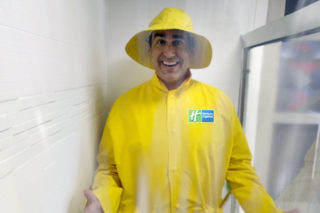
The hospitality company also made another foray into virtual reality this year by filming a 360-degree video of Rob in a raincoat highlighting a guest’s room experience through the power shower—all while delivering the snappy spiel the funnyman has long been known for.

“It’s somewhere between a squirt gun and a fire hose which, as we all know, is the sweet spot,” Riggle says of the water’s “proprietary blend” during the two-minute immersive experience.

It’s not the first time IHG has been at the forefront of innovative technology. During the 2012 London Olympics and Paralympics, IHG’s Holiday Inn brand used augmented reality to allow visitors to take pictures with the athletes. They’ve also kept things a bit simpler by offering 360-degree virtual tours for their hotels.

Gribble joined [a]listdaily to explain how Holiday Inn Express is leveraging technology, social media and influencers for their integrated marketing campaign.

Why is using emerging technology such as 360-degree video critical to a marketing campaign? How do you plan on experimenting with such immersive experiences like virtual reality in the future?

0ddb820

Our target guest, who we call the ‘smart traveler,’ is a tech-savvy individual who generally travels with at least four devices. We know that they’re always online and consume much of their content via mobile. As such, it’s important to us to leverage technology to reach them where they are. With our new 360-degree video, the combination of the new technology and the unique, humorous approach allows us to connect with consumers through a memorable, tongue-in-cheek experience.

We always keep our finger on the pulse of the latest technology and marketing trends in order to break through to our target guests in ways that interest and matter to them. Last year, we leveraged truly innovative technology when we took our one-touch pancake machines on the road and amplified breakfast by creating an immersive experience that allowed consumers to laser print their selfie on the pancake. By combining something simple like pancakes with the innovation of laser-printed selfies, we created something incredibly engaging for consumers that was widely sharable via social media.

Why is it important to give an influencer creative freedom? Would you use the same approach with, say, a YouTube or Instagram influencer?

Consumers are very smart and know when content is inauthentic. This is why it is important for brands to partner with individuals who genuinely align in style, tone and vision. When we first set out to find a creative director, it was a difficult position to fill because we knew whoever we hired had to check a lot of boxes. He had to be funny, since we know humor resonates with our guests, and he had to be smart. Rob’s humor and wit make him a natural fit as creative director and his personality is true to the Holiday Inn Express brand, which we believe is essential to any partnership.

What insights can you share from your integrated marketing campaign from 2015, which was highlighted by the Pancake Selfie Express? How did you measure success?

The 2015 “Stay Smart” campaign performed incredibly well. As a result of our 2015 campaign efforts and partnership with Rob, we saw significant lifts in all of our key brand health metrics. This year, the bar was set even higher, meaning that our team had to find new, creative and compelling ways to continue to drive brand performance. To achieve this, we’re continuing to leverage new technology and humor to highlight the simple pleasures that help our guests leave our hotels ready for anything.

HIEX_Power_Shower_Still_FINAL

What did you learn and refine for the latest “Stay Smart” campaign that focuses on the “simple pleasures?”

Last year, we went big on breakfast as we know it’s one of the most important decision factors for our guests when deciding where to stay. This year, we have expanded our campaign in order to showcase more of the ‘simple pleasures’ that Holiday Inn Express hotels offer guests. We’ve gone one step further by building our in-room credentials—a restful night of sleep, a good cup of coffee at the push of a button with the addition of Keurig K130 brewers in every U.S. guestroom and a powerful shower—in addition to breakfast. We have also fine-tuned our media approach in order to ensure we reach more of our target guests more frequently across digital and broadcast channels as well as through experiential activations.

How will you be leveraging the “Stay Smart” campaign on social? What’s the execution plan looking like on the brand’s YouTube, Instagram, Twitter and Facebook pages?

Humorous content featuring Rob as creative director performed very well across social channels in the 2015 campaign. For the first phase of this year’s Stay Smart campaign, we are focusing on Facebook and Twitter as we continue to raise the bar for engagement and break through the clutter with filmic shorts, GIFs and 360-degree video to highlight the brand’s smart in-room amenities—coffee at the push of a button, a powerful shower and a good night’s sleep.

In the second phase of the campaign, we’ll integrate a few new elements such as Twitter Polls and Facebook Canvas to highlight our breakfast offerings as we execute against experiential activations and media partnerships. This strategy is all part of laying the foundation for reaching our target guests.

How is “smart traveler” targeting millennial business and leisure travelers? 

Our target guest, the smart traveler, includes business and leisure travelers ages 25-to-44. These people are independent and self-sufficient, and value simplicity and efficiency. As mentioned, they see their hotel as a launch pad that helps them get a great night’s sleep so they are prepared to tackle the day. With these consumer insights in mind, we developed an integrated campaign that highlights the simple pleasures that our guests value and reaches them through the digital platforms in which they’re connecting throughout the day.

Follow Manouk Akopyan on Twitter @Manouk_Akopyan

Riot Games’ Whalen Rozelle On How Traditional Sports Is Helping ESports

A lot has changed since Riot Games first set out to develop League of Legends as a spectator sport. The independent studio, which is now owned by Tencent Holdings, experimented with every aspect of turning a video game into a properly-run international sports league. And Riot continues to tweak things even now as mainstream media outlets cover League Championship Series (LCS) and other eSports leagues on television and online, while non-endemic advertisers begin to tap into the huge online global audiences that follow their favorite teams and players.

The industry is now seeing traditional sports owners from Andy Miller to Mark Cuban, as well as former professional athletes such as Shaquille O’Neal and Rick Fox and current pro athletes such as Alex Rodriguez and Jimmy Rollins, invest in eSports teams. Whalen Rozelle, director of eSports at Riot Games, believes all of this mainstream attention is good for the entire eSports ecosystem—but it’s not changing the way Riot caters to its devoted fan base. Rozelle talks about the growing eSports business in this exclusive interview.

What are your thoughts on Andy Miller, who in addition to being a co-owner of the Sacramento Kings along with Shaq, now owns League of Legends and Counter-Strike: Global Offensive Team NRG? What does that say about eSports that we now have traditional sports owners migrating to owning eSports teams?

It is an affirmation, and a bit of legitimacy and acknowledgement of the success that some of the games have had, whether it’s League of Legends and the foundation that we’ve built with LCS and the regional leagues around the world or CS:GO and the fact that they’ve been very successful with the majors that they’ve had. It is a result of multiple years of education on our part and other publishers’ parts to let people know that this is not a fad, this is not something that’s going away. There is a large generation of sports fans, a new breed of sports fans whose “sports” are the games that they love to play. While there are some potential pitfalls of having so much mainstream media attention at once, in general, it’s a positive thing and will be good for the ecosystem that we’ve built.

How do you see having traditional sports athletes like Shaq, Alex Rodriquez, and Jimmy Rollins involved in eSports impacting that broader audience that still doesn’t understand eSports?

It’s helping because it’s not necessarily for the existing eSports fans. While existing eSports fans are excited to see figures that they recognize from the mainstream lauding the sport that they love, it’s the people who don’t know about eSports that they reach.

I think that even a better example is someone like Rick Fox, who is able to speak to both audiences as an owner of Echo Fox. He’s been able to articulate both to eSports fans why he’s so passionate about it, but also to the mainstream about why, given his sporting background experience, that eSports called to him as much as a traditional team sport like basketball did. Rick is different than Shaq and A-Rod, who are investors. I do think that for them it’s more affirmation and legitimacy and less that they’ll be necessarily seen as an insider and be able to explain what things are going on. But it’s still a positive overall trend and something we’re excited to see.

One of the reasons A-Rod was brought in according to Andy Miller, was to talk to pro gamers about dealing with the level of pressure in competition.

That’s what catches a lot of the traditional athletes off guard initially. Once they do some of their due diligence they realize that these pros are practicing as a team for 10 to 12 hours a day during their off days, and the level of the commitment that these LCS pros have to getting better and gelling with the team is a very close parallel to what you see in traditional sports. They have rowdy fans around them and they love to see their favorite players and team striving to be the best, and it pulls at the same heart strings as traditional sports. It’s something that calls to the same emotions and is the reason why we think that eSports is something that’s here today because in essence it’s the exact same thing as an official sport. We’re just playing video games.

How does having media companies like Yahoo and ESPN jumping on the eSports bandwagon impact the industry?

That’s actually less of a cause and more of an effect of what’s happening. By having ESPN and Yahoo covering this, that is a reflection of the fact that people are now educated on the value and the eyeballs and the momentum behind League of Legends eSports and other eSports out there. It’s certainly going to help because when we talk about bringing in non-endemic sponsors, and those teams being able to secure new revenue streams, it’s only going to help when they’re able to go on ESPN.com and see League of Legends and eSports be all over the front page. Ultimately, that’s a really positive thing.

What has been the key to the success League of Legends has had in eSports?

We can boil it down to three core principles: focusing on consistency, on creating a cohesive experience and also creating a sport with a broadcast experience that’s high quality. Those are the three core colors of what has led us to make the decisions that we’ve made for LCS in Season 2, when we moved from a sporadic tournament model with a lot of third parties to one exclusive consistent league where pros and teams are playing every week so fans can experience their favorite players.

Consistency has been important in having regularly scheduled matches in each region that fans know they can tune into just like they know every Sunday they can watch football in the United States. In terms of the cohesive experience, the key fundamental was about lowering the barriers to entry, getting rid of some of the paywalls and some of the other policies that turned off eSports fans in the past. It’s about making it easier for fans to approach the game and the sport by creating great videos with storytelling around our pros and trying to create the emotional connections that tie fans to players. And finally on the high quality experience—it was really about ensuring that we created the experience that matched the passion of eSports fans. We didn’t create that passion, but we were able to recognize it and realize that these sports fans deserve something that rivals traditional sports. Through doing appropriate recruiting and bringing in people who not only had high craft skills but understood that authenticity and  empathy and being true to a core that made eSports great, we’re able to make these investments and put a high quality experience on the “field” week in and week out.

What are your thoughts on the future of eSports?

We want to always challenge ourselves to be better week-over-week, month-over-month, year-over-year. We’ve learned a lot from traditional sports and we’ve taken a lot of examples from them. Some have worked really well, but some haven’t. We’ve learned from it in either way, but we also think that we should continue to challenge ourselves and continue to innovate, and never settle for what we’re doing now.

Mountain Dew Dives Into ESports With Drone Racing

Whether it’s motocross or skateboarding, Mountain Dew has a history of backing extreme and action sports. The soda brand is now diving deep into drone racing in a new sponsorship with DR1 Racing.

The DR1 Invitational will make its television debut this August on the Discovery Channel and Science Channel, making it the first drone race to air on national broadcast TV. It will also be paired with a Twitch stream that will produce weekly content. Over the next month, five digital episodes will also dive promote the event and the 12 pilots that will be racing.

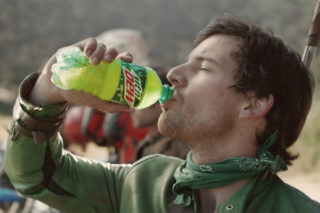
In addition to their partnership with DR1Racing, Mountain Dew also launched a creative TV commercial dubbed “drone hunting” that’s meant to take inspiration from the world of sport, tech and innovation. The ad was filmed in the forests of Casablanca, Chile.

What can fans and spectators expect from the real thing? Pilots are slated to face-off in a gauntlet of environmental and man-made obstacles as they fly their drones at speeds of more than 80 miles per hour. The inaugural race will take place at the Sepulveda Dam in Los Angeles this summer on a course designed by MultiGP and LMNO. Spectators can watch from above.

Mountain_Dew__Drone_Hunting_Do_The_Dew_16Mountain Dew’s partnership with DR1 Racing is another big step for the burgeoning discipline of drone racing and its cross-pollination with eSports. The International Drone Racing Association signed a multi-year, international media distribution deal with ESPN last month, and in 2015, Miami Dolphins owner Stephen Ross invested $1 million into the Drone Racing League.

Brad Foxhoven, founder of DR1 Racing and producer of the DR1 Invitational, told [a]listdaily that drone racing’s biggest differentiator from competing leagues is their focus on the pilots.

“This gives us a lot more time to get to know them, see them fly, and have them compete against one another in a format that showcases their talent and skills. Fans want to see pilots like Ummagawd, BanniUK, and A-Nub compete against each other, and this type of race guarantees that,” Foxhoven said. “Fans can certainly expect to see a lot of flying with some of their favorite pilots.”

Mountain Dew secured a sponsorship with pilot Tommy “Ummagawd” Tibajia, making him the first drone racer to sign a deal with a brand.

Manos Spanos, Mountain Dew’s senior director of global brand marketing, joined [a]listdaily to discuss how drones are now a part of the “Do the Dew” global marketing campaign, and how caffeine and content tie in with their other recent interactive activations.

Mountain Dew’s partnership with DR1 Racing is another big step for the burgeoning discipline of drone racing and its cross-pollination with eSports. The International Drone Racing Association signed a multi-year, international media distribution deal with ESPN last month, and in 2015, Miami Dolphins owner Stephen Ross invested $1 million into the Drone Racing League.

Brad Foxhoven, founder of DR1 Racing and producer of the DR1 Invitational, told [a]listdaily that drone hunting’s biggest differentiator from competing leagues is their focus on the pilots.

“This gives us a lot more time to get to know them, see them fly, and have them compete against one another in a format that showcases their talent and skills. Fans want to see pilots like Ummagawd, BanniUK, and A-Nub compete against each other, and this type of race guarantees that,” Foxhoven said. “Fans can certainly expect to see a lot of flying with some of their favorite pilots.”

Mountain Dew secured a sponsorship with pilot Tommy “Ummagawd” Tibajia, making him the the first drone racer to sign a deal with a brand.

Manos Spanos, Mountain Dew’s senior director of global brand marketing, joined [a]listdaily to discuss how drones are now a part of the “Do the Dew” global marketing campaign, and how caffeine and content tie-in with their other recent interactive activations.

AAEAAQAAAAAAAAOOAAAAJDY0MTdhZGI3LWI0NjMtNGI5Ni04NzQ3LTZlOTAyOGY5NzZkOA

What prompted Mountain Dew to jump on the drone racing wagon? Why is it a good fit for the brand?

Mountain Dew has always been a brand that progresses culture, whether it be progressing action sports through Dew Tour or being among the first brands to take on virtual reality, so being at the forefront of this burgeoning sport is perfect for Dew. We wanted to get in early and help to progress and shape the sport as it explodes onto the scene globally. The demographic that enjoys drone racing closely aligns with our brand—people who want to instigate and have a damn good time.

How do you explain what drone hunting is to someone who’s never heard of it? How do you sell them on the idea of this new culture?

The ‘drone hunting’ TV creative is part of our global ‘Do the Dew’ campaign that hinges on the belief ‘it doesn’t exist until you do it.’ We hope Dew Nation—from the U.S. to Thailand, from Brazil to Iceland—sees this exciting new creative as a global rallying cry to dream up new experiences and have a damn good time doing it. As Dew Nation grows around the world, so does the opportunity to create something exciting that never existed before.

Why was it important to secure Twitch as a partner? 

Drone racing has a close connection to the e-gaming world through the first-person view and remote-controlled drones. It only made sense that we would partner with Twitch—the world’s leading social video platform and community for gamers—to expand our reach and allow fans to view the live stream as well as a multitude of additional drone racing content through the DR1 Twitch channel.

How will the gaming and eSports demographic help drone racing grow? 

Drone racing is very unique in that it bridges the worlds of technology, gaming and sport to appeal to a multitude of people. Having the backing of Twitch and the gaming community will only help the sport grow, as we know it is a very socially active community that is at the edge of discovery and instigating new trends.

Mountain Dew is using drones in the “Do the Dew” global campaign. What are some other ways you’re leveraging sports in marketing initiatives?

Because Dew Nation is an eclectic group with varied interests, we leverage several sports platforms, from our history in action sports and NASCAR to newer partners like the NBA, all to create a deeper connection and provide experiences to our fans that offer a damn good time. We have a rich history in action sports through Dew Tour, and are working with our partner The Enthusiast Network to innovate and progress the sport through new courses and formats. We also are serving up content to our Dew Tour fans through the new website DewTour.com.

Our longstanding relationship with NASCAR and Dale Earnhardt Jr. enables us to reach passionate racing fans, and this year we’ve extended our reach through partnerships with Kasey Kahne and Chase Elliott. We’re working with them in the more traditional sense through our TV commercial for DEWcision 2016, but also engaging them in new ways through VR. It’s all about getting our fans closer to the experiences and people they love.

We are wrapping up year one of an exciting new partnership with the NBA where we are celebrating basketball culture and the intersection of sport, technology and art. Through a unique Google Tilt Brush activation at the NBA All-Star Game that allowed fans to create basketball-inspired art in VR, to an art installation called ‘Courtside Collection’ at the recently launched 3-on-3 basketball tournament—Dew NBA 3X—Mountain Dew is committed to bringing a damn good time to our fans through their varied interests.

Follow Manouk Akopyan on Twitter @Manouk_Akopyan
The Power of Featured Apps

Getting your app featured by the App Store is obviously a terrific achievement—but just how much does it matter? Does it matter more in different countries? How long does the boost last, and is this effect getting stronger over time? Analytics firm App Annie has studied the issue of featured apps in Apple’s App Store and provided some useful data for marketers. App Annie looked at free iPhone apps featured between June 2013 through March 2016 in five countries: Brazil, Japan, South Korea, the UK and the US.

Let’s get one thing clear: Apple’s App Store is still the best place to make money from mobile games, despite the slowing of iPhone sales in the last quarter. Apple’s App Store accounted for 58 percent of global app revenue in 2015 compared to 36 percent for Google Play Store, according to IDC. That’s despite the fact that Apple only accounts for 15 percent of global app installs. The conclusion is easy: iPhone owners spend more money than Android owners. So much so that Apple’s share of app revenue rose 36 percent in 2015 despite the fact that its share of total app installs for the same period fell 8 percent.

However, it is important to note that IDC’s figures don’t include advertising, which is a major source of revenue that’s dominated by Facebook and Google. One other thing to note is that there are many non-Google Android app stores (because Google hasn’t been operating in China) which account for the remainder of the app revenue.

For marketers looking to get their share of iOS app revenue, becoming a featured app in the App Store is an obvious goal. As you would expect, being a featured app had a positive effect on apps, but the effect on games was some 4x greater. The effect was a 140 percent increase in the number of game downloads during the period when the game was featured. The effect of being featured is not as great as it once was, particularly for non-game apps. Back in 2013, non-game apps could expect an 80 percent boost in downloads, but has dropped down to 25 percent.

Still, for marketers of mobile games, getting your game featured on the App Store is seen as a win that’s more important than any other third-party endorsement. But getting featured is not an easy task. Larger publishers make establishing a good relationship with the App Store staff a priority, but that takes time and effort. Apple always has the final say on what’s featured, and often requires major changes to an app before it will even be considered. A great deal of effort can go into to trying to get your app featured, but without success. Marketers have to decide if that time would be better spent on activities that have a greater chance of bearing fruit.

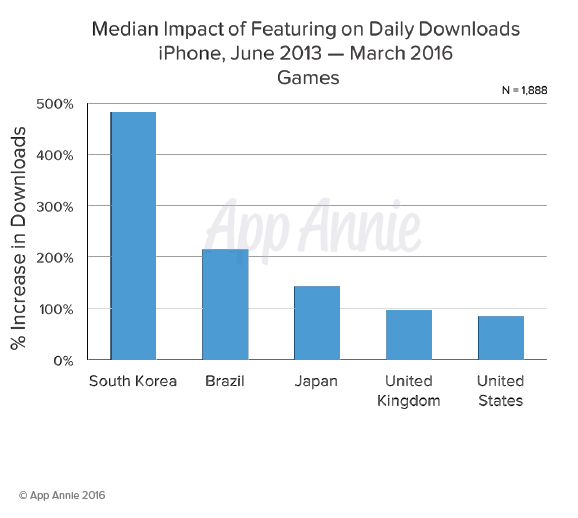
Another thing marketers need to consider is that the effect varies between countries. In South Korea, getting featured in the App Store was a huge boost, providing almost 500 percent more downloads. By contrast, the boost in the US was less than 100 percent. Still a great lift, but certainly nowhere in South Korea’s league. Why is the effect so large in South Korea? App Annie attributes that to the relative newness of much of the iPhone audience in South Korea, which has seen iPhone market share jump since the introduction of the iPhone 6, and new owners are always more likely to download apps.
Featured App Success By Country

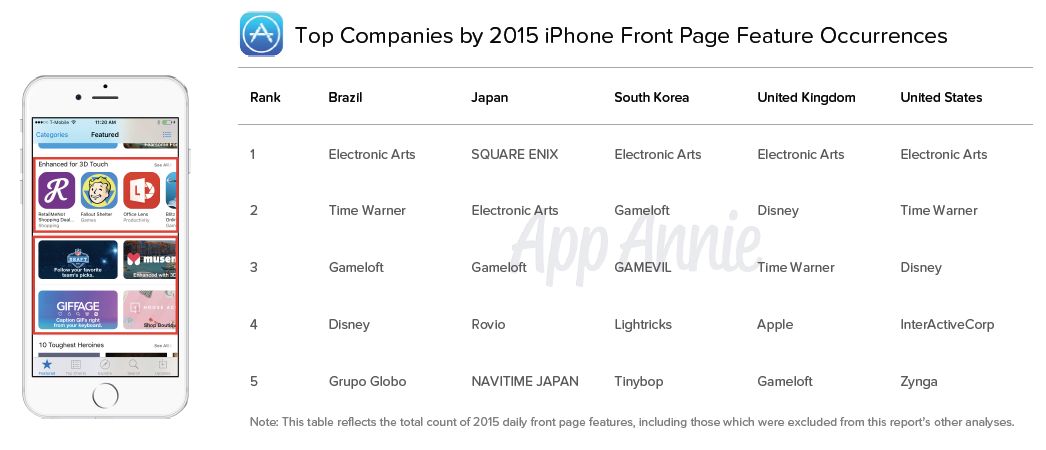
Certainly, it’s not a coincidence that major publishers keep getting their apps featured on the App Store. While the games from the top publishers are almost always well-polished, you can bet that the publishers have more resources to throw at the task of getting a game featured. Electronic Arts is highly successful at this, being the leading company featured in Brazil, South Korea, the UK, and the US—and number 2 in Japan. Getting your game featured in the Main Banner on the front page of the App Store is an even better feature position, and even harder to achieve. Once again, Electronic Arts has had great success with this, and Apple often uses it to feature its own apps.

The boost provided by feature placement in the App Store is something that a savvy marketer will build upon, using the increased user base to keep up organic install momentum. Advertising around featured placement is an important strategy. “Gameloft is unique by the diversity of games that it brings to the App Store. All our games have very high production values for each and every specific audience we target, enabling us to broaden the ecosystem. When Apple comes to the same conclusion and brings strong featuring support, there is often an exponential effect. We aim to advertise our games at the same time as featuring.” said Baudouin Corman, GM Americas at Gameloft.
Featured Apps By Company

Being a featured app is not sufficient in itself, but it sure helps your marketing. “Strong featuring doesn’t necessarily ensure the success of a title, but it goes a long way in launching and sustaining a successful app. We believe that great games and great brands are drivers of app store featuring, and we work closely with app store managers to showcase the products and features that their audiences want,” said Chris Heatherly, SVP and GM at Disney Interactive Games.

How Loot Crate Is Taking Over the ‘Geek Box’ Market

The “geek box” market has taken off ferociously, with companies from Geek Fuel to Super Geek Box offering mystery packages filled with toys and other goodies on a monthly basis. At the forefront of it all is Loot Crate, which still dominates the market.

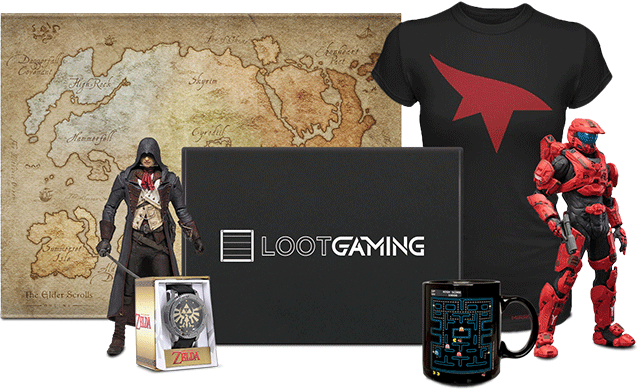
First established in 2012, the subscription box service quickly grew in popularity, with licensed items from popular brands from video games, movies and TV shows such as Doctor Who. Additionally, the company offers specialty crates that are focused on specific fandoms, including ones based on Star Wars (timed with the theatrical release of The Force Awakens), Aliens and Firefly. Others include ones built for anime fans, and a package devoted to dog owners, which is aptly named Loot Pets. This year, it continues to build steam, with the launch of its recent Loot Gaming package, as well as a forthcoming Loot Crate DX, which promises bigger and better things on the horizon.

The company has grown significantly, with millions of subscribers who share their love for the service through social media and unboxing videos that gain hefty view counts on YouTube. It has also formed a number of partnerships, including working alongside eSports team OpTic Gaming and anime streaming company CrunchyRoll.

Loot 2

[a]listdaily discussed the success of Loot Crate with CEO Chris Davis and chief experience officer, Matthew Arevalo, including how it was able to draw in some big-name partners, as well as what could be next down the line for the Loot Crate team:

ChrisDavis
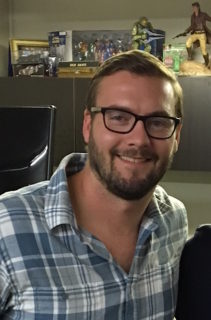
Chris Davis, Loot Crate CEO

What prompted the creation of a “geek box” business?


Chris: At the Los Angeles Startup Weekend where we officially launched, we pitched the idea of “Comic Con in A Box.” The goal was to bring the same sense of community and exclusivity to a Looter’s door every month that you got attending events like San Diego Comic Con. We wanted to be different from other “box” companies, by delivering a great experience beyond the crate and building a real community.

Your subscriber base has gone through the roof over the past few years. What would you say is the biggest key to success for Loot Crate?

Matthew: We are a service, platform and community completely dedicated to solving for the end subscriber (Looter) experience. We do not compromise the contents of the crates based on any outside factors that would diminish that amazing fan reaction. Our community is very welcoming to all types and is structured in a way to give a voice to fans that has never been possible before. Our brand partners from Marvel to Sony and Gearbox to Activision all understand that we are a unique, engaging and a creative way for them to get their biggest fans something they’ll always cherish. It all revolves around amazing products and extends beyond the crate interaction that includes original content, event activations and so much more.

How does the company get such great partners on board for Loot Crate packages?

Chris: Whether it be our specialty crates we’ve done for the Alien 30th Anniversary or our regular subscription lines, we work out relationships with the entertainment companies based around major tent pole events like movie premiers, game releases and other significant moments to curate items to celebrate those via themes. After theme selection, we use community feedback, subscriber surveys and user focus groups, as well as our internal teams, on each line to determine what will deliver the best value and impact.

What strategy goes into creating crates like Pets and Loot Gaming?

Chris: The reason we kept just the main core crate for so long before we expanded to Loot Anime, Gaming, Pets, DX, among others, is because we wanted to make sure that the experience of those lines wasn’t just strictly focusing on those verticals with a new name and subscription. We wanted to make sure the experience was unique, complimentary and interesting. Each line does include our signature support, quality and curation, while also providing its own unique take and presentation.


Matthew
Matthew Arevalo, Loot Crate chief experience officer

What has been the response to Loot Gaming?

Matthew: The buzz and reaction has really been incredible. We saw firsthand in a full capacity panel at PAX South, where we made the announcement of Loot Gaming, the crowd reaction and it has just been amplified as unboxings come in. Gamers in over 30 countries around the World have taken notice that our all exclusive offerings of the founder crate, along with continued digital offerings as part of every crate, have been able to surprise and delight with items recently from top franchises like Tom Clancy’s The Division (which includes exclusive in-game content), Fallout 4 and more.

What can you tell us about Loot Crate DX? 

Matthew: Loot Crate DX was created especially for fans who are interested in higher-end products, merchandise and collectibles. Loot Crate DX takes our flagship mystery box experience to the next-level by delivering even more exclusives and higher-quality geek and gamer gear from the biggest, newest and most sought after franchises.

Where do you see Loot Crate and the “geek box” business going in five years? 

Chris: We do not consider ourselves a “geek box” subscription. Thanks to our ever-growing and engaging community of subscribers, expanding product lines and experience based content around the products, we see ourselves as helping to fuel the passion in all fans. We have some exciting announcements occurring in the next few months that will really showcase this vision and provide even more ways to interact with our brand, including partnerships and new launches.