Twitter Exec Explains Power Of Social Media In ESports

Canadian media company theScore embraced eSports early by expanding its sports coverage with a separate theScore eSports site and mobile app back in February 2015 to include games such as League of Legends, Counter-Strike: Global Offensive, and Dota 2. Now the company has added Kirstine Stewart, the vice president of media for Twitter in North America, to its board.

The first female board member at the company, Stewart will directly apply her experiences directing Twitter’s media activities across the United States and Canada and its partnerships in television, sports, gaming, talent, music, fashion, news and government to help theScore expand its position in competitive gaming.

The former executive vice president with the CBC, Stewart was also a member of the 2016 NBA All-Star Game Steering Committee and an ambassador for the 2015 Women’s World Cup. In this exclusive interview, she talks about the opportunities in eSports today, and explains the role social media plays for the first sport born from digital.

Why did you decide to join the board of theScore?

One of my personal professional goals has been to serve on a board, and theScore has long been a company I’ve admired for its forward-thinking approach to sports media. With my background in tech, media and passion for sports, this felt like the perfect fit.

What do you feel differentiates this site from what ESPN, Yahoo and so many startups are doing in the eSports space?

TheScore has always been at the forefront of mobile sports. It was the first sports app on the iPhone, and the first media company to take eSports seriously by launching a stand-alone app. Their flagship app is the second most popular sports app in North America, and their eSports team is very much taking a leadership position in the space. All this makes for a very exciting opportunity.

What are some examples of recommendations you’ve given to the site from a social media standpoint?

It’s too early for that—I only officially joined the board less than two weeks ago, but I look forward to working with CEO John Levy and his team on continuing to push the company in the right direction.

What role have you seen Twitter play in the eSports space from a fan perspective, especially given its global real-time audience?

Twitter plays a huge role in eSports, just as it does with “traditional” sports. ESports, as an industry, is a digital native. Fans have grown up watching their favorite games and tournaments online, mostly. It’s possibly the first sport that’s risen to prominence without the need for mainstream television coverage. This makes digital media its natural home. And we know fans love engaging with each other, as well as with their favorite players and teams.

How have you seen pro players and teams take advantage of social media?

Conversations are taking place between fans, teams and players all the time. I love what my fellow Canadian and former NBA star, Rick Fox, is doing now that he’s the owner of Echo Fox. Rick has almost 250,000 followers on Twitter and is doing a great job of engaging with his fans and using his celebrity to bridge the divide between traditional sports and eSports, raise awareness for his team and increase the credibility of competitive gaming with the mainstream.

What differentiates the eSports fan from the traditional sports fan in social media?

I’m not sure there are huge differences. Both sets of fans use social media to react and comment on action from their respective tournaments and competitions in real-time.

How has Twitter connected with the livestreaming viewership of eSports fans?

Twitter has always been a great companion to live events, and we continue to see conversations happening there around eSports events as they take place. With “traditional” sports, we’ll soon be bringing the live event and sports conversation on Twitter together on a single surface.

What role do you see the TBS and ESPN broadcasts of eSports playing in growing the market?

The increase in television exposure tells us that eSports continues to break into the mainstream, but the vast majority of eSports fans continue to watch via online platforms. So while we wouldn’t expect this to have a major impact on viewing figures, it may help to convert any remaining eSports skeptics about its popularity.

What opportunities are there for brands and sponsors in eSports from a social marketing perspective?

Lots. ESports has a dedicated, loyal and engaged global fan base. Many large brands are already involved in eSports, and more will follow as it continues to grow in popularity and exposure.

Over one billion people are aware of eSports today globally according to Newzoo. Where do you see eSports five years from now?

Impossible to predict, beyond the fact that eSports is here to stay.
American Express’ Facebook Chat Bot Blends Finance And Contextual Tips

American Express has upped the ante in their social strategy by embracing Facebook Messenger chat bots in order to serve as a modern concierge for US cardholders.

The financial services corporation previewed their Amex bot initiative and demonstrated their pilot plans in an activation at Cannes-Lions Innovation festival in France last week by showcasing real-time notifications and purchase alerts, restaurant recommendations and more.

“Partnering with Facebook gives us the chance to explore different types of real-time features that are possible for us to deliver to our card members in Messenger, allowing us the opportunity to be a part of a card member’s journey every step of the way,” Matthew Sueoka, vice president of digital partnerships and development for American Express, told [a]listdaily in an interview. “The concept we demoed at Cannes shows how we can help card members who opt in to the Amex bot for Messenger stay on top of their purchases and take advantage of their card’s many benefits. The scale and flexibility of the Messenger platform makes it a powerful channel for us to explore new ways to connect with our card members.”

Expected to launch in the next few months for eligible US Consumer and OPEN customers, Amex describes a possible scenario unfolding like so: “For example, if a platinum card member purchases an airline ticket from Las Vegas to New York City, he or she would receive a purchase notification in Messenger and then may also receive a helpful reminder about how to access The Centurion Lounge at the airport, as well as restaurant recommendations, courtesy of The Infatuation, for the upcoming trip.”

Sueoka says the activation was designed to make the lives of their consumers simpler, easier and more streamlined, and that they look forward to hearing more from their card members in the coming months. For now, the bot will engage in dialogue through automated messaging consisting of answers to “yes-or-no questions.” It’s yet to be determined if deeper conversations will take place with cardholders and customer service representatives.

“There are a lot of possibilities in terms of what we can build on top of Messenger, and our team is thinking through the opportunities and is excited to test out these new concepts with our card members who opt in,” Sueoka says. “Given that this is a concept at present, we will have more details when the pilot launches.”

The finance giant didn’t become fast friends with Facebook overnight, either. The two platforms have partnered in the past in a series of Amex marketing initiatives including discounts and special offers based on “likes” and interest, as well as letting cardholders redeem their Membership Rewards points for Facebook Ads credit.

“Facebook was one of the first places we brought the Amex Offers platform, and it was a true jumping-off point for us,” Sueoka says. “We are thrilled to continue to work with them to offer innovative experiences for our card members.”

Amex is continuing to pioneer programs in digital innovation to further boost user engagement and loyalty. It’s a core company pillar further echoed in their 2015 annual report.

It’s also a strategy that brands like Bank of America, 1-800-Flowers and the NBA, which debuted a bot earlier this month just in time for the Finals, have already capitalized on after Facebook’s chat bot initiative that was announced during April’s F8 developer conference.

Mattel and Uber are just some of the others embracing and jumping on the big bot bandwagon, too. There are also startups like Sequel who enable brands and content creators by developing synthetic personas to engage users.

The chat bot infrastructures are already in place. Whether or not consumers will be engaged enough in an authentic way to continue the conversation remains to be seen.

Follow Manouk Akopyan on Twitter @Manouk_Akopyan

What Marketers Need to Know About Google AdWords Changes

The seismic shift you felt recently was caused by Google AdWords undergoing some fundamental changes. Some are positive, with new features coming to AdWords that promise to save you time and improve results. Others are more worrisome, with big changes in Google’s algorithms impacting search results in new ways, forcing marketers to adapt. In both cases, marketers are well advised to pay close attention, since whatever Google does has huge impact across the entertainment and software industries.

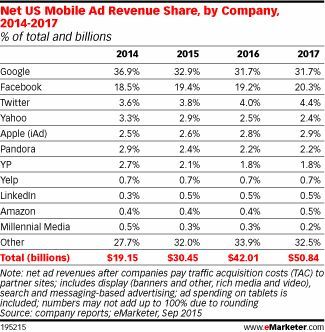
Google has been the king of desktop searches, but increasingly the company is shifting to mobile. As Google noted in its Inside AdWords blog, “Every year, there are trillions of searches on Google and over half of those searches happen on mobile. And across the millions of websites using Google Analytics today, we’re seeing more than half of all web traffic now coming from smartphones and tablets.” Therefore, Google has rolled out a number of changes in recognition of this increasingly mobile-first world. Google’s the strong leader in online advertising, and it intends to remain that way despite the challenges from Facebook and others.Mobile Ad Revenue

Google now makes its Universal App Campaigns (UACs), first introduced for Android apps, available on iOS. UACs allow app developers to quickly and easily create and launch mobile app install campaigns, with the the interface merely picking up some details about the app then generating creative assets that are sent off to run. Those campaigns delivered more than two billion downloads for advertisers across Google Search, Google Play, YouTube and the Google Display Network. Google has also reformatted its text ads to work equally well on mobile or desktop, and later this year will provide expanded text ads that will allow more prominent headlines, longer description lines and let you customize your URL path.

Another change Google is rolling out is what the company dubs responsive ads for display, which adapt to the format and aesthetics of sites on the Google Display Network. These campaigns are created dynamically once you give them a few pieces of information, grabbing assets from Google Play with images and text you provide. The ads created this way match the look and feel of content users are browsing. This comes along with Google allowing access to cross-exchange inventory, which will include more websites and apps worldwide. Also, Google is allowing you to optimize campaigns around in-app events, not just around installs. (Many mobile ad networks already do this, of course, but it’s useful to have in Google, especially with UACs.)

Google’s also increasing ad exposure in YouTube and is experimenting with a new ad unit in Gmail. Now, this shouldn’t be taken as a sign that Google’s ad revenues need boosting—the opposite is true, with Google’s ad revenues climbing at a rather impressive rate. The company booked $19.08 billion in ad revenue during Q4 2015, up 18 percent over last year, while cost-per-click (CPCs) have been flat or declining since Q3 2014. YouTube, in particular, is showing impressive growth, with overall revenues for 2016 projected to hit $12.8 billion, up from $8.5 billion last year. Certainly some of that is due to the subscription revenues from YouTube Red, but there’s plenty of extra ad revenue in there, too.

There’s also a new unified bid structure allowing you to set individual bid adjustments for each device type, between mobile, desktop and tablet. Google will give you wider range to adjust bids up to 900 percent of the base value. Eventually you’ll be able to manage bids for all devices in a single place and anchor a base keyword bid to the device most valuable to you, and then adjust that bid up or down for other devices. It’s a recognition of the multiple-device world we live in, and the fact that not all products are searched for and purchased at the same rate through different device types.

Perhaps more important than these AdWords changes are the changes that Google has announced to how they’re searching and ranking websites. For the first time, Google has revealed the top-three ranking signals that their algorithm uses. In the past, Google has noted that there are more than 200 parameters the algorithm uses, but never before has Google revealed the top parameters. Last year Google announced their article intelligence system, RankBrain, was their number three ranking signal. This year at a Google Q&A in late March, Google Ireland’s search quality senior strategist Andrey Lipattsev revealed the other two factors: links and content. Queried further about their relative importance, Lipattsev said there was “no order” to their importance, meaning all three are at the top.

The message from Google has been clear: Don’t get caught with old content on your site, or risk heading to the bottom of the rankings. Google’s been pushing this for a while, trying to weed out content farms, companies with static websites and even a few giants like eBay have been seeing their rankings drop.

Now, though, some of the biggest publishing brands in the industry have watched their rankings drop with the changes to Google’s algorithm. There have been some massive hits at some major players—TheAtlantic.com lost 80 percent of its SEO visibility, and Wired.com lost 65 percent of its mobile visibility. Even Apple dropped 63 percent, though, it’s not a publishing company. These are not trivial differences.

There are signs that branded search results are getting redone, with even Google’s own Gmail seeing its mobile visibility lowered. There was some speculation that it was only mobile, but the data showed that desktop sites had taken similar drops. “Google was serious about ensuring companies migrated to the focus on new and differentiated content rather than relying on existing content to maintain its search engine rank,” said Shai Aharony, founder of Reboot Online.

The message from Google is that content marketing needs to be fresh, not just repurposed content with a few minor changes. Google’s algorithm won’t be fooled by some cosmetic changes. Marketers need to think about more in-depth strategies for content marketing, and include social media content, links and apps in the mix as well. That may mean conducting research, finding customer stories to tell, or finding ways to have customers help in generating more content. Marketers, start your content engines! You can’t take your search position for granted any more if your content is not being refreshed regularly.

Bang & Olufsen Exec Discusses How They’re Making Sound Decisions In New Tech

Legacy companies that have century-long strongholds in their respective markets sustain prime peaks by serially executing sound decisions. Luxury Danish brand Bang & Olufsen is no exception.

Their first significant product was a radio—remember those, kids?—and they’ve gone on to corner the high-end audio-visual market with distinctive designs ever since both inside and outside of the home. The premium sound they bring is a mainstay for car manufacturers like BMW, Mercedes, Audi and Aston Martin.

Simon Silva, Bang & Olufsen’s global customer experience manager, joined [a]listdaily to discuss how the company is implementing and marketing new technologies.

AAEAAQAAAAAAAAbzAAAAJDNmMTVmNjdkLTBjMzktNDk5MC04MDJkLTlmMjBhNzdlYzJhZQ

Bang & Olufsen has been around for 91 years. How are you trying to constantly reinvent yourself within your respective position?

Bang & Olufsen is really proud of the heritage that has been built over the last 91 years, and that has been built by sticking to our core values. It’s about using our pride, passion and persistence to deliver those enduring magical experiences through our products and integrated experiences.

How are you reaching out to global markets? And how do people respond?

We use traditional channels for communication but we’re putting a greater emphasis on our digital communications. The response has been really positive as people love to know more about the brand. We are over 90 years old now. We have so many interesting stories to share from the meticulous craftsmanship that goes into our products, to the freelance designers we use.

What is the foremost trait you’ve learned about your customer base?

‘Time’ for our customers is the ultimate resource, so it’s important that we offer luxurious simplicity and beautiful utility. The BeoSound Moment is a great example of this. The luxurious simplicity is delivered through the premium materials of the oak and aluminum finishes and only requires a single touch to instantly access your music. The beautiful utility is shown through the gorgeous user interface where you can use the MoodWheel to set the mood, or go through and play your curated playlists.

How do you measure customer touch points and develop strategies specific to them?

We use our CSI reports, our social media channels, talk directly with customers and also spend time on the shop floor. In order to develop the strategies, it’s about having a variety of inputs from our customer insights research, looking at retail trends and talking to our teams on the shop floor who are with the customer day-to-day.

10333826_10152024016631607_5604106993888365604_o

Bang & Olufsen makes TVs, audio systems and home automation products. How do you market the products to differentiate from the pack?  

We do what we do best—which is deliver beautiful sound, iconic design and seamless integrated experiences.

How is Bang & Olufsen leveraging augmented reality, virtual reality, and other immersive experiences?

Our first project to leverage these great technologies is through the BeoHome Design App. The BeoHome Design App lets you digitally visualize the different Bang & Olufsen products in any given space. You can choose between all the different speakers, sound systems and televisions and place them wherever the camera on your iPad is pointing.

How can forward-thinking brands best utilize AR and VR technology?

Brands need to look at the customer journey and see at which points the experience can be enhanced through these technologies. It has to be really purposeful, with the end result being to put a smile on the customers face and to solve a need. Simplicity is key.

Follow Manouk Akopyan on Twitter @Manouk_Akopyan

https://www.youtube.com/watch?v=MSy7GpNXTc0

Sacramento Kings Exec Explains Why Team Is Exploring VR, Video Games And ESports

The sports world is still abuzz about the 2016 NBA Draft—which has taken place on the heels of the most-watched NBA Finals Game 7 in history with LeBron James and the Cleveland Cavaliers upsetting the Golden State Warriors for the world championship.

As the 2016-17 NBA Season gets ready for tip-off in October, one of the big stories will be the grand opening of the Sacramento Kings’ Golden 1 Center. The Kings have been one of the leading teams in exploring new technology, including both augmented and virtual reality, over the past two years. The team also recently partnered with 2K Sports to integrate its new uniforms into NBA 2K16 and used virtual reality to showcase the uniforms for fans.

Ryan Montoya, chief technology officer of the Sacramento Kings, talks to [a]listdaily about virtual reality, video games and eSports in this exclusive interview.

What did your 360-degree game livestream reveal about the type of publicity and activity VR opens up?

We’re committed to using technology to enhance the fan experience, not only in-arena, but in the community and across the globe.

VR allows us to give basketball fans who are not able to experience a game live the opportunity to do so. In October, at our home opener, we used VR to provide kids at a school in India and patients at a local Sacramento children’s hospital the opportunity to virtually “attend” the game and “sit” courtside.

Around the world, there are fans who may never have the chance to be a part of the spectacle of NBA basketball and VR has allowed us to connect with emerging fans, find new ones and provide a truly unique experience.

Why did you decide to explore virtual reality with the launch of the new uniforms?

With a focus on using technology to enhance the fan experience, it was natural to debut our new uniforms in an interactive and innovative way. The VR experience allows us to provide fans a unique all-access 360-degree perspective of the uniforms.

What are the advantages of VR at this early stage of the technology?

At the Kings, we are huge believers in VR. In fact, last year we announced a strategic investment in VOKE, a leading VR innovator. We believe this technology has enormous potential and the possibilities for its application are endless.

We were the first team in the NBA to experiment with VR two years ago to help us provide fans, potential sponsors and ticket holders an opportunity to experience the innovative design features of our new arena, Golden 1 Center (opening in October), in an innovative and creative way. It powered our ability to completely sell out of all suites, courtside seats, and club spaces largely before construction even commenced.

When Golden 1 Center opens, we look forward to sharing the excitement of the NBA in new and exciting ways. Using VR technology that is device-agnostic and allows fans to select their views and direct their own experience will allow us to do just that.

What role is mobile devices, including Google Cardboard and Samsung Gear VR, playing in introducing consumers to VR?

We’ve had great success introducing VR to our fans, using the Oculus Rift demos at the XC to preview select spaces in the arena. We’re also using Cardboard viewers to share views of Golden 1 Center with prospective ticket buyers while in their seat at the Sleep Train Arena. Our fans are able to experience the new uniforms through VR in our Arden Fair and Galleria at Roseville team stores, introducing them not just to the uniforms but to VR as a whole. Team store staff are on hand to walk fans through using Gear VR headsets with the 360 video loaded in.

How are the NBA players enjoying VR?

NBA players, like their millennial fan base, are incredibly tech savvy and interested in the latest trends and devices. They are quick to pick up new social networks, recognizing the value of their personal brand and engaging with their fans. As a result, there’s naturally a lot of excitement in our locker room about the next-generation tech we will be debuting at Golden 1 Center. When it comes to VR, many of our players have shown an interest after experiencing our immersive preview experience of the new arena. It happens every time we bring in new technology, like Google Glass broadcasts during warm-ups or a VR photo shoot, the team is curious and wants to learn more.

Does the excitement cross over to NBA fans?

The NBA’s popularity is not confined to the United States. Across the world, massive NBA fan bases are present in Europe, China and India in particular. For fans who may never have the chance to step inside an NBA arena, new technology such as virtual reality is a hit because it brings them closer to the game. We’ve had great success with using VR to preview Golden 1 Center for fans and also to reach new fans who may otherwise never have an opportunity to attend an NBA game.

How are you working with 2K Sports to use NBA 2K16 as a platform to connect with gamers? 

The NBA has the youngest fan base of all major sports, and they’re connected to social media platforms and video games. There is huge crossover between the gamer community on 2K and our fans that engage heavily with us across our digital channels. By partnering with 2K, we’ve been able to share our jerseys with the global gaming and NBA community, allowing them to be the first to see them in action.

The new uniform system is available to download in-game and for customization of My Player profiles. For the launch, Kings center Willie Cauley-Stein visited 2K’s studio, where he had the chance to debut the new uniforms over NBA 2K’s daily livestream and speak directly to the gamer audience.

What does this gaming platform open up for the Kings?

Collaborating with NBA 2K to release our uniforms allows us to engage with fans where they are spending their time online. Fans have already been downloading the new uniform system in-game and customizing their My Player profiles.

Andy Miller said that the new Kings stadium has been “designed for eSports.” What opportunity do you see eSports opening up for the stadium?

When Golden 1 Center opens in the fall, it will be the world’s fastest, most-connected arena. Our unparalleled internet connectivity (over 17,000 times faster than the average home Internet connection) combined with the largest 4K Ultra HD indoor video board is ideal for eSports, as well as drone racing and robot competitions. ESports—just like concerts, trade shows and graduations—provide another opportunity for the community to engage with the arena and its benefits, and for Golden 1 Center to help bring more visitors and positive economic impact to downtown Sacramento.

We’ve also seen the NBA and 2K enter eSports with NBA 2K: Road to the Finals this year. How do you see turning the NBA 2K video game into a “sport” helping the Kings engage the younger NBA audience?

A huge part of basketball’s appeal and popularity is how easy it is to play the game, regardless of whether you’re part of a team or by yourself, inside or outside. The NBA has one of the youngest fan bases of a major sport, and as these audiences become more technologically savvy, they will start to look for new ways to engage with the game.

We see eSports and multiplayer game modes as the next step for fan engagement with the game of basketball, just as video games were before them. Being able to play five-on-five basketball against five other gamers helps to create that same team feel from the court, only this team is made up of players from around the world at any given moment.

How The Minnesota Vikings And 3M Scored A Partnership And Built U.S. Bank Stadium

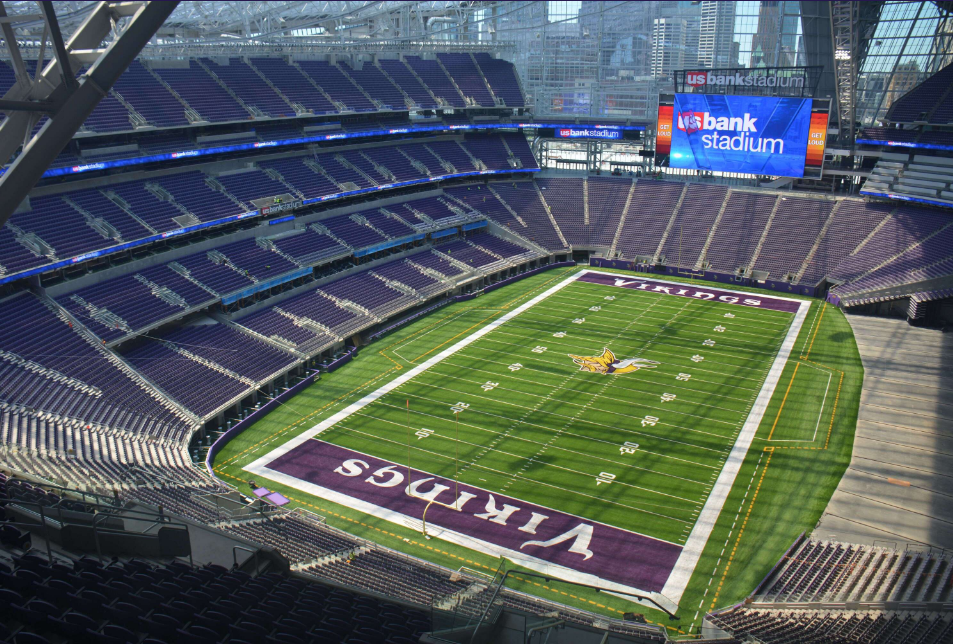
The Minnesota Vikings will become the latest football franchise to play in new digs when they officially open U.S. Bank Stadium’s pearly purple gates against the arch-rival Green Bay Packers on September 18.

The 66,200-seat stadium is already towering over the Minneapolis skyline and is five weeks away from hosting its opening event in a Premier League match between Chelsea and A.C. Milan. The official ribbon-cutting ceremony is July 22.

Construction of the stadium—which first began in April 2014—is basically a few screws away from completion. The building could not have been erected without the help of 3M, another Minnesota institution and official science partner of the Vikings who contributed with more than 50 of their products, including graphic films and architectural finishes, throughout the stadium.

Attendees will be able to see 3M technology from all parts of the cavernous abode that’s twice the size of the since-imploded Metrodome. Football fans may best remember the Vikings’ outdated stadium as the surreal scene to a mountain of snow forcing its roof to catastrophically collapse hours prior to a game in 2010.

Since winter has no intentions of ever leaving Minnesota, U.S. Bank Stadium will have a clear, lightweight and self-cleaning roof. 3M introduced their industry-leading science-based technology through Ethylene Tetrafluoroethylene polymer (ETFE), a clear, lightweight film used on the roof panels.

Most NFL prognosticators are predicting that the Adrian Peterson-led Vikings and its prodigious defense will advance deep in the postseason during their inaugural year playing in a $1.1 billion state-of-the-art, multi-use facility.

[a]listdaily caught up with Nick Harris, 3M’s senior sponsorship and events manager and Jeff Anderson, the Vikings’ executive director of communications, to discuss some of the science and marketing behind Minnesota’s newly minted marvel.

Screen Shot 2016-06-23 at 1.35.59 PM

What are some ways 3M applied science in the construction of U.S. Bank Stadium?

Harris: Vikings fans will be surrounded by 3M technology—from the graphic films covering walls and DI-NOC architectural finishes in concessions, to the unique film that was used to create the clear, lightweight and self-cleaning roof—the first sports facility in the US with this kind of roof. 3M fire barrier products will also protect the stadium for years to come. Even during construction, 3M technology helped builders stay safe through personal safety products like respirators, eye wear, helmets and hearing protection.

How does the science behind ETFE and the clear, self-cleaning roof work?

Harris: The stadium will be covered by high-performance film, extruded from 3M Dyneon ETFE. The product lets light in, is lighter than glass, and is more cost-effective than retractable alternatives. The stadium’s 248,000-square-foot roof and facade is covered by 75 three-layer ETFE film cushions, making U.S. Bank Stadium the largest ETFE film project in the US. Some of the individually air-filled cushions are more than 1,200 square feet long and about 32-feet wide. The top film is printed with a geometric pattern, which scatters the sunlight and prevents a greenhouse effect in summer. In winter, the film roof protects the interior from the cold outside temperatures. The film cushions allow 95 percent of daylight to pass through, but their weight is only about five percent of the weight of glass. As a result, the supporting steel structure is light and slender, offering spectators a premium view of the playing field.

Open-air football stadiums are not often a viable option in northern climates. The Dallas-based firm HKS Architects chose the ETFE film cushion technology, which is already widespread in Europe and Asia, to enable year-round use for a variety of events. The design lowered construction costs by around $100 million compared to a retractable roof. Since the Metrodome’s roof collapsed in 2010 under the weight of a 17-inch snowstorm, architects and roof planners paid particular attention to the load-bearing capability under heavy snow falls. Compared to other roofing membranes, ETFE films feature superior values for tear strength, resistance to tear propagation and puncture resistance—which let the air-filled cushions easily cope with highly concentrated impact loads like hail. Their use in northern Europe and the Alps prove their winter compatibility in areas with heavy snowfall. U.S. Bank’s asymmetric roof inclines more toward the north to fend off the snow. The films are so smooth, snow can hardly get a grip, sliding off in an almost controlled manner. A heavy rain shower is enough to clean it.

tempBerg-160521-7799--nfl_mezz_1280_1024

Why did the Vikings choose to form a 20-year partnership with U.S. Bank for the naming rights?

Anderson: U.S. Bank is a prominent and respected Minnesota institution that carries a deep commitment to the economic and social well-being of the state. We are proud to partner with them on both U.S. Bank Stadium and the Places to Play program, which will benefit communities throughout Minnesota by further creating safe, quality and accessible places for kids to be kids.

More than fifty 3M products were used during the design and building of the stadium. Will you be highlighting any of this prior to the start of the season as part of your marketing plan?

Harris: We’re so proud of our involvement with the Vikings and our partnership to help create the most advanced US sports facility. Our customers are already familiar with many of the products in the stadium, but having them in one location gives us a great platform to share and spark further conversation.

How will the 3M-branded first aid stations work? Will it help fans cope with devastating, last-second losses?

Harris: We predict an undefeated season at home for the Vikings in their new stadium! The ACE brand by 3M will be the preferred supplier of first aid stations in the stadium, and we plan to provide bandages, wraps, ice packs and an array of other first aid products that can help fans who need assistance.

tempbest-of-2013-adrian-012214-ah012214--nfl_mezz_1280_1024

A new $1.1 billion stadium offers a tremendous opportunity to further build a team’s brand. What is the Vikings’ integrated marketing plan around U.S. Bank Stadium heading into the season?

Anderson: From day one with this project the focus for the team has been about the fan experience. U.S. Bank Stadium will offer an unmatched fan experience and will open unique ways in which we can further develop our relationship with Vikings fans. We are incredibly excited about our new opportunity to speak to fans on all levels, from advertising and commercials, to in-stadium production and experience, to regional marketing events and activities. We now have the ability to reach fans in so many different ways all over the North.

3M and the Vikings are both Minnesota staples in the community, and that marriage makes plenty of sense. What are the main factors for 3M identifying other potential sponsorship partners?

Harris: The partnership with the Vikings is a great opportunity to share stories that highlight 3M science applied to life with a broader audience of sports fans around the country and around the world. Aside from the opportunities it brings us, we are just plain proud of our Minnesota heritage and are excited about the home-team partnership. As for other sponsorships, we look very carefully at the business value and alignment with our business goals before moving forward with any sponsorship decision.

How do the Vikings plan on leveraging its own brand, and the 3M brand, over the lifetime of the partnership?

Anderson: As a strong Minnesota brand, 3M is synonymous with science and innovation. Certainly those characteristics go hand in hand with enhancing the fan experience and growing the passion for football and the Vikings, so we look forward to working with 3M on those possibilities. Additionally, we always want to help our partners leverage the Vikings brand. We work with each partner individually to find what works best for them and fits their goals.

Follow Manouk Akopyan on Twitter @Manouk_Akopyan

https://www.youtube.com/watch?v=L3x1sbhWvMo

Take-Two CEO Strauss Zelnick Discusses ESports, Sequels And More

Take-Two Interactive had one of the most impressive E3 booths this year with its recreation of a two-story New Orleans French Quarter building, which celebrated the upcoming launch of 2K’s Mafia III. The game publisher also promoted its bestselling franchises WWE 2K17, NBA 2K17, Sid Meier’s Civilization VI, and XCOM 2 at the annual trade show.

The company is on a roll, having completed its 2016 fiscal year with GAAP net revenue of $1.414 billion, up from to $1.083 billion last fiscal year. Thanks in large part to the success of Grand Theft Auto Online, GAAP net revenue from digitally delivered content grew 53 percent year-over-year to a record $697.7 million.

Strauss Zelnick, who has served as CEO of Take-Two since January 1, 2011 and chairman of the company since March 2007, talks to [a]listdaily about the potential eSports opens up for the company and the challenges of launching original games in today’s market.

What impact does eSports play as new games like a Battleborn or Evolve are being developed?

Everyone who is in the development community is mindful of eSports, but I don’t think we’re yet at the point where we would want to design a game around the hope that it will become an important eSport. Everything that’s going on in the marketplace informs our thinking, but it’s too early to say that we would actually be designing games around the possibility of them appealing to an eSports audience.

What happened with Leagues of Legends was very organic. The folks at Riot very cleverly made the title available and, over time, began to modify it. In fact, that title really speaks to almost all of the revenue that is eSports-related in the business now. But it feels like the audience voted, more than the company decided. And we think that that’s probably about right.

We suspect that’s how eSports will develop going forward, but naturally we have to be mindful about the opportunity and try to pursue it. So our own view is that fewer than 10 games in the coming years will be meaningful for eSports. We certainly hope to have one or more of them, but it probably would be pushing it too far to say that we’re actually developing titles in that direction.

What are the challenges of launching a new IP such as Battleborn into today’s sequel-driven ecosystem?

Markets always have sequels, and the best companies always put out new intellectual property. Because we’ve been launching new intellectual property ever since we took over the company in 2007, we now have 11 franchises with at least one 5 million-unit-selling release and 50 individual multimillion-unit-selling titles. We’ve launched nine new brands since 2007, including Battleborn, Bioshock, Borderlands, Carnival Games, Evolved, The Darkness, WWE, and XCOM, so we are believers that you keep the business fresh. It is challenging. It is risky. It doesn’t always work out the way that you would hope, but we’ve been very pleased with the results.

That said, they have to succeed from a quality point-of-view. Our aim is to maintain our reputation as a company with the highest Metacritic scores for a third-party publisher. We’ve had that mantel for many years, and hope to continue to do so. So with the caveat that you have to deliver the highest quality, both with new IP and sequels.

One differentiator between games and Hollywood is that game sequels often explore brand new stories and locales. What’s the challenge of delivering sequels such as XCOM 2, Mafia III, and Civilization VI to gamers?

It does happen sometimes in the movie business as well, but I agree it’s more typical in the interactive entertainment business where you hang on to the brand, you hang on to some of the themes, and you feel empowered to change any number of other things including the lead characters—which typically wouldn’t happen in linear entertainment experience. But that’s one of the many ways that interactive entertainment is different than motion pictures or television. The gameplay and the brand are the stars, and the characters can come and go. That’s exciting creatively. It allows us to do really extraordinary things.

Can you explain how Grand Theft Auto Online’s content extends the life of the game with a recurring revenue stream? Does this represent a major shift in the gaming industry?

You make a very good point. In fiscal 2016 our recurrent consumer spending was at its highest level ever and that counted for over a quarter of our total revenue, which is extraordinary. That’s an 11-fold increase since 2011 when the business was nascent. So at present, consumer spending is essentially digitally distributed revenue that isn’t full game downloads, so it would be downloadable content, virtual currency game payments, and the like.

The business used to be big physical releases, and people would show up and buy them or not, and eventually the titles would be reduced in price, and they were cataloged, and then we’d be out of the market for a while. What’s exciting about staying engaged with the consumer with digitally distributed content of all types is that we can keep the brands alive, build franchises, and continue to delight consumers in between these big physical releases and we can create revenue and profits as we do it.

Specifically with regard to GTA Online, this has been a really extraordinary story. The title is nearly three years old and the fourth quarter of the last fiscal year were respectively the best quarter and the best fiscal year ever for Grand Theft Auto Online in virtual currency sales. And those sales are obviously attracting engagement, and engagement is tracking delight, and that’s what we’re here to do. Grand Theft Auto V has sold over 65 million units. It remains the highest-rated title on Xbox One and PS4 and it has become clear that—for an age-appropriate audience—when you get new hardware, you need to have Grand Theft Auto. And when you have Grand Theft Auto, generally speaking, you connect to the internet. And when you connect to the internet, generally speaking, you try Grand Theft Auto Online. We’ve remained excited and gratified by it.

How do traditional paid games complete in today’s market when there is so much competition from the free-to-play world?

I’m not sure the competition is free-to-play with console games, because they’re still very different experiences. The bulk of the free-to-play market are games that you consume on smartphones for short amounts of time. The demographics are more female than male. Whereas for console and PC titles, it’s a few more male than female, and they tend to reflect deep engagement. Both can be really interesting. There’s no doubt that the free-to-play ecosystem is popular. It’s highly competitive because budgets are lower. The engagement levels are lower. The audience is unforgiving and fickle, and it’s not clear you can transition your users from one title to another, although some have tried.

Coors Light Cracks Open A Can In Virtual Reality

YouTube made a big bet with 360-degree video last year, and brands quickly capitalized by getting creative on the platform with their integrated marketing campaigns. They’ve since introduced a live component, and the ad opportunities have proven to be aplenty since no headset is required to view the premium content.

Brands are quickly recognizing there is a demand for VR and 360-degree video by listening to consumers—and they’re delivering. According to Google data, global search interest for virtual reality on Google has grown nearly four times in the last year.

Enter companies like Coors Light, who are taking a nice cold crack at VR for their new “Climb On” campaign, a three-video series implementing the immersive technology that’s designed to appeal to a millennial’s thirst for adventure.

Each video—which features whitewater kayaking in Queensland, downhill biking in Cairns and big wave surfing in Tasmania—ends with twenty-something adventurers cracking open a cold can of Coors Light. 

Brendan Noonan, marketing director for Coors Light, joined [a]listdaily to discuss what new ideas the beer brand is brewing to broaden its reach.

Screen Shot 2016-06-23 at 3.04.22 PM

What is the “Climb On” campaign designed to accomplish for Coors Light? What’s the message? What prompted Coors Light to begin implementing VR and 360-degree video? 

Coors Light is committed to inspiring people to climb their personal mountains, and to celebrating the perseverance that makes the climb worthwhile. The new virtual reality and 360-video technology struck us as a fun, interesting way to bring that brand purpose to a much wider audience of beer drinkers. We started by creating the virtual reality program aimed at boosting our consumer engagement in bars and restaurants, with our distributors ordering more than 90,000 VR viewers. Extending the program to our social media platforms through 360-video is allowing us inspire our fans online, as well.

What did you learn throughout the production process? How will you measure success?

For these videos, we’ll primarily look at the level of consumer engagement to gauge success. In the on-premise, that means how many people view our VR videos and are then inspired to share their own climb on social media. With the 360-videos online, we’ll be looking at the amount of time people spend viewing the videos and how many times they’re shared.

What is the best way for brands to approach this immersive storytelling format to further engage with consumers?  

Whatever marketing tool you’re using, it works best when it’s clearly in service of your brand positioning. For Coors Light, we believe VR and 360-video is a tool that makes a lot of sense because it’s such a powerful way to bring to life our “Climb On” positioning.

Why do millennials respond better to marketing involving adventure and new experiences?

Much of the reason we’re so excited about the “Climb On” positioning is that it transcends age, gender and ethnicity. It’s about the mindset of embracing new challenges as exciting opportunities rather than daunting challenges, and anyone can have that mindset.

How do you plan on using VR and 360-degree video in the future? 

We’ll see how this initial foray into VR and 360 goes for us, but if the early results are any indication, you can expect to see more on this front from Coors Light in the future.

Follow Manouk Akopyan on Twitter @Manouk_Akopyan

https://www.youtube.com/watch?v=cw_DfTjwHgs


https://www.youtube.com/watch?v=OWwnYOsN16w

‘Kill Shot Bravo’ Takes China’s Mobile Gaming Market By Storm

China has the largest mobile gaming market in the world, so it’s no wonder why so many developers are eager to enter the market. That’s no easy task, given how there’s no Google Play store to centralize Android app purchases. However, the Canadian studio Hothead Games, maker of the hit action shooter Kill Shot Bravo may have the key to taking on this important market. In partnership with Cheetah Mobile, the company is winning over Chinese players. The developer announced today that Kill Shot Bravo debuted at #5 on the Chinese iTunes App Store, demonstrating the game’s global appeal.

Vlad Ceraldi, Hothead co-founder and director of development, talks to [a]listdaily about how Kill Shot Bravo is taking hold in the Chinese market, and how the free-to-play game has become a global phenomenon.

Vlad_Ceraldi
Vlad Ceraldi, Hothead Games co-founder and director of development

What is Kill Shot Bravo about?

Kill Shot Bravo is one of the most popular first-person shooter games on mobile in the world, enabling players to step into the role of a Special Forces soldier who must navigate secret missions across the globe while eliminating hostile forces that stand in the way of a peaceful world. The game includes a very unique real-time player-versus-player mode that allows players to test their skills against other snipers in live ranked matches, as well as a new Alliance Mode that takes social multiplayer FPS action to the next level.

How is Kill Shot Bravo the ideal game to bring over to Chinese audiences?

Chinese audiences love fast-paced action games with intense graphics, and that’s exactly what Kill Shot Bravo provides. In fact, the game seems to have universal, worldwide appeal, as we have noticed that players have been finding it in the app stores from countries all over the globe. But it was the game’s mix of heart-thumping action and extremely detailed graphics that made us decide to bring it to China.

What do you think Chinese players are looking for in a shooter?

Aside from action and graphics, a good shooter game must also deliver a compelling storyline and a plot that really engages the player. This is true in China and throughout the world. Chinese players, in particular, go through content much faster than most other players, so it was important that we created a faster release schedule that gave Chinese players the new levels and content they craved.

Bravo-China-Ad2

Did any significant changes to Kill Shot Bravo need to be made in order to appeal to Chinese players?

Along with the new publishing schedule, we also had to tweak the economy a bit to better fit the payment behaviors of Chinese players, and we reduced the difficulty of the first several levels so that Chinese players could get deep into the gameplay a little faster. We also worked with Cheetah to create a custom pricing, sales and promotion schedule specific to Chinese audiences.

What are the challenges of bringing a mobile game to China, compared to publishing it in Western countries?

One major challenge was working with so many different Android app stores to get the game published, as opposed to just being able to focus on Google Play here in the West. So it was important that we work with a partner like Cheetah, who had contacts at all of the major app stores, including the iTunes App Store, to make sure it got noticed and received the attention it deserved. These efforts were very successful, as the game was featured by several of the app stores and garnered lots of very positive reviews.

With multiple Android stores in China, how do you promote a game in such a large country with no central store like Google Play?

That’s exactly right. You have to work with Android stores like those on Tencent, Youku, Baidu and many others. So it’s a lot more work, but in the end, it creates an advantage if you can master all of them, because so many game developers just focus on maybe one or two.

Will other Hothead-developed games soon be making their way to China?

Our China team is actively working with new and our existing partners to publish all of our new shooter titles that are currently in development. Watch this space as we will be announcing our schedule of new games very soon. We believe that they all have potential in this very important market for us.

Is E3 Still Relevant? Marketers Say “Yes”

Last week, it became apparent that E3 as an event was in a state of transformation. Not only is the definition of “electronic entertainment” being redefined to encompass virtual and augmented reality, but the once hallowed industry-only walls were being broken down by an urgent need to reach the community which supports it. Via livestreaming, EA Play and E3 Live, E3 is becoming gradually more open to the pubic to ensure its relevancy.

The question of E3’s continued relevancy had been on a lot of people’s minds—so much so that Kotaku even penned “People Sure Like Asking If E3 Is Still Relevant“—which is basically a compilation of articles much like this one. Naturally curious, we set out to ask marketers at E3 why they were there and why E3 is critical to them. As it turns out, there are a lot of passionate proponents of E3’s importance and influence.

“E3 has certainly evolved and I think we’ll continue to see more evolution and more change. How we market and how we put together games 10 years ago is not the same as what we do now,” said Candace Brenner, senior director of global marketing at Daybreak. “I think that’s why E3 is adding that element of consumer because they realize how vital our players are to the fabric of the industry.”