Mazda Exec Discusses Autonomous Driving, Virtual Reality And Video Games

Mazda’s metamorphosis from a Japanese marque to an American automobile mainstay has mostly been possible thanks to stellar marketing.

Whether it’s hitting the streets of Austin for SXSW as a sponsor giving free rides to attendees, or introducing massive multichannel content campaigns highlighting its “kodo” design language, the car manufacturer is taking consumers on a journey under the modus operandi “Driving Matters” while positioning themselves as an upscale driver’s brand.

Eric Watson, Mazda’s marketing director who’s worked a slew of positions for companies like Land Rover, Jaguar and Ford throughout his career, joined [a]listdaily to discuss how the company is approaching autonomous driving and other immersive technologies.

Mazda was named “Best Car Brand” by U.S. News & World Report in 2015. How are you building a marketable brand profile to customers this year? 

Mazda has a very unique customer base who appreciates the joy that driving brings, and really, our marketing campaigns are designed to do that: to connect with people around one of their passion points around driving. Last year we launched a campaign on how a car is used in your daily life to bring that level of excitement and passion.

How would you describe the typical Mazda driver?

A Mazda driver appreciates their car. It’s more than going to point A and Point B. They like the driving experience. They like the way a car looks. They like the way a car feels in their hands, and how it responds to their inputs. And that’s the story we’re trying to tell . . . as a car brand, you really have to carve out what your niche is, and what you stand for. We want to connect with people who love driving.

Mazda announced it had its best annual sales year in two decades. What do you think was the cause for this?

I think we have a great product lineup, both from a design aesthetic and also from the engineering and technologies that go into our cars. We’re really at a place that’s connecting to our target customer with our message.

Would you consider the Miata the flagship car for Mazda?

We certainly have a great product line across the board. It’s a favorite of many people. It’s the best-selling roadster of all time in the world. It’s certainly a flagship in design and performance of what our philosophy is around of “Driving Matters.”

Mazda and Microsoft teamed up last year to bring the 2016 Mazda MX-5 to Forza Horizon 2 for free, as well as a chance to win an actual, real-life version of the MX-5. How does Mazda engage with video gamers? 

It was really a multi-faceted campaign that occurred over a six-to-seven-month time period. Not only was it an inclusion in the actual game with both our heritage cars and our new car, but we also had online contests within the Xbox system where people got to interact with Mazda through design contests. We took that partnership to SXSW (in 2015) where we invited people that raced over a couple month’s span to continue that competition and had an activation there, and also E3 later in Los Angeles that year where the finalists raced head-to-head against each other in a live environment and had a chance to win an MX-5 Miata. One of the cool things is that we surprised both of those contestants with a brand new car. So it was fun. 

13116248_10156833739415363_1407435860495919185_o

Does Mazda have any plans of getting into eSports to acquire new target audiences?

People have grown up over the last 20 years playing video games. It’s become very mainstream, and that’s an audience we want to connect with now and in the future. There’s many there that share our passion for driving.

The car-buying process, and how customers encounter and explore a vehicle, is vastly changing. How can manufacturers use virtual and augmented reality in the retail experience?

Virtual showrooms can be a reality. We’ve seen a lot of demonstrations of technology. We explore from time-to-time different options to do that. As a marketing tool, VR and AR have potential to give people an experience without physically having to be in the vehicle. It will give an opportunity to take your product and make it accessible to more people in their own environment and own time. You’re able to change the color of car, go into the interior and really get an immersive experience. Eventually, someone will want to go to the showroom to have a one-on-one experience with the car. Virtual reality will aid their shopping process and narrowing down their choices.

Mazda and CEO Masamichi Kogai have taken a backseat on autonomous driving to instead focus on the actual pleasure of driving. What is the biggest challenge self-driving cars presents car manufacturers?

Mazda’s approach is going to be able to focus on the driver and be able to give an experience to the driver that is both delivering joy and pleasure but also providing safety for them and their drive. I think as the industry goes the next few years, there will be a balance between that driving pleasure and enjoyment and safety that autonomous driving can bring into the cars.

Are you personally looking forward to autonomous driving?

I think there are aspects of it. I think the safety features are going to be great, and make the experience more enjoyable. But I enjoy and want to have that connection to the car and be able to steer and press the gas and press the brake.

13240769_10156855059860363_3330563635062447672_n

Will society have qualms of getting on the road?

I’m not sure exactly what the future is going to bring. I think elements will be brought into make the driving experience safer for everyone. But I think there’s many people who still enjoy that visceral driving experience. 

What are some specific strategies Mazda wants to execute over the next ten years as the autonomous craze drives by? 

Four years ago, Mazda took a very unique approach to develop Skyactiv Technology. It’s really a suite of engines and transmissions that greatly helped improve fuel economy, which is important for a sustainable future. But it also helped us continue to have a great driving feel. So we’re able to make advancements around gasoline technologies. . . . That was an important step in our transition, and kind of a view of where we’re headed in the future.

Follow Manouk Akopyan on Twitter @Manouk_Akopyan

Bud Light Becomes Latest Brand To Bring ESports To Its Strategy

Beverage brands like Red Bull, Pepsi and Coca Cola have been bringing out the big guns when it comes to empowering the burgeoning eSports industry through its integrated marketing campaigns. Bud Light became the latest brand to brew similar sponsorship plans by announcing its All-Stars program at E3.

“Bud Light stands for sports no matter what field it’s played on … When we came into the [eSports] space, I think the biggest thing for us was looking at the fans,” Jesse Wofford, Bud Light’s digital brand manager, told [a]listdaily. “We’ve been in sports marketing for 25 years. We really understand that. The cool thing for eSports for us is that the fandom there is so passionate. It’s really cool that when you go to an event, it just clicks. They love the players. They love the sport. So for us, it was easy to understand that kind of passion.”

The beer brand opted not to back a single team or league, and instead, let fans vote for five of their favorite players through Twitter on specific game titles like Halo, Street Fighter, CS:GO, Hearthstone and Heroes of the Storm under the Bud Light banner.

“We want to showcase these guys as celebrities and ambassadors of eSports, and elevate them to make sure they get the recognition they deserve as true athletes,” Wofford said. “We’re always going to look for ways for fans to connect with these guys better. … We have some surprises coming up.”

The beer brand first announced its eSports plans in April, then released its list of All-Star nominees in DreamHack Austin in May. Now, the All-Stars will hit the Bud Light Twitch channel over the course of this summer and be involved with custom content activations before heading to the TwitchCon main stage in September to compete in a three-round elimination tournament.

For more on Bud Light’s involvement with eSports, check out the interview with Wofford above.

Follow Manouk Akopyan on Twitter @Manouk_Akopyan
Samsung Is Enhancing Mobile Gaming With Vulkan Technology

Super Evil Megacorp is using smartphone-and-tablet exclusive games like Vainglory to seize a piece of the mobile eSports pie.

Realizing the mobile market needs a legitimate wave of support, Samsung chose Vainglory as one of its featured games to showcase its Vulkan technology for their Galaxy S7 devices. The new Vulkan graphics API is designed to make Vainglory perform better for players. The next generation Vulkan graphics provides 30 percent faster performance, graphic fidelity to render more images on-screen and improved battery life.

Super Evil Megacorp’s chief operating officer Kristian Segerstrale and chief technology officer Tommy Krul joined [a]listdaily to talk about Vainglory, the future of eSports and Super Evil’s partnership with Samsung.

Doritos’ #MixArcade Showcase Steals The E3 Spotlight

Over 70,000 video game pros and Joes passed through the E3 turnstiles in Los Angeles for the tent-pole global industry event of the year, and although there surely was big business layered throughout the three-day proceedings, the show doubled as a massive party.

Smack dab in the middle of the celebrations, Doritos stormed the downtown skyline at L.A. Live for three consecutive nights with a six-story game and music fortress billed as the #MixArcade as the likes of Wiz Khalifa, Big Boi, Steve Aoki, Rae Sremmurd, DJ Jazzy Jeff, Empire of the Sun and Zane Lowe took turns hitting the 60-foot stage.

“For me, as a lifelong gamer, playing at E3—on a giant arcade stage no less—is a dream come true,” Aoki said. “I believe in making bold statements through music, gaming and on Twitch. That’s why this bold experience hits home.”

From unlocking bonus content to launching special effects, the non-stop party of the week gave fans onsite various control elements of the performances through LED wristbands that lit up red or blue with the simple push of a button. The performances were also available to view via Twitch livestream where fans were also invited to participate.

In between the live sets, the Doritos and EA partnership played a prevalent role, too. Never-before-seen content of the upcoming anticipated game Titanfall 2 was revealed on the #MixArcade stage. The likes of NFL Hall of Fame running back and Rams legend Marshall Faulk also kept the mood loose by bringing Madden 2016 titlist Frank “Stiff” Sardoni Jr. to the stage to flex some of his championship muscle.

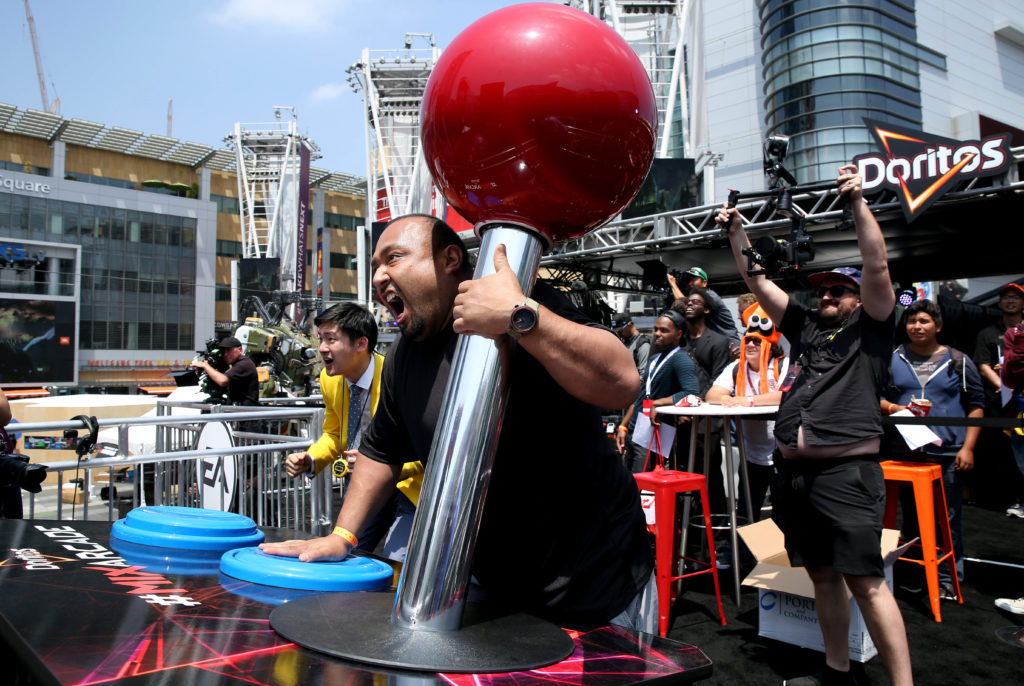
In celebration of Doritos’ 50th anniversary, the chips brand also dipped its name into world record books with the distinction of “World’s Largest Arcade Machine.”

“Doritos is a brand that believes in living life to the fullest and embracing bold experiences,” said Jeannie Cho, vice president of marketing for Frito-Lay. “We were honored to combine our heritage of gaming with music in the Doritos #MixArcade at E3 Live, once again putting control in the hands of fans. The gaming and music communities have long been partners on the small screen—now we’ve brought them together on the big screen.”

Cho joined [a]listdaily to further detail how the #MixArcade proved to be the non-gaming brand activation of E3.

Why did Doritos decide the E3 audience was one that it needed to seize?

We believe that imagination and creativity are unlocked when we combine different influences together. The Doritos #MixArcade allowed for an epic live experience by mixing elements of technology, gaming and music together. Building on our heritage of SXSW and the Super Bowl, the Doritos activation at E3 was a canvas for fans to create the ultimate live mix of gaming and music. Doritos also has a deep gaming heritage; we’ve partnered with many gaming brands throughout the years and have a strong connection with the gaming community.

How did the idea for #MixArcade come about? What was it designed to do?

Doritos has long been about epic entertainment and believes in putting control in the hands of consumers. To bring our newest product—Doritos Mix—to life, we created four classic arcade-style games, each inspired by the four pieces in the new product. We wanted to bring the online mix arcade experience to life in a way that mixes different influences to create a unique experience.

With #MixArcade, we built the world’s largest arcade game and introduced it at one of the most influential gaming expos. We provided more access, entertainment and control by giving fans the opportunity to level up their gaming experience by unlocking interactive elements throughout the show via LED wristbands that control various elements of the performances. The #MixArcade was a fully functioning arcade that featured a 30-feet-by-32-feet LED gaming screen for live arcade game play during the day and concert visuals during the evening, a six-foot joystick and an arcade within an arcade featuring a retro (and normal size) arcade room, with games, a lounge area, game demo stations and product samples.

What went into picking the artist lineup?

We selected performers who are all about epic and bold entertainment experiences, since Doritos has a similar mindset. And the lineup was a mix of gaming and music genres with performances that also mix musical influences in a way that brought a unique fan experience each night—specifically EDM, hip-hop and iconic, old-school DJs.

How did you engage with the attendees and community on social channels?

Before the concert began, fans received LED wristbands that lit up red or blue to control various elements of the show with the push of a button from their wrist. Fans could also watch the performances live on our Twitch channel where they actually impacted the show in real time by casting votes in chat to unlock specific effects and be part of the interactive concert experience.

Follow Manouk Akopyan on Twitter @Manouk_Akopyan

Gambitious Co-Founder On Why Crowdfunding Is Broken

Gambitious Digital Entertainment co-founder, Mike Wilson, is making his 22nd annual pilgrimage to E3 this year. The long-time game industry veteran is wearing two hats at the show, also serving as co-founder of Devolver Digital. Devolver will be set up in trailers in a parking lot across the street from the Los Angeles Convention Center, and is also hosting Gambitious for its meetings. Additionally, both companies are championing independent games. Wilson talks to [a]listdaily about his newest company and explains why Gambitious’ approach is best for both developers and investors in this exclusive interview.

Where did the idea for Gambitious come from?

We’ve been thinking about this for many years, even before we started funding in 2013. We started in 2012 when Obama signed the JOBS Act, funded our first game (Train Fever) in 2013, and started publishing in fall of 2014. We’ve funded 11 games to date and have released seven.

What differentiates Gambitious from Fig and other crowdfunding initiatives?

We’re not doing public-facing crowdfunding. We’re working with 10, 20, or 50 accredited investors at a time who are putting up $2,500 or more each for any given game project.

We’re slowly building out a network of accredited, or “sophisticated” (as they say in other parts of the world), new game investors. Hard Reset: Redux just became the fifth of seven titles shipped thus far to earn out in under a month, and it’s the third of those to earn out in under a week.

I feel like we’re the only ones trying to look out for these new game investors. Everyone else is trying to figure out how to get just money from the general public.

Why is your approach good for developers?

It’s too much to ask up and coming indie developers try to make a great game and also deal with a bunch of investors, not just as a community, but as partners with a legal responsibility to report and pay their dividends out according to regulations.

It’s not that they are dumb or can’t handle money, but that isn’t and shouldn’t be their focus as a small team trying to do a very hard thing in the first place.

Also, a public-facing equity crowdfunding raise requires a huge investment into legal fees (as much as $100,000 per project) and setting up all the entities and mechanisms currently required. This is an unworkable amount of money for indies making games whose total budget is under $1 million. It’s also just a waste of money versus other ways to get funding. This is part of why you see other platforms having great go for bigger raises, which also often means the developer needs to already be famous. And if they are famous, established developers and/or one working with a well-established IP, it begs the question of why they can’t just get funded from the existing “smart money” investing in games, i.e. publishers and VC’s.

We are focusing on indies who really need a path to funding, along with some support from a publisher. And for these smaller projects to make sense, the publisher has to be operating in a similarly “indie” way. These are not projects that are big enough to feed old-school overhead-intensive publishing machines.

What about companies like Fig, which focus on well-known game developers to help generate awareness and funding?

We’re not focusing on famous game developers. We feel like the indies who need this sort of help and friendly financing, also often need mentoring from a publisher. That’s a huge part of our job. It’s like we have two separate pieces of the same company. We run the business like an indie game publisher, and then another team is going out and raising the money behind each game.

Will you ever allow average people to invest in these games?

The rules came out May 16 that allows people to do that. We’re just not focusing on that. We’re letting the dust settle on that to see what happens with the other companies. As I mentioned, it’s still pretty cumbersome.

We think there are plenty of people in the world who can better afford to possibly lose money on games—the same types of people who buy stocks or mutual funds. We’d rather let other people make the mistakes in public equity crowdfunding first, to put it bluntly.

You mentioned two games haven’t made back their money yet. What are they?

Our worst case is Breach & Clear: Deadline. It’s the one-year anniversary and it’s at 35 percent return on investment. That’s pretty good as a “worst case scenario,” as it still gave you one-third of your investment back. Normally, when an investment goes bad you get nothing back. We still have four years to bundle and promote the game to get that number up to 65 percent.

Don’t get me wrong, we’re still mad about it. Devolver has a track record of not losing money on any games. And Gambitious wants to be just as successful.

What’s your company’s best success story so far?

Train Fever is up to 200 percent return and there’s still another three years to go after September.

But the biggest difference is our games are actually shipping. There are no elaborate schemes of shares being exchanged and shell companies being set up, and no sharing of equity or IP from the developer.

I don’t want 1,000 or 100 partners in a legal entity. We employ pure profit sharing. Our investors receive the exact same profit share as we do as individual investors.

Why have we seen so many high-profile games crowdfund huge amounts, only to not ship?

Everyone knows the Star Citizen story all too well. Even great developers like Double Fine blew through four times the money they raised and still didn’t finish the game on time. It’s not like they’re bad people. But you need to pay out on milestones as people achieve goals, or deadlines will never be hit. It’s also still the case where people are not raising all the money they actually need—they’re trying to raise what they think they can. And then they try to find a publisher to pay for the rest.

What’s your strategy for building franchises?

Train Fever is still selling at full price on Steam and we’re coming out with a sequel this September. When they came back for the sequel we raised that money in less than a week. We’re not into tying up studios to long-term or sequel deals. We’re trying to do what Devolver does; making it a frictionless experience that makes developers want to come back.

How are early investors liking it?

If you gave me $5,000 and I give you back $6,000 and mailbox money for five years of profit participation from the date of the original shipment, it’s not a bad deal. You earn out immediately because the publisher is the one paying out the dividends, and like pretty much any investment in entertainment, the investors get repaid first for taking the risk.

After a while, you have this catalog of 10 games, and maybe eight of those are hits and you get mailbox money out of them. Some people are doing it because they dig games, and others are just taking some money and looking at it as an investment.

What’s the involvement of Gambitious and Devolver executives in these deals?

Gambitious and Devolver are investing in each game, and several of the principles of each company are also investing in the games individually. We’re on the same side of the table to fight to get that money back to the investors because we are them, and we have same terms as they do. And obviously, we’re trying to provide a very positive experience to those new to investing in games.

What’s your latest investment?

Crush Your Enemies, which is a fast-paced, tile-based RTS from Polish developer Vile Monarch, shipping on PC and mobile on July 13 was the most recently closed investment raise, and we’ll be announcing another one next week that just closed.

GamerSaloon Is Betting Big On ESports With ‘Madden Pro League’

GamerSaloon is a platform that allows video game enthusiasts to compete online against other in their favorite video games to win cash and other prizes.

Gabe Rubin, founder and CEO of GamerSaloon, joined [a]listdaily to discuss their how they’ve paid out $35 million in prizes over the last 10 years, their new “Madden Pro League,” and the necessary steps they’re taking to work with game titles like FIFA and NBA 2K as official partners.

271ac7f

GamerSaloon facilitates video game tournaments for cash prizes. Can you explain how this process works for those that are unaware of your platform?

A user signs up for free, creates a profile, and funds their account. They then find an upcoming tournament to join or create an on-demand tournament and invite challengers to participate. All entry fees are collected securely by GamerSaloon and held in escrow until the outcome of the tournament is verified. Matches are played on the user’s console, PC or mobile device. Typically, the winner of each match will report the results of the match to the site. The loser then has a time window to verify or dispute the reported result. If the loser doesn’t respond the reported results are verified by default. Once the results are a verified, applicable prizes are awarded.

You’ve dished out over $35 million in prizes since operating in 2006. What are the most popular titles gamers play through your platform?

The most popular game titles are Madden, NBA 2K, FIFA, MLB: The Show, and NHL.

How is the business model for GamerSaloon structured? Who gets paid what?

GamerSaloon.com takes a service fee on every tournament entry. The service fee can vary but the average service fee is 14 percent.

1781774_1064323930278064_5239608768282222910_o

How are you generating serious interest for the “Madden Pro League?” What were your key takeaways from your $15,000 live tournament in Las Vegas earlier this year?

The GamerSaloon $15,000 Madden Community Championship in Las Vegas reinforced the demand for Madden as a competitive eSport and solidified GamerSaloon as reputable tournament organizer. Top players from the community attended the event and provided valuable insight for future live events and online action. In fact, it was through our open dialogue with players that we decided to launch Season 1 of the GamerSaloon ‘Crew-v-Crew Madden Pro League.’ Teams of three players competed individually each week to earn wins for their team and the chance to play in the finals for $1,500. The first season was such a success that we recently launched the second and have brought two sponsors on board, including Title Sponsor, StockX, and JerkyXP. The action is streamed every Wednesday night on the GamerSaloon Twitch channel with play-by-play coverage, similar to the RedZone channel. We’ve created a full Crew-v-Crew portal that includes real-time standings, player profile cards, past videos, and upcoming matches. Team and player rivalries are already running deep and drawing interest from all sides. As an official Twitch Partner, GamerSaloon is working with Twitch to feature the final stream for the officially named ‘StockX Madden Crew-v-Crew Pro League.’ We’re actively looking for strategic partners and sponsors to help grow the Madden community.

What steps are you trying to take to work with Madden, and others titles like FIFA and NBA 2K, as official partners? What needs to happen for this to become a reality?

We have had previous talks with TakeTwo Interactive, the developer of NBA2K, as well EA. Both are actively pursuing eSports as a means to increase gameplay of their respective games. We’re currently focusing on running high-quality live events, facilitating consistent online gameplay, and creating a deeper layer of content around the competitive scene. Our main goal is to continue to grow the sport eSports titles and extend gameplay throughout the year. We’re very open to working with game developers to do so.

The proliferation of daily fantasy sports has made some serious headlines over the last year. How are you regulating gambling?

What we offer is not considered gambling in most jurisdictions. We offer skill-based contests, similar to a golf, fishing, bowling, or billiards tournament in the physical world. If a video game relies predominantly on elements of chance to determine the outcome such as card games or dice rolls, we don’t offer contests in those games.

Madden Pro League Icon

You have over 1,000,000 registered members. How are you engaging and interacting with your community?

We have a very strong community. We’re actively engaged with our members through social media, email and internal site messaging. Our community relationship department has an excellent relationship with the Madden, NBA and FIFA communities. Our team is constantly listening to our community to ensure that we provide our members with an amazing experience.

What’s the No. 1 lesson you’ve learned since being in business?

The No. 1 lesson that I’ve learned since being in business is that execution and focus are crucial in creating a successful company.

How do you envision this space progressing in the future?

Over the past 10 years, I’ve witnessed the eSports space evolve from something that was considered to be underground to mainstream. Everyone is talking about eSports and trying to figure out where this space is going. I think that over the next three-to-five years, there’ll be even more growth within the industry. Live events, streaming and corporate sponsorships are all areas that I see gaining tremendous growth.

Follow Manouk Akopyan on Twitter @Manouk_Akopyan
Razer Unveils New VR Headset, $5 Million VR Development Fund

Razer and Sensics, co-founders and organizers of Open Source Virtual Reality (OSVR), unveiled the second Hacker Development Kit, the HDK 2. The $400 HDK 2 features an upgraded display (2160×1200) for a visual experience on par with the Oculus Rift and HTC Vive. It will be available in July for $400 at the Razer online store with plans to expand sales to Newegg and physical retailers later this year.

The HDK 2 will be available to demo at Razer’s E3 booth this week with games such as RedOut, Theme Park Studio, Infinite, A-10, and The Hum: Abductions, alongside the Gloveone motion tracking gloves from Neurodigital Technologies. Upon public release, the gloves will be available as a controller option for the HDK and all OSVR supporting head-mounted displays in the open ecosystem.

“The HDK2 is the next iteration in the headset we’ve had out for a year,” Jeevan Aurol, product marketing manager of software at Razer. “This headset displays images at 90 frames per second and offers a 110-degree field of view, as well as a diffusion film screen to reduce screen effect. This screen was built for VR with custom optics and a larger eye box, making it more comfortable to wear. It pumps out clear, vibrant visuals.”

Aurol said the HDK2 was designed for both developers and consumers. The basic package includes the positional tracking hardware (infrared camera and mount) and the HMD.

“We designed it to be flexible,” Aurol said. “Developers can innovate the way they want to bring cool new products and software into the OSVR ecosystem. As a consumer, I gain unrestricted access to innovations as they roll out like brand new controllers.”

Gamers will have unrestricted access to open source platforms such as SteamVR. Aurol said any content built for Vive will work on the HDK2 and the HDK1. The platform also supports Epic Games’ Unreal Engine 4 and Unity Technologies’ Unity 5 game engines.

Aurol said Razer will continue to sell the HDK1 for $300 for people who want to get into VR without spending as much money.

“We’re building an open source VR ecosystem with over 320 hardware and software companies,” Aurol said. “The software development kit unites everyone into a single ecosystem, which will ultimately help VR succeed.”

Aurol said consumers benefit from OSVR because they can choose from a variety of HMDs and controllers without worrying about compatibility, building their custom dream VR rig.

“It’s about giving consumers a choice and the ability to optimize what we have in VR today,” Aurol said.

Razer is also launching a $5 million Developer Fund created to bring more VR content into the ecosystem.

“Our take is the industry is very young and one of the current issues its facing is lack of content,” Aurol said. “Mainstream consumers need to adopt VR for it to succeed and we need content on all hardware. We’ll have 10 headsets in the market by next year. If other hardware vendors enter the market, and they don’t have access to content, they’ll die out quickly. If you’re introducing a new HMD or controller, you need to have content to attract mainstream interest and help the entire industry. The VR industry is only as strong as its weakest link.”

Razer is sponsoring the $5 million, but Aurol said it will constantly grow through the support of OSVR partners. The fund will support both hardware and software makers.

“If you’re hardware developer we’ll help you with marketing support, public relations, and other business initiatives,” Aurol said. “If you’re a small or large developer you can apply now. An OSVR fund member will review it—Razer is currently overseeing applications because it’s investing the initial $5 million—and look at the quality of the content, and then if it passes we’ll approve it and the developer gain funding.”

Aurol said this funding is very different from the traditional model because Razer is helping to kickstart content sales for the developer from the start.

“When they release content, we’ll buy the game keys—the number of game keys we buy depends on the negotiations,” Aurol said. “We can offer a minimum guarantee in sales. We’ll have promotional activities when we buy the game keys, passing them to press for reviews for press and bundling them with hardware promotions.”

And Razer will help developers gain exposure.

“We’ll offer marketing and promotional support to help generate more awareness of the content. For example, we’ll invite developers down to our E3 booth and allow them to sell content through the SDK and talk to press and attendees. It’s a great way to gain awareness.”


What IoT Means For Brands

The Internet of Things (IoT) is defined as “a proposed development of the Internet in which everyday objects have network connectivity, allowing them to send and receive data.” While our computers and smart phones are connected devices, the IoT refers to a system of objects that communicates with the manufacturer, user or other objects. Imagine, if you will, an alarm clock that tells the coffee maker to start each morning or a GPS that texts your friend to say that traffic is bad and you’re running late. That’s the IoT.

Why Is IoT Becoming So Popular?

Although the term IoT is used a lot these days, the technology has actually been utilized for decades—including ATMs as early as 1974. The biggest problem brands have faced in developing IoT devices, however, is the sheer amount of data to process. Cloud storage technology has made IoT more feasible, but not without its challenges. In 2013, for example, Virgin Airlines announced a fleet of connected Boeing 787 aircraft designed to detect mechanical failures and prevent tragedies before they happen. The price of having everything from wing flaps to luggage on the network is processing half a terabyte of data each flight.

Analyst firm Gartner predicts that by 2020 there will be over 26 billion connected devices. The IoT market is expected to grow to $151 billion by 2020, according to market researcher Research and Markets. That includes infrastructure, software, processors, sensors and other tech. The market is growing in part due to advances in technology, but also increasing areas of global internet accessibility.

How Brands Are Using IoT

Rolls-Royce recently partnered with Microsoft to integrate its Azure IoT Suite and Cortana Intelligence Suite into its next generation of Rolls-Royce intelligent engines.

Farmer’s Insurance is reportedly looking into IoT technology that will alert the driver if their vehicle was hit while they weren’t around, say by a shopping cart.

UPS uses IoT sensors on its fleet to monitor mileage, optimum speed and overall engine health.

Some John Deere tractors can tell a user the best time to plant or when it’s time to irrigate the soil.

Last year, Johnnie Walker announced an upcoming line of Blue Label whisky “smart bottles” that will know when it has been opened and communicate messages to the drinker through a phone app.

Disney World uses MagicBand, a wearable wristband containing RFID tags, to track visitor movements and analyze which areas are most popular. Disney World visitors can check in to the park, buy food, and gain FastPass on rides by tapping the band on their receivers.

It seems that just about anything could be connected via the internet, even a Met Gala dress. Connecting a product to the IoT can offer both the user and manufacturer valuable feedback on how the item is used or when it’s time for an upgrade. An item that “gets” the customer is a brand, product and marketing strategy all in one. How brands utilize IoT is limited only to the imagination, data processing capabilities and, of course, security precautions.

From Google’s self-driving cars to connected Atari devices, the world, it seems, is ready for IoT.

Zappar Brings Augmented Reality To Brands

Zappar’s business model is simple, yet innovative and very much in demand from forward-thinking brands: to create snackable and immersive augmented and virtual reality content experiences on mobile.

The content-creating company’s strategy boils down to working closely with brands, license partners and retailers across the world to produce innovative, customizable market-leading solutions as bite-sized entertainment. Their modus operandi has already yielded deals with an impressive list of brands that include Coca-Cola, Visa, Warner Bros, Rovio and SEGA—just to name a few.

Now the United Kingdom-based startup is putting the tools they’ve been using over the last five years into the hands of the everyman content creator by introducing a comprehensive set of AR and VR creation tools called ZapWorks. It was officially released at the Augmented World Expo in Santa Clara, California.

“It’s a rich, interactive experience that offers a different way of thinking about advertising on mobile devices. To our knowledge, there isn’t another platform that could deliver the depth of experience and with the ease of application at an affordable price point on the market,” Caspar Thykier, co-founder and CEO of Zappar, told [a]listdaily. “What we’re excited about is that five years ago, we set out to properly democratize this technology. Now that this is live, it just takes us to a completely different space. That’s hugely exciting—to put the tool in the hands of creators.”

Thykier and company are also still enjoying their AR activation for The Angry Birds Movie that featured over a billion “BirdCodes” distributed through partners such as Lego, H&M, McDonald’s and Pez. Each code introduced an AR experience.

ZapWorks was used to create the AR experiences on Pez’s dispensers tied to the Angry Birds Action! game. Gabriele Hofinger, head of marketing for Pez International, said: “We pride ourselves on being the pioneer of interactive candy, so it’s a natural next step to move into AR and add another layer of interactivity for our customers. What Zappar is doing with these tools will really bring this tech to bear in the marketplace.”

Thykier joined [a]listdaily to talk about how he’s re-imagining what’s possible on the mobile canvas.

Screen Shot 2016-06-06 at 2.44.12 PM

ZapWorks offers fully vertically integrated tools that provide a single user interface for creating and distributing content and gathering analytics. Can you further explain the platform?

It’s only been at this point probably where we wanted to have a direct and proper dialogue with agencies, and make sure the tools were ready and fit for purpose for all developers. I think with the launch of ZapWorks, we’re at that point. We’ve had the studio piece in beta for the last nine months. We had 3,000 downloads, and learned what that community wants. I think we’re at a point now where we’re confident in the tools external people have accessed, and that it’s the same as that we’re using. Our job now is to keep that quality threshold high and really teach this new audience of digital creators how to go about building things of a similar standard. That now becomes our job, really.

What’s your take on AR or VR brand activations? Does one work better than the other in terms of marketing?

It’s a very interesting question. This year, more than any other year, you go to events and conferences, you have AR and VR pitted against each other like a weird celebrity death match like ‘who’s going to win?’ And I’m not sure if that’s fair, really. They offer different context, and they both have equal merit. Our view on it is ‘how do we make sure any of these experiences are available to as many people as possible.’ But brands need to make sure it conforms to the right context for the end user, and have it makes sense for that specific occasion. ‘What’s the business problem you’re trying to solve? What is the challenge? And what’s the best way to approach it?’ I definitely don’t subscribe to ‘which one’s better’ because they’re different experiences.

How was the partnership with Rovio formed for The Angry Birds Movie activation?

It was actually one of those brilliant bits of new business developments. It couldn’t have been better. We actually started with a small interactive-annual publication in the UK called Pedigree Publishing. They work with licensed products, one of which was Rovio. We had created a range of augmentations that had appeared in Pedigree, and it caught Rovio’s attention. Unbeknownst to us, they’d obviously been in the background trying to understand what their strategy would be around connecting the physical world of things to digital devices, and how that would play around the movie launch. After that, they approached us. They’re a great company to work with. They have a clear understanding of the digital world, because that’s where they come from. They’re willing to take it to its furthest level in terms of properly integrating things in their product and promotions. It’s a perfect example of where we got in, right in the ground floor with their thinking, and how they were going to activate this entire program.

Angry Birds McDonald's - combined

Can you dive a little deeper in the activation? How did it work?

We created a custom code, based on our Zap code scheme, and more than a billion bird codes were released around the world. We worked with them to identify a range of experiences that can then be applied to different partners like McDonald’s and Pez on how to create rich and immersive AR experiences that are easy to execute on a global scale. That’s where the beauty of things like a custom code come in because it alleviates a lot of the difficulty of activating and implementing these things for huge multinationals. We gave them a light, six-to-seven megabyte embed component. When you first open the app, it’s a really easy thing to get into. The scanning code is always readily available. With Pez, we made a specific mini-game that used their candy as a way to make an experience that was related to the game, but also gave them branding within it. We had to make the user interfaces work all around the world. We wanted to have different partners have completely different experiences that were exclusive to them. And that’s important for different markets for Rovio to construct those partnerships with different retailers and brands.

You’ve worked with a slew of diverse brands. Which sectors work better than others for bite-sized experiences?

The clients we work with tend to be the thought leaders in their market. If they’re not No. 1, they’re No. 2—people who have innovation as part of their DNA and culture. Rovio epitomizes this. There’s only certain ones we’ve begun to identify that are doing loads of more work. From a sector perspective, we’ve certainly been doing activations with entertainment studios like Warner Bros., book publishing, education, pharmaceuticals, consumer packaging, and events. There are a number of verticals which AR provides a specific solution. Once someone does it, it kind of gives others permission to do it, too, because they don’t have to be the ‘fall-guy.’ It’s about identifying the business need, and creating repeatable business around it. We learned there was traction of AR in the retail environment. We learned through doing.

What are the keys to a successful AR campaign? How do you formulate a strategy?

It boils down to the four C’s to success that we talk about a lot: context, call to action, content and commitment. Context is at the apex. It has to be the right occasion. Consumers have to have an interest in what they’re looking at to give it the time and attention it needs. Plus, there are other elements like light, audio, and if there are people walking in front of you. The CTA is as important as the technology. You clearly have to tell people what they’re going to do. There is no way around it, or else people won’t engage. If everything is aligned, you have great levels of engagement. It will work.

Follow Manouk Akopyan on Twitter @Manouk_Akopyan
Kabam Exec Reveals Blueprint For Success In Chinese Mobile Market

Kabam’s mobile game, Marvel Contest of Champions, has been downloaded more than 75 million times and has over 7 million consumers who play every week. It’s one of Marvel’s most popular mobile games, having generated over $300 million in revenue to date.

Last month, Kabam released the iOS version of its mobile brawler in China, which offers the largest mobile audience in the world. The company decided to self-publish the title, which required a lot of additional work, but the game quickly shot to the number #1 most downloaded game in China shortly after launch and continues to perform strongly.

Kent Wakeford, chief operating officer of Kabam, explains how the company will now reap the rewards of the foundation it built for mobile game publishing in China.

How has Marvel Contest of Champions evolved?

Kabam and Marvel have a deep relationship. The game was created through a series of meetings with the product teams, thinking about an environment in which you can have this experience where you can pit any Marvel character against another. We found an old Marvel comic book called Contest of Champions and it was like a lightbulb went off.

Our creative team took that fiction and created a whole experience with gameplay around that, and expanded it with new characters. That’s how the concept ideated. Kabam Vancouver, which has a lot of former Electronic Arts developers from the console business, created an experience with that “wow” factor for a mobile device.

How does this game tie into the Marvel Universe of movies and television shows?

Over 100 people are working on this game. We’ve worked closely with Marvel to create a pipeline 12 months out with all of the key beats from collaborating on films like Captain America: Civil War, Ant-Man, Guardians of the Galaxy, and Netflix’s Daredevil series so our game ties into the big beats.

We’ve also been able to create our own fiction and expand the Marvel Universe from the creative talent within Kabam. Our team in Vancouver had an idea for a character that could live within Marvel, and spent time working with the Marvel creators to create Guillotine. She’s a new heroine with whole backstory and narrative. Marvel put that character into the re-released Contest of Champions comic series. We developed VenomPool—we brought Venom and Deadpool together to create an over-the-top character with crazy powers. We’re working on another Kabam-created character that will be released in July.

How has this partnership with Marvel evolved?

It’s a two-way collaboration. The Contest of Champions comic was republished based on the power of the game. Not only have we done a great job of making a game fans love to play, but we’ve added to the Marvel Universe.

And we’re just in the beginning stages. You’re going to see a lot more collaboration beyond the new July character, and we’ll be working on a lot more tie-ins with the films and TV shows coming out.

Can you give an example of how you worked with a recent film like Deadpool in the game world?

In the Contest of Champions fiction, the Collector collects all these heroes and pits them against each other. We had Deadpool take the place of the Collector and make everything challenging with special quests for people to get in and play. It took advantage of the humorous aspect. We have a Deadpool character in the game, and we also introduced VenomPool at that time.

Can you talk about the global popularity of this game?

Kabam is a global gaming company. Our games are played in close to 130 countries around the world. Our goal is to make sure consumers have access to great games, and when married with great IP, that it resonates around the world. We’ve launched Marvel Contest of Champions in over 100 countries. North America remains the strongest market for the game. A big part of that is the history of Marvel in the US, but we have millions of people who play the game from South America to Europe to Russia to the Middle East. And now we’ve launched the game in China.

What makes China a unique mobile games market?

China has become the world’s largest mobile gaming market. It generated over $6.5 billion in revenue in 2015, and it’s growing faster than any other market in the world. The Marvel IP does very well in China. They have a lot of loyal fans around this brand. When we talked to Marvel about bringing this game to China, we thought about what we needed to do to bring this iconic brand to China.

What was the process like to deliver a Chinese version of this game?

We had to change the experience for Chinese consumers. We spent four months changing the technology and developing the technology and data infrastructure. We’ve created a pipeline so that we can bring a product into China. We spent six months working with AWS to get all of the hosting for the game right with no latency. We had to solve issues across two major network backbones (China has two, where in the US there’s only one). We needed to allow people to go back and forth across these networks.

China also has a different device fragmentation than other countries with a lot of lower-end devices. We had to make sure the game worked across all of them.

There are also regulatory requirements. You have to work with two different ministries to get licenses for the game so we could publish. And we only published on iOS. You can’t self-publish on Android in China because those app stores are all local. We will bring our game to Android, but we’ll need a partner.

How has the actual game changed for Chinese players?

The gameplay features are a lot different because of consumer play patterns and tastes. Chinese players are more sophisticated. They progress faster through the games. We created systems that added depth and a deeper story that connected everything, so they could see their powers increasing. We created an RPG Gear system and a Quick Fight system, so they could quickly fight through.

We also changed the visual presentation. There’s a lot going on on the screen in China.

Instead of strictly translating the game, we designed the text to the local market. We recreated the narrative with the understanding of the emotional feeling that the Chinese consumer would get from the words. We rewrote the game for the Chinese market.

How are you marketing the game in China?

Kabam’s initiative to self-publish in China created a structural advantage that we can now bring all future games that we create into the Chinese market. All the blood, sweat, and tears are going to pay off now, and in the future. Going into China, we’ve had an office on the ground for five years with 200 employees. What we needed to build up was a marketing infrastructure. We put people on the ground in China to work with all of the ad networks and social platforms. We integrated all the tracking solutions and SDKs. We had to understand and translate the results of spending on media.

We’ve been able to optimize the advertising creative and understand what resonates with consumers, the landing page optimation, what visuals Chinese gamers like to see from an app icon perspective. And then in the media planning, we can buy and optimize and get CPI (cost per install) that are equivalent in China to what we get in Western markets. Now we can buy media just like we do in the West and target consumers and look at the yield. It’s an amazing infrastructure that we’ve created, and we learned a tremendous amount.

We were the #1 downloaded game in all of China, and it’s the result of a lot of effort across the board from the studio to the publishing group.

What opportunities have the Chinese chat apps opened up for marketing this game?

In-app chat is extremely popular in China. Tencent Games are often in the Top 20, and a large part of that is because they have the power of WeChat, which is the largest social platform in China. It’s the power of that channel that can drive consumers into games and drive installs. We’ve been doing a lot of work with WeChat. We’ve spent marketing dollars there, and have seen the impact and benefits of marketing through those social channels.

We worked through Disney and Marvel’s WeiBo channels to drive excitement of the game socially. Social channels in China for mobile have a much tighter correlation to the success of games than they do in the West. WeChat is tightly integrated into the gaming system. QQ is another Tencent platform that is very popular.