‘The Witcher’ Series Creator Talks About Making A Gamer-centric Brand

Much like Valve, CD Projekt is more than a game developer. The company is probably best known for creating the hit Witcher franchise, inspired by a Polish fantasy novel series written by Andrzej Sapkowski, but it also founded the digital game sales platform, GOG. GOG works a lot like Steam, but leans more heavily on classic and independent games. The service also prides itself on providing DRM-free games and adding more value to purchases through free extras like game soundtracks and a number of other features. Both the marketing approach for The Witcher games and GOG represent CD Projekt’s fundamental philosophy toward fairness and creating a “gamer-centric brand,” which has been at the core of many of the company’s decisions.

Aiming to please gamers in a fair way appears to have paid off in a big way. Not only has The Witcher 3: The Wild Hunt (which follows the success of Assassins of Kings) been an undeniable sales success (sold without DRM on GOG), but it has also won numerous awards and gained top honors at GDC, SXSW, and The Game Awards Show. In addition to releasing a host of free content, the open-world game’s season pass includes two massive premium Expansions. Hearts of Stone released last fall and added 10 hours to the game, while Blood and Wine is expected to add another 20 hours when it comes out later this spring. Much like the main game, Hearts of Stone earned a tremendous amount of praise from both fans and critics, and players are eagerly awaiting the next addition.

Marcin Iwiński, co-founder of CD Projekt Red, talks to [a]listdaily about what a gamer-centric brand is, how it has applied to promoting The Witcher series, and how the game franchise has grown since the first game launched in 2007.

MIwinski_b&wHow would you describe a “gamer-centric brand”?

In a nutshell, a gamer-centric brand means that you put the interest of gamers in the center of everything you do. Selling games is, in reality, a bilateral deal between you and the consumer, so each time you make a business decision you need to ask yourself the question: how will gamers feel about that? Is that fair?

What I see happening too often nowadays is this bilateral deal becoming a one-way thing. You either get what the gaming companies offer or opt-out and get excluded from the newest pop-culture craze. We don’t want to be like that. Fairness is very important for me personally and for the entire studio.

What makes The Witcher 3 a gamer-centric brand, and in what ways does a gamer-centric promotion differ from a more traditional one?

Let’s start with the editions, with the way we built them. Is what we put in the box of good value for money for the gamer? We decided that the best option is the simplest one, just like it looked back in the day: a beefed up standard edition and a really limited collector’s edition. The thing is, our standard edition contained many items that are typically reserved for higher-tier SKUs: the entire soundtrack, a map of the game world, a The Witcher medallion, we even threw in some stickers. We simply think we owe gamers for investing their money in our games.

Another part of being gamer-centric is the post-release support gamers get. Like I said before, when a gamer is buying The Witcher, they enter a business relation with us. Bilateral relations are never fire and forget—you can’t simply launch a game and never release a patch for it. We’ve released more than ten in the course of just a couple of months, and we keep on working to improve the game. We do our best to practice what we preach and continue this dialogue with gamers well after launch.

Examples of this are changes to controller input gamers requested (we introduced an alternative approach to controlling Geralt’s movements), or tweaks in the UI. These are real-life examples of things nobody explicitly has to do. We do them because it’s part of the gamer-centricity we so believe in. Obviously, we will never be able to introduce every change and fulfill every request The Witcher fans submit, it’s simply impossible, but we try and we don’t intend to stop. The above are just a few examples, but the possibilities for content creators to be gamer-centric are practically infinite. They just need to think how they would like to be treated as gamers… and then do it.

Did you have to change your approach when promoting premium post-release (DLC) content?

First of all, let me make a clear distinction between what we consider DLC and what we call Expansions. DLC are smaller pieces of content, something meaningful and of value, but not something we would feel comfortable charging for. An additional quest or armour set, in the grand scheme of things, is not something that costs us a lot to produce. DLCs should be free, they should have “thanks for your support” written all over them. I mean, older gamers probably remember times when developers published map packs for games; times when patches contained something like an additional weapon or mode. And nobody considered charging for that. We’re all about getting back to the roots with DLCs.

Expansions are a different thing. Again, getting back to the past, I remember something called an “add-on disc.” Something that frequently contained half or more of the content the base game contained. We believe in that approach, and this is how we see “premium post-release” content. Will gamers feel it’s fair if we charge them for this? This is a question that never leaves our minds when we design our Expansions. We’ve proved that with Hearts of Stone, and we’re working super hard to double down on that promise with the upcoming Blood and Wine expansion (it contains a whole new region for the game!).

Did the success of The Witcher 1 and 2 make promoting 3 easier, or did the high expectations bring additional challenges?

The answer to both parts of the question is yes. The Witcher 1 put us on the map. The Witcher 2 was built on the experiences we gained, but it also included something very precious you can’t “do” in-house—it gave us tons of player feedback, things we could never come up with on our own. It was also our first contact with consoles, as Assassins of Kings was released on Xbox 360. This, and everything in between, enabled us to set the third installment of the series in an open world. On the other hand, the high expectations a year before launch had put pressure on the team, just not the kind of pressure that makes you buckle—everyone was super motivated and knew that we had to deliver on our promise. And I think we did!

What are some of the ways promoting The Witcher has changed over the course of three games?

Back in the early days—with the first installment of the series—we were an unknown studio without any pedigree, and since the market back then was solely relying on box distribution, we had to get a publisher [Atari] on board in order to get the game to the market. It wasn’t easy—we were new, we lacked credibility, and every single company we were talking to were asking themselves the same set of questions: Will they finish the game? Will they deliver a quality product? Will it sell?

We mitigated those risks by financing most of the game ourselves, but in order to have it finished, we had to partner with someone. The game was PC-only, it was the first installment in the series, and nobody wanted to take a major risk on the marketing front. That made the marketing budget really, really tiny. Surprisingly for everyone involved but us, the game took off really well and started receiving critical acclaim. The sales were good, too. This was the best possible scenario we could have hoped for and it laid foundation for a much smoother setup for The Witcher 2. Here, we decided that we go all in. We used all the proceeds from The Witcher (and then some) and co-published. Co-publishing meant that all the decisions regarding marketing and PR campaigns, as well as what the value proposition for the gamer was, were ours. It went much smoother than in the case of The Witcher, and we were quite happy with the final effect.

The major change came with The Witcher 3: Wild Hunt. Assassins of Kings has been a success, so again, we took all we made and went all in. There was one crucial difference, though: this time we exactly knew what we wanted to achieve on the promotional front. We decided to handle all the communication ourselves and do all of the gaming shows ourselves. In other words, we owned the entirety of the PR, marketing and value proposition construction process. Since we were launching for the first time on all the three major platforms (PC, Xbox One and PlayStation 4) simultaneously, we managed to back it up with a substantial marketing budget and make the voice of The Witcher as loud and clear as we always wanted to. All around the world.
How Activision Blizzard Is Introducing A New Kind Of Athlete

Frontline is about being where your customers and prospects are, and many audiences are playing and watching video games, which helps explain the meteoric rise of eSports in recent years, and few people are as knowledgeable about eSports than Mike Sepso, head of Activision Blizzard Media Networks and MLG Co-Founder. His keynote speech at the [a]list summit outlined the growth of eSports, and how the Activision Blizzard Media Networks was working to bring it to mainstream audiences.

Together with Steve Bornstein (the former CEO of ESPN who launched the NFL Network), they are working to combine the best of eSports and traditional sports to appeal to a mainstream audience. In doing so, they will help mature the eSports and turn it into a sustainable business, which will galvanize what hundreds of millions of fans around the world have done when they turned a passion project to a real business.

“In the simplest terms, eSports is just competitive gameplay,” Sepso explains. “It’s me playing you in Call of Duty, Counter-strike, or whatever your favorite game is. And just like football or basketball, there are professionals who do this, with professional broadcasts and professional broadcasters announcing the games. There are lots of amateurs trying to make it into the big leagues, and most importantly, there are millions of passionate fans who really love and engage with this as a sport and are really focused on the personalities behind the sport and drive it forward.”

For Sepso and those at Activision Blizzard, this is an opportunity to not only build an interesting and big new media business, it’s also about celebrating these personalities. ESports personalities are just like any other athlete, who work really hard to perfect a skill. On question that often comes up is, “How do you know this is a sport, and not a bunch of people who happen to be very good at video games?”

Sepso responds by saying, “The skill gap between top professional players in eSports is very similar to me trying to play basketball against Lebron James.” It’s enormous, and a lot of that has to do with innate talent, but it also takes a lot of hard work.

ESports currently brings in over 100 million unique viewers worldwide. The sport, in aggregate, is bigger than the NBA in terms of viewership. That is a very far cry from 14-years ago, when the MLG started in hotel ballroom spaces, using folding tables and a lot of duct tape. Traditional sports have had decades and billions of dollars to invest in infrastructure and mature business models to drive it forward. ESports doesn’t have it yet, but it’s quickly getting there.

As evidence, Activision Blizzard recently hosted the biggest Counter-strike event in the history of eSports, the MLG CS:GO Major Championship, at the Nationwide Arena. It’s interesting to note that Counter-strike: Global Offensive, the game featured in the event, was developed by Valve, not Activision. Activision Blizzard Media Networks is out to push the whole industry forward, so it is working alongside companies that would otherwise be competitors to further grow eSports.

To demonstrate the strategy for bringing eSports into the mainstream, Sepso presented a video featuring Oleksandr “s1mple” Kostyliev, who is one of the best Counter-strike players in the world, and moved from the Ukraine to the U.S. to join Team Liquid. Sepso points out that the interesting thing about the video is that there is very little gameplay. When you think about traditional sports, it’s much less about the technicalities of the game or understanding the rules. It’s really all about understanding the personalities and storylines, and the Activision Blizzard Media Network is working to bring those personalities to the forefront.

ESports has grown from events where players had to bring their own Xboxes to sold-out sports stadiums, with tens of millions of people turning in over the course of the weekend. The Nationwide Arena, where traditional sports like hockey are normally played, was packed with ten thousand fans for the whole duration of the tournament. We’re not talking about two or three hour sporting events, either. These were 10-hour events held three days in a row.

Sepso remarked about how the experience was very much like attending a regular sport. Then he broke down what that meant in terms of numbers.

The CS:GO Major tournament brought in:

  • 10 thousand live spectators.
  • 71 million video views.
  • 45 million hours viewed over the course of six days, globally. The event was broadcast in 15 different languages on a variety of digital platforms, but none were television.
  • The peak was 1.6 million concurrent viewers across all the platforms, which is one of the largest eSports broadcasts in history, and the biggest for Counter-strike.

The next level is to get mainstream sports fans involved, and Activision Blizzard Media Networks is in the best position to do that. There are already 126 million eSports viewers globally, which is an audience that’s a little bigger than Major League Baseball, and just under the NBA. Projections show that next year will see over 300 million viewers globally.

ESports Engagement

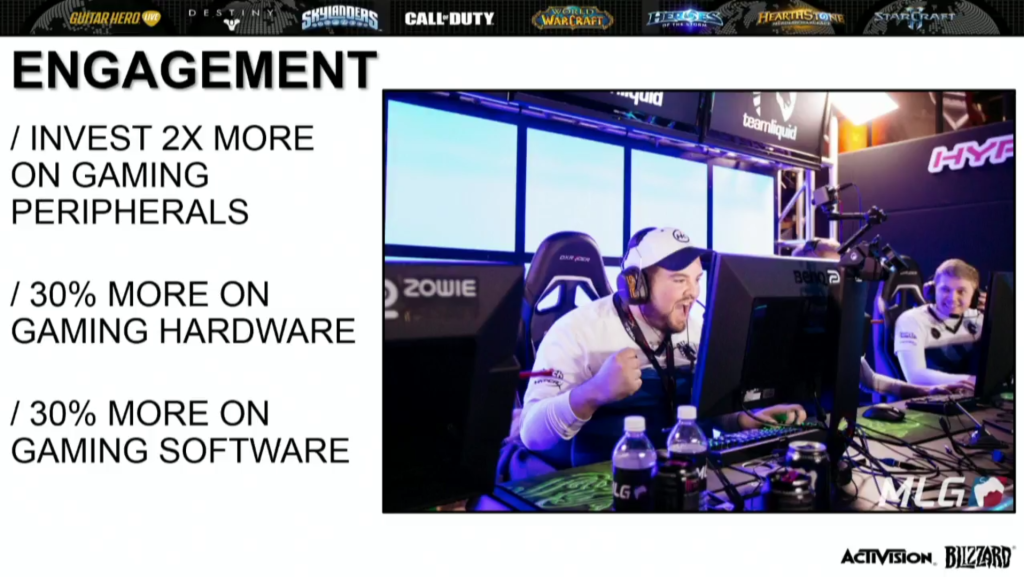
Bringing eSports to the mainstream means opportunities such as monetizing at that level. Activision Blizzard Media Networks is working to bring the personalities and storylines to the forefront and help brands attach to them. There’s a tremendous amount of potential for brands to take advantage of. In terms of engagement, eSports fans spend twice as much on gaming peripherals, 30 percent more on gaming hardware and 30 percent more on gaming software. But the industry is still in the very early stages compared to the audience for on traditional sports.

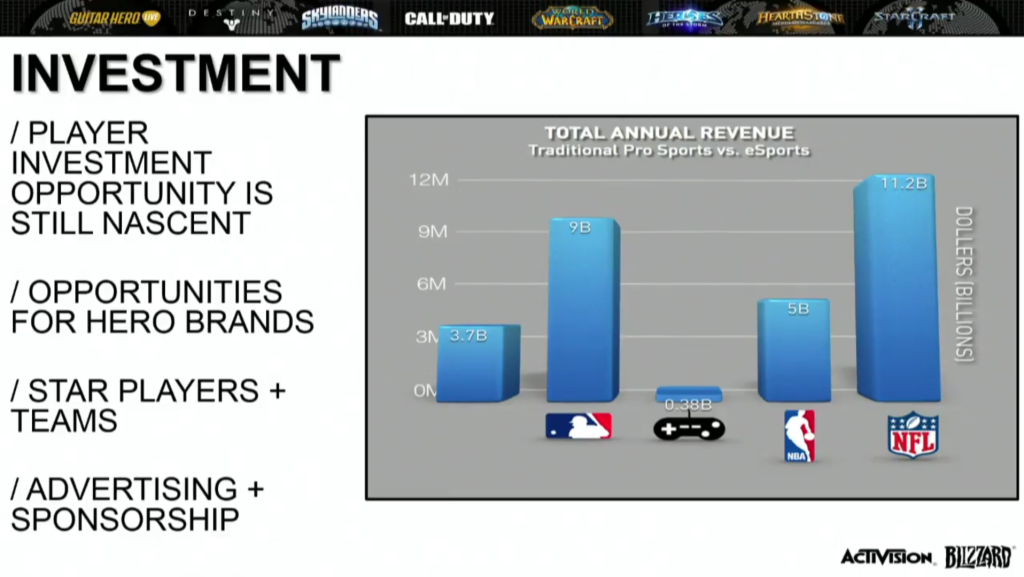
The earned investment is significantly lower, as the four traditional major pro sports bring in about $29 billion in annual revenue, which comes out to $21 per viewer. ESports, on the other hand, earns $200 million, which is $2 per viewer. But using conservative projections, the growth of the audience will put eSports at about a $1 billion in revenue by 2018. So, not only is it big and scaling, it’s growing quickly.

ESports Investment

Activision Blizzard wants to deliver the fans a lot more value. By driving up the value for brands and advertisers to get into this, they can help better monetize events, which means they can invest a lot more back into value propositions for players and fans.

Focusing on telling the stories of these interesting athletes is key to capturing the mainstream audience. Technically, Activision Blizzard Media is following traditional sports formulas to present a new kind of athlete to the world so that their popularity goes beyond those of hardcore fans. Not that hardcore fans should be overlooked, since they can be even more hardcore than traditional sports fans.

Celebrating Players

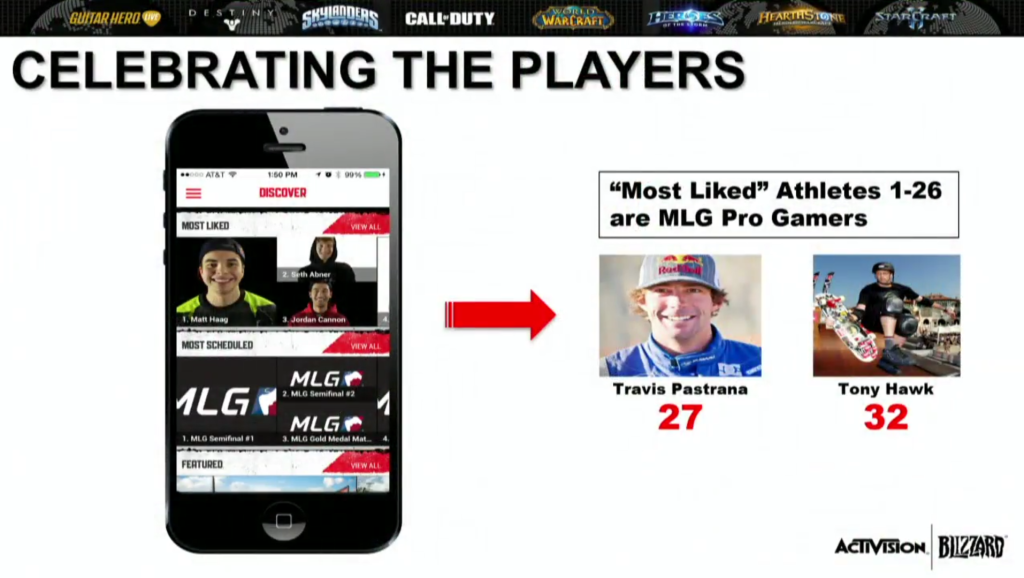
Two years ago, the ESPN Austin X-Games allowed eSports in, and it hosted an app that let fans “favorite” the different athletes. Positions 1-26 were dominated by eSports players, while well-known athletes like Travis Pastrana ranked 27. Sepso noted that eSports competitors have incredible fan engagement because they are “digital first, social media trained athletes.” They are in front of their fans “in a way that might make Kim Kardashian feel overexposed.”

Ultimately, Sepso concludes that it’s not really about the games, leagues or any of the technical stuff, which is still great for the core fans—it’s the storylines behind these talented young people.

4 Execs Explain Why ESports Is At The Nexus Of Consumer Trends

The [a]list summit was packed with meaningful presentations, and one of them centered around the how the relationship between gamers and brands has shifted from one of consumer and creator to mutual collaboration, with a growing emphasis on creating entertainment value together with the gamers.

Michael Cai, Interpret’s senior vice president of research for video games and technology, moderated a discussion Wednesday at the W Hotel in Seattle on how publishers and brands are becoming facilitators of the consumer desire to create and produce.

Andy Swanson, Twitch’s vice president of eSports:

“You can’t say ‘I want to market to eSports.’ You have to be more focused. What is the demographic you want to reach? What level of penetration do you want to have? You have to understand the content. You’re going to want to look for titles and communities that are similar.

“Last year we saw the non-gaming brands standing around the pool, dipping their toes, wondering ‘who’s going to do the cannonball?’

“Brands need to understand the eSports calendar, just as they would with major sports.

“Endemic brands have really powered eSports.

“ESports broadcasts are a lot like poker. It took off two years ago. The eSports industry allows for viewers to see it from another perspective.

“Creating content that’s easily engaging is going to mature.

“The gold rush for games is coming from a publisher’s perspective.

Dan Ciccone, rEvXP’s managing director and agent for OpTic Gaming:

“Don’t get hung up with a particular game. It’s the ‘typical geek culture’ aspect and lifestyle that’s appealing. Some of it is stereotypical, but their social lifestyle revolves around it. But don’t get too hung up on it.

“If you want to understand what the mobile future of eSports will be, download Vainglory or Clash Royale.

“The eSports audience is already there. … It was not a real surprise when Pepsi got involved in the space. 2016 is very transformative because mainstream media is turning it to the limelight.

“ESports has provided a creative opportunity to take a risk. Turtle Wax is a great example … There’s definitely a secret sauce.

“Brands need to bring value into the space.

Rahul Sood, CEO of UNIKRN:

“Imagine watching Russell Wilson practice for six hours, and then go and practice based on what you were just watching. That’s what gamers are doing at home nowadays.

“Brands have to be creative on how to leverage social as a platform. You have to get in front of this audience in a relevant way that is authentic because the gamers are very fickle.

“The audience loves, eats and sleeps this thing day and night.

“There’s no better way to learn eSports than from your kids.

“With League of Legends, Riot Games is like the Ferrari in the space.

“You have to be authentic and relevant in the space. Brands have to think out of the box and not attach media ROI.

“One of the biggest challenges in eSports is underground, unregulated gambling where kids can gamble their virtual currency (real money), and they stream it, too. It needs to be regulated. Our eyes and ears need to be out for this. It shouldn’t be happening.

Matt West, Ayzenberg’s director of content strategy:

“How do I understand what’s happening on the screen with broadcasts? The NFL does a great job of walking you through everything on-screen. ESports needs to create understanding and widen out the opportunity to experience growth. Can you create context? That’s a huge opportunity right now.

“Everyone is going to have a different view of what their KPI and ROI is.

“ESports is trying to align everyone’s interests, and provide a lot of context.

“Mobile eSports is catching up. The technology is definitely there.

“How do we reach bigger people? Investment, structure, organization and align everything.

“Maybe you shouldn’t be there at all. Maybe it’s the not space for you.

Bridging The Gap Between Startup And Corporate Culture

The 12th edition of the [a]list summit is underway today from Seattle, where marketing experts come together to exemplify what it means to be Frontline. Keynote speakers included Ruth Yomtoubian, director at AT&T Foundry, which creates, implements and commercializes innovative projects for AT&T. Its network of innovation centers explore new technologies that help serve startups, developers and partners like Cisco, Ericsson and Intel.

Yomtoubian’s keynote explained AT&T’s approach to innovating an experiential and Frontline brand using the Foundry model. She recounted her history in bridging the gap between startup and corporate culture, starting with her time living in New Orleans after Hurricane Katrina, where conditions forced business owners to become entrepreneurs as they rebuilt the city. Then she spoke about her first year at AT&T, where she managed a team of technicians in Oakland and Berkley, sometimes literally driving an F-150 around and learning to understand the dashboards and operational mindset.

She also states of AT&T has a 100-year legacy of transformation, but can sometimes fall into a trap of being unable to take risks, which is why the Foundry was formed. You have to “disrupt from the inside out,” and have the room to bring in new ideas and absorb them.

Innovation is continuously changing and covers a huge multitude of topics according to the times. Plus, there’s a lot of “faux innovation,” where something is just called innovative without looking any deeper into it. So, in order to handle the “innovation overload,” brands have to find ways to cut through the noise.

To this end, Yomtoubian offers nine brand indicators that the Foundry uses:

  • Open and flexible space: A team’s mindset is completely changed when everyone isn’t in cubicles and walled off. There’s a better exchange of ideas.
  • People: In a process referred to as Engineering Serendipity, you need the right people in an innovation center, because they represent your brand. They need to be collaborative and open, and most importantly,  they need to be able to handle ambiguity. Prospective team members are asked how have they been able to create value in an environment of ambiguity in interviews. They have to be willing to try new things.
  • Culture: A team’s culture has to be collaborative and experimental. We have to, as a culture support each other, in talking to startups and developing new technology. Partnerships are in the DNA of the Foundry.
  • Outreach and inreach strategy: The team must connect with stakeholders with an informed point of view. Startups may come knocking on our door, and the brand should be aware of the technology that’s available, or already in the works. Sometimes, companies just some perspective on what’s innovative. The Foundry has interacted with over 1,500 start-ups, VCs, developers and thought leaders to forge new partnerships. It has also spoken to Government representatives about the meaning of innovation and how they can support it. The goal is to create an entire digital experience, but people won’t know that if they’re not openly communicating it.
  • Approach to work: Yomtoubian discusses a “bias towards action.” For example, the Foundry was approached with an acoustic recognition technology that could potentially help with public safety. Instead of creating a budget and plan, the team decided to experiment with the technology first, then come up with applications. Long development cycle has a low tolerance for risk, so projects at the Foundry are generally comprised of 90-day sprints. Teams offer a one or two-page inception document and get to work on a proof of concept instead of doing long-term projects.
  • Projects as catalyst: Companies must ensure work can be absorbed back into the business. The On Ramp connected car platform explored what experiences consumers wanted from a connected car. They discovered new ways consumers wanted to use the connected car, then created a platform and APIs to support them. A similar approach was used for Cascade, messaging service that unified different phone numbers into one. It became a catalyst for other projects involving identities.
  • Engaging with startups: In order to bridge the gap between startups and corporate culture, the Foundry must act in the role of both translator and guide. They help coach startups on how to talk to AT&T executives, so that they don’t spend too much time talking about the wrong topic. At the same time, it helps startups understand how different organizations can help them.
  • Provide a platform: AT&T is showcased as a thought leader in the broader tech industry through an online video series called Futurecast. These are curated, intimate discussions with thought leaders designed to vet, debate and ultimately spark ideas that will help determine the course of technology. As a result, startups benefit in the “reflected glory” of the AT&T brand, where it becomes a platform for them to share their technologies and thoughts. These speakers end up becoming “brand ambassadors,” because they have their own following that they bring, which helps elevate AT&T’s brand as a future-thinking and innovative.
  • Partnerships: The Foundry seeks to find “alignment at the cusp of startups and corporate.” They do so by sponsoring discussions, like with the Futurecast platform, to find brand alignment. A prime example of this is with the exploration of drone technology, which is expressed through partnerships with companies like RocketSpace. RocketSpace helped create a futurist report to showcase AT&T’s point of view around drone technology.

Keynotes From Facebook, Activision Blizzard And AT&T Foundry

Can’t make it to Seattle on April 20 for the[a]list summit? You’ll be able to stream it live from 9 a.m. to 5 p.m. PT on alistsummit.com.

Check out the full agenda of speakers for the upcoming [a]list Frontline Marketing summit. The event brings together marketers from around the country to spend the day to learn and mingle with other forward-thinking marketers and thought leaders from top companies and platforms as well as creators.

With new 60-second branded video on Instagram and Facebook’s now-notorious strength in mobile video, marketers will have to now contend a video-driven environment on social media. Facebook and Instagram’s head of industry for global marketing solutions, Paul Peterman, will be giving a keynote on adapting and creating content for the mobile experience.

Activision Blizzard Media Network senior vice president and MLG co-founder Mike Sepso will keynote the event to talk about how the company is building the ESPN of eSports. Sepso will give the audience a look into Activision Blizzard’s strategy to deliver a best-in-class fan experience across games, geographies and platforms, to further the development of their leading eSports ecosystem.

From creating premium content and leveraging its broadcast technology platform, to hiring ESPN’s former CEO, Steve Bornstein, Activision Blizzard Media Networks sees a future with giant stadiums, megastar players organized in big leagues, super-fans and big business. ESports represents marketing opportunities beyond traditional gaming.

Leading the charge of a whole different kind of streaming experience, YouNow’s Paula Batson, VP of PR and Communications at the platform, will be giving a presentation about what makes a successful streamer and how to grow a streaming audience.

YouTube sensation Connor Franta and his business partner Andrew Graham, senior talent manager at Big Frame, will participate in a fireside chat with Steven Lai, head of talent at ION. Their conversation will delve into the latest trends in creating authentic content together with brands. Franta, who boasts millions of subscribers across his two channels, is also becoming a savvy marketer in his own right by releasing his own line of coffee, Common Culture Coffee, as well as his record label, Heard Well.

The future is now and AI is already all around us—Cortana, Siri, Google Now, IBM Watson… Creative Director of the Halo Franchise, at 343 Industries/Microsoft, Frank O’Connor will be on hand to compare and contrast the fictional and real aspects of AI and how marketers and mankind should prepare.

Dr. Scot Refsland, founder and CEO of RotorSports, will join [a]listdaily‘s Jay Baage for a fireside chat about a new phenomenon which is exploding on the Internet, drone racing. Drone racing is a fast-growing extreme sport in which pilots compete head-to-head with small flying drones while wearing first-person-view goggles. It’s all fueled by a highly engaged social media community.

RotorSports produces the U.S. National Drone Racing Championships and the inaugural 2016 World Drone Racing Championships in Hawaii which attracted over 40 participating countries. Scot has a Ph.D. in virtual and augmented reality and is is particularly interested in the intersection of drone racing, eSports and mixed reality technologies. He serves as an advisor to the International Drone Racing Association (IDRA).

Shiraz Akmal is CEO and co-founder of SPACES, an independent virtual and mixed reality company formed by the members of DreamWorks Animation’s DreamLab, an innovation center that spent the last three years creating virtual reality experiences for major movie studios, technology and products. SPACES will share examples of how global brands are leveraging the magic of virtual reality to teleport their audiences anywhere.

Rebecca Markarian, Ayzenberg’s senior vice president of social and digital media, will hold a Q&A with Dennis Todisco, Twitter and Niche’s head of digital creator community. The two will discuss how brands can be creative at the speed of conversation on social media.

Joey Jones, Ayzenberg’s vice president and creative director, will address how successful stories have worked over the ages through various mediums in light of today’s advents in VR, AR and 360-degree cameras.

[a]insights’ data scientist and advisor, Dr. J. Galen Buckwalter, and chief technology officer Kai Mildenberger will be on hand to give attendees a look into the future of predictive marketing analytics through their work on developing Brand Soulmates to line up ideal influencers with premium brands.

Previously announced speakers include:

  • Jim Louderback, Entrepreneur and Business Strategist
  • Ruth Yomtoubian, Director, AT&T Foundry
  • Eric Gradman, CTO, Two Bit Circus
  • Chris Younger, Principal and Director of Strategy, Ayzenberg
  • Stu Pope, Principal and Creative Director, Ayzenberg
  • Vincent Juarez, Principal, Ayzenberg & ION
  • Robin Boytos, Director, Analytics, Ayzenberg & [a]insights
  • Jon Simon, VP, Integrated Marketing, Ayzenberg
  • Andy Swanson, VP, eSports, Twitch
  • Dan Ciccone, MD, rEVXP, Manager, OpTic Gaming
  • Michael Cai, SVP, Research, Video Games and Technology

Past speakers include:

  • Morgan Neville, Academy Award-winning Documentary Filmmaker
  • Jonathan Murtaugh, US Head of Industry for Film and Television, Facebook & Instagram
  • Stephanie Horbaczewski, CEO, StyleHaul
  • Michelle Phan, YouTube Superstar and Founder ipsy
  • Andy Swanson, VP, eSports, Twitch
  • LeAnne Hackmann, Sr. Director, Global Content Strategy & Activation, Mattel
  • Allison Stern, Co-Founder & VP Marketing and Business Development, Tubular
  • JC Cangilla, SVP of Business Development, New Form Digital
  • Seamus Blackley, Xbox Co-Creator
  • Lorenzo Di Bonaventura, Producer, Transformers Franchise
  • Shay Carl, Co-Founding Talent of Maker Studios
  • Peter Levin, President, Interactive Ventures and Games, Lionsgate
  • Terry City, Head of West Coast Operations, Buzzfeed
  • David Hayes, Head of Creative Strategy, Tumblr
  • T.J.Marchetti, CMO, Awesomeness TV
  • Maria Pacheco, Sr. Director, Mobile Marketing, Dreamworks Animation
  • Mary Healey, Global Lead, YouTube Brand Partner Program
  • Elaine Chase, Senior Director, Global Brand Strategy and Marketing, Hasbro
  • Scott Carlis, VP of digital and social media, AEG (LA Kings)
  • Jack and Jack, Influencers
  • Zach King, Influencer
  • Olga Kay, Influencer
  • Nolan Bushnell, Founder of Atari of Chuck E Cheese
  • Ed Lin, Director of Brand Marketing, Warner Bros
  • Jordan Weisman, CEO, Harebrained Schemes
  • Min Kim, CEO, Nexon America
  • Jeanette Liang, Executive Director, Global Digital Marketing, Estee Lauder
  • Mike Webster, Director of Marketing, Capcom
  • Kristian Segerstale, COO, Super Evil MegaCorp
  • Leo Oleb, Director of Marketing, Kabam
  • Ryan Weiner, Director of Marketing, Activision
  • Phil Marineau, Director of Marketing, Electronic Arts
  • Ryan Cameron, Xbox Director of Marketing Communications, Microsoft

For the latest updates and agenda, check out alistsummit.com.

PricewaterhouseCoopers Sees New Opportunities For Brands To Court Female ESports Fans

PricewaterhouseCoopers (PwC) has taken a look at the growing eSports market with its latest consumer report, “The Burgeoning Evolution of eSports,” which breaks down the diverse gaming community, outlines the levels of consumer awareness of eSports, and analyzes the potential opportunities and challenges for industry growth.

PwC forecasts that the eSports industry will reach $463 million in 2016 with eSports viewership exceeding top traditional sporting events such as the MLB World Series and NBA Final. The report finds that the majority of current eSports consumers will either increase or maintain their level of involvement in the coming year, both in viewership (83 percent) and participation (72 percent).

Deborah Bothun, Entertainment, Media and Communications leader at PricewaterhouseCoopers, explains what this data means for sponsors, advertisers, and media companies in this exclusive interview.

pwc_BothunWhat impacts are the televised eSports events across ESPN, Turner and other networks having on generating awareness of eSports with mainstream audiences?

While we cannot comment on the specific network, the premiere of eSports on traditional television is a huge win for the competitive community and one that will help catapult its awareness. Regardless of its growing digital footprint, traditional television still provides tremendous reach, and one that’s especially necessary in the sports world.

What role do you see television playing for the eSports audience versus the traditional streaming audience?

It is undeniable that livestreaming has been instrumental for the growth of eSports. Yet, in some ways, it has helped build an audience of people who were predisposed to it, in that consumers intentionally went online to connect with other gamers or play anonymously. Television can help broaden the eSports audience and reach consumers who either do not even know they are fans yet or want to learn about the industry.

What opportunities does eSports open up to marketers and brands today?

ESports is only getting bigger, and with such growth comes investment opportunities for brands and marketers who hope to capitalize on the success. One does not have to be a gaming company to get in on the action. Viewers can be reached beyond traditional advertising and sponsorships such as merchandising, mobile apps that provide data such as scores and stats, or fantasy betting. Other examples to start with include branded uniforms, branded hydration, and branded transportation.

How is eSports viewing impacting the time consumers spend playing games and watching other entertainment?

We see consumers, especially men, heavily invested in game strategy. Much of the time, they are watching eSports from a competitive lens in that they not only enjoy watching their favorite games being played at the highest level, but they also watch competitions to improve their own skills. So while we cannot say for certain, it is feasible that eSports viewing only makes a player want to play more.

How does the amount of females interested in eSports compare to the traditional female gaming audience?

From a player perspective, the number of women in the traditional gaming space isn’t yet matched in the professional scene. This could be the result of less female interest than men, or many other factors.

What impact do you see this female eSports audience having on the potential for female pro gamers?

As the female eSports audience continues to grow, so too will the number of female players. Overall treatment of females in the gaming community has become a noteworthy topic that is being discussed, and we have heard discussion of all-female tournaments, for example.

How diverse is the eSports audience racially?

Diversity is a big priority for the eSports community as a whole. Our survey indicates that the eSports audience is racially diverse, skewing slightly towards Asians and Hispanics. However, it is important to note that the online world has given players anonymity, so as live events become more popular, it will be interesting to see if the diverse online nature of the game transfers over to in-person, where the community is less diverse.

There are now eSports tournaments going on every week. What are consumers looking for in terms of game genres? And what role do big prize pools play in attracting audiences?

ESports fandom and loyalty are heavily tied to the content itself, unlike traditional sports where fans tend to follow specific teams or players. Content is tremendously important when trying to build an eSports audience. Our survey indicates that first-person shooter games are the number one watched genre in eSports among viewers, regardless of age, gender or type of gamer. Our survey also indicates that prize pools don’t play a large role in attracting an audience—location, games played and price are most important (in that order).

What role do you see virtual reality playing in eSports moving forward, and in how consumers watch events?

We see tremendous potential for the convergence of virtual reality (VR) and eSports. Though mainstream adoption is still a ways off, investors are starting to see opportunities for this space such as cloud gaming using VR as a way for the audience member to see alternative plays or scenarios. Also, VR will allow for content creation continuously making games that look more realistic so that players can fully immerse themselves.

Star Power: The Rise Of A-List Actors In Video Games

When it comes to the success of a film, the difference between an unknown actor and a famous one can directly affect box office earnings. Studios have marketed accordingly since the beginning, touting the names of their stars as the prominent points to convince audiences to buy theater tickets. Therefore, it makes perfect sense that the video game industry would adopt this same star power to promote interactive works—especially as the lines between live-action and computer graphics continue to blur.

Thanks to the continued advancement of motion capture and facial tracking technology, video games are able to convey subtle facial expressions and movements that were previously impossible. As a result, A-list actors are becoming more prevalent in video game performances to both enrich the gameplay experience and of course, attract those actors’ fans to the game. The idea of exploring a new medium can be exciting, as Kiefer Sutherland found while portraying Snake in Metal Gear Solid V: The Phantom Pain. Konami utilized facial capture, which is a series of metal balls glued to the actor’s face. These markers are then read by a camera and translated to the character’s animation to capture every subtle movement. “The face of the character in the video game is doing exactly what I’m doing while I’m reading the script,” Sutherland told GameSpot in a 2013 interview, “That’s impressive.”

While actors are finding themselves fascinated by the new technology, they are more attracted to deep storylines and compelling characters.

“I’m not a gamer and I even knew about this game,” Kiefer Sutherland continued. “I was certainly keenly aware of the legacy of these games; the unbelievable success of these games.”

The first video game to feature the performance of an established celebrity was Night Trap in 1992—starring Dana Plato of Diff’rent Strokes. Although the controversial game featured live-action video footage rather than celebrity voice acting, the idea of using famous actors to market a game continued thereafter. The growing list of A-list actors and actresses providing vocal performances include Sir Patrick Stewart (Castlevania: Lords of Shadow 2), Christopher Walken (True Crime: New York City), Gary Oldman (Call of Duty: Black Ops), Katee Sackhoff (Call of Duty: Black Ops III; EVE Valkyrie), Kevin Spacey (Call of Duty: Advanced Warfare) and Sean Bean (Papa Sangre II).

Although an actor’s voice and movements provide the performance, the advancement of motion capture is allowing developers to use an actor’s likeness in a realistic way. This technology uses star power to market both what the game is about and the famous face of who’s in it. Remedy’s Quantum Break features the performance and likeness of Shawn Ashmore (X-Men: Days of Future Past), so it’s no surprise that Ashmore’s character has become the prominent “face” of marketing campaigns.

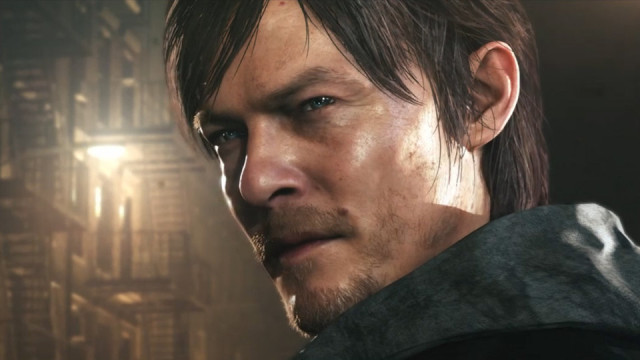
All main characters in Rockstar’s L.A. Noire featured the performances and likenesses of its famous actors (such as Aaron Staton), while the since-cancelled Silent Hills was to star The Walking Dead‘s Norman Reedus in the same way.

Norman Reedus was cast in both likeness and performance for the cancelled, 'Silent Hills' game
Norman Reedus was cast in both likeness and performance for ‘Silent Hills.’

Video games continue to advance in technology and as a story-telling medium. With that new-found responsibility, developers are turning to A-list actors to portray characters through voice, motion, likeness, or all three. This strategy not only aids in the development quality of a video game, but allows for marketing outreach that extends from gamers to movie fans, as well as proving that “star power” has found a new home.

Discovery Is Deepening Its Reach With Volume In Virtual Reality

Discovery believed virtual reality would fundamentally change the way viewers connected with content. So last August, they evolved their digital brand and identity by launching a VR-dedicated site with nine original short-form experiences.

In eight months, they’ve already produced over 70 short-form videos and dedicated resources to shoot a slew of more shows in the immersive format. Their video strategy complements Seeker, a millennial-centric web-native network with over 250 socially driven videos premiering every month. Programs like Edge of the Earth 360, which takes you to a VR trip through a weather balloon 100,000 feet in the air, will be debuting in May.

Screen Shot 2016-04-18 at 2.10.43 PM

The business model is shaping up quite nicely, too. The company has already indicated it will accommodate Madison Avenue, and Discovery’s 3 billion cumulative subscribers in more than 220 countries, by selling ads for VR in time for upfront marketplace.

Suzanne Kolb, Discovery Digital Networks’ executive vice president and general manager, oversees the company’s portfolio of web-native brands and series, original digital development, Discovery VR, and social partnerships.

Kolb, who previously was the president at E! Entertainment, joined [a]listdaily to discuss how they plan on building culturally relevant content.

How will Discovery continue to use VR to take the brand places it’s never gone before?

Immersive storytelling has always been a part of our DNA. As a leader in digital experiences, we saw firsthand how completely enthralling VR was; bringing this experience to our viewers and launching Discovery VR became a no-brainer. Whereas advancements in digital technologies (e.g. HD, 3D, etc.) have historically improved an existing viewing medium, VR is unique because it’s an entirely new way to consume content. With this, we’re continually exploring ways to further engage our fans and place them in situations they may otherwise not be able to experience.

How is Discovery leveraging relationships with brands like Gillette and Toyota to create VR content?

We love working with partners like Toyota and Gillette who want to do something different—in this case working with us to leverage the power of VR to bring dynamic, immersive stories and experiences to a wider audience shared by both brands. Building native content through strategic ad deals also allows us to add even more fresh content to our steady publishing stream and provides us with some unique distribution opportunities.

What is currently the biggest challenge for marketing VR?

survivorman-swamp-rules

The biggest challenge, like all programming, is to tell the best stories and create exceptional experiences. In this case, you want to make sure the technology is genuinely amplifying that story and experience. The next challenge is getting the word out. The technology’s rapid rise in popularity is a direct result of its broad appeal. That being said, it’s still a new technology, so simply educating consumers about what it is and how to use it is a challenge all content creators have to address. We believe the only real way to convert the consumer is through exceptional content that clearly benefits from being told in a VR form. The next step is having a volume of that content so you become reliable to your audience. With over 70 short-form videos on Discovery VR to date, we’re definitely getting there.

Is Discovery testing out VR capabilities for television in any way?

Since Discovery VR’s launch, we’ve created complementary VR experiences for many of our linear franchises including (but not limited to) Discovery’s Gold Rush and MythBusters, Animal Planet’s Puppy Bowl XII, Science Channel’s Secret Space Escapes and Survivorman and—most recently—Destination America’s Ghost Asylum. The dynamic experiences transform fans into characters, bringing them one step closer to their favorite programs. With such a diverse portfolio of linear and web-native networks here at Discovery Communications, there are so many opportunities to create even more of these thrilling experiences—and we’re excited for what’s to come.

Follow Manouk Akopyan on Twitter @Manouk_Akopyan.


3M Using Science And Technology To Solve Problems For A Better Planet


The current world population is 7.3 billion. By 2050, it’s expected to reach 9.7 billion, according to the United Nations.

3M wants to combat the proliferation of people posing challenges in the coming years by consistently using science and technology to look for creative solutions in solving the planet’s problems—all while never losing focus on the big picture.

At SXSW last month, the company’s main mission was to help people understand the impact 9 billion people will have on the planet through an art installation highlighting the importance of collaboration in addressing global issues. They also wanted to help visitors understand how they can radically reshape toward a more sustainable future.

penny-work-photo

“The goal is to start a dialogue on how each of us plays a role in improving the planet through collaboration and ingenuity,” Penny Wise, chief branding officer at 3M, told [a]listdaily.

Wise joined [a]listdaily to talk about how 3M is working toward driving global change.

How are you engaging with people for a better future?

I’m amazed by ideas and depth of discussion around important issues. The next step in our brand platform is to engage in dialogue, challenge people on ideas and create different kinds of experiences from what traditional companies normally create. We’re one company, but it’s about all of us as individuals who want to make a difference. We’re the ones who can improve lives by using science and technology to make the future better. By 2050, there are going to be 9 billion people on the planet. We don’t want it to be a dark and horrible place and experience.

What educational tools are you using to accomplish this?

We still do traditional media, but we’re using a lot of digital and social activations in order to engage. We’re thinking about content in a very different way—where it’s less about the features and benefits of products and more about the utility and big picture, and the steps they can take toward solving problems. We want to provide the solutions.

How is the audience responding for a call to action for social good?

We hear positive responses like, ‘I didn’t know 3M did that,’ and ‘I’m now interested in the company.’ Engagement is really climbing through our digital and social channels, with dramatic increases in our Twitter and Instagram following. So people are definitely listening, watching and responding. Our outreach has been very effective.

12828272_1181946905169630_6777339095539211335_o

3M is a legacy company that our parents and grandparents might best identify as the Scotch tape company. How did the brand evolve to become much more than that? What’s in store for the future?

That’s a really great question. I think what’s interesting for 3M is that 80 percent of the company is actually B2B versus B2C. So, our most famous brands like Post-it Note and Scotch tape are our consumer-facing brands. But our challenge is to tell the broader story of 3M technology and science, and how we improve lives. The brand is founded on science, which allows us to leverage the technologies that we have. That positions us really well for the future because we are going to help people solve the big problems. I think we are making great strides of telling that story and showing our depth.

How is science and technology a part of 3M’s overall business strategy?

Well, we can’t give away any secrets. The core DNA of our company since our inception is science. We have an amazing roster of scientists. They take our technologies and apply them in different ways to create the products and solutions. To give you an example, we have Aluminum Conductor Composite Reinforced (ACCR), which replaces traditional power lines. You can push twice as much power through that same line to meet the needs of cities. The future is to make a difference with people, and in the planet, and how we’re going to drive change.

How are you educating people to help make a change in society?

There is so much that 3M does that you can’t be able to put it all in one place to be able to share it with people. We make over 70,000 products. It’s about ‘how do we pick the ones to highlight? How do we share more? And how do we do it in a compelling way and create with purpose?’ Our brand platform 3M Science Applied to Life gives us the framework to tell our story in a cohesive, unified way that we haven’t done before. Now, we’re telling our story louder than we have before, because we have a strong story to tell.

12829231_1182583975105923_6186912954075639637_o

With such a robust product line, which one would you like 3M to be associated with the most?

The nostalgia in me says says there are two founding technologies for everything that has evolved over time—abrasives and adhesives. Having said that, that’s one of 46 technology platforms, and it’s just like a drop in the bucket considering all of the things 3M does. We’re so much more than what we started from. We’ve been able to cross markets that other companies have not.

How can people collaborate with 3M’s efforts for a better planet?

Each individual can do one small thing each day—like recycling junk mail, or buying fruit with a bump or a bruise—to make a difference. It’s really the simple things. For our customers, the message is: ‘Let’s talk. Let’s understand what your issues and problems are. And how can we work together to help bring solutions to make a difference.’ And it’s not just us. It’s us and other companies—everybody—uniting to make a difference. Take a step back from the big picture and find something you’re passionate about. We don’t want to dictate that for you. We understand people are already doing this. We just want them to realize the impact they can have. It’s your future.

Follow Manouk Akopyan on Twitter @Manouk_Akopyan.


BrightLocker CEO Details Crowdpublishing Business Model

BrightLocker hopes to change the development game. The startup, which is led by an executive team with experience from major game companies such as Electronic Arts, Blizzard, Sony, and BioWare, has introduced the concept of “crowdpublishing” to the game industry.

The company has launched a platform for gamers to imagine new games, pick which should be made, invest in these games, and then earn rewards, achievements and cash from playing them. BrightLocker has already launched its first game, the iOS title LightEaters.

BrightLocker CEO, Ruben Cortez, explains how his company differs from Fig, Gambitious, and other entrants in the crowdfunding market and what impact it could have on the video game industry.

rubencortezHow does BrightLocker differ from Fig, Gambitious, and other companies in this space?

Fig and Gambitious are simply crowdfunding platforms for games. BrightLocker goes well beyond this, encouraging gamers not just to fund development, but to be instrumental in the creation and selection of games to be developed, and to earn rewards and cash once games are launched. For the first time ever, gamers have an opportunity to earn a share of revenue from game ideas they themselves generate and our community helps fund. BrightLocker provides the professional game development resources to make the games our community wants to see made.

What’s the difference between crowdfunding and crowdpublishing?

Existing crowdfunding simply asks participants to provide cash in exchange for an end product that may never happen. Crowdpublishing instead encourages gamer involvement across the whole process, from submitting original concepts and selecting which get made through to the actual development and launch. Unlike other game-funding services, BrightLocker directly uses professional development teams, so gamers know funded games will get made.

What opportunities are you providing for investors?

The original game creator is rewarded with a share of revenue. Funding participants receive rewards they can use across the platform and for game unlocks. We have plans to expand participant rewards beyond just digital and physical goods and experiences, to possibly include financial rewards. BrightLocker will announce more details about equity investment opportunities in the future.

What opportunities are there for gamers?

Gamers have an opportunity to see their game created by a professional development team and published for all the world to play. Best of all, we pay the original game creator a royalty out of all revenue generated from game sales, including in-game transactions. There is no cap on the amount of revenue share a creator can earn. The better the game sales, the more the idea creator can make. The creator also gets credit in the game and on the platform for being the creator of the game.

What kind of structure is there, and what exactly are people “owning” through this business model?

Gamers own a continued share of revenue for both first-party and third-party distribution rights. Gamers who submit game ideas, yet don’t win, retain all rights to their game, including any professional services purchased.

At this time, we are not announcing details of our equity crowdfunding plans, but will release those in coming months.

How does this operate around the JOBS Act framework?

Reg A+ of the JOBS Act means that “non-accredited” investors can join in and potentially receive financial benefits from equity investments made into companies. This is certainly a development we welcome. With this in mind, we do have plans to include our own opportunities for gamers and other investors to investment in games. We will outline this in future releases.

Can you detail the first game that’s gone through this process?

LightEaters was created as an internal project designed to help us prove concepts we had created on how to truly innovate the crowdfunding-player experience. We eventually realized we had a fun game and extended our production to fully polish the game for distribution. We built the game using the same principles we will use to crowdpublish games once we are live. LightEaters gives players a glimpse of the integration plans we have for future games.

Why did you choose this title for this model?

LightEaters was selected as a game of sufficient scope to test our game pipeline and platform integration. While we do intend to offer cross-platform games in the future, iOS offered a short enough development timeline to complete our platform integration quickly. And also because it’s a fun title we think gamers will enjoy.

What are you looking for when it comes to additional games to fund?
BrightLocker’s unique crowd selection process allows gamers to vote on which game ideas they want to see created by our professional development teams. So gamers will help us choose those games they would most like to play. Additionally, BrightLocker is considering and will continue to consider established video game IP to be placed on the platform for funding and development as well.

How are you connecting with gamers and investors once there is an opportunity?

Gamer communication happens exclusively through the platform and our social media channels. We’ve built the platform to provide gamers with a rich experience throughout the whole game creation process, as well as through the playing of our games. When we offer equity investing opportunities, the platform will help facilitate investor communication and those investment transactions as well.