Lionsgate And Unity Unlock Marketing And Monetization Model For VR Ads

Brands are experimenting to discover the right pieces to the virtual reality puzzle and figure out how the visceral vertical can provide viable non-linear value in their marketing pipelines.

One of the leaders of this movement is the world of cinema professionals, who are working toward creating premium tie-in experiences for big-budget movies.

Movie megalith Lionsgate, along with Unity, the world’s largest VR development company, might have formed their own tangram by way of “Virtual Room,” an interactive VR advertisement and storytelling format for the forthcoming film Jigsaw.

The immersive ad format and short-form experience gives players and horror buffs the ability to interact with objects as they learn more about the new film and decide how they save themselves from impending doom and gloom. The film is set to hit theaters on October 27. The VR feature is seemingly a perfect fit for the eighth and latest installment in the Saw horror franchise, which involves escape-room horror.

“We’re always looking for new and innovative ways of shining a spotlight on our upcoming film releases and engaging the passionate fans who seek them out,” David Edwards, senior vice president of digital marketing at Lionsgate, told AListDaily. “The rich film vocabulary that the Saw franchise has amassed throughout its storied history, and the new directions taken in this October’s Jigsaw—to embrace and evolve those iconic story elements—are an ideal fit for the VR medium. . . . With this immersive ad opportunity specifically, and through our Jigsaw marketing campaign in total, we’re incredibly excited for the chance to frighten, delight and intrigue horror fans, steadily preparing them in the months and weeks to come for a new vision of Saw.”

Virtual Room is part of a pilot program designed to showcase Unity’s capabilities in bringing engaging VR ads to the forefront.
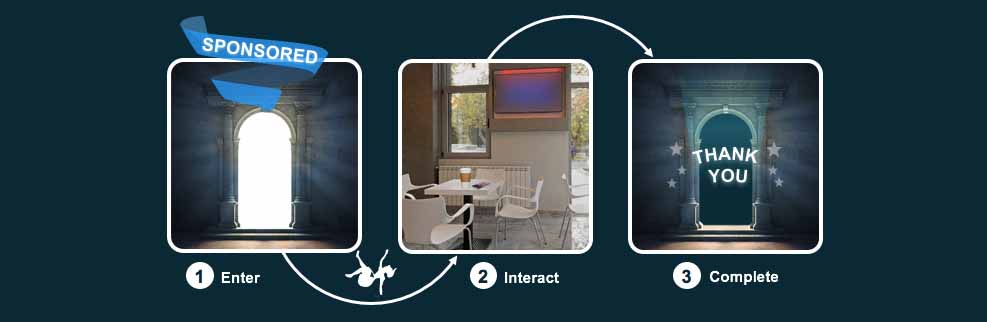
“Unity is enabling advertising in two ways through the Virtual Room program—by using our engine to make the advertiser creative, and using our network of content developers and apps to distribute that experience,” Agatha Bochenek, head of mobile and VR and AR advertising at Unity Technologies, told AListDaily. “The Virtual Room ad format will be a sandbox environment for brands to build their stories with high-quality content, and will include objects and interactions that reflect the brand and ultimately drive positive awareness and engagement.”

Bochenek believes Virtual Room is equivalent to the 30-second ad spot of VR and will become an integrated part of the moviemaking process in the future, expecting it to stretch across a diverse portfolio where a user can either be immersed in a children’s movie while being surrounded by a cartoon-like world, or a film where they’re thrown straight into an action sequence.

The challenge of developing such VR advertising will be to use it respectfully so that doesn’t overwhelm users, Bochenek says. “It will be a fascinating evolution to see, and I’m excited about it from a consumer perspective as well.”

The partnership with Lionsgate to create such experiences also open new avenues for Unity developers to monetize content, which till now has been limited to micro transactions and in-app purchases.

“Our secret sauce is putting development tools and technologies into the hands of the world’s greatest storytellers—the brands themselves,” Bochenek says. “Whether it’s fear, thrill, amusement, love, awe, or simply escapism, the immersive storytelling format of a movie is incredibly powerful. And movie ads or trailers are meant to evoke similar feelings in a shorter form. When you compare a flat screen to being within a VR experience, people can feel so much more. It can create a stronger emotional connection, and be a very powerful way of engaging a user to convey a key message, encouraging more people to want to see the film.”

The interactive experience is created within the Interactive Advertising Bureau’s (IAB) emerging ad experience guidelines.

“In a new space, it’s common to experiment and approach things differently. And while innovation is crucial to the success of a new medium, the many options can be daunting,” Bochenek says. “The IAB, and the members of the VR committee, including Unity, want to ensure the ad experience is scaleable and assure successful parameters to meet advertiser ROI. The best way to do that is to create standards that allow for creativity without the potential failure of an unproven idea.”

Lionsgate has long embraced VR and AR from a marketing perspective. They have launched promotional VR efforts for past film releases, often alongside major technology partners like Samsung and Qualcomm, ranging from games to complex and fully interactive room-scale experiences to simpler, behind-the-scenes 360-degree and 3D video features.

“Cinemagoers have always wanted to enter into the worlds of their favorite films,” Edwards says. “VR allows for exactly that.”

Mira’s Prism Smart Glasses Opens AR Doors To Brands For Social Activations

Augmented reality start-up Mira debuted its new Prism smart glasses to attendees at VR Con at San Diego Comic-Con over the weekend. The untethered headset will launch this fall and work with Apple iPhones. It will come bundled with a remote control and a suite of games and apps. It’s currently available for pre-order at $99 and will be sold at retail for $149.

Users open an app on their iPhone, slide the phone into the Prism headset and begin exploring interactive holographic content. Prism’s clear lenses enable users to remain present, setting the Mira experience apart from the isolation inherent in portable VR headsets.

“We’re guaranteeing about a dozen AR apps from games to web browsers and 3D design tools at launch,” Ben Taft, co-founder and CEO of Mira, told AListDaily. “We’re also allowing third-party developers to publish their own apps in the app store, some of which will be free and others will be available for purchase.”

Mira has partnered with immersive content studios, including Funktronic Labs, Big Red Button Entertainment and Fuzzy Logic, to create an initial suite of AR experiences for developers to learn from and consumers to play. These experiences range from solo challenges to multiplayer games, including mixed-reality puzzles, holographic chess and digital warship battles. The remote tracks acceleration and rotation and includes a touchpad, trigger and two buttons; it can be used as a fishing rod, laser pointer, paintbrush, steering wheel and magic wand.

“These are studios that have built a handful of VR and AR experiences that we fell in love with, so we reached out to them and asked them to be part of this program with us,” Taft said. “We’ve been working with them to create this first wave of experiences and really shape the platform together.”

Outside of its mass market price point, Prism is marketing its Spectator Mode, which allows users to collaborate and explore in AR. This feature also allows anyone to record video or capture photos of their friends’ experience and share via social media across iPhones and iPads.

“AR is inherently social and inherently shareable, especially with the feature that we built that allows you to share your experience in real-time with someone else, or the fact that you and I can both put on a headset and share an experience together,” Taft said. “That sort of social nature and viral nature allows people to really understand the experience outside of just trying it. They can join in even without a headset, and that shareable aspect of Prism is going to let more people understand the experience before putting on the headset.”

This social and viral component is something Prism is opening up to brands.

“A lot of brands we’re in talks with right now are interested in this shareable component,” Taft explained. “We have an amazing studio pipeline set up so brands that are interested can come to us and we have a handful of vetted 3D content studio partners who are already familiar with our software and the headset, and we pair them with the brand and help them create an experience on top of our platform.”

Mira recently raised $1.5 million in seed funding from Sequoia Capital, Troy Capital Partners, S-Cubed Capital, Salesforce CEO Marc Benioff, Jaunt VR founder Jens Christensen and artist/tech investor will.i.am of the Black Eyed Peas.

will.i.am was at VR Con to announce that he invested in Mira because he’s going to incorporate AR into his 2018 global tour. Once AR becomes a part of a concert experience, this will open up new opportunities for brands to literally get into concertgoers’ faces, and also introduce new opportunities to reward fans through everything from sponsored content to contests.

Powered by the Unity 3D game engine, Mira is releasing a software developer kit, enabling creators to develop unique experiences or retool existing VR or gaming assets for use on the Prism headset. Taft said Prism Developer Editions will be sent to studios a few months before the consumer launch of the headset.

“Interested developers can create sophisticated, multiplayer experiences that extend interactions beyond the screen and can easily publish their work to a mass market reaching millions of mobile users,” Taft explained.

The recently announced Apple ARKit will allow developers to create content for Prism.

“ARKit is going to create a wave of experiences that anyone can look at through an iPhone,” Taft said. “It’s going to educate people on a mass scale about the difference between AR and VR.  They’re going to understand virtual objects superimposed in the real world. You can imagine walking around outside and playing a game on your smartphone and then coming home and sliding it into the Prism and bringing that same experience more to life in the environment around you. We’re encouraging all our developers to think about how content lives both in the phone world and in the headset world, and more importantly how they interface with each other.”

The Ayzenberg EMV Index Report

Download the Ayzenberg Earned Media Value Index Report

Ayzenberg Group has released the Ayzenberg Earned Media Value Index (AEMVI) to shed light on the value of engagement metrics like cost per click (CPC), cost per view (CPV) and more across major social networks. These types of values are key reporting metrics for marketers to understand the overall effectiveness of a campaign. The index puts this critical information in one place for platforms like Facebook, YouTube, Snapchat, Instagram and more. Compiled from our research and more than 10 years of media, social and influencer experience, Ayzenberg Group is now making this index publicly available.

Ready to understand the earned media value of social and digital endorsements and actions? Just fill out the form below to gain immediate access to the report.


While this research is provided by Ayzenberg at no charge, we do ask for your assistance in maintaining a certain level of knowledge about who is accessing these valuable assets. We will never sell or distribute your information outside of Ayzenberg Group without your permission.

Analysis: June’s Biggest Twitter Trends


Editor’s note: Robin Boytos is the director of analytics for Ayzenberg Insights. AListDaily is the editorial and publishing arm of the Ayzenberg Group, the parent company of Ayzenberg Insights. For more on Ayzenberg Insights, visit ayzenberg.com/insights. 


Top 25 US Twitter Trends For June 2017

Summer is in full swing. With fall shows wrapping their season finales, this month we saw a shift in the US from TV shows to trending tweets during live sporting events.

Draymond and Uncle Drew were referenced during NBA final matches, Mr. Met was a reference to a Yasiel Puig spectacle, UFC 212 trended during an exciting upset of Jose Aldo on UFC fight night and USMNT trended during the US vs. Mexico World Cup qualifying event.

Last month’s emergence of political and socioeconomic undertones trending in the top 10 continued this month—Bill Maher’s racial slur on national television, Eric Trump’s investigation for ties with Russia, political tension in Qatar, a scuffle between CA House representative and the media, and #MakeMeCringeIn3Words quickly went in a political direction with references of Trump. Perhaps we are less distracted with our TV shows or maybe this is an indication of the political restlessness surfacing in America.

Here’s our take on the trends for this month—stay tuned to see how these trends continue to evolve, and check out last month’s biggest trends to compare.

US Hashtag Spotlight

The hashtags of most interest to marketers in the US this month were #NationalBestFriendDay, #NationalDonutDay and #WWDC2017.

#NationalBestFriendDay captured the mindshare of the Twitter community with many posting endearing pictures of their best friends. Nintendo was able to jump in on the trend with a witty poll asking fans to choose their best friend from the Nintendo game, Animal Crossing. This Tweet received 34,000 votes and over 3,000 likes, retweets and comments.

#NationalBestFriendDay was also a natural topic for sports teams like the Chicago White Sox, Indianapolis Colts, and Oakland Raiders—who all participated in the trending topic.

#NationalDonutDay happens annually on the first Friday of June. Donut shops such as Dunkin Donuts received the most publicity, but some non-foody brands were able to benefit from the trending topic. Waze cleverly encouraged fans to #WazetoDunkin with their participating post.

Apple made headlines with their trending hashtag #WWDC2017 during their Worldwide Developers Conference where they announced new products and programs. Surprise announcements at branded or general consumer events tend to make headlines for big brands and can even trend nationally on Twitter if the timing is right.

Top 25 Global Twitter Trends For June 2017

This month, Twitter fans were tuned in to live sporting events across the globe. From NBA finals to cricket matches to World Cup qualifying futbol matches—#NBAFinals, #INDvPAK, Arda Turan, #استراليا_السعوديه, Corinthians and #ENGvAUS fell into this category. As World Cup gets into full swing, we’ll likely be seeing more of these trends.

Political events, particularly the boycotting of Qatar and Chilean politics also made headlines—Qatar, #الشعب_الخليجي_يرفض_مقاطعه_قطر, #AquiEstaChile and La Vega fell into this category.

Global Hashtag Spotlight

Global hashtag spotlight this month is #DiaMundialdelMedioAmbiente—World Environment Day in Latin America. Police stations, cycling communities, environmental groups and public natural parks participated in this trend. Although most brands did not engage—many individuals tweeted and shared pictures doing their part for the environment.

Acura’s Real-Life Augmented Reality Race Is Inspired By Video Games

Acura created the first-ever, live, augmented reality race, which the car manufacturer livestreamed on Facebook on Monday. The “What A Race” marketing activation was designed to showcase the performance of the 2018 TLX A-Spec sedan.

Jessica Fini, social media manager for American Honda Motor Company, told AListDaily that while 360-degree video and virtual reality are great immersive technologies, they still simulate everything the spectator sees and hears.

“Acura is a premium car brand, and that means we have a number of very real, physical, tangible products we want our audience to experience,” Fini said. “No matter how good a VR simulation is, it’s never going to be as good as actually sitting behind the wheel.”

Fini said AR makes it possible for the brand to combine the premium experience of sitting in and driving an Acura TLX via the immersive worlds and experiences created with real-time gaming engines. The AR technology makes it so the driver can go from Antarctica to the Amazon jungle to erupting volcanoes in the Pacific Rim all in one sitting. At the same time, the smell of a new car, the feeling of being pushed back in the seat when accelerating and the roar of an engine are not simulated sensations—they’re real because they’re created by actually driving the TLX.

Acura enlisted Chuck actor Zachary Levi and technology influencers Sam Gorski, Dom Esposito, Maude Garrett and hosts NSX GT3 racecar driver Ryan Eversley and online personality Bradley Hasemeyer to partake in the livestreamed event.

The car brand leveraged targeted paid media and organic tactics to connect with audiences interested in its brand, as well as those interested in subjects like emerging technology and video gaming. Acura also partnered with a series of influencers who further amplified the experience with their audiences, specifically within Twitter and YouTube. On Facebook Live, Acura allowed viewers to influence the racetrack, connecting the crowd and driver. Through Facebook reactions and comments, viewers opened shortcuts and offered support to drivers while they’re on the tracks. Prompts encouraged fans to use reaction emoji throughout the race, revealing shortcuts and clearing obstacles to influence the course’s landscape.

“Our four competing drivers were not professional drivers, and they didn’t know what they’re getting into,” Fini said. “We had full confidence that all of them would have a great time as they go through the race of a lifetime.”

The idea for “What A Race” came from Acura’s newest feature—super handling all-wheel drive (SH-AWD)—which Fini said enhances the driving experience through a series of advanced, real-time calculations of individual wheel velocity, steering angle, engine torque, transmission gear and lateral acceleration to apply the optimal torque distribution at any time during the drive.

“To tell that story, we wanted to combine the precise nature of SH-AWD with the unpredictable nature of an ever-changing racecourse, one where regular drivers get to drive the car in a race consisting of three totally different and uniquely challenging environments,” Fini said.

Acura looked no further than the video game culture to create this real-life AR race.

“Video games had a tremendous influence on this project,” Fini said. “Video game technology is also what enabled Acura to bring this idea to life in the first place. Modern, real-time 3D game engines and the hardware that runs them have become incredibly powerful in recent years, and this gives us great potential for innovative, technology-powered creative work.”

Acura teamed up with AR production firm Current Studios to concept and execute the “What A Race” experience, where drivers wore custom-built race helmets with AR technology embedded in the extra-wide visor, allowing for a full-color high definition, 80-degree viewing experience.

The helmets are connected to a computer in the rear seats that provides the high performance rendering capacity needed to keep the experience running smoothly and visually sharp at high speeds—all powered by the Acura TLX.

“The cutting-edge piece of technology allowed Acura to integrate the real and virtual worlds in a completely new way,” Fini said. “Creatively, that meant the sky was the limit in deciding which environments we wanted to bring the TLX into and how we wanted to test the car in these different environments. We were able to play around with an infinite number of variables when designing the landscape, road layout and driving challenges for each of these worlds.

The Current Studios team patched into the TLX’s ABS system to accurately track the vehicle’s wheel speed and direction. To further mitigate any potential technical snafus during the race, the team custom fabricated a device attached to the undercarriage of the vehicle, allowing the location of the car in the AR world to be automatically reset remotely and quickly, as needed.

“A main pillar of this project was authenticity,” Fini said. “Technology enabled us in bringing the race to the world live, in a way that allowed our audience to interact with the virtual world, without smoke and mirrors. With Facebook Live, overlayed the AR world on top of the racetrack, and suddenly the live audience saw everything the driver was seeing. . . . This made it a truly unique and first-time experience for our audience.”

‘Spider-Man Homecoming’ Marketing Swings Into Full Effect

Spider-Man webs his way back into theaters with Spider-Man: Homecoming on Friday, and to avoid franchise fatigue, Sony Pictures crafted an expansive marketing campaign to get viewers’ Spidey senses tingling.

Outside of the standard slate of trailers, Sony Pictures teamed up with ESPN to release a special promotion centered around the NBA Finals last month. In the ad, Spider-Man, played by actor Tom Holland, received an invitation to a viewing party hosted by Avengers’ member Tony Stark, played by actor Robert Downey Jr. In the NBA ad, Spider-Man runs into Stark’s secretary Happy Hogan, played by director Jon Favreau, NBA greats Magic Johnson and Tim Duncan, famed comic book writer Stan Lee and producer DJ Khaled.

https://www.youtube.com/watch?v=UdDFpmNmor4

Fans of the web-slinger have been clamoring for him to interact with other Marvel heroes, like Stark. Legal issues forced Sony to use only Spider-Man and his foes in their previous two cinematic incarnations. However, the 2015 deal with Marvel Studios allowed Sony to access the popular Avengers roster.

Sony further highlights Spider-Man’s interaction with other Marvel heroes in the PlayStation exclusive short A Film By Peter Parker. The announcement shows some of the events from last year’s Captain America: Civil War, but from the point of view of the young hero.

For fans wanting to experience being Spider-Man himself, Sony and CreateVR released Spider-Man Homecoming Virtual Reality Experience. The game allows players to suit up, swing around and defeat villains like the Vulture, played in the film by actor Michael Keaton. Sony is releasing the game on PlayStation VR, Oculus Rift, HTC Vive and in select Cinemark theaters.

Sony also announced a partnership with Audi, a brand deal that stretches across several Marvel Studio releases—which previously entailed the Audi R8 V10 Spyder in Iron Man 2 and the Audi R8 in Avengers: Age of Ultron.

The car manufacturer will unveil the new Audi A8 in Spider-Man: Homecoming and will show the new AI traffic jam feature in a scene with Holland and Favreau. The company also released a digital short showing the teenage hero trying to get his driver’s license.

“We tried to find the sweet spot where this character arc might intersect with the Audi brand,” Benny Lawrence, manager of media and branded integration at Audi of America, told AListDaily. “Passing a driver’s test felt like the perfect milestone in a young person’s life.”

https://www.youtube.com/watch?v=GIXyL9vlYo4&feature=youtu.be

Feeling equally driven, Dell will feature the hero in the marketing campaign of their new Inspiron 15 7000 gaming laptop. On the mobile side, Sony and Dell invited fans to try a location-based Spider-Man game in Times Square, New York. Spider-Man Scramble challenges players to get the superhero atop a New York skyscraper in the fastest time.

Spider-Man: Homecoming stunt-double Chris Silcox took the web-slinging shenanigans one step further. In a London photo shoot with Premier magazine, Silcox wore an authentic movie suit, climbed the London BT Tower and Heron Tower and performed flips and acrobatics to help promote the film.

Most fans can’t get their hands on a movie-accurate suit, so Goodwill announced a costume competition on Twitter, challenging fans to build their own custom Spider-Man outfit. While it did not have to shoot webs or climb walls, the suit had to be made with used materials, do-it-yourself style, similar to how the teenage hero created his first costume.

Digital content agency Portal A invited YouTube celebrities to a custom design studio to create their own costumes and promote the contest.

Pizza Hut took to Twitter to announce a tie-in with the movie, which included a cameo in the film for the pie maker, as well as a Spider-Man-themed box for consumers ordering from the chain. The limited-edition packaging aimed at reviving the restaurant’s cheesy bites pizza.

All of the marketing partnerships likely drove Spider-Man to the wall and in need of a caffeine kick, which led him to drop into Starbucks and prank customers in the coffee shop by rapelling from the ceiling to grab his drink.

Dave and Busters introduced an arcade conversion of the 2014 mobile game Spider-Man Unlimited, which is now updated with custom assets from the new film.

Hot Wheels hopes to reconnect with Spider-Man’s comic book history with toy recreations of the Spider-Mobile. The dune buggy was first introduced in 1974 and the scale toys will be a San Diego Comic-Con exclusive later this month.

Accessories brand Charlotte Olympia also drew inspiration from the comic book style by releasing a limited edition line of shoes and purses with the iconic webbing pattern.

General Mills partnered with Sony to create Spider-Man-themed packaging for its fruit snacks and cereals, which included water squirters designed after the hero’s web shooters.

Sony is also using the excitement around Spider-Man: Homecoming to help boost promotion for the 2018 release of Marvel’s Spider-Man game for PS4.

“We’re influenced by certain situations, but this is an original story and these are original events,” Bryan Intihar, creative director for Marvel’s Spider-Man at Insomniac Studios, told AListDaily. “I’m a big Marvel fan, and as cool as it would be to recreate these events, I want to give people a new experience.”

Sony Pictures has had a difficult relationship with Spider-Man since the studio’s acquisition of the film rights in 1999. Spider-Man Homecoming marks Sony’s third attempt at creating a franchise around the comic book icon. Since 2002, Sony has experienced diminishing box office returns on their Spider-Man films.

It remains to be seen if the multifaceted marketing for the forthcoming film helps move the needle with moviegoers and the franchise’s fervent fans alike.

https://www.youtube.com/watch?v=kuFxoQyil1E

Jonathan Goldsmith, “The Most Interesting Man In The World,” Trades Beer For Tequila

Jonathan Goldsmith, best known as the original most interesting man in the world from the Dos Equis marketing campaign that ran from 2006 through 2016, is back.

And he’s still thirsty, my friends, only this time he has a taste for Astral Tequila. He can be seen in a new commercial, essentially reprising the character that changed the face of Dos Equis, saying, “I told you, I don’t always drink beer. Astral Tequila.”

After becoming a globally recognized pitchman, Goldsmith can now pick and choose the brands he works with while also having the power to own a piece of the ventures, too. Ooma is another brand that he has an equity position in.

“I only want to do things that are important to me,” Goldsmith told AListDaily. “Dos Equis sent me to Mars, and I came back with Astral Tequila. Astral is an incredible tequila. The other day George Clooney sold his tequila company (Casamigos) for a billion dollars, and that was in just under four years. So, I hope that’s the coming trend. Astral is a double-gold winner and it’s going to be a huge launch over the summer; I’m very excited about that. I’ve got an equity position in the company. Master Sommelier Richard Betts has created something very, very special.”

Goldsmith said he’s part of an entire campaign for the new brand, which he expects will be another “meteor” in the advertising world.

“It’s going to be tremendous,” Goldsmith said. “It’s great.”

For a decade, Goldsmith was the face for arguably one of the most iconic marketing campaigns of this millennium for Heineken USA’s Dos Equis brand until they decided to go for a younger frontman.

Goldsmith said the fame eventually became so great that he had to move to Vermont. “I started to get a lot of recognition, not just from fans but also from the industry because it was a different kind of a sell,” Goldsmith said. “By the third year (of the campaign) we left Los Angeles. I had no anonymity whatsoever. I had no privacy. And I’m not complaining, believe me. You’re talking to a very lucky guy.”

Goldsmith knew the campaign was forever changing his life in the second year, when people who stopped asking if he was the Dos Equis guy and started asking if he was Jonathan Goldsmith.

“People started to know me, and then I got so many offers and invitations to do all kinds of things,” Goldsmith explained. “After the second year, a fellow came down to my boat and offered me way more than a million dollars—I don’t remember the exact fee—to say ‘I once made a mistake’ and hold up another beer.  Of course, I couldn’t do that.”

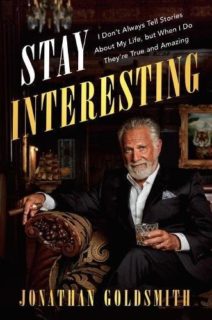
Goldsmith reveals a lot more about his life in the new Penguin Random House book, Stay Interesting, which is yet another opportunity that Dos Equis has opened up for the actor.

The 78 year-old actor had spent decades as a young man racking up over 500 television and movie credits, starring opposite John Wayne and Judy Garland during his career. But it wasn’t until the Dos Equis fame that Hollywood really rolled out the red carpet.
“I made a living as an actor and I did well, but I didn’t reach the heights that I wanted to,” Goldsmith admitted. “And this incredible campaign just took me to places that I never dreamt of before. It really was an extremely meteoric rise. Everything that had been closed to me all my life—the best tables, the recognition, the red carpets—it all just started pouring in. I was the face of the campaign, but the brilliant kids that wrote the stuff changed TV advertising. We won every single award in the industry.”

Goldsmith worked on an annual contract with Dos Equis. And after years of portraying the character, he began hearing rumors that the brand was looking for somebody younger.

“We just thought it was a matter of time before I was replaced, but I didn’t think it was going to happen at the height of the success of the campaign,” Goldsmith said. “They were gaining double digits in sales every year. I can certainly understand changing a campaign, but why at its height? But then we heard that they had a deal with ESPN television, and rumors had it that some of these executives wanted to go younger because of that. So that was a choice that they made, and I thoroughly enjoyed those years. As far as the new fellow [Augustin Legrand] is concerned, I wish him nothing but good luck.”

Goldsmith has had his share of good luck, especially after taking a 10-year break from acting to score the role of the most interesting man in the world.

“After I was replaced on the Dos Equis campaign, some beer companies apparently had spoken to my manager,” Goldsmith said. “I don’t know how serious they were, and I had a non-compete clause anyway. But I’m in a wonderful position that I never experienced before in my entire life, in that I can pick and choose and get involved with those projects that make sense to me, and that I can feel some passion about. Tequila certainly is one.”

Audi Swings Into ‘Spider-Man’ With Marketing Integrations

Sony Pictures’ newest Spider-Man reboot starring Tom Holland is getting rave reviews, which is good news for Audi. The luxury car company continues its Marvel product integration on the big screen with Spider-Man: Homecoming, opening July 7.

Movie fans worldwide will get an exclusive first look at the new Audi A8 in the film, which pits Spider-Man against super villain Vulture (played by Michael Keaton). The luxury sedan’s Audi AI technology has been integrated into the film.

Benny Lawrence, manager of media and branded integration at Audi of America, told AListDaily that from Iron Man to Captain America to Spider-Man, the Audi brand has been a key part of these stories through their marketing partnerships.

“These settings are ideal to showcase our high-level technology and performance capabilities to a global audience. Super heroes need super cars,” Lawrence said.

Lawrence said that the not-yet-released luxury sedan’s Audi AI traffic jam pilot is featured in a scene with Holland (as Peter Parker) and Happy Hogan (Jon Favreau).

“It shows how under certain conditions, Audi AI traffic jam pilot will allow the A8 to take over the task of driving for short periods of time when the feature is activated,” Lawrence explained. “And of course Tony Stark drives his Audi R8 V10 Spyder. At one point we see Peter behind the wheel of an Audi TTS Roadster. Tom told us that he thinks that the TTS could outrun Spider-Man, except in New York traffic.”

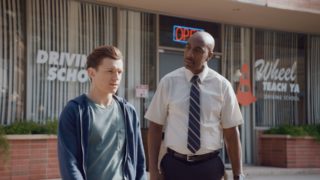
Audi also enlisted Holland and comedian J.B. Smoove to star in a humorous video short called “Driver’s Test,” which follows Smoove and Parker during a driver’s test. While driving an Audi prototype, Peter notices a bank robbery in progress and uses Audi AI technology to help him fight crime, leaving the instructor none the wiser of Spidey’s quick exit.

Lawrence said at the heart of the Spider-Man character is a timeless, coming-of-age story about an everyday person with extraordinary powers.

“We tried to find the sweet spot where this character arc might intersect with the Audi brand,” Lawrence said. “Passing a driver’s test felt like the perfect milestone in a young person’s life.”

Audi of America’s social media agency of record (Muhtayzik Hoffer) developed the promotional campaign. The video was shot last month by film director Jody Hill, who is known for comedies like Eastbound and Down and Vice Principals. Lawrence said Audi has consistently used entertainment as part of the marketing strategy to tell stories about new vehicle launches and target individuals seeking progressive luxury.

Audi is targeting YouTube with this video, and the huge number of digital savvy consumers who watch and share video shorts.

“The largest generation in US history is known for their use of technology,” Lawrence said. “Showcasing Audi AI to a new generation is crucial. Audi AI represents future automated driving technology.”

Lawrence said the car brand has always looked at entertainment partnerships as an opportunity to communicate to an audience that cares about the latest and greatest in technology, design, and performance.

“Over the years, we’ve been able to work closely with casts and directors from our partners, bringing authenticity to anything we create,” Lawrence said. “From the Russo brothers directing an Audi short for Captain America to Tom in ‘Driver’s Test,’ we enter into any integration with the intent to create something that will excite the fans while sharing our latest models.”

Lawrence believes the brand has been able to create storytelling opportunities that connect with consumers.

“Whether it’s our trademark humor or making a statement, we find the right time and place to communicate something about what Audi stands for—in an entertaining way,” Lawrence said.

https://www.youtube.com/watch?v=kuFxoQyil1E

Buffalo Wild Wings And Fox Sports Introduce New Social VR Experience

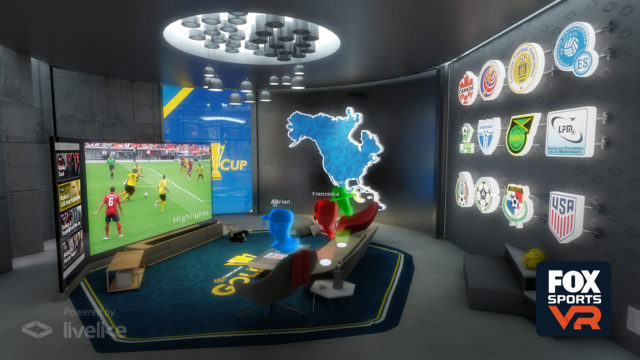
Buffalo Wild Wings, an active esports participant recently with Turner’s ELeague, has jumped into the virtual reality sports game. The brand is the first to experiment with social VR with Fox Sports and VR company LiveLike, where users will be able to order Buffalo Wild Wings food inside from VR for real-world home delivery—all while watching the game with friends and a fellow community of fans.

Buffalo Wild Wings is sponsoring a virtual suite experience across three CONCACAF Gold Cup matches, which are available free on the Fox Sports VR app. The soccer games kick off July 8 for United States-Panama match and will continue with a still-to-be-determined contest on July 22 or 23 and culminate with the Gold Cup championship on July 26.

Michael Davies, Fox Sports’ senior vice president of field and technical operations, told AListDaily that VR opens up a more immersive and interactive element to the viewing experience.

“One thing that we’re working on with Buffalo Wild Wings is to directly connect the immersive experience with the kind of experience that they would like to convey,” said Davies. “In addition to the normal banners of Buffalo Wild Wings signage, we can also allow some interaction within the virtual suite.  And we are just scratching the surface with VR and the kind of interactivity we can provide within the medium—it makes for a very creative sandbox of possibilities.”

Davies said this sponsorship with Buffalo Wild Wings is the latest in a line of “lean-forward campaigns.” Fox and LiveLike updated and revamped the VR suite for the brand. Social VR also opens up new opportunities for ad sales teams to create more targeted sports integrations. All of the Fox Sports VR activations are available on Samsung Gear VR, Cardboard VR and other mobile devices.

The virtual suite for these soccer games will allow four people to congregate in VR and engage with the brand, as well as take in the action on the pitch. Fans will be able to customize their VR avatar, but in the future more customization options will be added.

When entering the experience, users will be able to select a “social” tab and a “join friends” button that connects to Facebook. At that point, friends who have done the same will pop up on your friends list, creating the opportunity to view the experience in a social environment. Additionally, the experience can automatically select a viewing partner at random, with viewers having the ability to seamlessly switch social VR “on” or “off.”

Davies said this first activation is an experiment, so additional friends could be added to future games for a larger social experience.

“We find that the people who have engaged with us in the past are people that like to be a part of the cutting-edge rollout of these kinds of things, so I would expect that we will change a few things based upon what we learn,” Davies said. “The cool thing is that this experience stands on its own with or without social, but there’s no doubt that this is a seismic event in terms of VR and the possibilities of engaging people with a medium that has been criticized as being insular can open up in this way is truly exciting.”

Users will be able to watch the soccer games from four angles, including one positioned behind each goal and one that puts fans in the stands. Fans can choose from any of these views on the fly, or watch the produced “director’s cut” and allow Fox to switch camera angles for them. Davies said this option has been the most popular with past VR sports broadcasts.

“We understand that people aren’t going to watch the whole game in VR—that’s ok,” Davies said. “We want to supply an experience that they can dip in and dip out of. It’s something different and complementary to the game they’re watching on television.”

Fox Sports is working with CONCACAF to deliver additional 360-degree video content that can be viewed inside the virtual suite.

“Over the last year and a half, we have gotten better and better at shooting it, and CONCACAF has been great to work with—they’ve submitted a lot of the ideas and supplied the access for the kinds of things we are doing,” Davies said.

Introducing a social aspect to sports in VR replicates the experience fans would have watching soccer or other games inside a Buffalo Wild Wings restaurant.

“It potentially allows friends who are rooting for the US to get together from across the country to watch together in a whole different way,” Davies said.

Over the last 18 months, Fox Sports has offered more than a dozen major events in VR, including Super Bowl LI, the 2016 and 2017 Big East Men’s Basketball Tournament, the 2017 UEFA Champions League final, the 2016 US Open Championship, the 2016 MLS Cup, the 2016 Bundesliga season opener, the 2016 Daytona 500, the 2016 Big Ten Football Championship and a PBC heavyweight title fight.

“Any sport is a good opportunity for social VR,” Davies said. “But the Gold Cup is particularly exciting due to its international appeal. Sports are tribal—we’re hoping this is a good opportunity to allow people to be with the people that they would otherwise want to be with. In the end—sports are meant to be enjoyed with a group—we hope this ends up being a tool to allow people to do just that.”

Davies hopes to extend social VR to other sports as an offering that can go to any of our VR activations.

“It’s truly exciting what this could mean for social viewing, and this will be the first step in figuring this out,” Davies said.

Marketers Are Integrating IoT To Engage Consumers

Forward-thinking brands are using IoT in innovative ways. IoT devices can offer timely, relevant, data-driven engagement to consumers and manufacturers alike. By 2020, there will be over 26 billion connected devices, and the IoT market will be worth $151 billion, per Gartner.

The retail industry is ready to adopt the futuristic technology, according to a study by Research Now and Qualtrics. A global survey of 1,700 executives across multiple retail segments found that 96 percent are ready to make the changes needed to adopt IoT. Sixty-seven percent have already implemented IoT capabilities in some form. In-store tracking is a popular use for retailers, with 35 percent saying that they currently have the ability to know when specific customers are in the their stores.

In fact, IoT has found a special place with retailers interacting with consumers on-location. Home Depot’s mobile app assists customers in locating items throughout the store. Other retailers, like Macy’s and Rite-Aid use beacons to offer deals timed with a consumer’s location and activity.

“We just see a great upside in using beacons to enrich the one-to-one experience with our customers,” said Gerard Babbits, Rite-Aid’s senior director of digital marketing.

Inanimate objects in our daily lives are getting smarter by the day—the Smart Home Market will be worth $121.73 billion by 2022, according to Markets and Markets.

Amazon Dash Wands and buttons allow customers to instantly order everyday products. The Amazon Echo learns new skills on a regular basis, which is beneficial to voice search. Patrón paired with the Echo smart speaker to deliver over 150 cocktail recipes.

Gartner predicts that by 2020, 250 million cars will be connected to the internet. Tesla vehicles receive upgrades through IoT and send data back to the manufacturer for analysis.

Over half (51 percent) of the world’s top marketers believe IoT will revolutionize the marketing landscape by 2020, per Marketo.

Is your brand connecting to IoT?