Theme Parks Market Halloween-Craving Consumers By Creating Communities

When it comes to the Halloween season, spook-starved inhabitants apparently have an uncontrollable appetite that constantly needs to be satiated.

The National Retail Federation forecasts that 179 million Americans will spend a new high of $9.1 billion for Halloween-related festivities across all purchasing categories this year, an increase of $700 million from the previous record set last year.

As the horror-themed holiday season keeps bleeding more into September, theme parks continue to shape fright-filled experiences, from securing exclusive IP to having one-to-one dialogue with the community, to capitalize on revenue streams for the fertile market.

The big four—Disney, Cedar Fair, Six Flags and Universal Studios—all have their own branded variation of Halloween-themed attractions as soon as the leaves begin to fall each autumn.

Six Flags is celebrating by startling horror fans across its theme parks with Fright Fest for the twenty-fifth consecutive year this season with properties like Suicide Squad and a variety of other attractions, mazes and even a night club.

James Geiser, vice president of marketing and sales for Six Flags, says Halloween has become such a huge event and cause for celebration that it’s grown from a single day at the end of October to some retailers launching campaigns immediately after Labor Day.

“Since Six Flags owns the biggest, scalable event across North America, and we’re able to deliver co-branded marketing programs with huge brands like Coca-Cola and Mars,” Geiser told AListDaily. “We provide brands who might have a Halloween specific campaign the opportunity to reach the family audience through sampling, and we also work with brands targeting consumers who are 18-and-over by creating custom content across our Nielsen-measured digital network. All of these touchpoints drive awareness and engagement throughout the run of Fright Fest.”

Six Flags, who reported $580 million revenue for the recent quarter, an increase of $23 million to the same period last year, looks for the best brand fit based on common strategies and goals. For Coca-Cola, the Snickers-sponsored Fright Fest partnership made perfect sense, Geiser said.

“Coca-Cola’s goal is to connect with teens in an authentic and engaging manner. Those teens are fans of our brand and Fright Fest in particular,” he said. “From there, we look for common space to activate the brands and promote the in-park experience. It’s really a win-win all around.”

To retool their storytelling and marketing strategy each year, Geiser said the Six Flags creative teams work on content both from an entertainment perspective and on the communications front, looking at current events, along with trending topics and interests to build unique concepts and experiences. One creep area the theme park is capitalizing on is the current captivation for clowns as well as featuring scareactors in advertising.

“Six Flags owns the thrill space for theme parks, and Fright Fest provides the perfect opportunity to scare people in a fun and thrilling kind-of-way,” Geiser said. “We don’t take ourselves too seriously and we encourage our creative teams to have fun with this event. Great ideas come from everywhere, including our guests and employees. We keep it fresh by updating the scare factor every year. Research has told us our guests want it scary, so we plan to over-deliver on that front.”

As for the actual marketing of Fright Fest, Geiser said Six Flags continues to see social media playing a key role in driving awareness and demand. The media teams are focused on Instagram and Facebook to drive campaigns.

“While the platforms themselves are not new, the way we’re using them is,” Geiser said. “We’re developing our ads to feature social content using tailored creative for the platform. We want to startle people as they’re scrolling across their news feed. In addition, we’re using data better than ever to prospect for new guests and connect with existing ones.”

Another theme park leveraging a strong social media strategy is Universal Studios.

John Murdy, creative director of Halloween Horror Nights at Universal Studios Hollywood, has year-long, one-on-one conversations with consumers by personally running the Halloween Horror Nights Twitter account. His tone and approach on the platform includes building relationships by sharing behind-the-scenes content and insight into how the event is created.

“Our fan base is not shy. They like to suggest properties we should be doing. Halloween Horror Nights is super important to our fans—more than you would ever think,” Murdy told AListDaily. “Their passions fuels us. Horror is cyclical and goes through phases, so I solicit their opinion and ask them what they’d like to see to stay one step ahead. A lot of times, we get a temperature check on the brand just by the reaction we see on social and their desire to see certain things. That very much informs what we do. There are several properties that we’re in negotiations now for the future that we can very much attribute to the fan base.”

Murdy says the Twitter community literally demanded he look into Insidious. The back-and-forth dialogue made him realize how much the community cared about the property. Coincidentally, contemporary horror films producer Jason Blum wanted to work with Murdy and Universal too, and so the journey started. This year they gave birth to “The Horrors of Blumhouse,” mazes inspired by the The Purge franchise, Sinister movies and the recently released Happy Death Day.

“Our vision for this event since day one is that we’re going to work with the biggest brands in the world of horror—and we’re going to create living horror movies that are coming after you,” Murdy said. “Being the studio that invented the horror movie, we’ve been true to that brand.”

Blum pitched the idea of a compilation maze based on his films and then left the rest to Murdy and his team at Universal to decide what that iteration and inspiration should be. Both Murdy and Blum came to the agreement that mazes serve as the best form of marketing for a moviemaker because consumers get to the live through the films first hand.

“From a movie or TV marketer’s perspective, you’ve got a massive number of people from the same demographic that you’re trying to reach—and you can touch them all at the park with a physical and visceral experience through a maze,” Murdy said. “In my mind, it’s the best possible way to promote a property and get people excited about it. That’s pretty exciting for our fans, because the mazes turn into the ultimate live-action trailer for the movies.”

Insidious does not hit theaters until January, and Happy Death Day was released in the middle of Halloween Horror Nights, so fans are getting a chance to live through the experiences before potentially seeing it on screen. Universal has also experimented with other interest areas like the Black Sabbath rock and roll maze in 2013. Murdy said that the filmmakers he works with are naturally horror buffs themselves and for the most part, frequent Halloween Horror Nights each year.

“We get in on the ground level with the moviemakers,” Murdy said. “I’m reading scripts at the early stages practically before everyone. We have a comfort level between us because it’s a mutually beneficial relationship. We get great content for our event and they get an audience excited about a property. When we start the design and publicity process we always approach it as year one. We don’t ever get to a place where we’re comfortable and say ‘we got this.’ It’s always about being hungry and taking it to the next level no matter how successful the event has been before.”

https://www.youtube.com/watch?v=6gka1KHfQ7s

Rovio’s Iron Maiden Fandom Begets ‘Angry Birds’ Partnership

Angry Birds Evolution is hosting a head-banging Halloween thanks to a partnership between game developer Rovio and metal band Iron Maiden. The two-week celebration transforms Bird Island into a battleground that pays homage to Iron Maiden, its mascot Eddie the Head and the heavy metal universe as a whole.

Angry Birds Evolution is a game built for an older audience with tons of interesting pop culture references, really crazy looking birds and sometimes even with somewhat dark humor,” Miika Tams, vice president of games and product lead for Angry Birds Evolution told AListDaily. “The game’s version of Bird Island can contain pretty much anything—we always aim to surprise the audience with something that they would not be expecting to see. Obviously, [including] Eddie the Head and Iron Maiden is a great example of telling an unexpected story.”

Through November 1, Eddie the Bird—an avian version of Eddie the Head—is a collectible character in the game, and his four evolutions represent four different album covers from Iron Maiden. Players who successfully recruit Eddie the Bird to their team during the Halloween event will get to keep him forever.

The team at Rovio are fans of the band, and Iron Maiden’s many album covers provided no shortage of inspiration from demons to Egyptian pharaohs. Tams told AListDaily that they wanted to pay attention to every detail when translating Iron Maiden’s aesthetic to the game.

“It is actually quite surprising how well Eddie fits the Halloween version of the game,” said Tams. “Evolution´s Halloween and Eddie [may sound] very surprising and somewhat strange, but when you see the game, it is actually very natural fit.”

Angry Birds Evolution may be one of many spin-offs in the popular franchise, but teaming up with Iron Maiden represents new territory for the Finnish developer.

“This is the first time Rovio has partnered with Iron Maiden and Eddie the Head,” explained Tams. “This is also the first time Iron Maiden has partnered with a mobile gaming brand, the first time Iron Maiden has allowed a partner to use their typography and the first time Rovio has changed the typography of Angry Birds to a partner’s font. A lot of firsts.”

Rovio is finding “birds of a feather” with musicians across the world and has partnered with artists like Shakira and De La Soul in the past.

Iron Maiden has its own official mobile RPG game called Iron Maiden: Legacy of the Beast that will incorporate Eddie the Bird sometime next year. The free game puts players in the role of Eddie in one of his many forms to create teams and battle through multiple worlds with turn-based combat. The band declined to comment for this article.

Rovio will be offering exclusive Eddie the Bird merchandise to fans throughout the event, although Rovio was unable to share details at this time.

“The team is a big fan of Iron Maiden, and we are super excited about how well Eddie the Head fits in Angry Birds Evolution,” said Tams. “Even Iron Maiden’s music fits very well with the game. This truly is the most metal Halloween campaign ever.”

‘Raw Data’ Creator: Promoting VR Takes Spectacle

James Iliff, co-founder and chief creative officer at Survios

Raw Data is regarded by many as the ultimate sci-fi VR action experience. Players must infiltrate the company Eden Corp to uncover its dark secrets while fending off waves of robotic attackers. Players choose from a variety of characters, each equipped with different weapons and abilities, and they can either play alone or alongside friends in the two-player cooperative campaign or the team-based competitive multiplayer mode.

Developed by Survios, the game launched for the Oculus Rift, HTC Vive and PlayStation VR in October. Many see Raw Data as a flagship title, given how it helped set some of the standards for VR gameplay that we see today, such as blending teleportation with a movement animation like dashing so players aren’t taken out of the experience. That’s one of the reasons why it’s a featured experience at arcades like the IMAX VR Centre.

“We feel that VR is much better as a shared experience,” Survios co-founder and chief creative officer James Iliff told AListDaily. “We saw how lots of people in the early days were complaining about how VR could feel isolating and how putting on a headset was like putting on a blindfold. We realized that having a multiplayer experience made things better because that’s how human bonds are formed—having a shared goal that you can work together to achieve.”

Iliff, who was joined by Survios senior product marketing manager Hunter Kitagawa, discussed how VR built relationships in ways that weren’t possible in traditional games, where the primary means of communications are either through text chat or voice. Players lose the “carnal vessel,” otherwise known as the ability communicate using body language and facial expressions. VR gives players that connection using in-game avatars.

“We realized that the most engaging, engrossing and exciting form of experience you can have in VR is with a game,” said Iliff. “People like to play together, and play is a desirable and honorable goal in and of itself because we don’t see it—or any form of entertainment—as a form of escapism. In fact, we’re trying to enhance and expand lives.”

Engaging The Community

Kitagawa said that Survios has been active in the gaming and VR communities to promote Raw Data.

“There are a ton of VR meet-ups and conferences that we attend to showcase our product,” said Kitagawa. “Unlike most other games, the challenge for VR is that you have to try it to fully understand it. So, experiential and event-based marketing is extremely important for us. Getting this out to the public has been one of our top priorities.”

Hunter Kitagawa, senior product marketing manager at Survios

Outside of gaming, there are lifestyle events like SXSW and tech events, and in addition to those, Survios has been engaging with communities online, particularly on Reddit.

“One of the great things about the VR community is that it’s extremely passionate and optimistic,” Kitagawa explained. “They want to engage and feel like they’re part of the development of the game.”

The developer connects with its community through regular livestreams and Discord. Iliff went so far as to describe the community as an extension of the team, given how dedicated it is at helping to improve and promote the game.

“It feels like there’s a larger team out there that has our back and we’re sharing in the creation of this experience,” said Iliff. “They’re just as much product owners as we are.”

“These are the people who are completely buying into the dream of VR, and they need ammunition,” Kitagawa added. “They need great games, great experiences and great developers. So, we try to give as many opportunities for our community to go out and evangelize as possible.”

Survios is being ambitious with its growth strategy, going beyond the game to build a franchise. This includes Raw Data comic books and developing a video series. The company also has an ARG (Alternate Reality Game) campaign in effect, where Eden Corp has its own websites to draw fans deeper into the world of Raw Data.

“We try to put out as many dimensions of our universe as possible for our fans to get lost in, talk about and share with their friends,” said Iliff. “Building out that franchise is a big aspect of getting the word out. Having that attention to detail to a product and expanding it outside the game so that it feels more like a universe gets people excited about it on a deeper level.”

Iliff also said that the company will be looking for more franchising opportunities and cross promotions as its portfolio grows. In addition to developing its own games, Survios also publishes games from other developers in digital stores and in arcades across the globe. All of it is building the company up as a major digital enterprise.

Making A Spectacle

Although conveying VR on 2D platforms such as Twitch, YouTube and Facebook can be challenging, Kitagawa said that mixed reality is going a long way toward getting the message across. With mixed reality, influencers can place themselves inside of a virtual world and viewers can watch them and go through it in real-time. It connects the physical and virtual worlds and it could prove to be a major hardware driver.

“When non-VR users see that, things suddenly start to click for them,” said Iliff. “They realize that it’s more than just a traditional game—it’s a new generation of experience that they haven’t had yet. It primes them for seeking out the experience for themselves in stores or arcades.”

The chief strategy for Survios has been to get as much exposure as possible at events. Kitagawa recounted a time when VR demonstrations were held privately behind closed doors, bringing that aura of mystery and exclusivity that works well for traditional game and technology marketing.

“Our philosophy has always been to be inclusive and make it available to everybody,” said Kitagawa. “So, our strategy has always been around the idea of spectacle. How do we create spectacle in a public setting? We don’t want to hide the players. We want to elevate them.”

Iliff added that at events, Survios is always looking to show its content on stage, with screens on every wall, while a broadcaster talks about an ongoing competition on a loudspeaker.

“It draws a crowd and gets you excited,” said Iliff. “There’s nothing to hide and there are no secrets. That much flies in the face of what you would traditionally see at conferences such as CES, E3 or GDC, where there are big billboards on the outside but it’s actually kind of like a dungeon on the inside. We’re trying to turn that on its head and showcase everything all at once in a big spectacle, so people get excited about it.”

Making Friends

Attending events and making a big spectacle is great, but you have to get there first. Iliff said that Survios wouldn’t be as well positioned as it is today if it weren’t for partners and sponsors such as AMD and Alienware, which hosted an afterparty when Raw Data was announced in January 2016. Afterward, hardware companies such as Nvidia and Intel brought Raw Data to major conventions like GDC and PAX by integrating the game into their booth spaces.

“Getting that love and excitement from partners has been a huge boon for companies like Survios in getting products in front of more eyeballs in addition to getting a legitimacy boost from these big corporate brands,” said Iliff. “They’re putting their stamp of approval on it.”

There’s a second important support structure that complements that seal of approval from large companies, and that’s other VR game developers. For example, Kitagawa talked about an ongoing social campaign called “FreeKeyFriday,” where Survios challenged someone to play a competing game for the chance to win a Raw Data key. Then the following week, that game developer would do the same in reverse.

“We’re marrying our communities together and growing those ties,” said Kitagawa. “It’s extremely collaborative.”

Past events have included games such as Arizona Sunshine, Rec Room and The Brookhaven Experiment.

“We cross-promote with these other VR developers and we’re bringing conversions to each other while growing the community at large,” said Iliff. “It’s a scenario of ‘a rising tides raises all boats’ because we all know that we’re all in this together and we’re all believers in this technology. So, we have to support each other.”

But this cross-promotional effort goes beyond mingling different VR game communities. According to Iliff, it creates a platform for social discovery.

“Once people become VR users, they become more dedicated to it,” said Iliff. “That means, all of sudden they hop on social media and Reddit and they’re getting a whole interwoven web of discovery where all the VR developers are talking about each other’s innovations. They’re able to discover new products faster that way, and we think that’s growing the market in a healthier way than if everyone was closed off and focused only on themselves. People want to help each other right now because they want VR to succeed.”

Understanding The VR Space

Survios remains optimistic about the future of VR, despite how the technology is currently in the “trough of disillusionment” part of the hype curve. In fact, both Iliff and Kitagawa say that they’ve observed significant growth in VR within the gaming sector, with more enthusiasts looking to pick up the next high-tech gadget, more VR arcades popping up all over the world and leaders in the industry like Bethesda committing to VR.

Iliff believes that confusion among consumers may be coloring the perception of VR. That is, low-cost solutions such as the Samsung Gear VR and Google Cardboard provide largely passive experiences like 360-degree videos, which are just one step up from watching them on a 2D screen. Although the low cost will attract many users, they don’t necessarily promote understanding for the deep, active experiences games like Raw Data provide on premium (and significantly more expensive) headsets.

“Active VR is where our heart is,” said Iliff, explaining how more advanced and compelling content will drive acceptance of the technology. “We put user experience above everything else. Having the best experience is going to be what drives technology and content forward.”

Hardware improvements such as becoming untethered and having a more comfortable, attractive form factor will also go a long way towards mass consumer adoption. But ultimately, it may be the VR arcades that will be most people’s first point of contact for premium VR.

“Arcades have been a big focus for our business,” said Kitagawa.

Survios observed how at events, users who take the headset off frequently want to know how they can have the experience at home. With this in mind, the developer adapted Raw Data to fit the arcade setting, complete with the call-out to pick up the full game at the end.

“Had we known that VR arcades were going to be so big, we would have built Raw Data from the ground up to function in retail and arcades,” said Kitagawa.

“That’s the best way to market,” Iliff added. “If people are already voluntarily playing your game in a public location, that’s the best way to convert them.”

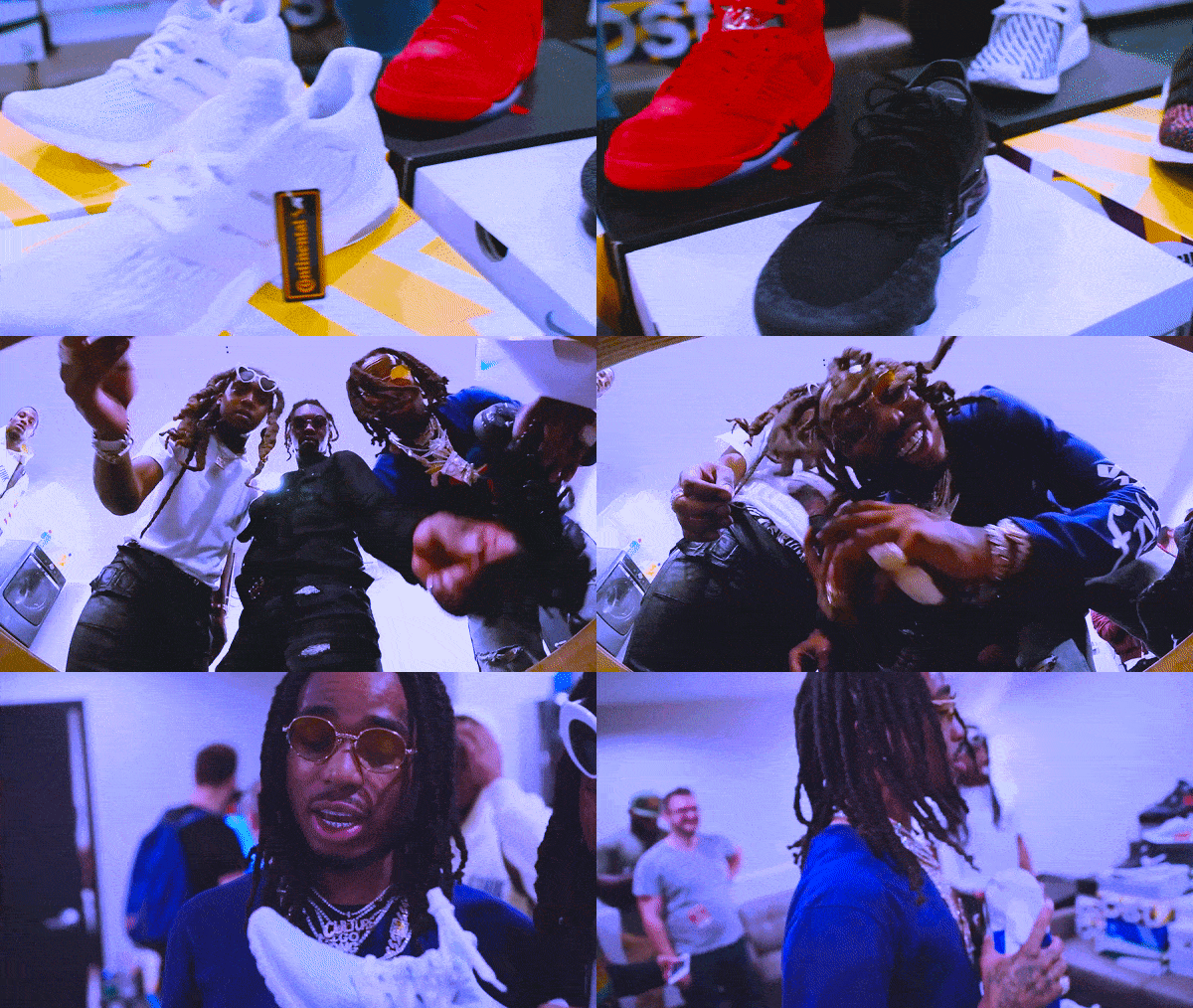
Exclusive: Migos Talks About Their Partnership With Finish Line

There arguably isn’t a hotter hip-hop group right now than platinum award-winning trio Migos.

The Georgia-bred, chart-topping threesome of Quavo, Offset and Takeoff—owners of a bevy of bangers since dropping their debut album two years ago—are one of the few current superstars running the rap game.

With such a powerful and wide-reaching platform, athletic apparel retailer Finish Line has enlisted the rap stars to serve as creative directors and as the faces of the brand’s new marketing campaigns, using them as well as other social influencers to target audiences across the sneaker sphere.

Migos, certified everywhere with no need to print a resumé, is slated to take creative control of distinctive fashion styles and themes for product shoots by directing the on-set vision. The group will also connect with Finish Line’s fan base by curating social content.

“Our partnership will be a reflection of what’s to come for American fashion in the next 10 years,” Quavo told AListDaily. “The fashion industry is a daily revolving door with new trends, releases and collaborations. The benefit of our partnership is that we create and set those trends with our music, fashion and lifestyle. Finish Line has the selection to help choose your voice, and Migos is the voice of the millennials.”

Paul Diehl, senior director of content, social and consumer trends at Finish Line, said the collaboration will serve as a forum for the BET Awards-winning triumvirate to express their creative concepts to an audience that appreciates functionalities—all while boosting the brand’s reach and relevancy.

“We’re looking to continue strengthening the connection between sport, style and music—Finish Line is positioned in the intersection of these ideas,” Diehl told AListDaily. “Migos has a strong pulse on today’s culture and widespread visibility that will help connect consumers to our brand. Working alongside Migos will allow us to explore in more depth where performance, street and style meet.”

Diehl said this partnership is unique to the company because the group won’t be held to one specific brand; they’ll take consumer voices and channel it through the style offerings they select. The young, rich and bougie triad will have creative freedom to pick and style the products that speak to them from every make available. The deal provides much more control than most celebrity ambassadors get with the usual garden variety TV spot or digital activation.

“Our No. 1 goal is to pump energy into the lifestyle and image of the brand,” Offset told AListDaily.

“We intend to create and infuse our brand with Finish Line through our social media influence, curate one-of-a-kind shopping experiences for exclusive releases and meet and greets,” Takeoff told AListDaily.

“Whatever looks they pick will be authentic to who they are and what they would wear daily or for a special event,” Diehl said. “We have a few specific multi-brand product launches planned and we’re excited to surprise our consumers with what’s to come.”

Musicians are increasingly taking on roles as creative directors—just last week, Asics tied its brand to Steve Aoki to inspire a collection of shoes and other apparel. In recent years, Puma has worked with the likes of Rihanna, The Weeknd and Big Sean as creative directors, just as Adidas has with Kanye West and Pharrell Williams. Outside of shoes, Akon is trying to bring virtual reality to the masses as the chief creative officer for Royole, just as will.i.am tried before him with Intel and 3D Systems. Lil Yachty, who previously has partnered with Finish Line for digital experiences, is also the creative designer for Nautica. And just last month, Foot Locker and Timberland teamed up with Nas to launch a Legends Collection.

Migos performing on stage

Migos making its way to Finish Line—which is unlike anything the brand has ever done before—is part of the company progressing its mission and approach to delivering consumer products. In recent months, Finish Line has also updated its app and debuted new store concepts with cutting-edge technology and in-store experiences.

“Migos already connects with our consumers through their music and online presence, so this partnership enhances that connection and allows us to join in on the conversation to understand our consumers on a deeper level,” Diehl said. “We’ve evolved the way we highlight the brands and styles that resonate with our consumers. Everything we do for the Finish Line brand ties back to our mission of providing the most desirable sneakers and latest trends from top brands and responding to our consumers’ expectations.”

Diehl said partnering with Migos complements their social strategy of not pushing specific products. A quick survey of the brand’s hip-hop and sport-infused Instagram page supplements that sentiment. It also helps the brand maintain cultural relevance by having conversations with consumers—all while facing mountainous tasks and marketing challenges plaguing retailers in the shoes, apparel and accessories categories.

Consolidated net sales for Finish Line, which runs across 950 branded locations in the US, were $469.4 million, a decrease of 3.3 percent over the prior year period, according to an earnings report released in September. Comparable store sales also decreased 4.5 percent, while their Macy’s department stores sales increased 5.6 percent.

“Our influencers are important because they’re also our consumers. They serve as an extension of our consumers because they live and breathe the brands we partner with and the products that we sell,” Diehl said. “We work hard to ensure we’re on the same page as our consumers. We’re always improving our speed, our messaging and our product offering to give them what they want, when they want and how they want it. The industry constantly changes. Making sure we’re on the cutting edge of today’s latest trends is crucial.”

Esports Brand Sponsors Advise Speaking Fan Language

Esports marketing isn’t just for energy drinks. As tens of thousands of gamers descended upon DreamHack Denver, several brands—endemic and non-endemic alike—took the opportunity to connect with a young and engaged fan base.

AListDaily caught up with some of the top brands at DreamHack Denver to talk about how they approach the gaming demographic and stand out in a saturated marketplace.

Circle Pay

Circle is a social money transfer app that recently began its journey into esports marketing. DreamHack Denver may have been Circle’s first major sponsorship for esports, but the team there includes video game industry veterans and esports enthusiasts.

Josh Hawkins, vice president of marketing for Circle, warns brands against marketing to gamers without first doing their homework.

“The esports and gaming community is multidimensional, very tightly knit and has a very low tolerance for bullshit,” said Hawkins. “Advice for marketers getting into the space? Do your time. Immerse yourself in the community, deliver real value and be real.”

Leesa Sleep

When you think of gaming, you might not think of mattresses, or even about getting much sleep. But since DreamHack is a three-day, round-the-clock event, having a mattress company as a sponsor made sleeping on-site a welcome option. In addition to a booth at the DreamHack Denver expo, Leesa created a Sleep Zone where special ticket holders could reserve a bed for the weekend.

Lily Hecht-Leavitt, head of partnerships at Leesa Sleep told AListDaily that the brand’s price, digital presence and ease of set-up made a positive impression on the gaming community.

“We started out on the Giant Bomb podcast and that’s how we first learned that we resonated with the gaming community,” said Hecht-Leavitt. The company has partnered with sites like GeekDad and Hardware Canuks, as well as other gaming and tech enthusiasts across social media.

When you’re a brand that could potentially appeal to multiple demographics, using the same campaigns across the board just won’t do.

“Everything we use is catered to a specific audience,” said Hecht-Leavitt. “Use the language. We say things like ‘recharge’ or ‘respawn’ on a Leesa mattress. You want to make sure that the imagery you’re using is right. Even the font and the positioning [are important]. You also want to keep [brand messages] short and to the point—something catchy. If you can combine all that together, you can create something great. Also, have some kind of offer. Promo codes allow us to track web traffic to see the ROI.”

Sceptre

Sceptre has manufactured TVs and computer monitors for over 30 years and drove right into esports marketing as the brand sponsors Azio Esports, who came in second for League of Legends in DreamHack Denver’s BYOC (Bring Your Own Computer) tournament.

Alan Liu, web and gaming director for Sceptre, told AListDaily that DreamHack Denver was Sceptre’s fifth gaming event so far.

“Esports is ramping up like crazy,” said Liu. “We wanted to see how we could apply our affordability and quality to the typical gamer. We recently came up with a few lines of curved monitors and we fashioned them with lights, nice panels, etc. and we’re slashing the prices to appeal to the college gamer who can’t afford those top-of-the-line monitors.”

Sceptre offered $200 off a 32-inch curved monitor, bringing the price down to $199.99 during the show, and 4K UHD TVs for as low as $289. While low prices are often a strong selling point, Liu explained that gamers care about the quality more.

“It’s all about the specs,” he said. “With esports, everyone’s watching the pros and the top streamers. It’s kind of like traditional sports—when they see a pro player or streamer and their gear, they’re going to want to be just like them. By appealing to that mentality, you’ll be able to attract many more gamers—from casual to pros.”

HyperX

Gaming peripheral brand HyperX positioned its large booth next to the DreamHack entrance for all to see as they arrived. Attendees were able to test out the latest products, including keyboards, headphones and the newly released computer glasses.

Annie Gerard, global strategic marketing manager for HyperX told AListDaily that it’s not enough to be an endemic brand when speaking to gamers.

“In terms of our marketing, we really try to be authentic,” said Gerard. “The gaming community sees through your marketing PR spiel, so if you’re not really part of their lifestyle speaking their lingo, they’re going to walk away. One of the ways that we do that is by passionately supporting the communities out there from teams to streamers and cosplayers—we really try to connect with them to offer exclusive content or bring them to the shows, allow them to meet fans and celebrities.”

Esports marketing from the brand includes the sponsorship of a number of teams, including Cloud9 and Team Liquid, both of which were competing—and won—in Denver. Despite their esports fame, HyperX advises brands against catering to just one segment of gaming, citing their slogan, “We’re All Gamers.”

Mastercard’s Saks AR Demo Shows Where Retail Tech Is Heading

Mastercard debuted a new augmented reality shopping experience that incorporates Masterpass and Identity Check Mobile with iris authentication. The tech was developed with Qualcomm Technologies and Osterhout Design Group and is being demoed at the Las Vegas Money 20/20 conference through the Saks Fifth Avenue brand.

Mastercard’s new AR experience has been designed to work with ODG’s new R9 smartglasses, allowing shoppers to view digital representations of products before they commit to a purchase, learn more about what they’re buying, see additional options not available in the physical location and get instant recommendations or other information relevant to their unique experience.

When done shopping, users can pay for items using Masterpass, which will first authenticate the user’s iris using Qualcomm Technologies’ iris authentication. The shopper then selects a card from their Masterpass-enabled wallet and completes the purchase by selecting the Masterpass button on the screen. Items can be taken home from the store or shipped, depending on availability.

This demo comes on the heels of Masterpass exploring virtual reality purchases through a Swarovski shopping experience earlier this month.

Sherri Haymond, executive vice president of digital partnerships at Mastercard, told AListDaily that this new technology taps into the radical shifts that the world of commerce is undergoing.

“ODG’s smartglasses offer a hands-free, heads-up and body position independent form factor that gives users a richer, more immersive experience in AR,” Haymond said. “This allows people to more fully engage with the world around them, on the go. This technology allows retail brands to engage with their customers in new ways—driving sales and bringing foot traffic back in store. It unlocks new ways for brands to reach and engage with consumers—to differentiate their brand, build loyalty and drive sales.”


Ralph Osterhout, founder and CEO for ODG, said just as individual brands have shifted a significant and growing portion of their media spend from traditional TV into mobile and digital advertising, AR smartglasses offer brands a new platform to reach consumers, in an even more contextual real-time way.

“We have heard from many marketing agencies and brands who are interested in developing unique memorable consumer experiences at events with our AR smartglasses as a first step in familiarizing themselves with the platform and its capabilities,” Osterhout told AListDaily. “We expect these activities to grow rapidly in the coming years. Retailers are starting to show interest in installing an experience like this Saks demonstration as early as 2018.”

According to an April Salsify study, 77 percent of shoppers use a mobile device while shopping in stores to research availability and pricing.

“Many high-end retailers like Bonobos, Paul Evans, Marc Jacobs and Restoration Hardware are rethinking inventory strategies to reduce footprint and cut costs—moving to a ‘boutique-showroom’ approach, stocking fewer items in store and offering a broader selection through online,” Haymond explained. “The AR smartglasses experience allows the shopper to organically merge the benefits of retail and online shopping together, giving them access to further inventory that may not be available in store while maintaining that richer in-store experience.”

There is also a growing trend among shoppers of buying “outfits” rather than items, which has allowed upstarts like StitchFix, TrunkClub, Wantable and MM.LaFleur to flourish. Haymond said this new technology allows shoppers to create outfits with personalized recommendations pushed directly to them via iris scanning on the glasses.

In the wake of the hacks on Target, Home Depot and Neiman Marcus, retailers are struggling to protect their cash-register systems from malware looking to hack shoppers’ credit card information. Haymond said this experience makes payment and delivery more secure and seamless for both retailers and shoppers.

Given ODG’s limited consumer reach today, the burgeoning AR market across Apple and Google devices opens up more immediate opportunities for Mastercard.

“Mastercard sees additional opportunities to leverage AR and seamless payments to enhance the consumer experience in areas like home services,” Haymond said. “Imagine a home-decorating experience, for example, where you can design a room in your home and then close the loop on the entire process by enabling transactions right on the device.”

Haymond believes AR and AI will open new opportunities for both consumers and retailers, including the creation of a new world of real-time impulsive online shopping, allowing brands and retailers to even more accurately tailor offers and messages to consumers contextually.

Circle Pay Sees Gamers As ‘Natural Fit’ For Its Marketing

Josh Hawkins, vice president of marketing for Circle

Circle Pay is a free social payment app that allows users to send money like a text message. The Boston startup got its start as a bitcoin wallet, but it now focuses on US dollars, UK pound sterling and euros, and it recently founded a separate company called Circle China.

Hoping to connect with young, digital native consumers, Circle was an official sponsor of DreamHack Denver—the company’s first major commercial partnership in the space.

Josh Hawkins, vice president of marketing for Circle, joined AListDaily at DreamHack to discuss the company’s esports marketing strategy.

“The esports sector has really blown up over the few years and it has achieved a very attractive scale for marketers,” said Hawkins. “Surrounding gaming gatherings, pop-up tournaments, and community events, there is an enormous volume of peer-to-peer payments. Use cases span collecting entry fees for tournaments, to groups making payments for venues, to tipping on livestreams. It’s a natural fit for a social payment app like Circle Pay.”

Those attending DreamHack Denver could win $100 by downloading the app and sending $25. Four winners were selected each day of the event. The Circle logo was also prominently displayed on the DreamHack Denver website and around the expo floor.

“We have a number of esports enthusiasts at Circle and have employees that come from the game publishing industry,” said Hawkins. “We’ve been fortunate to have connections in the community, and early on we spent time with grassroots organizers of regional tournaments and events across New England. Since then, we’ve been branching out, sponsoring organizations on college campuses like Harvard University’s Esports Club, and even newer venues for esports like Wizard World.”

Hawkins explained that gaming isn’t the only way Circle hopes to attract new users.

“A significant part of our go-to-market strategy has been focused on activating digital natives, millennials and Gen Z consumers,” he said. “These segments have a very basic expectation that sending and receiving money should be the same as texting, sharing photos and posting videos—instant, free and global. Apps like Venmo and Square Cash don’t provide this—you have to wait days to get your money out or pay fees to cash out instantly. They also don’t work internationally or across currencies. These are key demands among millennials and points of differentiation for Circle.

“We’ve engaged influencers in the past including domain experts on millennial money issues and trends, various artists on Instagram, [as well as] some work with Vine producers. We’re only just beginning to explore influencer marketing within the esports community and have active conversations going with pro teams and agencies in the space.”

Circle has raised $136 million in funding, backed by some of the earliest investors behind Facebook and Snapchat and financial institutions like Goldman Sachs. The app does not charge any fees for its services and doesn’t plan on charging them in the future.

“We don’t believe that consumers should be charged a toll to move money across the internet,” said Hawkins. “Blockchain tech, digital currencies, machine learning and AI are helping to rapidly commoditize services offered by banks and remittance providers. In our view, charging fees to use money isn’t a viable long-term business model.

“Circle is focused on providing a free public utility for the exchange of value. To offer consumers free instant global payments requires us to maintain liquidity in fiat currencies and crypto assets, where we have an active trading desk. This generates revenue for the company. In the future, we also plan to provide value-added services related to retail investing, which will bring monetization opportunities.”


Kabam Builds ‘Marvel Contest of Champions’ Engagement With Movie Hype

Luke Takeuchi, senior producer at Kabam for Marvel Contest of Champions

As the highly anticipated Marvel movies continue to grow and draw in huge audiences, so do its related games—especially Kabam’s mobile fighting game Marvel Contest of Champions, which is now approaching its third year of operation.

The game continues its strength through regular engagement with users, particularly at events such as the New York Comic Con (NYCC), where Kabam was situated next to the Marvel booth on the show floor and hosted three gaming tournaments where attendees were able to take on a new boss each day. Kabam used the event as an opportunity to announce that Morningstar, a character created specifically for Marvel Contest of Champions, would be added to the game as its newest character. Attendees got a first look at Morningstar a week before her official release, along with the vampire hunter character Blade, who will be joining the game around Halloween.

Players that got through the pre-qualifier challenge moved up to the qualifier to try to beat the boss and get on the leaderboard. Then the top three players from each day went head-to-head on the Marvel show floor to compete for prizes that ranged from iPads to in-game currency and champions. The tournament culminated in the grand final competition held on the third day, where a trophy was given out in addition to other prizes.

“It’s a much bigger competition than we had last year,” Luke Takeuchi, senior producer at Kabam for Marvel Contest of Champions, told AListDaily, describing how the developer varied each day to encourage attendees to return for unique experiences. Kabam began spreading hype for the competition weeks prior to NYCC through its social media channels, and the enthusiasm was amplified by excitement for the upcoming movie Thor: Ragnarok.

“Marvel has been growing like crazy this year,” said Takeuchi. “We’re just about to hit our third-year anniversary, and we’ve had a pretty crazy year in terms of feature updates and new characters. We release new characters every two weeks and we released our Halloween build, which features all the champions we showed off at New York Comic Con.”

Takeuchi then went into detail about how Contest of Champions leverages the film releases.

“We had a lot of great films this year,” Takeuchi explained. “Guardians of the Galaxy Vol. 2 was huge for us, and Thor: Ragnarok is the next beat. We did some stuff for Spider-Man: Homecoming as well. We have a good partnership with Marvel, so we get access to some of that content early to see who the major characters are going to be and what will be some of the major story beats.”

Kabam incorporates characters and showcases top champions in line with theatrical releases. For example, it introduced Yondu and Nebula when Guardians of the Galaxy Vol. 2 came out in April. Similarly, Kabam released its version of Spider-Man along with the villain Vulture to coincide with the launch of Homecoming.

“We’re not giving too much away for Thor: Ragnarok yet, but obviously Hela will be one of our main champion releases,” said Takeuchi. “It’s always about the champions and the story. We release champions and ongoing quests along with new features and content.”

Takeuchi also said that building characters that please both comic book fans and moviegoers is a balance, because the developer also has to consider how the characters will fit into its fighting game system.

“In terms of meeting those expectations, visuals are No. 1,” said Takeuchi. “When we’re picking champions, we make sure to pick the version that fits the iconic image most people have. When it comes to theatrical characters, we work very closely with Marvel so that we have a one-to-one reference, so we’re building it as close to the theatrical release as possible. The same goes for their abilities and how they move. We have a dedicated character team that syncs up every character.”

It’s impossible to completely rely on a movie release schedule to feature new characters and content, so Kabam falls back on Marvel’s vast collection of superheroes and villains during the off months. Sometimes that means that they can ride the wave of enthusiasm from a movie a bit longer. For example, Kabam released The Hood and Dormammu in February as a kind of continuation of the Doctor Strange movie storyline.

“We work our schedule around the major theatrical releases every year, but when it comes to non-theatrical characters, it comes down to fan favorites,” said Takeuchi. “After Spider-Man: Homecoming, we did Green Goblin and Doctor Octopus. We’re coming up on three years, so we’re trying to round out that roster. We’re keeping an eye on Reddit and all our social media channels and forums to see which champions they want to see—which champions are still in demand.”

Kabam also releases a new quest at the start of each month, tying its story and characters to movies whenever possible. Takeuchi explained that regular updates have kept players engaged for the past three years and it may be the key to keeping the game growing years into the future.

“It’s about staying current and making sure there’s always stuff for users to do,” Takeuchi said, explaining how Marvel Contest of Champions remains a top mobile game among a sea of competition. “We’re always looking at what areas we’re deficient in—always making sure there’s enough content, characters, major features and game modes—expanding the game and building it over time. We’re hitting our third-year anniversary, but we have plans reaching out to the next few years to ensure that we’re current and keeping users engaged with new content.”

DreamHack Explains Why It Brought Esports To Denver

Michael Van Driel, chief product officer and director of esports for DreamHack

DreamHack Denver (DHD) introduced professional esports to the Mile High City over the weekend, bringing with it some of the world’s top CS:GO, Quake, Halo, Hearthstone, Super Smash Brothers players and more. This is the first time DreamHack has come to Denver and it is estimated to have attracted between 20,000-25,000 visitors.

Michael Van Driel, chief product officer and director of esports for DreamHack, joined AListDaily at the event to discuss the marketing implications of esports.

“We want to be in places where we don’t already see big gaming events and where we think there’s a community that can attach itself to us,” Van Driel said. “When we looked around, it seemed like Denver was a good city for that.”

After more than two decades in Europe, DreamHack brought the world’s largest LAN party to the US last year, which forced the team to think a little differently.

“Compared to other markets, it feels like Americans are constantly being bombarded by so much stuff going on,” said Van Driel. “We had a successful first year in Austin because it was the first ever, [but] I think we took it a little bit for granted how much Americans are bombarded with a million things happening. Keeping [DreamHack] in people’s mind takes a lot more effort than in Europe, it feels like.”

DreamHack sponsors include giants like Twitch and Monster Energy, but the Denver event also attracted newcomers like the Leesa mattress company and money transfer brand, Circle.

“Monster is probably our biggest partner,” said Van Driel. “They’re actually one of the companies that I would give credit to for helping us expand to the States. They started sponsoring us about four years ago, and our friends there kept saying, ‘you have to come to the States’ so they’re one of our biggest backers. They’ve helped make this all possible.

“Circle is actually a new partner. I think for a lot of the brands, there aren’t too many gaming events in Denver and Colorado, so it was good for them that we’re here, whereas a lot of other areas might have been saturated with other gaming events.”

As esports become more mainstream, marketers are attracted to the young, engaged demographic.

“The [marketing] interest is growing more and more, especially from the non-traditional brands,” said Van Driel. “We have a mattress company here exhibiting and looking to reach gamers. More of these brands are really waking up to how big the esports community is. The esports fan has a high disposable income—it’s a great demographic. These are cord-cutters [the brands] aren’t reaching on TV, so there has been more interest from sponsors. It doesn’t happen overnight, so it’s still gradual growth, I would say. BMW and Mercedes are both active in the space, so I think the trend will definitely continue.”

Because of the global nature of DreamHack, not all advertising works in all regions, Van Driel explained.

“We certainly draw lines around certain industries. If you think about advertising alcohol, we need to think about the implications of that. In Germany, our event is 18+ because of laws around violence and video games, so we actually have to age-gate the event and then if the legal drinking age is 18 there, well, that’s not really a problem. Gambling is another big one. A lot of our audience is young kids, so we wouldn’t want to advertise cigarettes, for example. For the most part, we try to keep family-friendly brands and those with a similar code of ethics.”

For brands interested in marketing to the esports fan, Van Driel offered some advice.

“Take your time, do your research, and don’t go too big too fast—but definitely do it. It’s a huge audience, it’s a lot of value. Also, I would say to do it in an authentic way because esports fans can smell bullshit a mile away. It’s really important to engage with them in an authentic way and not just be obnoxious about the advertising. It’s really important to add value to an esports fan’s experience. What we do wouldn’t be possible without our sponsors and I think, for the most part, esports fans have a very positive perception of our sponsors.”

Buffalo Wild Wings Delves Further Into Esports With Team Dignitas Partnership

Buffalo Wild Wings has partnered with Team Dignitas, which is owned by the Philadelphia 76ers. The restaurant chain will become the official hangout for Team Dignitas while receiving a prominent logo placement on the sleeve of the team’s jerseys. As part of the sponsorship, there will be scheduled player appearances at restaurants, exclusive video content featuring players, and branding on monthly Team Dignitas livestreams across Twitch and Facebook.

Buffalo Wild Wings and Team Dignitas hosted a 1v1 amateur League of Legends tournament at TwitchCon on October 22 featuring 16 attendees. Each participant in the three-hour tournament received a custom gift bag, while the winner took home a grand prize package that included a $300 Buffalo Wild Wings gift card and Team Dignitas-branded merchandise. Team Dignitas players Terry “Big” Chuong and Adrian “Adrian” Ma competed head-to-head with finalists in front of the live audience as well as across Twitch.

The companies will team up to host an online amateur tournament in the coming months.

While this marks the brand’s first sponsorship of an esports team, the restaurant chain previously sponsored Turner and WME/IMG’s ELeague last year.

Bob Ruhland, vice president of marketing at Buffalo Wild Wings, told AListDaily why he felt the company’s sponsorship of ELeague was a great entry into the gaming industry.

“We learned a lot about fans’ passion for their games, teams and tournaments,” Ruhland explained. “It is incredible how engaged this rapidly growing audience is with the different players or teams digitally. We learned that the esports community was looking for a place to watch streams together. This understanding helped evolve our commitment to esports, which is how we landed on a partnership with of Team Dignitas.”

Ruhland continued by stating that Buffalo Wild Wings and Team Dignitas are two internationally recognized brands that have a lot of parallels.

“At the core, both brands support and encourage fans’ passion for competition, and have a desire to provide them with the best viewing experience,” he added.

There’s also the added benefit of having an NBA team as the ownership group behind Team Dignitas.

“The ownership from the 76ers will help bridge any gap between the growing esports community and more traditional sports fans,” Ruhland said. “It helps showcase how important the esports community is to the overall sports industry.”

Video content plays a key role in connecting brands with the global esports fan base. Ruhland said one of the ways his company is utilizing the team’s video capabilities is through the “Buffalo Wild Wings Stream of the Month.” Every month, a team member will host an all-day stream on Twitch for Team Dignitas fans to engage with.

“We will also work together to promote some of the unique activations that Buffalo Wild Wings and Team Dignitas are putting together in the future,” Ruhland added.

Traditionally, Buffalo Wild Wings has targeted a young professional sports and college sports fan demographic to its restaurants, which stream live events from across all leagues. This overlaps with the burgeoning esports fan base.

“Both groups are younger and highly connected, spending time on their phones watching and engaging with their favorite sports,” Ruhland said. “On top of all that, they enjoy watching sports in a social setting, whether at a Buffalo Wild Wings or hanging out at a friend’s house.”

When it comes to the Buffalo Wild Wings brand, Ruhland believes the company’s passion for competition and desire to provide unique experiences is a big aspect of what sets it apart from other chains.

“Esports fans are always looking for new ways to view their favorite games, teams and tournaments, so we plan to work with Team Dignitas to provide those unique activations in-person, online and in our restaurants,” Ruhland said.

Buffalo Wild Wings ran into some issues last year with individual locations not broadcasting TBS ELeague competitions consistently.

We learned a lot from our broadcasting of ELeague last year,” Ruhland explained. “Working with our partners, we will work to eliminate misperceptions to ensure Buffalo Wild Wings stores are providing the best possible viewing experience for fans of all sports.”

While MLS, NFL, MLB and NBA games are regularly broadcast across the many HDTVs inside Buffalo Wild Wings locations, esports could become a more regular staple as the brand attempts to connect with this growing fan base.

“We’re always looking for new ways to celebrate competition in our restaurants,” Ruhland said. “Our partnership with Team Dignitas is one of the many ways we can continue to support our Fans’ passion for sports of all kinds and connect with the rapidly growing esports community.”

Buffalo Wild Wings has already kicked off its first live player appearance, and that’s another angle that traditional sports can’t compete with.

“Oftentimes fans only see pros behind a screen, but hosting pro players in Buffalo Wild Wings restaurants brings esports fans an exciting opportunity to come together and engage in a new setting,” Ruhland added.

There are currently more than 1,230 Buffalo Wild Wings locations across the world.