The Tokyo Game Show (TGS) drew crowds from across the globe this weekend, showcasing the latest games, peripherals and some pretty amazing photo ops. Here are the trends that caught our eye.
Old Is New Again
Remakes and tie-ins are all the rage for video games this year, especially for PlayStation. From Rise of the Colossus to Zone of the Enders, publishers are revisiting old titles and betting big on nostalgia to drive sales.
A number of updated fan favorites from “back in the day” are coming soon, including a 3D remake of Secret of Mana andYakuza Kiwami 2. Although fans won’t get a look at the Final Fantasy 7 remake during TGS, previously unseen footage was revealed at a Distant Worlds Final Fantasy concert on Friday—which should hold them over for a while, at least.
While these announcements have some fans excited to relive the games of their past on new consoles, others wonder why there aren’t more new titles being announced.
Japan Plays Up Esports
TGS hosted its first large-scale esports activations this year, including two stages sponsored by Sony and Samsung. Eight invitational tournaments took place over the two-day event, pitting players in Call of Duty: Infinite Warfare, Street Fighter V, Monster Hunter Double Cross, Counter-Strike Online 2 and more.
Gaming peripheral manufacturer HyperX made its first appearance at TGS this year, hosting live competitions for Overwatch, Playerunknown‘s Battlegrounds and Street Fighter V.
Twitch hosted commentary and livestreams of games throughout TGS and was on-hand with a huge booth to promote H1Z1: Road To Twitchcon—an invitational competition that has taken place at gaming events throughout the year. The player with the highest score won a trip to compete in the H1Z1 Invitational at Twitchcon 2017.
It’s hard to imagine that Japan—home of Sony, Nintendo and so many other gaming giants—would be slow to adopt esports in its native country. A cap on cash prizes and concerns about gambling have largely kept the industry from taking off as it has in other corners of the globe.
“At first I did not have a positive image of esports as it seemed something introversive, but esports is actually no different from watching real sports games,” Takeyoshi Yamada, deputy editor of Nikkei Technology Online,said in a keynote speech at the event. “I hope to turn the Japanese esports market into one that is big and fun, like overseas.”
VR Pushes Forward
It wasn’t uncommon to see event-goers looking around in a VR headset, and the technology was out in full force at TGS.
In addition to console and PC titles, VR arcade attractions were also made available for demonstrations. South Korea’s Sangwha set up its Gyro VR attraction that rotates players 360 degrees while in a VR environment.
Sony demoed a strong lineup of PSVR titles including Monster of the Deep: Final Fantasy XV, Skyrim VR, The Inpatient (a spin-off of horror game Until Dawn), VR support for Gran Turismo Sport and more.
As with esports, VR has experienced its own adoption problems in Japan. This has given way to a surge in VRcades in the region that offer monetization options for both developers and arcade owners.
Kingsman: The Golden Circle debuts in US theaters this weekend and if manners maketh man, then marketing maketh brand.
This star-studded sequel to the hit 2014 action spy comedy has the Kingsman members banding together with their American spy counterparts—Statesman, including Channing Tatum and Jeff Bridges—to defeat a global threat. The film also features Colin Firth, Julianne Moore, Taron Egerton, Mark Strong, Halle Berry and Sir Elton John.
The marketing team at 20th Century Fox wanted to draw audiences into its cinematic world of spies—including where they hang out and what they drink.
Expedia staged an interactive takeover of its VisitBritain site, allowing users to explore images from either the Statesman or Kingsman realms and be entered to win a trip to Britain. Kingsman: The Golden Circle was filmed across Britain and features iconic landmarks including Savile Row, Hyde Park and Eventim Apollo.
“The collaboration with 20th Century Fox and VisitBritain was built around the idea that films are powerful motivators for travel,” Andrew van der Feltz, senior director of Expedia Media Solutions told AListDaily. “Research by VisitBritain shows that more than one-third of all potential visitors to Britain want to visit places they have seen in movies or on TV, and leveraging the new Kingsman: The Golden Circle film was a natural fit. The film’s uniquely British style is a powerful opportunity to inspire US travelers to take a trip to Britain, and the campaign on Expedia’s points of sale helps VisitBritain reach a highly qualified travel audience.”
Another location used to film The Golden Circle is the GlenDronach distillery in Scotland. In honor of the film, GlenDronach has released a new GlenDronach Kingsman Edition 1991 scotch whisky. Only 240 bottles of the whisky will be made available to the US market, priced at around $600 each.
The Statesman got their own spirit—bourbon—courtesy of Brown-Forman.
“Our objective was to take what they’d used in the film, this fun, interesting creative bourbon storyline, and bring it to life,” Old Forester president Campbell Brown told Forbes. “So we’ve created an Old Forester Statesman product that is very different from the Old Forester that you would be buying today. It’s in an older sort of bottle, it’s a premium expression of what we make.”
For pop culture fans, spies and alcohol may remind you of the hit Fox show Archer. An animated crossover has Kingsman Eggsy dashing for his agency’s hideout when he runs into none other than “the world’s greatest spy.”
The team over at 20th Century Fox couldn’t ignore the obvious connections between its film title and another golden circle happening in the sky. But rather than simply promote around the solar eclipse, the marketing team took credit for it. Calling it the greatest movie promo ever, 20th Century Fox mocks itself with marketing tropes such as “millennials” and “low hanging fruit,” resulting in a humorous campaign that included a sponsored hashtag on the day of the eclipse.
The marketing brand message for Kingsman: The Golden Circle is simple: enjoy the finer things in life and don’t take the film too seriously. The sequel is expected to debut between $40-45 million, outpacing its predecessor.
Rob Pardo spent 17 years creating games at Blizzard Entertainment before the former chief creative officer left three years ago to explore new opportunities. Last year, Pardo raised $25 million and co-founded Bonfire Studios, an Irvine-based startup that’s working on an unannounced original game. He is also making his first public speaking appearance since launching his new studio at the View Conference, which takes place in Turin, Italy on October 23-27.
Pardo talks to AListDaily about the lessons he learned in game development, the opportunities new technology has opened up for small teams and how Hollywood and the video game industry have helped push storytelling forward in this exclusive interview.
What made you decide to speak at the View Conference and what will you be discussing in your keynote?
It started with Maria Elena (View Conference director) reaching out the last couple of years. I generally resist doing much international travel, but the conference has always been on my radar. I spoke with a fellow entrepreneur up in Silicon Valley, Maureen Fan (Baobab Studios) and she loved the experience she had at View. Even though I’m a homebody, I do like to go out and see what the different communities are like out there in the US or internationally. I’ve spoken at conferences in France and Australia in the past. [At View] I’ll look back at my time at Blizzard and be reflective of my time there. I’ll tease out some of the lessons learned along the way. It’s essentially a love letter to Blizzard because it was a special time in my career. Hopefully, some of those things will help other people and inspire them to do great things.
What has it been like starting up again with Bonfire Studios?
It’s been awesome. I’m sure if you fast forward five years there will be some war stories, but right now we’re in the early honeymoon phase. We’ve been operating for a year now and I’m learning a lot again. While I was fortunate to be at Blizzard when it really grew and scaled, I never got to be there from 0 to 50 employees, but at Bonfire I’m learning how to do new things every day. There’s a whole adventure to it again and it’s been great working with a small group again. Blizzard has a lot of phenomenal people across the company, but I wouldn’t get to work with them except for occasionally in small group settings. It’s great to be making games again instead of making new departments.
What new opportunities are there for Bonfire Studios in the gaming space?
We’re in a new golden age in the game industry because there’s so much great technology that enables small teams to build games. Whether it’s using game engines or creating assets or using Amazon web services to host a game, it allows us to build a small team out to make a great game experience. We just hit 12 employees total and we’re all in the same room. We just hired a new illustrator and artist and have some concept stuff up on the website.
When will you be talking about your first project?
I learned lessons in the old days that it’s better to wait until we’re far along in the development process before talking.
What did you learn about Hollywood movie-making through working on the Warcraft film with Legendary Entertainment?
There are a lot of challenges when adapting a game into a film. I was a co-producer on the Warcraft movie. Fundamentally, most games that turn into movies are based on a non-linear story narrative or an IP or universe, not an actual three-act structured story. One analogy for Warcraft was that there’s not one story with one group of characters. Warcraft is like the Marvel Universe with its own chronology, different characters and heroes. The question was where do you shine the spotlight and what two-hour story do you create out of it? That’s extremely challenging. I’m really proud of what we were able to get onto the screen. The movie looks like a Warcraft movie. That’s one of the first challenges you have in adapting a game.
How did director Duncan Jones being a gamer help with this adaptation?
That’s always positive, and you have a couple different challenges. You have to make a great movie, but you also need to make something that connects with the fans and does justice to the universe. You have to be part of the game community to understand that universe and that connection.
How have you seen the video game and movie industries push new technologies forward, like with performance capture, which is now a staple of most big games?
There are gaming companies with a more mo-cap focus, and some Hollywood studios with a more traditional computer animation focus. But they’re all very interlinked with character performance. As a game developer, you’re always looking at the film effects and what they’re doing with characters. And as games have gotten more advanced, more visual effects companies are looking at what the top game companies are doing.
The fitness industry has discovered a lucrative audience in the gaming community—despite a long-held assumption that video game fans are obese and lazy.
“The persistent notion that gamers are overweight slobs without concern for their own health is patently incorrect,” SuperData Research CEO Joost van Dreunen told AListDaily. “This is both a result of gaming becoming more mainstream and a shift in awareness around nutrition and health.”
Twitch, the livestreaming platform known for its active video game community, has experienced a surge in fitness streamers over the past two years.
“We are definitely seeing growth in the space,” Brittany Brown, Twitch community programs manager told AListDaily. “One interesting fact is that whenever we spotlight a fitness stream, we generally see a new batch of fitness streamers cropping up shortly afterward. When people realize there is an outlet for them to embrace their passion and also monetize it, it is a great motivator to start streaming on Twitch.”
Jackson Bliton—known as Bajheera—has amassed a large following on Twitch for streaming both his World of Warcraft sessions and his gym routine. The gaming bodybuilder is an influential figure in both the fitness and gaming communities, recently partnering with Bodybuilding.com to offer discounts on its products.
“Because Twitch represents a new economy for fitness content creators, it is beginning to attract more of them,” says Brown. “Brands need to be where their users are and although it is at a nascent stage, Twitch represents the next evolution of the fitness industry.”
Fitness brands have connected with the gaming community—and vice versa—through games like The Biggest Loser, Gold’s Gym Dance Workout, Gold’s Gym Cardio Workout and Jillian Michaels Fitness Ultimatum for the Nintendo Wii. Nike partnered with Take-Two Interactive to provide bonus content for NBA 2K18.
Gaming brands are also marketing to the health-conscious players. To promote Assassin’s Creed: Origins, Ubisoft has introduced a branded line of athletic wear called the Assassin’s Creed Kinetic Collection. The collection includes jackets, hats, pants and more for the gamer on the go.
Speaking of “go,” many gamers said—some jokingly, others not—that they would play Pokémon GO hoping that the location-based game would help get them in shape. The game convinced millions to walk outside with what technology research firm Gartner calls “persuasive algorithms.”
“The Pokémon GO phenomenon showed how gamification algorithms, combined with augmented reality, can induce people to leave the indoors and step into the wider world, with potential benefits for fitness and health and for local businesses,” Gartner noted in its October 2016 report, “Top Strategic Predictions for 2017 and Beyond: Surviving the Storm Winds of Digital Disruption.”
Augmented reality is one way to encourage healthy behaviors, and another is virtual reality. Many health-conscious consumers are now donning VR headsets to work out in virtual environments with or without equipment such as stationary bikes.
“Gamification” of exercise routines, as well as other aspects of daily life like work and education are becoming more commonplace. Exercise is predicted to become more gamified by 2020, according to Pew Research. Setting goals, repetitive tasks and seeing results—these are all notions gamers already know and enjoy.
Fantasy sports has immeasurably heightened the fervor in fans since the turn of the millennium. The competitive game category has blossomed into a powerful subculture calling for countless hours of sports programming and endless ink spilled online each day, breaking down intricate athlete details and nuances.
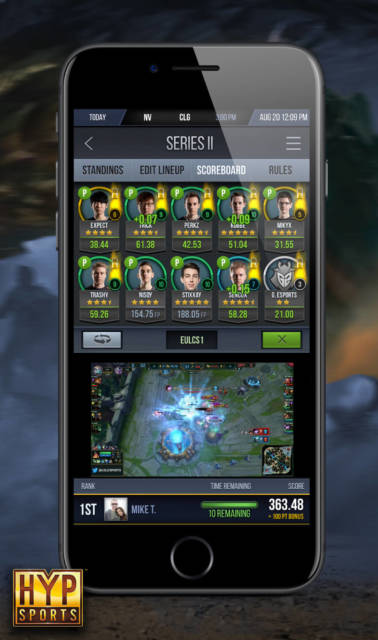
With such a demand for fantasy fun, HypSports is bringing in the new kid on the block—esports—into its platform so that users can form their own League of Legends fantasy esports teams.
HypSports differentiates itself by not drafting a roster upront, but rather playing general manager yearlong and developing a squad throughout the season by acquiring and upgrading players daily using platform-specific collection and crafting mechanics.
Mike Taramykin is the CEO and co-founder of HypSports. He is building his new fantasy sports platform by bringing in experience from both sides of the business. In his previous three positions over the last 12 years, Taramykin has been an executive vice president at Fan Duel, vice president of Zynga as well as vice president and general manager for Electronic Arts.
Taramykin joined AListDaily to dish details about HypSports’ direct-to-consumer, microtransaction business strategy, and how it will differ as a fantasy sports platform with a fresh approach.
Why did you decide to gamify live sports and esports? What steps were you trying to solve in the consumer journey?
Over the past 20 years, our team has created a lot of sports games. As part of that process, we’ve talked to many sports gamers and fantasy fans to understand why they play and, just as importantly, to understand why they sometimes stop playing. What we found was that fans love sports games because they feel that it brings them closer to their favorite teams and athletes. But many fans eventually stop playing when they feel that they are no longer competitive and don’t have a chance of winning. Meanwhile, we have all seen a pronounced shift in the overall consumption of sports content as the underlying demographics change and new technologies come into play. And while demographics are always changing, we think that this time is different. Consumers in general have more content choices than ever, and as a result, sports content finds itself competing with video-on-demand, free-to-play games and social media. A little over a year ago, our team realized that there was a tremendous opportunity to combine the proven engagement mechanics of games with the real-life daily drama of sports to create a truly unique experience that other content categories can’t deliver.
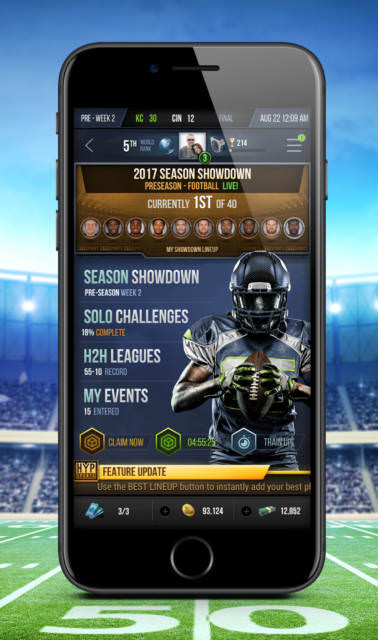
What is Season Showdown and how are you marketing the new mode to specifically target your audience?
Season Showdown is the mode that greets every player each day when they first log on. Having Season Showdown in addition to our head-to-head and solo modes was the needed element that is pushing us to bring this app to a wider audience. Since our players are intelligent fans and engaged content consumers and creators, we want to respect them and interact with them using their own preferred platforms—YouTube, social media, athlete endorsements and team sponsorships. We’re looking at every avenue right now. That said, we’re focused on three types of marketing content: education, awareness and engagement.
Can you further explain the threetypes of marketing content?
With education, we’ve improved our website with tips and created new tutorial videos so that prospective players can quickly understand our game and get easy answers to their priority questions. With awareness, we’re talking to multiple teams about strategic partnerships that would include sponsorship elements such as signage, social media, multimedia and experiential marketing. We’re also going to be working with key digital platforms, websites and social content providers for sports fans, as well as talking to pro athlete influencers about their experiences playing HypSports. With engagement, we’ve got a lot planned, but the most immediate engagement promotion is the #FansCompete campaign. Beginning with the football season, fans are encouraged to share their rosters on their social platforms to win prizes. We are also inviting our HypSports players to share and create content for our website—our intent is that our loyal players will be able to use our platform to share their personal brand, personalities and sports and esports knowledge.
How is your approach to social, influencer and streaming designed to be different and hit home for potential sign-ups? Do you plan on testing any new platforms?
Our social, influencer and streaming campaigns are designed to convey how HypSports is a season-long competition for all fans. It’s designed to actively engage fans everyday by giving them things that they can do to improve their rosters so that they have a better chance of winning future matches. Just like real sports where teams and athletes are always training, in HypSports there is always something for players to do so that they can improve their chances of winning on game day. We like to think of HypSports as ‘the game when the game isn’t on.’ As a result, our players stay highly engaged throughout the entire season, because every game matters. Yes, we’re planning to test all sorts of new and existing platforms to see what works for us. It’s exciting to think about all the direct ways that we can reach fans, but at the same time it can quickly become overwhelming so we’re taking a methodical approach trying various platforms.
What are the avenues for sponsorships and partnerships that you plan on exploring?
We’re looking at a lot of options, but we’re most excited about the conversations that we’re having with pro sports and esports teams, as well as the brands that appeal to sports fans. Our main goal right now is to get as many fans onto our platforms as possible. Playing everyday, building their rosters, competing against other fans and most importantly feeling engaged and connected to their favorite sports and esports teams and players. We believe that one of the best ways for us to connect with these fans is to partner closely with the teams, players and brands that they already love. And for us this means finding the right partners and then working closely with them to enhance their fans’ overall experience throughout the season and all year long.
Mike Taramykin, CEO and co-founder of HypSports
How does your business model shift traditional fantasy sports? What are the engaging opportunities out there?
For years, fantasy sports has been about stats and (to some part) money, while sports video games have been about hand-eye coordination and twitch skills. In our consumer research, we constantly heard how casual fans eventually quit both when they felt that they could no longer win. So, while their passion for sports never went away, they would lose interest in their fantasy team or put down their game controllers when the work required to stay competitive grew to be too much. The two stories that we heard most often was how fantasy players give up after week four or five because they drafted poorly, or their team was riddled with injuries and they didn’t have the time to read every article about who to start or sit. Likewise, gamers would say that they stopped playing their sports video games because developers changed the controls every year and they didn’t have time to learn all the new modes and button combos. In both cases the customers told us that they lost interest when they felt that they couldn’t be competitive. So, the opportunity for HypSports was to create a season-long competition where every player was competitive throughout the season. This meant creating roster-building mechanics that allowed a player’s team to constantly improve over time, thereby strengthening their chances of winning their upcoming matches. We want fans to always look forward to the next match and always feel better about their chances of winning the next game. That’s kind of what sports is all about.
How are you leveraging mobile gaming, and particularly through the gamification of real-life events?
We’ve designed HypSports around proven, fundamental, mobile game mechanics of collecting, crafting and questing—which is exactly how real sports works, too. In real sports, teams try to collect the best players, then they constantly train to craft each player’s individual abilities, and then the team sets off on a quest to win a championship. Our platform creates the same experience for the fans—only on their phone and with a user-friendly UI.
What is the proven way you’ve appealed to millennials?
I think we do a great job of bridging the gap between traditional pro sports and esports, which in turn appeals more to younger fans. We believe that the world of sports is always expanding, and sports fans enjoy watching competition between the best players in the world. Esports is no different. In many ways, it’s more exciting right now to see a whole new category of competition develop right in front of our eyes. On our platform, we not only provide a competition for esports fans, we also have a linked economy that incentivizes all players to compete in multiple sports and esports seasons. For millennial sports fans, we provide an integrated app for playing along with all major sports and esports leagues.
What are your thoughts for new sports monetization models?
We believe that there are exciting new ways to build massive businesses that cater to a new breed of digital sports fans. Most existing models revolve around either sponsorships, ticket sales or merchandising. What none of these models account for yet is that today’s sports fans are always connected, always ready to transact and fully accustomed to microtransactions. We believe that in the next five-to-ten years, sports will become an ‘always on’ direct-to-consumer service business with incredible new revenue channels. The games industry went through the same transformation over the last decade, and now more than half of the $108 billion dollar game industry generates its revenue from free content and microtransactions, two business models that didn’t really exist 15 years ago. The same will happen in sports, and we want to help drive this trend.
How would you assess the current fantasy sports landscape?
Fantasy sports is a great category that is enjoyed by 60 million sports fans in the US. The industry recently went through an exciting growth cycle, which was driven in large part by the invention of daily fantasy sports. Now daily fantasy sports growth has slowed, and we believe that is because the current offerings have found their audiences. We also believe that this indicates there is an opportunity for innovative new products that appeal to the approximately 130 million US sports fans that are not interested in the current crop of fantasy sports products that are available.
How do you envision competing with platforms that are already dominating the fantasy sports landscape?
We don’t see ourselves as competing with existing fantasy platforms because we have a different value proposition. Our product is 100 percent free-to-play and it’s designed to engage fans in a season-long competition, complete with playoffs and finals. Our game is designed to let fans join at any time in the season and lets them play right up until the very last game of the year. Furthermore, HypSports is designed for fans to play all year long. We incentivize cross-sport play by awarding resources in each sport that can be used in any other sport. As a result, our crossover between NFL and NBA players was 90 percent last year, and now we’re seeing close to a 40 percent crossover between MLB and League of Legends (LoL) esports.
What is your ultimate vision and strategy for scaling HypSports?
We believe that sports fans are just as passionate and competitive as the teams and athletes that they follow. This means that we want to turn traditional sports and esports into a personal competition for the fans so that they can leave their mark on the world of sports at large. We envision working very closely with teams, leagues, athletes and brands to engage fans on a daily basis, to support season-long competition and drive year-round retention.
Facial recognition is no longer the stuff of science fiction. The technology has been used for everything over the years from identifying criminals to tagging friends on Facebook.
An obvious use for facial recognition is marketing, as brands hope to cater messages to each individual.
The facial recognition market size is estimated to grow from $3.35 billion in 2016 to $6.84 billion by 2021, at a compound annual growth rate of 15.3 percent, according to Markets and Markets.
Here are some ways that brands are using the technology to interact with a consumer’s face.
Expedia—Discover Your Aloha
Expedia partnered with the Hawaii Tourism Authority to create an interactive campaign called Discover Your Aloha.
The Discover Your Aloha microsite features brightly colored images and video footage designed to represent a variety of possible activities on the islands. With the viewer’s permission, custom-built facial recognition software identifies which footage evokes the most positive reaction and offers a discounted vacation package to match.
“By integrating the facial recognition technology to identify the content and guide that resonates most positively with the viewer, the experience and perception of the Hawaiian Islands as a travel destination can be even more personal and inspiring for the viewer,” Noah Tratt, global senior vice president for Expedia, wrote on the company’s website. “It’s not just about being innovative, but it’s using innovation in a strategic way to achieve the right results.”
Olay—Skin Advisor
Consumers can tame oily skin, wrinkles and other concerns by allowing Olay’s AI-powered app to take a look.
Users who download the Olay Skin Advisor app are asked a series of questions about their existing skin regimen and areas of concern. Taking a selfie allows the tool to identify skin problems and recommend Olay products that can help.
“Many people don’t realize that it was Olay scientists who developed the technology behind the portable facial imaging systems most commonly found today in department stores and dermatologist offices,” Dr. Frauke Neuser, Olay’s principal scientist told AListDaily. “These systems are great tools to provide a personalized skin analysis—but the technology behind it is linked to feature-based image analysis and is, therefore, hardware-based. In order to make this type of consultation mobile and available to many more women, we knew we had to come up with a different, ‘smarter’ approach. AI was the perfect fit to provide an extremely accurate, yet educational and engaging user experience.”
https://youtu.be/9gOp4Hyw38M
Douwe Egberts—Bye Bye Red Eye
A few years back, Dutch coffee company Douwe Egberts used facial recognition to dispense free coffee whenever a passing traveler yawned. The company set up a coffee machine at the O.R. Tambo International Airport and word quickly spread—sending consumers “yawning” to partake in the promotion.
Apple—Face ID
Keep your new iPhone X safe from evil twins, because Apple’s latest gadget forgoes the home button in favor of facial recognition. The same technology can be used to animate and record messages through emoji.
Talking poo may be entertaining, but Apple no doubt has a bigger plan in mind for its neural engine. With facial recognition built right in, Apple will be able to gauge consumer reactions to apps and advertisements. While the company has not expressly announced these plans, they would not come as a surprise to anyone.
Other uses of the technology have included displaying messages targeted to women on bus stops, advancing through an ad by blinking, “checking in” to a location to receive special deals and more.
Marvel vs. Capcom: Infinite (or #MVCI) has finally arrived after plenty of fanfare from both brands. Marketing for the new fighting game focuses on the playable characters, as well as the many ways they can be used to defeat an opponent.
Capcom hosted a pre-launch event at the Folsom Street Foundry in San Francisco on September 18. During this event, fans were given early access to Marvel vs. Capcom: Infinite prior to it going on sale. The entire event was broadcast live from the Capcom Fighters Twitch channel. Early copies were available at a nearby Gamestop, where executive producer Yoshinoro Ono was on hand for autographs.
Providing hands-on experiences with the game has been Capcom’s biggest strategy for urging pre-orders, beginning with E3 and followed by a large San Diego Comic-Con activation. Marvel Games were on-site with an arsenal of games, including Marvel vs. Capcom: Infinite for players to try.
Funko Pop! created a series of special vinyl figures inspired by the game—each coming in a pack of two that pairs one Marvel character with one one from Capcom. Dueling pairs include Captain Marvel vs. Chun-Li, Rocket vs. Mega Man X, Gamora vs. Strider and more.
Customization is a major draw for fighting game fans, not just aesthetically, but for creating different play styles. In Marvel vs. Capcom: Infinite, using Infinity Stones grants a character special abilities or boosts to aid them in battle.
To help illustrate all the possibilities for gameplay, Capcom hosted a number of livestreams and interviews and released trailers that focused on specific character abilities.
Of course, aesthetics are fun, too—and the game offers a number of variant costumes for its battling heroes. Pre-ordering Marvel vs. Capcom: Infinite unlocks special costumes for Thor, Ryu, Hulk and Mega Man X. A special Captain Marvel pilot costume is available for PlayStation 4 players.
“Gladiator Hulk” and “Warrior Thor” costumes no doubt help build hype for Thor: Ragnarok before it hits theaters in November, as well as Captain Marvel—whose film won’t debut until 2019 but is still getting a lot of hype.
A special collector’s edition of Marvel vs. Capcom is available and it includes four statues—Mega Man X, Chun-Li, Captain Marvel and Iron Man—along with a deluxe edition of the game and a box of light-up Infinity Stones. Marvel unboxed the collector’s edition on Facebook Live, giving fans an exclusive first look.
Marvel celebrated the game in August by creating 20 variant covers that feature Capcom character battles. Titles include Iron Man, I Am Groot, The Mighty Thor, Rocket and more.
Capcom is investing a great deal in esports for its fighting franchises and is considering the addition of Marvel vs. Capcom: Infinite into its Capcom Pro Tour. In addition, Capcom is building an infrastructure for mobile esports, beginning with its Street Fighter franchise. If the company’s job postings are any indication, other franchises may soon enter the mobile esports arena.
Marvel vs. Capcom: Infinite is available now for PlayStation 4, Xbox One and PC.
If your basketball-loving friends and co-workers are suspiciously absent today, that’s because Friday was 2K Day—the early access release of NBA 2K18. 2K helped get fans pumped for the big day by creating branded excuses, doctor’s notes and even a letter to break up with a significant other for more time to play. A sponsored hashtag on Twitter inserted a special logo next to tweets containing the phrase, #2KDay.
Beginning on September 8, 2K offered a free downloadable experience called The Prelude on the PlayStation Store and Xbox Live. With it, players could get a head start on the game’s career mode, and all progress carries over to the full game.
The annual sports franchise celebrates not only a love but a life of basketball—a passion shared by millions of fans and NBA all-stars worldwide. Promotion around NBA 2K18 has largely centered around “The Neighborhood”—a new open-world mode to explore. The game’s slogan, “Run the Neighborhood,” captures the idea of hard work and building a reputation from the ground up, beginning in the players’ own virtual neighborhoods.
Locations and challenges inside NBA 2K18 are natural opportunities for branded partnerships that include Spalding, Ruffles, Big Baller Brand sneakers, Nike, Mountain Dew, Walmart and Reese’s Puffs cereal.
However, the partnerships expanded beyond logo placement. Players using the NikeConnect app were able to unlock special in-game offers including boosts and jerseys.
Specially marked boxes of Reese’s Puffs cereal contain a 25-digit code printed inside that unlocks 2,500 worth of in-game currency that gives players a jumpstart in building their custom MyTeams. General Mills (parent company of the Reese’s Puffs brand) also sponsored a full-game livestream ahead of the game’s launch.
Of course, the biggest draw of the NBA 2K franchise is the roster of real-life basketball stars. This year’s cover stars include Kyrie Irving (Standard Edition), Shaquille O’Neal (Legend and Legend Gold Editions) and Kristaps Porzingis (My NBA 2K18companion app).
NBA athletes are not only included in the game but also prominently featured in trailers and personalized promotions.
https://youtu.be/3eFKX96JDUs
A new Snapchat filter overlays Shaq, Karl-Anthony Towns, Paul George and Kyrie Irving over the NBA 2K18 logo, each performing their respective victory dances. Irving even had a bit of fun by “dancing with himself” on 2K Day.
Copies of the game may be going fast, but not as fast as the GameStop NASCAR stock car, racing the circuit with NBA 2K18‘s cover prominently displayed on the hood. The car is driven by Erik Jones, NASCAR’s Rookie of the Year, and came in at number 18 over the weekend at TheHouse.com 300 in Chicago.
Considering the “Run The Neighborhood” trailer has been viewed nearly 5 million times in just two weeks, it’s pretty safe to say that fans are excited. All this hype will aid both publisher Take-Two Interactive and the NBA as they prepare to launch the inaugural NBA 2K esports league in 2018.
“We know our players are big fans of the NBA 2K game and many of them work closely with the development,” Matt Holt, vice president of global partnerships at the NBA told AListDaily. “It’s going to be interesting to see how we can connect our players with this esports league.”
New York Fashion Week is a time for the world to see what’s “in,” but it’s not just for clothing and accessories. The annual event is also about ideas from social justice to inner beauty, inspiring a host of non-endemic brands to create spectacles of their own.
Papyrus
Each year at New York Fashion Week, American Greetings hosts the Café by Papyrus–a pop-up venue where attendees can grab a coffee or tea and send intricately designed greeting cards. The decadent hangout spot returned this year, but Papyrus “popped up” somewhere else for the first time—the runway.
Papyrus—an American Greetings company—partnered with fashion designer Adam Selman and artist Daniel Sean Murphy to create a set made entirely of paper. Bright blue flowers, grass and 100 Papyrus hummingbirds lined the runway as models showed off Selman’s collection.
“This is really historic. Integration into a show has never really happened before as far as we know,” Alex Ho, chief marketing officer for American Greetings, told AdWeek. “It’s a testament to the traction we’ve had over the years and the tie to fashion.”
Floral designer Lewis Miller and his team have been known to create guerilla-style flower installations around New York City with splashes of bright colors and texture in unexpected places.
For New York Fashion Week, Miller chose a construction site for his latest work and this time, he collaborated with wallpaper brand Farrow & Ball. Normally described as a “pretty bleak city corner,” the construction site was transformed by wooden pallets layered with vibrant flowers. The walls surrounding Miller’s installation are covered in printed Farrow & Ball wallpaper.
“Ultimately, I think we are creating something truly spectacular, fresh and whimsical that celebrates the best of both our brands,” Miller told Vogue.
“Building on the creative energy of a city like New York, especially during Fashion Week, we hope to inspire people everywhere to find a moment of escapism in the everyday—whether it’s in their home, on their daily commute, at work, or on their way to a fashion show,” added Charlotte Cosby, head of creative for Farrow & Ball.
Female-focused publisher Refinery29 hosted an immersive experiential installation for New York Fashion Week. The colorful activation featured 29 individually curated rooms linked to brand partners including Ulta Beauty, Aldo, Clarins, Dunkin’ Donuts, Juicy Couture and Cadillac with Jason Wu.
Each room in the aptly named “29Rooms” activation holds an interactive brand message. The Clarins room includes plants used in the company’s Next Generation Double Serum, for example, and Belletrist—a community devoted to books and authors—featured a giant typewriter that encouraged visitors to share their stories.
Visitors were able to rent Snap Spectacles for free and were encouraged to share their experiences across social media.
Shoe brand Aldo curated a room that invited guests to celebrate their own styles on a runway called “Love Walk.”
“Our team believes that Refinery29 has really redefined what it means to do a brand collaboration and what it means to do an experiential marketing campaign,” Katie Green, Aldo’s senior director of communications, told AdWeek. “They’ve been able to create an opportunity in this new digital and social era to really create meaningful content for brands while also allowing you to be part of a greater conversation during a time when let’s face it, there’s a lot of clutter during fashion week.”
Continuing its #HowFashionTravels campaign, New York Fashion Week sponsor Lexus provided a fleet of nearly 100 vehicles for show-goers and industry insiders.
Another activation in partnership with Interview Magazine called “Lexus: Set in Motion,” let visitors be the star, stepping onto a set to be professionally photographed next to a Lexus vehicle. The activation was more than just a photo op, offering professional makeup and hair touch-ups. Even the photos were taken by an industry professional.
“Through our partnership with Interview Magazine, we are able to invite the public to experience what a real editorial fashion photo shoot is like, which is something Lexus has not executed in the past and is a unique opportunity that we can offer to the general public,” Lexus general manager Greg Kitzens told Marketing Daily.
Celebrities are everywhere during New York Fashion Week, but this year ushered in a new era for one unexpected icon—Minnie Mouse. The Disney icon, whose reputation as a fashionista dates back to 1928, hobnobbed with the likes of Kate Bosworth, Jhené Aiko, Nicki Minaj and Paris and Nicky Hilton.
Minnie met with fashion designers and swung by the offices of both Instagram and Refinery29. She even wore a custom outfit courtesy of fashion designer Monse and appeared at the Monse fashion show.
In the past year, Minnie has worn custom designs by Alice + Olivia’s Stacey Bendet and Olympia Le-Tan, helping to solidify Disney’s place in the fashion world.
While the majority of Wargaming’s 150 million registered World of Tanks players are on PC, the company continues to look for new ways to engage with console gamers. The company’s latest effort to market the free-to-play WWII brand to a global console audience is through Xbox Live Arena support, which opens up new opportunities for Wargaming’s esports initiatives.
TJ Wagner, creative director and executive producer at Wargaming’s Chicago and Baltimore studios, told AListDaily that Xbox Live Arena support will allow anyone to create clubs and customized user-generated tournaments on Xbox One.
“We are working closely with Microsoft to carefully implement Arena into World of Tanks,” Wagner explained. “Arena is a great tool that allows players to create tournaments and publishers like ourselves to sponsor major events. The Wargaming development team is working with Microsoft to create the necessary tools to seamlessly integrate World of Tanks into the Xbox ecosystem.”
Along with the release of user-generated tournaments, gamers can now sign up for the first Wargaming Skirmish, which will take place on September 15.
Wagner said that both Wargaming and Microsoft are marketing these Arena competitions across social media, their respective game portals and directly from the Arena platform.
“These Wargaming Skirmishes will be our first tournaments with prizing,” Toby Mast, senior producer of the World of Tanks, told AListDaily. “As these become more competitive, it may lead to even larger tournaments with higher number of teams, longer-running events and improved prizing.”
Initial prizing will include in-game currency and virtual items but are opportunities for brands and sponsors to step in or host their own custom tournaments. Hollywood studios like 20th Century Fox and Warner Bros. Pictures have worked with Wargaming in recent years to cross-promote films like Fury and Dunkirk, which could open opportunities for film swag, tickets and other items to be won through competitive play.
To date, the focus of Wargaming esports has been solely on PC, where the majority of World of Tanks gamers reside. That league play has attracted brands like Facebook, Intel, PayPal, SanDisk and Razer to connect with that audience.
“Over the past few years, we’ve worked with our community leaders to host Wargaming Community Tournaments (WCL),” Mast said. “During these WCL events, we’ve seen a consistent increase in the number of teams participating and we know they are eager for more frequent competitive events. Now with Xbox Live Arena, the process to host user-generated tournaments is all within the console and much easier than ever before. Our community is already planning to create their own tournaments, so we expect UGTs to grow quickly.”
As the global World of Tanks esports ecosystem grows on consoles, Wargaming is looking for better ways to integrate sponsors.
“We’re very excited for the future of esports on the console,” Mast said. “World of Tanks has the perfect player base for sponsored events, so we’ll see what opportunities will be revealed as Xbox Live Arena participation grows.”
These tournaments on Xbox Live Arena can live separately from the established World of Tanks global esports league, which makes it easy for brands to host and run their own console tournaments.
“Arena allows Wargaming to bring an esports component to World of Tanks on console, something our players have been asking about for some time,” Wagner said. “Our console team is dedicated to player happiness, so we are happy to bring something to our tankers that they have been asking for.”
Mast added that the plan is to add a tournament structure to PlayStation 4 in the near future, further expanding the esports opportunities across console for this free-to-play brand.