Study: In-App Spending Varies By Platform, Geography And Category

It’s probably no surprise that in-app spending is expected to increase over the next few years. From beating a level with the help of game add-ons to booking that adorable bed and breakfast, the app market continues to expand into emerging demographics across the world.

It might come as a surprise, however, to learn that geography, operating systems and app category all impact in-app spending in different ways. For example, iOS users spend two-and-a-half times more than Android users per month because they tend to be less price-sensitive, according to a new report from AppsFlyer. Android users, meanwhile, spend five times more than iOS users on utility apps like anti-virus and memory boosters because of the open Android OS platform.

The report, titled The State of In-App Spending, measures over $300 million of in-app purchases by more than 100 million users from April to May 2016. The results may vary considerably, but don’t fall into that pit of marketing despair just yet—it’s all about knowing your audience.

Asian Users Spend The Most Per App

According to the report, these users spend $0.70 per month per app as opposed to the average global user, who spends $0.50 a month per app. Gaming apps are especially popular in the Asian market, with users spending 75 percent more on in-app purchases than users in other regions. According to IDC’s new Worldwide Semiannual Mobility Spending Guide, enterprise and consumer spending on mobile devices and related software and services in Asia/Pacific (excluding Japan) will grow at a compound annual growth rate (CAGR) of three percent from $514 billion in 2015 to $578 billion by 2019, making it the largest region in the world in terms of mobile spend.

“Mobility has had a significant influence in Asia, creating unique markets and business models that cater to a new generation of consumers embracing a mobile-first world,” said Avinash K. Sundaram, research manager for enterprise mobility at IDC Asia/Pacific. “A great example of this trend is WeChat in China, which started as a messaging app rival to WhatsApp but has now transformed itself into a social commerce platform where consumers find and pay for services ranging from food to movies and even transportation.”
app spending by region

North Americans Love To Shop

The average North American shopper spends $43 per in-app purchase, compared with the average Asian shopper who spends the equivalent of $11. In fact, North American retail app users outspend all regions in this category—the average European retail app user by two-and-a-half times, and the average Asian shopper by more than three times.

According to a June survey conducted by global polling firm, Penn Schoen Berland, around 60 percent of parents are planning to buy at least one thing on a mobile device and 30 percent plan to do at least a quarter of their shopping on mobile. (Based on 1,500 individuals surveyed)

Gamers And Shoppers Have Very Different App Spending Habits

Only about 3 percent of gamers make in-app purchases, while 12 percent of those using shopping apps pull out their credit cards. These figures are attributed to intent (presumably you would download a shopping app with the intent to purchase), as well as the vastly different costs of virtual versus physical goods ($7 versus $36.54 average purchase amount).

The Whales Of Latin America

AppsFlyer data shows that gamers who do make in-app purchases tend to spend significantly more than the average gamer—30 percent more, in fact. This is known as the “whale” phenomenon, and these users become the main source of income for free-to-play games. There are many such “whales” in Latin America, it turns out, who are spending 48 times more on in-app purchases than the average Latin American user. Although Latin American app users spend an average of about half of users in other markets, those who do spend big.

The Possibilities Of Augmented Reality Storytelling

Editor’s Note: [a]listdaily is the editorial arm of Ayzenberg Group.

Noah Eichen and Matt Bretz, both of whom are creative directors at Ayzenberg, sat down to discuss the potential behind augmented reality.

The two started right away by discussing “mixed reality,” grouping both AR and VR together. Talking about the experience from the Halo demo at E3 last month, Eichen explained, “I would say the sensation is like grabbing a person out of the world . . . moving them where you want, finding the right plane where they look like they’re standing in front of you, and then having their action play out. You’re just sort of witnessing that through this headset.”

“[Microsoft HoloLens] is the one device on the market that’s completely untethered,” explained Bretz. “So you don’t have to have it connected to a phone or a PC and you can be in the real world, mixed with the things that you’re adding as holograms, so that you can continue to be working on your PC or talking to someone.”

Filmmaking was also talked about, as Eichen explained the challenge of the tech: “When I first tried it, what I started thinking about was . . . if I could imagine in a couple of years, when we want to make a commercial with CG characters or real-life actors . . . and they’re placing actors and timing out shots, and everyone can visualize . . . we can all see the holographic world they’re building. And to me, that’s really an interesting way of looking at it.”

Newzoo Introduces Global Mobile Intelligence Tool

With the worldwide global mobile market continuing to grow, Newzoo has introduced a new initiative that will help keep track of many variables, making it easy for companies to see how successful their mobile releases are.

Today, the company announced the launch of its Global Mobile Intelligence Suite, which is designed to keep track of mobile devices, app stores, apps, monetization, engagement and mobile audience across a global scale, according to the press release. This enables expansion into areas that couldn’t be measured before, including China’s Android market.

“This is a huge strategic step forward for us,” said Peter Warman, CEO of the company. “Newzoo Mobile aims to serve practically all industries with an interest in mobile on a global scale, and to provide a range of mobile intelligence services currently unavailable in the market. App store data is an important part of the portfolio, but the true magic happens when different sources of data are combined in unique and smart ways. What’s more, Newzoo will continue to offer the support and service it is known for, proving that there is a difference between offering great data and a great global market intelligence product.”

In development for almost a year, the suite will help companies analyze the market in various areas, including audience, devices, revenues and key metrics—in addition to having support for international rollout plans and marketing campaigns.

Speaking with [a]listdaily about the announcement, Warman explained, “We started to set this up in early 2015 and realized that to secure the growth of our company for many years to come, we needed to diversify in terms of clients, markets and/or products. Our Newzoo eSports effort has succeeded in giving us new business in terms of markets as we now work for the biggest brands, entertainment and sports companies as well as (traditional) media companies to help them understand, size and seize opportunities in this space. However, we wanted to make an even bigger impact across all industries.”

Newzoo Mobile Intelligence

When asked how the Global Mobile Intelligence Suite will work alongside Newzoo’s new mobile division, Warman broke the explanation down into three reasons. “With games leading monetization on mobile and mobile taking a third of the world’s gaming market, mobile has always been key to our games-related offering of market intelligence to clients. It was easy to see that serving only the games business was limiting the potential of our effort on mobile, so serving all industries with mobile intelligence became our big blue ocean for the long term. We set up separate teams to ensure we kept our focus and leading position in games and eSports. So, this is the first reason: long-term growth of our business.”

“The second one is that our clients that are not pure game companies (e.g. hardware, media companies) kept asking us if we could provide the same service for other verticals,” Warman continued. “We talked with them about their current level of knowledge and vendors and a common pattern appeared. The missing part was not as much in data granularity but in the combination of data, insight and service that they felt they were missing. App store data can help you in one way, engagement and monetization metrics in another way just as consumer insights solve certain problems. High-level forecasting of app ecosystem revenues towards 2010 is another example.

“The third is that we have been looking in-depth at the reporting on all levels of the global mobile ecosystem. We were surprised how outdated it seemed in terms of terminology, methodology and outlook on trends that really matter. For instance, we found it hard to believe how many companies with different interests rely on ‘units shipped’ and ‘installed base’ data to size the amount of devices in use. We want to change this and bring the innovativeness in market intelligence to the mobile world. On a global scale. For all industries.”

Chinese gamers play a big part in the creation of the suite as well. “Having the identical depth of data on China as well as on the majority of countries outside of China is an enormous benefit to us. With approximately one-third of mobile devices being sold in China each year and China representing almost a third of the worlds’ mobile game revenues, you cannot say you have a truly global service if you do not have a similar quality of intelligence on China and the US for instance.”

Image Source

How Netflix, Amazon And Hulu Are Growing With Partnerships

For the longest time, we’ve discussed how streaming media services like Netflix and Hulu are providing a new direction for where viewers check out their content, moving away from traditional television as a result. But the way these companies are finding partners and trying new ideas to keep these viewers coming are unique—and will help change the face of what we’ve come to expect from streaming media.

Netflix

The defining leader in the streaming media market is Netflix, a company that continues to make killer deals not only with programming partners, but also working with those to provide better accessibility—and it just landed a huge partner through Comcast, they announced Tuesday.

The streaming channel declared a truce with the cable giant, and as a result, will be included as part of the Xfinity X1 module, where consumers can choose from programming straight through their Comcast-enabled device.

“Comcast and Netflix have reached an agreement to incorporate Netflix into X1, providing seamless access to the great content offered by both companies. We have much work to do before the service will be available to consumers later this year. We’ll provide more details at that time,” the companies noted in a statement.

As a result, Netflix could see a huge spike in viewership, and Comcast would also benefit by keeping consumers from simply “cutting the cable” to view whatever’s on Netflix, since it would now be an integral part of the service.

The company also recently made some moves on the programming front to keep consumers happy. Earlier this year, they signed a deal with Disney to become the “exclusive pay TV home” for a majority of its programming, including Marvel-licensed films like Captain America: Civil War and future films from Pixar and Lucasfilm, among other studios. In addition, it also announced a partnership with The CW earlier today. The move will allow hit shows, as well as premieres, to run on the streaming network a mere eight days after their season finales end on TV. It’s a deal that’s expected to be worth $1 billion, about the same range as Disney’s.

“Netflix members in the US love the great lineup of series from The CW, and we are thrilled to extend the relationship and bring those shows to our members exclusively now, just eight days after their season finales,” said Ted Sarandos, chief content 0fficer at Netflix about the deal. “This is a great step forward with a valued network partner to give fans exactly what they want, when and how they want it.”

For fans of shows like Supergirl, Arrow and The Flash (along with potential hits like Riverdale and Frequency), this is a massive deal—and, again, it’ll simply add potential subscribers down the road.

https://www.youtube.com/watch?v=gBL0TWVd_IA

Amazon Prime

Amazon Prime continues to grow, mainly due to its diverse library of programming. What’s more, it has HBO as a top-ranked partner with its service, despite the fact that the pay channel launched its own on-demand service, HBO Now, last year.

Shows like The Wire, Deadwood and Six Feet Under continue to be huge favorites with the streaming community, intertwined with Amazon’s own programming, including shows like Transparent and Mozart In the Jungle, along with various films and other TV shows.

Hulu

Hulu, meanwhile, continues to thrive with its own original programming, including The Mindy Project and 11.22.63, both of which have been huge hits with their subscribers.

However, the company’s most interesting direction of late seems to be with virtual reality, as it recently announced that it’s working on Hulu VR. With it, the company promises that consumers can “experience your favorite shows and movies on Hulu like never before.

Immerse yourself in our alternate, 3D viewing environments for a whole new perspective on TV.” The service is currently up and running for various devices, including Oculus Rift and Samsung Gear VR, among others.

Where network and cable programming execs continue to find ways to keep audiences coming back for more, streaming media continues to make strides in many different directions, through programming, innovation and deals that can help attract more subscribers. And there are still many more moves that are likely to come as 2016 rolls on.

https://www.youtube.com/watch?v=_uwanee-lS4

How Asian Gaming Brands Steadily Grow Westward

Just a few months ago, China surpassed the US as the world’s biggest market for video game revenues, particularly with mobile, thanks to its millions of users. And it has kept that lead ever since, but it’s part of a much bigger picture of the Asia Pacific market, including Japan, Taiwan, South Korea and Australia. For the past few years, Asian companies that have found success in their home countries are looking to grow internationally through investments, acquisitions, and bringing their games to a new audience.

Breaking Down Revenues

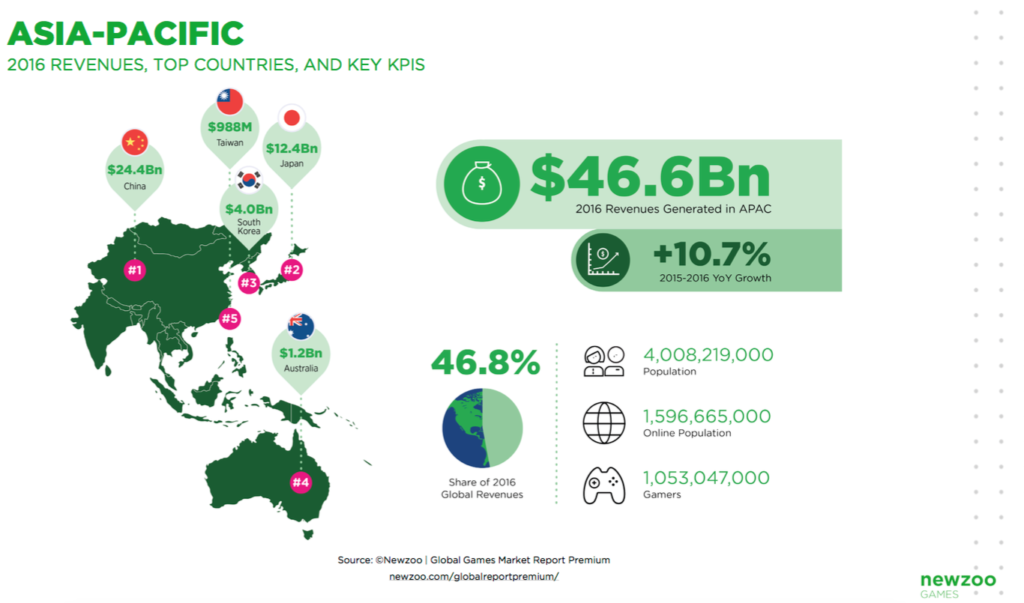
According to Newzoo’s Global Games Market Report, Asia-Pacific’s console, PC and mobile game revenues for 2016 total an estimated $46.6 billion for the year, with more than half coming from China with $24.4 billion. Close behind is Japan with $12.48 billion, and the rest split up amongst the other countries.

Chart

Out of a population of nearly four billion people, over one billion (a quarter of the population) are gamers. However, there’s still plenty of room to grow, and China is in far lead.

To help track Asia’s gaming growth Nielsen, working alongside TalkingData and its base of 650 million monthly active users, introduced a new Games IP Evaluator, with three purposes in mind: identifying audience profiles, quantifying game potential and optimizing game development and launch.

“Although 40 to 50 percent of all new mobile games involve an IP acquisition and the percentage continues to grow, most mobile game developers enter into IP partnerships based on their past experience with no support of forward-looking quantitative analysis,” said Steven Li, vice president of Nielsen’s Entertainment Vertical in China. “The Nielsen Games IP Evaluator offers developers insightful consumer research to fully understand IP potential and the right form for mobile games.”

Tencent Is Everywhere

If there is one thing that has become increasingly clear with China gaming market right now, you just can’t ignore Tencent.

Founded in 1998, Tencent has come a long way in a short time, mainly due to the popularity of online games like CrossFire and Dungeon Fighter Online, which has attracted millions of gamers. But it made a name for itself in 2011, when it purchased a majority stake in Riot Games, giving it one of the biggest properties in eSports today: League of Legends. The game continues to be a colossal hit, and Tencent completed its acquisition of Riot late last year, moving closer to eSports dominance.

Tencent also invested in a number of other companies, in an effort to expand its reach more towards Western shores. It purchased a 12 percent stake in Activision Blizzard and a small stake in Epic Games in 2012; it purchased portions popular developers such as Robot Entertainment (Orcs Must Die) and Glu Mobile (creators of Kim Kardashian: Hollywood); and it also purchased a major stake in Pocket Gems, the creators of the popular mobile game War Dragons.

But perhaps its biggest move since acquiring Riot Games took place last week, when it acquired Clash of Clans developer Supercell for $8.6 billion, giving it ownership of one of the biggest mobile companies in the US. With this purchase, Tencent now has control of 13 percent of the global $99 billion mobile market.

“China is home to more gamers than any other country,” CEO Ilkka Paananen said about the deal. “Tencent’s platforms reach around a billion users (yes, a billion!). And, they have around 300 million unique users playing games on their platforms. What this means for us is that together with Tencent, we can bring our games to so many more players. Also, their social platforms offer many new possibilities for our games, particularly for social play. All of this is very exciting!”

In short, that means more revenue and business for Tencent, adding to its already impressive mobile game sales numbers.

With the bases for social networking, eSports, mobile and web portals covered, Tencent is a big reason why the Asia’s gaming market is so immense.

South Korea Expands

While Tencent is famous for investing in developers, other companies have not only done the same, but brought their own IPs to a worldwide audience while also developing new ones.

Nexon, for example, got its start in South Korea back in 1994. It is generally credited as the company that started the free-to-play market and it rose to success with titles such as MapleStory and Dungeon & Fighter, which is one of the biggest free-to-play PC games in China.

The company has been working for years to reach a global audience. In 2015, it pushed for the Western markets with Ghost In the Shell Online, and partnered with a US developer Big Huge Games to produce the highly popular mobile game DomiNations. Shortly thereafter, it acquired the developer in a deal for an undisclosed amount, but with many dividends, thanks to DomiNations‘ 19 million downloads.

It’s also working with Respawn Entertainment on a trio of mobile games based on its hit property Titanfall, with the first expected to arrive later this year in time for the sequel’s release on consoles. Nexon will also publish Lawbreakers, the first game developed by legendary game designer Cliff Bleszinski’s new studio, Boss Key Productions.

Another major company from South Korea is NCsoft, the publisher responsible for a number of hit games over the past few years, including Lineage and WildStar. These titles have not only established an audience of Asian players into the millions, but also a great deal of interest in the US as well.

The company pushed its expansion into the West further last year with the opening of Iron Tiger Studios, a new mobile studio out of San Mateo. With it, NCsoft promised to work on a number of original IP’s for various platforms, as well as translating other established properties on the mobile front. “NCsoft West is accelerating and the launch of Iron Tiger is a key step in enabling us to develop extraordinary and innovative games more rapidly and across more platforms,” said the company’s senior VP of mobile Jesse Taylor about the opening, speaking with GamesIndustry International.

It also has a growing presence in eSports, with its owned company ArenaNet recently investing $200,000 into a Guild Wars 2 World Tournament.

While on the topic of eSports, Korean game publisher, Bluehole, has also been making waves, moving beyond its usual MMORPG territory to create a new experience called Battlegrounds in conjunction with Irish developer PLAYERUNKNOWN. It will bring another Asia Pacific-based company more into the Western market, in the hopes of following the success of its previous release, Tera, which first started in Korea and has found success in North America.

When it comes to catering more to this market, production director Dr. Chang Han Kim explained, “First and foremost, we’re focused on creating a good game, but we plan to conduct a very open development process as well. We hope to get very closely engaged with the community, share a lot of the stuff that takes place in our office, seek feedback as much as possible, and just really focus on creating a good game.”

And then there’s the South Korean eSports scene. Countless players invest hours at a time in games like League of Legends and the years-old Starcraft II. Activision Blizzard regularly holds tournaments there, with millions of fans watching both live and online broadcasts to see the best players in the world compete. According to The New York Times, it’s even considered a “national pastime.” Considering how Korea is the country where eSports first took off, it’s little wonder why companies are looking to take advantage of how eSports interest and popularity is growing around the world.

Amazon’s Echo Could Help Brands Reach Targeted Audience

Amazon’s Echo may not just be built for convenience—it could also open a door for marketers as well.

The online retailer confirmed Friday that, along with its “on-demand button” system, it has enabled its voice-activated speaker, which uses a digital assistant named Alexa, to order new items using voice requests. This includes thousands of items that range from food to accessories to media-based items. All a customer has to say is something such as, “Alexa, order (product)” and Alexa will make a suggestion. Afterward, all they need to do is say yes to finalize the order.

Not all items are available, as Alexa is mainly compatible with items that are available through Amazon Prime. That said, new items are being added regularly, so it’ll become a more useful utility over time.

This is the latest evolution for Alexa, which previously was able to play NPR radio, check a bank balance and even order an Uber car if needed. “We launch things when they are ready,” said an Amazon spokeswoman about the evolution of Alexa’s services. “Our speech science engineers have made something very complicated and difficult to do so exceedingly easy for customers.”

So how will this technology benefit brands and marketers? It provides a new way to reach out to consumers without ads. By partnering with Amazon and offer sponsored products or services, it can find a way to naturally cater to a targeted audience.

Companies have been quick to adopt certain technologies over the past few years. For example, Marriott created a virtual reality program to take visitors to distant tropical islands and other exotic places around the world, even if they were already on a vacation. McDonald’s also recently embraced VR technology, with campaigns based around its Happy Meal and The Angry Birds Movie.

It’s sure to take some time, as the ordering system just went live today. However, as Alexa’s use becomes more frequent, partnering with one of the world’s biggest sellers could be a key way to reach consumers.

Newzoo: Tencent Dominates Chinese Android Market

Newzoo has released a new report on the top 100 grossing Android games in May for the Chinese region and game publisher Tencent accounted for an amazing 44.5 percent of the Chinese mobile revenues.

Publishing 23 of the top 100 titles, Tencent’s MOBA (multiplayer online battle arena) King of Glory continues to be the company’s top performing title in terms of revenue, second only to Mojang’s Minecraft. The most installed title from Tencent was Happy Lord, a popular card game that is playable across both low and high end devices.

Tencent recently acquired Clash Royale developer Supercell and the investment is paying off. In May, Clash Royale landed the No. 3 spot in top downloaded games on 360 mobile assistant and No. 6 on the Baidu Mobile Assistant store. Action game Huo Ying Ren Zhe climbed into top 10 grossing games after being released only two months ago. In May, Tencent published 10 of the 20 top grossing titles.

Newzoo_TalkingData_Top_Android_Games_May

Kent Wakeford, the chief operating officer of Kabam who brought Marvel Contest of Champions to China, attributes Tencent’s success to its social element. “In-app chat is extremely popular in China,” Wakeford told [a]listdaily in a recent interview. “Tencent is often in the top 20, and a large part of that is because they have the power of WeChat, which is the largest social platform in China. It’s the power of that channel that can drive consumers into games and drive installs. We’ve been doing a lot of work with WeChat. We’ve spent marketing dollars there, and have seen the impact and benefits of marketing through those social channels.”

Sandbox titles like Minecraft are giving Tencent a run for its money, and with Terraria coming to Chinese markets in the near future, the two games may be competing for the top of the charts. With Southeast Asia representing 45 percent of the $99.6 billion dollar video game industry, brands are turning to the region to reach this lucrative market.

Samsung And NBC Are Bringing The Olympics To Virtual Reality

NBC is gearing up for an unprecedented slate of Olympics programming this summer for the Rio Games, and along with broadcasting all of its events on television, it’s shooting to bring the experience to a whole new platform—virtual reality.

The company announced today that it will introduce VR coverage of the Olympic Games to Samsung Galaxy smartphones and Samsung Gear VR through its specialized NBC Sports app. It’s expected to broadcast over 85 hours of VR programming over the course of the event, along with the Opening and Closing Ceremonies, which are set to immerse viewers like never before.

Though the programming will be on delay, it will take showcase gymnastics to track and field to beach volleyball, among other sports.

“The world’s greatest sporting event is always a showcase for cutting edge technology, and we’re thrilled to partner with Samsung and Olympic Broadcasting Services to bring our viewers even closer to compelling Olympic action with virtual reality,” said Gary Zenkel, president of NBC Olympics. “Olympic fans can be transported to iconic venues such as Maracana Stadium for an unprecedented view of the Opening Ceremony, and Copacabana Beach for an immersive beach volleyball experience in the sport’s ultimate setting.”

“Fans of the Olympics will now get to experience the world’s best athletes as they compete in some of the most popular events of Rio 2016 in a whole new way: through virtual reality,” added Marc Mathieu, chief marketing officer at Samsung. “We are thrilled to work with NBC and OBS on this first-of-its-kind endeavor, connecting fans right to the action in Rio, powered by 360-degree storytelling, virtual reality and our Galaxy phones.”

Samsung has already put these services to good use. Taken from the documentary A Fighting Chance, the feature focuses on a pair of Olympic volleyball hopefuls from Vanuatu as they train for the upcoming games.

https://www.youtube.com/watch?v=kzowygyFAUQ

The move into virtual reality is a smart one for NBC, and serves as a potential testing ground for the use of the technology with future promotions NHL, boxing and possibly even other programming. In May, NBC broadcast the Kentucky Derby in 360-degree video. CBS and Fox have both tested VR for sporting events, too.

For now, users can definitely make the most out of the Olympic coverage and see what it feels like to be there in some capacity.

Apple Users Spend Twice As Much On Mobile Games Than Android Players

It’s no secret that free-to-play games, even the most popular ones, rely on a small minority of paying players (especially high-spending “whales”) for revenues, and it’s always a challenge to find and attract users willing to spend money on virtual goods. However, AppsFlyer is helping to shed some light on the matter with a new report titled The State of In-App Spending, which examines the spending habits of mobile gamers from around the world. As it turns out, Apple iOS device users happen to be the biggest spenders.

The report first discusses monetization, with revenue generated by app developers between in-app advertising, premium models and purchases. Back in 2011, paid-for apps led the charge, but as of late, in-app purchases and advertising have taken over more than 50 percent combined compared to full-price apps. By next year, that number is expected to grow by an additional ten percent.

Screen Shot 2016-06-30 at 12.49.12 AM

Perhaps one of the biggest find of the report deals with iOS versus Android spending, as the numbers indicate that users spend more on Apple’s platform. In-app purchases make up $1.08 compared to Android’s $.43, while the average purchase of gaming apps is at $12.77 for iOS and $6.19 for Android—double the amount.

The report also covered monthly in-app spend and average purchase per user divided by countries (for April/May 2016), and Asia scored big in this department, with the highest numbers on the chart. $.70 for IAP (all users) was noted in this country, along with $10.65 for average purchases. Meanwhile, other countries, like North America and Europe, reported lower amounts.

Screen Shot 2016-06-30 at 12.52.37 AM

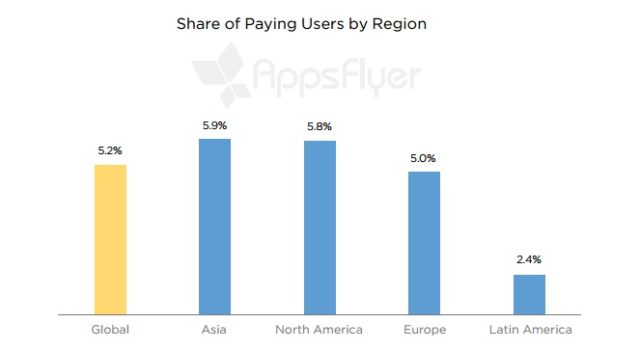
Asia has the highest number of paying users by region, barely beating North America by .1 percent (5.9 percent compared to 5.8 percent). They’re both higher than the 5.2 percent global average, with Europe close behind with five percent.

Screen Shot 2016-06-30 at 12.54.01 AM

AppsFlyer also discussed “whales,” which make up 3.5 percent of overall gamers that make in-app purchases, but spend approximately 30 times more than the average gamer—by a rough comparison of $9.39 vs. $.32 a month per gaming app. It also noted that North American shoppers generally spend about $2.68 on in-app purchases per title, with a 2.5 times higher total than the average European app shopper. It also beat Asia by three times the amount. The average in-app purchase value comes up to $42.82, which is four times what Asian customers spend, which is around $11.13.

Screen Shot 2016-06-30 at 12.55.14 AM

AppsFlyer’s head of marketing, Ran Avrahamy, sat down with [a]listdaily to discuss the report more thoroughly, providing further insight on iOS and Android spending habits.

Ran Avrahamy
Ran Avrahamy, AppsFlyer head of marketing

What do you believe accounts for such a significant spending difference between iOS and Android users?

iOS users have always outspent Android users. A large part of the reason why could be the type of person who buys an iOS device, which tends to be fairly expensive, compared to the type of person who buys an Android device, many of which are on the more affordable end of the spectrum. Some people have speculated that iOS users spend more because most iOS users already have their credit card and payment information loaded into iTunes, so the payment process is more streamlined, but we believe that is less of a factor these days.

Does the comparatively higher number of Android users make up the difference? 

Yes, that is certainly a factor that developers must consider. iOS users may spend more, but Android’s lead in overall market share makes the platform impossible to ignore from a business and revenue opportunity perspective.

Is there something particular about the iOS platform that encourages higher spending? Conversely, is there something about Android that leads to lower spending?

The more streamlined payment process in iOS could certainly be one factor, but as mentioned earlier we don’t feel it’s a significant factor. The Android platform has improved greatly over the years to make in-app payments easier and more friction-free, so the differences are more likely attributable to differences in user types.

Do you think there is anything that can be done by either app or platform developers to grow the Android spending numbers?

One thing that developers can do is try targeting Android audiences that are likely to be more affluent, whether that means targeting them by device type (going after owners of high-end Android smartphones like the Samsung Galaxy S7, the Nexus 6P, or the HTC 10), location (by targeting countries that spend the most, like those in Asia), age, income or other available parameters.

Given the findings, is it better for developers to focus mainly or exclusively on the iOS platform?

While iOS users typically spend more, Android’s market share is much greater than iOS’—and according to new reports, it is still growing. So developers would be foolish to completely ignore the majority of users. In fact, for certain categories—like utility apps—it might make sense for developers to focus solely on Android, since users spend much more often within this category on Android than they do on iOS. There can also be lower costs for paid promotion of Android apps, which broadens the potential for attracting users that do have a high lifetime value.

Overall, we recommend that a balanced approach makes the most sense to build a sustainable business. Developers should always be exploring, testing and measuring the activities that drive the highest quality users to their apps on both platforms.

Image Source

Kabam’s Next Ambitious Project Heads To Pandora With ‘Avatar’

Interactive entertainment company Kabam has already proven to be a force to be reckoned with in the mobile world, especially with popular titles like Lord of the Rings: Legends of Middle-Earth, Star Wars: Uprising and Marvel: Contest of Champions. But that isn’t stopping the company from stepping into new territory because it’s about to take on one of the biggest franchises to date.

The company has announced that it’s working alongside Lightstorm Entertainment and 20th Century Fox Film to create a strategy game based on the world of James Cameron’s 2009 film Avatar. As with previous titles Kabam has worked on, the game will feature a focus on massively multiplayer online (MMO) action, built around developing strategies in the world of Pandora.

Kabam will work closely with Lightstorm to re-immerse fans into the world of Avatar just in time for its anticipated cinematic sequel—expected to arrive sometime in December 2018.

“We develop games that people return to and play for years, and the Avatar game will deliver new and unexpected thrills to gamers for the foreseeable future,” said Kent Wakeford, chief operating officer of Kabam, about the project. “James Cameron and the Avatar franchise are synonymous with groundbreaking technology and pushing the envelope. We plan to live up to those standards by creating the best triple-A massively multiplayer mobile game possible for the franchise.”

The game will feature characters and environments from the movie universe, with consistent updates, including potential missions that could tie in with not just the sequel, but other films. Cameron currently has four different Avatar sequels on the slate, with plenty of room for the game to expand.

“Kabam has an excellent reputation for building compelling mobile games that explore detailed worlds, which makes them an ideal partner for our franchise,” said Jon Landau, Avatar producer and chief operating officer of Lightstorm Entertainment. “The world of Pandora is massive, far beyond what we are able to include in our feature films, and we think fans will be excited by the level of additional depth and detail that they will be able to experience in this game.”

Even in the shadow of big franchises like Star Wars and Marvel, Kabam considers Avatar its biggest project to date, especially considering the original film’s massive $2.8 billion box office haul. “Much like the Avatar films, this mobile game will bring a brand new experience to players everywhere. Phones and tablets will become high-fidelity windows into a living, breathing, interactive world of stunning beauty,” said Mike Verdu, president of studios and chief creative officer of Kabam. “The company has put forward one of the largest development budgets in mobile gaming history and assigned some of its top talent. The final product is going to be amazing.”

There’s no word on when the game will release, but it’s likely that Kabam will take its time with it and release it right when the movie sequel begins building up toward a release.

Considering Kabam’s previous track record with mobile games, Avatar should have no trouble finding a strong mobile audience.