Björk And Unity Take VR Engagement To A Whole New Level

Icelandic singer and actress Björk made history last week by conducting the world’s first live motion capture press conference at the European launch of the Björk Digital exhibit—an interactive VR experience that spans her career. After experiencing the exhibit, press attendees engaged with Björk during the Q&A session through a virtual avatar, which captured her movements and reactions in real-time via the Unity 3D engine. The artist could hear, see and respond to the audience (located at London’s Somerset House) from Reykjavik, Iceland.

Björk has been a long-time supporter of immersive technologies such as virtual reality, which has become most evident with her 2015 album, Vulnicura. Four songs from the album have been transformed into 360-degree VR experiences, with plans to convert the remaining five songs as Björk Digital tours the world. Meanwhile, the live motion captured press conference represents a major milestone in technology, showing the potential VR applications for other live performances and entertainment experiences such as concerts, sports events and speeches.

Marcos Sanchez, head of global communications at Unity Technologies and Andrew Melchior, the technical producer of Björk Digital from Third Space Agency, spoke to [a]listdaily about how they brought the artist’s vision to life.

How did Unity become involved with Björk’s digital exhibit and real-time motion captured press conference?

Sanchez: We were approached by the team that put together the press conference after they had chosen Unity to be the platform on which they would base the experiences. We love working with artists who are pushing the boundaries between technology, art and people. They really did all the heavy lifting; we just worked in an advisory capacity.

Can you describe the Björk digital exhibit?

Melchior: The Björk Digital exhibit is an eclectic mixture of virtual reality, immersive audiovisual technologies, real instruments, a 5.1 cinema room and a tablet based ‘Biophilia’ music making application.

The foundation of the touring show is the brilliant ‘Black Lake’ immersive film installation created by Björk with James Merry and director Andrew Huang for MoMA in New York. This features two large projection screens showing versions of Andrew’s amazing piece shot in the subterranean lava caves of Iceland.

Then we have three mobile 360 film virtual reality experiences for the songs ‘Stonemilker’, ‘Mouth Mantra’ and ‘Quicksand’. These extraordinary audiovisual works by Björk were done in collaboration with her creative collaborator James Merry, Andrew Huang, Jesse Kanda, Dentsu Lab in Tokyo, Warren du Preez and Nick Thornton Jones. They transport the viewers to visit Björk on a beach, look out of her actual mouth and then fire augmented reality visuals in and out of her amazing ‘Rottlace’ face mask in linear 360 videos.

For this section of the Björk Digital exhibition, we use mobile VR players to let visitors watch the 360 VR films on a phone with the best quality headphones to make sure the dynamic, immersive audio is as great as the visuals. The 4K equirectangular 360 films are hung around a dome created in a special Unity shell to make robust standalone applications that are suited to the play, pause, rewind and repeat of the gallery environment and are capable of utilizing the full audio rendering capabilities within the Unity authoring platform.

The last piece, ‘Notget’ is a real departure creatively and technologically from the linear 360 films and uses the virtual reality real-time game engine in Unity, a fully featured high-end head mounted display, fast computers with powerful video graphics cards and room tracking cameras. This places the visitor into a mysterious, and dynamic computer generated environment featuring Björk in an amazing 3D motion capture performance directed by the visionary directors Nick Thornton Jones and Warren du Preez.

How did Björk explain her vision and what she wanted to do?

Melchior: I find the creative and technical process with Björk, who has such breadth and depth as an artist, is always an iterative and innovative journey with her and her creative, production and management teams.

Björk has always absorbed and experimented with a wide spectrum of horizon scanning technical innovations, VR being the latest in a long line of technologies she has implemented creatively in her recording career. In this instance, we first all met while discussing augmented reality (AR) and how real-time holographic media was starting to become a real possibility with emerging devices and opportunities for new layers of immersion and interaction. Devices being ushered in, such as those being presented by Google’s mixed reality startup Magic Leap and their counterparts from Microsoft and Apple, gave us all some exciting pause for thought about the adjacent possible.

Björk and James were excited about the creative potential for the real world scans we made of Iceland with the X-Rez team and their LIDAR (light and radar) drone captures of the countryside during the making of Black Lake. Björk, James and Andy Huang had a rich palette of 3D objects and assets from the post production outputs from the ‘Black Lake’ film, and they were able to insert these materials into an object-based world browser concept as a kind of VR collage.

The full downloadable Vulnicura VR album experience has been designed by them to test the musical boundaries of this new medium and place the viewer in the middle of an Icelandic volcanic tundra, using the frozen lava motif of Björk from the ‘Family’ moving album cover as its central navigation and song browser. Above this striking frozen lava sculpture of Björk are visual ‘totems’ that depict the album song titles. The user then navigates around each experience by staring at the totem of their choice and teleporting into the distinct pieces.

The overall effect and impact of this first VR Album plays very much to Björk’s passionate interest in Icelandic ecology and uses VR to allow the viewer to connect with the musical landscape that offered Björk her inspiration for the tracks on Vulnicura.

How was Björk’s avatar developed?

Melchior: The amazing streaming avatar was designed by Andy Huang for Björk using scans of her body and face augmented with his own masterly digital paintbrush skills featured in the soon to be premiered ‘Family’ VR narrative. It is based on sketches Björk made and three years of discussions between her, Andrew Huang and James Merry.

The model created by Andy was given to our super skilled Unity developers and animation team Twisted Oak, in San Francisco, who rigged the model with the experienced assistance of Unity Technologies engineers and The Imaginarium Studios motion capture specialist teams based in Ealing, here in the UK. The team in Iceland used MotionBuilder to capture and stream Björk’s motion capture performance data from the Icelandic Multimedia School in Reykjavik live into Unity, which was running in real-time at Somerset House in London and displayed for journalists on the Björk Cinema room screen with 5.1 audio.

What does the virtual interactive press conference represent for the future of VR?

Sanchez: We believe that some of the most compelling applications for VR will have a social component and will involve transcending traditional physical boundaries so people can interact in other realities. At some point in the near future, that same press conference could be done completely virtually with each person putting on a headset to enter a room as the avatar of their choice—talking and interacting just as they would in a traditional press conference. Imagine the holodeck, and you see where we’re going.

How do you think other brands take advantage of real-time motion capture?

Sanchez: Motion capture can be used in everything from gameplay to movies, to virtual experiences. By capturing people’s real physical movements and inserting into other worlds, you’re offering them the ultimate in immersive experiences, which gives brands the emotional connection that they seek. I don’t think we really know exactly what those will look like yet—it’s a brave new world, and were just in the experimentation stages when it comes to understanding what works and what doesn’t. That said, we’ve already seen some amazing things including the fully immersive Ghostbusters Experience at Madame Tussauds that was created by The Void. Expect to see more as people get even more creative.

PlayStation 4 Goes Pro With 4K Graphics And ‘Forward Compatibility’

Wednesday’s PlayStation Meeting press conference, held in New York City, catered to the love of superior video game and movie graphics with the reveal of PlayStation 4 Pro, an improved version of the PS4. Code named “Neo” during Sony’s E3 press conference this summer, PlayStation 4 Pro will come equipped with a faster processor, a 1TB hard drive, better graphics and support for 4K resolution.

Sony’s move into 4K isn’t surprising—Microsoft unveiled a similarly upgraded version of the Xbox One at E3 this year, code named Project Scorpio. It will also feature support for 4K display and is expected to launch next fall. Never one to bow to the competition, Sony is one-upping Microsoft by releasing PlayStation 4 Pro on November 10 for $399. What was surprising about this press conference was that there was hardly any mention of virtual reality, as the PlayStation VR launches next month, presumably because there’s nothing new to report between E3, Gamescom and PAX West. Instead, Sony aimed to excite viewers with just how shiny and beautiful new games can be by demonstrating Mass Effect: Andromeda and Horizon: Zero Dawn—two of many games that will offer sharper graphics when played on the PlayStation Pro. In fact, Call of Duty: Infinite Warfare, Modern Warfare Remastered, and Black Ops 3 will all be getting Day One patches for PlayStation 4 Pro consoles.

“PS4 Pro is not intended to blur the line between console generations,” Mark Cerny, the chief architect for the PS4, said on stage. “Instead, the vision is to take the PS4 experience to extraordinary new levels.”

In addition to offering a slim version of the PS4 and better graphics for both future and current PlayStation games, as Sony discussed the concept of being “forward compatible.” A firmware update next week will enable all PS4 consoles from the original 2013 base model to the Pro to playback in high dynamic range (HDR). Of course, you’ll need a television that supports HDR to enjoy the improved graphics.

PAX West 2016: The Future Is Virtual And Diverse

PAX West, formally known as PAX Prime has wrapped its 13th year and 25th PAX event to a sold-out crowd. Open to the public, the Penny Arcade Expo is famous for its hands-on video game demos, publisher displays and of course, a whole lot of cosplay. The yearly event brings fans and developers together before the holiday release season and reinforces hype for titles that were announced during E3. Tens of thousands attended the annual event, although exact metrics are not yet available.

Of the many video game attractions, publishers took the opportunity to announce additional content coming to Gears of War 4Mafia III and Halo 5: Guardians just to name a few, plus additional details for a plethora of upcoming games like Dishonored 2Forza Motorsports 3South Park: The Fractured But Whole and Friday the 13th. PAX is the perfect forum for communities to come together and discover new games or get their hands on demos to try for themselves.

The Future Is Virtual

VR MarketingNot surprisingly, virtual reality was a major focus for brands at this year’s show, as it was during E3 and Gamescom. On the main convention floor, brands like Sony, Intel and Nvidia demonstrated their latest virtual reality technologies. A few blocks away, headset makers HTC and Oculus hosted a special “VR Village” at the nearby Westin Hotel. Alienware is celebrating its 20th anniversary this year by introducing its first-ever VR-ready notebooks: the new Alienware 13, Alienware 15, and Alienware 17. A pre-alpha build of Rock Band VR was made available to the press, as well, putting gamers right on stage.

The Future Is Diverse

The video game and tech industries are still largely a “boy’s club,” but are slowly moving toward a more diverse and accepting community. PAX West hosted its third “Diversity Lounge” at the event, which featured booths representing the LGTBQ communities and GeekGirlCon, among others.

“Gaming companies need to recognize the value in embracing diversity and the best way to do that successfully is to make sure your workforce is diverse,” said Diversity Lounge organizer Benjamin Williams. “There is a lot of work to create parity in gender and for racial minorities in the gaming industry profession.”

The Future Is Embracing The Past

Nostalgia plays a major role in purchasing decisions, so it’s no surprise that a number of retro-inspired or remastered games would make an appearance at this year’s PAX West. Gearbox Software announced Duke Nukem 3D: 20th Anniversary Edition World Tour, a re-release of the original classic with a brand-new, eight-level episode coming to Xbox One, PC, and PS4. The game will be available on October 11, and is available for preorder now.

During the “VR Village” event, players were treated to a remastered version of Rez Infinite, the 2001 music-based rail shooter made originally for Dreamcast and PlayStation 2. Square Enix hosted a celebration of Tomb Raider‘s 20th Anniversary and eccentric game developer, Suda51 announced a remastered PC version of Silver Case.

PAX-West-2016-Omegathon-over
A recreation of the famous “Video Armageddon” set. (Source: GeekWire)

The folks at Penny Arcade closed out the event with a bang, going “totally wizard” with a recreated set from a 1989 video game film. Penny Arcade director of events Ryan Hartman created a full-sized replica of the “Video Armageddon” tournament finale set from The Wizard, hosting a Super Mario Brothers 3 tournament in keeping with the film’s story. Hartman “had been dreaming of this one for a few years,” he said after the show. “The 25th PAX made the most sense.”

Follow H.B. Duran on Twitter @ThatHBDuran

Featured Image Source

Listen Up: 5 Examples Of Effective Podcast Marketing

Approximately 46 million Americans ages 12 and over are now listening to podcasts each month, according to a report by Edison Research and Triton Digital. While it’s not unusual to hear spoken promotions for a podcast’s sponsors during the show, an increasing amount of brands are creating their own podcasts as well. As with all branded content, reaching the consumer on a personal level is the key to success, and for these brands, that’s exactly what they’re doing.

EBay: Open for Business

EBay’s Open For Business podcast is about creating a business from the ground up. Hosted by John Henry, entrepreneur and founder of Cofound Harlem, each episode explores topics ranging from hiring employees to telling your brand’s story. It also speaks with business owners who have survived the experience. Open For Business even explores why immigrants make up a disproportionate amount of the country’s business owners. You’d think that a podcast by eBay would be about auctions and how to list items to sell. Instead, the global auction house is appealing to the American spirit of making one’s own way in the business world.

Investigation Discovery: Detective

Lt. Joe Kenda.
Lt. (Ret.) Joe Kenda shares his experiences on “Detective”

If real-life murder mysteries get you excited, Investigation Discovery continues the action with exclusive detective interviews that you can’t see on the TV shows. The network’s podcast, aptly named Detective, delves deeper into cases that investigators will never forget. The first season focused on Lieutenant (Ret.) Joe Kenda of the Colorado Springs Police Department and star of Investigation Discovery’s Homicide Hunter.

Kenda’s serious yet entertaining storytelling paints a vivid picture of what it’s like to stare into the face of tragedy, solve the case and somehow manage to keep his sanity. Season two features interviews with Detective Garry McFadden, a 27-year veteran of the Charlotte-Mecklenburg Police Department. McFadden stars on the new show I Am Homicide.

GE: The Message

The Message is an eight-part science-fiction thriller series about cryptographers who try to decipher a message from an alien. Since launching last year, the series has been downloaded more than five million times and became No. 1 on iTunes.

“It opened up a new story medium for us, something we hadn’t done, and with a new audience,” says Andy Goldberg, GE’s global chief creative officer. “Not necessarily a different audience—they may be engaging with us in other ways—but sometimes when you engage with an audience in a different form it takes on a whole new association, which is good. Creatively what I love about it, is it was something we hadn’t done before, and many brands shy away because in a way it’s such a throwback to old school radio. It’s branded GE Podcast Theater for a reason, but at the same time it’s not like there’s a GE ad interrupting the middle of the story.”

“We developed this idea of doing branded content, and I was like ‘branded content has been done before. That’s been going on for years,'” Goldberg continued. “When we looked at the podcast space, we felt it was getting past the stage of [only] interviews with Serial-type podcasts happening and people tuning in over and over again. And it was a bit of a throwback in how old storytelling would happen, and I think that intrigued me a lot.”

https://youtu.be/so7dannZUvg

Umpqua Bank: Open Account

What better way to empower bank customers than to educate them about money? Last September, Umpqua Bank launched Open Account, a podcast created by former MTV correspondent SuChin Pak that “gets honest” about money and why there is a culture of silence around finance and financial literacy. By December, the first three episodes had been downloaded 70,000 times, the highest number of downloads of any other new podcasts launched at the same time.

Slack: Slack Variety Pack

Collaboration company Slack hosts a podcast called Slack Variety Pack, which has been described as “Office Space meets Monty Python.” The idea is to present “stories about work and life, told in a very human voice,” explains Bill Macaitis, Slack’s chief marketing officer. “Funny, inspirational, serious, innovative. It was something we hadn’t seen a lot of podcasts doing.”

The bi-weekly show aims to represent both the serious and silly sides of work collaboration, from how to be productive at a hockey game to kids wondering why grandparents don’t reply to emails. Slack Variety Pack wrapped its 28th episode in May, but alludes to future “podcast adventures.”

Follow H.B. Duran on Twitter @ThatHBDuran

Op-Ed: The Growing Power Of Television Ads For Games

Television ads used to be the big leagues for games, the place where the top-selling (or those that aspired to be top-selling) games would go to find a massive audience. Primarily, we’d see ads for console and PC games. Then, as Facebook became the platform for massive growth in games, TV ads for social games became popular. Once mobile games became the high-growth segment of the games industry, TV ads for games shrank.

Now television advertising for games is on the rise in a big way, according to iSpot.tv. Its report on 2015 showed enormous growth: “Ad dollars spent on TV by the video game sector increased 47 percent last year vs. 2014,” the report states. “During 2015, 65 brands placed 406 different spots on US national television just over a quarter million times, adding up to an estimated media value of $629.2 million. That’s up significantly from 2014 when 52 brands ran 298 different spots, spending an estimated $427.4 million to air them 154,500 times.”

The investment in television advertising isn’t trivial for publishers. The biggest brands spent heavily to get good exposure. “Supercell, for instance, spent heavily on Clash of the Clans,” noted the iSpot.tv report. “It was the only game maker to hit the $3 million mark in estimated media value on a single day for its TV ad placements, in fact, it did that multiple times (during the Super Bowl and the NBA Finals). The company ran 29 unique commercials throughout the year with a cumulative estimated media value of $59.8 million.”

More than half of television advertising for games occurs in the last four months of the year, according to iSpot.tv. This year looks to be no exception, as the summer months see a slowdown in ads. July had only $23.4 million in advertising, led by Machine Zone, with King in second and PlayStation in third place. We’ll see a boom for the holidays, not only with important console software launches, but with console hardware new arrivals and the potential for VR hardware advertising as well.

Why the surge in TV ads for mobile games? The answer is simple: It works, and it’s more cost-effective for the right product than install ads, especially for reaching the right demographic. A What’s App’ning study examined TV spending and app traffic for 60 mobile apps across ten categories including games, between October 2014 and December 2015, using comScore, Nielsen and Think Gaming data. “Fully 77 percent showed a direct correlation between TV spending and app traffic,” the study noted. “When TV ads ran, unique visitors went up 25 percent; when TV didn’t run, unique visitors dropped 20 percent.”

The study listed some specific examples, including how Pet Rescue Saga saw a 40 percent difference, averaging 2.5 million unique visitors when spending $1.1 million a month, but falling to 1.8 million unique visitors the months when ads didn’t run. Game of War, which typically spends $9 million/month on TV, saw its unique visitors fall 25 percent, from 2.5 million to 2 million, when TV ads didn’t run. Clash of Clans, which averaged $4.5 million per month in TV ads during that time, lost 17 percent of unique visitors when off-air, with the total falling from 11.9 million to 10.2 million visitors.

It was a cost-effective investment for these game publishers. “Brands’ estimated monthly revenues far exceed their TV investments,” the study noted. “For example, Clash of Clans averages $36 million in monthly sales vs. $4.5 million in TV spending; and Game of War averages $24.6 million in monthly sales for its $9.1 million in TV ads.”

The prime target of these TV ads for games are live sports, where the viewers aren’t likely to record the shows and skip over commercials and represent a great demographic for the right type of game. “For many of these raiding-strategy games, if you can target an audience that “delivers more men 18-34, 18-49 and 25-54 who are in upscale households ($100,000+) than any other cable network,” according to a Prime Media Productions report discussing ESPN and a mostly male and the hard-to-reach 18-49 demographic. “Well why not go after them?” said Carter Dotson in a TouchArcade article about TV ads for mobile games. Dotson also points out that ESPN is losing viewers so that venue may be losing some of its appeal to game advertisers.

Damon Danieli of Appuri believes that we’ll see even more TV advertising for games, as publishers figure out ways to track the performance of their TV ad spend versus app installs. “Top-tier mobile gaming companies have a User Acquisition (UA) team responsible for managing their Cost Per Install (CPI) campaigns . . . These companies are becoming hyper-local and temporal in their segmentation criteria in order to see lift from campaigns shown in regions and different times. Statistical rigor is applied to see if there are significant lifts in the organic traffic or if it is just noise,” Danieli wrote.

“Companies are building very sophisticated systems for combining all sources of user acquisition, temporal data such as media campaigns running, properties of their player and in-game behavior,” Danieli continued. “Appuri helps these companies by providing the post user acquisition data platform, churn prediction and retention management. From this platform, they can determine the per-unit cost, retention and LTV while campaigns are running and bring up or tear down those sources to maximize revenue. Adding this to their own inventory management system for serving up ads from non-competitive games gives these companies the ability to effectively arbitrage their user acquisition cost.” This accounts for the way sophisticated publishers like Machine Zone, King, and Supercell continue to increase their TV ad spend because they have the data to show that it works.

Atari CEO Discusses Taking Brand Recognition Beyond Video Games

Atari has been around since the dawn of video games, and it remains one of the most enduring brands in the industry. Classic arcade games from the ’70s and ’80s such as Asteroids, Centipede and Missile Command are still loved by many for their nostalgic value, as evidenced by the successful launch of Atari Vault for PC last March, which includes 100 of the company’s most iconic titles. In the same vein, Atari announced in June that it was partnering with AtGames to bring its retro games to modern consoles this holiday season with Atari Flashback Classics Volumes 1 and 2.

Although the company is best known for its retro titles, Atari has been steadily expanding toward other industries, including consumer electronics. Last year, the company launched a mobile app called Atari Fit, which “gamified” exercise routines and encourage people to go outdoors—months before Pokémon GO released. In a seemingly unlikely pairing, Atari announced in May that it was partnering with SIGFOX to develop a line of branded Internet of Things (IoT) connected devices that will focus on home, pets, lifestyle and safety.

Other partnerships include one with hip-hop artist RZA to produce an album that celebrates the legacy of the company by featuring the sounds and music from Atari’s classic games collection. Not long after, Atari announced a partnership with the audio company ROAM to develop a set of branded high-quality earphones and mobile audio products.

Atari CEO, Fred Chesnais is one of the executive producers for the RZA album, and as part of the partnership deal, Atari has become a shareholder in ROAM. Chesnais talks to [a]listdaily about growing the Atari brand from its video game roots to consumer electronics.

Fred Chesnais Headshot landscape
Fred Chesnais, Atari CEO

How would you describe the Atari brand?

Atari is an iconic and globally recognized brand that transcends generations and audiences. The brand is broader than video games and targets many segments of the interactive entertainment industry. As an interactive entertainment production company, Atari continues to own and manage a portfolio of more than 200 games and franchises, including world renowned brands like Asteroids, Centipede, Missile Command, Pong, and RollerCoaster Tycoon.

Last year, Atari launched the Atari Fit app. With the tremendous success of games such as Pokémon GO in getting players out and active, does Atari still intend to grow in the fitness area?

We believe fitness is an important part of being healthy and that was one of the driving forces behind the development of the Atari Fit app. We are working on other concepts and game ideas that will also encourage active play. More details will be shared later this year.

In May, Atari announced a partnership with SIGFOX to develop branded Internet of Things devices. What led to this partnership, and how does the Atari brand relate to IoT devices?

I have known Ludovic Le Moan, SIGFOX CEO for quite some time and we saw an opportunity to work together and develop Atari-branded connected devices using SIGFOX’s global IoT network. We believe we can bring our brand, our expertise in developing applications and managing communities to develop very interesting products. By partnering with SIGFOX, we are going to use the Atari brand and develop a product line that will include categories such as home, pets, lifestyle and safety.

What led Atari to expand its brand beyond gaming and toward consumer electronics technology?

As an interactive production company, Atari has been developing products beyond gaming for a long time. Consumer technology naturally lends itself to gaming and we see that connection as a market opportunity to develop products such as connected devices using a trusted and recognized brand.

Any word on what Atari IoT devices are coming and how soon we might see them?

Our product line will include categories such as home, pets, lifestyle and safety. We are currently in development stage and you can expect to see the initial product offering hit the market in 2017.

How did the partnership with hip-hop artist RZA come together?

We worked with RZA before on the video game, Getting Up: Contents Under Pressure. During that time, we developed a good relationship and discussed partnering again for the right project. We are thrilled to be working with RZA again, and this time to create new music based on and inspired by the sounds and music in Atari’s vast collection of games.

ROAM-AtariAtari also recently announced a partnership with ROAM to develop branded earphones. Given the partnership with RZA, how would you describe Atari’s relationship with the music and audio technology industries?
Music, audio technology and video games have been co-existing together for a long time. Gamers wear headsets when playing their favorite games. We want to be a part of that entire experience and that is why our new line of gaming headphones and earphones will serve as a platform to bring ROAM’s personalized audio to listeners and gamers alike.

What would you say is the biggest reason Atari has remained such an enduring and recognizable brand?

Because it means entertainment and innovation, things everyone likes, combined with an amazing logo.

Microsoft Shows Off ‘Gears of War 4’ And Indie Games At PAX West

It’s PAX West time once again, and Microsoft is taking full advantage of the event being is being held in its home state of Washington. Open to the public, the company’s pre-PAX ID@Xbox open house event takes place on Thursday on the Microsoft campus in Redmond. Complimentary buses will ferry guests from the Washington State Convention Center to the open house, where fans can try over 50 video games from indie developers using the ID@Xbox publishing platform. The event is free, and it offers complimentary soda along with the chance to win prizes such as an Xbox One, branded apparel, controllers and even tickets to the sold-out PAX event.

In addition to hands-on play time with games like Outlast 2, Everspace, Cuphead, Pit People and new content for ARK: Survival Evolvedthose who attend the event can collect pins for each of the games and meet the developers. The event gives Microsoft’s independent development partners a chance to shine before the holiday season and creates personal memories for those who attend, introducing emotion to future game-buying decisions.

microsoft pax west

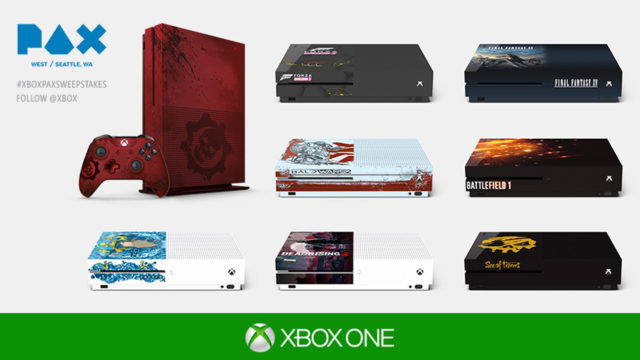
Naturally, Microsoft will have a presence inside the convention center as well, showing off titles that were announced during E3Gears of War 4Halo Wars 2, Forza Horizon 3, Dead Rising 4, ReCore and Battlefield 1. Taking up three booths in the North Hall, Microsoft will offer hands-on game demos and eight custom Xbox One S 2TB consoles, which convention-goers can snap a picture of and share on social media for a chance to win. Each console bears designs inspired by Gears of War 4, Halo Wars 2, Forza Horizon 3, Dead Rising 4, ReCore, Sea of Thieves, Battlefield and Final Fantasy XVThose outside of PAX can still enter for a chance to win one of the consoles by re-tweeting a message from Xbox on Twitter.

The biggest push from the game publisher is Gears of War 4, which is debuting its new Horde 3.0 and Arms Race modes for fans to try. Based on their performance, players can win t-shirts, pins, physical gear packs and on Saturday, a special poster drawn by comic book artist, Tony Moore.

Frontline marketing such as the ID@Xbox open house and Gears of War 4 challenge make the emotional difference between “I heard that game is cool” and “I remember the time I played that game at Microsoft.” As we near the big holiday shopping season, time will tell whether these tactics have paid off, especially since Gears of War 4 launches October 11.

‘Marvel Tsum Tsum’ Brings Plush Toy Superheroes To Life

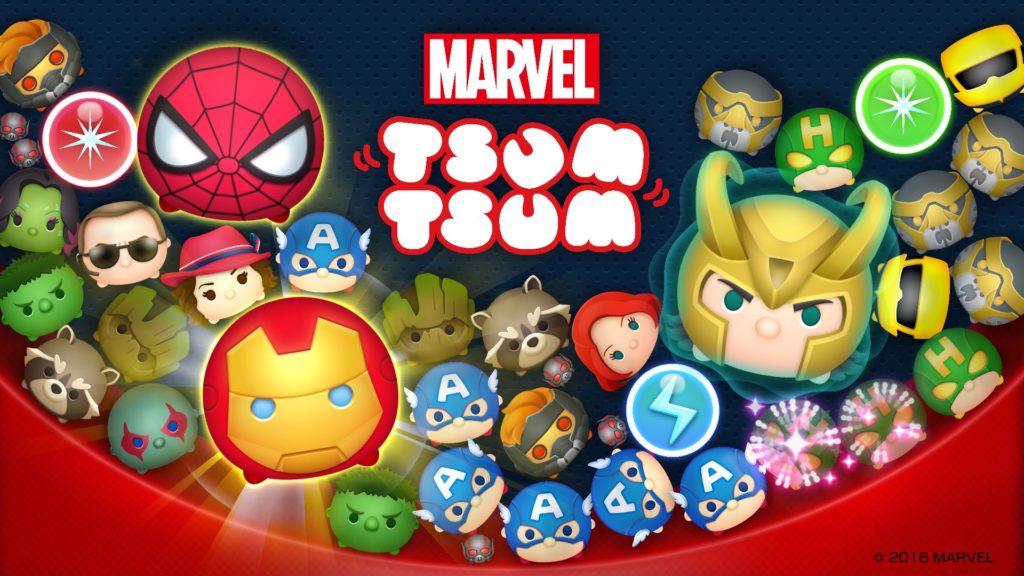
The summer movie blockbuster movie season is over, but superhero fandom lives on in TV and video games. One of the most inventive takes on the Marvel comic book universe comes from the newly launched mobile game, Marvel Tsum Tsum. With it, players have a chance to collect Tsum Tsum-styled characters—inspired by the Disney plush toy line made for easy stacking into pyramids—and power them up to tackle puzzles and challenges.

Similar in some respects to a match-3-type game, players draw a line to connect strings of Tsum Tsum figures based on popular Marvel characters such as Iron Man, Captain America, Hulk, and others as they tumble onto the screen. Long matches enable different power-ups as players race to clear as many characters from the screen as they can before time runs out.

The game is developed by XFLAG and published by mixi, one of the most popular social networking services and smartphone game providers in Japan. It is distinctly different from Disney Tsum Tsum, which was developed and published by Line Corporation last year, even though both are inspired by the Disney toy line. Marvel Tsum Tsum launched in North America this week on both the Apple App Store and Google Play, with a roll out in other territories coming soon.

Erika Nakamura, senior producer for Marvel Tsum Tsum at mixi, describes the game to [a]listdaily: “Marvel Tsum Tsum is a simple-to-play connect-3 puzzle game. Players can also team up with friends to defeat supervillains.”

In discussing the mobile game’s social features, Nakamura explained that mixi’s XFLAG Studio “is focused on creating content that players can enjoy together with friends and family,” and that one of its core features is multiplayer so that players can pair up and compete. “Players can also connect with each other on Marvel Tsum Tsum via social media,” Nakamura adds, and mixi plans on promoting the game by hosting a viral campaign using its cooperative batter feature with a distinct focus on Marvel fans.

So what is the key difference between launching a mobile game in the North American market compared to Japan? “Compared to the Japanese market, in the North American market, there is less of a tendency for people to play together using smartphones. This is probably our biggest challenge,” Nakamura explained.

There are currently no cross-promotional plans between Marvel Tsum Tsum and the Disney Toy line, but Nakamura explains why the Tsum Tsum-style makes for such an appealing game. “The adorable Tsum Tsum characters with cute rounded forms contribute to their lovability. In addition, gameplay is simple but exciting with flashy and cool effects, like character skills. These are the main features that we believe make Tsum Tsum popular.”

Lastly, we asked what mixi tries to keep in mind when launching a mobile puzzle game such as Marvel Tsum Tsum globally. “We believe that running our service with a focus on our target’s needs is the key to success,” said Nakamura. “User testing will be done regularly after the launch to keep our service optimized for our players by improving the game to meet their needs.”

MARVEL_TSUM_kv_150dpi_c

‘Call Of Duty: Infinite Warfare’ Soundtracks Are Spinning To Vinyl

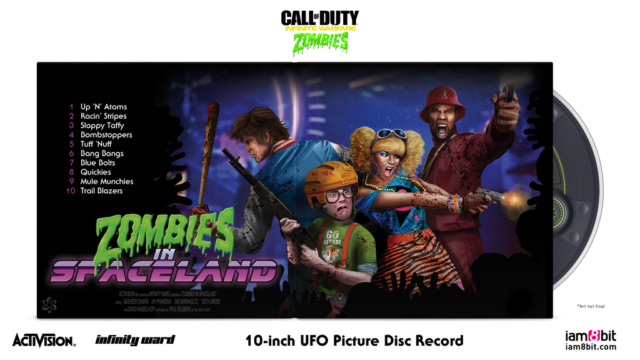
Time to break out the turntable, Call of Duty fans! iam8bit has partnered with Infinity Ward to release two limited edition vinyl soundtracks for Call of Duty: Infinite Warfare and Call of Duty: Zombies in Spaceland. Limited to 3,000 prints each, these albums will be sold separately and available for pre-order beginning Friday, September 2 through iam8bit’s website.

The iam8bit Call of Duty: Zombies in Spaceland soundtrack vinyl features ’80s pop synth-inspired music by the Infinity Ward team and David Hasselhoff’s DJ game character on the cover. Pressed on a 10-inch UFO picture disc record, the soundtrack also includes the digital edition. “Of special note, it’s really fun to watch the UFO spin on the turntable,” iam8bit added in a statement.

Meanwhile, The Call of Duty: Infinite Warfare soundtrack vinyl features music by composer, Sarah Schachner (Assassin’s Creed: Unity) and exclusive album art by UK-based illustrator, Chris Skinner. The set includes 2xLP picture discs with music mastered specifically for vinyl as well as the digital soundtrack.

In a recent interview with Game InformerCall of DutyInfinite Warfare composer, Sarah Schachner said she wants the soundtrack to “capture the loneliness felt in space and the burdens of war.”

“I think the emotional aspect of this Call of Duty sets it apart in an interesting way,” Schachner continued. “Also, the future setting allowed more room for creative experimentation than if it was tied to a past or present era. The developers at Infinity Ward really wanted to try something different with this game, and that was a lot of fun for me.”

Schachner is participating in the “Maestros of Video Games” panel during PAX on September 4 with fellow composers, Inon Zur (Eagle FlightFallout 3 & 4), Jack Wall (Call of Duty: Black Ops 2 & 3Lost Planet 3), Sascha Dikiciyan (Deus Ex: Mankind Divided), Austin Wintory (Banner Saga, Assassin’s Creed: Syndicate) and David Housden (Volume VR).

How Stella Artois Got Its Groove Back With The Roots

Stella Artois, an Anheuser-Busch InBev brand, has developed new technology to connect with its consumers. According to Todd Allen, vice president of global marketing for Stella Artois at Anheuser-Busch InBev, the premium beer brand targets the 25-to-39-year-old mobile-first generation.

“They’re tech-savvy and everything needs to be enabled through mobile and social media, which is how they connect with brands,” Allen told [a]listdaily. “We’re catering to a slightly more affluent consumer who values experiences over possessions.”

Stella has partnered with hip-hop band The Roots, creative agency Sid Lee and production company Tool to release “Bittersweet,” an interactive music video (and original song) that can change the flavor of the Belgian beer.

Allen said The Roots experimented with different pitches, instruments and music styles to create an original, multi-sensorial song that stimulates the ears and the taste buds, based on the research of Professor Charles Spence of the University of Oxford. Professor Spence found that there are surprising connections between the senses (hearing, vision, touch, taste and smell)—when one sense is stimulated, it triggers an effect on the remaining four senses. Called “crossmodal correspondences,” this theory comes to life in two versions of “Bittersweet.”

“The bitter side uses deeper sound and darker colors that can influence the taste of the Stella, while the sweet side is brought out with the more high-energy, fruitier flavors through brighter colors and horns from the music,” Allen said.

Dustin Callif, managing partner of digital at Tool North America, said his team created designs that were projection-mapped in the background during music video featuring The Roots.

The Roots

“We stacked the videos together so users can seamlessly toggle between the two versions of the song and experience the music video,” Callif said. “There’s a slider at the bottom of the interactive music video that allows you to track whether it’s more bitter or sweet based on what you’re watching and listening to.”

Allen said Stella is encouraging a conversation online and through social channels for people to discuss this interactive experience. The Roots has also been active in promoting the music video through social media. It’s part of a bigger marketing effort that combines multiple senses.

On August 17, The Roots performed both arrangements of “Bittersweet” at an exclusive seating during the opening night of Stella Artois hosts “Le Savoir,” a multi-sensorial dinner theater experience in New York City that ran through August 22 at Skylight Clarkson Square. The show launched August 4 in Montreal for eight nights and moves to Buenos Aires September 9 for eight nights.

Approximately 400 people per night attend the two-hour experience with 134 people per seating and there are three seatings per night. Allen said at Le Savoir,”Stella Artois is bringing together culinary wizards Bompas & Parr, 45 DEGREES (Cirque du Soleil’s events and special projects company) and The Roots to create an experience that stimulates all the senses. Guests will be transported through the seasons during a multi-course dinner featuring food and beer pairings inspired by the spectrum of flavors in a Stella Artois.

Allen said Stella will continue to deliver these experiences throughout this year and into 2017 with local events at key restaurant accounts around the world. There’s also an at-home activation, which encourages consumers to host a party that combines the passion points of food and music.

Stella has explored technology in the past. In January, the company partnered with Matt Damon’s Water.org by launching a YouTube 360 video, which brings to life the experience of one woman and her family in Honduras. The company used the Sundance Film Festival to debut the 360-degree video.

“Virtual reality is going to be a huge platform going forward,” Allen said. “We launched this project where consumers could buy any of three limited edition chalices, and for every chalice sold Stella Artois will help Water.org provide five years of clean water for one person in the developing world.”

Allen said virtual reality allows people to live and feel what it’s like to be the woman who has to walk six hours to get clean water. It shows that the problem is real. “VR is an incredibly important and innovative medium,” Allen said.