[a]listdaily is coming to you live from TwitchCon 2016! Stay tuned for exclusive interviews discussing the latest developments and news from the event. And be sure to check out the highlights if you miss any part of the livestream.
Here is the agenda for the show:
1:10—Welcome to TwitchCon w/Jessica Villarreal and Matt West
1:25—Daybreak on H1Z1
1:35—20 Questions: Naughty Dog, Gunnar and Alienware w/ iiJeriichoii
ELeague represents one of the big success cases in creating a synergy in eSports, balancing between digital streams on platforms such as Twitch and broadcasting live tournaments on television on TBS. It completed its first season of Counter-Strike: Global Offensive (CS:GO) tournaments in July, and recently announced that the next CS:GO Major Championship will be held beginning January 22 in Atlanta. The Grand Final will be televised live on TBS with a simulcast on Twitch on January 29 from the historic Fox Theatre.
Christina Alejandre, ELeague’s general manager and vice president of eSports, spoke at the New York Media Festival this week about the success of the first season.
In the world of eSports, TV is a brought audience. The core community watched using platforms like Twitch, and ELeague knew that. “We wanted it on television because we felt that we were capable of giving it that kind of framework and exposure that eSports normally had [online],” said Alejandre.
The bet paid off, as TBS saw a 95 percent increase in the coveted 18-to-35-year-old demographic during the ELeague’s first season. Over 19 million people tuned in to TBS on Friday nights to watch ELeague. Many were people who had never watched an eSports tournament before. Friday nights had become a destination for families to watch eSports, with fans explaining concepts to new viewers.
When asked about the reaction fans had to ELeague, Alejandre said that the feedback was overwhelmingly positive. However, Alejandre also explained that there was some apprehension. “I think that when we started the first season, a lot of people who were into eSports desperately wanted us to succeed,” she said. “But the community was also kind of holding their breath for us to fail because it was definitely a risky endeavor to put eSports on television—whether or not we could drive a consistent audience.”
Part of the concern was in bringing a number of non-endemic sponsors into the eSports space. Alejandre explained that people wondered whether ELeague would be all corporate and “TV-ify” eSports. “We didn’t want to TV-ify eSports,” Alejandre explained. “They already had a solid foundation and our job was not to reinvent the wheel. It was to provide this framework and exposure. We also worked closely with our partners and sponsors to make sure they were integrated in a healthy way.”
ELeague’s sponsorship partners include Buffalo Wild Wings, Credit Karma, Geico, Dominos and the movie Sausage Party. There even once was a Sausage Party studio takeover on ELeague. Additionally, Buffalo Wild Wings would host weekly ELeague viewing parties at its restaurants. But one of the most successful partnerships was with the sandwich chain Arby’s.
ELeague worked very closely with Arby’s, which came onboard with the mentality, “Hey Turner, we’re super excited about eSports and you guys are experts in this space. What we don’t want to do is be the guys that show up to the party that weren’t actually invited,” Alejandre explained.
Arby’s sponsor integrations included the “Locked and Loaded” series of videos, which took eSports players to shooting ranges to fire real guns at sandwiches. Arby’s provided a different sandwich each week and released slow motion videos of them exploding. “It was just an amazing piece,” said Alejandre “and it was also just kind of funny to watch these players, who are the best at their craft, but some of them could not shoot a gun to save their lives.”
Then there were the TV commercials, which featured the deep voice of actor Ving Rhames (Pulp Fiction, Mission Impossible) talking with Counter-Strike-themed language. In the game, one team plants a bomb and defends it while the other team tries to move in and defuse it. In the commercial, Rhames becomes agitated as a sandwich beeps and then explodes, which saddens Rhames. Some commercials have a message at the end reading: “Don’t try this at home. It’s a waste of a sandwich.”
“[The audience] saw that and were like, ‘you made this for the Counter-Strike community? You get us!’” said Alejandre. That’s when ELeague and Arby’s starting seeing a lot of positive feedback. Arby’s showed that it wanted to be part of the community instead of just selling roast beef sandwiches. “When people walk past an Arby’s now, I guarantee you they look at them very differently.”
https://www.youtube.com/watch?v=E-Qci6ZriUU
“How often, in a sporting event, do you have people in the audience cheering for a sponsor versus cheering for what’s going on? Arby’s did such a great job with its commercials—their commercials were targeted toward the community and showed that they ‘got them.’ The audience showed its appreciation by cheering ‘Arby’s, Arby’s, Arby’s!’ And they were tweeting about the commercials,” said Alejandre.
ELeague did a study featuring Arby’s and found that brand awareness, how much people liked them, and purchase intent grew by double digits. So the partnership was very successful for both, showing the power of integrating partners in a natural way.
“For a lot of these partners, it’s not just ELeague saying, ‘look, you need to integrate so our game or product doesn’t get hurt,’” said Alejandre. “We need to be smart with how we integrate with you because that fan base can turn on a dime. But as long as you embrace the community, they’ll embrace you right back.”
Alejandre also explained how ELeague chose CS:GO for its featured game because “CS:GO is a FPS (first-person shooter) game and the basic rules of understanding it are very simple. If you choose a MOBA-type game to start with to be the primer for competitive gaming, you’re going to get a lot of people who are going to be overwhelmed with all the different rules, all the different characters, and will have no idea what they’re watching.”
When speaking to [a]listdaily, Alejandre explained the game-selection process. Did ELeague choose games based on their popularity in the eSports space, or ones that sponsors most likely want to be associated with? “I think it’s a combination,” she responded. “We have to look at all the different angles. Is it something that’s relatable or understandable? If not, can [Turner] make it relatable and understandable? How popular is the existing fan base? We’re probably not going to dedicate an entire ELeague season to a game that’s not as popular, but there are a myriad factors that go into it. We have a great research team, and we all talk about it. All of us are gamers too, and [we ask] ‘do we just understand this game because we play it?’”
When asked whether ELeague would consider following EA’s strategy of featuring sports games such as Madden or FIFA as eSports—ELeague is under the Turner Sports umbrella—Alejandre said: “I think there are a lot of benefits to it, and that people understand a basketball game or football game. And also, the Turner Sports synergies are there. But we’re closely watching it, and it’s definitely one of the things that we watch and evaluate.”
It’s not just for gaming anymore—PlayStation 3 and 4 owners can already enjoy video streaming services like Netflix, Hulu and Amazon from the comfort of their controllers, but Sony has extended that offering even further with HBO and Cinemax. Both networks launched Thursday on PlayStation Vue, Sony’s own streaming and DVR platform, and HBO NOW is available as a stand-alone service as well.
PlayStation Vue subscribers have the option of bundles that include HBO, Showtime and over 100 other channels or simply subscribe to HBO and Cinemax individually. Already have an HBO subscription? No problem. PlayStation Vue users with an active HBO subscription can also access programming from HBO NOW at no additional cost by linking their PlayStation Network email and password. PS Vue is also available for Roku and iOS or Android mobile devices.
Source: Sony Interactive Entertainment
The move to include these popular channels helps establish Sony as a streaming network provider, and therefore a source for digital marketing revenue. According to a report by the Interactive Advertising Bureau (IAB), advertisers and media buyers have invested 114 percent more in original digital video programming over the past two years. Combine that with a die-hard fan base for Game of Thrones, and PlayStation Vue could be enjoying a new source of income.
The power of digital entertainment is very real, with viewership expected to surpass primetime TV.
With the announcement of these new subscription options, Sony took the opportunity to remind viewers to watch the series premiere of HBO’s sci-fi drama Westworld airing October 2. It should be interesting to see what kind of cross-promotion comes from a Sony-HBO-Cinemax partnership.
Sony is a prime example of not putting all the demographic eggs in one basket, taking advantage of the company’s full range of electronics and video game influence to cross-promote itself, like placing Sony phones, laptops and PlayStation 4 systems in its original series Powers.
Video games and movies are becoming best friends. From the rising popularity of game-to-screen adaptations to game engines reworked for film, technology is blurring the lines between watching and playing. Now, two respected companies are coming together to create video game, movie magic.
The motion picture financing, production and global sales company Good Universe has joined forced with the award-winning indie game developer Campo Santo. Their first project? A film adaptation of the developer’s first game Firewatch.
Good Universe offers creative collaboration and financial support in the film industry, working on a variety of film genres from comedy (My Big Fat Greek Wedding 2) to horror (The Forest). Company founders Joe Drake and Nathan Cahane were also involved in Sam Raimi’s Don’t Breathe for Sony. Campo Santos, although a young company, is comprised of video game industry veterans whose work includes Bioshock 2, Call of Duty: Advanced Warfare, Ori and the Blind Forest and more.
“When we met Good Universe we were floored by how they recognize, cultivate and produce incredible stories,” Campo Santo founder, Sean Vanaman said while announcing the partnership deal to the The Hollywood Reporter. “It’s rare you meet another group that shares so many of your values and makes the process of creating things even more exciting. We can’t wait to see what we make together.”
As for Good Universe, they wanted to team up with Campo Santo for their “utterly beguiling storytelling and amazing creative instincts.”
The partnership will involve the creation of content for both video games and film, a one-stop shop for franchise creation and sales.
Firewatch, which has sold nearly one million copies to date, tells the story of a fire lookout named Henry who uncovers clues in the Wyoming wilderness about mysterious occurrences. Isolated, he is able to communicate only with his supervisor through a walkie-talkie. Adding to the suspense, a shadowy figure keeps watching him from afar.
There is no word yet as to whether the film will be a direct adaptation, sequel, prequel or entirely new story set in the wilderness.
Virtual reality has obvious potential for immersive storytelling, but how does that translate for digital advertisers? The Interactive Advertising Bureau (IAB) released a report exploring VR’s potential as it pertains to just that. The report provides key takeaways from interviews with two dozen professionals in advertising, publishing, VR and platform development, along with a number of related case studies.
Hype Or Here To Stay?
The overall consensus across a variety of industries seems to be that VR isn’t going anywhere but up—illustrated by over a billion dollars invested in the technology during the first half of 2016 alone. VR is often compared to 3D TV, an ill-fated trend that was supposed to revolutionize the way consumers watch content but quickly went the way of the laser disc. In just a short time, however, the technology has proved its staying power, mainly because of its versatile applications.
IAB reports that in the next two years, respondents believe we’ll see more brands engaging in 360-degree video, a low-cost “gateway” into more interactive forms of VR. Other forms of advertising may also appear in VR like 2D digital billboards, 2D video and even TV spots. In Australia, for example, Microsoft introduced the first 4DX cinema advertisement for its new game Forza Horizon 3.
Defining VR
Because there are many ways to implement this rising tech, the term, “virtual reality” gets tossed around a lot around the media, from 360-degree videos to fully-immersive video games. While the latter allows the user to interact with their rendered environment, 360-degree video allows users to move the camera, but are otherwise at the mercy of pre-scripted content. Chris Hercik of Time, Inc. told IAB that for him, 360-degree video or photo experiences are not necessarily VR. “I think we need to clearly distinguish the two, because when we’re talking to advertisers or partners, we need to clarify which one offers just a point of view and means of looking around, and which one is more immersive.”
Advertising In VR
Publishers, agencies and creators seem to agree that the VR growth trajectory will be directly affected by the cost of its devices. 360-degree video is predicted to remain an entry point for advertisers. Dedicated content, such as Hilton’s virtual vacation activation or the Kate Moss’ dream sequence for Charlotte Tilbury’s new fragrance are just two examples of how brands are utilizing the new technology.
When it comes to content offered within a VR experience, however, fans aren’t as keen to participate. Immersv CEO Mihir Shah noted engagement numbers drop whenever a VR user experience has been interrupted. “If we put an advertiser in a queue, with a ‘check this out’ call to action—within the user’s current VR experience, people simply hit the skip button, or they leave,” Shah explained. “You can’t just put things into a scene. A lot more work needs to be done to get the integration points right. It can be extremely jarring when you’re immersed in another world.”
It seems that the more immersive an experience, the more emotional attachment a user will develop for that brand. Mia Tramz from Time Inc. told IAB that in her mind, the future of the medium is fully immersive experiences.
“360 VR experiences are great on-ramps to VR and for acquainting consumers with the medium, but the platforms that offer more immersion and interaction—especially in room scale—are undeniably compelling.”
General Mills is the first presenting sponsor of Yahoo ESports Live, an hour-long pair of weekly live shows. Late Night League focuses on Riot Games’ League of Legends landscape, and Tilted covers the entire world of competitive gaming. With custom branded segments and video advertising during live programming, the new campaign for Reese’s Puffs Cereal will also include Yahoo’s livestream coverage of ESL One New York 2016 on Saturday and Sunday.
Scott Baldwin, director of marketing for cereal at General Mills, told [a]listdaily that the company has been looking at eSports over the past year and settled on this partnership with Yahoo because of its audience and reach.
“Reese’s Puffs is a favorite of millennials and we’re always looking for new ways to engage with this audience,” Baldwin said. “ESports is such a broad space and it’s where our consumers are, so we saw this as a great opportunity to get involved.”
Baldwin said General Mills is targeting millennials, men and women alike, with this cereal.
“It’s not just 18-to-20 year olds in dorms, but a much broader demographic,” Baldwin said. “And we’ve seen that with Yahoo ESports. It’s a range of age and a nice mix of men and women, some of going upward of 30-plus. But 18-to-30 is the sweet spot.”
The fact that eSports lives online and is a completely digital audience fits right in with the overall marketing strategy for the cereal.
“What we do for Reese’s is all oriented toward this target demographic, so we’re not on traditional TV airing spots now,” Baldwin said. “Our work is already customized to them. It’s fun, and funny. It has that vibe. It’s out of the norm. It’s not about the family eating breakfast at the kitchen table.”
The tagline for Reece’s Puffs campaign is “you either love them or you’re wrong.” General Mills has integrated its humorous spots into the online content. So far, the company hasn’t created commercials specifically about eSports.
“We didn’t want to artificially make Reese’s Puffs content because we don’t want to pander to the audience,” Baldwin said. “We have fun content to share.”
Reese’s Puffs is also integrated into Yahoo’s Twitch and Facebook Live channels. Baldwin said the company has a robust social engagement across all platforms that millennials interact with hoping that they’ll share Reese’s Puffs content that they find funny or interesting.
“It’s early, but we’re pleased with how it looks,” Baldwin said of the one-year sponsorship deal General Mills signed with Yahoo.
“Are we reaching audience we’re after? Yes,” Baldwin said. “We’re watching engagement and how people are reacting to content on social media. We’ve learned from all of our brands that are working with gamers that you can’t just put something out there. Your content needs to be different and sharable and something that really draws them in. We don’t want to talk at them, but talk to them and make it engaging and fun to watch.”
This isn’t General Mills’ first foray into gaming. Baldwin said Cinnamon Toast Crunch has been marketing to late-night gamers for several years. And Totino’s Pizza Rolls partnered with Twitch for a Super Bowl bucking couch activation featuring influential streamers. Last October, Totino’s had an on-pack partnership with Activision’s Call of Duty: Black Ops 3. This October the brand has an on-pack partnership with Microsoft’s Gears of War 4, which is being released October 11.
Devin Kunysz, marketing manager of Reese’s Puffs at General Mills, told [a]listdaily the brand has also targeted gamers at events like the recent PAX West in Seattle.
“We were a Twitch livestream sponsor at their broadcast booth handing out Reese’s Puffs at a table for anyone to enjoy, including the broadcasters,” Kunysz said. “We had a large bowl of cereal in the Reese’s Puffs Pit that attendees could slide down and find a prize. We had a variety of prizes, including Xbox One game consoles.”
Baldwin said the Reese’s Puffs Facebook page gained several thousand followers from that PAX West activation.
“We’re starting this in little bits and seeing how it goes,” Baldwin said. “It’s a pretty dynamic space, so we’re watching and seeing how people respond.”
This year’s ESL One New York, which takes place this coming weekend (October 1-2) at the Barclays Center in Brooklyn, New York, will be a milestone event. ESL has partnered with Sliver.tv to bring the first Counter-Strike: Global Offensive (CS:GO) eSports tournament to be livestreamed in virtual reality. The event will bring virtual reality and 360-degree viewing to a variety of devices, including web browsers, Google Cardboard, the Samsung Gear VR and high-end headsets such as the Oculus Rift and HTC Vive.
Not only will viewers be able to engage with the tournament like never before, but they’ll also get a spectacular in-game point-of-view. That means they’ll see everything that the players are doing from within the game in real-time, synchronized with the ESL’s live 2D broadcast of the event.
Sliver.tv CEO Mitch Liu spoke with [a]listdaily about the partnership with ESL and how it will be bringing a whole new level of interaction with viewers with the world’s first VR eSports livestream.
Mitch Liu, Sliver.tv CEO
How did Sliver.tv and ESL come to partner for this event?
Well, that’s a great story. We were looking for user feedback in the CS:GO subreddit board with lots of great core gamers, and it turned out that an ESL team member was part of that community. They reached out to us, and once we showed them our technology and capabilities, they were blown away by it. Long story short, we decided to team up to do the first-ever VR 360 livestream of a major eSports event.
Why was ESL One New York chosen to be the first VR livestream?
We chose the upcoming ESL One event at the end of this month since it perfectly coincides with Sliver.tv’s launch of our livestream platform. What better than to showcase it at one of the largest CS:GO events in the world and be part of that awesome experience?
What can viewers expect from the VR experience?
We’ll be integrating the 2D program feed directly from ESL broadcast source into our VR world, and rendering in real-time the 360 third-person point-of-view game world via our virtual cameras. Our machine-vision algorithms identify in real-time who the player is in the 2D program feed and automatically selects the most optimal virtual camera located on the game map so that both feeds will be in sync. The viewer is essentially immersed within the VR game world and can just sit back and enjoy a live CS:GO match like never before.
What are the challenges of livestreaming eSports in virtual reality, especially for so many different platforms?
The livestream technology in itself is super challenging, and to be able to compress everything within a real-time pipeline is something we’ve been working on for a year now, and we also patented the technology. Scaling the platform to support tens of thousands of concurrent users across our website, mobile apps supporting Panorama-360 mode, Cardboard and across all of our VR apps is a huge undertaking. As a go-to platform for all things eSports, 360 and VR as well as the destination site for all eSports fans, we must support low-end mobile devices all the way up to the Oculus Rift.
How will Sliver.tv and ESL promote the VR livestream?
We’re relying mostly on ESL to help us on this front. They have millions of followers across their Twitter, Facebook and other social channels to spread the word pre-event. During the event, ESL will be promoting Sliver.tv and the VR experience through analyst desk callouts during their live broadcast. Post event, we plan to create exciting highlight reels, replays with special effects and top plays by teams, players, etc. so fans can revisit their favorite moments at any time.
While traditional sports owners have jumped into the eSports business in the past, it’s never been through the actual sports organization. The owners of the Philadelphia 76ers are the first to enter the eSports business by acquiring a pair of teams—Team Dignitas and Team Apex—and rolling them into the NBA organization’s structure. The Sixers intend to manage the day-to-day operations of Team Dignitas, sharing best practices in sponsorship, sales, branding, digital marketing, merchandising, publicity and more; as well as devote resources to player recruitment, development and wellness.
Philadelphia 76ers CEO Scott O’Neil [pictured above] told [a]listdaily that this acquisition gives the new Team Dignitas, which includes both the original team and Team Apex under one name, a competitive advantage by being able to enact the resources of the entire organization. “Myopically, we have more people in our sponsorship service sales and activation group than Dignitas and Team Apex have on their entire staff,” O’Neil said. “This is an opportunity to get all of the weight and resources and the actual workload and contacts of a major league professional sports franchise behind Team Dignitas, so we can catapult them into the upper echelon of the eSports space.”
The 76ers co-managing partner, David Blitzer and managing general partner, Josh Harris also own the New Jersey Devils NHL team, the Prudential Center in Newark and Premiere League soccer team Crystal Palace.
“Our sponsorship teams from our NBA and NHL franchises will drive sponsorship deals in the eSports space,” O’Neil said. “We’ll also have more resources for Team Dignitas to go out and attract more teams and new players.” Team Dignitas was originally formed in September 2003 with the merging of two Battlefield 1942 teams. The new Team Dignitas will field players across League of Legends, Counter-Strike: Global Offensive, Overwatch, Heroes of the Storm and Smite.
Game industry veteran, Greg Richardson will serve as chairman of the new Team Dignitas. Michael O’Dell will lead team operations as president, alongside vice president and general manager Michael Slan. Richardson told [a]listdaily that eSports is a fast-moving and dynamic market.
“This announcement of the Sixers getting involved is big news,” Richardson said. “It allows us to take a front row seat with existing leagues, game publishers, teams, players and fans. Starting tomorrow, a large part of what we’re doing is exploring what opportunities there are for Team Dignitas and the entire eSports ecosystem.” He also stated that while over a quarter billion people watch eSports, the ecosystem is not monetizing very well. He believes the Sixers can help Team Dignitas and the entire eSports industry.
“This is a business that, in order to win, you need to go out and generate revenue, invest in players and create an environment where players want to play,” O’Neil said.
O’Neil said one of the focal points of the organization will roll over from traditional sports, which have had quite a jump in the number of years invested in the training of professional athletes. On September 23, the Sixers opened the Philadelphia 76ers Training Complex, the largest and most technologically advanced training facility in professional sports. At 125,000-square-feet, the two-story training complex is home to two NBA regulation-size basketball courts, ten baskets, a 2,800-square-foot locker room, hydrotherapy room with a 40-foot lap pool and hydraulic training lift, organic player restaurant, and amenities designed for player health, wellness, communication and comfort.
“The way to become and remain dominant in any sport is to attract the best players in the world,” O’Neil said. “We’ll bring our sports background in health, hydration, nutrition and sleep to our eSports players.”
Richardson said Team Dignitas has gaming houses for its League of Legends teams in Southern California, but a lot of players across other games are spread out and play online. “Now we have the facilities to bring teams together for boot camps and training camps, which is a big win for the players we have today and a great way to try to attract world class free agents,” Richardson said. “We can help players be more successful, happier, and more healthy human beings.”
O’Neil said the NBA is the most dominant global league in the history of sports. Sixers games are available in 212 countries around the world and the NBA has League Pass, a digital passport to games around the league. “With eSports, our universe of potential fans and our business opportunities is now the entire world,” O’Neil said. “The Team Dignitas brand can be built in China, Singapore, the UK and North America. It’s upon us to dream big and build the infrastructure in a strong enough way to answer the opportunity.”
Richardson said Team Dignitas will continue to work directly with the fan base to collect feedback on what the community wants, as it always has. They’ll now have the added resources of a traditional sports organization to help with everything from merchandising to sports health. “ESports has an incredibly powerful and deep fan base,” O’Neil said. “LCS Worlds last year drew more people than the BCS national championship game. Yet, there’s some level of need to be validated from this group, which is what we can bring to the table. We understand the power and impact of this audience. We see this as an opportunity and there’s room for eSports to grow.”
The Sixers acquired the eSports franchises in partnership with NextEquity Partners, a growth equity and venture capital investment firm. The relationship between the Sixers, Team Dignitas and Team Apex was fostered by Tobias Sherman of WME-IMG, who represents Team Dignitas on new partner acquisitions.
Wargaming is expanding its eSports business beyond its core World of Tanks PC game, which has grown a strong global audience over the past few years. The publisher recently ran a successful one-day tournament featuring sixteen World of Tanks Blitz teams as a final test before slowly jumping into eSports with it. Now Wargaming is gearing up for its first Blitz Twister Cup.
The tournament will kick off with online preliminary matches starting September 26 across four regions with the best team from each region competing at a live offline event later this year. As many as ten players can register per team for the 7-vs.-7 competition.
Carlo Delallana, senior producer on World of Tanks Blitz told [a]listdaily that everything is handled on the client inside of the mobile game. “We give them all the tools to register for the tournament and they’ll get pinged before a match.”
Although this is Wargaming’s first step into mobile eSports, it’s part of a detailed road map that was laid out last year by the eSports team. The development team has added training rooms to the game and the ability to seamlessly launch tournaments. “We’ll add more features to expand things like camera controls so casters can fly the camera around and comment on the match,” Delallana said. “We’ll also add built-in livestreaming support in a future update.”
Even without built-in support, Delallana said players are using Mobcrush and Twitch on their own to stream games today. Wargaming will livestream the Blitz Twister Cup just as they’ve livestreamed the Wargaming.net League competitive tournament.
“We’ve been able to learn a lot from the World of Tanks (eSports) league,” Delallana said. “There are a lot of similar things from the tool standpoint. We do have some functionality in Blitz that’s exclusive to us, which makes it easier to set tournaments up quickly.”
While the World of Tanks eSport has grown established teams over the years, there’s only a small percentage of crossover between the mobile game and its big brother, according to Delallana. “If you’re a primarily a mobile player you’ll stick with Blitz, so I think we’ll get some new folks coming into the competitive scene,” Delallana said. “Blitz is an interesting product in the Tanks line-up. We’re targeting a different consumer, although very much in our space. There is a way for us to expand that eSports audience.”
One key element Delallana said will help grow Blitz as an eSport is the ability to watch the competition from within the game. That’s something Activision has done with Call of Duty: Black Ops 3 and it’s on the roadmap for Blitz, although not necessarily for this year. “If you can fire up Blitz and watch eSports directly from within the game, folks would never have to leave the client,” Delallana said.
Just as Wargaming has built out the presentation around its Grand Finals event for World of Tanks, this first official eSports outing is a learning experience.
“The theatrics of the live event is something we’re going to figure out,” Delallana said. “This first iteration is to debut Blitz and say we’ve arrived as an eSport. As the mobile eSports following gets bigger, the theatricality of the event will evolve.”
Delallana is bullish on eSports, given the success Blizzard Entertainment has had with Hearthstone and Super Evil Megacorp has had with Vainglory. “A lot of people watch Twitch on mobile devices, so the audience is already there,” Delallana said. “Those gamers might want to start rooting for mobile eSports over time.”
This first tournament will offer in-game gold for participants, so there’s an incentive for players who are competitive. Moving forward, Delallana said real cash prizes will become part of Blitz eSports. Real money will also help establish an ecosystem, which has already evolved with Hearthstone and Vainglory in the mobile arena.
“Once you debut an eSport, there will be teams and individuals and rising stars,” Delallana said. “This will be our first opportunity to see these global players emerge, and we want to make sure we give them the opportunities to explore Blitz competitively as a career choice.”
Blitz also opens up new sponsorship opportunities for brands interested in reaching mobile gamers. Wargaming recently held a Rise of Continents asynchronous competition across all its World of Tanks Blitz servers and Sennheiser headphones were awarded to winners.
“So we’ve dabbled in sponsored competitive events outside of the eSports environment and we hope to expand that opportunity when we properly debut Blitz,” Delallana said.
Market intelligence firm App Annie has released a fascinating report on mobile game TV ad spend in Japan, which should be of great interest to game marketers around the world. The use of TV ads for game marketing has been growing in recent years, and mobile games have led the way. The appeal of the TV ad spend is that you can reach a broad array of customers in a variety of demographics, many of whom would never be likely to encounter an ad in a mobile app. Plus, with ads for mobile games during live sporting events, tracking the response to the ad is something that game publishers can easily do by looking for spikes in downloads during the time of the event.
In Japan, TV ads have been a powerful marketing tool for mobile games going back many years. Japan’s fascination with mobile games began well before the current smartphone era, when Japan had “feature phones” that could play some pretty nice games and acquired a devoted, high-monetizing audience. This enthusiasm for mobile gaming has transferred to smartphone games, and so has the use of TV ads.
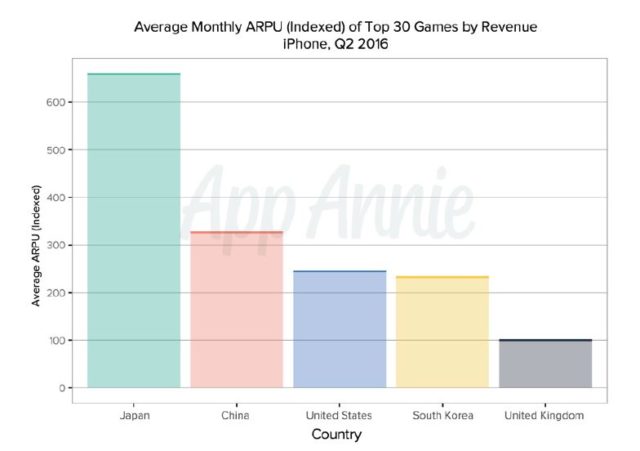
Why is Japan of great interest to mobile game marketers? The answer to that is simple: Japan is where the big money is in mobile games. “During Q2 2016, the average revenue per user (ARPU) of the top 30 highest-grossing games in Japan far exceeded that of the top 30 games in the other major markets we analyzed,” App Annie’s report noted. The first conclusion drawn from those figures is that mobile games should launch in Japan when it makes sense, because there is a lot of money to be made. That’s not very likely, since Japanese prefer games made in Japan: “90 percent of 2015 mobile games revenue generated in Japan came from games published by Japanese companies,” App Annie noted.
The deeper insight is that mobile games in Japan may augur a potential future for mobile games in other countries. What if you could increase the ARPU of games in other markets to get near the levels in Japan? Massive revenue could be achieved even without obtaining the very largest audience. There’s some evidence that this is possible. Pokémon GO is getting some 10 percent of its users to spend money, an astonishing figure when the average is nearer one or two percent. Could more games be able to reach this sort of monetization?
Television advertising is an important tool for Japanese mobile games and an important part of the overall ad spend in Japan, accounting for some 30 percent of ad spend over the past ten years. App Annie looked at data from 2013 to 2016 in three large regions of Japan that represent the majority of the market. App Annie’s analysis showed that TV ad spend in Japan grew nearly 70 percent from 2013 to 2015, according to data from Video Research and Dentsu. While Japanese companies dominate the mobile game market in Japan, the data suggests that foreign companies are increasingly using TV ads to break into the market. “Foreign game companies’ ads went from representing less than 4 percent of the ad spend in Video Research’s data in 2013 to over 20 percent in 2015,” App Annie noted.
It’s not a surprise that mobile games in Japan are using TV ad campaigns when you look at the numbers: “On average, the first month of a mobile game TV campaign in Japan saw an increase in downloads and revenue of roughly 225 percent and 25 percent (respectively) from the previous month,” according to App Annie. While revenue isn’t impacted anywhere near as much as downloads are, the higher amount of downloads sets the stage for future revenue growth, as the monetization tends to occur after the user has been playing the game for some time.
Television ads for mobile games are important not just for user acquisition, but for re-engaging lapsed gamers. Since 2013, TV ads for mobile games in Japan have focused more on older games, showing that publishers are looking to use TV to lengthen engagement as well as attract new users and increase monetization. This can be seen in the data that shows the average age of games being advertised on TV in Japan has more than doubled since 2013. Some of the top games in Japan, like Puzzle & Dragons and Monster Strike, continue to be solid performers years after release. Keeping that up is achieved partly through heavy TV advertising.
https://www.youtube.com/watch?v=KGT949VMCOQ
One more important point that App Annie’s report makes concerns the role-playing game (RPG) category, which is the most important genre in Japan’s mobile games market. “In addition to having higher engagement in terms of sessions and time per user, RPGs also receive higher ARPU than other categories in Japan,” said the report. The importance of RPGs could also be seen in TV ad spend, where the median RPG had a 75 percent higher TV ad spend than the median non-RPG, which was also about the same ratio between the two types of games for revenue.
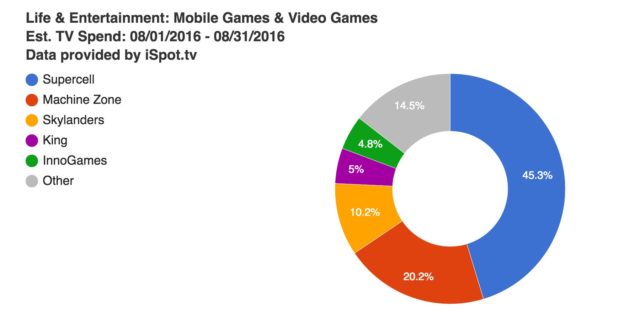
The importance of TV advertising for mobile games isn’t just in Japan—the US is seeing increasing TV ad spend for games, with mobile leading the pack. The total estimated spend for August was $27.2 million, according to a report by VentureBeat and iSpot.tv. Some 21 different brands ran 64 spots almost 13,000 times in August, the report noted.
Mobile games led the pack in US TV ad spending, with over 75 percent of the ad spend. The leader by far was Supercell, with 45.3 percent of the spend, followed by Machine Zone at 20.2 percent and King and Innogames at about 5 percent each. Activision jumped in with Skylanders ad spending that accounted for 10.2 percent of the total ad spend, but it can certainly be argued that a significant portion of that will mean added mobile game sales for Activision, since smartphone and tablet versions of Skylanders have the same functionality as the console games.


 It’s not a surprise that mobile games in Japan are using TV ad campaigns when you look at the numbers: “On average, the first month of a mobile game TV campaign in Japan saw an increase in downloads and revenue of roughly 225 percent and 25 percent (respectively) from the previous month,” according to App Annie. While revenue isn’t impacted anywhere near as much as downloads are, the higher amount of downloads sets the stage for future revenue growth, as the monetization tends to occur after the user has been playing the game for some time.