PlayStation VR Architect Discusses 4K And Evolving Ecosystem

Sony dedicated much of its E3 booth to PlayStation VR, which will launch October 13 for $400. With 50 games shipping in its launch window, the leading game console maker is betting on the future of virtual reality.

Ian Hetherington, CEO of eeGeo, was the founder and chairman of Evolution Studios (Motorstorm, DriveClub). He became involved in the early development of Project Morpheus (PlayStation VR) after Sony acquired his Liverpool-based studio.

With HTC Vive, Oculus Rift, Samsung Gear VR, StarVR, and PlayStation VR all on display with a variety of games at E3 this year, Hetherington talks to [a]listdaily about the upcoming 4K upgrade for PlayStation VR and the evolving landscape of virtual reality as a gaming and entertainment platform in this exclusive interview.

How were you involved in the development of PlayStation VR?

Evolution had a very active R&D group employing specialists with advanced 3D technology experience, often cutting-edge. These specialist areas included stereoscopic visioning from advanced Euro Fighter HUD development, point cloud manipulation and sampling technologies, Lidar, etc.

Sony acquired Evolution in 2007, and these technologies were applied to driving game simulation and PlayStation’s early stage VR experimentation.

How did input from Sony’s game development teams influence the headset?

Sony was excellent. While a global studio resource operates under strict commercial business objectives, they allow the studios to experiment in diverse ways, which ultimately adds to the IP portfolio and creates an edge in the market—Eyetoy, Buzz, etc. This is a healthy approach which preserves the integrity and interest of studios, particularly those that are a result of acquisition. Most of the successful studios I have worked with, and there are many, live to innovate.

How did you design PlayStation VR to be upgradable to 4K?

This occurred after my time with the company. Due to a few dedicated pioneers, the VR head-mounted display specification has evolved to a base specification for a sustainable VR experience—head movement to retina latency, movement sensor accuracy, resolution, more than 90 frames per second, etc. Each and every one of these is fundamental to basic VR viability. 4K is becoming part of this basic specification and you will see it as a must-have for the next generation of VR-enabled mobile devices.

What do you think will be the PlayStation VR’s impact on the overall VR ecosystem?

By definition, the majority of console content will be games related. This defines itself as niche when compared to the mobile/VR ecosystem, which will run to tens of millions of users, and more importantly, location-based VR.

What impact are the new PC, console, and mobile VR headsets having on entertainment?

You have to differentiate between entertainment as in Hollywood and console gaming, and the mobile sector. There is no doubt that there will be impressive “experiences” on console, however, there is plenty of research which supports the fact that you do not need ultra-high resolution to create immersion and the mobile experience is more than capable of producing this.

How is this technology opening up opportunities for brands and sponsors?

We’re in the early days as we are just laying down the foundational layers of what the VR/AR experience will be capable of delivering. Much like the early days of 3D over 2D, this is quite a shift in user expectation. The quest right now is to deliver platforms that allow content creators to experiment easily and quickly.

What does eeGeo do?

EeGeo has developed a technology to map the world in 3D. We produce a country-by-country model of entire geographies including roads, buildings, terrain, digital height, etc. Uniquely, we model not only the outside of buildings but also interiors. We do this in a totally seamless way. This is a foundational layer for VR, and particularly AR. If you want to position data in the real world, then the eeGeo platform is the perfect platform to author and position that data accurately.

We have proven the platform with over five million downloads to date, and a commercial base of key customers in a variety of sectors.

We are already VR enabled on Cardboard architectures, and scaling up in resolution and features is relatively easy. We have a substantial backlog of platform deliverables, which will put us far ahead of the curve in VR and AR mapping. We firmly believe our core technology differentiates us sufficiently from Google, Apple, etc. to make this a sustainable proposition. I have disrupted established markets in the past, and I see no reason to stop eeGeo from doing that again.

What do you think about mixed reality?

VR form factors will inevitably give way to mixed reality devices. I see VR as a stepping stone where experimentation is more open, but real-world use cases will dominate in time.

How do you see VR and mixed reality evolving over the next five years?

Exactly that: evolving. I see us quickly moving away from the current use cases for experiences and gaming, toward social, communication, and location-based services. This is a mirror world where data is key and discoverability and proximity are the primary indexes. There is much talk of intelligent buildings, Internet of Things, etc. At the moment, this is mostly concerned with data harvesting and not data usage.
Tencent’s Plan To Dominate Mobile Gaming And ESports

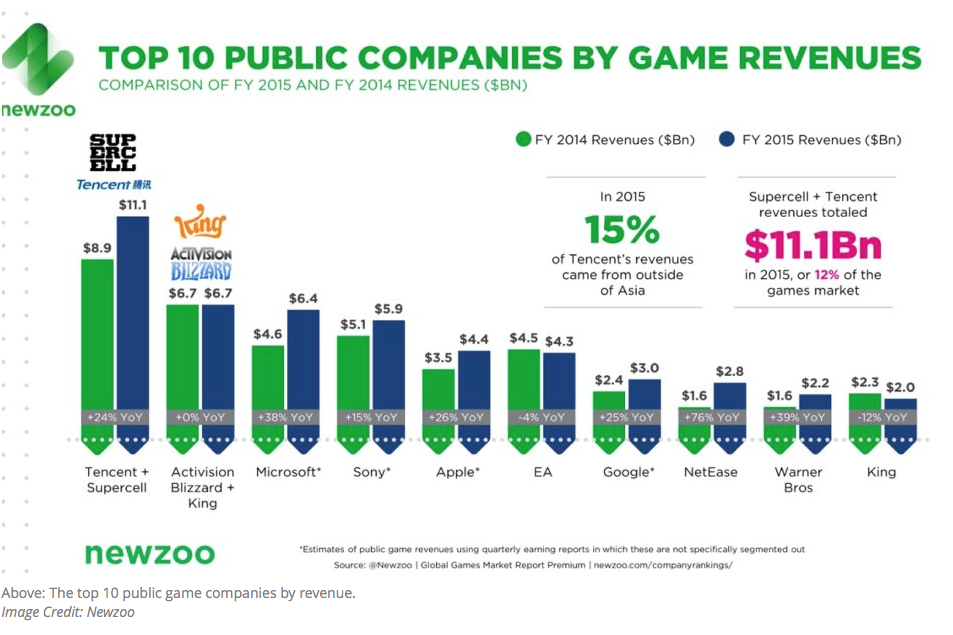
The Chinese tech giant, Tencent, is the largest gaming company in the world, far outpacing companies such as Activision Blizzard, EA, Sony and Microsoft in global video game revenues. The company has a long list of partnerships and investments, which include a minority stake in Snapchat and a deal with Disney to broadcast ESPN content on its digital QQ Sports network, but its fame comes from owning the most popular social networking service in China: WeChat. The company used the popularity of the social media platform to invest in other areas of entertainment, including the virtual reality meeting space, AltspaceVR, and (most notably) a number of video game companies, many of which are based in the US.

Although the company keeps most of its investments a secret, its high-profile deals—including the recent acquisition of Clash Royale developer, Supercell—indicate a strong focus toward dominating eSports and maintaining its position as the biggest gaming company in the world. Here are some of the major game developers Tencent is involved with.

Supercell

There was a great deal of speculation leading up to today’s deal, where Tencent purchased 84 percent ownership of the Clash of Clans and Clash Royale developer for $8.6 billion. Acquiring the mobile game giant was a logical move, considering how Newzoo reported that Clash Royale was the world’s top-grossing free-to-play mobile game for March 2016 by bringing in $110 million in global revenues. That’s on top of the $2.3 billion the game earned in 2015.

With the inclusion of Supercell’s Clash of Clans, Tencent has near complete control of the top grossing mobile eSports games in China. Tencent’s King of Glory debuted at number one on the list of top grossing Android games in China, and ranks at number 4 for top grossing mobile eSports games on iOS. That success is expected to continue for the foreseeable future.

Riot Games

Tencent acquired a 93 percent majority stake in Riot Games in 2011, and made big news when it purchased the remaining 7 percent last December. Riot Games is the developer behind League of Legends, the most popular competitive video game and eSport in the world. The game maintains 100 million active users a month, and generates about $1.5 billion a year, according to SuperData Research.

Riot still enjoys complete autonomy, and still operates as an independent studio (as Supercell will), and while the buyout didn’t do much to shake up the gaming world, it helped to further strengthen Tencent’s eSports investments.

Glu Mobile

Niccolo de Masi, president, CEO and chairman of Glu Mobile, famous for the massively successful Kim Kardashian Hollywood, described how Asian companies that have found great success in their domestic markets will seek to expand to Western markets through investments, partnerships and purchases. He might as well have been describing his own company’s experience, as Tencent increased its stake in Glu to 21.5 percent in February.

Glu is currently working to develop a version of Tencent’s successful mobile shooter, WeFire, for Western audiences. The company also announced a $7.5 million investment in the Icelandic game studio Plain Vanilla last January. The studio is responsible for the hit mobile trivia game QuizUp, which is currently being adapted into a live prime-time game show. Glu might acquire the studio completely if the game continues to do well, which could help consolidate the web of partnerships, as Tencent has been a Plain Vanilla investor since 2013. In April 2015, Tencent worked with Plain Vanilla to launch a Chinese localized version of QuizUp called WeQuiz, which quickly rose to the top of the Chinese iOS App Store.

Activision Blizzard

Seeing Activision Blizzard’s revenues ranked second to Tencent (even after it purchased of Candy Crush Saga developer, King Digital, for $5.9 billion) makes the two companies appear as rivals. While that may be true to an extent, Tencent has investments in Activision Blizzard, so the success of its competitor is also success for Tencent. As Peter Warman, CEO of Newzoo pointed out, “When Activision Blizzard broke loose from Vivendi back in July 2013 in a deal sized at $8.2 billion, a consortium called ASAC II purchased $2.34 billion, or almost 25 percent worth of shares.” A large contributor to this consortium was Tencent, and the company owns a part of the recently launched Call of Duty World League, which offers a $3 million prize pool.

Then there’s how almost every competitive game produced by Blizzard, including the recently released Overwatch, are popular eSports. Also, let’s not overlook the fact that Tencent is the official distributor of Candy Crush Saga in China.

According to a statement made to Fortune, Warman believes that Tencent has three main goals: “growing its share of the Western games market as a whole, growing the global mobile games market, and dominating eSports in China.”

Epic Games

Epic Games is famous for many reasons, chief among them being the Unreal Engine, the original Gears of War trilogy, and (most recently) the competitive MOBA (Multiplayer Online Battle Arena) game Paragon. Tencent bought approximately 48.4 percent of the company’s outstanding shares for $330 million in 2012, and the strategic investment gave Tencent the right to nominate directors to the game studio’s board.

In addition to bringing Paragon into open beta later this summer, Epic Games is heavily promoting the Unreal Engine (especially for VR development), developing two new games, which include Unreal Tournament and Fortnite. ChAIR, which is owned by Epic, is working with filmmaker J.J. Abrams on a collaborative project called Spyjinx.

Capcom, EA And More

Tencent doesn’t just specialize in investing outside of China. It also partners with companies to distribute games in its own country. It is currently partnered with Capcom to develop Monster Hunter Online in China and the game’s producer, Tao Weishi, has expressed that he’d be interested in continuing the partnership with some of Capcom’s other IPs—including Resident Evil, Street Fighter, Devil May Cry, Onimusha, Dino Crisis, and Sengoku Basara.

Monster Hunter Online is being developed using CryEngine, and coincidentally, Tencent is the exclusive operator of Crytek’s online game, Warface in China. Additionally, Tencent manages FIFA Online 3 in China for Electronic Arts, making for another not-quite-rival in the global gaming space. Who knows what these partnerships will lead to down the road?

Consumers Want More From Virtual Reality Than Games

If last week’s E3 is any indication, virtual reality is relying heavily on video game developers to create compelling content to help accelerate adoption of the technology. However, it’s capable of so much more, and consumers are aware of that.

A new report from Greenlight VR, titled “2016 Virtual Reality Consumer Adoption Report,” takes a closer look at these expectations, explaining how consumers want to explore other uses for VR, including travel, (non-gaming) entertainment, education and home design.

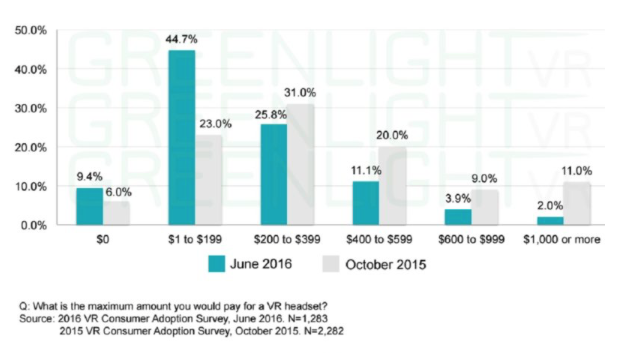
The first factor that the report discusses is price, as consumers aren’t so interested in paying a lot of money for virtual reality gear, compared to back in October. The most affordable choice for those polled is the Samsung Gear VR (retailing for $99), followed by the PlayStation VR (currently priced at $399).

Screen Shot 2016-06-21 at 11.28.42 AM

While gaming is still a popular option among those getting VR (61 percent of those polled showed interest), it didn’t quite rank as high as other categories. Travel topped the list with a 73.5 percent interest, followed by movies/videos (67.3 percent), live events (67 percent), home design (65.9 percent) and education (63.9 percent).

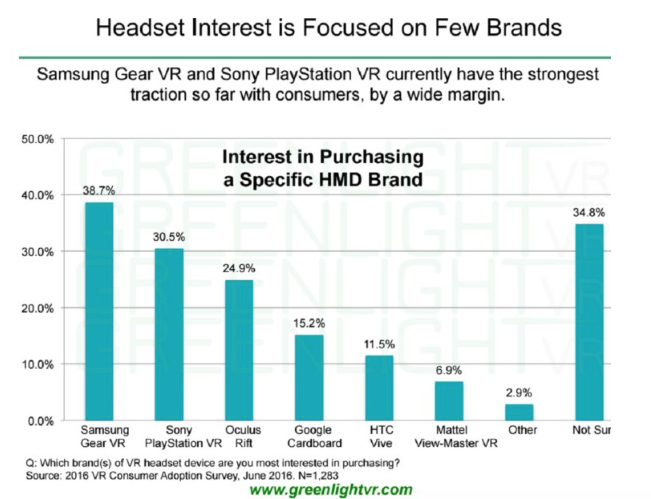
As far as which headsets people want the most, the Samsung Gear VR ranked the highest at 38.7 percent, followed by PlayStation VR (30.5 percent) and Oculus Rift (24.9 percent). However, 34.8 percent noted that they aren’t sure which headset they want to go with yet, stating that most companies haven’t done a solid job in terms of explaining just what their headsets can do. This will likely change as devices like the Oculus Rift and HTC Vive get more widespread distribution and support.

Screen Shot 2016-06-21 at 11.30.17 AM

“Virtual reality has always been more than a medium for gaming experiences and consumers understand that,” said Clifton Dawson, CEO of Greenlight VR, regarding the report. “Our findings from multiple studies suggest that some players in the VR ecosystem may be overly focused on gaming. The reality is that consumers have a wide variety of interests for using virtual reality. Platform and content providers would be wise to consider these bigger, richer findings as they develop their content portfolio and marketing strategies.”

The report also made note of the positive reception of virtual reality, with 86 percent noting they had a positive experience. “Overall, we were struck by the strongly positive and broad interest in VR in general, and in specific uses in particular,” said Steve Marshall, senior vice president of research and consulting for Greenlight VR. “Given all the attention in the press, we expected to find gaming as the primary consumer interest in VR. The reality is that consumers have a wide variety of interests for using VR—starting with travel and adventure.”

Tencent Acquires Supercell, Increases Mobile Dominance

Even those with only general knowledge of mobile gaming recognize the company Supercell, or at least one of its multi-million-dollar generating games, such as Clash of Clans and Clash Royale. So it’s little wonder why the Chinese tech giant Tencent, which took full ownership of League of Legends developer Riot Games last year, decided to add Supercell to its holdings.

Tencent announced today that it is acquiring Supercell in an agreement to buy 84 percent majority ownership from Japanese telecom outfit Softbank, which was confirmed by Supercell. As a result, Supercell’s total valuation will reach a whopping $10.2 billion, and will give Tencent incredible dominance over the mobile gaming market worldwide. The deal is worth an estimated $8.6 billion.

Many factors went into the deal, including how the studio will continue to operate independently, just as Riot Games does. For Tencent, expanding reach to more gamers is the main goal.

“China is home to more gamers than any other country,” explained CEO Ilkka Paananen. “Tencent’s platforms reach around a billion users (yes, a billion!). And, they have around 300 million unique users playing games on their platforms. What this means for us is that together with Tencent, we can bring our games to so many more players. Also, their social platforms offer many new possibilities for our games, particularly for social play. All of this is very exciting!”

Newzoo explains how Tencent now has 13 percent of the global $99 billion dollar gaming business. Its acquisition of Supercell boosts its annual revenues significantly, with a 24 percent year-over-year increase. Meanwhile, its main rival, Activision Blizzard (combined with its purchase of Candy Crush developer King) has a smaller portion, followed by Microsoft, Sony and Apple.

Screen Shot 2016-06-21 at 11.10.43 AM

“This is certainly a good deal for Tencent,” said Peter Warman, CEO of Newzoo, about the report. “It solves a huge strategic problem and provides immediate additional revenue potential. This year, Supercell is on track to make over $2 billion outside of Asia. This is significantly more than the $1.3 billion Tencent made outside of Asia last year, the majority of which came from League of Legends. Tencent will now finally make serious mobile revenues outside of its home turf.”

This means doubling (or perhaps even tripling) the $1.3 billion it managed to generate outside of Asian markets the previous year. “The immediate opportunity comes from the Android ecosystem in China, representing around two-thirds of the Chinese mobile market,” said Warman. “Clash Royale is one of the best performing games on iOS in China and has just recently launched on Android in the third-biggest store in China: 360 Mobile Assistant. Tencent’s MyApp store is the biggest. Though it is not written in stone yet that Kunlun will no longer publish Supercell games, it seems obvious that Tencent will take over. Using Tencent’s store and QQ community represents an immediate $1 billion+ opportunity for Supercell’s portfolio in China, particularly Clash Royale.”

This acquisition will no doubt shake up the mobile industry in the months ahead, and maybe that means seeing more awesome Liam Neeson commercials in the future.

Starbreeze Exec Discusses Opportunities With Location-Based VR

Just ahead of E3 2016, Starbreeze AB announced a pair of big hardware technology deals with Acer and IMAX to secure its place in the burgeoning location-based virtual reality entertainment market. These will include specialized theaters and arcades where audiences may experience premium VR at a low cost.

The Swedish company is entering a joint venture for the StarVR Virtual Reality (VR) Head-Mounted Display (HMD) with Acer. The two companies aim to cooperate on the design, manufacturing, promotion, marketing, and sales of the StarVR HMD to the professional and location-based entertainment market.

Separately, IMAX will create a premium VR experience that will leverage Starbreeze’s StarVR headset technology, which provides a 210-degree full peripheral field of view—double that of any other VR headset currently available. Starbreeze’s existing library of VR entertainment content and games will be made available to consumers, as well as the premium content resulting from the recent IMAX Google VR camera business. IMAX will also look to establish new VR content partnerships through its existing Hollywood filmmaker and studio relationships.

Starbreeze will bring new interactive content through its publishing and partnerships in the gaming industry, which includes its relationship with leading Hollywood studio Lionsgate, with whom Starbreeze is developing its John Wick: The Impossible Task VR game as well as others.

Emmanuel Marquez, chief technology officer at Starbreeze, talks to [a]listdaily about the ramifications of these new deals in this exclusive interview.

What does partnering with Acer bring to the table for the StarVR virtual reality headset?

There are so many things. We’re a gaming company that came up with this slightly crazy idea: that we should own the full vertical of VR. We saw some great potential for the medium early on and knew we wanted to develop for it, but considering the early stage of development on the hardware side, we quickly realized that we needed more juice—better specs, if you will—to fully realize our vision for it. Acquiring InfinitEye was our first step, and we believe we’ve done great so far, but each version of the headset you’ve seen so far has been assembled by hand. To fully launch the StarVR headset on the market, and especially with our new collaboration with IMAX, we really needed a partner that knows manufacturing, and Acer was the perfect fit.

We’re seeing a more crowded marketplace for VR hardware. How do you see your technology standing out from the pack?

There are so many applications for virtual reality where the pro market is more demanding on specs and not as price sensitive. We do deliver a premium experience with generally higher specs, and the 210-degree field-of-view makes a difference for sure. We feel that we can differentiate ourselves very well from other segments, and we’re very comfortable catering to the pro market as a focus; especially with the IMAX collaboration putting the StarVR headset in IMAX VR centers all across the world.

How does Acer’s brand and marketing muscle help your VR hardware endeavors?

We’re still in the letter of intent phase with our contract with the details being worked out. But of course, we feel that a well-established hardware partner will be able to bring a lot to the table.

Starbreeze has said previously that its VR games will be cross-platform. How will you entice gamers to invest in your hardware over Vive, Oculus, or PlayStation VR?

There’s plenty of room in the market still, and we believe we can find our niche that fits the profile of the StarVR. So we’re looking to focus on the pro markets, meaning business-to-business applications and location-based entertainment, like our collaboration with IMAX, and we will approach the market somewhat differently. That said, it doesn’t mean we’ll never sell to consumers, but our main focus will definitely be the pro markets.

How are the marketing dollars from Facebook, Google, Microsoft, and other tech giants raising the awareness of VR and helping a company like Starbreeze?

We love people spreading the gospel of VR, in any shape or form. It’s a new medium truly, and nothing like 3D glasses. VR needs to be experienced first-hand—and we mean real VR, not just a 360 video.

What have you learned about developing games for VR through working on The Walking Dead and John Wick games?

There are so many things in game mechanics that you have to re-think and re-imagine. And so many things that people react to differently that you only learn by doing, testing and then re-iterating. It’s a fun and very gratifying process where you basically have to start off by acknowledging that you need to think differently.

What challenges remain in creating long-form interactive content for home VR?

We’re still learning and pushing the boundaries of what’s possible, and we’re seeing longer and longer usage times in the headsets on the market. There are multiple challenges ranging from hardware limitations, comfort, and how to present the experiences, but we imagine that the time people stay in the experiences will increase as we learn and develop. Maybe not this year or next, but definitely in the future. This is also why we feel that the location-based market is a good place for us to see how people react to different experiences in a controlled setting.

With location-based VR, how do you see your partnership with IMAX helping to keep a distance between what’s available at the mall verses what’s available at home?

The price of the initial investment of a head-mounted display and PC that powers the headset aside—it’s not so much about keeping a distance but that we can offer experiences that really blow your mind, which wouldn’t be as accessible for the homes. You already have challenges with finding that spot in the house where you can move around in VR without getting your knees bruised from bumping into furniture. There are so many great accessories and set-ups today that enhance your experience that just wouldn’t be viable to put in a home. We can cater to that.

How are you working with IMAX?

We’re setting up a joint venture where we’ll collaborate on location-based premium VR experiences. We’re providing the StarVR and our knowledge from the tech side. Having had the Overkill’s The Walking Dead experience on the road gave us so much insight on people management, getting people comfortably in and out of the experiences, running the tech on the road, and in different locations and weather conditions.

IMAX’s obvious know-how about location-based entertainment is a huge asset, as well as their retail and movie industry knowledge. While we bring our gaming expertise, IMAX complements us really well on the cinematic side.

The Void is bringing Ghostbusters to its platform and opening stand-alone entertainment centers. Do you see VR as the next gen arcades?

Absolutely, and in the interim, as we continuously update the hardware and learn more about how to craft the most engaging and immersive experiences, location-based is a perfect way to introduce VR to the masses.

Based on how quickly gaming technology develops, how do you prevent a repeat of the arcade crash of the ’90s after home consoles caught up?

I would rather compare VR tech to the shift in TV and display manufacturing evolution. My bet is that we’ll make leaps in development quite frequently over the next few years.

You’ve worked on several movie licenses for VR gaming. What role do you see both the home and location-based markets playing in allowing filmmakers to connect with fans of their franchises?

The VR experiences can definitely serve as a second screen (or should we call it third?), to amplify any experience shown in the theaters. Imagine going to watch Star Wars on the big screen, then go into the VR center next door and jump into your favorite pod racer and take it for a spin.

When do you foresee your location-based experiences becoming a reality in the U.S.?

We started the StarCade project because we wanted to learn more about VR experiences, and it fit our vision of being location-based, cost-effective and accessible. While we planned the project, our two recently announced collaborations were taking shape. Fast forward to today, and we now have a fantastic production partner in Acer, and a superb collaboration with IMAX.

IMAX definitely shares our vision for location-based entertainment and we’re very proud to have them as a partner for the re-imagined version of our StarCade project. We’ve now consolidated all the StarCade work into the IMAX VR collaboration and we’re excited to bring both gaming and cinematic experiences into the venues. The first pilot venue will still open in LA, but we’ve selected a new location and it’ll be opening later this year. We’ll then start rolling the concept out to more locations.

VR is huge in China right now. What type of global market do you see for this technology?

Asia really has location-based figured out, China included. There’s a great culture of going to a specific location, meeting with your friends and hanging out with karaoke bars, sports bars, internet cafes, etc. We definitely see the potential for VR centers in the region.

Kanye West Guides His Mother To Heaven In ‘Only One’

Wherever you find Kanye West, the influence of his mother is not far behind. From the themes of his music to naming his design and content house DONDA, West has taken considerable steps to honor his late mother, who passed away in 2007. Now, the 22-time Grammy winner and larger-than-life personality has turned to the video game industry to create an interactive memorial.

The trailer for Only One debuted at Sony’s E3 press conference last Tuesday in Los Angeles featuring an animated version of Donda West riding on the back of Pegasus as they surge through the clouds toward Heaven, where Donda receives her wings against an epic, ethereal landscape. Players of Only One, which does not yet have a release date, will assume the role of Donda as she enters through the gates of Heaven.

Only One, a 2014 song of West’s of the same name featuring Paul McCartney, is a collaboration with animation studio Encyclopedia Pictura (EP) with directors Isaiah Saxon and Sean Hellfritsch. EP has created videos for artists such as Panda Bear, Grizzly Bear and Björk.

During his Yeezy Season 3 fashion show in February, West shared a snippet of Only One for the audience, saying, “I worked on a video game and I wanted to show y’all. The idea of the game is, my mom traveling through the gates of Heaven.”

Despite his fame, West told the audience he had a difficult time finding a game studio to work with, but finally partnered with EP to realize his creative vision. Aside from the premise and art style, no other details about the game have been revealed.

The Only One game trailer was unveiled the same day that West announced his Saint Pablo tour. West will be returning to North American arenas for the first time in three years to perform The Life of Pablo—a raw collection using a gospel theme to explore the concept of redemption and made to sound unfinished. The link between gospel and his mother’s ascension into Heaven are unlikely a coincidence and could even be an indicator as to the aesthetic of West’s upcoming tour.

7 Mobile Games Heating Up Summer 2016

Mobile games are expected to generate $99.6 billion in global revenue this year, with no sign of slowing down. In fact, 2016 has already seen some fantastically successful mobile games, including Miitomo, Nintendo’s first entry into the mobile market, along with EA’s Bejeweled Stars and SimCity BuildIt. So it’s little wonder why publishers were showcasing their big mobile titles at the Electronic Entertainment Expo (E3) last week. According to the ESA, over 90 exhibitors presented mobile games (70 more than the previous year), shown at the show’s Online and Mobile Game Pavilion.

Here are the mobile games that were announced at E3 2016 that will get audiences hooked this summer.

The Elder Scrolls: Legends

Bethesda surprised fans last year with the announcement and sudden launch of Fallout Shelter last year, the publisher’s first mobile game. Fallout Shelter has gone on to enjoy tremendous success on both iOS and Android, spurred on by the release of Fallout 4 last year, and will be releasing on PC in July with additional features. Now Bethesda is looking to repeat that success with The Elder Scrolls: Legends, a strategy collectible card game coming to mobile devices and PC, based on the longstanding The Elder Scrolls series. The game is currently in beta with no official release date, but the timing might coincide with the release of Skyrim Special Edition—a fully remastered version of the 2011 game, launching later this year for Xbox One, PlayStation 4 and PC—which was announced last week at the Bethesda pre-E3 press conference. Alternatively, the game could also include a tie-in with The Elder Scrolls Online: Tamriel Unlimited, which recently boasted a huge surge in player numbers.

Deus Ex GO

Releasing this summer, Deus Ex GO takes some of the gameplay from the main series (stealth, cybernetic augmentation, and combat) and presents it as a living board game. Longtime fans of the Deus Ex series may be very pleased with the straightforward yet challenging gameplay that was showcased during E3 last week, and the game will help stir up excitement as we draw closer to the August 23 launch of Deus Ex: Mankind Divided. The team at Square Enix Montreal also won the Apple Design Award for Lara Croft GO last week, so if that game is any indication, we can expect great things from this Deus Ex-inspired mobile entry.

Final Fantasy Brave Exvius

Although Square Enix put most of its promotional attention toward Final Fantasy XV at E3 last week, Final Fantasy Brave Exvius is the first game in the longstanding series to be built from the ground up for mobile devices for a worldwide audience. The free-to-play game gives fans what they’ve come to expect from a Final Fantasy game, including a deep story and a compelling combat system. Topping it all off is a pixel art style mixed with 3D graphics, which resembles some of the classic games in the franchise. Brave Exvius has already had over six million downloads in Japan and is looking for even greater success when it releases for Western audiences this summer.

Kingdom Hearts Unchained X

Similar to Final Fantasy Brave Exvius, Kingdom Hearts Unchained X [pronounced Unchained Key] is the first game in the series to release for mobile devices and lets players enter a magical world where Final Fantasy and Disney characters team up to protect different worlds from a dark force called the Heartless. The free-to-play game released last year in Japan, the US in April, and in most parts of Europe last week. Best of all, Unchained X‘s story has a tie-in with the upcoming Kingdom Hearts III.

Batman: The Telltale Series

Telltale Games has a strong reputation for developing deep and mature adventure games based on popular franchises such as The Walking Dead, which is entering its third season this fall. However, fans won’t need to wait long for a new Telltale game, since this summer will see the debut of The Dark Knight in Batman: The Telltale Series. In it, players take the role of the masked superhero, who is still early in his crime-fighting career, and must balance his life as Batman with being Bruce Wayne. About 30 minutes of the game was shown to attendees at E3 last week, and it promises to keep the experience fresh for longtime fans of both the comics and movies by taking familiar stories and turning them on their head. As expected, the game will feature Telltale’s signature decision system so that players can craft unique adventures.

Pokémon GO

Nintendo’s legendary game designer, Shigeru Miyamoto, surprised audiences last week when he revealed that the much-anticipated augmented reality mobile game, Pokémon GO, is expected to release at the end of July. Although the release will not coincide with the launch of the Pokémon GO Plus accessory, it will give thousands of excited players a chance to explore the real world in an effort to capture Pokémon on their smartphones.

Developed by Niantic (Ingress), the game is currently undergoing extensive field testing in the US, Japan, New Zealand and Australia. Tens of thousands of participants are averaging about “30 pokéball throws per second,” according to Tatsuo Nomura, Niantic’s senior product manager. One can only imagine what that number will grow to once the game officially releases.

Severed

If you’re looking for something a little dark and different, Severed could be the game for you. Developed by DrinkBox Studios (Guacamelee), the game launched for the PlayStation Vita in April, and will come to iOS, the Nintendo Wii U and 3DS this summer. In it, players take the role of a one-armed girl who wields a living sword and must knit together her story from disconnected memory fragments as she progresses.

Marvel Taking Its Video Games In New Direction

For the past several years, the Marvel-based video games were usually tied with movie licenses such as The Avengers, Iron Man and Thor. However, few were as well received as the films they were based on.

That might change, with Marvel working towards producing more original games based on its properties. This past week, Sony officially announced a new Spider-Man video game for the PlayStation 4, developed by Insomniac Games (Ratchet & Clank). According to Marvel Games head Jay Ong, this is just the beginning of the company’s latest shift.

Speaking with GamesIndustry International, Ong explained, “When I joined, I knew that with a treasure trove of some of the greatest superhero stories and characters ever, it should be our mission to devote ourselves to making these great, epic games our fans will love. So along with the senior execs at Marvel and my team within the games business, we devised a brand new strategy to be very selective and only partner with the best game companies on earth. We wanted to work very selectively with companies that shared our vision, our ambition, and really usher in a brand new era for the Marvel games business.”

That means fewer licensed games and a focus on AAA games with an original take. “For the most part, yes. Although I think it’s part of our strategy to have a relatively diversified portfolio that meets different kinds of audience and gamers’ tastes,” said Ong.

That’s not to say that previous partnerships were a failure, as Marvel-inspired mobile and console games have been huge successes, including Activision’s line of Spider-Man games. “We’ve had a long history of success with Activision, and we still have a great relationship with them,” Ong said. “But the future of the Spider-Man console games is with Sony and Insomniac. We’re delighted about this partnership, and that’s something that’s going to continue forward. With [regard to] other console partners, stay tuned. There are many more interesting additional things to come. But Activision is in the past, with regards to Spider-Man.”

As for whether the games will feature crossovers with the Marvel Cinematic Universe, “the world’s full of surprises,” Ong said. “You never know.”

The new Spider-Man game doesn’t have a release date, but even though it won’t be tied to a film, it’s very likely to come out sometime next summer, when the web-slinger’s next film, Homecoming, hits theaters.

Sony Primes World For PlayStation VR Launch

Sony had a heavy burden of expectations going into its presentation at E3 this week. The company has been the clear leader in the latest generation of consoles with over 40 million PlayStation 4 consoles sold. The company rose to the task by delivering an array of game trailers and announcements from its pre-E3 press conference on Monday from the Shrine Auditorium, backed by a full orchestra and chorus conducted by famous TV music composer, Bear McCreary.

Amid the steady showcase of upcoming games came Sony’s big hardware announcement: PlayStation VR will ship October 13, 2016, with a starting price of $399. The company did not clutter up the event with any other retail specifics, but there will surely be different offerings, and a bundle with a PS4 and PSVR seems natural.

Sony’s fall sales picture is really in two major parts, a difficult marketing challenge. First, there are all of the non-VR PS4 games that Sony wants you to buy this fall. Second, there are the PSVR games and experiences that Sony also wants you to buy, with some (such as Resident Evil 7) that can be played both ways. There’s also the task of explaining the difference between a full game and what Sony is calling a “VR experience,” which apparently is a much shorter game that may offer a much lower price point.

Sony made it clear that PSVR is coming out strong. “2016 is a seminal moment in virtual reality,” said Sony Computer Entertainment head, Andrew House. “The time has come for everyone to enjoy VR in their homes. We have the necessary processing power in 40 million PS4s.” After showing the launch date of October 13, starting at $399, House went on to hammer home the value proposition. “We’ll have more than 50 games by the end of the year for PSVR.” That includes some of the biggest Sony franchises as well as some of the biggest titles from other publishers.

Showing VR titles to an audience via standard video is less than optimal, but there really isn’t a good alternative yet. Still, the action shown was impressive. Final Fantasy XV made an appearance with a PlayStation VR experience, which is in addition to the full game that’s coming out September 30, 2016 for PS4 and Xbox One. Resident Evil 7 will appear on January 24, 2017, and the game will be playable all the way through in VR. You can also look forward to Star Wars action with a Battlefront X-Wing VR Mission and Batman Arkham VR among the 50 titles coming this year.

Analysts, as well as fans, were impressed with Sony’s lineup. “As expected the PlayStation VR was front and center (October 13), with a strong initial lineup including a new installment of Resident Evil 7Star Wars Battlefront: X-Wing VR Mission and Final Fantasy XV VR Experience,” said SuperData CEO Joost van Dreunen.

Sony delivered a great lineup of upcoming titles and took PSVR excitement to the next level. With over 50 titles to choose from by year end, there should be no shortage of ways to enjoy the PSVR hardware this holiday. Marketing mission accomplished, Sony.

The Hottest Trailers From E3 2016

E3 is the place for amazing video game showcases, demonstrations and trailers. And as Twitter recently reported, gamers really love watching, sharing and commenting on them—making them the best way to build up hype for a game or service.

Now that E3 2016 is over, it’s time to relax and appreciate some of the most amazing videos to be shown at the shows. Here are the biggest and best trailers, for the hottest games, shown at this year’s E3 and EA Play.

ABZÛ

ABZÛ will take players on a dreamlike journey into the ocean depths, where majestic creatures and hidden secrets are found.

Agents of Mayhem

Created by Volition, Agents of Mayhem is an offshoot of the over-the-top Saints Row franchise, and players will be able to become superheroes tasked with saving the world. The open world adventure game is certainly one to keep an eye on as we come closer to its 2017 release.

Batman Arkham VR

Battlefield 1

DICE promises to make every Battlefield experience bigger than the last, and it’s proving it with Battlefield 1. In it, players will take control of some the largest war machines ever invented and dive straight into a war that promises that no two battles are ever the same.

Call of Duty: Infinite Warfare

Call of Duty takes us to the future of war with Infinite Warfare, featuring stunning sequences that take place in outer space. The scope of war has never been bigger.

Days Gone

Dead Rising 4

The ultimate zombie slayer, Frank West, returns this holiday to face hordes of the undead with a wild array of crazy weapons.

Death Stranding

Many wondered what the Metal Gear Solid creator, Hideo Kojima, was working on now that he’s no longer with Konami. The answer is a surreal-looking horror game called Death Stranding for the PS4. It features The Walking Dead actor, Norman Reedus, as a clear reply to Kojima fans who were disappointed by the cancelation of Silent Hills last year.

Destiny: Rise of Iron

Detroit Become Human

Detroit Become Human made its big debut at the Sony pre-E3 press conference, and it left quite an impression with its spectacular graphics a sci-fi world that’s dealing with growing tensions between humans and their android servants. Although there is no release date, it promises to include the same kind of moral decision-making that characterized games such as Heavy Rain and Beyond: Two Souls.

Deus Ex: Mankind Divided – Breach

Eidos Montreal announced BreachDeus Ex: Mankind Divided‘s competitive arcade puzzle mode—last week with a dedicated livestream. The mode was revealed amid a number of other announcements, including a partnership to bring some of the cybernetics appendages featured in the game into the real world, blurring the lines between fiction and reality.

Dishonored 2

Bethesda’s pre-E3 press conference gave an extensive presentation detailing the world of Dishonored 2. The game, featuring a fantastic steampunk world populated by supernatural assassins, releases this November for Xbox One, PlayStation 4 and PC.

https://www.youtube.com/watch?v=lNFtACeifcU

Eagle Flight

The Elder Scrolls Legends

Farpoint

FIFA 17

FIFA 17, the most popular sports game in the world, will take fans on an emotional journey with its story campaign. Featuring a character named Alex Hunter, and a host of real-life football managers, players are challenged to grow their careers from being a relative nobody playing ball on the streets, to becoming one of the most famous players of all time.

Final Fantasy Brave Exvius

Final Fantasy XII: The Zodiac Age

Final Fantasy XV

For Honor

Featuring brutal melee combat from three different factions, For Honor promises to deliver a deeply intense experience when it releases on February 14, 2017 (Valentine’s Day). Alpha testing registrations were announced at the Ubisoft press conference, giving prospective warriors something to look forward to.

Forza Horizon 3

When it comes to beauty and speed, few games match what Forza Horizon 3 has to offer. Featuring a huge open world, off-road vehicles, and cross-platform connectivity with Windows 10 PCs, the game is sure to get players revved up when it releases in September.

https://www.youtube.com/watch?v=fTSUgXkfooA

Gears of War 4

Gears of War 4 made a huge splash at the Microsoft pre-E3 press conference for a number of reasons. The high-action game will be one of the first titles to take advantage of the recently announced Xbox One S’s new features. Additionally, it’ll be one of the first games to support the Xbox Play Anywhere Program, which means gamers will get both the Xbox One and Windows 10 versions of the game for one price. Progress and achievements will also be shared across both platforms. So even though this is the fourth game in the series, it’s first in many other important areas.

Ghost Recon: Wildlands

Large open worlds was one of the biggest themes at this year’s E3, and Ghost Recon: Wildlands promises to deliver the largest one yet. Featuring a battle with a giant drug cartel, the game will give players plenty to explore and unpredictable moments when it releases next year.

God of War

Gran Turismo Sport

Gravity Rush 2

Gwent: The Witcher Card Game

Halo Wars 2

The strategy game based in the Halo Universe makes its return, backed by fan demand. Although the game doesn’t release until next year, Xbox One players didn’t have to wait long to try it out. An early beta was hosted throughout the week, and another one for PC players is expected to start sometime in the near future.

Here They Lie

Horizon: Zero Dawn

Injustice 2

Inside

The Last Guardian

Lawbreakers

The Legend of Zelda: Breath of the Wild

Promoted as one of Nintendo’s most ambitious games, the new Legend of Zelda game will feature the largest game world the company has ever created. Nintendo gave E3 attendees an incredible view of what’s in that world with a show floor booth that recreates the game’s environment in real life.

Lego Star Wars: The Force Awakens

Madden 17

Madden will be at the forefront of EA’s eSports plans in the coming year, with a series of Major tournaments totalling $1 million in prize money. EA even hosted a Madden 16 finals tournament at EA Play earlier this week, with a grand prize of $50,000.

https://www.youtube.com/watch?v=VEmQEFCBp2c

Mafia III

2K Games created a spectacular E3 show floor experience to promote its upcoming action game Mafia III. E3 attendees were transported through space and time: 1960s New Bordeaux, a fictional city heavily inspired by New Orleans.

https://www.youtube.com/watch?v=rwWmeQ14f4Q

Mario Party Star Rush

Mass Effect Andromeda

NieR Automata

Prey

Quake Champions

Given the tremendous success id Software and Bethesda Softworks saw with last month’s release of Doom, it was only natural that they would bring back another gaming classic: Quake. Announced at the start of Bethesda’s pre-E3 press conference, Quake Champions will be a highly competitive game releasing for PCs first. It will also be Bethesda’s first official entry into the world of eSports.

ReCore

https://www.youtube.com/watch?v=WnKT9ZCGgBE

Resident Evil 7

Scalebound

https://www.youtube.com/watch?v=D-ZVMU_KA-M

Sea of Thieves

Skylanders Imaginators

Featuring fully customizable characters and the fan-favorite character, Crash Bandicoot, Skylanders Imaginators promises to revitalize the slowing toys-to-life category. Attractive gameplay and characters won’t be the only thing it brings to the table, as Activision Blizzard Studios announced this week that the Skylanders Academy television show will be broadcast on Netflix. So audiences can watch the show, play the games, and collect the toys.

South Park: The Fractured But Whole

Spider-Man

Star Trek: Bridge Crew

Ubisoft is embracing virtual reality in a big way, and it’s pushing the envelope with games like Star Trek: Bridge Crew. The game’s announcement came as a surprise, with a video featuring Star Trek actors Levar Burton, Jeri Ryan and Karl Urban, who were all deeply impressed by the experience. This is the first Star Trek game for virtual reality, and it’s easy to become excited over the prospect of boldly going where no one has gone before.

State of Decay 2

Statik

PlayStation VR steps into the weird side with Statik, the “virtual reality game about technology, perception and puzzles.”

Steep

Tekken 7

Titanfall 2

Titanfall, the competitive sci-fi shooter featuring gigantic robots, returns this October and it will be bigger and better than ever. Not only will the game finally feature a single-player campaign, which many fans have asked for, but it is also making its debut on the PlayStation 4.

Tom Clancy’s The Division: Survival

Tom Clancy’s The Division: Underground

Trials of the Blood Dragon

Released on the same day the game was announced, Trials of the Blood Dragon marries the challenging gameplay of Trials with the neon retro ’80s sci-fi world of Far Cry 3: Blood Dragon. The result is one bright and insane game.

The Walking Dead: Season 3

Watch Dogs 2

Watch Dogs 2 is one of the biggest games to be showcased at the Ubisoft pre-E3 press event, and it allows players to turn the city of San Francisco into a hacker’s playground. To promote the game, Ubisoft made it look like their presentation was being hacked by the fictional group, DedSec.

We Happy Few

World of Final Fantasy

Xbox Play Anywhere

Microsoft announced its program to unite gamers across the Xbox One and Windows 10 PC platforms. Digitally purchasing an Xbox Play Anywhere-branded game for one platform automatically gives you a copy for the other. Furthermore, progression and achievements are carried over, so players are free to continue their games from their PCs when they don’t have access to the Xbox One consoles.

https://www.youtube.com/watch?v=KDtOEvxjnG0

Xbox One S

Xbox Project Scorpio

Announced at Microsoft’s pre-E3 press conference, Project Scorpio promises to be the most powerful console ever built. With six teraflops of power running at 60 Hz, the console will support 4K Ultra HD gaming and virtual reality, and give both developers and enthusiasts the console they’ve always wanted.