How Celebrities Are Expanding Their Brands With Mobile Games

Celebrities do quite well for themselves, between big name projects, promotional appearances, endorsements and more that keep them buzzing on social media. But one area that’s becoming increasingly hard to overlook these days is mobile gaming.

Ever since Kim Kardashian teamed up with Glu Mobile in 2014 with Kim Kardashian: Hollywood, the way consumers perceive celebrity-licensed games has changed quite a bit. Hollywood has managed to gross more than $100 million over the past two years, mainly due to in-app purchases of virtual items, like new outfits.

Since then, a number of celebrities have tried gaining similar success, and even Kardashian herself has found new ways to always be talked about. Here’s a rundown of how celebrities are growing their brands with mobile games.

Kim Kardashian

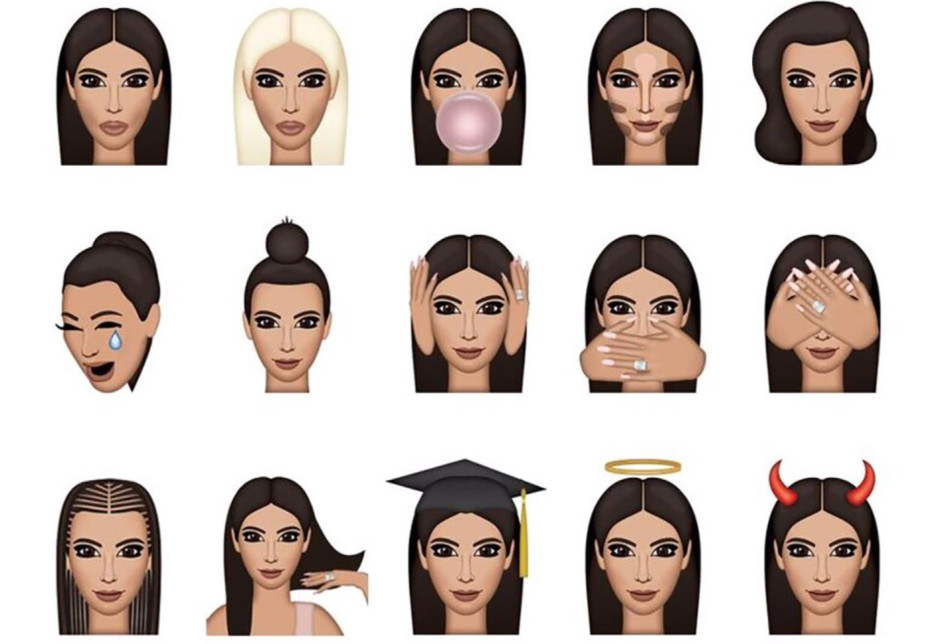
Kim Kardashian-West followed up the success of Hollywood with a special emoji keyboard app called Kimoji late last year. Selling for $1.99, the app features a number of Kardashian-inspired images for users to communicate with. The app recently launched in-app purchases for $.99 and is reportedly doing very well with the over-160 new stickers introduced to it, further signifying Kardashian’s place not only in pop culture, but also the digital space.
kimoji-930x644

Tyga

Instead of starring in another Hollywood simulation, the rap star opted to put himself in an endless running game called Kingin’ World Tour. It puts the superstar on the run from camera-wielding paparazzi, while avoiding objects and collecting coins in the world. The real draw of this game is its Cash Competition Mode, in which players can compete to see who can run the longest and earn real money. As a result, the app has fared rather well, and put Tyga’s name further on the market.

Gordon Ramsay

Ramsay is a celebrity chef who has made a name for himself with his no holds barred attitude on shows like Hell’s Kitchen and Master Chef. That makes him an ideal star for Glu Mobile’s Ramsay Dash, a simulated cooking game where a virtual version of the chef judges your food service performance. Dash includes bleeped out swearing, matching with Ramsay’s kitchen attitude and authentically recreates his persona in game.

Taylor Swift

The pop superstar made a name for herself with several number one singles and a hit tour, but now Taylor Swift is set to introduce a “new, one-of-a-kind digital gaming experience” later this year with Glu Mobile, the team behind Kim Kardashian: Hollywood. Not much is known about the game just yet, but it won’t be Glu’s first pop music-inspired game, given that it has worked with both Katy Perry and Britney Spears. Regardless of how the final release ends up, Swift will no doubt see a huge boost from the mobile game, one that fits her celebratory stature.

Jason Statham

Action star Jason Statham stars in the action game Sniper X, which released last year, and puts players firmly behind an assault rifle to take down enemies. Statham provides steady narration throughout the game, as well as tips on how to stay in one piece. It’s a unique approach for a celebrity-endorsed game, but one that has done well for adrenaline junkies.

https://www.youtube.com/watch?v=u8NAAsQ4Gag

Demi Lovato

Late last year, songstress Demi Lovato got involved with Pocket Gems for a simulation-style mobile game called Path To Fame, where her fans can make key decisions with their singing career. The game has been a moderate success for all parties involved, and have helped push Lovato to a record-breaking 2016 with a tour and single releases.

Shakira

The hip-shaking superstar, who recently starred in the Disney movie Zootopia, has has shaken up mobile with a game called Love Rocks. In it, players can take on traditional match-three puzzle gameplay while competing against other Shakira fans—and even the superstar herself—for the highest score. Love Rocks has done considerably well for the pop star and Rovio, which is mainly known for the Angry Birds franchise.

https://www.youtube.com/watch?v=9oFNegOod1A
Disney Interactive Explains Expressive Power Of Emoji Game

Disney Interactive is targeting moms and millennials with its new match-3 mobile game, Disney Emoji Blitz, which features over 400 emoji based on Disney and Pixar characters from films like The Little Mermaid, The Muppets, Monsters Inc., Toy Story, Finding Dory and Frozen.

Once an emoji is collected within the game, it is also unlocked in the special keyboard, which can be used to send Disney and Pixar emoji to friends in messages. With over 6 billion emoji sent around the world a day, Disney hopes to connect with this huge global audience. Disney Emoji Blitz has launched ahead of July 17, which is World Emoji Day.

Nacia Chambers, executive producer of Disney Emoji Blitz at Disney Interactive explains how the company is marketing this new take on match-3 in this exclusive interview with [a]listdaily.

Why did you decide to focus on emoji?

A little over a year ago, we started to realize how popular emoji were becoming in the culture at large. They’ve become a really fun way to communicate, which matches up so well with Disney storytelling. From there, it was just a little jump to creating those same, well-known, set of expressions for beloved Disney and Pixar characters at the center of a game and keyboard.

What does Emoji Blitz add to the match-3 mobile game genre?

We made a few tweaks to the crafted power-ups you typically see in match-3 games. Also, our meta game is not a linear saga map. It’s not new, but it feels refreshing.

Also, Emoji Blitz has more excitement than your normal match-3. Each game is a 60-second round filled with action, blitz modes, combos and power-ups. Plus, you never lose a level like in some match-3s. Every round of pure positive fun earns you gold, which you use to buy new emoji!

The bigger difference is our Disney emoji characters. Each character emoji has a unique power-up that affects the match-3 board in a way that relates to the Disney character you know and love. They add charm, whimsy and bring the Disney magic to each round.

Probably our biggest innovation is the extension keyboard. When you collect an emoji character in the game, it unlocks in an extension keyboard that you can use to communicate via text and email. As far as I know, this is the first game to offer that additional value to players. With the theme of Disney emoji, it was a natural fit and we’re glad that we were able to bring it to our audience.

How does the game connect with a person’s real chat and messaging through emoji?

As you play Disney Emoji Blitz, you collect emoji—both characters and items. Included as part of the Disney Emoji Blitz app “bundle” is an extension keyboard. When you install it, you can use all of your collected emoji in messaging apps. Players will be able to express themselves with a total of 400 emoji, eight expressions per character and over 200 Disney emoji items like Mickey’s shoe or a princess gown.

How do in-app purchases work?

The players can earn coins (soft currency) and gems (hard currency) through playing the match-3 rounds, competing on the leaderboards, as well as completing missions, item cards and daily challenges and villain events. Coins can be used to purchase new emoji through mystery boxes and boosters for the match-3 rounds. Gems can be used to speed up the game through things like skipping missions or speeding up timers. The whole game can be played for free, and all emoji unlocked for free using the earned coins and gems, but players are also able to speed up their progression with real money if they choose.

How does your game tap into the various Disney brands such as Star Wars, Marvel, Pixar and others for emoji?

At its core for now, Disney Emoji Blitz focuses on Disney and Pixar character emoji. However, our item emoji give us flexibility to include some of the other brands in the Disney family. You’ll find lots of Disney Parks-themed item emoji at launch, including the Mickey Premium Bar, Matterhorn and Mickey Mouse Ear Hat emoji. And we’ll be adding more Disney brands over time. The game can also pull in different IPs through our special events. We already have fans asking for Star Wars and Marvel emoji, so it is very top of mind for the team.

What’s your target demographic for this game?

Our target demographics are moms and millennials. But we hope that Disney fans and casual gamers of all ages enjoy Disney Emoji Blitz.

How are you marketing this game to that age group?

We’re running a paid advertising campaign on Facebook, Instagram and other channels that help us to specifically target players in our demographic who love casual games. Because of the social nature of emoji, we’re also promoting the game on our Disney-owned social outlets with really adorable emoji ad creative to pull in Disney fans. We are also launching Disney Emoji channels on Instagram (@DisneyEmoji) and Facebook (@DisneyEmoji).

The team also has bi-coastal awareness events planned for our launch weekend… one in Times Square in New York City and one in Anaheim at Downtown Disney. We did a mini-takeover in Times Square at the Disney Store on July 14, with fun giveaways and the game on the jumbotron, Disney and Pixar emoji face fans for the crowd, and a takeover of the Disney Store front wall. On July 17, World Emoji Day, we’ll be celebrating at Downtown Disney with Radio Disney. There will be game demos, photo ops, contests and fun surprises for fans. Both events are going to be amazing.

What type of cross-promotions are there for this game across Disney brands?

Our marketing team has put together amazing support for this game in our launch window. During the mini-takeover of Times Square on the 14th, Good Morning America celebrated World Emoji Day and the launch of the game on air. Disney Channel will be celebrating the launch of the game starting on World Emoji Day, and we’ll be supported by the Disney Parks and Radio Disney at our Downtown Disney event on July 17.

What’s the rollout plan for additional emoji?

At launch, we’ll have more than 400 emoji. There will be 33 character emoji with eight expressions each, and over 200 Disney-themed item emoji like Cinderella’s slipper and a thumbs up Mickey glove. We’ll be adding two-to-four new character emoji and a handful of new item emoji every month.

Why Companies Are Loving Facebook Video Ads

Facebook has been experimenting with new video features for some time now, and they’ve paid off quite well, resulting in three billion daily views by the start of 2015 alone. But the real surprise is how quickly companies are turning to the social giant for advertising, using its video system to get the message across.

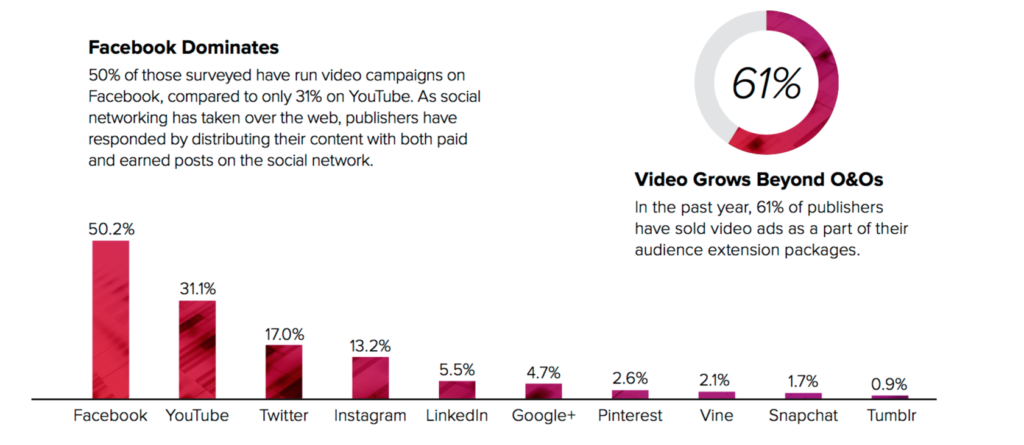
A new report from Mixpo, titled State of Digital Advertising Report, reveals how popular Facebook’s video has gotten. The report shows that 50 percent of companies have launched some form of video campaign on the site, a huge jump compared to the 31 percent on YouTube, and even bigger than Twitter (17 percent), Instagram (13 percent) and Snapchat (two percent).

Screen Shot 2016-07-14 at 11.42.18 AM

New video advertising campaigns are also on the way. The report points out that 36 percent of companies intend to utilize Facebook video ads sometime in the year ahead, based on findings from more than 250 digital publishers across the US.

“Facebook is the most effective way to reach a large digital audience,” the report noted.

The report also shows that digital video advertising will see a $10 billion spend this year—a 28 percent increase over 2015. Video is also seeing dominance in the mobile field, as the market for those devices will see a 47 percent growth year-over-year as well.

Part of that success comes from accessibility, according to Mixpo. “Today’s digital publisher can turn a single video into a scalable marketing asset that serves across TV and various owned and unowned digital channels.”

While Facebook video has most of the attention, Mixpo also noted the success of programmatic video spending. “By both feeding and benefiting from programmatic buying, publishers have helped US programmatic display ad spending grow into a $22 billion business.”

Screen Shot 2016-07-14 at 11.43.50 AM

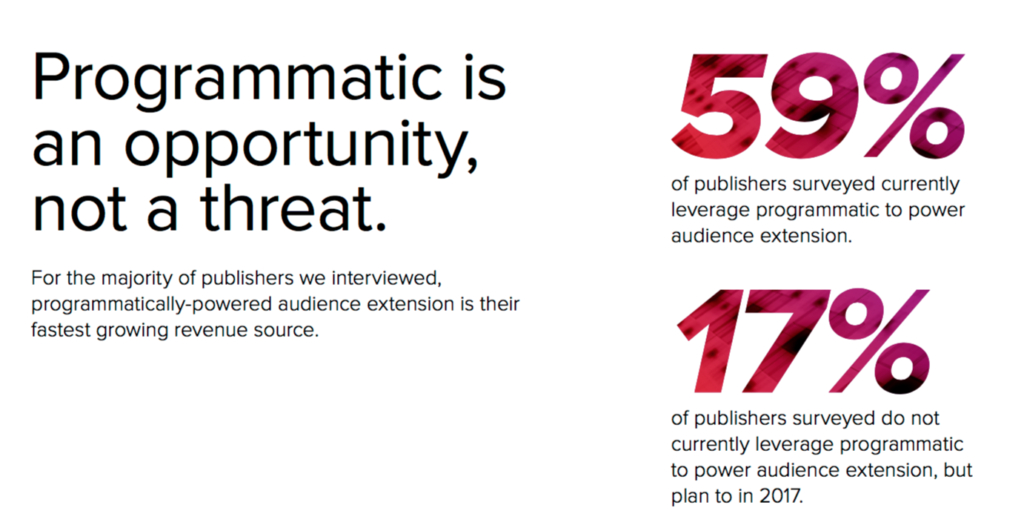
While not every company is involved in programmatic advertising, 59 percent currently have some involvement for audience extension, and 17 percent of those polled intend to look into it in 2017.

Mixpo’s report also discusses mobile, as 48 percent of companies have some concerns regarding the increase in mobile consumption. They’re worried that there may be less traffic and inventory, and less revenue as a result. However, the company remained optimistic. “By pairing premium content with impactful mobile ad opportunities, publishers can play the supply/demand curve to their favor.”

Finally, the report discusses the digital ad formats with the highest ROI, with pre-rolls being the most effective, followed by rich media, display and social. Digital publishers are also working more to push their video tools beyond their own sites for other businesses and partners to use, with 61 percent successfully selling “audience extension packages.”

Publishers aren’t slowing down on ideas either, as more opportunities are likely to open up in the next year. “This means making video an option within every ad format, from interactive VPAID and VPAID 2.0 ads to in-banner video executions,” the report notes.

The report has quite a bit of eye-opening information for those looking to expand their video-based advertising on social media, especially on Facebook.

A secondary study, titled “Animoto’s Social Video Forecast 2016” says that 63 percent of marketers and small business owners are looking to invest more in video over the next year, while 60 percent of marketers polled stated that video marketing is a “must-have” in the market.

There’s no specific format that these videos need to follow. A report from Adweek pointed out that marketers are looking more into a square-shaped video format, making for a friendlier, TV-style ratio compared to the usual 16:9.

Data provided by digital shop Laundry Service points out that videos shot in this format have a 54 percent higher popularity than 16:9 clips, while 67 percent of audiences are more likely to watch a square-shaped video, rather than the usual format.

Image Source

Newzoo Reveals Most Viewed ESports Games For June 2016

Millions of fans around the world tune in to eSports-related events such as this weekend’s EVO tournament, which will be broadcast live from Las Vegas. However, it’s difficult to get a precise number of how many people tune in and how different games compare to each other. Fortunately, Newzoo has provided informative numbers to give us a bigger picture of the eSports scene.

Newzoo has posted a new report, Most Watched Games on Twitch by eSports and Total Hours, which measures not only the most popular titles on the streaming service, but also just how popular they are using data gathered from the past eleven months.

“Exposure on the platform can have a direct positive impact on player retention and game sales,” Newzoo noted, which echoes a similar statement made by Twitch’s Danny Hernandez.

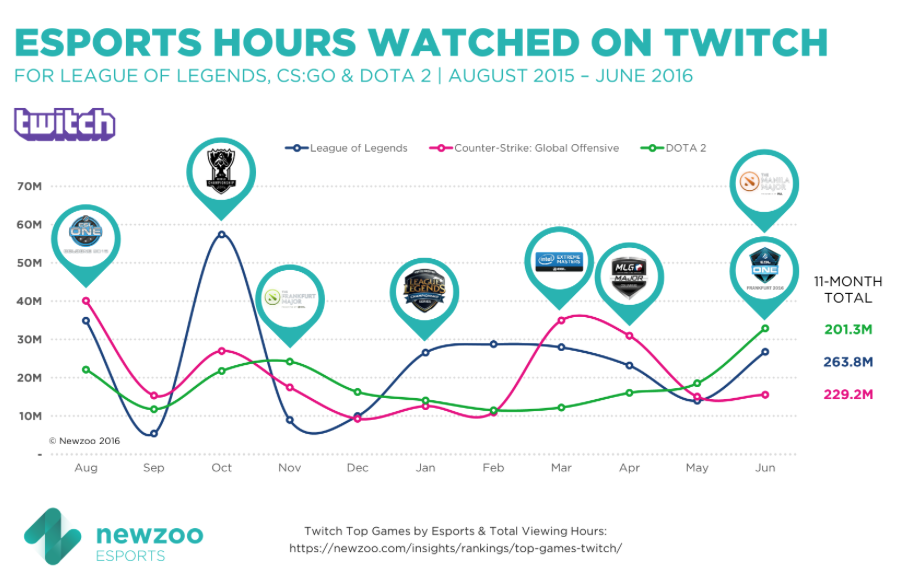
Out of all the games on the market, established eSports favorites such as League of Legends, Counter-Strike: Global Offensive and Dota 2 dominated the list, with League‘s World Championship (Worlds) in October, generating nearly 60 million hours of viewership. In fact, League drew in almost 264 million hours of viewing over the past year alone. CS:GO also saw some big viewership numbers during the ESL One tournament in Cologne last August, gathering over 40 million hours viewed.

Screen Shot 2016-07-14 at 10.53.28 AM

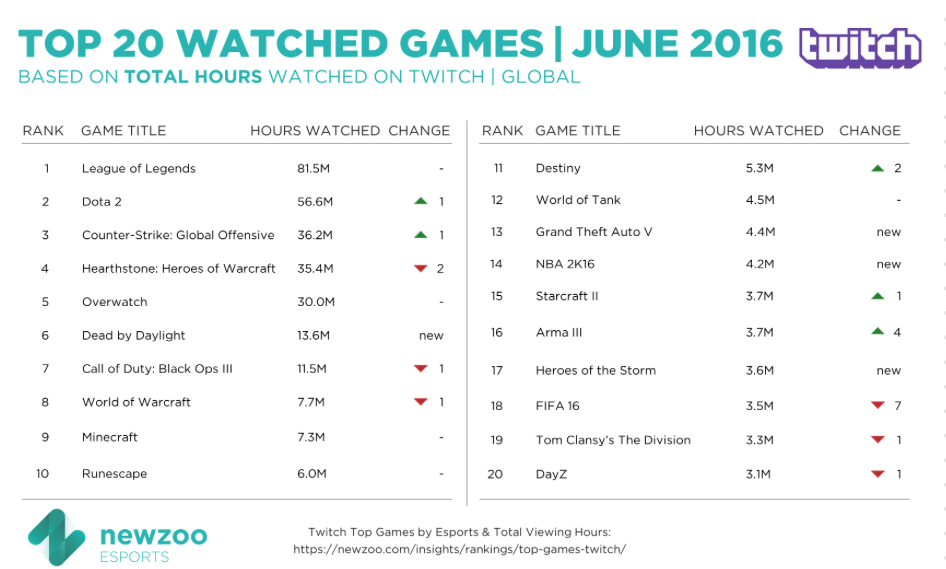
League accumulated 81.5 million viewing hours for June 2016 alone, making it the top selection for the month. Dota 2 followed closely behind with 56.6 million, and CS:GO took a healthy third place spot with 36.2 million. Other noteworthy titles include Blizzard’s fast-paced multiplayer shooter Overwatch (30 million) and the newcomer, Dead By Daylight (13.6 million). Other games were lower on the list, but still managed to generate a great deal of interest in terms of viewership, with the final entry, DayZ, getting 3.1 million.

Screen Shot 2016-07-14 at 10.55.10 AM
Taking a closer look at the past year of viewership between the “big three” (Legends, CS:GO and Dota 2), League of Legends dominated in early October with its World Championship (as previously noted), but the numbers wavered quite a bit between the three games. Despite this, each one ultimately managed to get well over 200 million eSports hours watched on Twitch—a sign that none of these games are showing any sort of fatigue.

Screen Shot 2016-07-14 at 10.56.30 AM

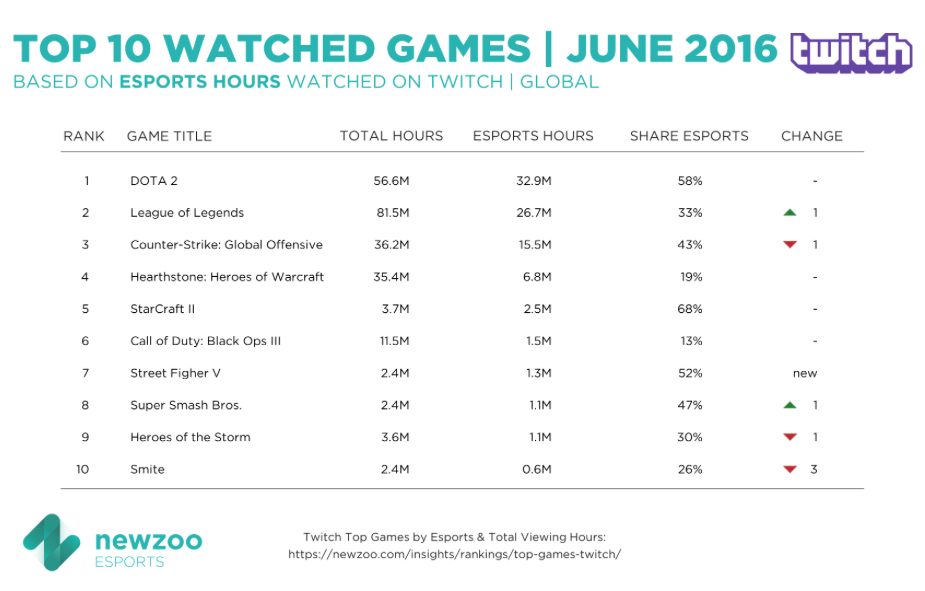
As far as the most-watched games on Twitch go, Dota 2 managed to swipe the lead from Legends, with 56.6 million hours watched overall for June and a 58 percent eSports share overall. Even though Legends had more hours (81.5 million), it only had a 33 percent share in eSports. Other noteworthy games on the list include Hearthstone: Heroes of Warcraft in fourth place (35.4 million hours, 19 percent share), Call of Duty: Black Ops III in sixth (11.5 million hours, 13 percent share) and Capcom’s popular fighting game Street Fighter V in seventh (2.4 million hours and a whopping 52 percent share). No doubt all eyes will be on Capcom’s brawler at EVO this weekend.

Razer Exec Discusses How Brands Can Navigate ESports And VR Waters

Open Source Virtual Reality, a content accelerator program led by Razer, is designed to support the vastly developing VR community.

With that mission fully in mind, Razer announced a $5 million developer fund to bring more VR content into the ecosystem, as well as the release of their second installment of the Hacker Development Kit, at E3 this year.

“VR is working toward being a mainstream success thanks to all the developers who have stepped up to the plate to deliver the next-generation in interactive experiences,” says Chris Mitchell, the virtual reality lead at Razer. “The OSVR Developer Fund allows us to directly support the efforts of VR pioneers across the breadth of this developing industry, while at the same time ensuring that content is available to everyone in the industry. It is our contention that if everyone who is constructively contributing to the VR ecosystem succeeds, then VR will succeed. Closed doors in the world of development are a death sentence.”

Justin Cooney, Razer’s director of developer relations for OSVR, added: “We understand content developers have various development challenges and we’re committed to helping them get ahead of those barriers. The OSVR Developer Fund helps to support initial sales while enabling developers to contribute to the VR industry as a whole. Together, OSVR and its content partners enjoy the realization of a shared vision for the future of VR.”

[a]listdaily caught up with Mitchell (video above) to discuss how they’re enabling content creators, and how non-endemic brands can get involved with virtual reality and eSports verticals.

New XSplit Platform Will “Connect Entire Gaming Community”

SplitmediaLabs, creators of the popular XSplit Gamecaster program, which allows gamers to easily set up and customize livestream broadcasts, then edit videos using the XSplit Broadcaster, is looking to take streaming to the next level. Today, the company announced the acquisition of gaming discovery and social platform Player.me and tournament management service, Challonge. Both are part of an investment strategy to “create a platform that connects the entire gaming community with the content they love.”

Henrik Levring, CEO of SplitmediaLabs, stated in a press release that, “To date we’ve been mainly focused on maintaining leadership and driving organic growth of XSplit, but these acquisitions will move us into the realm of providing more services for the gaming community as part of a grander vision.” Levring further stated, “We’re going to shake things up a bit over the next few years, by making streaming opportunities as accessible and rewarding as possible for all, from individual players and content creators to eSports entrepreneurs and publishers.”

SplitmediaLabs’ chief marketing officer, John Howe Marshall, spoke with [a]listdaily to discuss the creation of this new platform, the goal of bringing the entire gaming community together, and what it could mean for content creators, viewers and everyone in between.

What led to the acquisition of Player.me and Challonge?

These acquisitions are part of a total $10 million investment strategy to build out a platform to bring the entire gaming community together, from high-profile streamers to viewers and everyone in between. With Player.me and Challonge, we are able to start building on this broader vision.

How do XSplit, Player.me and Challonge complement each other?

I think the three services complement each other really well. XSplit is the tech that helps millions of streamers create professional quality content. Player.me is all about discovering content and creators that you’ll love based on the games and genres of games that you play. Challonge makes setting up game tournaments super quick and easy. These are all things that are really important to streamers and consumers of livestream content as well—high-quality broadcasts, discovering new viewers and new content, and setting up awesome online events.

What can XSplit subscribers look forward to as a result of these acquisitions?

XSplit subscribers can look forward to a broader range of services tailored to the specific needs of the streamer and content creator. Beyond providing the technology and tools to create high-quality streams and broadcasts, we’ll be working to help make streaming more accessible and more rewarding than ever.

Can you give us some insight on what the “grander vision” for the new XSplit platform might include?

While I can’t give too many specifics, we’re working to build a new platform for everyone in the gaming community, streamers and viewers alike. We want to help players connect with one another, share and create content, and even compete with one another as they grow their own followings and communities. By bringing in Player.me and Challonge we’re taking a huge first step toward this.

In what ways will the new XSplit platform different from services such as Steam, Twitch or Facebook Live?

Our platform will be different in that it is tailored specifically to players and broadcasters of gaming content. We work closely with content creators of all sizes and have an intimate understanding of the needs of the streamer—from the perspectives of technology, community, monetization and discoverability. We’re baking all of that into our platform because we strongly believe that internet video content is changing the way the world consumes media. We’re building a platform to change the way players everywhere come together, create and share. We really feel [that] what we’re developing is actually going to be complementary to the likes of Steam, Twitch and Facebook Live.

What challenges are ahead in growing the new platform?

We’ll surely face many of the same challenges that any new platform hitting the market will. One challenge for us going forward will be to continue to grow the popularity of streaming, both from a creation and consumption standpoint.

Ideally, what do you want people to think of when they hear XSplit?

When people think about XSplit, we still want them to think of it as the best option for livestreaming and content creation—but when people think about Player.me, we want them to think about content and community as the new platform will aggregate Challonge and other services going forwards. We want people to think of Player.me as a one-stop shop for all their needs, whether they are a streamer looking to grow their audience, a player discovering new communities, or a viewer looking to find more awesome content.

How To Know If 360 Video Is Right For Your Brand

Sometimes, as a marketer, it’s tempting to hop on that hype train and see where it leads. The rest of the time, brands are wisely cautious about investing in new and potentially fleeting technology. One such trend is 360-degree video, an interactive medium that has seen some traction in the world of marketing. This may leave you asking, “is 360 video right for my brand?” To answer that, let’s answer these burning questions:

Does 360 Video Work?

Yes.

In a recent experiment, Google created two ads for Columbia Sportswear, one with traditional video and the other offering 360-degree interaction. Although the viewer-retention rate was higher on traditional video, the 360 ad had a significantly larger click-through rate. In other words, users did not have to look at the video for long before deciding to watch it in its entirety. In total, the 360 ad drove 41 percent more earned actions than the standard ad and drove more engagement with Columbia’s YouTube channel than the standard ad. Google also determined that people were sharing the full-length video by cutting and pasting the URL.

“In fact, we saw messaging apps like WhatsApp and iOS messenger listed among the traffic sources for the 360 version—but not for the standard version,” says Jim Habig, product marketing manager at YouTube, per the Think With Google report. “The full-length 360 video had a 46 percent higher view count at the end of our experiment than the standard full-length piece. As a result, the 360 ad was a more efficient buy since its cost-per-view was lower when organic and paid views were combined.”

Other brands chasing the 360 dragon on YouTube include car manufacturers such as BMW and Infiniti and musicians like Eminem and Beyoncé.

Recently, Samsung teamed up with the World Surfing League for a virtual surfing trip in Tahiti, showing off its Samsung Gear VR camera; the video currently sits at over 16 million views. Networks are also getting in on the action, changing the landscape of television reporting. On YouTube, the Discovery Channel and Mythbusters took viewers under the waves to explore a shark-infested shipwreck, resulting in 10.6 million views. ABC News, meanwhile has garnered 18.6 million views on Facebook for their 360-degree tour of a New York Times Square blizzard in January.

Who Can Use 360 Video?

Anyone with a story to tell, so long as it’s told effectively. We’ve documented 360 marketing campaigns for Coors Light and Holiday Inn, and their executives echo the same sentiment.

Wirewax is the world’s first interactive video platform, adding clickable hotspots, or “tags,” to any moving person or object in a video. This technology can be used for facial recognition, learning more about a piece of art or clicking on a video of food to get a recipe.

“360 is a thing that needs to be creative,” warned Wirewax co-founder, Dan Garraway at this year’s [a]list summit. “It needs to be thought about as much as [when] you’re making a normal video. A lot of the problem with technology when it applies to creative industries [is that] people get very excited about the technology but lose the creative. So one of the reasons why this 360 interactive project we’re launching with Ayzenberg is so important is that the guys have been thinking about it from concept outwards. It’s about using the narrative and actually making a point for making it 360. There is interaction which adds to the narrative of the story.”

With the addition of YouTube’s 360-degree livestreaming capabilities, brands can get creative with the way they unveil new products, take users behind the scenes or broadcast events. If a brand can be translated to visual storytelling, chances are, a 360 video can work, too. Rather than “talk at” a potential customers, brands are inviting them to explore a world created just for them. It’s the difference in attractiveness between “psst, hey you wanna see something cool?” and “come inside, we made cookies.”

What’s Next For TV ESports Coverage

In September 2014, ESPN president John Skipper noted that eSports wasn’t worth the coverage, mainly because “it’s not a sport—it’s a competition.” However, less than two years after he made that remark, the network will be airing its biggest eSports block to date.

This Sunday, July 17, the ESPN and ESPNU channels will air an unprecedented 18 hours of eSports programming, starting early in the morning with re-airings of matches from the Madden NFL 2016 Championship as well as the 2015 and 2016 Heroes of the Dorm competitions. Following these, ESPN 2 will broadcast live coverage of the EVO World Championship for the first time, airing the final round of the 2016 Street Fighter V face-offs. Audiences will also be able to stream each of these shows using the WatchESPN app.

This is the latest move in covering eSports, which first began when it aired Heroes of the Dorm back in April 2015. Even non-traditional eSports fans, such as Michelle Beadle, got into it, noting, “I took the bait. Just turned on ESPN 2. As someone whose face appears daily on the channel, I don’t have answers. #LeeroyJenkins #chicken.”

Speaking with [a]listdaily, John Lasker, vice president of programming and acquisitions for ESPN Digital Media, explained the importance of airing eSports competitions on its channels. “We’ve bought into this competitive side that the content needs to be live, and that’s the most important peak point of our findings,” he explained.

“The ESPN eSports vertical launched in January of this year. It hasn’t changed what we do on the TV side, but it’s an organic extension to what we’ve recognized at ESPN on the importance of this category. We want to treat it like any other sports category. Doing two years of Heroes of the Dorm or the recent Madden event, gamers quickly recognize we have an appreciation for this audience.”

But ESPN is part of a much bigger picture as eSports continues to evolve on television, moving beyond the usual livestreams provided by Twitch and YouTube. Back in April, the ESL announced the world’s first 24/7 eSports TV channel, eSportsTV, featuring a cavalcade of coverage through a number of partners, including Twitch, Azubu, Hitbox and Yahoo. Featuring over 2,000 hours of live gaming and eSports content, as well as traditional ESL-based shows, the network is expected to be a big hit this year.

More mainstream networks are getting involved with more eSports-related programming. The CW, partnering with Machinima, aired a Mortal Kombat X-related eSports special earlier this year, where players competed for $100,000 in prize money. TBS has taken over Friday nights with its ELeague series, focusing on devoted Counter-Strike: Global Offensive players competing for high stakes.

So what could be next for eSports on television? There are a few things that could happen. Firstly, ESPN is likely to continue expanding its coverage with other popular events. It could air The International, Valve’s Dota 2 Championship, which has thousands of fans and millions of dollars in tournament prizes. That would expand upon its ESPN vertical, along with events involving Street Fighter V. Then there’s Riot Games’ immensely popular League of Legends Worlds Championship, which pulled in 4.2 concurrent viewers last year.

After covering Mortal Kombat X, the CW could broadcast Injustice 2 competitions after the game releases next year. The superhero fighting game would match well with the channel’s collection of popular comic book-themed shows that include The Flash, Arrow, Supergirl and Legends of Tomorrow. Furthermore, the CW is co-owned by Warner Bros., which would make it an excellent way to promote its games to an enthusiastic audience.

https://www.youtube.com/watch?v=t0UUDWEvuTo

As more companies become involved with eSports, and the industry becomes more popularized online through Twitch, YouTube and initiatives from Facebook, we can expect to see broadcast coverage of eSports continue to grow.

Twitch’s ESports Evangelist To Brands: “It’s Not Simply: Buy ESports. Check.”

Twitch’s eSports evangelist, Andy Swanson, sat down with Ayzenberg’s Matt West to discuss how Twitch is working with developers and brands to explore opportunities in eSports.

“We are starting to see this trend of eSports for everyone,” West noted as games like Rocket League, a pick-up-and-play family game and Vainglory, a mobile multiplayer online battle arena (MOBA) have lately emphasized eSports.

“I think the important thing is going to be treating the higher levels—the upper echelon—as a true eSport, making sure that you’re not going too casual,” said Swanson when asked what the current challenges were with developers and publishers getting involved in eSports. “When [professional players] get to this level, they are doing this for a living, in most cases. That’s what we want to do—create a sustainable place where each of these games has an opportunity to create their own eSport and have it be sustainable for the long tail future.”

“You also have to have an audience. You also have to have consumers. You also have to have people that will play the game and be aspirational about ‘I want to be able to do that,'” Swanson went on to say.

“With a professional league, you have to have a premium production to go behind it and with a premium production, you have a premium price tag. Sponsors inevitably end up being part of the conversation,” said West, highlighting Amazon Appstore’s involvement with Vainglory. But what other brands are sponsoring?

“Interestingly enough, en route with Rocket League, we actually got, the very first, I believe, of branding dollars from Exxon Mobil that Twitch has ever seen,” said Swanson. “They see it as a natural brand association.”

Swanson went on to say that other non-endemic brands have expressed interest in the space, like tire manufacturers and quick-serve restaurants, alongside more obvious sponsors like peripheral companies.

“We’re just opening Pandora’s box in terms of all the opportunities that are coming out,” said Swanson, but cautioned that for non-endemic brands, there is a lot of education and alignment which must happen in terms of understanding what games, viewers, demographics, content and timing fit most with the brand.”It’s not simply: buy eSports. Check.”

Swanson and West also touched on the upcoming broadcast of the Street Fighter IV Championship at EVO on ESPN 2 and what this kind of mainstream exposure means for the eSports community.

“We know that by going on to linear television that you’re exposing this tour to an audience that generally wouldn’t have watched it or ever seen it before,” said Swanson. “We really view this as a validation of what we’ve been doing these past years.”

FaceIt Founder Discusses $1.75 Million Investment In ESports Championship Series

The ESports Championship Series (ECS), a league founded by FaceIt and supported by Twitch, will kick off Season 2 with twenty Counter-Strike: Global Offensive teams on October 7 and run through December 8. Ten CS:GO teams in North American and ten teams in Europe will battle during the season with $1.75 million in prize money and team investment.

The ECS will also host its first open qualifiers for teams interested in joining the ECS league from August 5-27. The winners from each qualifier round will join an additional four invited teams in each region’s ECS developmental league, with the top two teams in each region’s developmental league then facing off against the bottom two teams of ECS Season One in a promotion match. The two winners from each region’s promotion match will then join the eight teams from Season 1.

Michele Attisani, chief business officer and co-founder of FaceIt, explains to [a]listdaily how the ECS is expanding and what the challenges are in staying relevant in the crowded CS:GO ecosystem in this exclusive interview.

Michele Attisani
Michele Attisani, FaceIt co-founder and COO

How does the relationship between FaceIt and Twitch work with ECS from a business perspective?

We and Twitch share a very similar perspective on how to evolve the eSports industry. We’re aiming to increase its maturity and professionalism, but equally preserve its unique identity and values. That starts with providing stability and quality to the community, players and teams involved.

What type of audience numbers did you reach with the first season and for the finals?

The first season and the finals together had great numbers. For the entire season, we had over 30 million views. The finals were also distributed on linear TV in over 35 countries. The fans who attended the live finals were some of the most vocal and fun fans we have seen at an eSports event. And with our main seating full, we had the largest CS:GO crowd the UK has seen.

What did you learn from the first season?

As with all events, we have learned a huge amount. We had to start very quickly in Season 1 due to scheduling with other events, which made everything a little more complicated. One of our biggest regrets in Season 1 was not having had the time to build the development league. We have made sure that we have focused heavily on this in Season 2, creating a comprehensive development league and open qualifiers. We now have a lot more time to work on the show, the quality of the content, timings and experience, so expect a lot of improvements in the entertainment value for Season 2.

What are some changes you’re making as a result of that?

The development of existing and new players into the ECS is something that we feel very strongly about, as well as our commitment to the community. Starting in Season 2, we’ll have open qualifiers into a development league. This means players at all levels will get the chance to make it to the big leagues.

We are well known with players for making sure they have the best possible experience, and we are very proud of that fact. We are always striving to make sure we improve the overall professionalism, content, formats and the players’ and talent’s experience, while keeping to the core of what makes the ECS, CS:GO and eSports unique.

Continuous evolution and improvement are key. Standing still will make you fall behind in this fast-growing industry, and we definitely want to work more on how to bring our events to even more fans. Distribution and ticket sales were quite new to us, and we already have plenty of good ideas on how to make the whole experience better for everyone.

How has sponsor interest in this league evolved and what are some of the companies you’re working with?

Sponsorship in the industry as a whole is really starting to develop as more non-endemic sponsors realize what an amazing opportunity eSports can be for reaching a very specific and invested audience. Our endemic sponsors such as Corsair, Asus Republic of Gamers, DXRacer and TheScore eSports still form the backbone of the ECS. But this season we also added sponsorship from movie studios for Jason Bourne and X-Men: Apocalypse, which integrated well and produced great results with an audience that standard advertising has a hard time reaching.

What opportunities does your league open up for non-endemic sponsors?

We have a strong track record when working with sponsors, as well as strong statistical reporting in the manner that non-endemic sponsors expect. We are setup to easily support these sponsors and focus our marketing with them to their specific KPI’s. One of our biggest assets—and biggest opportunities for sponsors—is our community. We focus heavily on building the show that our viewers want with intelligent integration of non-intrusive sponsorships. This means that not only is it a better experience for our viewers, but sponsors also reach a more invested and dedicated community.

What impact has the popularity of CS:GO across so many different leagues, including TBS’ ELeague, had on this game? Is there enough demand for all of this programming?

There are positives and negatives to the growth we are seeing. For example, broadcasters such as Turner, with our support, have shown the levels which can be reached in broadcasting quality, as well as providing access to a wider audience and a wealth of non-endemic sponsors. This has encouraged us to also increase our own production quality. Our studio at IMG in London is one of the country’s leading facilities. And the team we put together for events is a mixture of both television and gaming veterans.

We do still see some viewer fatigue due to the high number of events, which is leading to viewers and teams making decisions on which to attend. This could be seen as damaging by some, but we feel that the long-term outcome will be positive for the development of the industry and will be the catalyst for improved scheduling and higher quality production.

The impact on the teams and players is part of the reason we’re creating a system within the ECS, where teams have a strong say in what happens as co-owners. Ensuring that decisions we make are good for the players is important. For example, we used soundproof booths at our finals because it’s something that players feel is important to play at their peak performance. But it honestly makes production a lot harder and increases the costs considerably.

How do you work with other CS:GO leagues to allow teams to compete throughout the year?

We are in communication with many of the major leagues in the CS:GO scene and we make sure that our scheduling overlaps as little as possible with theirs. For Season 2, we have given existing ECS teams over three months notice for their first matches and the schedules for 2017. It’s very important for everyone to be clear and prepared with information for teams in future years.

How will the prize pool increase from the first to second season?

The prize pool for the ECS is not our core focus. While it’s competitive, the real prize is the financial support teams and players receive for being part of the ECS with the goal of creating sustainability and support. Our focus is on the growth of the ECS as a legitimate league that promotes best practices in the eSports ecosystem and CS:GO. Because of this, all of the teams in the league receive generous fees from the ECS and share profits as the league grows. As a starting sum for Season 2, we will be putting up $1.75 million as a mixture of prize money and teams fees.