OpTic Gaming Co-Founder Discusses Rise Of ‘Call Of Duty’ ESports

Ryan “OpTicJ” Musselman, co-founder and chief operating officer of OpTic Gaming, is featured in a new paperback book from Harper Collins, OpTic Gaming: The Making of eSports Champions. Musselman, along with co-founder Hector Rodriguez, have been around since the infancy of eSports.

Activision Blizzard has taken control of Call of Duty‘s destiny through the acquisition of Major League Gaming, and console eSports are getting a push from Sony, so things are looking up for OpTic Gaming and other pro teams. With Infinity Ward readying Call of Duty: Infinite Warfare and a new Call of Duty XP event planned for this fall, Musselman talks about the past, present and future of eSports in this exclusive interview with [a]listdaily.

When did you see the potential for Call of Duty as a sport?

We had an inkling in 2007 when Hector (Rodriguez) and I competed in OpTic’s first LAN event (and finished in third place) during Call of Duty 4, but the content, streaming and the overall embrace from the developer’s end were still in [their] infancy. Similar to the rise of eSports with other titles, the intensity and engagement of the community from players, event organizers, fans, publishers and developers provided a good indicator that something special was on the rise, even with the absence of large prize pool commitments at the time.

What was the eSports scene like back in the early days?

It was raw, but nonetheless exciting. The scene was certainly more niche and you wouldn’t hear the word “eSports.” Seeing teammates in person on a very irregular basis made for some great memories and a growing passion to see the industry evolve into what it looks like today, especially knowing that we’ve only just begun. It was common to see overcrowded living rooms, LAN centers and small hotel conference rooms as the main stage for competition. You can get a good feel for it in the Smash Bros. documentary that was released on YouTube back in 2013. Experiencing competitive gaming at an early time was such a golden experience that we will appreciate forever.

How did OpTic work with Activision and its developers in fine-tuning Call of Duty for eSports?

A strong line of communication was opened with Treyarch, primarily through David Vonderhaar, their studio design director. We first met David during a Black Ops livestream as he jokingly teased us about OpTic’s infatuation with the sniper rifle. He and his team have been amazing advocates of community feedback, pro feedback and eSports growth overall. That simple line of communication led to additional involvement from other organizations, which further paved the way for more growth, shoutcasting and competitive development.

What impact have you seen the relationship between pro gamers and Call of Duty developers have on the quality of eSports?

Better in-game mechanics as it relates to competitive play, not to mention the overall institution of the Call of Duty World League. Collaboration and communication continue to be key as eSports grows.

What are the challenges of having to learn a new game every season with Call of Duty?

Overall, it’s adjustment to spawn points on new maps, weapon and perk combinations, callouts and playing styles that vary based on the game mode within the map. A lot of it comes down to communication and decision-making, but players are getting very seasoned with this annual change, so solving the challenge may become less burdensome.

What’s it been like looking back at the 10-year history of OpTic Gaming through this book?

Hector and I had a moment of reflection on this the other day, and coupled with the amazing and tremendous progress came a deep sense of appreciation for our Green Wall followers—the dedicated fans who teamed with us to realize our dream and see the organization become what it is today. We’ve seen pictures of OpTic tattoos, fan art and more. A fan once cut the OpTic logo into the grass of his yard. We can’t help but look back and see our roots: friends sitting in their bedrooms while playing video games on the internet.

What do you feel has been the secret to the success OpTic Gaming has had with Call of Duty over the years?

Consistent adaptation during competition and unrelenting motivation to improve, coupled with good relationships from some of the greatest CoD players of our generation.

From a long distance view, Counter-Strike: Global Offensive and Call of Duty seem similar. What is it about CS:GO that has catapulted that game to such a high trajectory?

It’s important to look at Counter-Strike as a whole versus CS:GO alone because the gameplay is just so timeless and still so addicting. The tactical brilliance and skill required to play at the highest level of competition makes for great entertainment.

What impact do you feel Activision’s acquisition of MLG will have on eSports moving forward?

We anticipate a continued positive impact. MLG is very experienced at running leagues and tournaments and both organizations have always been supportive of OpTic. We’re excited to be in the same pool of industry professionals who are passionately and strategically invested in the growth of the Call of Duty eSports scene.

What are your thoughts on taking Call of Duty to outer space with Infinite Warfare?

Name the playing field and we will be there.

We’re seeing more prize money in eSports across the board and new ownership opportunities for teams and players. Do you wish you were younger and able to compete in this environment?

My competitive nature will always say yes, however I’m very happy to be in my role, including my previous roles that have given me an opportunity to contribute large and small to the environment.

A lot of pros stay within the industry. Why did you decide to leave?

Pro is a strong word for my skill level. I always knew I would be more involved on the business end, compared to my teammates who compete at the highest level of competition. Simply put, the most skilled players with the best chemistry should take the reins in competitive play. My transition was ultimately driven by new opportunities in the gaming space, on top of a desire to see players and organizations work hand-in-hand to cultivate an astounding eSports industry.

How did your eSports experience, and those of many of your teammates, pave the way to corporate gaming jobs?

You learn the business in its rawest form while simultaneously building critical relationships that bring new opportunities to the table. My affiliation with OpTic is largely responsible for my career in gaming and content (alumni of Machinima and the Google/YouTube gaming team). It’s been a pleasure to meet and work with other passionate and experienced professionals from various industries who all have something unique to bring to the eSports industry.
YouTube Gaming Discusses 360 Video And ESports

“You know, a lot of people talk about competition in eSports. But, first and foremost, you’ve got to build a community around your game that people love and then eSports becomes a part of it,” said Ryan Wyatt, director of content and partnerships at YouTube Gaming to [a]listdaily.

Events are a big focus for YouTube this year particularly with the platform’s 360 video, as they look to bring the event experience to folks sitting at home. Wyatt went on to discuss how YouTube’s 360 platform has already been utilized for events like Coachella, and how it may be used in eSports as well.

“Can you imagine being at the League of Legends World Championship and having a 360 junk cam in the middle of the audience and feel like you’re right there watching?”


Brands And Consumers Want Virtual Reality, But Is The Technology Ready?

Brands and consumers everywhere are more than a little excited about virtual reality. In fact, the VR industry could see its first $1 billion year, according to a report from Deloitte Global, with around $700 million coming from hardware sales and the rest coming from content.

With the dream of making all of our science-fiction fantasies come true, brands are pouring money into the technology like never before. According to research from venture capital database, CB Insights, the amount of investor dollars pouring toward virtual and augmented reality (VR/AR) has increased about 7.5 times in the last year. In fact, investment in those technologies reached $1 billion in the first quarter of 2016, eMarketer reports, compared to $144 million in the same quarter of 2015.

Separate research from the UBM Game Network found that 20 percent of gaming professionals were working on AR apps last year, up from 7 percent in 2014. Mind you, those figures reflect a time before our benevolent Nintendo overlords conquered the world with Pokémon GOIt’s kinda hard to hear over the sound of investors writing checks and programmers furiously typing at the moment.

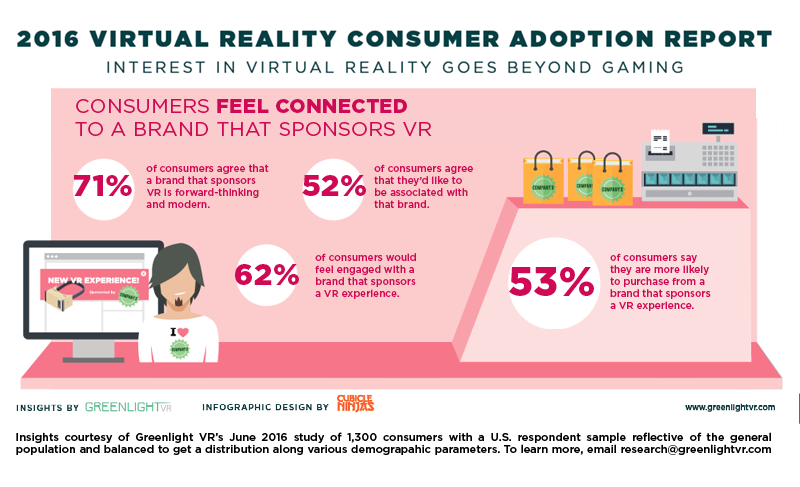
We all know that virtual and augmented realities are all the rage, but how do consumers feel about it? According to a new study by Greenlight VR, 71 percent of those surveyed views a brand that sponsors VR as forward-thinking and modern, while 52 percent would like to be associated with that brand. Additionally, 53 percent say they are more likely to purchase from a brand that sponsors a VR experience, such as a concert, or eSports broadcast.

section2-CR-infographic

“We’re seeing specific VR activities have unique emotional footprints, offering fascinating insights for those who are considering their VR strategies,” Steve Marshall, senior vice president of research and consulting for Greenlight VR, said in a statement. “For example, among our sample, watching a live broadcast event in virtual reality generates significantly higher ratings of positive emotions such as ‘happy’ and ‘energetic’ when compared with playing a VR video game.”

Even those who have never experienced VR for themselves had good things to say about the technology after watching informational videos—91 percent reported positive feelings about it. Among those who haven’t tried VR before, 65 percent were interested, 32 percent were surprised at what it could do, 25 percent felt “happy” and 58 percent reported being “amazed.”

Not everyone is excited about the sudden interest, however. Veteran investor Mitch Lasky admitted that his “intense emotional experience” while using the current high-end headsets did not convince him that VR was a smart investment within the next few years. Considering the fact that Lasky can count Riot Games and Snapchat among his own smart investments, it’s a perspective worth considering.

Speaking at Casual Connect USA on Tuesday, Lasky expressed concern with the sudden sense of urgency for brands to jump onboard the VR hype-mobile. “When I look at it more structurally, I’d say something that may sound a little strange: perhaps the Facebook acquisition of Oculus wasn’t the greatest thing for the development of VR in the long run. It set such a high watermark, and it rung the bell so loudly for the industry, that it sort of forced the hand.”

As brands jump in the deep end to keep up with trends, they run the risk of creating a so-so or broken product that audiences will not appreciate. For Lansky, his biggest concern is whether or not the technology is truly ready.

“I’ve seen 25 or 30 excellent demos,” he explained. “I haven’t seen a lot I would consider finished products, or even things that suggest finished products. And if it’s anything like mobile games, I started a mobile games business in 2000. It wasn’t until 2008 or 2009 that they really became viable as big businesses. It was not just the launch of the iPhone, but the launch of the App Store, and even the launch of in-app purchases, that were necessary to get mobile games catalyzed in a way that made it meaningful as a business. VR may take a while.”

FX Networks Drops Comic-Con Fans Into ‘American Horror Story’ VR Experience

Virtual reality has been a key marketing tool for Hollywood film and television studios over the past four years at San Diego Comic-Con. This year will see a variety of new VR experiences, ranging from Warner Bros. Suicide Squad to Nickelodeon’s Legends of the Hidden Temple to FX Networks’American Horror Story Fearless VR experience.

FX Networks is once again taking over the Hilton Bayfront Park from Thursday to Sunday to promote ArcherAmerican Horror StoryThe StrainIt’s Always Sunny In Philadelphia and Sex&Drugs&Rock&Roll. The FXhibition will include a 25-foot “infected” Lady Liberty statue from the vampire horror show The Strain. It’s Always Sunny In Philadelphia’s Paddy’s Pub will offer an escape from the heat providing water on tap for fans to stay cool throughout the day.

After using VR to transport fans into the world of Guillermo del Toro’s The Strain last year, FX is focusing on American Horror Story this time around. The AHS Fearless VR Experience will allow fans of Ryan Murphy’s long-running TV series to become a part of their favorite show and test the boundaries of their own fear. To avoid waiting the long lines that haunted last year’s experience, fans can reserve a spot at AHSReservations.com.

Kenya Hardaway-Green, vice president of integrated promotions at FX Networks, explains the power of virtual reality as a marketing tool in the midst of the largest consumer pop culture gathering in the world in this exclusive interview with [a]listdaily.

What were your goals with this American Horror Story VR Experience?

The premise of the sixth installment of American Horror Story will not be revealed until the premiere on Sept. 14. We were looking to create an immersive experience that would serve as a thrill ride through previous installments of AHS and excite fans with what’s to come. Our goal was to create this experience so it could be enjoyed by die hard fans of AHS, as well as anyone daring enough to give it a try.

What did you learn from last year’s The Strain VR Experience activation that you’re applying to American Horror Story this year?

Our VR experience for The Strain was extremely popular with Comic-Con fans last year. As a result, we had long lines and extended wait times to enter the space. This year we have developed a reservation system that will allow visitors to reserve a space at AHSreservations.com. We want our guests to enjoy their time in our activation, not spend their day in a queue.

How did you work with actors and creatives from American Horror Story on this VR experience?

We took our inspiration from the series and a few terrifying moments AHS fans may recognize. It’s a fun ride.

Creatively, what does VR open up for storytelling?

Virtual reality is a great storytelling tool because it allows us to take an audience and drop them right in the middle of the action. For a fan, there is no better place to be. It also challenges us to tell a more complete story through environments and sound design. The participant has a 360-degree view into the world we create so we can add a richness to the narrative that’s lacking in other presentations.

What’s the gist of the experience and how long is it?

AHS Fearless VR takes fans on a journey through frightful encounters inspired by previous installments of AHS and gives them the chance to face some of their biggest fears. The experience is 4.5 minutes long.

What type of themed set-up do you have for the VR activation given last year’s The Strain VR experience?

All I can tell you is that we call it “The Vault.”

How does VR connect with Comic-Con attendees?

VR experiences at Comic-Con allow us to attract hardcore fans of not only our shows but fans of various entertainment genres and technology as well. There is still a great deal of curiosity surrounding VR and we cater to that interest to tell our stories to a broader audience.

How do you use VR to market to those not in San Diego?

The great thing about producing a VR experience is that the content is portable. Unlike other engagements we have invested in for Comic-Con, this will have a life beyond the event.

As mobile VR devices continue to become more popular, what role does VR play in marketing beyond a big show like Comic-Con?

As VR technology becomes more accessible, the demand for content will grow. Audiences will be more receptive of branded content as it allows them to sample the technology. It is a great opportunity to capture an adventurous audience.

What impact do you see PlayStation VR having on VR for FX shows?

I think I’m going to be creating more VR content!

Nickelodeon Using VR To Promote ‘Legends Of The Hidden Temple’ Movie

Nickelodeon is going back to the ‘90s at San Diego Comic-Con this year. And for the fourth time, the kids’ network is using virtual reality to market a show. This year, it’s Legends of the Hidden Temple that’s getting a new live action TV movie, along with a 360-degree experience brought to life through Samsung Gear VR for those who visit the 1,800 square-foot Nickelodeon booth on the convention floor.

Jaime Dictenberg, senior vice president of Nickelodeon Consumer Marketing, explains the lessons learned from marketing to Comic-Con attendees through virtual reality in this exclusive interview.

Why did you decide to use virtual reality with Legends of the Hidden Temple?

VR is generating interest from millennials, who remember the Legends of the Hidden Temple game show fondly from their own childhoods, so it was a perfect opportunity for us to reacquaint them with the property. We created a beautiful set for the movie, which is perfect for VR because it allows fans to fulfill the fantasy of stepping into the movie and exploring the Hidden Temple.

Legends of the Hidden Temple

What’s the VR experience like?

The Legends VR experience is a guided tour from the game show’s original host Kirk Fogg, who reprises his role in the re-imagined movie. He walks viewers through the mysterious and sometimes spooky rooms within the Temple, and the audience is immersed in the temple environment as they explore the corridors of the Hidden Temple. Like the adventurers of our movie, they follow Olmec’s clues on a quest to find the animals from the original show and obtain the Pendant of Life.

Who produced it and how were the show creators involved?

Nickelodeon’s creative promotions team and Immersive Media partnered to produce the Legends 360-degree VR experience. Both teams worked closely with the movie production unit to ensure that the end product would be true to the upcoming movie and a great experience for fans that grew up with the original program.

How long an experience is it and what platform are you demonstrating it on and how many demos will there be at Comic-Con?

The experience is five minutes long and it will be showcased on four Samsung Gear VR units. The activation will be up and running at Nickelodeon’s booth every day of Comic-Con.

We’ve seen VR at Comic-Con for several years now. What role does this technology play in standing out from the crowd?

The VR technology has been around a few years, but utilizing VR as a storytelling medium is just getting started. Nickelodeon has a history of creating incredible characters and telling unforgettable stories, so our fans are eager to see us bring that expertise into the VR space. This will be one of the first hands-on experiences that many kids will have with VR. As far as millennials who’ve already had a chance to experience VR at Comic-Con, we’re betting that they’re more than willing to sign on for one more Temple run.

How has Nickelodeon worked with or learned from other VR experiences across the company?

This is Nickelodeon’s fourth time using 360-degree VR and we learn something new with each execution. Keeping the viewer engaged with both the story and the environment is key. We use Easter eggs, interactivity and sight and sound cues to direct the user’s attention and keep them engaged. Experiments in 360-degree storytelling are shared across Viacom so each network is free to experiment for their own audience, while leveraging best practices in technology, technique and vendors.

Can you detail the VR activation for Legends?

The experience transports fans into the world of the upcoming action-adventure TV movie inspired by the iconic game show. Virtual visitors to the Hidden Temple are guided through the dangerous corridors by none other than original series host, and official Temple tour guide, Kirk Fogg. After exploring several of the rooms and corridors, visitors will enter the epic Throne Room where King Olmec resides. He challenges adventurers to find the five iconic animals from the original series (like Orange Iguana, Purple Parrot, Red Jaguar, Silver Snake and Green Monkey), ultimately revealing the Pendant of Life that allows them to escape the temple. Visitors must hunt all around them, guided only by their keen eyes and Olmec’s cryptic clues. Especially eagle-eyed users will spot Easter eggs hidden throughout the entire Temple experience.

With a lot of retro celebration at Comic-Con this year, how big a push will the Legends show get?

Nickelodeon’s Comic-Con booth will offer several ways for fans to interact with and experience Legends of the Hidden Temple every day of the convention. In addition to a VR 360-degree experience that will transport fans into the world of the upcoming TV movie, Comic-Con attendees can also interact with Legends’ King Olmec and test their knowledge by answering trivia questions for the opportunity to win prizes. Also, on Saturday, July 23, returning cast members Kirk Fogg and Dee Bradley Baker, along with star of the new TV movie Isabela Moner, will appear on the “Back to the ‘90s” panel and sign autographs at the booth.

Can you explain what the live-action movie is about?

Drawing on the original game show’s premise of kids competing to retrieve artifacts from a mysterious Mayan temple, the upcoming Legends of the Hidden Temple action-adventure TV movie will follow three siblings who embark on a high-stakes, life-or-death mission. The TV movie will feature elements from the original game show including: Olmec, a talking head who knows the secrets behind the temple; the Steps of Knowledge, the entrance to the temple; and cameos from a green monkey, red jaguar and silver snakes, among others.

What role does Comic-Con play in the overall marketing of a movie like Legends?

With its diverse group of attendees, Comic-Con allows us to reach fans who grew up on the original show and potential new ones. We’re able to offer a deeper dive into the property through our activations at the booth like the Olmec trivia and the 360 VR, and the cast panel will give them a sneak peek at the movie featuring stars Kirk Fogg and Dee Bradley Baker from the original show.

Can you detail the trivia game activation for Legends?

Fans can interact with Legends of the Hidden Temple’s King Olmec and test their knowledge by answering trivia questions for the opportunity to win prizes.

How Glu Mobile’s ‘Rival Fire’ Brings Tencent’s Shooter To The West

Given the tremendous success of Kim Kardashian: Hollywood and last month’s critically acclaimed Gordon Ramsay: DASH, it’s easy to forget that Glu Mobile has a history of producing a wide variety of games that don’t have celebrity names or movie licenses associated with them. However, considering how the company’s newest game, Rival Fire, is adapted from Tencent’s WeFire—the most popular action shooter in China—it’s still working with big name support.

The partnership with global gaming giant, Tencent, to bring WeFire to Western players was announced last November. Rival Fire uses the same graphics engine and many of the same core features that made the original game popular but adapted to suit a global audience.

Rival Fire launched on both the Apple App Store and Google Play today, giving Western players a chance to check out its unique blend of action and social gameplay. Glu Mobile’s president and CEO, Niccolo de Masi, talks to [a]listdaily about working with Tencent in the ultimate East and West collaboration to bring WeFire to the world.

Niccolo de Masi, Glu Mobile president, CEO & chairman

In what ways does Rival Fire differ from the original game, WeFire?

Rival Fire utilizes the most engaging parts of the original in addition to synchronous co-op PvE (Player-Versus-Environment) and PVP (Player-Versus-Player), an industry first that we’re tremendously proud of.

How has Glu worked with Tencent to develop the game, and what would you say it is about Rival Fire that will appeal most to a global audience?

The development of Rival Fire is the result of a powerhouse collaboration from East and West. Tencent and Glu have worked alongside one another over the past year to deliver a game with an immersive storyline, stunning 3D graphics, engaging social features, and multiplayer gameplay—features that have been historically reserved for PCs and consoles. It is a true one-of-a-kind mobile shooter experience transformed for a Western audience.

Was there any consideration given to associating a celebrity with Rivals, similar to Sniper X with Jason Statham?

At this time, we’re highly focused on delivering a high-quality third-person shooter to the market and supporting that community of players with a robust pipeline of updates, live events, and support.

How does releasing a shooter for mobile devices compare to games such as Kim Kardashian: Hollywood or Gordon Ramsay DASH?

Glu has a diverse portfolio of titles spanning five genres: Action, Celebrity, Sports & Racing and Simulation. Rival Fire falls into the Action category, and there are certainly major differences in the target audience, features, community etc. However, our ongoing vision is to deliver unmissable entertainment, no matter the genre.

Rival Fire_01


What has Glu learned from releasing Frontline Commando and Deer Hunter games about promoting shooters on mobile devices?

We always aim to learn, as a team from each title we release into the market. As time goes on, socio-competitive features have become increasingly important parts of any game. For mobile, that comes in the form of co-ops, or “guilds,” offering players the opportunity to be a part of a community. Additionally, PVP features offering players the chance to go head-to-head with others provides a unique competitive, adrenaline-filled, edge. Both of which Rival Fire has.

What are some of the most important things to keep in mind when releasing a new mobile shooter, even when it’s based on a popular game like WeFire?

WeFire is the most successful mobile shooter in China. However, we must take into account that it was built rather specifically for that market, which differs tremendously from the West. We’ve used the success of WeFire’s engine and art style as a launching pad and iterated on it to suit the audience we’re going after. Mobile shooters are tough to do well, but Glu has a long track-record of success in the space. Shooters are typically associated with AAA console titles, so convincing players that a mobile shooter is worth their time requires that expertise.

Rival Fire_04

mNectar CEO On Mobile Game Advertising: “Downloads Are Dead”

About three years ago, in an era before the Apple Music streaming service, Wally Nguyen was browsing through the Apple Music Store to purchase songs when he had a realization. You could listen to 30 to 60-second samples of songs to decide whether you liked them, but you couldn’t do the same with apps. The only way to try a game was to download it in its entirety, which was a considerable waste of time given how it only takes a few moments to realize whether you like a game or not.

Coincidentally, Nguyen’s longtime friend, Artem Grigoryan (mNectar CTO), had reached a similar conclusion while working with interactive showcase technology—users could rotate a virtual watch from within an ad—and thought that it could be applied to games. The two partnered with Daniel Cheng (mNectar CRO), who reached out to developers such as Kabam (Marvel: Contest of Champions) to find out that there was strong interest in removing the mobile game download barrier.

That’s when they formed mNectar—an ad platform that streams 30-second demos called Playable Ads straight to a user’s mobile device. Users can play a game straight away and then decide whether or not they want to download a game after experiencing the demo. According to mNectar, the conversion rate is seven times greater than with video ads, while user retention does twice as well. Considering how the cost-per-install advertising rates are rising ever higher, with developers and publishers spending between $3 to $10 per person, connecting gamers with the games that they’ll stay with is critical. It is no wonder why both Google and Apple are implementing similar technologies in their respective app stores.

Wally Nguyen, CEO of mNectar, talks to [a]listdaily about the how mNectar’s Playable technology will shape how users discover mobile games in the future as the era of downloads dies out.

Note: This interview has been edited for readability.

Wally Nguyen
Wally Nguyen, mNectar CEO

How are mNectar’s Playable Ads better than traditional downloads?

When you think about it, downloads are dead. You’re streaming movies on Netflix and streaming music on Spotify. I haven’t used a Microsoft document in about five years; I just use Google Docs. So, for all intents and purposes, the download was dead. But on our mobile devices, downloads are everywhere.

We have these devices that are supposed to be the future, but we’re stuck in the 1990s in terms of downloading everything. Downloads are also just a barrier. If you want to try anything on mobile, you have to download it. Three-quarters of apps that are downloaded get deleted within a day, according to TechCrunch. So, 75 percent of the time, people end up downloading something and then they delete it. That’s a massive time-suck to the user, but that’s also a waste of money for developers.

We know that the app install market is worth between $5 to $7 billion right now. That’s how much game developers are spending to market and acquire new users, what they’re really paying for is that barrier. About 75 percent of that $7 billion is wasted because we know [most] users delete whatever they just downloaded.

With Playable Ads, we stream the real experience to you. There’s no lying or misleading that you might get with a video or any other type of ad. You get the game, you play a level, and if you like it,  you’ll probably download it. If you don’t, you probably won’t. It’s simple product marketing, but really hard to build from a technology standpoint. But now that we’ve been at it for three years, I’m proud to say that we haven’t lost a single customer, and they come back to tell us that we’ve saved them a ton of money. We’re only acquiring that 25 percent of customers who want to play our games.

Playable Ads are about 30 seconds long. Is that enough time for users to engage with games?

It depends on the genre. If you’re talking about a casual match-3 game, 30 seconds is about right. If you’re talking about something longer, like Marvel Contest of Champions, we’ll probably go up to a minute or a minute-and-a-half. With something deep, like Game of War, we’ll go a little bit longer.

The thing about Playable is that we can track real engagement. The most prevalent ad form for apps today is video. They generally auto-roll, which interrupts the experience, and you’re stuck watching it. Most people treat them like TV commercials by putting down the phone, walking away, and doing something else. With Playable, we know that users are actually playing, and we can track every touch event. We know—when we stream millions of Playables every day—the appropriate amount of time for a user to get hooked, and that’s data we give back to our clients.


Google has streaming demos in the Google Play search. How do Playable Ads compare?

The only two players in the world that do this [app streaming] right now is us and Google. Google announced its playable products back in November, so I’m proud to say that we’re about two years ahead. We can both stream to WiFi very easily, but mobile users could be in a cab or otherwise moving. mNectar is the only one that can stream down to cellular coverage, including Edge, LTE and 4G. We can stream to any device, to any mobile user, as long as it’s at least iOS 7 or Android 4.4.

What do you see as the future of Playable Ads?

We believe that downloads will go away. In the very near future, we won’t be downloading anything on our devices; we’ll just be streaming content. In between here and there, we believe we train users to get into app streaming through advertising.

When you say the end of downloads, you mean you’re working towards streaming full games?

Exactly—that is how mNectar is poised. We have a trained market. Advertising is the start of the path for us. When users sample games for 30 seconds to a minute, the natural question is, “why can’t I keep playing?” We’ll be able to turn our infrastructure to allow for full play. That is the vision for the company. The infrastructure we built today for advertising is the same infrastructure we’ll use for full streaming of all content on mobile.

Playables are said to have seven times the conversion and twice the retention rate of video. What do you think accounts for that?

We ran video ads to see how they worked and also got first party data back from our customers. We saw a 7x conversion rate compared to video. People are downloading apps after Playables because they trust the experience. They know what they’re going to get when they hit download, and there are no surprises. It’s all about setting the proper level of expectation. Video is a massive over-promise and under-deliver. With Playable app streaming, what you see is what you get, and the retention rates are high for that reason.

What do you think about hits such as Clash of Clans and Game of War, with their popular commercials?

I think those examples are great ones, but they’re different. There’s no argument that Supercell and Machine Zone are two of the most successful game studios to date, but they didn’t start with TV commercials. TV was the island of last resort, in that they had been spending for years and maxed out all mobile avenues of getting people to see their games. The reason I say island of last resort is because there is no data in TV commercials. There’s no link between running a $5 million Super Bowl ad and the number of views you’ll get. It’s really hard to connect that data.

I would argue that we don’t compete with TV commercials because we’re not the island of last resort. We’re the first call for advertising games. Machine Zone is running Playable advertising like crazy. They got a taste of it and saw the better conversion and retention rates, and now it’s one of their more popular ways of advertising. I also want to state that product marketing shouldn’t be only for the rich developers. Only the top one percent of developers can buy TV commercials. We have a really big problem right now in that the top 100 stays the top 100 unless a cultural event like Pokémon GO comes around.

Apple just announced paid app search. That’s not going to change anything. We’re working with a lot of indie developers that have an average CPI (Cost Per Install) of $5 to $8. That’s not scalable. You spend $8 to acquire a user and maybe make a dollar off of them? Only developers that are already wildly successful, or funded with a lot of money, can afford to buy users at a loss. We’re helping all app developers get the right type of audience, and help the audience find the right type of game.

With so many mobile games available, how will mNectar keep from overwhelming users with content?

There’s a very strong, rational argument that we’re at “peak app.” The market is too saturated, and I think that’s why there’s a lot of enthusiasm around VR and AR. It’s like a new gold rush. I don’t think a lot of the fundamentals are there, but I think a lot of developers are just praying that VR becomes the next app platform because it’s really hard to make money on mobile now.

In that future, I think games must earn the user’s attention. Another stat is that most users only use about nine apps in total. I think that’s where mNectar will thrive. When you have to earn your right to be in that top nine and not be deleted at the end of the day, it’s all about setting up the proper expectations the first time. Video ads have encouraged 93 percent of users to download ad-blocking software. Users are sick of being fooled by video and all other types of ads. The advertising industry is cannibalizing itself because it refuses to evolve and put the user first.

That world is great for mNectar. Apple and Google love us because we don’t lie to users. In that peak app future, where advertising gets fewer and fewer eyeballs because of ad-blocking, I believe product marketing will go much farther.

Jack In The Box Cooks Up Special Marketing Sauce Via Virtual Reality

Known for its comedic and often strange TV commercials, Jack in the Box has begun testing the waters for virtual reality marketing. To create hype around its new Brewhouse Bacon Burger, the restaurant released two video teasers in which mascot, Jack “goes undercover” with glasses and a mustache. The same day, a “VR Experience” was released, which doubles as a 360-degree video with no headset required.

Sitting at a bar, viewers can look around and explore the environment without leaving their barstool. A man demands a drink, while some girls begin to flirt. Eventually, the bartender brings a dark ale, which can only be stared at. Jack comes out of the back room, gingerly holding the Brewhouse Bacon Burger, which he presents without a word. The mustachioed, bespectacled Jack gives the signal to keep it a secret, then quietly takes his leave. The scene fades out, leaving the food in spotlight.

jack burger

The VR experience was created not so much for the public, but for members of the media, according to Richard Cran, ‎vice president of marketing and communications for Jack in the Box. The video’s purpose is to get media as close as possible to Jack and the new menu item.

“The press got the thread presented in a way that was very personal and one-on-one,” Cran told The Wall Street Journal, “And VR enabled that. Our consumers broadly will get that through television and streaming video and digital television.”

Although the extent of virtual reality or 360-degree video marketing for the brand has yet to be unveiled, Cran reportedly hinted at plans to cash in on the Pokémon GO gaming craze. Fast food chains like McDonald’s have been testing virtual and augmented reality as well, offering Swedish consumers VR headsets made out of Happy Meal boxes and AR codes to promote the Angry Birds movie.

More brands are looking into virtual reality marketing, and for good reason. According to estimates from research firm Forrester, approximately 52 million units of virtual reality will be in enterprise and consumer use in the US by 2020.

Now, if only each unit would be complemented with a brew and a burger.

How ‘Superhot’ Meets The Challenges Of VR

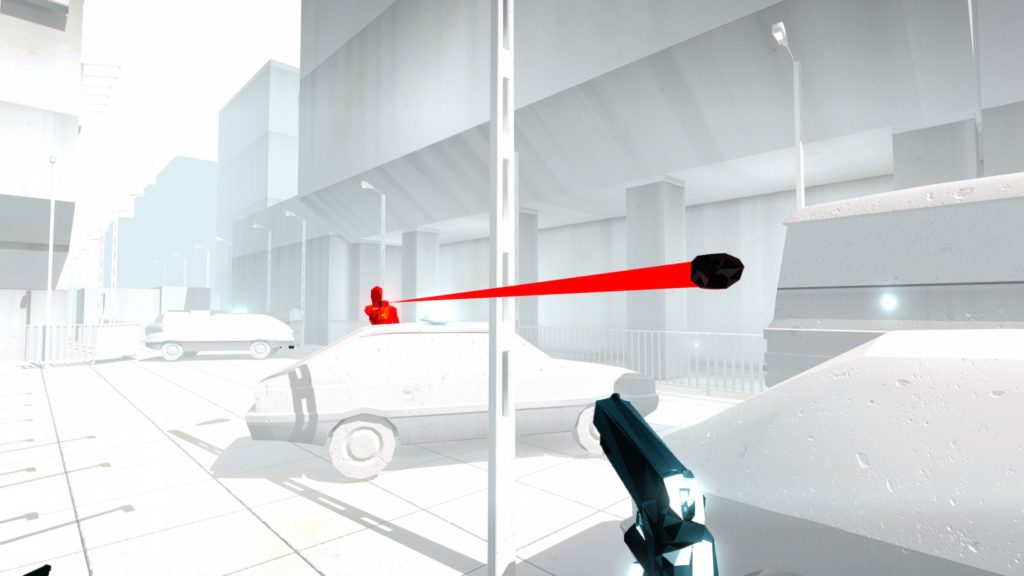
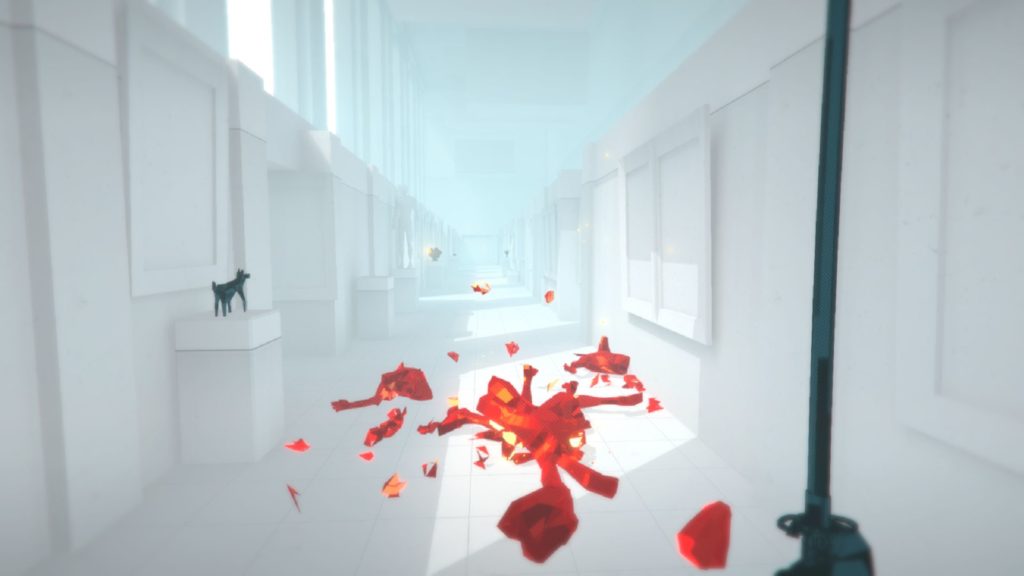
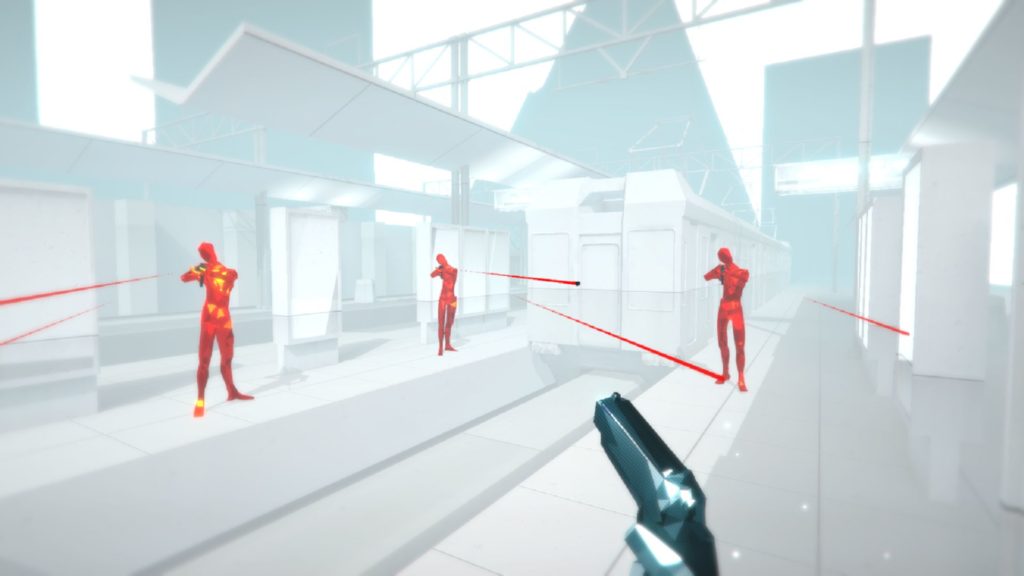
Superhot provides the ultimate action movie challenge. Assailants come after player with a variety of weapons, but the action only progresses only move as the player moves. Time is otherwise frozen, giving players the chance to figure out a path to dodge all the bullets, reach their enemies, and take them out. It’s a challenging mix of strategy and action that made for the perfect demo when Oculus was showing the DK2 version of the Rift headset at conventions.

The regular, non-VR, version of the game released last February for PC and on Xbox One in May. While it enjoyed a great deal of critical acclaim, fans were left wondering when the virtual reality release would be coming. As it turns out, the developers—Superhot Team—had bigger plans in store. Instead of turning the existing game into VR, it decided to rebuild the game from scratch so that it would properly fit with the technology. Created in partnership with Oculus VR, Superhot VR was announced with an all-new trailer that revealed how it would support the upcoming Oculus Touch controllers for deeper immersion. However, the response wasn’t quite what the independent developer expected.

Tom Kaczmarczyk, co-founder of Superhot Team talks to [a]listdaily about working with Oculus to transition Superhot to VR, the challenges of working with a new platform, and some of the unpredictability involved.

Superhot VR is said to be completely re-imagined and redesigned experience. Can you go into detail about how the experience compares to the non-VR version?

It’s an intensely physical experience. More so than with most VR games, I would say. That feeling of intensity—of being in the center of the action that we focused on so much in regular Superhot—is now amped up to eleven in VR. You felt a bit like you were choreographing a badass action sequence every time you completed a level in Superhot. Well, now you physically need to go through the entire choreography yourself.

You feel 100 percent engaged, [and] it often gets tough as nails if you push yourself, but once you dodge that final bullet and smash the head off of that last remaining enemy with your own bare hands, you feel just exhilarated.

From a design perspective, we’ve got a lot of new locations and scenarios and there are even a few gameplay mechanics that emerge in VR that we wouldn’t have in a regular PC/console incarnation of Superhot. The entire story mode is now delivered differently. It erodes the borders between the realities in and outside of the headset and plays with your feeling of immersion in a rather dark, disturbing manner.

Why redesign Superhot for VR instead of porting the current game?

We started exploring VR way back in 2013. Oculus reached out to us even before our Kickstarter campaign, and we did a bunch of experiments around adding VR to our old browser-playable prototype. We were pretty much at the wild, uncharted forefront of VR development at that time.

After the first batch of prototyping and research, it very quickly turned out that a naive, one-to-one VR adaptation of Superhot simply would not cut it.

You often imagine that shooters in VR are going to be among the coolest experiences ever. You expect that games will just drop players into Quake-like mayhem, give them virtual rocket launchers and have everyone instantly run and jump around like it’s 1996 but in VR. As it turns out, that’s about as far from the actual experience as you can get. The range of motions available to players in VR is vastly different from regular games. You put a player in VR and suddenly he’ll be able to crawl, sidestep, look around corners and shoot from behind cover, but he won’t be able to walk freely without feeling ill.

It’s a much, much greater difference in a FPS than in any other genre. Board games, platformers and TPP (third-person perspective) games can be VR-ified fairly one-to-one. VR FPS (first-person shooter) games need to be designed with VR in mind from day one, or they just feel wrong.

So back in 2014, we found one part of the Superhot experience that worked really well in VR and shipped it as a 5 minute tradeshow demo for E3 for Oculus DK2. It was loads of fun; people loved it, and the extra publicity gave a huge boost to our Kickstarter campaign. It also opened our eyes to how much more research we needed to do before we could create a truly satisfying Superhot experience for VR that spans beyond that 5-minute demo.

superhot_press_screenshot_04

What are the challenges in promoting Superhot VR compared to the non-VR version?

Ooh, that’s a funny one. Turns out we showed up with our VR announcement right in the middle of a very emotional discussion around VR platform exclusivity. Sort of like the darkest time in that Community episode with Troy bringing pizza just to find everything inexplicably on fire.

We started teasing and released a short gameplay trailer for Superhot VR at the beginning of June. We expected cheers and excitement that Superhot VR is a tangible title and that it’s being treated with the care and budget it needs to flourish. What we didn’t know is that apart from reaching our usual terrific bunch of players and followers, the timed-exclusivity also inadvertently triggered a negative reaction from a super-vocal group of PC Master Race gamers.

Before we had a chance to react and properly explain why we needed a timed-exclusivity agreement with Oculus, pretty much all of our social channels got set on fire.

It took a while for the discussion to die down. We went super transparent and put a lot of spotlight on the developer’s side of the story; we talked a lot with some of the more vocal anti-exclusivity activists, but it’ll still take a truckload more time for all the damage to heal after that short period of aggressive brigading.

Generally speaking—blissfully running a controversial announcement head-on against an emotionally loaded bunch of highly engaged gamers: 3/10. Would not recommend.

superhot_press_screenshot_12

In the long run though, we’re hoping to get people as excited as we are about the VR incarnation of Superhot. It’s such a tremendous amount of poetically abstract, exhilarating violence and pure physical fun that it’d be a pity if there were VR players who overlooked the experience. We’re still figuring out how to best convey that immersive gameplay experience in regular trailers and videos, and that’s a rather tough cookie to crack. How do you talk and convey the emotions and the intensity you feel while playing Superhot in VR to a player who hasn’t played anything in VR yet? We’re still scratching heads and looking for good answers.

How has Oculus helped in developing and promoting the game?

On the most basic level, Oculus provided the funds and resources that we needed to be able to afford to make Superhot VR from scratch instead of lowering the bar and just gluing VR support onto regular Superhot. The actual involvement goes a lot deeper, though.

Our relationship with Oculus started a lifetime ago, back in 2013. Oculus reached out to us even before our Kickstarter campaign, and we became good friends throughout the years of developing “regular reality” Superhot. We bounced a lot of different concepts and spent a scary amount of time figuring out how to do proper VR FPS design. Once we got close to releasing Superhot on PC, we took a short breather, considered our options and decided on a hardline—forget porting and just redesign Superhot for VR from scratch.

Since we understood how much effort, expertise and money we’d need to throw to make this a truly excellent title, we poked Oculus, figured out a way to make the arrangement work together and have been using their swaths of VR experience ever since.

Will Oculus Touch controllers be required for Superhot VR?

At first, yes. It’ll work with other hand tracking controllers a short while after release, though. We’re thinking about VR gamepad support as well, but that’s definitely not coming until later.

What do you think are some of the biggest challenges for mass adoption of VR technology right now?

From a developer’s perspective, I see a very strong chicken and egg problem here. It’s near-impossible to produce high-quality titles for VR when there’s only around 100,000 people with headsets out in the wild. The market is tiny, compared to consoles or PC. Using only expected sales revenue to finance development, budgets simply don’t add up if you’re hoping to create anything larger than a short experimental experience or a proof of concept. You simply can’t make a responsible decision as a studio head to commit your company to a large VR production without external financing.

At the same time, the lack of high-quality VR games does not really inspire mainstream players to buy into VR just yet. Most gamers aren’t particularly excited about technology just for technology’s sake. They’re excited about what they can do with it and what games can they play. Right now, it’s tough for most mainstream players to feel excited about any of the currently available VR games enough to rationalize spending $700 on a VR kit.

superhot_press_screenshot_07

On the one hand, we have the economies of game development prohibiting studios from making high-budget games for our fledgling VR market. On the other hand, we have the lack of high-budget games prohibiting gamers from flocking to VR and expanding the market. This vicious circle is super limiting to the rate at which VR is adopted organically.

Knowing that, we’re seeing a very strong commitment from platform owners to leapfrog a decade of organic growth by throwing money at the problem and bankrolling high-budget, high-marketing VR titles right now. There’s nothing inherently wrong with that, and I’m fairly certain that’s the best shot we’ve got at getting VR mainstream by 2020. At the same time, that means that most if not all of high-budget games available for VR for the next couple of years will be handpicked and groomed by just a few tiny groups of people working for platform owners.

Since it’s just a handful of hardworking, well-meaning people stuck doing gatekeeping for an entire ecosystem, we’re running a risk of excellent and innovative game ideas never getting realized simply because they’ll never manage to get properly pitched to those guys. Be it because the developer is in the wrong geography, the genre isn’t really a favorite for the reviewer or because maybe the reviewer just had a bad day. The situation will improve as the market matures and publishers and investors join the fray, giving devs lots more options to pitch their concepts. But for the time being, it’ll be tough for some devs to find enough resources to realize their creative visions.

Fingers crossed we’ll no longer have that problem in a year or two.

Groovin’: Video Game Soundtracks Return To Vinyl

They’re flat and round and full of video game sound—the last decade has seen a revival of soundtracks being released on vinyl, opening the market to collectors everywhere. Although the practice is far from new, with albums dating back to the 1970s, there has been a significant rise in popularity for the platform in the last decade.

The most recent franchise taking its music to the turn table is Rocket League, an eSports phenomenon that attracts both casual and hardcore fans. The game’s developer, Psyonix has just announced the Rocket League: Vinyl Collection, a 3xLP, 180-gram album housing both Volumes 1 and 2 of the Rocket League Official Soundtrack. In June, Hello Games unveiled a worldwide music tour by band, 65daysofstatic for the No Man’s Sky soundtrack, also released on vinyl.

More and more, developers are using video game soundtracks to promote their brands with behind the scenes looks and celebrating a game’s legacy through live concerts. These days, developers and publishers announce the release of a soundtrack with as much fan fare as the game, itself. That usually includes digital and physical CDs, however, although more and more and turning to the classic, grooved medium.

So, why vinyl? It’s not just for hipsters anymore. Assuming the LP was produced from an analog master and not digital, gaming audiophiles prefer the true, warm sound of a record over a CD. It also comes down to rarity. In recent years, several publishers have offered special limited vinyl collector’s editions of game soundtracks like The Last of UsMinecraftBioshock 2 and Hotline Miami, limited to anywhere between 500 to 5000 copies. The Machinarium vinyl soundtrack, for example, included five pressings, the first pressing limited to 555 printings and all first pressings signed and numbered.

Vinyl, itself, is also considered more rare, and is therefore more collectible by fans. As the music industry transitions to a digital age, any physical copy will start to become more collectible in nature. According to an April report by International Federation of the Phonographic Industry (IFPI), 2015 digital music revenue surpassed those from all physical music formats for the first time. This is largely attributed to the growing popularity of streaming music services like Pandora and Apple Music. What this means for consumers is the growing desire to own something they can hold and show their friends.

Releasing a physical, vinyl soundtrack may not appeal to all fans of a franchise, but it will certainly appeal to the most loyal. So long as the practice does not become so popular as to saturate the marketplace, limited edition vinyl soundtracks are an effective way to ensure a physical legacy for a brand.