Knott’s Berry Farm Is Bridging VR And Competitive Gaming With America’s First Free-Roaming Virtual Experience

Almost one year ago to the day, Six Flags and Samsung struck a strategic partnership that brought virtual reality roller coasters to amusement parks in North America for the first time.

Disneyland, Universal Studios and SeaWorld quickly followed suit with a suite of immersive VR installations of their own. In fact, the Six Flags-Samsung deal was such a smashing success that last month they added a new a layer to their offerings with complex gameplay and two mixed reality experiences.

VR attractions continue to gain popularity amongst consumers; its great potential is helping theme parks build their brand by offering a variety of rides and experiences—with no end in sight to both the adventures being introduced, and the lines that accompany them.

Cedar Fair Entertainment, the parent company of Knott’s Berry Farm, is now joining the fray in a new way by upping the ante with another first in “VR Showdown in Ghost Town,” the only permanent, free-roaming VR experience at a US theme park.

The custom VR attraction, which aims at allowing for guests to be the stars of their own show by combining VR with a realm of competitive gaming, will have consumers embarking on a time travel adventure as they’re transported to a futuristic version of the Knott’s western town of Calico.

Multiple players will be equipped with wireless VR headsets and futuristic blasters as they go on a mission with other groups to defend the town against robotic creations. Made collaboratively with the Bay Area-based VRstudios, the one-of-a-kind adventure will open in April in the Knott’s Berry Farm Boardwalk Arcade.

Christian Dieckmann, vice president of strategic growth for Cedar Fair Entertainment, the parent company of Knott’s Berry Farm, and Kevin Vitale, president of VRstudios, joined [a]listdaily for a joint interview to discuss their one-of-a-kind experience, and the future of “techtainment” in theme parks.
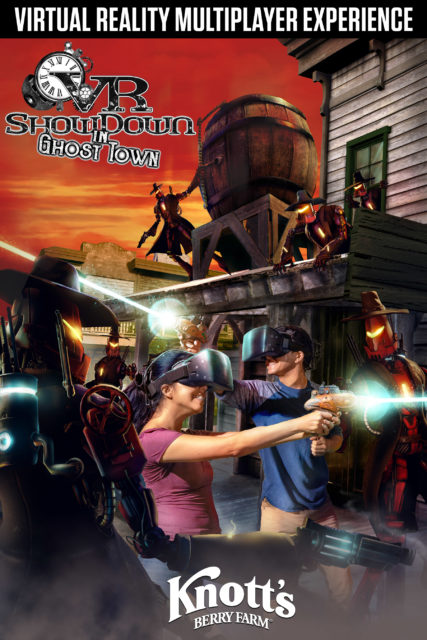
VR Showdown In Ghost Town at Knott's Berry Farm Poster High-Res

Why is Knott’s pursuing immersive and unique experiential technology and getting into VR? What led you to this decision?

Christian: We’re always looking for new and exciting ways to entertain our guests. VR can enable a true sense of presence in a virtual world, and allows each user a chance to interact directly with their digital environment. It’s really a limitless canvas in many ways, which is why it’s attractive to location-based entertainment operators such as amusement parks. Also, a vast majority of people still have not experienced VR; we think there will be a lot of interest from our guests to have their first taste at our parks. Purchasing a high-end VR system is not a cheap endeavor, so we can provide access at a fraction of the cost to our guests.

Why did you decide to go with a free-roaming installation, rather than an actual ride?

Christian: VR-enhanced rides are a very exciting concept, but we wanted to go in a different direction in this case. This will be more game than ride. By using a free-roaming system, we can take full advantage of the capabilities of VR and let our guests be the stars of the show. Players will be able to freely move around within the virtual world. They will see the digital avatars of other players in the game, creating a social element, as they compete for individual high scores while striving toward shared team goals.

Why is VR all the rage in theme parks nowadays?

Kevin: The advancement of VR technology has reached a point where we can provide exciting, specialized and compelling experiences for the needs of location-based entertainment venues and their guests. Consumers are becoming increasingly interested in experiencing VR. Price points and other system requirements for in-home VR still make the barrier too high for most consumers, other than the avid enthusiast. In addition, theme parks can offer much more elaborate and rich experiences, incorporating high-quality creative material, haptics and other sensory elements, and in some cases props and live actors. Therefore, we believe that out-of-home entertainment venues, like theme parks and Knott’s, will enable more consumers to try VR with a high-quality experience, which will in turn help to encourage the adoption of VR/AR across all segments.

VRStudios focuses on completely wireless walk-around systems. Why do you think this works better than an actual ride? 

Kevin: Freedom of movement and interacting directly with the VR environment both enhances the immersive experience for the participant, and opens up the range of options in the experience such as the ability to simultaneously compete or collaborate with multiple other players. Amongst the benefits of the VRstudios system is the flexibility to offer a range of content and VR experiences that will keep participants coming back for more. Depending on the experience, this could be offering different levels of competitiveness or reward, solving new parts of a puzzle or rotating in completely new themed experiences. As you can imagine, our customers are experiencing economic, operational, competitive and marketing benefits from the application of our VR systems, technology and content.

Why is there a growing appetite for gaming-like experiences in theme parks? Is it possible for VR to one day have its own category?

Christian: As we move from the ‘information age’ to the ‘experience age,’ consumers expect to be able to interact with their environments directly, and don’t necessarily want to be passive participants the entire time. Theme parks are no different in that regard. Gaming, VR, AR and other forms of interactivity—both digital and non-digital—directly address those needs. In terms of standalone VR centers, there are a number of firms, both established companies and start-ups, that are trying to crack that nut, with many planning to open shop over the next one-to-two years. There will be a number of challenges, including figuring out the Rubik’s Cube of pricing, capacity, utilization and capital investment that can generate attractive economic returns. Regardless, I anticipate that we will witness a wave of innovation at the intersection of technology and location-based entertainment over the next several years. As for VR at Knott’s Berry Farm, we think being able to leverage our existing foot-traffic patterns in the park gives us a huge advantage in terms of achieving success and a strong return on investment.

What market research led you to deciding that people would pay extra to have this VR experience? How much will the extra fee be?

Christian: We have done some studies on past VR projects and have seen high overall guest satisfaction, and confirmed a willingness to pay. We also view this VR experience as being similar in many ways to a laser tag installation from a pricing perspective. ‘VR Showdown in Ghost Town’ is one of the many exciting new experiences coming to Knott’s in 2017 and will be available to guests at an introductory price of $6, in addition to park admission.

What have you learned from your competitors who have activated with VR in their theme parks while watching from afar? 

Christian: At Cedar Fair we have actually been quite active ourselves in the category of which we are calling ‘techtainment.’ That includes interactive and immersive media-based attractions, VR and AR. We have learned a lot from our own projects across multiple amusement parks, as well as from those of our direct and indirect competitors. At a basic level, we have to make sure the experience is fun. It doesn’t matter how amazing the technology is if the guest isn’t smiling on the way out. We also have to make the user interface as frictionless as possible, including streamlining how people get in and out of the attraction, making sure they know what they are doing once they’re in the virtual world and keeping everything glitch free the entire way.

VR technology can be reprogrammed to give riders different experiences on the same ride. Is this a critical element for marketing a ride for return visits? 

Kevin: With VR, variety is important; however, the quality of the user’s overall immersive experience and easy logistics for theme park operators will also be the strong factors influencing repeat visits.

Do you plan on giving VR another crack for Knott’s Scary Farm after last year’s miscue? If so, what can you share?

Christian: At a general level, we do believe that VR and AR have strong potential for the Halloween season. We haven’t made a decision yet about what we’re doing this year at Knott’s Scary Farm, but we are kicking around some ideas internally.

How will you be ramping up marketing as you prepare for the launch with VRStudios next month? What is going to be your integrated, cross-channel strategy?

Christian: There will be a coordinated PR effort and social media support in the weeks ahead. We think our guests, including our season pass holders who make multiple visits to Knott’s, will be very excited to try out this cutting-edge new virtual attraction. 

What have you learned from the Universal Studios attraction you spearheaded that will help you advance the theme park VR experience? What are consumers clamoring for? 

Kevin: People love anything new—to be thrilled and scared, experience action and fantasy. It was amazing to watch how collaboration, combined with innovation and the years of entertainment skills of Universal, allowed visitors to experience a culmination of narrative engagement seamlessly blended with the physical and virtual worlds. Guests could be social, puzzle solve and compete in VR gaming—all in one orchestrated experience. We now look forward to unveiling the one-of-a-kind VR experience developed by the collaboration, entertainment skills and depth of experience between Cedar Fair, Knott’s and VRstudios. For the industry, it’s early in the game and innovation continues at a rapid pace. As good as these experiences are today, we are just scratching the surface of creating amazing new VR-based amusements and attractions that can never be experienced at home.

Follow Manouk Akopyan on Twitter @Manouk_Akopyan

Activision Blizzard’s Brand Message: ‘Innovation Never Goes Out Of Style’

Activision was making third-party games before they were cool . . . or existed, for that matter. Founded in 1979, Activision was the world’s first independent developer and distributor for console games, beginning with the Atari 2600. Three decades of game development has a way of teaching a thing or two, particularly about new technology and how it applies to beloved franchises.

From classics like Pitfall! in 1982 to mammoth franchises like World of Warcraft, Candy Crush Saga and Call of Duty: Infinite Warfare, Activision—now Activision Blizzard—is behind many of the world’s most popular titles to date. Boasting an impressive $6.61 billion in 2016 (42 percent growth over 2015), the company is not only ruling the video game industry, but driving it.

A New Kind Of Athlete

“Professional gaming competitions are creating celebrities who are recognized and revered as athletes were in prior generations,” Activision Blizzard CEO, Bobby Kotick told Forbes. “Spectator gaming is becoming as popular as mainstream sports.”

Activision Blizzard acquired Major League Gaming (MLG) in late 2015, and has been making waves in the eSports scene ever since. The publisher’s Counter-Strike: Global Offensive Major Championship (CS:GO Major) generated new viewership records during its March 30 to April 3, 2016 broadcast, with audiences generating 71 million video views and watching an incredible, record-breaking 45 million hours of live broadcast. CS:GO Major—the first held in North America—also set a new record of 1.6 million concurrent viewers across over-the-top (OTT), web, mobile and in-game streaming formats.

The CS:GO Major event was streamed live with enhanced features like real-time situational data. “Our product strategy is related not only to the live fan experience, but also the over-the-top streaming platform,” Mike Sepso, senior vice president at Activision Blizzard and former president and co-founder of MLG told [a]listdaily.

During Blizzcon 2016, Activision Blizzard surprised the world by announcing its Overwatch League, inspiring players of all skill levels to dream big. As Activision Blizzard’s second-most-popular streaming title, Overwatch attracts over 8 million monthly active players and an average concurrent viewer count of over 21,000, according to SuperData Research.

The publisher is not only helping to drive the success of today’s highly-lucrative eSports industry, it’s changing the way publishers think about trends in the Chinese market. Overwatch sales exceeded all expectations in the region, proving that players are willing to pay for competitive games upfront—something once believed this lucrative demographic wouldn’t do. “China’s games market may be dominated by free-to-play MMO and mobile titles, but Overwatch’s success indicates the potential for premium games in the country is growing,” said SuperData Research CEO, Joost van Druenen in a report for August video game sales.

Streaming video games has become a major driver for publishers, creating a type of ecosystem in which games are made, then played by popular streamers and enjoyed by thousands of fans, which in turn drives sales. Activision Blizzard’s partnership with Facebook now allows players to stream Blizzard titles directly to the social network, further adding to this growing trend of “spectator gaming.”

Mobile Mastery

What makes someone a “gamer?” Whether a player is hardcore or casual, Activision Blizzard has undoubtedly cornered the market. At $41 billion, mobile games were by far the most lucrative form of interactive entertainment in 2016, surpassing retail games and free-to-play online games by $26 billion and $19 billion, respectively. In addition to its unstoppable Call of Duty franchise, the acquisition of King Games means that this publisher has access to some of the most lucrative casual franchises in the world, including Candy Crush Saga.

Activision Blizzard saw not just an opportunity in terms of revenue, but within the modern state of our industry. The publisher recognizes gamers of all preferences from matching puzzles on the train to taking on international opponents in a packed, eSports arena.

candy-crush

The Ability To Evolve

The company has evolved over the last few decades in technology and creating a thriving network of creativity. Activision Blizzard was recently named among Fortune’s 100 Best Companies to Work For and currently employs over 9,000 people.

While it’s only natural (and necessary) to adopt new game development technologies, Activision Blizzard is leading the way in terms of other tools, as well. For Call of Duty: Infinite Warfare, the company released two interactive chat bots on Facebook that garnered over six million interactions almost immediately.

The interactive media giant isn’t limiting itself to video games, either. Through Activision Blizzard Studios, the company is expanding its reach to TV with Skylanders Academy on Netflix, and a Call of Duty film in the works. “Activision Blizzard Studios is yet another way we’re celebrating our players and fans, and we expect that our film and television productions will entertain and delight whole new audiences, as well,” said Activision Blizzard co-president, Nick Van Dyk during the Blizzcon announcement. Although the Warcraft movie was made before Activision Blizzard Studios was announced, the film likely helped bring the game back into people’s lives in time for the launch of the Legion expansion launch last summer.

“Our priority is audience focus—the recognition and appreciation that our audiences invest so much in our franchises and our responsibility to them to continually innovate within those,” said Kotick. “We feel a tremendous responsibility to our audiences to keep our franchises exciting.”

Wesley Snipes Stars In Standalone VR Short Film To Complement ‘The Recall’

One of the most decorated action movie actors of his generation is taking his talent from the big screen to virtual reality—all for the same project.

Wesley Snipes will star in The Recall VR Abduction, a 10-minute standalone short that exists in the same universe and cast as the upcoming Sci-Fi horror The Recall, a feature horror film that follows a group of friends who are abducted during a weekend cabin trip.

The guns-blazing Snipes, who saves the cast, is slated to virtually interact with the user through the eyes of another cast member played by R.J. Mitte (Walt Jr. of Breaking Bad) to pursue death-defying adventures in a world facing alien invasion. The transmedia experience places viewers in a story colored by extraterrestrial terror and lets users encounter Snipes’ mysterious character through the eyes of Mitte.

Directed by Mauro Borrelli, it is complemented with multiple endings different from the feature. Scheduled for release prior to the feature, it also serves as rich marketing collateral to promote the film in a dynamic medium, effectively changing the way theatergoers hear about movies and rewriting the way movie producers package content.

“The cool thing is that for theater actors, or thespians, this is a great format, because shooting in VR is similar to shooting a play, or performing a play,” Snipes said of his first foray into VR. “You don’t have the luxury of cuts, and short takes, and do overs. You have to be on your game, and since everything is in the shot, everyone else needs to be on their game at the same time.”

The Minds Eye Entertainment feature film is scheduled for release later this summer.

Kevin DeWalt, producer of The Recall and CEO of Minds Eye Entertainment, a Canadian independent production and distribution company, as well as Travis Cloyd, an executive producer in virtual reality, joined [a]listdaily for a joint interview to discuss their innovative approach to making and marketing movies.

VR-pic-5
Josh Courtney (VR Producer), Wesley Snipes, Travis Cloyd (VR Producer)

Is this unique standalone VR experience a trend moviemakers will be increasingly adopting as a marketing tool moving forward?

Kevin: We are leading that trend. It’s exciting to be given this new technology at the forefront, and to be incorporating it into our film projects before other production companies realize and recognize what an asset it could be. There are many companies introducing new headsets, and the world of VR is becoming more and more accessible to the average viewer. It will be very useful in marketing and building awareness of The Recall. Also, it’s a great new channel for generating revenue.

How will you be marketing the 10-minute film? Are there any new social platforms you plan on testing?

Travis: We’re going to have the viral and behind-the-scenes 360 videos posted on platforms like Facebook and YouTube. We’re using these platforms to build momentum toward both the VR piece, and the film. We are balancing this 360-style promotion with standard marketing procedures, too. Anywhere we can get exposure, we’ll be advertising.

What was it like working with Wesley Snipes? As a whole, are mainstream actors embracing their craft in VR the same way? Or is it different?

Kevin: I don’t know how it could get any better. Wesley has been the best anyone could be. His thespian background helps him understand the complications that do exist in filming 360 and VR content, including less opportunities to cut the shot. He easily adapted to these challenges, and embraced them. Wesley is one of the first people to truly be embracing VR in terms of high profile actors, and we are excited to work with him as an actor and producer on the project.

Why is it imperative for brands to use 360-degree video and VR for their integrated marketing strategies?

Kevin: There are not a lot of films that are using 360, so that is a competitive advantage. We are able to go behind-the-scenes and show the average viewer what it’s like in a more immersive way. So it is a tremendously valuable item in the tool kit for marketing films.

VR-pic-4

What have you learned along the way about creating engaging VR experiences? What’s your special storytelling sauce?

Travis: There are more opportunities and physical spaces to distract, challenge and engage a viewer with the 360 perspective. In addition, immersive audio and carefully crafted music is key to elevating the storytelling experience. Finally, with the added space in the 360 perspective, you can tell multiple stories at once more easily. These three things—combined—are our secret sauce.

What needs to happen for VR to take the next step into the stratosphere?

Kevin: There needs to be better storytelling in VR content. Everything has been experiential, but nothing has been really story driven. We were excited to put an extra emphasis on story in our collaboration with Wesley Snipes for The Recall VR Abduction.

What is currently the biggest challenge for marketing VR?

Travis: Getting the average consumer to acclimate to the storytelling conventions of the platform and technology. The VR world is revolving and having to adapt with new cameras and headsets, and it’s just about getting used to watching the stories in a different way, and exciting viewers about the opportunity for a transmedia experience.

Follow Manouk Akopyan on Twitter @Manouk_Akopyan

Warner Brothers Goes Big With ‘Kong: Skull Island’ Marketing

Kong: Skull Island marks the fearsome theatrical return of a legendary monster. It’s been 12 years since the giant gorilla hit the big screen. Having been rebooted so many times, Warner Brothers and Legendary Entertainment needed to get the world excited for the king’s return in otherworldly ways.

A Legend Returns

Studio marketing efforts have been focused on the ferocity and sheer size of King Kong in the film—the largest one yet. To bring some perspective to just how massive the latest version is, denizens of Los Angeles can take a look at his 25-foot prints as they appear around the city. Footprints first appeared on the beach near LAX on March 3, then again at Capitol Records on March 5, outside LA Live on March 6 and near Runyon Canyon Park March 7. Those brave enough to investigate the sightings were given promotional T-shirts. Of course, social media posts about the sightings are a given.

Beginning in February, fans around the country were invited to use the hashtag #(city)LovesKong for a chance unlock an early screening in in their hometown. Sponsored hashtags are also available for #KongSkullIsland and #KongIsKing.

Creating A World

Kong is the undisputed king of Skull Island, a mysterious and dangerous place that time seems to have forgotten. Skull Island has been added to Google Maps, complete with “reviews” and Kong superimposed over a number of 360-degree photos. The location is connected to an interactive website that allows users to explore the island through team diaries, promotional trailers for the film and a peek at some of the other creatures living on the island.

A 360-degree experience has been created for Samsung VR called Destination Skull Island, that can also be viewed without a headset. The virtual adventure casts users as a member of the crew sent to Skull Island, where they come face-to-face with Kong, himself.

As with any film, a great deal of care and passion have gone into the concept and promotional artwork for Kong: Skull Island, which was celebrated during a pop-up gallery March 3 in New York. Three limited-edition posters were offered for sale, which quickly sold out.

Of course, what would a blockbuster film be without its Hollywood stars? In addition to the usual interview tours, Alamo Draft House Cinema hosted a Facebook Live Q&A session with Tom Middleston, Brie Larson and Samuel L. Jackson to get fans excited and delve deeper into the characters they play.

While all this promotion is serious business, the actors didn’t mind having a little fun at their own expense with the help of Comedy Central and comedian Jeffrey Ross.

At the heart of Kong: Skull Island is a legacy that its filmmakers wanted to preserve.

“If anything, our Kong is meant to be a throwback to the ’33 version,” film director, Jordan Vogt-Roberts told Entertainment Weekly. “[Kong] was a movie monster, so we worked really hard to take some of the elements of the ’33 version—some of those exaggerated features, some of those cartoonish and iconic qualities, and then make them their own.”

With all this build-up, the legendary monster has a reputation to uphold . . . which he’ll need when he fights Godzilla in 2020.

Kong: Skull Island opens in theaters this Friday.

VR ESports: The Future Or A Pipe Dream?

It’s an understatement to say that there’s a lot riding on virtual reality. Billed as the next big thing across multiple verticals, according to analytics platform CB Insights, approximately $1.48 billion of venture capital was invested in VR/AR startups in 2016. Even taking Magic Leap’s $793.5 million series C out of the equation, we’re looking at a whopping $686.5 million in funding. Throughout the years, we’ve seen glimpses of what the marriage of virtual reality and gaming could look like and now the worlds of Tron and The Matrix don’t seem all that far away. A little over two years after Facebook’s $2 billion acquisition of Oculus, VR is at an inflection point. Early investors have made their bets and are waiting to see how the adoption trajectory further develops before diving even deeper and more conservative funds are in a holding pattern. All appear to agree on one thing—that VR is a killer use case away from the mainstream. Could VR eSports or competitive gaming be that use case? Let’s take a deeper look at why or why not.

Edward Chang
Edward Chang is the EIR for eSports/gaming at The Chernin Group and Founder at basikz.co.

The Case For

A New Experience: For the most part, PC and console gaming have essentially been played the same way for the past 30 years. VR represents a few departures from the status quo—it’s a truly immersive experience. Life-like visual and audio processing, movement and positional tracking, as well as haptic and integrated sensory feedback all contribute to an adventure that’s absolutely realistic, to the point that during certain Vive sessions I forget where I really am. VR also offers a unique blend of physical and digital. I’ve heard many times from those who don’t understand eSports that there’s no “sports” behind it. That can absolutely change with VR and awesome companies like Virtuix, offering a VR treadmill which allows users to truly explore the virtual world around them, and The Void, which puts you inside digital worlds layered over interactive environments on a theme park scale, provide a glimpse into what could be.

There’s also an opportunity to capture an entirely separate group of players from today’s gamers, ones that have never been PC or console gamers or stopped playing early on in their lives, VR arcades are coming! IMAX opened its first VR hub in LA in January and has plans to debut five more this year. Polygon also has the scoop on game publishers trying to reach these audiences:

Capcom runs a pop-up VR experience that has players strap Vive controller to their feet and then slip on the headset and hold two more controllers. Once inside the game, the player uses their hands and feet to wreak havoc on a city as a massive monster, stomping, batting their arms and belching lighting with the controllers. Bandai Namco has an experience that places players in an elevator jetting to the roof of a high rise. Once there, players have to walk across a real world wooden plank to try and save a virtual kitten depicted as mewling for help hundreds of floors above the ground.

Monetization Opportunities: There are plenty of financial incentives for VR eSports to become mainstream. The first is hardware and device sales. Being able to play the latest and greatest games have always been one of the biggest drivers for upgrading hardware. Combine that with manufacturers chomping at the bit to cash in on VR first-timers who that need to upgrade their graphics cards, phones and monitors and you have a very compelling monetary case.

On the publisher side, VR game pricing seems to be settling in between the mobile and PC markets, according to insights from Josh Farkas, founder of VR development studio Cubicle Ninjas:

This is in addition to the in-app purchase opportunity which hasn’t been prominent mainly due to the lack of depth in today’s VR games.

In addition to direct sales, marketers will have access to a brand new world of advertising. We have no idea what ad units and CPMs are going to look like in this brave new world, but early tests are promising. Sliver.tv, a 3D-livestreaming platform, is experimenting with in-game ads and the results are pretty cool, as seen in the screenshot below. Lucid Sight, a VR game dev and ad network, ran an activation with Lionsgate to promote the movie Divergent: Allegiant based around a 4-minute video ad in-game that users could skip after 10 seconds and saw completion rates (defined as watching the entirety of the ad) of close to 30 percent. What’s clear is that there’s revenue to be made across the board, and hardware companies, game publishers and advertisers alike are well incentivized to acquire users.

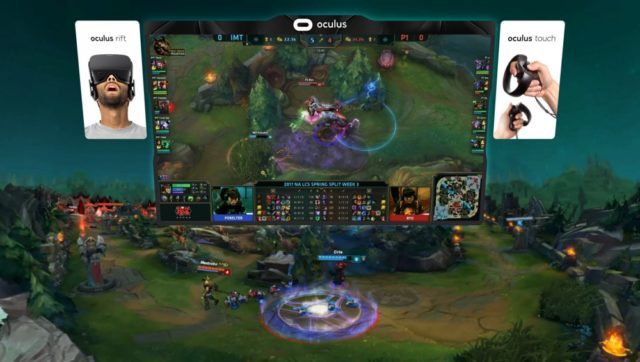
Sliver Katowice IEM
Sliver’s coverage of IEM Katowice 2017.

The Case Against

Proliferation of VR devices: The biggest knock on the overall potential of VR has been disappointing sales numbers. According to a Digitimes report,

Many research firms’ numbers also have shown that VR product sales in 2016 have been weaker than expected due to lack of content and high product costs. VR/AR technologies also require more improvement in order to stimulate demand from both the consumer and enterprise sectors.

Sony’s PSVR, Google’s Daydream View, HTC’s Vive, Oculus Rift and Samsung Electronics’ Gear VR have all achieved sales that are weaker than market expectations.

A strong eSport doesn’t only need top-level professional play, it needs large numbers of viewers. Looking at viewership:MAU ratios for popular titles (based on average professional league viewership), the numbers are extremely low—150,000:100,000,000 for League of Legends and 40,000:12,000,000 for CS:GO. If these ratios are any indicator, the player base needs to grow exponentially before any significant VR viewership takes place. In addition, device sales generally don’t take into account the fragmentation of hardware today. There’s already five “major” devices on the market today and standardization of devices is a must when it comes to competitive gaming. You’ll never see a Call of Duty tournament where OpTiC Gaming is on Xbox while EnVyUs is on Playstation, nor will you see an Overwatch match where Cloud9 is using PC’s while CLG is using Playstation 4’s.

Meaningful Content: Up until now the lion’s share of games have simply been demos of VR capabilities, “life simulators” or single-player games with very basic functionality. When a full-scale FPS, MOBA or Strategy game backed by a triple-A studio gets released, expect to see metrics like session length, in-app purchases and overall viewership trending upward, along with the infrastructure for competitive leagues. Watch for eSports tournament organizers like ESL, FaceIt, Beyond the Summit or NGE to be the first to test the market for VR competitive gaming tournaments.

Spectating: If VR games are this difficult to play, what can be said about viewing? ESports fans can watch content from anywhere today—their PC, phone, console, Apple TV and more! But with the VR-required hardware, will this be a moat too wide for the Average Jane to swim across? Companies like BoomTV, Genvid, Sliver and Valve are working on making this easier to do, and expect platforms like VREAL, YouTube and Twitch to leverage technology to make the transition more seamless. There’s also the ultimate question of who’s paying for the content—will these platforms be able to charge users for the service or will they be able to find brands willing to make a bet in the early days on VR livestreaming?

VR eSports coming to fruition or not is ultimately dependent on the parent industry. I’m of the mind that truly disruptive technologies take time to adopt and VR will reach the predicted trajectories that many of these exciting companies are working towards. I also believe that competitive gaming will be a huge driver for adoption as we see hardware costs lowering and content maturing.

NBA Using ESports To Broaden Basketball’s Fan Base

The NBA and Take-Two Interactive Software will launch the inaugural NBA 2K eLeague in 2018. The new professional competitive gaming league will bring together the best basketball gamers in the world. Matt Holt, vice president of global partnerships at the NBA, told [a]listdaily that approximately half of the current NBA teams will participate in the first season of this video game league.

“We’d been having a lot of conversations with our gaming partners and our owners have been interested in the [eSports] space, so when 2K began exploring this, all of those conversations converged,” Holt said. “It’s a basketball video game, which is core to the NBA brand, and we felt it was perfect timing to team up with 2K and launch this league.”

This marks the first official eSports league operated by a US professional sports league. The new league will consist of teams operated by actual NBA franchises and the founding teams (each composed of five professional eSports players with custom-created avatars) will be announced in the coming months. Additionally, the NBA 2K eLeague will follow a professional sports league format: competing head-to-head throughout a regular season, participating in a bracketed playoff system, and concluding with a championship matchup.

“You can expect our eSports league season to run in tandem with the NBA season and have some tie-ins with regular season games and other events like All-Star and the Finals,” Holt said. “We’ll have live events in our first season, some of those may be in NBA arenas and some may be in smaller studios or different venues better suited for this type of experience.”

While the overall eSports industry has seen significant activity in recent years, Holt said the sports game genre is still in its infancy when it comes to competitive gaming. “We felt this was a good place to dip our toe in the water,” Holt said. “We’re trying to become intelligent in this space by talking to all of those publishers involved in eSports and we’re bringing our knowledge of professional sports.”

Holt concedes that the eSports landscape currently has a lot of fracturing of governing bodies. “We bring pro league expertise and infrastructure to the table, along with our teams, which is another support element,” Holt said.

Of course, at the core of the NBA are its players. 2K recently held an exhibition video game match between Still Trill, the winners of the $250,000 NBA 2K17 All-Star Challenge, and NBA stars Kevin Durant, Kyrie Irving, Paul George, CJ McCollum, and Aaron Gordon in New Orleans. Still Trill beat the NBA stars 95-52.

“We know our players are big fans of the NBA 2K game and many of them work closely with the development,” Holt said. “It’s going to be interesting to see how we can connect our players with this eSports league.”

The NBA and 2K are looking at the long game as they develop NBA 2K eLeague, which means fans won’t see outrageous prize pools like the one Valve offers for The International with $18 million up for grabs for Dota 2 teams. “As we build out the structure for this eSports league, we’re looking more at developing and sustaining a real league through salaried positions for the pro gamers and some prize pools,” Holt said.

Gaming houses, which are common with traditional eSports games like League of Legends, Counter-Strike: Global Offensive and Dota 2, could be part of the NBA 2K eLeague. “We’re thinking about that concept and having teams located in local markets,” Holt said. “We’ll probably go that direction.”

The NBA and 2K are still figuring out details like what jerseys pro gamers will wear, and how traditional NBA logos will be featured. “We’re locking down team participation and then logically out of that we’ll take a deeper dive on branding,” Holt said.

Furthermore, the NBA is offering a sponsorship patch on real team jerseys beginning next season and the eSports world has followed the path of NASCAR with sponsors emblazoned across pro gamers’ jerseys and gear.

Holt said the NBA has received a ton of interest from both new and existing sponsors in the business community to have some form of jersey sponsorship for the pro gamers. In addition to reaching a potentially new (and younger) audience through eSports, eLeague will also open up sponsorship opportunities for each NBA team.

“Our teams have done a great job of working with local sponsors in their arenas and markets and this eSports league will mirror that as well,” Holt said.

Since eSports is a truly global digital sport, the NBA and 2K are open to expansion beyond North America. “We’re going to have teams in North America initially, but as we get into years 2 and 3 of this we’ll look to expand internationally,” Holt said. “It’s going to be a lot easier to expand into areas like Europe, China and Japan through this eSports league.”

Real Grass And Sniper Cats: This Week In Game Promotions

A legend returns and things get serious with the cartel this week in the world of video games. To help spread the word, fans were transported to a fantasy world, Die Hard‘s director came out of retirement and a few celebrity endorsements certainly didn’t hurt.

The Legend Of Zelda: Breath Of The Wild

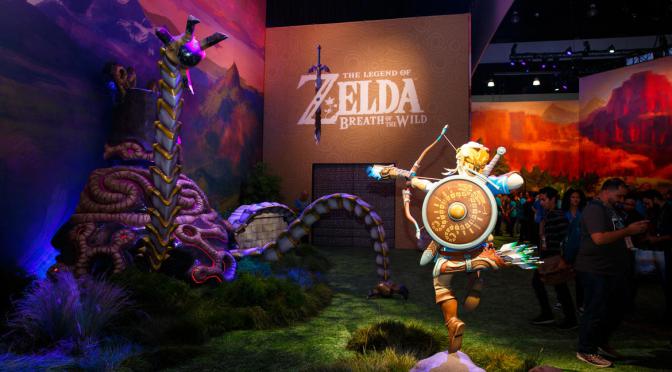
After three decades, Nintendo’s classic franchise returns in The Legend of Zelda: Breath of the Wild—exciting fans and helping to usher in the brand new Switch console. While nostalgia played a major role in creating this title’s hype, some interactive marketing did wonders to get the party started. For the first time, Nintendo dedicated its entire 30,000 square foot booth at E3 2016 to one game, transporting fans to a “living” world of Hyrule. The reveal of The Legend of Zelda: Breath of the Wild was met with great enthusiasm by the press and fans alike, and its dedicated booth became a star all on its own. The floor was covered in real grass against the background of a stunning mural. Expo attendees were surrounded by life-sized props, statues, ambient nature noises and every 24 minutes, the booth transitioned from day to night and vice versa—immersing explorers into matching colors, sounds and shadows.

Above: Nintendo's "Living Hyrule" booth at E3 2016.
Above: Nintendo’s “Living Hyrule” booth at E3 2016.

In addition to five new amiibo figures that include in-game bonuses, Nintendo has created offers for those who own figures from the original title, The Wind Walker, Ocarina of Time or Twilight Princess. Use of these amiibo figures with Breath of the Wild will unlock special items or Wolf Link to help players on their way.

Fans were treated another glimpse of the new game when Nintendo aired its first Super Bowl ad for the Switch console. From there, the brand has benefited from the help of celebrities such as Jimmy Fallon and John Cena, who have played (and subsequently raved about) the game prior to launch.

The Nintendo Switch launched without game bundles or demos, something that will no doubt hinder its initial success. However, The Legend of Zelda: Breath of the Wild encouraged hardcore fans to pick up the console without delay, something that no doubt assisted in initial success. Those enjoying the game can take advantage of an expansion pass that grants immediate in-game bonuses plus access to both DLC add-ons scheduled for later this year.

Tom Clancy’s Ghost Recon Wildlands

Ubisoft‘s latest entry in the Ghost Recon series involves some very serious dealings from within the cartel, which are illustrated through a live-action short film called War Within the Cartel. The 30-minute video stars rapper-turned-actor, Tip “T.I.” Harris, and features the Santa Blanca drug cartel as they seek to flush out a traitor within their ranks. Its events lead up to the opening moments of Ghost Recon Wildlands. As with Ubisoft’s previous live-action The Division shorts, War Within the Cartel premiered on Ubisoft’s Twitch channel and is now available to watch for free on Amazon for Prime subscribers.

Director John McTiernan (Die Hard) created a live-action trailer for the game featuring a cat and the red laser of a sniper’s rifle. For a healthy dose of back story, players can pick up a new novel called Tom Clancy’s Ghost Recon Wildlands: Dark Waters by Richard Dansky. The story acts as a prequel to the events of the video game, focusing on each member of the operative and the mission that initially brought them all together.

Those who participated in the game’s beta through Ubisoft’s Uplay game service will get access to the Unidad Conspiracy reward, which includes three exclusive missions. The only catch is that to receive their reward, gamers must play the retail version of the game by March 31. Beta players also received exclusives for use in-game, such as skins and weapons.

In addition to airing its short film on Amazon, Ubisoft has also partnered to offer a War Within the Cartel items pack free for those with Amazon and Twitch Prime memberships. Those who sign up to receive rewards through the official website can earn points that can be redeemed for real prizes such as apparel, in-game items, consoles and experiences.

Peter Moore Moves On From EA; Ubisoft Plucks Four Fellows From Telltale Games

From video games to traditional sports, there was no shortage of career shuffling this week.

A visionary of the video game industry is moving on to a new challenge in the Premier league. Peter Moore, formerly the chief competition officer at Electronic Arts, is going from digital games to the real deal, as the 61-year-old was appointed as chief executive officer of Liverpool.

“Passion is essential for all of us at Electronic Arts. It’s what gets us up in the morning and drives us to do extraordinary things. And if you’ve ever met Peter Moore, you know that he quite literally wears his passion for Liverpool FC on his sleeve. So it’s with great excitement that we congratulate Peter on following his dream to become the next CEO of his beloved Liverpool Football Club,” wrote EA CEO Andrew Wilson. “Peter has been with us here at EA for nearly 10 years, and I consider myself privileged to have had the opportunity to work alongside him for that entire journey. If you’ve seen him on stage, or follow him on Twitter, or have ever read an interview with him, you will have a sense of Peter’s wit and charisma.”

Moore joined EA in 2007 to head up the company’s sports division. He has previously held senior roles with Microsoft, SEGA and Reebok.


Four fellows from Telltale Games veterans are joining Ubisoft’s San Francisco studio. Dennis Lenart, Nick HermanPierre Shorette and Adam Sarasohn have all been hired by the studio to expand its storytelling efforts for such titles as The Walking Dead, Tales from the Borderlands and Minecraft: Story Mode.

“We are excited to welcome these strong industry veterans to our skilled team at Ubisoft San Francisco,” says, François Pelland, executive producer at Ubisoft San Francisco. “As we continue to expand our portfolio of games, we look to hire the best talent in the industry and infuse team members with a shared passion for development.”


Another former EA executive has landed a new job, too. Farshid Almassizadeh, formerly the vice president and COO of EA Interactive, will join SPYR, a holding company with wholly owned subsidiaries in both the mobile game and app development and publishing industry, as its chief strategic advisor.

James R. Thompson, SPYR’s CEO and president, stated: “Everyone at SPYR is very excited to be working with Farshid.  His many years of experience and connections in the gaming industry are going to be invaluable to the company and we believe that he will help us cultivate all of the seeds we have planted over the last year to grow our games business and revenue.”


Former UFC chief content officer Marshall Zelaznik is joining Major League Gaming as its new global head of business development. At MLG.tv, Zelaznik will reportedly oversee maximizing the revenue opportunities around the distribution of MLG and Activision Blizzard’s eSports content, building and executing on the growth strategy for MLG’s proprietary content distribution platforms.


Pandora has appointed Naveen Chopra as chief financial officer. Chopra will be responsible for Pandora’s finance, corporate development and strategy, investor relations, facilities and CIO functions.

“Pandora fundamentally changed the way we listen to music and continues to lead the way in reshaping the future of music for listeners, music makers and advertisers,” said Chopra. “It’s an exciting time to join the team and a unique opportunity to combine my passion for world-class consumer services and strategic and operational experience to help guide Pandora’s growth and deliver shareholder value. I look forward to working closely with Tim, Mike and the entire Pandora team.”


Veteran media executive Mary Ann Turcke has been named president, digital media and NFL Network, per NFL commissioner Roger Goodell.

“We are delighted to have an individual of Mary Ann’s talent and expertise joining the NFL to lead the NFL Network, NFL Films and our digital and technology groups across the organization,” said Goodell. “Mary Ann has distinguished herself throughout her career, not only managing the complicated broadcast operations of Bell Media, but also growing their media sales and leading their telecommunications and IT services. I am confident that our teams in Los Angeles, New Jersey and New York will greatly benefit from the breadth of her experience and her vision for the future.”

“I am thrilled to be joining the NFL, one of the greatest and most exciting brands in the world,” Turcke said. “I feel fortunate to be given the opportunity to lead this team and work closely with Brian to focus and grow the NFL Network, NFL Films, NFL.com and our digital and technology assets.”


Turner Sports has promoted Matt Hong to the newly created position of chief operating officer to oversee all aspects of Turner’s involvement in setting the strategic direction and leading day-to-day operations of NBA TV, NBA App, NBA League Pass and NBA.com.


Vevo has named Will Jackson as their new senior vice president of strategy and operations. Jackson formerly was the vice president of corporate strategy and international development at Pandora.


Amani Duncan has been named senior vice president of music for MTV.


Toyota announced a series of executive leadership appointments in North America, namely in marketing. The 14 new appointments can be seen here.


Paul Rittenberg, who led all TV and digital ad sales efforts for Fox News, is stepping down from his position of executive vice president of advertising sales.

In making the announcement, co-presidents Jack Abernethy and Bill Shine jointly said, “Throughout his 20 plus years at FOX News, Paul has developed powerful relationships with clients and built one of the most respected and successful teams in the industry. Coming off our most profitable year yet, we are tremendously grateful to him for his many contributions in making both FOX News Channel and FOX Business Network the most coveted marketing platforms in cable.”

Epic Games’ Unreal Engine Is Opening Enterprise Business Doors In Automotive, And Other Industries

Marc Petit, general manager of Unreal Engine enterprise business at Epic Games, previously spent his career at Autodesk building tools for content creators. Petit told [a]listdaily that moving to Epic was the next logical step for him.

Epic used the Game Developers Conference (GDC) this week to showcase non-gaming uses for Unreal technology. This year, Lucasfilm and Industrial Light & Magic showed off scenes from Rogue One: A Star Wars Story with K2-SO running on Unreal Engine 4. And The Mill and Chevrolet displayed an augmented reality Camaro race featuring real-time cars masked overtop a motion capture vehicle.

“The Epic brand is very strong and the technology is available to everyone—source code and and all,” Petit said. “We’re seeing a lot of adoption across different businesses. And we’re actually catching up on the customers who have adopted the technology. Ever since I’ve been here, every day we came across somebody doing something interesting with the technology.”

Petit said in the architecture industry, the high-quality money show used to be the video walkthrough of a new building. But now, people want interactive walkthroughs.

“They’ve been adding Unreal Engine to their pipeline to create this interactive content, mostly for VR,” Petit said. “A survey of the high-end architecture industry last October found that 10 percent of architects were using Unreal Engine to do this. And 30 percent of those surveyed said they’re evaluating it for use in production.”

Petit sees a lot of high-end work being done for the marketing of new real estate properties, like billion dollar towers in Mumbai or in New York. People now invest very large amounts of money creating immersive, interactive experiences to sell their condos.

Barbie vlog

“There are a lot of projects that require public approval, like transport for London where they want to create a highway for bicycles,” Petit said. “You have to market the idea to your constituents. In the past they would have done that with video, but now they create interactive content so that people can actually see what it will look like before any work has begun.”

Epic is seeing a parallel tract to the advent of computer graphics. Today, people are migrating and upgrading to real-time interactive and VR.

“The automotive industry was always an early adopter of computer graphic technology, and last year, we showed our work with McLaren on design validation at GDC,” Petit said. “We’re talking to all of the automobile manufacturers because with cheaper game technology and cheaper VR headsets, they want to deploy their interactive content much more deeply. They do this at several key places in their product development cycle: design, validation and approval. At the design stage, you can throw a car into an environment in real-time and get a good sense of what it’s going to be like.”

Today, McLaren is using UE4 in VR to enable collaborative reviews between team members in their design centers in California and around the world. This can span into manufacturing work, looking at individual parts and creating the tools for those parts.

Epic’s game engine is also at the heart of the revolution about how companies want to sell cars and the global appetite for built-to-order vehicles. GDC 2017 featured a prototype Chevrolet car configurator, but McLaren’s just launched an Unreal car configurator in New York City that runs on a 70-inch touch screen TV to help sell $300,000 cars. They also have a VR version, but Petit believes the social nature of selling a car will focus on the big screen for now.

“When you look at a movie screen from afar it’s very different than being next to the sales guy configuring your car,” Petit said. “You get to see the content, so the quality bar is very high.”

Another area car companies are turning to Unreal for is built-to-order workflows. Now that Tesla is selling cars online, other manufacturers are trying to follow suit to avoid pre-building cars and sending them to dealerships only to have them sit in the parking lot there for a long time.

“We’re seeing very similar trends in trains, in private jets, everywhere in transportation where you have built-to-order,” Petit said. “And it goes beyond the aesthetics. It’s about short-circuiting the old ordering process because they connect Unreal to their SAP system. So it’s actually a real built-to-order management system. When you buy a $50 million jet, I’m sure you have a lot of expectations ahead of time.”

Unreal has also been used by Mattel to make Barbie relevant to GenY girls. The engine was used with Faceware to create a weekly eight-minute-long Vlog series on YouTube. The series took off, attracting over 1.5 million subscribers. That helped Mattel increase sales of the doll by 11 perecent.

“Before Barbie was just a plastic doll that mom had, but when you see the new face generator we debuted at GDC, she feels like a Disney character talking to you in this setting,” Petit said.

Epic also worked with Hasbro at a press conference to debut the new Mr. Monopoly Live Facebook game. They brought Mr. Monopoly to life to interact with the audience on social media using a motion-capture actor feed into the Unreal Engine.

VR, Playable Ads And Other Hot Announcements From GDC 2017

The annual Games Developer Conference (GDC) in San Francisco is a thriving hub for developers and others in the gaming industry to share knowledge, network and get hands-on with the latest development tools. Here are some announcements you might have missed.

AR/VR

It’s no surprise that virtual reality is the big star of show this year, with a number of hardware already available, and even more on the way. Unity’s latest update, Unity 5.6 will feature support for Google Daydream and Google Cardboard for Android and iOS starting March 31. AMD announced a partnership with Valve to support asynchronous reprojection—Valve’s own feature designed to improve the VR experience and eliminate judder.

LG has unveiled a prototype VR headset for Steam, becoming the second partner (after HTC) to develop for the platform. Although not many details were available to the public, the headset will be wired and runs on PC. LG has been using GDC to get feedback from developers as it continues the path toward a commercial product.

Microsoft was on-hand with a holographic VR headset that combines the mixed reality of HoloLens with the immersive worlds of VR. The internal prototype was available by invite only, and despite some initial concerns like a short chord and motion blur, the flip-up screen will definitely set this unit apart from its competitors.

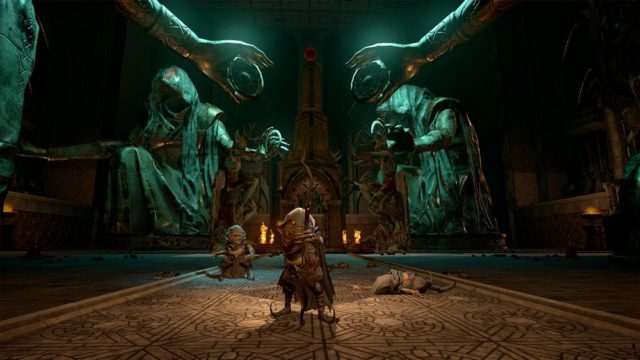
Above: Mage's Tale
Above: Mage’s Tale

Oculus announced several new games during the conference designed for Oculus Rift and Samsung Gear VR:

While special controllers tie into many of today’s VR headsets, Oculus VR vice president Jason Rubin doesn’t believe they will replace what people already use and enjoy.

“I believe that the magic of having your hands in VR is incredibly important for new users, and will be important forever,” Rubin told Gamasutra. “But there will be times, after VR matures, where people come home and go ‘I just came home from eight hours of work, and right now what I want to do is this [leans back in his chair and mimes holding a gamepad in his lap.]”

Epic announced that its VR shooter Robo Recall is now available for free on Oculus Touch, in addition to native mod editor for the game. Players can now add new maps, characters and weapons to create (and of course, stream) fully customizable experiences.

On stage, Epic presented a short film for Chevrolet called The Human Race. Filmed only with Mill Cyclops, a virtual production toolkit by post-production firm The Mill, vehicles and effects were rendered in real-time on stage, demonstrating the time-saving capabilities of being able to see CGI effects live on set or in post-production.

Gaming For The Viewers

Online streaming has become an integral part of video game success and enjoyment across the spectrum. It’s no surprise that Amazon expanded its GDC presence this year to include tutorials, demos and over 30 classes for its Lumberyard engine.

Twitch developers were also on-hand to answer questions, while Hi-Rez Studios demonstrated how it uses Twitch to engage its fans, while offering new experiences for viewers.

Twitch announced the ability to purchase games directly through a live stream on the site, beginning with partners Telltale and Ubisoft. Although a list of available games is not yet available, the streamer would receive a portion of the game sale when purchased through his/her page.

Making Ads Fun

Google is rolling out a series of tools to add playable ads for Android developers. This new feature would allow players to try a lightweight version of a game when it is advertised within a another title. The company is also expanding rewarded advertisement offerings to AdMob and auto-rotating ads between vertical and horizontal views for increased effectiveness.

Shiny New Tech

Nvidia finally unveiled its new graphics card, the GeForce GTX 1080 Ti, claiming an aggregate improvement of 35 percent over the GTX 1080. Facebook slashed prices for the Oculus Rift and Touch controllers to $500 and $100, respectively.

According to GDC’s annual “State of the Industry” survey, game developers are feeling optimistic about Nintendo’s upcoming Switch console, but are unsure about the prospects of mid-cycle console refreshes like the PlayStation 4 Pro and Xbox’s Project Scorpio.