Retailers Are Seeing Green With These St. Patrick’s Day Shopping Trends

Retailers may be feeling the luck of the Irish this weekend, thanks to St. Patrick’s Day falling on a Friday and a rough political climate that will no doubt offer many an excuse to let their hair down with some green beer and corned beef.

The National Retail Federation estimates that St. Patrick’s Day spending will reach a whopping $5.3 billion this year—the highest in survey history, and up dramatically from last year’s $4.4 billion.

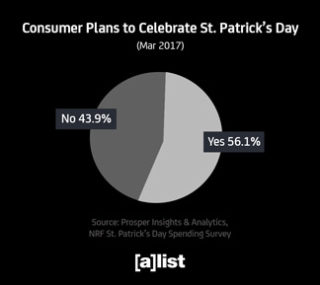
consumer-plans-to-celebrate-st.-patricks-dayAccording to NRF’s annual survey conducted by Prosper Insights & Analytics, more than 139 million Americans plan to celebrate the Irish holiday this year, and are expected to spend an average of $37.92 per person. Fifty-six percent of those surveyed plan on celebrating St. Patrick’s Day, with 88 percent of those celebrants wearing green to kick off the festivities.

The holiday is most popular among individuals 18-to-24 years old, the survey found, with 77 percent celebrating. NRF notes those ages 25-to-34 will be the biggest spenders at an average $46.55.

A little more than half (52 percent) of celebrants will purchase food, followed by beverages at 41 percent. Nearly a third (28 percent) said they were planning to purchase apparel or accessories for the celebrations, with 22 percent buying decorations and 14 percent buying candy.

“St. Patrick’s Day is a time for consumers of all ages to have fun and celebrate all things Irish whether it is attending a parade, cooking an Irish meal, or meeting friends at a bar or restaurant,” said Pam Goodfellow, the principal analyst for Prosper Insights & Analytics. “While more Americans are planning to celebrate the shamrock-filled day, expect millennials to take the lead among the festivities.”

Grocery stores will benefit from holiday shoppers, with 39 percent planning to make purchases there. Twenty-nine percent will visit discount stores, the survey revealed, with 21 percent headed to bars and restaurants, and 18 percent visiting department stores.

If you’re planning on chowing down on corned beef and cabbage this weekend, you’re in good company. According to the US Census Bureau, $133 million worth of cabbage was imported to the US in 2015, so we can only imagine how much was shipped ahead of this record-breaking holiday.

How SXSW Experiential Brand Marketing Is Still Thriving

SXSW has evolved into one of the world’s most preeminent interactive activation playgrounds celebrating technology, marketing, music and film and endless open bars in greater Austin.

If you’re a Mad Men-like marketer who has interests of pushing a brand message further—not to mention the limits of the human body during a 10-day party masked as a conference—then you must descend to the Lone Star State every March for a slate of events and programming that will inspire ideation in your respective discipline.

Fittingly, the current political climate was a pressing topic at panels, too. Even former vice president Joe Biden came to town for the conference and delivered a tearful speech.

“Keep Austin Weird” is the slogan of the city, and no two companies did that shockingly better than Hulu and Bravo.

To garner attention for their new upcoming show Stripped, cable TV network Bravo unveiled 60 models dressed in nude fabric in an activation that spread from the Austin Convention Center to jam-packed Sixth Street. Rain or shine, the flash mobs of models moved across downtown—some days with men covering their waistlines with just a pizza box, and women covering their frames with trash bags. The shock marketing stopped people to ask “What’s going on?” only to follow it up with some snap shots for social. Mission accomplished.

Meanwhile, Hulu’s activation was a wee bit creepier—albeit somewhat political. To promote their new show The Handmaids Tale, the on demand subscription video service shelled out a swarm of mysterious-looking women dressed like handmaids to further portray the symbolism behind the series. Clad in red garb, women silently strolled the streets and randomly conducted communal congregations. Offering no explanation to their appearance, they handed out cards that read “Don’t let the bastards get you down” to anyone who would approach them. Although it was silent, Hulu’s message certainly still made a splash in the city.

With so many people being present from the film industry, or just movie buffs in general, SXSW is the opportune time to promote a show.

An activation that screamed “fan appreciation” more than “be sure to check us out!” was AMC taking over a parking lot for a pop-up Los Pollos Hermanos restaurant in anticipation of season three of Better Call Saul. Show stars Bob Odenkirk and Giancarlo Esposito also made an appearance for an autograph session. The only underwhelming part of the restaurant was that there was no chicken—only some samples of Gus Fring’s curly fries. The kitchen was closed to the public, so we really didn’t know what else was cooking back there.

Others shows with outdoor activations were Starz with a King Kong-sized bison for American Gods, and TNT with a giant wave-riding pool for Animal Kingdom.


If you’re a marketer ever interested in putting on a SXSW showcase yourself, be sure to factor in for abnormal weather that locally ranges from sweltering heat, to non-stop rain. It could really alter foot traffic.

Conveniently tucked away in the dry yet frenzied confines of an ACC ballroom was The Mummy Zero Gravity VR Experience, an activation that transported attendees to the movie’s set alongside Tom Cruise and Annabelle Wallis as they performed a stunt in Zero-G four miles above sea level.

Also in the business of promoting a show, but this time from an experiential brand house was National Geographic, who is fully getting ready to launch Genius, a series that explores the life of Albert Einstein.

With SXSW timed perfectly with Pi Day on March 14, they celebrated Einstein’s birthday with a week-long session of programming with “Further Base Camp,” which featured an AR activation, a robotic portrait of Einstein’s chalkboard and an interactive photo gallery.

“We wanted to engage viewers globally with this brand-defining, first fully-scripted series that will tell the dramatic, inspiring and untold story about the life of Albert Einstein,” Jill Cress, chief marketing officer at National Geographic, told [a]listdaily. “We hope to launch our new tagline ‘Further’ as the consumer-facing expression of the brand and inspire people to fall in love with our renewed, forward-thinking brand and build on the insight that your heart will take you further than your mind ever will.”

In addition to National Geographic, large tech and media companies like Dell, IBM Watson, Panasonic, Sony, Intel, FacebookYouTube, Pinterest, Mashable, Comcast, Dropbox, Adidas, Levi’s, Gatorade, Giorgio ArmaniOtterbox and Naked Juice borrowed local Austin staples as their headquarters for the week to create conversations with consumers through a variety of experiences.

Activations ranged from immersive experiences to Plain Jane freebies to panel discussions, and of course, plenty of beer and nosh. The casual SXSW atmospheres serve as a forum to either be educated, or relax and hob nob with fellow attendees and cultivate relationships to further business for the remainder of the year.

Mazda, Capital One, Monster and Pandora served as title sponsors for SXSW, and they each had unique experiences ranging from music to tech. Esurance, McDonald’s and Bud Light also were title sponsors, but they did not blow attendees away with large scale experiences as they have as recent as last year.

Amy Heidersbach, vice president of marketing for Capital One’s digital division, told [a]listdaily that their branded house at Antone’s was a marketing reflection of what the company believes in.

“The whole experience that we brought to Austin is about being beta brave,” she said. “Whether or not we work in technology, it’s the spirit, attitude and courage of thinking differently, which is what the people of SXSW already have. We wanted to give them a peek of how we’re being beta brave as well.”

Russel Wagner, Mazda’s vice president of marketing, told [a]listdaily that sponsoring SXSW for the last three years has been a no brainer to them.

“When we look at who our target audience is of highly educated, affluent people who are definitely looking to be on the cutting edge of film, music and technology. SXSW serves to be a logical partnership for us,” Wagner said. “The results in engagement on social and on-site activations have far exceeded what we’ve set out to do.”

Mazda invited attendees to explore the brand’s design and engineering spirit, and its technology at the Mazda Studio at Empire. Their presence with a complimentary ride service was felt even more than ever this year as the city was devoid of Uber and Lyft. Mazda also had a music showcase on an intimate outdoor stage featuring acts like Rick Ross.

Susan Panico, vice president of sales marketing at Pandora, told [a]listdaily that the main message Pandora is promoting at SXSW is that #MusicIsLife.

“With the thousands of people that come through our space over the music days, specifically, they really look at Pandora for being that connective tissue that helps bring them new and emerging artists, and expose them to music that they didn’t know, but it turns out being music that they will love,” Panico said. “That’s what our personalized music discovery service is all about. There’s a balance of not only having the live music, but also partnering with advertising partners to bring in activations into our space to ensure there are engaging experiences that people want to share on social. The way that we show up at SXSW is giving people experiences and wonderful music memories.”

Rapper T.I. blew the lid off the Pandora house Tuesday on the same night as Wu Tang Clan, Wale, Thievery Corporation and Erykah Badu did for Events DC, who earlier in the week became the first local, city and state convention and tourism board to sponsor eSports. Events DC arguably had the most anticipated show of the festival as they packed the 2,750-person Austin City Limits venue to the brim before Wu tore the place down.

Before the climactic show, the WeDC House hosted 23 ambassadors that represented the District and furthered the ultimate goal at SXSW of expanding the city’s technology sector, promoting DC’s innovative startup community and fostering new partnerships among the local and national business communities.

Another city to join the experiential madhouse in promoting its region as a hot bed filled with career opportunities and rich culture and community was Atlanta with its ChooseATL branded house, where musicians like Ludacris, Jermaine Dupri and Rich Homie Quan took turns either speaking, spinning or singing at Maggie Mae’s on Sixth Street.

Kate Atwood, executive director of ChooseATL, said: “We crafted a three-day SXSW experience that promises to ignite new ideas, create business opportunities and increase the world’s sense of connectivity to our vibrant region and people.”

Countries that also brought their unique flair and heritage to Austin included The Great Britain House, Be Brasil, Casa Argentina, German Haus, Japan Factory and French House.

However, for the first time in recent memory, SXSW programming seemed to be the focal point over large-scale, expensive activations and experiences, as well as a slew of start-ups hitting the scene.

With major FOMO occurring at all times, there definitely is no shortage of experiential options both intimate and grand to explore at SXSW.

It just requires fireman-like instincts for skipping the smoke and finding the flames.

Follow Manouk Akopyan on Twitter @Manouk_Akopyan
How Game Developers Build Communities Through Modding

Modifying or “modding” a video game has become a popular pastime for many gamers over the last few decades—skillfully taking an existing game and changing it into something new. These changes can be as simple as altering a character’s appearance to completely swapping out the assets to create a whole new game altogether. Some of today’s most popular games started as mods, chief among them being Counter-Strike and Dota, and both were acquired by Valve and turned into extremely successful standalone games. Modding keeps a game fluid and relevant, so it’s no wonder that many developers have harnessed this creative community to their advantage.

Rockstar is still rockin’ it with Grand Theft Auto V due to a never-ending realm of possibilities in the game’s open world but also due to creative mods from its fans. These mods range from homemade missions to absurd characters and vehicles—as fun to watch as they are to play. Rockstar will periodically host live gameplay sessions, highlighting fan creations in GTA V as experienced by popular YouTube personalities.

Minecraft is another highly popular game for mods, creating custom worlds and adventures for themselves or the enjoyment of millions of subscribers. Like GTA V, these mods create endless entertainment possibilities for players and those who stream online—helping to sell over 121 million copies. The game is used in classrooms, teaches problem-solving skills and is even being used for eSports, thanks to organizations like Super League Gaming.

Epic Games has a long history of supporting game mods by offers tools through its Unreal Engine (UE) to modify several games like Unreal Tournament and Studio Wildcard’s ARK: Survival Evolved. The company even offers UE4 tutorials to help players learn to mod its games.

“This goes back to when Epic Games first introduced the editor and modding tools to the community,” Stacey Conley, community manager for Unreal Tournament told [a]listdaily. “Some people were able to grasp the concepts around using the editor, but many had the desire to create but did not understand the tools. Unreal Editor communities started popping up and people started asking questions. The more knowledgeable members starting creating tutorials and sharing assets. The community thrived! Some of the people creating and using the community tutorials now work for Epic. They benefited from the tutorials in a big way and they want to be sure that people using Unreal Engine and our game modding tools have the same benefit. It’s a labor of love. The modding community has always been known for its goodwill and generosity. On top of that, we’re now seeing a number of mod editors built on Unreal Engine 4 being released on the Epic Games launcher. We’ve been building and releasing learning resources for UE4 for more than three years now, and new communities of modders are able to grow their skills from the large pool of tutorials and documentation that’s out there.”

Modding has made Epic “much more community-oriented on the development side,” Conley explained, saying that they take particular care to help their players succeed in their creative goals. After all, she said, modding offers players “the world.”

“You not only shape the game that you want to play, but you can change the visual style, add new weapons, and even make a whole new game,” Conley said. “There is no limit to what you can do. Modding also offers a sense of community to those who love games, and are interested in how they are made, learning by using actual development tools like Unreal Engine 4. Teams form, and some go on to create their own games. Some of the most successful games out there started as mods for other games. Rocket League, for example, came out of popular Unreal Tournament mods!”

“We are in the unique position of not only having gamers following us, we also have modders and licensees watching our streams for information,” she explained. “This cross-pollination lends itself well to streaming and our Unreal Engine stream is watched by people at both ends of the spectrum. People will watch our game streams to see a new feature in our games. The modders who watched will jump to an Engine stream to see how it was done. In turn, they will be guided to someone streaming workflow or even stream themselves. We also host streams of creatives, gamers and modders on our channels. We’re very happy to see more and more developers streaming their work and sharing their knowledge.”

ESL Founder Discusses The Path To Successful ESports Spectacles

Ralf Reichert saw a future in competitive gaming back in 2000, long before eSports became a global phenomenon. The CEO of ESL, the largest eSports company in the world today, was in Katowice, Poland for the fifth straight year earlier this month. He’s watched as Katowice grew from an Intel Extreme Masters (IEM) tour stop experiment into the largest attended eSports event in the world for four consecutive years. Katowice has been home to the IEM Finals, where the top teams in League of Legends, StarCraft II and Counter-Strike: Global Offensive are crowned. This year, over 173,000 people attended the event at Spodek arena and the Katowice International Congress Centre, which was built to support IEM. An additional 46 million tuned in to watch the competition.

With a contract to remain in Katowice through 2019, Reichert talks to [a]listdaily about the potential of replicating the success of this eSports competition and accompanying IEM Expo in other cities, in this exclusive interview.

How challenging is it to pull off an IEM event with a partner city like Katowice, especially given this year’s two-weekend schedule?

It’s a logistically monumental thing to do. About 1,100 people were working for us over two weekends and more than 4,000 flights have been booked for this event. So, it’s just a big thing. It’s probably as big as—from an organizational standpoint—as the Super Bowl, although I don’t know the exact numbers. It’s very different from the past expectations—that an eSports event is just a small thing. This is a global scale event, on a global scale logistics level, being organized with a draw of more than 100,000 people. You can’t find a hotel room within a 30-mile radius.

How do you envision this model from Katowice being replicated on another IEM tour stop or across another ESL brand in the future?

Our goal is obviously to replicate what we built in Katowice. It took us five years to get where we are, so the first one was much smaller. Other major events we’re doing in the US specifically is New York. We did this now for the third year, and we were sold out in a much smaller arena, but we sold around 8,500 tickets. So, it’s on its way there. It’s probably taking a little bit longer just because of the population around the city. If you look within 250 kilometers around Katowice, more than 50 million people live there. So the spread is actually extremely high in terms of accessibility. In New York, there’s a little bit more than 30 million people living in the same distance. So it’s logically a little bit harder, and much harder in places such as Cologne, where we managed to sell out with 14,000 people last year. That’s already one step further. We believe that with consistency, we can grow other events in terms of the model with the experience around it. Achieving the same level is a different question because Katowice became a European phenomenon where everyone wants to be, but we at least want to get close. And we believe that is possible.

What does the IEM Expo, which is a separate event, add to the attendance numbers?

The experience around it would start with the expo, which goes through the additional tournaments across other games. Then it goes over to where the YouTubers meet up, which then has cosplay contests and many different activities, comparable to a trade fair meets a festival. This is absolutely what we need to work on and improve for the other events, but that takes time as well. It’s not as easy as shouting and everyone comes. It’s really a give and take of the value you create, and then the bigger draw it gets, the more on-site activity you can do. Those on-site activities make it a better experience, which then draws more people.

What are some of the challenges that need to be overcome in areas like Brazil and Manila, where the infrastructure for big eSports events isn’t necessarily there yet?

That is just a question of iteration, honestly. We don’t plan to do Manila and Brazil this year, but we’re pretty sure that we want to try it next year again. The biggest lag there is technical infrastructure. That is the number one thing. We took a lot of learning from last year.

That’s when the internet went out during the tournament, right?

Yes. That happened, and there are ways to overcome it, but we want to plan well so that as these problems occur we’re prepared. But we’ll definitely go back to these places. We’re not only coming back to these places, but we’re going to three new places this year with Resorts World Genting (in Malaysia), The Verizon Theater in Dallas and Barclaycard Arena in Hamburg.

Manila is ESL One, where the model is to stay and come back the next year. Brazil specifically was ESL Pro League, which is more of a traveling thing like the Super Bowl. So, we’re moving that to Dallas and later this year, we’ll be going to Sydney with IEM.

Team NRG owner Andy Miller said that the new Sacramento Kings stadium was designed for eSports. What role do you see modern or retrofitted arenas playing in the growth of eSports?

For a stadium, it goes back to value and convenience. I’m pretty sure no one really knows yet how an eSports stadium should look like. A football stadium had a couple of hundred years to iterate the right model. So, it’s super interesting to see these things—super interesting for us to do something there—but I’m pretty sure we’re at the very start of that journey and that an eSports stadium in 10 years will look very different.

What he’s referring to is that it’s not solely built for eSports, right? This is a multi-purpose stadium, which has specific features built for eSports. That’s obviously an advantage that people will figure out who are great at building these arenas and improving them, how to make them even more eSports-friendly in that it will hopefully lead to more eSports events, and therefore for more content and bigger crowds.

What impact do you feel the recent Twitter livestreaming deal will have on your eSports events moving forward given the popularity of social media with eSports fans?

We expect it to be big and super successful. ESports has been growing fantastically on Twitch reaching more than 100 million people a month. For the next phase, and to reach the growth everyone is looking at and expecting, you need to go where the people are. We do believe that we can reach a new audience and attract a new audience there. We just piloted it this weekend, so it’s super fresh, but the feedback has been great so far.

Traditional sports leagues like MLB and the NBA have long seasons, but there are off seasons. ESports seems to be going all the time. Is there any fear of over saturating the ecosystem with any particular game?

It’s a very good question. There are not data points really that oversaturation is a problem. Specifically, looking at Counter-Strike, where there have been multiple tournaments going on at the same time, the viewership has been growing in four or five months now even though the amount of content hasn’t been lowered. One of the reasons traditional sports has these long off seasons, and actually this minimal amount of content compared to eSports, is because physically you can’t play more matches. If you look at the research around it, a basketball player can’t go beyond the limits of physical prowess of what they can do. And because eSports is not that physical—it’s mentally stressful—it seems like that barrier of how many tournament matches players can play is much higher. Saying that though, a lot of teams have cut back on the events they attend and the number of leagues they play in so that they can focus more. I do feel that there’s going to be a natural consolidation, where the best products and the biggest prizes will actually win, and therefore that will solve itself to some extent.

Deep Silver CEO Details The Benefits Of Having A Hybrid Business

Founded in 1994, the German-based Koch Media created a thriving publishing business with partners long before it started its own Deep Silver brand. It is the European entity of the two brands, focused on the distribution of games and films. The company does a great deal of partner business, distributing games (mostly as retail discs) produced by renowned publishers such as Square Enix, Sega, Bethesda Softworks, Codemasters and more across certain territories. The physical retail market is still a thriving one, particularly in parts of Europe, where many countries have bandwidth caps on home internet usage.

At the same time, Deep Silver is the company’s publishing brand, famous for releasing games such as the Saints Row series, Dead Island and Homefront. Agents of Mayhem, which is being developed by the Saints Row creators, is expected to launch later this year. Additionally, the publisher licenses products from partners and publishes them under the Deep Silver brand globally. For example, the upcoming role-playing game (RPG) Kingdom Come: Deliverance is one of its key titles for 2017 alongside many others.

“We have grown from humble beginnings 23 years ago, to a company that currently employs more than 800 people,” Klemens Kundratitz, CEO and co-founder of Koch Media and Deep Silver, told [a]listdaily. “About half of our staff is in development and the other half is in publishing. That shows you that our strategy is built on three pillars. One is the development of our own Deep Silver products and publishing them globally. Second is the partner business, where we adopt different roles for different partners in different parts of the world, depending on their requirements. The third pillar, which is the smallest, is the film business that we conduct in certain European territories. Overall, for an independent globally operated company, we believe that the combination of development and publishing with a very substantial partner business is the right strategy for growth.”

Kundratitz then discussed how the company’s strategy of publishing both partner games and internally developed ones has kept the company stable and growing for over 20 years.

Klemens Kundratitz, Koch Media and Deep Silver co-founder and CEO

What convinced the company to create two separate brand names?

We believe that, in order to be relevant to our global partners, it is good to have a broad portfolio of products. The difficulty for many publishers these days is that they have two or three games per year. That is independent of the size of the publisher. Very big companies have two or three products a year along with medium or small ones.

There are these large gaps between games, and in order to be effective as a sales or marketing organization, it’s good to have a continuous flow of products. Relevance can be achieved by mixing our own products with partner products. This is a gap in the market that we have detected and now we are a clear leader. Certainly, we are the number one publishing partner in Europe. Being partnered with so many companies is a testament to our leadership as a company, which is able to solve the problem global publishers have with gaps between their big releases.

How does publishing and promoting a game in Europe compare to the US?

You have to see that Europe is not just one country—we are dealing with many languages and cultures. To be effective in Europe, you have to have a local presence in the key markets.

This is why we operate with nine regional publishing offices in all of Europe. Not only do we need to localize all assets and messaging, we also have to culturally adapt our messaging and publishing to the individual European cultural region. You really have to go the long route and be present. That’s why we have a large footprint with both the sales and marketing and PR side to get the maximum impact.

What has contributed to the success of the partner business?

We’ve been doing the partner business for 20 years now, and it’s very stable. We’ve built ourselves a name for being a very diligent operator that’s trustworthy and able to work under the direction of the primary IP holder. Not every company is built around that. We take on different sets of responsibilities. We are quite unique with what we’re doing.

This is migrating from a hybrid business, dominated by physical, to eventually being one dominated by digital, but there will still be a strong physical part of it. Koch Media in Europe acts as a consolidator for the physical business. It becomes attractive for publishers, as they focus their own resources toward the digital side, to have a reliable partner to manage the substantial physical business.

Are digital and physical game releases two different worlds?

It is clearly one game, and so it’s one success. If you’re successful in one side of the business, you are usually successful in the other. There are pros and cons to buying a product digitally or physically. Some of the players like to buy digitally because it’s convenient, but there is also another very large part of our player base that likes to go into the store to pick up a product with the option to trade it in later. It’s a hybrid business that we operate in as an industry, and it’s going to be that way for the next ten years, I’m sure.

Although they operate separately, does success with publishing partner games help to strengthen the Deep Silver brand?

Yes, I think the two things help each other because we are one of the top five vendors in most of the European territories. Each of our products in the lineup will benefit our relevance in the market. That is the case for both partner products and our own products. Also, by being connected to these leading publishers, we are learning a lot from them and they from us for the best ways to bring products to market. Combining those two elements of the business is beneficial for both our own and partner products.

How would you describe the Deep Silver brand?

Deep Silver is, first and foremost, a label which is focused on games for gamers. We do not engage in casual or non-gamer activities. We look for quality products that have a worldwide audience rather than just a local audience. As you can see, we are quite at home in the action open world shooter genre, but also RPGs, which we consider to be at the core of Deep Silver.

We also handle products from partners under the Deep Silver brand. For example, Atlus chose us as its publisher in Europe and outside the Americas both digitally and physically. Persona 5 is a product we are about to launch in Europe, simultaneously with the US launch. That’s launching under the Deep Silver brand, but it is very clear that this is purely a publishing arrangement, while Saints Row is our own IP.

Has partner publishing allowed Deep Silver to take risks with developing new IP such as Agents of Mayhem?

Agents of Mayhem is a major project for us, in so far as we’re talking about a new AAA game IP. It’s first and foremost a Volition game with all the elements you expect from the studio. [It features] the over-the-top action, tone and ludicrous type of gameplay we know from Saints Row, but applied in a new way in a new IP. That’s a very bold and ambitious project, and we’re doing it because we believe that gamers are sick of sequels. We as a publisher have to be mindful of people wanting something fresh, new and exciting. Doing that requires a new IP. We have the full weight of the company behind the project, and I can tell you it’s going to be a very exciting launch this year.

Disney’s Magical ‘Beauty And The Beast’ Marketing

It’s a tale as old as time—consumers are drawn to brands that make them feel nostalgic, and Disney is the master of childhood memories. Beauty and the Beast has been re-imagined in live action and will dance its way to the big screen this weekend alongside a massive marketing effort. The film, starring Emma Watson (Harry Potter), Dan Stevens (Downton Abbey) and Luke Evans (The Hobbit) retells the 1991 animated classic with a few creative changes and additional songs.

Excited fans can spread the magic with the help of special iMessage stickers as well as exclusive Twitter stickers that can be added to photos. All-new merchandise from the live-action adaptation is already available, from little girls’ dresses to a limited edition set of fine china (yes, that includes Mrs. Potts and her son, Chip).

The official social accounts have been hard at work spreading the hype, especially on Valentine’s Day, with the official Twitter account rewarding lucky hashtag users with rose deliveries and Luke Evans (who plays Gaston) answering fan questions from the set.

While Beauty and the Beast isn’t the first of Disney’s animated films to be adapted into live-action, it was the first at many things, including the first animated film to earn $100 million in the US box office, the first animated film nominated for three “Best Song” Academy Awards and the first Disney film adapted for Broadway. For Disney fans, the film holds a dear place in their hearts—a feeling that can be shared with the next generation. Live action movies are enjoyed across generations, bridging the gap between fans old and new.

Thanks to the success of previously reimagined films like 101 DalmatiansThe Jungle Book and Alice in Wonderland, other films are reportedly in the works including The Sword in the StonePeter Pan, Alladin and Mulan.

Miami Heat And Misfits Find Synergy Between Basketball And ESports

The Miami Heat was the second NBA team to go all-in with eSports. After the Philadelphia 76ers acquired Team Dignitas and Apex, the Heat invested in Misfits. It just so happened that the first match of the Heroes of the Storm season was Misfits vs. Dignitas, so both NBA teams and both eSports teams extended the rivalry to include a Heat vs. Sixers match-up in the digital world. Fast forward to the NBA season, when the Heat and Sixers played on the hardwood, their eSports counterparts drummed up support for each team with their gaming audiences.

These are the types of synergies that marrying traditional sports with eSports open up for both parties, as well as basketball and eSports fans, according to Michael McCullough, executive vice president and chief marketing officer of the Heat.

“We had been watching the eSports space for a while like everyone else and we noticed some of the other moves teams and owners were taking,” McCullough said. “The opportunity was the fact that the eSports audience is, for the most part, younger and digital and social media savvy. We were interested in finding out if there was any crossover with their audience and ours, and how we could access that youthfulness for the benefit of the Miami Heat. We’ve been pleasantly surprised on both fronts since engaging with Misfits.”

McCullough has seen Misfit fans who are Heat fans and are excited they have an NBA team they can root for, and Heat fans who are eSports fans come to the forefront. “We’ve seen potential business partners who are either involved in the eSports world or want to be involved and are excited we partnered with Misfits and are looking to do things with both of us,” said McCullough. “That’s been the most eye-opening thing in this experience so far. We didn’t expect that.”

Ben Spoont, CEO of Misfits, told [a]listdaily that the Heat are handling the sponsorships, sales and activation and marketing for the team directly. He added that one benefit of having the Heat handle that business is that brands that are non-endemics to eSports are endemic to basketball. The professional service an NBA team can provide is unparalleled.

“One of the incredible things about this partnership is that we’re working with key stakeholders,” Spoont said. “Anything that touches off-the-court basketball operations or logos comes under Michael. We talk two or three times a week. Having that direct interaction with the Heat folks at a high level is incredible.”

McCullough said that when this Misfits partnership first launched, all of the Heat avatars were changed to Misfits.

“We have players wearing Misfits gear, we’re always chatting on Heat properties about Misfits, and we’re trying to make that connection to the broad audience,” McCullough said. “This connection can even be seen in the logo design. If you take a close look at the Misfits redesign, the ‘T’ has a little flame from the Heat logo. A lot of people don’t catch it, but it’s a nice little Easter Egg to make that connection.”

McCullough said the Heat are creating an entire line of Misfits clothing by its in-house creative team for the Heat-specific brand Court Culture, which is the number two brand at all Heat stores. “It’s very localized and we can react to things quickly on the court with player-specific shirts that resonate with fans,” he said. “I just saw a bunch of items in the Misfits line. We’re implementing the same process we use for Court Culture, where it’s all locally designed and created and we have local distribution through the Heat store channel. We’re going full out with this, and I think there will be crossover because the gear looks cool and the logo looks fantastic. We’ll continue to make the connection and put it on our talent and in our Heat environment.”

Spoont said having the Heat on board helps Misfits look at expansion. “We’ve always been very aggressive in expansion, acquiring Team SoloMid’s CS:GO team and Super Smash Bros. player Larry Lurr,” he said. “We’re poised and ready to go wherever we want. We can write our own way. The Heat have provided a tremendous brand lift and cache. It’s the Miami Heat, not just the owners. This is the basketball team deeply integrating and involving themselves in the business of eSports.”

The Heat have 22 million followers on social media and the bulk of that audience doesn’t live in the US. “The global aspect of eSports makes a lot of sense and gives us the opportunity to grow our global brand through Misfits,” McCullough said. “We’re looking to continue to grow our domestic and global brand and take advantage of the followers we have.”

NRG ESports President Explains New Opportunities ESports Opens For City Tourism

Although it’s not officially a city, the District of Columbia is the first of what could be a new wave of local, city and state convention and tourism involvement in the burgeoning business of professional video gaming, commonly referred to as eSports. Events DC, which represents the US capital’s convention and sports authority, has officially stepped in to sponsor NRG ESports, an electronic sports team owned by NBA veterans such as Andy Miller.

While Shaquille O’Neal, Alex Rodriguez and Jimmy Rollins are the more famous investors in NRG ESports, team president Brett Lautenbach told [a]listdaily that it was early investor Justin Siegel who made the introduction to DC. “We knew DC had interest in getting involved in eSports,” said Lautenbach. “They saw that the power of eSports was something to harness and there was a benefit to working together. Conversations moved very fast with the goal to help drive tourism interest into the DC area. There’s a lot of cool stuff we can do with them.”

Lautenbach explained how Washington, DC will have logos on the team jerseys, player streams and the NRG website. It will also serve as the host city for upcoming NRG boot camps to help players prepare for big competitions across games like OverwatchCounter-Strike: Global OffensiveHearthstoneSuper Smash Bros. and Rocket League. Local WNBA team, the Washington Mystics, will get a new $65 million 4,200-seat arena by late 2018, which will be wired for eSports as well as basketball. NRG ESports co-owner Andy Miller believes this sports and concert facility will also open up DC to future eSports events. Red Bull has hosted a couple of eSports events at local DC theaters over the past few years, but having a state-of-the-art arena certainly opens up more opportunities as leagues and tournament organizers like ESL, IEM, DreamHack and MLG look to expand.

We’ll see this trend more with new arenas outfitted with eSports in mind,”  Lautenbach said. “ESports has proven that it can fill arenas like Barclay’s Center, KeyArena, MSG and Staples Center by having the assets and facilities to engage the eSports fans,” Lautenbach said. “DC has its eyes set on hosting some major events, and hopefully our seven rosters of teams could be part of that.”

DC was also home to the first-ever White House Twitch livestreaming gaming event, which was organized by the Obama administration to educate gamers about health care reform. NRG ESports was part of that event, thanks to O’Neal’s connections. According to Lautenbach, it was there that Events DC was able to get to know NRG ESports better, stating that, “DC is looking at eSports and how to tackle that at every level because they see the massive amount of fans showing up at events like MLG Columbus and ESL One New York at Barclay’s Center.”

While no current NRG ESports team is based in DC, Lautenbach said that they’d love to send players there to practice and do boot camps. “When you’re a pro player at boot camp, you scrim for eight hours a day, but there has to be a moment when you walk away from the PC and do something else with your brain,” Lautenbach explained. “The ability to take in everything DC has to offer with its history is compelling.”

Lautenbach also sees the potential to have a gaming house in DC in the future. “We could have some players stationed there for a seasonal or year-round experience,” Lautenbach said. “I’m more fond of gaming facilities, where players can come and go for practices. I see that happening in the near future and it’s the obvious way for guys to interact.”

In addition to integrating DC across all of NRG ESports’ branding, the team’s video crews will shoot segments with players in the city to delve into its history. “We’ll raise awareness that DC is a great place to go,” Lautenbach said. “I’d be stunned if we didn’t see other cities jump into eSports. Teams and tournaments have so much to offer for the eSports community. Fans are excited and they’ll support any brand or organization that gets involved. We see this every time a new brand comes into the space. They’re welcomed by the fans.”

DC is the latest non-endemic to jump into eSports, but there are still a lot of brands sitting on the sideline.

“A lot of brands have jumped in and done amazing activations, but there are always parties that are a little hesitant,” said Lautenbach. “They should jump in now rather than later. ESports has been around a long time, but it’s still early days for these brands getting involved. It’s almost always about the community more than anything else. The only reason eSports is where it is today is because of those fans. They’re so rabid and dedicated at these eSports events. If you don’t see the value of that, I can’t convince you.”

Viacom Appoints New Paramount Network Marketing Chief; Rovio Founder Starts Kaiken Entertainment

Viacom continues to restructure its cable networks this week while Rovio’s former CEO starts a new entertainment studio. Here are some of the week’s most prominent job moves.

Niels Schuurmans, a Viacom veteran, has been named as the marketing chief for the Paramount Network, TV Land and CMT. As part of this role, Schuurmans will oversee the rebranding of Spike TV to the Paramount Network.


Additionally, Dario Spina was named chief marketing officer of Viacom Velocity, a division that creates marketing programs and content for advertisers.


Viacom is also continuing to consolidate its MTV and VH1 programming teams with the promotion of Lily Neumeyer to head of development for MTV and VH1. Neumeyer is charged with overseeing the development of unscripted programming for both networks.


MGM is also reportedly in talks with Viacom and Lionsgate Entertainment to acquire all of Epix, a premium cable network. Nothing is official yet, but the deal is could be valued between $1 billion and $2 billion.


Focus Features hired Dani Weinstein as its executive vice president of publicity. In this role, Weinstein will oversee all of the company’s theatrical publicity efforts.


Veteran film executive, Jennifer Peterson has joined 20th Century Fox as executive vice president of global theatrical publicity. Peterson previously worked at Lionsgate and oversaw the publicity campaigns for La La Land and all four Hunger Games movies. In this newly created position, she will lead the studio’s publicity team on a global basis. Her appointment begins on March 13.


Hershey Entertainment announced that it has hired Leslie Ferraro as its new vice president and chief marketing officer, filling a role that has been open since 2014.


Nickelodeon Group appointed Shelly Sumpter Gillyard to the role of executive VP of talent, music and events. Sumpter Gillyard has been with the company for 19 years, and will oversee talent relations across live television, music and live-action programming for all Nickelodeon brands in her new role.


The VR studio, Here Be Dragons (formerly known as VRSE.works), has brought on former Tumblr president, John Maloney as its new networks producer. Maloney will be tasked with


Similarly, the virtual reality production company, Mandt VR, announced that it has expanded its executive team adding the Emmy Award-winning director, Brian Cavallaro, as the company’s chief creative officer. In this role, Cavallaro will oversee the creative team and direct its artistic design strategy. Cavallaro also serves as the director of development and vice president of production for Mandt Bros. Production, and his most recent film, Dog Years, stars Burt Reynolds and will premiere at the Tribeca Film Festival.


Mikael Hed, the founder and former CEO of Rovio Entertainment has formed a new company called Kaiken Entertainment. Its focus will be on animation, publishing and apps, and it’s already off to a good start. Rovio agreed to sell its Vancouver-based TV animation department and its publishing unit in Helsinki to Kaiken.

In a statement, Hed said that this is a natural progression for both companies. “Over the past few years, mobile gaming has transitioned entirely to free-to-play, but the paying audience there is much older than what we see as our audience, which is the family audience. So, there is already a natural split between who we’re targeting,” explained Hed.  “We already had this type of organization in the past, and now we’re taking a step further, making it a separate company.”


Louis Castle, co-founder of Westwood Studios (makers of the Command & Conquer franchise), has been hired as the new head of Amazon Game Studios, Seattle.


Christophe Balestr, co-president of Naughty Dog (famous for the Uncharted video game series) announced on a blog post that he is departing the company after 15 years to pursue “personal ambitions and projects.” Balestr will officially embark on his new adventure starting April 3.


Sega and Creative Assembly have agreed to acquire Crytek’s Black Sea Studio. Under the new ownership, the Bulgaria-based studio will operate as Creative Assembly Sofia.

G Fuel CEO Explains How The Brand Became Endemic To ESports Fans

G Fuel has etched a couple of firsts in eSports recently, becoming the official energy drink of Turner and WME/IMG’s ELeague, as well as acquiring the sponsorship naming rights to ELeague’s Atlanta-based studio, now identified as the G Fuel ELeague Arena. Also, all of the competitors and casters have G Fuel cups next to them during the broadcasts as part of the product integration.

Cliff Morgan, CEO of Gamma Labs, told [a]listdaily that while the naming rights for the G Fuel ELeague Arena was closer to the price of a smaller US stadium rights, in reality, that stadium holds a few million people because of the reach of eSports across the global landscape.

“We felt this was the spot to take,” Morgan said. He referenced similarities to the Ultimate Fighter reality show that helped turn UFC into a mainstream sport. He believes what Turner is doing with ELeague will have similar results in pushing eSports into the mainstream.

“With ELeague on Turner, this exposes our brand to a lot of new people on TV at the same time as the core eSports fans who watch on Twitch,” Morgan said. “Over the first two seasons, Turner has managed to get viewership up. We decided to become the official energy drink of eSports because if we want to be synergetic, we need to defend our first mover advantage.”

Morgan previously worked with Turner in 2008 on the World Series of Poker. He said that having the ELeague commercial spots on Twitter are a great way to target the eSports audience, but getting on TBS is even better.

G Fuel was also prominently displayed across the 11th annual Intel Extreme Masters (IEM) tour, which included promotions at the IEM Expo in Katowice, Poland over the past two weekends.

Morgan said that G Fuel and Gamma Labs have risen up in tandem with eSports. “G Fuel has become endemic to the eSports space as a beverage company,” Morgan said. “We’re so much more than a beverage company.”

Case in point, Morgan said fans at the IEM Expo bought up all of the company’s collectible G Fuel shaker cups and tubs. In addition, they drank 60,000 sample cups of different G Fuel flavored drinks. There are 17 flavors available in the market today.

“IEM seemed like the right spot a year ago when we committed to season 11 because we were expanding so much globally and this tournament gave us an opportunity to tour South Korea and embed ourselves in other cultures,” Morgan said. “We opened an office in Seoul, Korea recently and have three guys working there full-time to build out our brand.”

Of course, South Korea is the birthplace of eSports and that country has a rabid fan base. “We feel we can emulate our business in South Korea because we have a lead-in with IEM,” Morgan said. “The young Millennial Koreans understand our business and they love eSports. And the pro gamers are like rock stars in that country. They’re definitely ahead of the U.S. in that respect.”

Morgan feels there are two things that differentiate G Fuel from energy drinks like Monster, Red Bull and Rockstar. G Fuel gets 95 percent of its business from online orders, and fans love the brand integration. “Every day on Twitter they’re seeing photos of people building out shelves and saving G Fuel tubs,” Morgan said. “That brand attraction is what everybody searches for. When we drop a new shaker cup, it’s like Nike launching a new shoe. We’ll sell 15,000 in three minutes.”

G Fuel also works directly with eSports teams and pro gamers with its flavors. For example, Faze has its own drink, FazeBerry and the team’s pro gamer, Nordan “Faze Rain” Shat has his own flavor called Tropical Rain.

“They all want their own flavors,” Morgan said. Saqib Zahid, the number one streamer on Twitch, who’s known as Lirik, is a G Fuel ambassador and will be getting a Peach Iced Tea flavor coming out in the next 60 days.

“We have a host of other famous pro gamers and influencers who will be getting flavors,” Morgan said. “It works really well for us.”

For parents who don’t want their kids to be consuming so much caffeine, Morgan said two additional caffeine-free and stimulant-free drinks will be added in the second quarter of this year—joining the current orange flavor.

The company is also launching a 24K drink on March 22 that will include 2 milligrams of real gold, which Morgan said is good for joints, muscles and the heart. “We’ve combined the gold flakes with some high-level ingredients,” Morgan said. “This product hasn’t been designed for sitting and playing video games like G Fuel. This has been formulated for physical activity and fitness.”