While much of the world may be focused on the Nintendo Switch launch on March 3, there’s another (much more affordable) option for gamers looking for multiplayer party games. Zurich-based startup, N-Dream has launched the cloud-based AirConsole with over 50 web-based games, and there’s even a Nintendo emulator for retro classics. Gamers can play any of these games for free with advertising or pay a $3 monthly subscription for an ad-free experience. There’s no downloading required, so it becomes an instant gameplay experience.
AirConsole operates on hardware already sitting around the house. It uses a smartphone as the controller and a big screen with internet access (such as a PC, Mac, Smart TV or tablet) to showcase the browser-based game. Each smartphone automatically adapts to fit the control scheme of each game.
According to Alice Ruppert, lead game developer at N-Dream, AirConsole was created because local multiplayer games and party games are becoming hard to find on traditional consoles. “With AirConsole, we try to bring back that social casual gaming experience,” Ruppert told [a]listdaily.
A team of six runs the company, but they’ve garnered the support of over 600 developers. N-Dream has hosted a couple of developer contests to incentivize small teams to make multiplayer games for its platform. The first contest received 20 submissions and 15 of them are launching for the platform. The current contest runs through the end of February and Ruppert expects 20 to 30 game submissions. The best game receives $10,000.
While AirConsole is available globally with servers in three continents, Ruppert said the majority of the platform’s user base is from the US with a large following in Western Europe. “We have had players from just about every country in the world,” Ruppert said. “We’ve tripled our traffic in the past few months, adding 10 percent more users every week. Each of our top games has been played by hundreds of thousands of players.”
A lot of the games currently available are exclusive to AirConsole, which ties into the dearth of local multiplayer games within the ecosystem. “Local multiplayer games have been named dead a few times, but we believe that there’s an interest and demand to play local multiplayer and we’re starting to get the numbers to prove that,” Ruppert said.
Ruppert said the goal is to add more quality games to the platform over quantity of games, stating: “We’re always looking for developers, but we have the monetization in place, the product is working and we know people are interested.”
The free-to-play model, which requires gamers to watch about eight or nine 30-second ads within an hour (and some ads are skippable), has been popular with gamers. “We’re working with different ad providers to fill the ads to experiment with which types of ads work best with our users,” said Ruppert.
To date, N-Dream has marketed AirConsole through ads on Facebook and some influencer campaigns. A lot of promotion has come organically online, especially through platforms like Reddit. Since all games are browser-based, games can be played on Smart TVs and Android TV, which will be a coming push for the company.
“Some of the games need individual apps because of limited performance on some Smart TV devices,” Ruppert said. “We’re trying to get more games on Android TV and we’re also talking to hardware manufacturers.”
N-Dream will be at GDC looking for new development partners.
Yet another media company is entering the competitive eSports landscape. Minute Media recently raised another $15 million in growth capital, bringing total funding to $60 million, with a focus to expand beyond soccer and traditional sports. The company has launched DBLTAP.com to offer fans a platform to create content around eSports.
Minute Media, parent company of fan-driven sports media platforms 90min and 12up, has grown from 30 million monthly users to 70 million over the last 12 months. Launched in late 2011, Minute Media is the world’s fastest growing digital sports platform. Through its worldwide fan contribution platform, Minute Media delivers over 20,000 pieces of original, socially-driven and then curated editorial in 11 languages to users in more than 200 countries.
Duncan McMonagle, senior vice president of strategic partnerships at Minute Media, explains what opportunities eSports opens up for brands in this exclusive interview with [a]listdaily.
How are you applying lessons learned from traditional sports like soccer and basketball to eSports?
We have learned that traditional journalism is increasingly shifting to citizen journalism, content consumption from legacy destinations to social platforms, that being informed and authentic is as important—if not more so—than simply being the first to report the news. We have built a platform that leverages these shifts and accelerates them in many ways. This has enabled us to carve out a unique brand of storytelling and helped us scale in two of the most saturated and toughest media markets imaginable: in global football (soccer) through 90min.com and US sports on 12up.com. It is an approach that is equally applicable to eSports as it is in traditional sports.
The eSports media landscape went from barren to saturated very quickly over the past few years. What are the challenges of finding an audience today as a new entrant to the space?
It depends on what sort of coverage you are providing. We are focussed on providing fan-centric content that surfaces what happens around the life. Whilst the competition for scheduling tournaments and the battle for streaming platforms has intensified, nobody has really centered on content that brings the event to life, or an experience which is the next best thing to being there for a fan. With an addressable and growing market of over 250 million eSports viewers, we think this offers a huge opportunity for finding existing and new audiences.
How will you differentiate your approach from Yahoo, ESPN, The Score, DoteSports and other media companies?
Everything we do comes down to the fan. Our proprietary CMS provides rich, interactive content templates that enables all fans to have a voice and generate discussion. You don’t need to be a journalist to create great content or be able to share your point-of-view on our platform. This enables us to create an authentic, informed opinion and scale across every team, game, genre and market where fans exist. We believe this approach, combined with the access to tournaments and talent that our partnerships with the likes of ESL, Dreamhack and teams such as Fnatic afford, will be a unique and very powerful combination.
What have you discovered about the type and length of content eSports fans are interested in across video and editorial today?
We have found that there is a huge appetite for short-form video content and interactive articles that include polls or opportunities to engage. Not everyone can or will sit through five hours of live broadcast, so we provide match highlights, Top Frags and Daily Round Ups and Best Of videos. Beyond the live-action, formats that get you closer to the teams and athletes to find out what they are really like, or day in the life formats with tournament organizers of team managers work well. In addition, fans love discussing topical news such as roster changes, heroes and villains—all the content that exists in other sports but isn’t currently well catered for in eSports.
What’s your rollout launch plan?
We plan to soft launch our platform from the start of Intel Extreme Masters in Katowice at the end of February. We’ll be testing further content and video formats, continue to learn and optimize the offering from community feedback, and follow this up with a number of key product rollouts between now and the end of May when we aim to make more of an official PR and marketing splash.
What’s your strategy in working with established eSports leagues?
To be authentic you need to be present. Working with the established leagues enables us to create our unique blend of arena floor reporting style that offers fans a different point-of-view, and a glimpse inside the world of eSports. It enables us to get close to the action, the teams, and the players, to ask the questions that fans most want answered, and in certain formats have the fans ask the questions themselves directly. It provides credibility to our platform and also creates valuable complementary content for the tournaments themselves.
What role will team and player sponsorships play for your company?
This isn’t something we’ve focused on as we hope to remain tournament/league/game/team/player agnostic in order to provide neutral unbiased coverage in our content. That said, we haven’t ruled out the idea of potentially creating our own team or tournaments if the opportunities arise, but it’s not a near-term focus.
What opportunities will your approach open up to marketers and sponsors?
DBLTAP enables brands and sponsors to interact and communicate directly with fans and gamers. We already co-create credible, authentic, on-the-ground storytelling and leverage engagement tools to get fans involved on 90min and 12up, and the same opportunity exists in eSports. The brands and marketers we have spoken with have all identified that eSports is already large but fragmented across games and audiences, and we will help them to come up with engagement programs that bridge multiple games and provide global scale
How will the latest round of $15 million help with this eSports expansion?
The latest round helps us expand the team and resources required to scale in eSports, to commit to certain strategic partnerships we have identified, and to help produce the best eSports destination for fans. It also affords us time to build a viable product and to scale faster into more markets.
What type of crossover do you see between the 12Up and 90min audiences and the eSports audience?
Our user surveys have shown that over 80 percent of our global sports audience are also avid gamers (playing over nine hours per week with friends) which fits with our demographic profile, so there is huge crossover potential from our 75 million monthly unique users. Many users are naturally focused on sports titles such as FIFA, Madden and PES however, so we’ll be looking to support the development of leagues and tournaments that focus on converting sports simulator gaming into professional eSports.
We’ve seen EA Sports aim for the broader competitive gaming space. Who’s your target audience?
We see there being two distinct audiences key to building a brand and scaling content in eSports. One is the existing eSports community for whom we aim to provide rich, engaging and entertaining content experiences. The second is active gamers that haven’t yet made the switch to mainstream professional eSports, and sports simulators definitely fit into this bracket. The reality is that there are many diverse audiences across eSports as a whole depending on the genre, game title, and country, which is why we will take a slightly different editorial approach for each where we need to be sensitive to the demographic or interests of the fans of those games.
With Nintendo rolling out additional marketing muscle to generate awareness for its Switch launch on March 3, including a traveling pop-up Switch and Play Store, retailers have been sold out of hardware for weeks. GameStop, the largest independent video game retailer in the world, has seen more interest in Switch than Nintendo’s previous console, Wii U, according to Eric Bright, senior director of merchandising at GameStop.
“We’ve seen tremendous demand for Switch,” Bright told [a]listdaily. “And of the initial allocation of pre-orders we took, the majority of them were done by PowerUp Reward customers. They’re definitely looking for this device. We have a ways to go before we satisfy all the demand that’s out there.”
There’s a link on GameStop.com for customers to provide an email address to receive news about the Switch, and Bright said that “the response has been amazing.”
Nintendo has captured gamers’ attention since revealing the Switch last month at events in Tokyo and New York City, where media got hands-on with the hybrid tablet and console device.
“They’ve taken a lot of franchises like Zelda and Mario that were popular in the Wii days, gave them HD graphics, and created a system that can be played on your TV and is portable as well,” Bright said. “Those are two big technology changes for games that didn’t exist before.”
Bright believes Nintendo’s decision to launch Switch in the spring will help propel the console throughout the year.
“The Q1 launch is one of the smartest moves Nintendo could have done,” Bright said. “Instead of pushing units out during the heaviest time of the year (in Q4), this allows them to build a base. So by holiday, we can focus on games. There will be millions of people who will be hungry for content, creating a richer development cycle for game publishers who will have an install base to support titles. This also will take some of the brunt off of Christmas and enable Switch to be better stocked at stores.”
Nintendo has also attracted over 60 developers who are working on over 100 games. “Nintendo has learned from the mistakes it made with Wii U because there’s a wide assortment of third-party games from developers like EA, Ubisoft, Bethesda and Take-Two, as well as first-party Nintendo titles like The Legend of Zelda: Breath of the Wild, Super Mario Odyssey and Splatoon 2.”
Nintendo is also courting independent developers, including the GameStop-published Has-Been Heroes from Frozenbyte and GameTrust.
“The variety of indie games for Switch is one of the brilliant things Nintendo was able to do,” Bright said. “Any new console launch is all about software and content and providing people a huge variety of games. Indie developers will only expand how many consumers adopt Switch and expand the age range. We see this appealing from the hardcore gamer down to the overall family gamer.”
While there will be an assortment of different launch window games, Switch won’t include a pack-in game. Of course, retailers like GameStop are offering gamers bundles.
“The biggest win for the customer is they can make their own choice with games,” Bright said. “They can pick which of the games they want to pair with the hardware they’re buying—whether they’re Zelda fans or 1-2-Switch. From our sales perspective, we’re seeing incredible demand. We’re pleased with the Switch attach rate. People are not just buying one game. They’re buying multiple games.” Bright added that Switch is enjoying a higher attach rate than Wii U, which included a pack-in game, although he wouldn’t specify numbers.
GameStop will be rolling out hands-on opportunities for customers to play the Switch, which is expected to be in short supply for at least the foreseeable future.
“We’re looking at which stores, but you can expect to see all sorts of events throughout the year as we educate the customer on this launch,” Bright said. “We’ll also have incredible launch day activities on March 3.”
Bright sees Switch tapping into Nintendo’s Wii gamers. “Customers are going to easily be thrilled with the fact that it’s something you can play with anyone in the house because it has that Wii playability,” Bright said.
GameStop will carry the entire lineup of Nintendo products throughout 2017, which includes Nintendo 3DS, 2DS and Switch. The retailer is no longer selling new Wii U consoles. “We’re no longer purchasing Wii U units, although customers can come in and pick them up pre-owned,” Bright said. “That’s mainly because it’s no longer being made available to mass retailers. Nintendo and ourselves are fully engaged in the new hardware line-up.”
Another part of that Nintendo lineup is the NES Classic Edition. Bright said GameStop is steadily getting a flow of units that are either being put in stores or online to make sure customers can come in and get it.
“We’re still seeing incredible demand for the unit,” Bright said. “There’s no slowdown, and we don’t see that stopping. We see that continuing for some time.”
The term, “instant classic” gets thrown around a lot these days, but Capcom has a knack for developing video games that stand the test of time. From Mega Man to Street Fighter, Resident Evil to Monster Hunter, this Japanese publisher knows how to keep the fans hooked for life.
If you ever wondered what “Capcom” means, the name is a compound clipping of “Capsule Computer”—arcade machines made by the company in its early years. It’s truly fitting, then, that Street Fighter—born on August 30, 1987 in the arcade—put the publisher on the map and is still going strong today. That same year, Mega Man debuted and remains a fan-favorite while becoming the company’s flagship franchise.
Paving The Way
Ever the pioneers, Capcom’s Street FighterII is credited with establishing many of the conventions of the one-on-one fighting genre. If you’re a fan of “survival horror” games, Capcom literally invented the genre as a marketing term to describe Resident Evil.
Like Nintendo, Capcom has recently started a push to mobile with nostalgic titles like Mega Man (games one through six), Street Fighter IV and original titles like Apollo Justice: Ace Attorney (a spin-off of Phoenix Wright: Ace Attorney) and Zombie Café. The new mobile division has “one eye on the latest technology and another on Capcom’s proud legacy,” according to press materials.
Resident Evil 7: Biohazard took a major leap into virtual reality—a first for the series that proved a big hit among fans. Masachika Kawata, Resident Evil series producer told [a]listdaily that it was time to return to the game’s tense, “survival horror” origins. “We felt that the franchise has moved forward in a more action-oriented direction and we figured this would be a perfect opportunity to take RE7 and really go back to our roots—revisit them and rethink what it means.”
Thinking Outside the Game
Love it or hate it, Capcom isn’t afraid to make films from its video game franchises. While Street Fighter isn’t exactly considered a masterpiece, it was still a commercial success. Resident Evil is the highest-grossing video game film series of all time having grossed over $1 billion worldwide. The films’ writer/director, Paul W. S. Anderson is now attached to bring Capcom’s Monster Hunter franchise to life through an original story. Now that the Resident Evil movie series has ended, time will tell if we’ll ever get that TV show spin-off.
Beyond games and movies, fans have been able to enjoy Capcom’s franchises in other ways over the years, especially in Japan. Whether they’re eating game-inspired food at the Capcom Caféor getting close and personal with Resident Evil zombies or life-sized Monster Hunter creatures at Universal Studios Japan, fans are able to immerse themselves into worlds that are no longer limited to a screen. Last year, the publisher debuted its Video Game Live concert series that combined rock music with soundtracks from its most popular titles. It is this creativity that fuels Capcom’s ability to keep their classics alive . . . although the T-Virus may have something to do with it, too.
Plays.tv, which launched in 2015, is a platform that lets gamers record, replay and relive their games. Its focus is to provide a video-based replay platform that doesn’t break after every patch and make it easy for professional players to review matches, analyze their gameplay, and share highlights with their communities.
Unlike other game capture utilities, you don’t have to hit any buttons when using Plays.tv with a game, and there are special features that work with top eSports titles such as League of Legends, Dota 2, Rocket League, Counter-Strike: Global Offensive and Overwatch with more added each month. The game capture tool automatically records entire game sessions, then breaks them up by each match. The videos also show key information, such as the champions selected for each match, the kill/death/assist ratio and whether the player won or lost. Additionally, the Plays.tv platform creates a visual annotated timeline of the match, marking all the key moments of the game. Those moments are automatically edited and tagged by the system, saving users a ton of time and work.
Dennis Fong, CEO and founder of Plays.tv
“For us, context is everything,” Dennis Fong, CEO and founder of Plays.tv, told [a]listdaily. The easy-to-use gameplay highlights tool is one of the main reasons why the platform is so popular among professional eSports players.
“It’s not just about video sharing,” explained Fong. “It’s about the fact that you can go back and replay the moments that you want to relive either for self-analysis or for sharing.” Although users can choose to put the videos on platforms such as YouTube, “Plays.tv is a full 360 ecosystem,” he continued. “In our ecosystem, there are millions of people that are finding creators and sharing clips of people that they follow. We proactively recommend clips to people based on their gaming habits.” The more Plays.tv learns about you, your rank, preferred characters, and how you play, the better it can connect you with the content that best suits your tastes.
Last week, Plays.tv announced that it secured $15 million in Series A funding. Financing was led by Shasta Ventures with investors that include the San Francisco 49ers and basketball star Jeremy Lin, in addition to Accel Partners, Tenaya Capital, DAG Ventures and Founders Fund. The company also announced a partnership in December to have its video replay functions integrated into the tournament platform, FaceIt. Fong goes in-depth with [a]listdaily about how eSports played a key role in the incredible growth and success of Plays.tv.
What is the goal of Plays.tv?
Plays.tv is about helping people tell a story about the games that they’ve played and allowing others to relive it with them. As opposed to coming out of a game with three random clips in your folder, with us, you see the timeline for your entire game with bookmarks, giving you a sense of the story arc. To create a highlight reel, you just select the clips, and we will stitch them into one for you.
How did the partnership with FaceIt come together last December?
FaceIt is the top tournament competition platform, used by a lot of pros and skilled, hardcore players. I think they heard from their community that a lot of people were using Plays.tv. We also saw the same thing, with people using #FaceIt on Plays.tv. So, the partnership kind of came naturally through both of our communities.
FaceIt has thousands of matches happening every day, but the only way to relive what happened in these matches was through stats, so they wanted video highlights from the point-of-view of the players. So, we connected and found a way to link FaceIt with a Plays.tv account so that videos are associated with specific matches, and those videos will appear on the match results page or the user’s profile page.
What will the $15 million investment allow you to do?
Well, Plays.tv is essentially a brand-new company. So, we have to pay for the staff and hosting all these videos. [The funding] also speeds up the pace of innovation. We’ve got a bunch of new tools and features that are coming out soon. It’s really about expansion. We have a lot of people who are using our platform already (it’s in the double-digit millions), and we want to continue building it out.
How did you get the word out about the platform to get such rapid growth?
It’s all been organic. We haven’t spent any money acquiring users. I would say that probably the biggest impact for us was the pro gaming eSports stars discovering it and using it as a tool to replay and analyze their game. Our replay tool is considered widely as the best one in the world. It’s even better than the in-game replay tools, which many games don’t have, and replays are available right after the match—you don’t have to do anything special. Because of those reasons, all the top pro teams—Team SoloMid (TSM), Cloud9, Team Liquid, Fnatic etc.—use Plays.tv as an indispensable tool as a way for them to improve.
It is also a video sharing tool, and these guys have massive audiences and fan bases. So, they started sharing their epic moments on Plays.tv and reposted them on Twitter and Facebook, in addition to using it on stream. Someone from TSM, with 40 to 50 thousand concurrent viewers, would use the tool to review his performance after a game before starting the next match. Viewers then asked about the tool.
That’s what got the ball rolling for us and was largely how we built our initial traction. There’s nobody that does what we do from the replay perspective.
How did Jeremy Lin and the San Francisco 49ers become involved with the funding?
Working with Jeremy Lin will be a tremendous opportunity for Plays.tv. As a gamer, professional athlete and an investor, he will provide unique insight to help us shape our platform. He’s a professional athlete with tremendous talent and work ethic, a gamer, and an experienced investor who can help us in many ways, including advising us as we expand our service in Asian markets. We sought out investors who understood our vision for the company and who could help us succeed through their insight, relationships, and expertise, which is why our relationships with Jeremy Lin, the 49ers organization and TSM will be so important moving forward.
We were introduced to the 49ers and Jeremy Lin through personal connections. The 49ers give us access to one of the most successful sports organizations in the world, and I’m sure this will help as the lines between eSports and traditional sports continue to blur.
How would you say investments from traditional sports helps validate and grow the world of eSports?
The top athletes and sports organizations in the world see the level of competition and dedication that pro gamers have to be the best. They also see the massive audiences that attend eSports events and watch online. Given the similarities between the two worlds, the investments we see from traditional sports and athletes is tremendous validation.
Fnatic is one of the most successful eSports teams in the world today. It’s also one of the most recognizable brands in eSports, with teams competing across 10 games, including League of Legends, Counter-Strike: Global Offensive, Overwatch, Dota 2 and Heroes of the Storm. These teams have competed in over 600 events and won over $7 million in prize money.
Founded in 2004 by Sam Matthews, who sold his car to send his team to compete at its first eSports event in Las Vegas, Fnatic is now a global company with its headquarters based in London and offices in Los Angeles, Berlin and Belgrade and gaming houses in LA, Berlin and Kuala Lumpur. It also opened its first Fnatic team store, called the Bunkr, in London last year—with plans to build more across the globe.
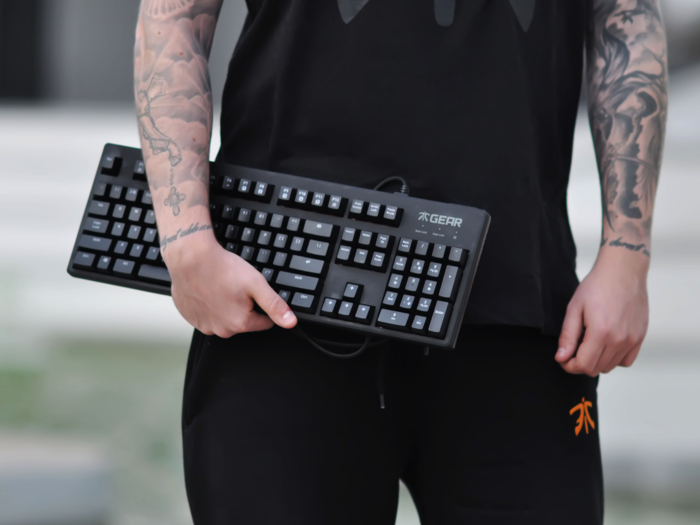
Wouter Sleijffers, CEO at Fnatic, was introduced to eSports through his work at online payments company, Skrill. He’s charged with building out the brand’s business opportunities, which includes a line of Fnatic Gear hardware and apparel. Reaching over 30 million fans monthly through its social media channels, Sleijffers talks about the opportunities eSports has opened up for teams in this exclusive interview with [a]listdaily.
Wouter Sleijffers, Fnatic CEO
How are you applying best practices from traditional sports teams, especially soccer clubs, as you build Fnatic?
We have little experience with the best practices in traditional sports teams. But in essence, you can see that the same logic and challenges apply. This means that (for example) I, personally take hardly any decisions that involve players, and leave that to the people we trust and are much better at making these decisions. We’re mostly busy with creating an environment where our pro gamers can be at their best, and there’s a lot happening behind the scenes that equally needs attention. Traditional sports and eSports are coming closer every day and with our recently launched venture with AS Roma, where Fnatic manages AS Roma’s FIFA team, we’ll both have access to our knowledge and best practices.
What’s your approach been with the Fnatic eSports store?
With Fnatic, we have a vision for ourselves and eSports, which we would rather call the “New World Sport.” The Fnatic Bunkr, our eSports store in London, brings that vision a step closer. It’s super exciting for our fans, pro gamers and everyone who loves competitive gaming, since we created a very cool store, with great eSport products and loads of events.
What can you learn from the success of traditional sports when it comes to jerseys, logos and merchandise?
Sports fans love team merchandise and it is no different for eSports fans. At the same time, we believe we can do better than that. We design, develop and engineer most of our products ourselves—100 percent Fnatic. Because eSports is something different and unlike anything we’ve seen before, the same goes for what we do at Fnatic.
What’s unique about eSports that can be applied to this type of merchandise marketing?
ESports has an immense global footprint and already has many heroes. Traditional advertising does not work anymore, but fans and enthusiasts still like to see the new things that the heroes and influencers are wearing and using. Being successful in competition is one, but doing and making things that people love regardless of the day-to-day results is another thing we’re pretty good at.
What have you seen thus far when it comes to sales of jerseys and merchandise aimed at females and children?
There’s definitely a demand for female and children jerseys and merchandise. A few things are relevant: don’t do the usual and certainly not stigmatize. You’ll likely want to develop and optimize your marketing and sales channels for it. For example, Fnatic female jerseys are more popular on Amazon than in our own shop. We’ve also recently introduced a Fnatic kit for children, where we likely need to do some more work on gifting.
What’s the most challenging part of releasing the Fnatic Rush Pro gaming gear in the crowded peripheral and hardware market?
The question we get most is if we really made all of these products ourselves. The answer is yes, Fnatic Gear is designed and engineered by Fnatic. Besides all the years of eSports experience that goes into our products, Fnatic Gear is unique in that you don’t buy just a piece of hardware with technical (useless) features. Fnatic Gear is here to make your gameplay better, to let you tap into the experience of our Pro Gamers, get access to exclusive content and be our VIP at many of our events, and receive further goodies.
How have you developed your own technology for that gaming gear?
We develop all of our current and future generation of products. The exception is our headset, the DUEL, which is a collaboration with headset company AIAIAI. This is because we loved their modular headset concept, which is a perfect fit for our vision that gaming hardware can be stylish and used for other purposes than gaming, such as music listening. So, with the DUEL, you buy at least two headsets in one, although multiple variations are possible.
Does having your own gear impact sponsorships with companies that make gaming mice?
It means that we can’t partner with everyone—as usually, these companies demand exclusivity with their product. As for ourselves, we like to give the choice to our pro gamers. If they prefer mice from another brand, they’re free to use them. It simply means we’ll need to put more work into continuing to make the best products.
What has entering the book business with ‘How to be a Professional Gamer‘ opened up for Fnatic?
The book business is not core to our activities. But of course, we don’t want to take away the chance for many of the eSports fans and aspirational pro gamers to read a great book about everything that goes into going pro in eSports. There’s a lot more that goes into it than one might think. Yet, it’s still the best job in the world to have!
What opportunities do you see for the store moving forward?
Although the store itself is a significant milestone in our mission, it’s really just a small seed we planted. When you set foot in the store, you realize that the opportunities are endless. Let’s say that, although we don’t have a stadium or arena with Fnatic, when we have launched multiple Bunkrs across the globe and make them all connected as much as eSports is, we’ll have the largest physical 24/7 eSports stadium for all kinds of competitive gaming fans in the world.
It’s a brand-new week and time for some shiny, new games to go along with it. Double Fine Productions is bringing its first franchise to virtual reality on February 21 with Psychonauts in the Rhombus of Ruin and gamers can dig into Adam Jensen’s past with a new Deus Ex: Mankind Divided “Criminal Past” DLC on February 23. This week, Ubisoft and Microsoft both take the lead in game promotions with late night comedy, a first-of-its-kind Twitter game and more.
For Honor
We might have been busy and very, very excited for the [a]list summit last week, but that doesn’t mean we didn’t notice this game’s marketing strategy . . .
Released on Valentine’s Day, this fighting game from Ubisoft pits players against one another as legendary warrior types throughout history—samurai, Vikings and medieval knights. Appealing to the PC market specifically, Ubisoft has teamed up with MSI and GeoForce to provide free copies of the game with the purchase of qualifying products. Through April 18, PC gamers can purchase either the MSI X99 graphics card, Z270 graphics card, H270 motherboard or GTX 10 series graphics card to receive a free copy of For Honor through Uplay.
The game received some welcome attention from Conan O’Brien when it was featured on Clueless Gamer on February 2. During a special Super Bowl edition of the segment, Conan was joined by Patriots quarterback Tom Brady and Falcons defensive end Dwight Freeney, along with other special guests. Let’s just say things got pretty competitive.
Ubisoft hosted a livestream to celebrate For Honor’s launch, but encouraged players to watch other streams or host their own, thanks to a team-up with Amazon. Players with a Prime subscription were given free in-game items as well as other goodies when signing up for a free trial of Twitch Prime. On February 7, Twitch hosted “War of the Factions Live,” a competition that featured popular streamers and celebrities like Jason Momoa (Justice League, Game of Thrones), Lauren Cohan (The Walking Dead) and UFC champion, Demetrious “Mighty Mouse” Johnson.
Grab For Honor and start your free 30 day trial of Twitch Prime to claim 10-day Champion Status & exclusive emblem.https://t.co/UKu9wB1wo0
Releasing on February 21 is Microsoft’s sequel to Halo Wars—a real-time strategy (RTS) game set in the sci-fi Halo universe. During E3 2016, a cinematic trailer was released revealing a new threat named Atriox—a Brute (big, bad hairy guy) who rose up against the Covenant (alien enemies from the franchise) and has been bad news for anyone crossing paths with him ever since. A number of subsequent trailers have been devoted to this new character—from the dramatic E3 reveal to Microsoft’s “Characters That Matter” promotions for the Xbox One.
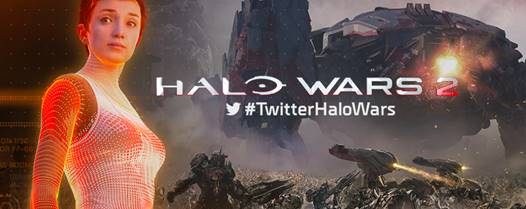
In a first for Twitter, fans were invited play an exclusive card game via Direct Message (DM) from January 19 to February 16. The game called #TwitterHaloWars allowed users to interact with Isabel, the AI character from Halo Wars 2, as well as invite friends to play along. Players were then transported into a training module where they played battle cards against their friends (or the computer) in an escalating three-round war of attacks and counters. Battle winners were provided with unique gameplay GIFs to share, along with exclusive downloadable content in the form of custom vehicle skin packs for use in-game.
“By creating this community experience exclusively on Twitter, we are able to bring fans around the world a truly personalized gaming experience in real-time,” said Dan Ayoub, studio head for strategy games at 343 Industries, in a statement.
Those who purchased the Ultimate Edition got early access to Halo Wars 2 beginning on February 17. To celebrate the launch, a live show was broadcast the night before with giveaways, cosplay and footage from the game. Microsoft’s Major Nelson (Larry Hryb) co-hosted the celebration and is currently offering a giveaway on his own website to win an Xbox One S Halo Wars 2 Ultimate Edition Bundle, Halo Wars 2 Banished Official Wired Controller for Xbox One, a Halo Wars 2 Loot Crate, J!NX gift certificates and digital Xbox One codes for copies of the game.
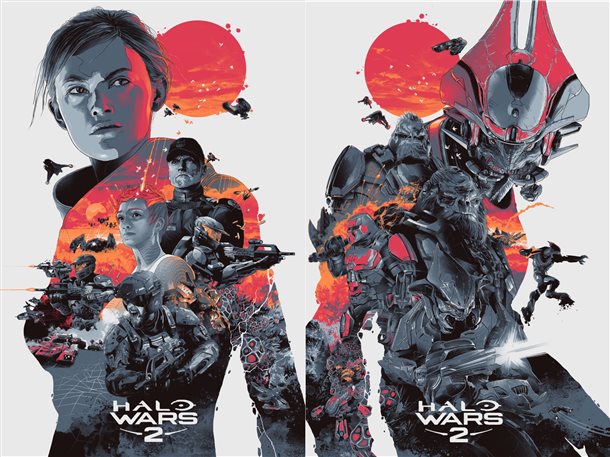
The Halo franchise has always been a source of beautifully designed characters and locales, and this title is no different. To (literally) illustrate this fact Microsoft teamed up with three talented artists to create unique posters for the game, which will be given away from the official Twitter account.
Art by Grzegorz ‘Gabz’ Domaradzki (Source: Microsoft)
Now that the world is beginning to take eSports seriously, what’s next? For those already at the frontline of innovation, change is coming.
“I think we’re going to see a lot more experimentation with different ways to distribute and deliver content for eSports and we’re going to see more growth,” observed Christina Alejandre, vice president and general manager of ELeague. “You have these games and these leagues that are firmly established ,so now it’s time to innovate [and] experiment.”
For Michael Tubman, sports and competition manager of Buffalo Wild Wings restaurants, TV plays a major role in how his brand participates—something that he predicts will continue to shift how eSports, in general, is viewed worldwide. “I think you’ll see more [eSports] going to linear TV as a complement,” he said. “ESports is digitally native and I think it always will be. It’s kind of the inverse of traditional sports, how they’re both trying to go in opposite directions as far as how they get at different customers.”
“Games will be a driving force for [social media widespread adoption of video] and eSports will be one of the spear points in that effort,” predicted Joost van Dreunen, CEO of analyst firm Superdata. “That’s going to fundamentally change the size of the market in terms of ad dollars available, but it’s also going to change the lay of the land. If you are designing a game that is a boxed, $60 thing that is sold to you through retail, those are very different design parameters than when it’s a game that needs to cater to an audience that has to be accessible but also have a sense of authenticity. That’s what these [social media] companies will be looking for.”
Oscar Miranda, business development manager for Wargaming America, likened eSports to professional baseball at the turn of the 20th century. It’s hard to imagine a time when America’s greatest pasttime wasn’t a professional, highly paid job—and professional gaming is headed in that direction.
“VR adds an interesting element to eSports because with VR, I no longer just have to watch on a 2D screen,” said Jan Goetgeluk, founder and CEO of Virtuix, noting the increasing possibilities for immersion into the competitions themselves. “I can put on a VR headset and be in the game [and] in the map. It’s much more engaging.”
“I see a broadening of the ways people watch eSports [and] engage,” added Bryan Chu, vice president of marketing for VReal. “When you get inside the game [with VR], it blurs the lines between viewer and broadcaster. You get a much bigger sense of presence and you start getting that connection between the fans, the athletes and the stars.”
“I see eSports, as it has over the past few years, moving toward the traditional sports space,” predicted Michael Flamberg, vice president and general manager of Nielsen Games. “Things are starting to get more organized and as brands get involved with it. It’s a natural evolution of making this more mainstream like a traditional sport. I think it’s going to eventually continue to move in that direction.”
A common thread among [a]list summit speakers this year was about the importance of storytelling through content. By tapping into the human interest side of eSports and casual gaming, brands learned lessons that transcended video game genres and demographics.
Heroes of the Dorm, for example, focuses on collegiate tournaments for Blizzard’s popular Heroes of the Storm title.
“One of the challenges that we have with collegiate tournaments, specifically, is that there’s a pretty high turnover of the players,” explained Adam Rosen, eSports business operations manager for Blizzard Entertainment. “One of the things that we had to focus on when we created Heroes of the Dorm was telling stories of that constant—the university. We found that it was pretty much a blessing in disguise. One of the reasons I think sports is so compelling is that we take a lot of interest in following the teams . . . following their stories and putting ourselves in their shoes. When a team is about to break the all-time record for consecutive wins, that’s something that we get behind and we root for. It’s interesting to us.
“We took a similar approach to Dorm where we said, ‘okay if we’re going to build storylines, we’re going to focus on two things.’ One of those things is stats, so we really dug deep within our games and really looked at the teams that are playing to create personas around them. We created strengths and weaknesses by how they perform in game . . . by doing that, we were able to really create identities around these teams that sometimes had players no one had heard of in their lives, but were suddenly interested because they had some sort of hook.
“Another thing we focused on was creating a really robust stream of content—telling stories within a single broadcast of a match [is difficult because] there isn’t a lot time. So we put a lot of emphasis on telling stories from start to the finish. We even made a documentary that was focused on the top four teams, their story [and] their path to that final stage. In doing so, we were able to shine a light on the human interest piece which we found really caused the audiences to connect with the teams in a way that hadn’t been done before.
“Our takeaway here is that by focusing on storytelling,” Rosen concluded, “we can focus on identities—and identities, at the end of the day, are what we connect with as fans.”
For the team behind ELeague—the eSports programming avenue by TBS—capturing the audience’s imagination through the players, too, became a vehicle for engagement.
“Storytelling is paramount to us,” explained Christina Alejandre, vice president of eSports and general manager for ELeague. “Overwatch [Open Grand Finals] was just a week-long tournament and we were working closely with Blizzard to find out who the different players and the different teams were—what stories to create around it. Even in a short turnaround time, we were able to create some of the stories.”
Steven Roberts, executive chairman of ESL, identified Intel as a prime example of a brand that has tied authenticity and credibility to the community.
“They spent an enormous amount of time over the past 12 years moving forward to every season getting better and better at telling the story about how their silicon chips are the type of performance-enhancing tool that gamers should use,” said Roberts. “They do a really good job of including their OEM at every event so that people at the event can test drive [and] understand the latest technology.”
Super League Gaming partnered with movie theaters to bring local gamers together to play and compete—an amateur arena that CEO and chairman Ann Hand likens to little league baseball. Her brand teamed up with League of Legends developer Riot Games, who guided them in how to interact with the community—something Hand appreciates.
“These publishers know their community better than anybody,” she stressed. “You just have to listen to them, and trust them.”
This year’s [a]list summit focused almost entirely on the theme of eSports and competitive gaming. While everyone agreed that authenticity is the key to engaging with an eSports audience, there’s also the matter of where and how to engage with audiences—decisions that are just as important as the brand messages themselves.
Gaming Videos Are A Driving Force
The world of competitive video gaming, including eSports, is more expansive than one might think, as SuperData founder and CEO Joost van Dreunen explained at the [a]list summit from the InterContinental Hotel on Thursday. When considering how games are consumed, one must think beyond the actual players and account for audiences too. Van Dreunen continued by saying that viewers don’t just watch competitions, they also watch YouTube videos for how to get through levels. The entire livestreame and VOD universe falls under the umbrella term “gaming video content,” which has about 1.1 billion unique viewers worldwide across all devices.
Van Dreunen stated that eSports has two main categories: people who watch but don’t play, and people who watch and play. Those combined numbers surpass the actual playing audience. Traditionally, people were only interested in watching if they were buying the games. But now a much larger audience can be reached (about 234 million people worldwide) who fit into both categories, and competitive games are changing how to meet this audience.
For example, van Dreunen talked about how Riot games is making League of Legends more watchable. The developers have worked to decrease the clutter on the screen, making the game easier to understand. At the same time, as Facebook and Twitter move into the video space, “games will be a driving force in that and eSports will be one of the spear points in that effort,” he said.
Following The Player Journey
Amazon owns streaming platform Twitch, but that’s just one way it’s involved with the video game industry. It also has multiple developers under the Amazon Game Studios brand name. Steve Fowler, head of marketing for Amazon Game Studios, explained how the company is actively increasing its efforts to follow the entire player and customer journey from beginning to end. Amazon’s process follows an individual who first sees or hears about a game and then asks about it. Then it continues as they watch others play before actively becoming players themselves.
“It’s not just the player journey anymore, it’s also the viewer,” said Fowler, who also emphasized the importance of video during his panel. He asked his developers the hypothetical questions ‘what if, instead of active players being the sole measure of success, they considered the number of viewers? What kind of impact would that change in perspective have on game development?’
Fowler later shed light on the potential for video content in gaming. “You mostly watch League of Legends from the player’s perspective. Imagine if you had to watch the Super Bowl from Tom Brady’s perspective the entire time. It would get pretty stale. We have a long way to go, but I’m super excited because I think that there are unique things we can do that even traditional sports can’t do because we’re in interactive entertainment.”
Mobile Gamers Aren’t “Gamers” Yet
Mobile is a major force in the gaming industry, but its entry into eSports has been relatively slow in comparison to console and PC gaming. A panel featuring Uyen Uyen Ton Nu, director of marketing at Super Evil Megacorp (makers of Vainglory), and Casey Chafkin, chief marketing officer and founder of the mobile eSports platform Skillz, discussed the defining differences between the two types of players.
“Mobile gaming at large is still a fledgling, niche area. But the potential for mobile eSports is astronomical,” said Ton Nu. She explained how with billions of devices around the world able to run a game like Vainglory, the addressable audience is massive, and therefore, it had tremendous potential to grow in the eSports market. Ton Nu also cited Vainglory’s incredible user growth as an example of this potential.
However, Chafkin deems things a little differently. “What we see is not just a size difference, but a self-perception difference,” he said. “Mobile gamers don’t see themselves as gamers. The average player on Skillz is playing 58 minutes a day and they are self-described as non-gamers, or casual gamers. When we think about the maturity of the space and the audience, a lot of it has to do with where the audience sees themselves in their evolutionary history.”
Skillz users are often playing games that people wouldn’t normally consider to be an eSport–like a finger bowling or bubble popping game—competitively. “I think this speaks to the idea that competition is intrinsic in gaming,” said Chafkin.
Although some might see it as paradoxical, Chafkin explained that “mobile gamers don’t see themselves as part of the eSports ecosystem, even though they’re actively participating in competitions.”
However, as mobile gaming continues to mature with more people playing competitively, Chafkin believes that they are becoming the base level of a healthy sports ecosystem, which is the amateur level of competition.
Making An Impact
Finding an audience—especially in eSports—doesn’t mean anything if you don’t know how to engage with them.
“For a brand to really make an impact, it can’t be about them,” said Bill Young, head of strategic partnerships and sponsorships, eSports at Twitch, in explaining how brands should take an altruistic approach.
Later in his panel, Young delved into fan engagement on the livestreaming platform. “I think what makes Twitch unique is the chat feature,” he said. “There are other live video platforms and other communities, but the chat feature that accompanies live video is the heart and soul of the community itself. You’re not just talking to your friends and folks who like the same games, you’re also talking to the content creators themselves, and they respond.”
In a separate panel, Hunter Leigh, head of eSports operations at Yahoo, Walter Wang, director of eSports at HTC and Candace Brenner, vice president of marketing at J!NX, talked about creating strong engagement with an eSports audience.
In comparing the Yahoo Sports and Yahoo eSports audiences, Leigh said “it’s striking how different those audiences are. [The eSports demographic] is much younger. The average [traditional] sports fan is about 35 and the average eSports fan is about 23. It’s sort of TV versus PC. ESports is also overwhelmingly male—the demo is 18-to-34-year-old-men, which is great—except that it comes with a whole host of challenges that are even more different from sports.”
Leigh explained some of the challenges come from trying to engage with a tech-savvy group, as they have grown up with technology and PC gaming. Chief among the challenges is ad blocking. “Ad block rates in eSports are absurdly high,” said Leigh. “Think of the highest number any website told you about their ad block rate, double it, and you’re getting in the range of the average eSports ad blocker.”
He continued by saying, “you can’t serve ads to this audience. If you want to connect with the core eSports audience, you need to do it through some kind of integrated content and probably get yourself on Reddit. Ad blockers and Reddit are probably two of the most fundamental concepts in getting into this space that non-endemic brands need to understand. The difference between hitting on Reddit and not hitting on Reddit to an ‘advertising’ campaign . . . is dramatic, and authenticity is a key part of landing all of that.”
Although authenticity was discussed at great length at the [a]list summit, the members of the panel also expressed the importance of platform to help bring it forward.
“Each game has its own community, and you need to speak to it,” said Wang. “All, or most of them, go on Reddit. If we don’t hit Reddit, some of the content is just not worth making.”
“When you look at your viewership numbers after a piece of content, you know night-and-day whether something has hit Reddit or not,” said Leigh, further emphasizing the point. “The platforms in this space are well established and passively powerful. Reddit isn’t actively messaging eSports in one direction or another, it’s just kind of out there. YouTube is a giant website that’s doing a lot of different things, and eSports is a piece of it. Even Twitch, which is very gaming focused—eSports is a slice of them. They are platforms that are allowing content to come on to them. Working with them and getting real presence on them is the difference between making a piece of content that nobody sees and making a piece of content that everybody sees.”
Brenner helped sum up the conversation by stating, “you have to tap into what the heartbeat is. If you’re talking about creating really compelling content or campaigns, or just a connection, it’s about tapping the emotional aspect of whatever it is. . . . It’s really about collaborative conversation and pulling out of that brand in what we think will resonate with that audience.”


 How have you developed your own technology for that gaming gear?