Keeping It Real: Video Game Experiential Marketing At Its Best

Video games take us to faraway worlds and thrust us into adventures most would never experience in real life. Being interactive by nature, video games create unique opportunities for experiential marketing, custom-suited to an already engaged fan base. After all—who wouldn’t want to explore their favorite video game for real? In a world where consumers value peer opinions and social media stars over the press, publishers like Microsoft and EA are shifting their marketing efforts toward in-person events. While many such activations take place during obvious gatherings like E3 or San Diego Comic-Con, these particular video game activations did not—but certainly went above and beyond to get fans excited.

Resident Evil 7: Biohazard

Ahead of the game’s launch, Capcom hosted Resident Evil 7The Experience in London from January 20 to 23—a real-life adventure that plunged fans into a horrifying world of zombies and much, much worse. Following the demos’ story, visitors took on the role of an intern reporter working for a paranormal investigation group called The Sewer Gators. Visitors had just 45 minutes to brave the dark house in search of missing team members, presumably without getting killed in some horrible fashion.

Final Fantasy XV

Lucky fans in the UK got to check out the game a week early and have a bit of experiential fun when Square Enix teamed up with IGN for the Final Fantasy XV IGN Premiere event in London. The exclusive event on November 22 featured life-sized creature statues, game demos and even a potion-making station. For those who weren’t able to attend, there was a one-hour live broadcast from the activation with developer interviews and never-before-seen game content.
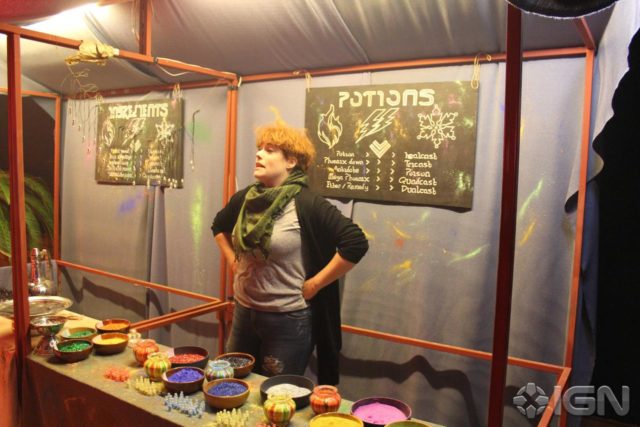
ff event

Dishonored 2

In London and at MCM Comic Con, Bethesda hosted a scavenger hunt that sent fans (literally) running toward locations to find replica “bone runes,” the collectible in-game currency used to obtain and upgrade abilities. Along with the runes, fans could pick up invitations to the Karnaca Supper Club—an immersive three-course meal set in the world of Dishonored 2. The activation, hosted by Grub Club, was a huge success and those who attended showed up in cosplay and posted dozens of times across social media. One couple even got engaged at the dinner table!

Rise of the Tomb Raider

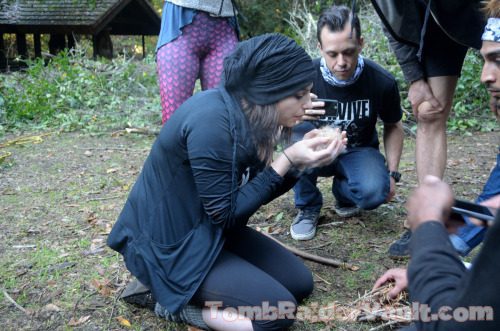
Celebrating the launch of Rise of the Tomb Raider: 20 Year Celebration Edition, Crystal Dynamics teamed up with Cliff Hodges’ Adventure Out to host Rise of the Tomb Raider: 20 Year Celebration survival training. This one-time event led 35 participants into the wilderness of Boulder Creek, California for five hours of survival training that included fire-by-friction, constructing earthen shelters, collecting and purifying water and making a bundle bow for hunting food. Joined by NatGeo Remote Survival host, Cliff Hodges and crew as well as members of Crystal Dynamics’ Rise of the Tomb Raider development team, fans competed for rare prizes and were treated to a BBQ lunch.
Watch Dogs 2

On October 13, Ubisoft invited game fans to an interactive tour of a smart home outfitted with HAUM, the in-game connected home technology used in Watch Dogs 2. The tour was captured on surveillance cameras and streamed live on Facebook and YouTube, where online fans were invited to “hack” everything in the home from the lighting to the music and even the temperature. The event attracted more than 350,000 impressions during the event, according to Lucile Bousquet, senior director of marketing and communications for Ubisoft Canada. To make the event seem more real, Ubisoft coordinated with Canadian news outlets, TSN and RDS, working with Bell Media to simulate the sites being hacked. Bousquet told Media In Canada that as a result, 50 percent of traffic to Ubisoft’s site on October 13 was from TSN and RDS.
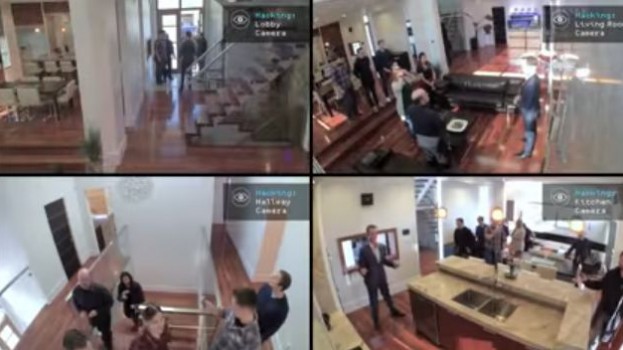
ubisoftlivehack-623x350

A recent study by EventTrack revealed that 98 percent of consumers capture content at live events, and 100 percent of those who capture content share it across their social media networks. While 83 percent of consumers share content from events up to 15 times—nearly half (47 percent) would prefer to share content they captured versus content fed to them by a brand. Experiential marketing allows gamers to meet other fans, share their adventures across social media and help solidify their nostalgia for a brand. All the more reason to get creative and invite fans to experience video game worlds for themselves.

Featured image credit: Phillip Noakes

Op-Ed: Balancing ESports TV And Digital Broadcasts

The first Heroes of the Dorm tournament (a collegiate eSports competition where teams play Heroes of the Storm to win $500,000 in scholarship money) was hailed by Activision Blizzard as a major milestone, being the first eSports event to be televised in the US—shown on ESPN2. However, that was two years ago, and now ESPN is scaling back its eSports coverage plans amid criticisms and low ratings for the tournament, giving Facebook a chance to pick it up and grow its eSports audience instead.

Although ESPN has aired both Poker tournaments and eating competitions, eSports may have been a step too far for many of its viewers—and there are good reasons why the company’s efforts haven’t been as successful as Turner’s ELeague, which hosted the ELeague Major over the weekend with a televised Counter-Strike: Global Offensive (CS:GO) Grand Final.

“We understand that the native platform for eSports is digital,” said Craig Barry, executive vice president and chief content officer for Turner Sports, discussing ELeague’s first season. “Understanding that the majority of our audience lives and breathes in the digital space creates a great opportunity.” The challenge for ELeague was to properly introduce eSports, which continues to grow in the digital space, to a more mainstream TV audience. That’s one of the reasons events like the ELeague Major play-offs and Quarterfinals were shown on Twitch and YouTube while the Grand Final was aired on television. However, there’s more to it than deciding on which tournaments to show.

Choosing The Right Game

There are quite a few games that are popular among eSports enthusiasts, chief among them being League of Legends (LOL), Dota 2, and CS:GO. ESPN was right to hope that light coverage of eSports might bring in a fresh, younger audience, especially considering how millennials watch as much eSports as they do baseball. It was also smart to look to a then an up-and-coming game developed by Blizzard as a starting point. Heroes of the Storm, which was still in beta at the time, was already growing in popularity among college students. Except, it turned out to be the wrong game for the wrong channel.

One of the main reasons ELeague chose to feature Counter-Strike instead of League of Legends was because it was both popular and accessible to viewers. There’s less explaining that needs to be done with a first-person shooter than with a MOBA, which usually starts with having to explain what MOBAs are and why people like them. Additionally, ELeague worked with key sponsors, including Arby’s, to help promote the CS:GO competition and win over gamers, who may have helped explain the game to newcomers.

While many hoped that Heroes of the Storm would shake up the eSports status quo in a way World of Warcraft changed MMORPGs, there was no getting around the fact that the game was Blizzard’s entry into the MOBA market, and its players and fans are generally the ones who understand it. Those that don’t have little motivation to learn more and find out what all the excitement is about. Furthermore, it was a newly released game that, despite Blizzard’s reputation, hadn’t made a name for itself yet outside of dedicated gaming circles.

According to Christina Alejandre, general manager of ELeague and VP of eSports at Turner Sports, TBS successfully attracted a younger audience. The first season of ELeague brought in a 70 percent increase in the male 18-34-year-old demographic, while there was a 38 percent increase in men 18-49. She also talked about how airing eSports on television helped bridge generations, as families came together on Friday nights to watch televised tournaments.

https://www.youtube.com/watch?v=PAcUIEO-3uI

It’s Still A Digital World

ESPN’s Heroes of the Dorm coverage last year may have been a kind of course correction, with a different balance between the digital and televised coverage of the tournament. However, it may have been too little too late. While ELeague hosted an Overwatch tournament during the off-season, ESPN viewers had to wait a year between Heroes competitions, and most dedicated fans were already used to watching tournaments online.

It’s also important to note that while Overwatch is also developed by Blizzard, it is a first-person shooter, and it quickly skyrocketed in popularity among both viewers and gamers despite not being free-to-play. Similar to the CS:GO tournament, only the Overwatch finals were televised while all the competitions leading up to it were broadcast online.

Even with the televised coverage of less esoteric games last year, audiences already got the message: ESPN was not the channel for eSports fans. Therefore, its annual broadcast was not enough to attract a new audience. So, perhaps the move to Facebook is the right move for everyone involved, being that it’s a digital platform for a largely digital fan base—especially given Blizzard’s livestreaming partnership with Facebook.

It remains to be seen how far ESPN intends to scale back its eSports plans and whether this move will impact coverage of games like Street Fighter V and Madden NFL. Will ESPN back out of eSports completely, handing the audience over to someone else, or strengthen its online presence before experimenting with TV broadcasts again?


Christina Alejandre is speaking at the [a]list summit. Learn everything you need to know to invest in today’s fastest-growing media channel—Competitive Gaming and eSports on 2.16.17 in Los Angeles. Go to alistsummit.com for more info.

Dell Exec Discusses IoT: It Has To Be Practical, Valuable And Solve A Real Problem

IoT is transcending industries and stimulating emerging markets, and executives are toiling on the frontline trying to identify proper use-cases for their brands to better connect with consumers for some next-level connectivity.

After all, by 2020, there will be over 26 billion connected devices in the ether for what is being billed as a $151 billion market; one third of executives admit that their companies actively deployed IoT in 2016, per Deloitte.

Mainstream vendors like Dell are leading the commercial side of the industry by pushing for smarter IoT devices and building on equipment and data by leveraging current tech investments to securely enable analytics-driven action.

On Wednesday, as part of the Dell IoT Solutions Partner Program, the hardware company made another move on that front by inking a deal with Great Bay Software to further facilitate visibility into IoT devices connected to heterogeneous networks as part of their Dell Edge Gateway 5000 Series.

Jason Shepherd, Dell’s director of IoT strategy and partnerships, joined [a]listdaily to discuss how they’re enabling secure IoT solutions and what brands need to do to create meaningful IoT activations.

Jason Shepherd, Dell’s director of IoT strategy and partnerships

On Dell’s IoT strategy . . .

“We’re focused on commercial and industrial use-cases. We’re seeing a lot of IoT in both of those markets. It’s clearly fragmented across the board. You’re seeing a lot of stuff around Alexa in the consumer space. Personally, the winners in the IoT world for consumers will be whoever owns the content pipe because you already will have that customer relationship. Amazon is doing great things there. We see some opportunity over time for Dell. But for us, it’s more on the commercial side. We have a lot of credibility in that space and customer relationships, too, with our partners that bring more of the operational side of the business. We come from the IT side. That’s where our traction is going to be.”

On how brands can create meaningful IoT activations . . .

“It has to solve a real problem. I can’t emphasize enough to be focused with experimentation and be practical about it. Solve a core problem, and don’t take on too much. Unfortunately, right now there are a lot of consumer-facing activations across the board that are not useful, and are out there just because marketers can do it. But they aren’t really valuable. And that’s why you don’t see traction. My advice to brands would be to solve a real problem and not just do something because it’s cool. It won’t fly because the average consumer won’t spend a lot of time and money, unless they like to tinker. We’re seeing a lot of ‘hey, look what I can do.’ That’s not that interesting. From a Dell perspective, it’s all about going after use-cases that drives a hard ROI for businesses that is repeatable. For us, we’re in a business to find the killer app and scale these solutions. We bring the infrastructure. Our partners bring the services.”

On the security concerns plaguing IoT . . .

“The key to security is that there is no magical answer that solves all problems. It’s about a layered approach, and knowing what you are doing. The DDoS attack that took down parts of the internet late last year was a bot that went out to IoT devices and started swarming the servers. Most of those devices had almost no security applied to it. What’s happening with consumers is there is this balance of instant gratification and ease of set-up and not having a password. You don’t have that issue on the commercial side because you’re going to do whatever you need to protect your business. There needs to be an education on the consumer side. It’s working with reputable suppliers. You’ll see that, especially with the consolidation happening with some of the larger players who own the pipe on the consumer side. You will build that in. You have fragmentation with all of the players doing cool things from a maker-movement standpoint when security is an afterthought because first and foremost it’s about going to market for them and just get something out there. It’s so fragmented and noisy that you can’t cover everything up. The attack surface is too big. When you get some centers of gravity, then you can start applying the security models and it starts to consolidate a bit. At Dell we’re doing the same thing on the commercial side for helping drive certain standards and being active in that community by working with partners. We have a lot of expertise in applying security measures. It’s about education and applying the right models.”

On education journey that needs to take place . . .

“You have to start with the use-case, and not be everything to everybody. That’s the struggle that needs to be balanced. A lot of it is going through and talking about the stories, and the impact of the use-cases. We used [Entourage star and Dell Social Good Advocate] Adrian Grenier for the potential of green impact for smaller farms. It’s about getting the message across of social and environmental impact. We’ve seen pockets of the killer app emerge. The big focus for us is to get that clarity.”

On the future of IoT . . .

“It’s driving the awareness and knowledge of security. We’re actively working on how to drive more consolidation on standards. We have to get the data integration problem more in check. Buzz really started peaking over the past couple of years. People were looking at it like ‘I want to own the customer. I want to lock people into my platform. I want to do everything.’ In 2016 people realized ‘holy crap! This is hard.’ They realized that they did not have to reinvent the middle. The industry needs a consistent baseline in the middle. You don’t have to own that and be proprietary to still add a lot of value. A big part of this year will be a consolidation effort. You’ll start seeing the platform proliferation die down. Over the next 12-to-18 months, you’ll see the platforms cut in half—some through acquisitions, some through just fizzling out—because you just don’t need 400 platforms to solve these problems.”

Follow Manouk Akopyan on Twitter @Manouk_Akopyan

https://www.youtube.com/watch?v=sja5OCzREkA

Newzoo: Forget What You Know About ‘Core’ PC Gamers

PC gamers have traditionally been a market unto themselves—hardcore, rig-building fans ready to tackle the most graphically intensive games on the market. While stereotypical hardcore PC gamers do exist in all their overclocked glory, data gathered by Newzoo reveals a parallel group of PC gamers who play less visually intensive—yet more competitive—games online, calling to question previous assumptions about the demographic as a whole.

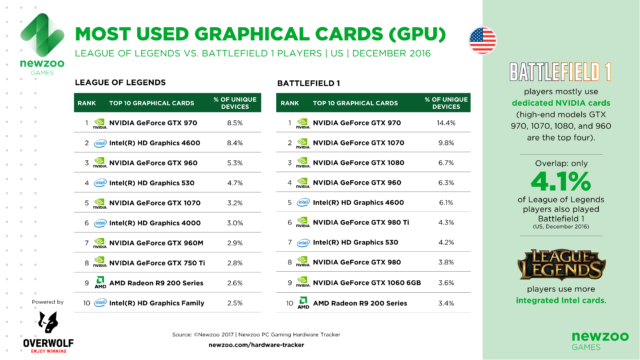
Using its PC Gaming Hardware Tracker, Newzoo examined the specifications of computers used by millions of US game enthusiasts for two popular PC games—League of Legends (LoLand Battlefield 1. Both games are competitive, highly popular and played on a PC—and yet when it comes to hardware, these titles only had a four percent audience overlap. While Battlefield 1 requires a more expensive kit to run its near photo-realistic graphics across 64-person multiplayer, League of Legends does not, allowing it to reach a wider audience and increase its portability.

“This is particularly essential for games used in eSports,” Newzoo noted in its findings, “where a low barrier of entry and a higher level of device portability are required to allow teams of players to travel, train and compete together.”

Newzoo_Most_Used_GPU_LoL_Battlefield

Peter Warman, CEO of Newzoo, told [a]listdaily that marketing a PC video game is no longer just about the players, but those who are watching livestreams as well. “There are a large number of game enthusiasts out there that spend more time viewing than gaming,” he said. “This also offers strategic opportunities for developers to branch out in terms of business models or to create interactive elements on top of streams. There already are some games in which the viewers determine the sequence of events in multiplayer games that are played by others.”

Warman went on to say that analytics behind games should cross all three groups—gamers, creators/streamers and viewers—and be combined to power effective marketing strategies. “We would rather ditch the term ‘core gamers’ and ‘core games’ completely,” he added, “and speak of game enthusiasts, immersive games, competitive games, etc.”

Newzoo is taking a “hardware per franchise” approach to identify segments of game enthusiasts that can be referenced for developers and publishers, as well as the increasing number of endemic and non-endemic brands that want to enter into eSports. “The eSports trends are finally giving these brands the opportunity they have been waiting for a long time,” Warman said, “to engage with digital natives and millennials through their favorite pastime—playing and viewing games and sharing content.”

When it comes to marketing to PC gamers, not all enthusiasts are alike.

“We are trying to make the point that graphically intense is not the only metric for what we used to call ‘core’ games,” Warman added. “Free-to-play business models that require as many players as possible and rely on extensive online multiplayer functionalities are not immersive in a graphic sense, but equally immersive from a competitive standpoint. These games put way less pressure on the graphics card. Performance depends more on the CPU and memory—especially considering the fact that these gamers are ‘mega-taskers’ who stream, communicate, run in-game apps and play a game all at the same time.”

Featured image source: Top Setup Magazine


Learn everything you need to know to invest in today’s fastest-growing media channel—Competitive Gaming and eSports on 2.16.17 in Los Angeles. Go to alistsummit.com for more info.

Editorial note: Some of the original language in this story has been changed. While the term, “PC Master Race” has long been utilized by the gaming community, we don’t defend the language. In light of the political climate, it’s insensitive and despite its commonness, we need to be better about moving the language forward rather than just being compliant.

Facebook Hires New Head Of VR; Vox Media Appoints First CMO

From mass media to home improvement, here are some of the biggest marketing job moves from the past week.

Vox Media has appointed Lindsay Nelson as its first CMO and Armando Turco joins as the first general manager of Vox Creative, leading the company’s branded content division. Nelson will drive relevance, authority, and aggressive business growth for Vox Media and its growing portfolio of brands and businesses.


Toys “R” Us has hired Carla Hassan as executive VP and global chief marketing officer to lead its global marketing efforts. Hassan previously served as senior VP for brand management at PepsiCo and worked at the company for 13 years in various marketing roles.


Lowe’s chief marketing head, Marci Grebstein, has left the company after 14 months in the position. However, the home improvement store chain quickly named a successor, Jocelyn Wong, as chief marketing officer. Prior to joining Lowe’s, Wong served as senior VP and chief marketing officer at Family Dollar.


Ford has hired former Apple executive, Musa Tariq as its vice president and chief brand officer. He starts on January 30, and will work to further build and differentiate the Ford brand.


Rosewood Hotels & Resorts announced the appointment of SiuYin Ko to the role of corporate director of sales. In this role, she will provide leadership and strategic direction for Rosewood’s North American Regional Sales organization. Additionally, Ko has been tasked with establishing a new regional office in San Francisco


Health technology software company, OptimizeRx promoted Ed Berger to the new position of SVP of marketing. In this role, Berger will be responsible for leading the company’s marketing communications strategy.


Adtech company, Mixpo has promoted Adam Noble to Vice President of Marketing and Erin Martin to vice president of customer experience and operations. Noble will oversee all brand and product marketing functions from the company’s Boston office. Martin, who was previously Mixpo’s director of marketing, is charged with enhancing customer experience and building the team, process, and operations structure to further Mixpo’s promise of best-in-class service.


Frozen food company, Birds Eye UK, has appointed Steve Challouma as its new marketing director.


Former Turner Sports VP of marketing, Jeff Mirman, has been named as chief digital officer at McCourt Global. In this role, Mirman will initially focus on the development of enhanced digital strategies for the sports and media assets in the McCourt Global portfolio.


Facebook hired Hugo Barra to head its virtual reality division three days after Barra announced that he was stepping down as Xiaomi’s global vice president.


Jagex Games Studio, developer and publisher of the MMORPG, RuneScape, has named Phil Mansell as both its COO and acting CEO. Mansell previously served as vice president of studios at Jagex and takes the role following the departure of outgoing CEO, Rod Cousens.


Florian Hunziker, former Harmonix COO and EA business director, has been named PlayStation America‘s new VP of third party relations and developer technology group. I Hunziker said that the company will continue to mix big publisher deals with support for small indie studios in an interview with Gamesbeat.


Grand Theft Auto veteran, Leslie Benzies confirmed rumors that he was starting his own game studio. The company doesn’t have an official name yet, but it will include former Grand Theft Auto leaders, Colin Entwistle and Matthew Smith. Based out of Los Angeles and Edinburgh, Scotland, the company is working on a next-generation open-world game called Everywhere.


Mobile gaming giant, King Digital acquired data analytics firm Omniata for an undisclosed price. King is known for using internal analytics and marketing to promote games such as the wildly successful Candy Crush Saga.


Italian publisher, Digital Bros has acquired the Assetto Corsa racing game developer, Kunos Simulazioni, in a cash and stock deal totaling €2.75 million ($3.45 million).


Warner Bros. has officially re-opened Avalanche Software after acquiring the company from Disney. Avalanche is best known for developing the toys-to-life game, Disney Infinity.


Crowdfunding platform, Indiegogo has appointed Nate Murray as its head of gaming. Murray has extensive experience raising funds for tabletop games, which he will use to help get video games started.


Media company Rooster Teeth, makers of Red vs. Blue, has launched its own indie game publishing division. The company has experience publishing its own game, RWBY: Grimm Eclipse, and is now it is now signing on more titles from independent developers. Its first game will Battlesloths 2025: The Great Pizza War from Invisible Collective.


Have a new hire tip? Let us know at editorial@alistdaily.com.

Connecting With Livestreamers That Best Suit Your Brand

As livestreaming for video games and other content continues to grow in prominence across platforms such as Twitch, YouTube Live and Facebook Live, more brands are looking to tap into this space. Twitch in particular, with its numerous video game streamers, connects strongly with the hard-to-reach millennial audience. But what should brands keep in mind as they look for the right broadcaster to sponsor? How do they ensure that they find the person that best represents them? [a]listdaily spoke with industry insiders to get their advice for getting onboard the livestreaming trend.


Twitch offers to do all the work when it comes to creating custom campaigns and community-facing sponsorships. However, John Newlin, custom solutions director at Twitch, offers advice for those looking to foster a relationship from the ground up. His three tips are:

  1. Don’t focus on reach alone. Just because a broadcaster has a large viewership, it doesn’t necessarily mean they are right for the brand. It comes down to community. Streamers who foster a sense of community on their streams and engage with their viewers will be able to help brands better connect with their audience. Also, look for Influencers who genuinely like and use the product or service. If selling more hamburgers is a brand’s goal, don’t go with the vegetarian streamer regardless of how popular they might be.
  2. Read the rules. Since most broadcasters list guidelines for their chat on their channel pages, look for those that promote their channels as being a hub for positive community interaction and convey a family-friendly vibe.
  3. Do your research. The types of games being streamed can help weed out channels that might be less brand-friendly, such as streamers who have a penchant for gratuitously violent and profanity-heavy games. Check out their archived videos to get a sense of which games they stream the most. Regardless of the games they play, it’s also important to learn about the type of community a streamer is cultivating and how much moderation they employ. Checking out their chat replay is a good place to start.

Roker Media co-founder and managing partner, Ronald Pruett, states that brands should start by considering the platform before connecting with a broadcaster. He also recommends devising a livestreaming plan, which would differ greatly from a traditional video series.

“Unlike a lot of platforms with influencers, livestreams are unique. I would say that different platforms go after different audiences. In other words, you may find an influencer or star on a platform [like YouTube], but their audience will be younger. Whereas someone on Facebook might target an older audience. So, platform selection is critical.

“More importantly, the whole concept of influencers and brands finding them is just starting to develop on livestreams for this reason: there are not a lot of folks out there who are great live. The output on platforms like YouTube are heavily edited. If I were a brand, I’d be extremely careful about confirming that the person I was working with has done a lot of livestreaming, and can manage the representation of the brand live.”


Chris Carley, TriplePoint PR’s influencer relations specialist, said that if there are already streamers who use and evangelize a sponsor’s product, they should be considered first for possible sponsorship. Although they may not be the largest influencers, they’ve proven to have a relevant audience, so a positive working relationship could have significant value. But the biggest advice he has for starting out is simple: Know who you are working with.

“First off, understand that content creators are not journalists, nor are they video producers with a full production team behind them. These are gamers and entertainers working to make a living off video content they produce themselves. The vast majority of content creators did not go to journalism or business school. Things like press embargoes, contracts and payment systems may be new to them. The more a sponsor understands this and can be patient with the content creator, the smoother the process will be.

“Second, similar to properly targeting your story pitches to the right journalists, sponsors should always take the time to watch as much of the potential streamer’s content as possible. Is the creator a variety streamer or focused on a specific genre of games, and would the sponsor’s game fit the audience? Do they use inappropriate language, do they rage at online opponents, or do they display any kind of behavior that the sponsor might deem inappropriate and not want to associate with? Sponsors should do the due diligence required to verify that they are ok with the maturity level of their content, and that they display and address games they play in a way that the sponsor is comfortable with.”

Additionally, Carley said that sponsors need to get comfortable with “relinquishing creative freedom to reach the desired outcome,” and that they shouldn’t try to control the messaging or insist that a streamer do something that goes against the character of the show. “This leads to a no-win situation,” he said. “The sponsor won’t get a good return on their investment, while the damage to community trust will hurt the streamer and their show. Sponsors should look for the right fit, not monetary-driven control of the talent. This isn’t a celebrity tweet nor a traditional ad spot.”


ION’s group talent director, Steven Lai, had this to say:

“As brands, it’s important to treat the broadcasters they choose to work with as a true partnership. And like any great partnership, it’s key to evaluate fit not just from a numbers perspective (viewership, audience size, engagement) but more importantly, a personality standpoint. Does the broadcaster share your brand’s values, ideals, and viewpoints? Identifying the personalities that match on all levels provides further credibility to the partnership leading to a much more meaningful, impactful, and long-term relationship.”

Image credit


Learn everything you need to know to invest in today’s fastest-growing media channel—Competitive Gaming, livestreaming and eSports on 2.16.17 in Los Angeles. Go to alistsummit.com for more info.

Stream.Me Uses ESports To Take On Twitch, YouTube and Facebook Live

The streaming market today is dominated by big companies like the Amazon-owned Twitch, Google’s YouTube Gaming and Facebook Live. A new entry in the video game streaming space is Stream.Me, which has tournaments running on games like Killer Instinct and Street Fighter V.

The video platform gives viewers the ability to simultaneously view multiple players and casters in up to 4K HD resolution video running at 60 frames-per-second. Stream.Me also allows users to blend audio from several streams and combine chat rooms from different sources. Michael Thompson, director of sales and marketing at Stream.Me, talks to [a]listdaily about the opportunities streaming platforms open up for sponsors and brands in this exclusive interview.

What separates Stream.Me from Twitch and other streaming platforms?

There are three things that separate Stream.Me from other streaming platforms:

  1. Our multi-stream feature. The multi-stream feature allows users to stream up to four content creators simultaneously without using a third-party program or software. Everything can be set up on the platform itself.
  2. The multi-chat integration feature (which goes with the multi-stream feature). Multi-chat integration combines chats from up to four content creator streams into one multi-stream chat where people can interact with each other even though they are from separate channels.
  3. Our partnership process. Our partnership process is a lot less stringent than other streaming platforms. To be qualified for a subscription button, you need to create an account, stream and get 50 followers. Once this is achieved, you will receive your sub button. The streamer can set the cost of the subscription as low as $1.00 and as high as $4.99. With each subscription, the streamer will get a 70/30 split of the revenue in their favor.

How large is your beta audience?

The Stream.Me beta had a small audience at first. In the months since then, and as we have rolled out the world’s first features that some of our more popular competitors have since copied (like streaming live from your app), our platform has grown to host more than 200 streamers and over 100,000 viewers.

What’s your rollout plan? 

Like any good rollout out plan, Steam.Me’s strategy will be flexible to match current trends, but there are some definitive details, including leveraging the most popular events like PAX, MomoCon and E3 to market and promote the platform.

As you have seen, we also are partnering with some of the top talent in the fighting game community (FGC) and having them participate in eSports tournaments we organize and host on the platform. We work with some of the most talented players in the world like Sonic Fox, the most decorated Mortal Kombat professional in the world, and Xixo, a member of the now-disbanded Natus Vincere (Na’Vi) team that won the 2015 Hearthstone World Championship.

We have a lot of other exciting developments in the works, and once we finalize them, we’ll make sure you are one of the first to know.

What role do you see eSports playing for your platform?

It only takes a glance at the major corporate brands now advertising at eSports events, the countless professional athletes from traditional sports clubs buying eSports teams, and the massive viewership numbers of tournaments to realize eSports is exploding in popularity.

By hosting tournaments on our platform, we have seen our viewership and number of new users skyrocket with each tournament.

How are you currently working with sponsors and advertisers?

We have partnered with sponsors like Arozzi Gaming Chairs, energy drink companies and have other deals in the works with some of the biggest companies in gaming, who are excited to see how Stream.Me will help grow their brand.

Like our competitors, our sponsors and advertisers have their products advertised on streams to viewers who are not subscribers. We also have seeded products with some of our most popular streamers—providing benefits to the sponsors by including organic advertising on specific channels while simultaneously giving our most popular streamers the option to obtain some free high-end physical goods that would cost them hundreds of dollars if they were to purchase on their own.

What opportunities do events such as the Savage Series open up for sponsors and advertisers?

Our Street Fighter Tournament, Savage Series, will open a wealth of new opportunities to directly reach the passionate Street Fighter community. We’ve found that while there is some crossover between our most active viewers and each eSports tournament we host, each new game brings in new viewers who devotedly follow their specific title, favorite teams and players.

By partnering with one of the biggest names in the Street Fighter scene, Alex Valle, and hosting the first tournament after the new patch adds Akuma as a playable character, we are uniquely positioned to help our partners and advertisers reach a significant portion of the Street Fighter community at a time when not much else will be occurring.

https://www.youtube.com/watch?v=K8IVVUt3Jgs

How are you marketing your platform to eSports fans?

We are reaching the eSports community by hosting tournaments with top talent on our platform that has a superior feature set.

Stream.Me is able to attract the best teams by providing industry-leading payout times. Often, these professionals are forced to wait months after winning a tournament to receive a paycheck. In our minds, that is wholly unacceptable. If an NFL player collects a check after every game, why should an eSports player have to wait months to receive payment? These world class athletes agree with our position, appreciate our respect for their craft, and how we do business.

We are able to attract viewers by offering tournaments with top level talent on our platform with market-leading technology like a fully integrated multi-stream functionality that doesn’t require a third-party app. That, in addition to 4K HD streaming at 60 fps, combined with the ability to merge multiple chat rooms into one, gives the viewer a second-to-none experience that turns a one-time viewer into a weekly active user.

How are you reaching ordinary gamers?

You are correct in the assumption that while eSports fans are ordinary gamers, not all ordinary gamers are eSports fans. This means we need a different approach to reach this specific audience.

We will have a presence at numerous consumer-facing events like MomoCon and PAX, which will allow us to present our superior feature set directly to potential viewers and the amazing eSports content we host on the platform, while simultaneously showcasing our friendlier terms for broadcasters.

Viewers don’t watch channels solely because of the platform they are hosted on. If they did, they would have come to Stream.Me a long time ago for our superior feature set, which is still in beta. Viewers come to a streaming platform to watch their favorite streamers. With our friendlier terms for streamers giving them the opportunity to monetize quicker and receive a bigger slice of the revenue, we have been able to attract some top talent away from other platforms, and we’ve found their audience comes with them.

What other eSports initiatives have you launched?

We’ve had a few successful eSports tournaments. The Deck Gauntlet (Hearthstone) and Kombat Cup (Mortal Kombat) events were both outstanding. We were extremely pleased with the results. We also have new projects in the works, but I’m not at liberty to discuss what they are at this time. However, I can tell you a LAN event will happen in the very near future.


Learn everything you need to know to invest in today’s fastest-growing media channel—Competitive Gaming and eSports on 2.16.17 in Los Angeles. Go to alistsummit.com for more info.

Bryce Harper Is The Star For Under Armour’s Big Bet On Baseball

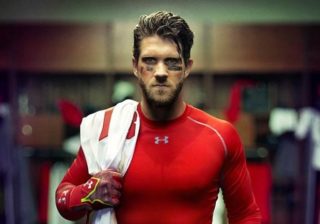
Bryce Harper is baseball’s first star born in the age of social media.

If you somewhat follow baseball, then you should know his story by now. His meteoric rise to the big show began in 2009 when at the age of 16 he was featured on the cover of Sports Illustrated, a Las Vegas prodigy with prodigious power ordained as the next LeBron James.

He put his pro career on the fast track by taking his GED and enrolled in a community college. By age 17, he was the No. 1 overall pick of the Washington Nationals. He made his MLB debut in 2012 and earned Rookie of the Year honors. At the tender age of 22, a monster 2015 season made him the youngest unanimous MVP in baseball history.

The historic campaign stamped his name as one of the sport’s rising stars, as well as its most sought after pitchman.

Last May, Under Armour added yet another distinction to Harper’s growing list of accolades—owner of the largest endorsement contract ever signed by a baseball player, a reported 10-year extension for a little more than $1 million a year. To boot, it was paired with his own signature line of shoes.

“At a very young age, UA gave me the opportunity, and I couldn’t have asked for anything better. They really took me in like family. They did everything they could to help me out on a daily basis, both on and off the field,” Harper tells [a]listdaily, seconds after being flanked with UA founder and CEO Kevin Plank. “You want to be with companies that invest in you and know that you have the talent to possibly be one of the best baseball players or athletes in the professional sport that you play. Kevin does a great job with all of the UA athletes, and not just me. It’s a great brand to be a part of and I couldn’t ask for anything better.”

The pact with the brand, which also included UA stock, is a big boon for Harper because baseball stars get enormous contracts to play the game but often have difficulty securing endorsement deals similar to the stars in other sports because of baseball’s lack of global exposure.

In the prime of his career, the personality-filled and unapologetically brash Harper is in pole position to demand dollars from sponsors who previously spoiled the likes of Derek Jeter, Alex Rodriguez, David Ortiz and Albert Pujols. In addition to being endorsed by UA for the previous six years, Harper has already secured deals with Gatorade, Jaguar, T-Mobile, MusclePharm and New Era.

And now he has his own shoe. The 24-year-old launched his own line of cleats with the UA Harper One during the All-Star Game in July.

under-armour-bryce-harper-contract-620x434

“When UA came to me and told me about branching it out and making my own shoe I was kind of shocked and happy at the same time. It’s a dream come true,” Harper says. “I was very excited to be a part of that process. They really let me spearhead it by letting them know what I wanted with the feel, and look, and give back with my Las Vegas roots. There are little hints of who I am in the shoe. I couldn’t have asked for a better look for it. That was the biggest thing. I wanted for it to be comfortable, and something that doesn’t fall apart so kids can go to the store and take advantage of buying the shoe. And it’s something I can wear every day. It’s nice.”

The five-year right fielder and millennial/Gen Z fan favorite says the best part of having his own shoe is seeing people wear it. UA is pushing for the product to end up in the hands of consumers with the global marketing campaign “It Comes From Below.”

The message? “Every great sporting moment starts with the feet.”

“Being able to see kids out there wearing my cleat is cool. It’s like wearing certain brands when you were growing up—you want to be like that player,” Harper says. “When they are wearing my cleats, I feel like they want to be like me. I’m very blessed and humble to see someone wearing my product, and I can’t thank them enough for doing it.”

underarmourmarketing

UA has only been making shoes since 2006 and the category represents just 17 percent of their entire sales. With sights on having a market share of the cleats category, especially with kids, it should help shrug off some of the struggles they’ve experienced in more lucrative shoes categories such as basketball and running, areas of which Nike dominates at 61 percent of all sales in the US.

However, on the cusp of Fortune 500 glory, UA is demanding a serious seat at the performance apparel, equipment and connected fitness table with the likes of Nike, Adidas and Reebok. They’ve steadily been hitting home runs by signing a stable of first-rate endorsers with the likes of Tom Brady, Michael Phelps, Jordan Spieth, Steph Curry, Cam Newton, Clayton Kershaw and the four-time All-Star Harper.

Already with more than 400 individual athlete partnerships across baseball, UA furthered their foothold in baseball in December by becoming MLB’s exclusive uniform provider. Their first professional league uniform deal will be for 10 years and kick into gear in 2020. The savvy moves have afforded the brand, which anticipates revenues of $4.9 billion for 2016, to steadily gain ground with a big bag of major marketing tricks. Athletes like Harper are noticing.

“I don’t want relationships to be watered down,” Harper says when asked what it’s like to work with brands. “I don’t want to just be with any product that’s out there. I don’t want to be with companies for only a year, or two months, and say ‘see ya later.’ I’m very fortunate to be associated with some very good products and can’t thank those people enough for what they do, and what they bring.”

Harper surely enjoys the spoils from sponsors off the field because of the monstrous numbers he’s put on it. Being marketable is one thing. Being marketable and an MVP candidate year-in and year-out is another.

bryce-harper-under-armour

Harper struggled to replicate his historic MVP season by batting a career low .243 in 2016—a campaign that was considered a down year altered by playing through a right shoulder injury.

He spent the offseason by going back to the basics and doing what originally got him there—swinging with his father Ron back home in Las Vegas.

“I’ve been in the gym every single day doing everything possible to get better,” he says. “That’s the biggest thing. You want to go into every single offseason and pick something to get better at. The swing has been feeling great. It feels amazing. I’ve been trying to get better, doing everything I can to get to that next step of getting the Nationals further into the postseason.”

Harper’s offseason was highlighted by marrying his longtime girlfriend Kayla Varner and avoiding arbitration with the Nationals by reaching a one-year, $13.6 million deal. Set to become a free agent after the 2018 season, his agent Scott Boras is reportedly seeking a deal in excess of 10 years and $400 million.

For now, it’s back to baseball again. Position players for the Nationals are scheduled to report for Spring Training on February 17, and Harper is champing at the bit to prove that a sub-par season, to his standards at least, was an exception and not a new norm.

“We have a great team and a great group of guys, and I know we are all looking forward to arriving in West Palm Beach for Spring Training and getting into Nationals Park and playing in front of our fans again,” he says. “I’m excited about it. I know everyone else is excited about it, too. I can’t wait to see what 2017 holds.”

Big Ten Network Lays Out College ESports Game Plan

The Big Ten Network (BTN), a joint venture between the Big Ten Conference and Fox Networks, has partnered with Riot Games to launch a season-long BTN League of Legends tournament on January 30 on BTN2Go and watch.lolesports.com with the championship game televised on March 27.

ESports clubs from Illinois, Indiana, Iowa, Maryland, Michigan, Michigan State, Minnesota, Northwestern, Ohio State, Purdue, Rutgers and Wisconsin will compete in the inaugural season. Teams will compete in the BTN East and West, playing a best-of-3 round-robin against division foes. At the end of the round-robin, the top four teams from each division will compete in a single elimination playoff bracket and the East and West champions will face each other in the BTN League of Legends Championship.

Riot is offering scholarships to the schools participating through a partnership with Scholarship America. Erin Harvego, vice president of marketing for BTN, told [a]listdaily that each school will receive six $5,000 scholarships for this trial season.

The BTN League of Legends champion will then compete in the League of Legends College Championship, which features the best collegiate teams from across the continent to determine the overall League of Legends collegiate champion. Riot has been awarding scholarship prize money to the winners of this college tournament for several years now.

Harvego said this BTN league is the result of an experiment with Riot at PAX East last year, where Michigan State took on Ohio State in League of Legends at the BTN Invitational.

“We became familiar with eSports a few years ago through some Big 10 students wanting to host a League of Legends tournament with some other schools,” Harvego said. “Through that initial conversation, I was introduced to Riot, and we did a test at PAX East that went so well that we decided to do this longer-form pilot program.”

Harvego hopes to build the foundation of a successful platform for future eSports intercollegiate competition.

“We hope to learn a lot in this pilot season, including what the best format is to reach the largest amount of people,” Harvego said.

This marks the first time Riot has partnered with a national collegiate network for an official season-long competition. The game has become especially popular on college campuses, where players have been showing their dedication and drive in the Campus Series, a season-long competition featuring more than 200 university clubs, including more than a dozen programs that offer scholarships, playing across the US and Canada.

Harvego was at PAX East last year to witness the passion and excitement that League of Legends opens up. The recent League of Legends World Championship was held at Staples Center last Halloween, the second time that stadium hosted a sold-out event.

Considering that Big Ten schools sell out massive football stadiums and pack basketball arenas, could college eSports find a larger home in the future?

“We’re not sure right now what role stadiums could play in eSports,” Harvego said. “This year, we’ll take our time and figure out our long-term strategy once we have some data.”

To date, Harvego hasn’t had any negative feedback about the tournament. Additionally, the network hasn’t had to face the question that those not familiar with eSports often ask: How is playing video games a sport?

“We’ll always have basketball, wrestling and football fans because everyone has different interests, but there definitely can be a place for eSports and traditional sports in college,” Harvego said.

While eSports currently attracts a younger audience base than traditional college sports, it also opens up a brand new audience for colleges to market directly to.

Harvego said eSports also introduces new consumers for brands and sponsors to reach through BTN.

“ESports opens up more possibilities for us with a whole new audience,” Harvego said. “This is something from a network perspective that is great programming and we want it to flourish and test out this year and figure out best practices.”

One thing Harvego said BTN is currently working through is how to explain League of Legends to a more traditional sports fan base.

When asked if there’s potential to add other popular games such as Counter-Strike: Global Offensive to BTN, Harvego admitted, “I’m a rookie in this eSports space, let’s see how it goes and figure out where to take it from there.”

The BTN eSports league is a network initiative and it not affiliated with the Big Ten Conference.


Learn everything you need to know to invest in today’s fastest-growing media channel—Competitive Gaming and eSports on 2.16.17 in Los Angeles. Go to alistsummit.com for more info.

AerServ Explains What Drives Mobile Brand Advertising

Mobile game publisher Gameloft has selected AerServ as their partner to drive in-app brand advertising, and this partnership illustrates the growth in mobile video advertising. Gameloft Advertising Solutions, Gameloft’s mobile advertising network, will gain AerServ’s expertise and technology to monetize and optimize yield across Gameloft’s arsenal of in-app advertising units. The goal is to bring high quality branded advertising into games. To that end, AerServ ads have been integrated into Gameloft games for rewarded video and mobile display ad units.

Mobile advertising is growing rapidly, and mobile video ads are leading the way as major brands see the benefits from in-app brand advertising. Video is the fastest-growing category on mobile, according to survey data from Cowen and Company. US mobile video ad spending is predicted to reach $17.42 billion in 2020, up from $4.35 billion in 2016, according to their numbers.

Gerhart small
Andrew Gerhart, AerServ COO

AerServ COO, Andrew Gerhart, spoke in depth with [a]listdaily about the deal and the future of mobile video ads.

Mobile video ads are performing well on mobile now, and Gerhart is optimistic about what lies ahead in 2017. “2016 was a fantastic year for mobile video, and we saw really great growth in that area and across all mobile applications, but video in particular had extreme growth,” said Gerhart. “That’s where we specialize the majority of our business. It performs really well for advertisers. Studies that we and other people have run indicate strong engagement and strong completion rates for advertisers that use those units. In addition, they seem to be the most engaging units for publishers and customers, as opposed to more intrusive units like an interstitial or a small banner ad. We’re seeing video continue to grow, and we anticipate in 2017 we’ll see continued growth in that area.”

Usually, in-app ads are about cross-selling other games, yet there’s a huge amount of brand advertising in other media that has yet to reach mobile in any great amount. Exploring opportunities for brand advertising in mobile games is what “kickstarted the Gameloft/AerServ partnership,” according to Gerhart. “That is where AerServ brings value to the mobile community. There are a number of different ad networks, exchanges and platforms that bring ads from other apps, cross-selling other apps. Where we add value is bringing the tools and the demand from brand advertisers like a McDonald’s, and a Chevrolet, and a Best Buy. That’s really where we focused our business, and it allowed us to engage with customers like Gameloft and drive great results for them.”

Brand advertisers have been dabbling in mobile ads, but the major influx that many have anticipated has yet to occur. “For brands, it’s not new for them, but they are certainly not at the maturity level (for mobile ad spend) as the games from Machine Zone or Supercell,” Gerhart said. “Those guys still dominate mobile ad spend, but it’s starting to shift. We’re seeing more brands come into mobile, but there’s still an education process and there are still some things that have to be worked out, but we’re seeing more spend in mobile coming from TV and non-digital media.”

AerServ

AerServ has expertise and technology that can help brand advertisers take advantage of the mobile medium. “There’s a couple of things that we do differently,” Gerhart explained. “The main thing we do really well, which gets customers like Gameloft to engage with us and drives successful partnerships, is our focus on mobile video.” That includes the technology that AerServ has built, the way their server supports mobile video, and the formats they support. What’s also important is AerServ’s ability to handle programmatic advertising. “All the stats show that 60 or 70 percent of ad spend today is programmatic, and they’re expecting that to increase in coming years,” noted Gerhart. “We’re positioned really well to allow publishers and developers to consume the demand from programmatic, but also to use our technology and tools to get their own demand from there. Customers can not only take in open marketplace demand, but they can set up private marketplace deals to sell their inventory at a premium.”

On the other end, there’s a lot that game developers can do to make these ads more effective. The key is to integrate advertising into the gameplay. “When ads are intrusive, they don’t work for anybody,” Gerhart said. “In the long term, the advertisers don’t get good engagement, and the users aren’t happy. Rewarded video is a great option because it’s integrated well and it’s not intrusive.” He also noted that native ads are “still up and coming” and that banner ads still have a place. One thing Gerhart stressed for games is making sure that they’re using programmatic so that brands have access to their inventory. “That’s really important, and not all games do that today,” Gerhart pointed out.

Gerhart is very positive about what the future holds for mobile video ads. “In terms of the next twelve months, we’ll continue to see an increase in marketers and advertisers coming into mobile,” he said. “We need to see some better technology around attribution and different things that advertisers care about. There are still some of these lingering issues, but those are small. If we fast-forward five years and we’ll see an explosion in connected TV and other media like that, but I still think mobile has such a long way to go. For the past four or five years, we’ve been hearing that now is the year of mobile. Now that consumption is at an all-time high, the market is starting to become educated. Game developers are becoming aware of brand, which is great—they understand that they don’t always have to advertise their competitors in their games.”