Bang & Olufsen is a near-century-year old company. Naturally, the Danish electronics audio brand has some offspring—and a boatload of competition champing at the bit for market share.
That’s where their sub-brand B&O Play enters the audio fray by targeting an audience of young, urban professionals with a fashion forward and contemporary offshoot of more affordable products than their parent company—all while upholding their quality design, sound performance and craftsmanship that they’re most known for.
“We are a start-up with a 90-year-old heritage,” Jens Jermiin, director of global marketing for B&O Play, told [a]listdaily. “We are standing on the shoulders of giants. At B&O Play, we are driven by a focus to bring to life our heritage of combining technology and design to create iconic products and outstanding experiences.”
Promotions and new product introductions are helping the expedited growth in the Bluetooth market. However, according to an NPD Report, Beats by Dre and LG accounted for approximately 65 percent of dollar sales in the Bluetooth headphone market for the first half of 2016. That leaves a bevy of brands hustling for proverbial bread crumbs from consumers already fully embracing a wireless future.
The product B&O Play is kicking off with this year is the sleek, bass-filled B&O Play Beoplay M5. And like their other products, the 360-degree speaker is compatible with the free Beoplay connected mobile app for iOS, which allows consumers to personalize and update their audio products on a single platform.
“Our key messaging to consumers is ‘to make beautiful music,’ achievable with B&O Play products in their lives,” Jermiin says. “We believe that music is basically making the world a better place—and we believe that if people are using our products to listen to music, they will listen to even more music.”
In December, the luxury subsidiary further touched on that notion by reimagining the importance of everyday sounds and the artistic values it holds by launching their first branded content campaign featuring a variety of artists discussing how they perceive sound in their daily lives. Each one-minute movie for the US-focused campaign is a nonlinear story about sound and highlights the connection between content and real-life happenings. It closes with the same message: “Make beautiful music.”
When discussing the design-oriented brand’s approach to capturing style-conscious customers, Jermiin says his brand’s focus is to drive end-to-end campaigns with linked activities that move the audience through the consumer journey to conversion.
In October, they used drones to promote their new B&O Play A1 Bluetooth speaker at a beach club in Singapore. The fun-in-the-sun concept allowed bikini-clad beachgoers to experience B&O Play’s mobility and sound quality, and even rent an A1 speaker by sharing their #BEOPlayA1 experience on their social channels.
“We are using social data to tap into relevant topics and events that have the attention of the people we would like to talk to, to build our position as a cultural leading brand and thus to become even more relevant and emotionally meaningful,” says Jermiin. “In line with our overall ambition to become the leading audio lifestyle brand in the world, we are working hard every day and leveraging data into actionable insights, to understand people and the role that audio plays in their lifestyle.”
In order to explore and innovate the brand, the brand is not shunning from experimenting with its marketing with emerging trends like virtual reality and SMART audio, Jermiin adds.
“It’s something that we follow with great interest as potential categories disrupting trends and services,” Jermiin says. “We are in a very exciting place. As an industry. As a company. And not the least, as a brand.”
The world might know Akon as a musician, and rightfully so. The multi-platinum recording artist moved dancefloors with a bevy of nightclub bangers at the turn of the millennium. But shortly after such hits as “Right Now” and “Smack That,” he shifted his focus to solar energy and providing electricity to millions of homes in Africa with his Akon Lighting Africa initiative.
In between the music and benevolent work, the global R&B music icon also showed a sense for the business side of the artistic world by joining budding tech company Royole as its chief creative officer to bring some serious swag in the tech space.
Royole, who touts itself as a “global pioneer and innovator of flexible displays, flexible sensors, and smart device technologies” and has a reported valuation of $3 billion, used the relationship with their newly minted CCO to introduce the special-edition Akon Moon, a 3D virtual mobile theater for movies, gaming and more.
“What made me so excited about Royole was that a lot of the things I wanted to get into, they were already doing it, and on a whole other level,” Akon told [a]listdaily. “The way the team thought about tomorrow is what attracted me the most. I was really cautious with which kind of companies to partner up with my interests in consumer electronics, and wanting to create my own virtual reality headphones. I didn’t want to do basic headphones like every other artist.”
Royole Moon combines two full HD 1080p AMOLED displays at over 3,000 PPI resolution that simulates an 800-inch curved screen with stereoscopic 3D, and unlike most VR devices on the market today, it doesn’t require specifically taped content for compatibility.
“It’s like sitting in an IMAX movie theater,” Royole founder and CEO Dr. Bill Liu told [a]listdaily. “We have a very high resolution display integrated in the device, complemented by a foldable design to incorporate the noise-cancelling headphones. It’s a perfect entertainment portal for consumers who like movies and music. We’re proud to have Akon as our chief creative officer. He’s very talented and has a lot of ideas that help us.”
Liu says Akon will serve as a bridge between science and art for his company’s engineering team and tech-savvy consumers by being involved with product design and creative direction for their line of products, specifically with ideation on the music side.
“Our products are geared toward global markets,” Dr. Liu says. “VR has been hot for the last few years. People have been talking about how everything is going to be virtual reality. I see it a bit differently, though. VR has a great future, and great potential, but it takes time. Especially on the hardware side. That’s why we designed the Moon differently. It’s not a traditional VR device. We focus on movie and high resolution video applications without motion sensors. That way, we can actually use the computation consumption to make sure the display resolutions are super high, and people can get great experiences with their movies.”
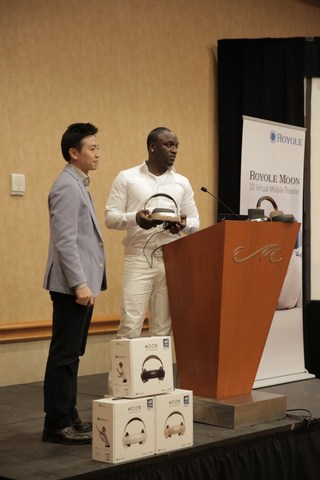
At CES earlier this month, Akon and Dr. Liu were front and center in Sin City to showcase their stable of products in both a press conference and a cavernous booth in the Las Vegas Convention Center.
That notion alone may have first been considered farfetched because Liu and Akon originally met in a hotel lobby at 4 a.m. in a chance encounter. Now, they’re both working in unison to change how sound is applied to new products technologies.
Royole, founded in 2012 by Stanford engineering graduates, capped off what they say was a successful show by winning CES 2017 Innovation Awards for their FlexPhone and Smart Cycling Backpack.
“We believe the future of information displays and consumer electronics will be mainly about human-machine interfaces, artificial intelligence and IoT,” Dr. Liu says. “You can see a lot of companies working on the AI and IoT side. We’re more focused on human-machine interface technologies with flexible displays and sensors and VR. But the industry is growing rapidly in these three categories.”
The Fremont, California-based verified “unicorn” company is growing, too, as evidenced by their expansion into a new $1.7 billion production campus in Shenzhen, China. The facility—Royole’s second in the country—will be used to mass produce their line of products. They are expecting the 1.1 million square foot project to be completed and fully operational during Q3.
Earlier last year, Royole announced their valuation grew to $3 billion after receiving $80 million in series Pre-D funding. They were also named “5 under 5” most innovative and fastest growing startup company by Scientific American.
Royole has over 700 employees from 12 different countries, but Akon is by far their most famous.
“What Royole has with flexible displays and flexible sensors, and what we’ve created with the Moon, this is a long-term relationship that we are building,” Akon says. “It’s the perfect plan to how we want to move forward. We want to have all the patents. . . . We’re coming with new innovative ideas and creations before people can wrap their minds around it. That’s what we’re dealing with now. Some of the stuff we’re doing won’t be profitable for another five or six years because it’s just too ahead of its time. We’ll have to descale that so it can engulf in the minds of the everyday person. The biggest challenge we are going to face is moving forward too fast.”
Although spearheading a burgeoning business in Royole and a creative product with Moon, Dr. Liu remains cautious by not forecasting a future with out-of-this-world predictions.
“There’s still a lot of work to do this year for all of the VR companies,” he says. “It’s still going to be hot. It just takes time.”
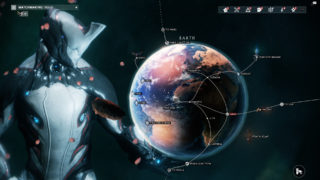
Warframe is free-to-play online action game where players get to act as space ninjas wearing battle suits called warframes. Players equip themselves with gear and weapons to explore the universe and save it from menacing monsters. Although everything in the game can be earned through gameplay, players have the option to purchase gear and cosmetic items using premium currency. But unlike many free-to-play online games, Warframe focuses on four-player cooperative gameplay without much emphasis on a competitive element, which is especially noteworthy given how its developer, Digital Extremes had a hand in creating iconic games such as Unreal Tournament and the multiplayer mode in BioShock 2.
Meridith Braun, Digital Extremes VP of publishing
Meridith Braun, VP of publishing at Digital Extremes, told [a]listdaily that Warframe was created as a last-ditch effort to transition away from the work-for-hire development it had been doing for 15 years. “We saw the change in the industry—the ballooning of AAA budgets for games that weren’t coming to independent developers. So, we needed to pivot to survive.
“Looking into the free-to-play model was the answer for us. It was something that we had a bit of experience with because Digital Extremes was founded in the shareware days, which I feel is kind of the originator of the free-to-play mechanism—you give the player a sample of what the game is like, and if it’s great and they love it, they’ll pay for more.”
Braun detailed how building a community was a key focus for the company when it started development on Warframe almost four years ago.
“[In the shareware days] we were connected directly to our players, and we got to talk to them closely. It was nice to get back to that model, where we were talking to them in real-time,” she said. “Now, in modern day free-to-play, we’re able to work with our community to change the game as they’re playing it, progressing and providing feedback.
“From the beginning, our community philosophy was to be transparent, update rapidly, and don’t be gross. There’s so much information that players have at their fingertips, so if you’re not on the ball with your communication—if you’re not straightforward and honest—they can see right through it. Updating rapidly gives us the opportunity to show them that we’re listening on a constant basis. The PC version receives anywhere from two to five hotfixes a week and major updates happen every six to eight weeks. We have conditioned the community to have high expectations of us, just as we have high expectations of them to stick around with us.”
To clarify what not “being gross” meant, Braun explained that “it’s our philosophy for a fair free-to-play model. We are all gamers, and we don’t like being hassled for our money. If the game is great, then it’s worth paying for. That’s the bottom line no matter what kind of business model you’re working with. We make monetization decisions that are much more subtle than other free-to-play games, and we hope that we’re paving the way for a new trend and a brighter outlook on what the free-to-play reputation has been since the early 2000s.”
When asked why Digital Extremes went with a cooperative shooter when it had a history developing competitive shooters, Braun said that
“It (Warframe) became a cooperative shooter after looking at the competition in the free-to-play landscape at the time, which was all PvP (Player-vs.-Player) focused. We thought that a differentiator was that there wasn’t one really good PvE (Player-vs.-Environment) shooter out there. But even though the publishers that we showed Warframe to loved the concept, artwork and gameplay, they said it would fail as soon as we said it was PvE. Luckily, we didn’t believe them, and we decided to do it on our own. The community was refreshed by a cooperative shooter, and our community was immediately set up as a friendly one, as opposed to one with immediate angst because they’re competing against each other to be better. Many people who participate in our forums and regular livestreams are surprised by how inviting, engaging and welcoming our community is.”
Warframe also released for the Xbox One and PlayStation 4 in 2013, and Braun talked about how it was more difficult to reach a console audience compared to on the PC. “On the PC, you already have them on a computer, so it’s easier to get them engaged in our community because they can go straight to our forums, Twitch page or social media pages. Both consoles have added a lot of great community features to their dashboards, but it’s still limited. You don’t have a keyboard for quickly chat with other people. So, it’s a lot more challenging for us to come up with creative ways to engage them and bring them to our other channels.
“It’s key for us to have very good relationships with Sony and Microsoft, and to work with them and let them know how Warframe is doing—especially since it’s an ongoing title and everybody is looking for the next new shiny thing. We’re in their ear on a regular basis, letting them know that Warframe is still big and still growing. We haven’t even peaked yet. We’re heading into our fourth year and we’re still growing.”
Braun also discussed how console players differ from PC gamers. “I think console players are fresher to this type of game. Free-to-play is fairly new to consoles, mainly with the PS4 and Xbox One, so we’re hitting a whole new set of gamers, and I believe that they’ve greeted it with much less skepticism than PC players. PC players have had this type of game for a long time and there are tons of free-to-play games out there that aren’t that great, so there’s more of a risk for them in picking the right ones. But Paragon released last year and so did Paladins. I think console players are very lucky because they have received the cream of the crop.”
As a free-to-play game, Warframe has done some CPA (cost per action) advertising to grow its player base, but Braun admits that Digital Extremes hasn’t done a lot to reach past its core community. “We’re starting to do more, but the stuff that we can’t measure makes us very nervous. When we first started Warframe, we barely had two nickels to rub together, and that’s why we focused on community and viral marketing—it was the least costly for us. We were watching games like Hawken and Firefall do enormous brand awareness campaigns and we were very nervous because we felt ourselves being dwarfed by their awareness. But we realized that we didn’t have to do that because they did, and they’re not around anymore.
“It was much more economical to start in the grassroots area, and less scary because we could measure it all. We could see players coming in from the various ways we were reaching out, and still to this day, there’s nothing better than word-of-mouth, which is why Twitch and YouTube [are so great]. People want referrals and testimonials.”
Although Destiny isn’t free-to-play, it’s similar in many respects to Warframe, and it has tremendous marketing and development budgets behind it. Braun discusses what it was like when the gaming juggernaut launched in 2014.
“We gripped our seats tightly and hoped and prayed,” said Braun. “Destiny was the first AAA game that we saw dent our user numbers when it launched. We were very nervous when it first came out, and we’ve kept track of what they’re doing—when updates come out—and we continue to do our own thing. Our players appreciate that we’re staying true to Warframe, and I think there’s always room for great games.”
In addition to being showcased on The Game Awards last year, Warframe launched a major updated called The War Within on the Xbox One and PS4 in December. The update had launched for the PC earlier last year and it broke concurrent player records that weekend, rocketing it up to one of the top three games on Steam during its release. Warframe was named as one of Steam’s top 100 games in 2016, and Digital Extremes intends to keep that momentum going in 2017. Plans are already underway to celebrate its four-year anniversary in a big way.
When you think of Coca-Cola, you probably imagine a polar bear or glass bottle of soda, but do you think of video games? You should. Recently named the third-most valuable company in the world, this 130-year-old brand is committed to engaging massive audiences and was one of the early mainstream brands to embrace eSports. Here’s how the most popular soft drink brand is making waves in the rising world of competitive gaming.
During an exclusive, 2014 interview with [a]listdaily, Matt Wolf (since promoted to vice president of entertainment, ventures and strategic alliances at Coca-Cola) said the company considers eSports a key pillar in its overall gaming strategy. The company aligned with Riot Games and its global League of Legends eSports infrastructure to build an amateur league featuring its Coke Zero brand.
The Power Of Streaming
“Two words: reach and scale,” Wolf expressed in the interview. “Twitch is powerful because it offers a direct-to-consumer marketing platform, however, we are really interested in the deeper integration with the community that lends itself more to the live event side of the business. The key to both platforms is credibility and authenticity—the right voice at the right time is critical to connect with the audience.”
Fans Need Communication And Engagement
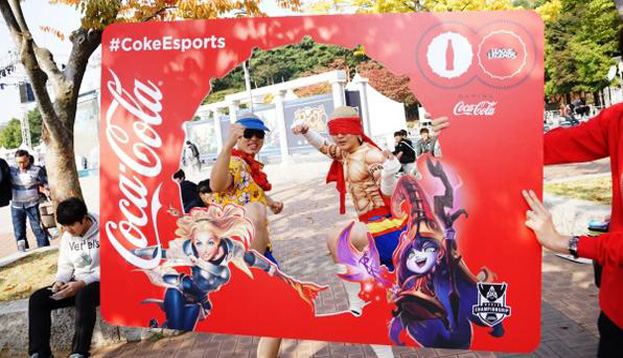
Coca-Cola’s Twitter account, @CokeEsports, engages over 354,000 followers each day, growing by 100,000 in just a year.
“We work closely with Twitter because it gives us a close one-to-one relationship with people who follow us and we can communicate quickly with that audience,” Wolf said. “The response by players and fans has been positive. We use it to announce new programs and initiatives like renewing LCS and the Cinemark movie theater deal for viewing parties. It’s been a very strong bright spot. It’s an interesting byproduct as it relates to Riot and eSports in general. Fans are very social. Twitter can be a tenuous form of communication, but we continue to create messaging and content that ultimately is about positivity and celebration of eSports. I read responses very carefully, and when fans respond it makes all of this work worthwhile.”
Coca-Cola’s head of global eSports, Alban Dechelotte told[a]listdaily that, from a brand perspective, there’s a greater ability for brands to be on stage in eSports than anywhere else in gaming in the past. “Fans love that Coke is engaged with them and recognizes the popularity of eSports,” Dechelotte said. “They love being invited to live events, whether it’s through an activation in movie theaters for League of Legends or connecting with fans live at the League of Legends world championship—which we see as the Super Bowl of eSports.”
Recently, the soda company hosted viewing parties for the 2017 Smite PC World Championship Grand Finals at select Cinemark Theaters across North America.
Authenticity Is Key
“ESports fans are just as, if not more, passionate about the games, teams, and players they follow than fans of traditional sports,” Dechelotte toldESports Insider, “but it is a much tighter rope to walk. Gamers are hyper-aware and highly communicative—make one mistake or appear disingenuous and you’ll get called out for it . . . not privately, either. If you understand them, speak their language, and give their passion the same level of respect and celebration as any other sport, they’ll love you for it.”
Dechelotte continued by saying, “we’ve learned to approach each game, community, and project we do with humility and tact. Overall, we think it’s better to start small and prioritize key insights in everything we do. ESports is not a fad. This is a real community and a sustainable industry that will keep growing year after year.”
Matt Wolf is a featured speaker at this year’s [a]list summit—sharing valuable insight into marketing strategies throughout the world of gaming. Coming to Los Angeles on February 16, [a]list summit: Competitive Gaming + ESports is the definitive event for marketers who want to understand eSports and competitive gaming and are looking to investigate opportunities in the space.
Register now to attend [a]list summit and learn the tactics and techniques to tap into this massive opportunity and get in front of this vibrant, burgeoning audience.
Seattle-based Drifter Entertainment recently raised $2.25 million in seed funding to develop virtual reality eSports games. The company was co-founded by former Epic Games, Microsoft and Oculus VR creatives Ray Davis, Kenneth Scott and Brian Murphy. While there have been experiments in virtual reality eSports from companies like Colopl Ni, it’s still a brand new frontier. So, Drifter Entertainment is meeting the challenge by bringing a team with experience in developing blockbuster franchises like Gears of War and Halo to the virtual reality ecosystem.
Davis, who previously served as general manager of Unreal Engine 4 at Epic Games, explains why his company believes in VR eSports in this exclusive interview.
How did your work with Epic Games help with this new venture?
First off, Epic is a fantastic place to work, full of really smart people. My time heading up the Unreal Engine 4 team gave me a great perspective on the evolution of the games development market, and I was also able to stay very close to the emerging VR technologies thanks to our close relationships with Valve and Oculus. Our work in building the Bullet Train VR demo for Oculus Touch was a huge influence in my decision to start a VR game development studio. It proved to me that VR truly had great potential to deliver the next generation of games.
What were your goals heading into this new company?
It’s safe to say we have two core focuses with Drifter. More than anything, we believe in building a great team with people who share our passion for chasing creativity, and we want to build a company that recognizes the value that really talented people bring to any project. We also believe simply in making things that excite us; things that we can show to each other and say, “holy s**t, that’s awesome!” It’s not always just about chasing after whatever will sell the most copies—it’s about creating works that you’re excited about, showing the world, and then building a community of fans who want to support you in making even more.
What do your partners’ diverse backgrounds bring to the table?
It’s a double-win that all of us have had the opportunity to work with AR/VR firsthand, in addition to having long track records in games development. We’re really able to hit the ground running when it comes to building VR content. Working with AR/VR in the earliest days has equipped us with a pragmatic approach: We understand that VR is going to rapidly evolve over the next few years, so it’s more important for us to ship early and often, versus falling into a traditional multi-year development cycle.
Why did you decide to focus on VR eSports?
In some ways, it’s a little less to do with VR, and far more to do with motion controls. We’re smitten with incorporating your physical movements into our game, which means players are now conveying a tremendous amount of information in a multiplayer environment. This opens the door for players to not only express themselves through their natural body language, but to also bring a new element of style to how they play the game. We believe this notion of incorporating physicality into the game experience makes for far more compelling eSports content. It’s no longer just how well you can master the rules of the game, but now your physical ability and character can play a key role. For pros, this gives a way for them to stand out among their competitors while creating far more engaging content for the spectators to view. In many ways, it brings the eSports experience even closer to traditional, physical sports.
Creatively, what has VR opened up for you as a game development studio?
Personally, making a new experience for VR has been exactly what I was craving as a game programmer after years of getting burned out on traditional AAA development cycles. So many things that you’ve taken for granted in making games just flat out doesn’t work in VR (i.e. player locomotion), so you’re immediately presented with some really hard challenges to overcome. That process (creatively smacking your head against a wall, and eventually finding an elegant solution) is incredibly rewarding, and is a big reason many developers will tell you that the act of making games is far more satisfying than actually playing them. Additionally, once you dive into VR, you quickly realize that there are many qualities the technology gives you “for free,” which help you craft experiences that are much more immersive and believable—qualities that every game developer has been chasing for the last 20+ years.
What VR platforms are you currently targeting?
Anything with reasonably good motion controls, which means Vive, Touch, and PSVR at some point. We love all VR, but if I can’t at least have my hands in the experience, then it just doesn’t cut if for us.
We’re seeing eSports selling out sports stadiums and 360 video being used to bring users into those stadiums. What do VR games open up from a “being on the playing field” perspective?
Active spectating in VR experiences is something I believe we’ll see a lot of development in over the next few years. Right now, we primarily watch our favorite pros superimposed over a video capture of the game. While that can be compelling, it rarely shares that same feeling as being physically courtside at your favorite ball game. With VR spectating, there’s no reason you can’t be toe-to-toe in that same situation, and get an experience that exceeds what you’d be able to experience in reality. Beyond that, there are a lot of interesting opportunities to involve active VR spectators into the match as well, much like how services like Twitch are offering more and more ways for fans to engage with their favorite players.
How are you allocating this initial $2.25 million funding?
This round of funding was exclusively focused on helping us build out the team, helping us grow from the founding crew of three to a team of around 15 developers across engineering, art and design.
When will gamers be able to start playing your titles?
Optimistically, we’re looking to make our first game available sometime in mid-to-late 2017. Game development, of course, is a highly creative process entailing a tremendous amount of iteration along the way, so it’s a safe bet we’ll dramatically shift our target dates every month from here on out.
Learn everything you need to know to invest in today’s fastest-growing media channel—Competitive Gaming and eSports on 2.16.17 in Los Angeles. Go to alistsummit.com for more info.
Big brands are beefing up their storytelling methods for the sake of content creativity and engaging consumers, and car companies are in pole position in driving that trend forward.
With native ads and content marketing increasingly becoming more of an alternative and preferred advertising method each day, marketers from BMW to Burberry are assembling teams to make long-form videos to build deeper connections through content with luxury consumers. With 70 percent of marketers planning to increase budgets this year, branded stories are a trend that likely will speed through 2017.
Currently in its eighth year, L/Studio is the Lexus-owned digital content channel that produces a collection of passion projects and programming in art, fashion, science, architecture and beyond designed to engage audiences outside of the traditional automotive encounter.
Whether it’s a mockumentary featuring Colin Quinn and Jerry Seinfeld with their live-action series Cop Show, a docuseries about the LGBT community like It Got Better, or partnering with Comedy Central for the eight-episode digital scripted series Junketeers, L/Studio’s long-form videos offer an eclectic collection that appeals to a broad demographic.
And it’s not only Lexus enjoying the wonders that long-form content does to brand affinity. Marketers from brands like Starbucks, Cap’n Crunch, Nutella, Geico and Chipotle are increasingly using branded content in favor of traditional ads—which typically have a limited shelf life—to improve recall, brand perception and intent/consideration.
Original branded content generates an average of 86 percent brand recall among consumers—a much higher number than the 65 percent with pre-roll advertising—according to a July study from Television News Daily, and brand recall is 59 percentage points higher for branded content, per a joint study from IPG MediaLab, Forbes and Syracuse University’s Newhouse School. The September report also noted that consumers are 14 percent more likely to seek out more content from the brands after a single exposure to branded content.
Lexus, however, is uniquely positioning L/Studio to “forget the call-to-action.” So don’t be surprised when the Lexus Sport Yacht, or any of their line of cars, for that matter, are nowhere near sight next time you catch their content.
Andrea Lim, digital communications manager for Lexus who oversees L/Studio, joined [a]listdaily to discuss how they’re strategizing to drive their short films business forward.
How has the strategy of L/Studio evolved since it first debuted as an experimental creative forum in 2008?
While L/Studio still serves as a creative platform for some of Hollywood’s top talent, it’s evolved into a partnered distribution forum and to house content from a broader definition of content creators—people who are influential outside of the traditional Hollywood circuit. We plan to continue to evolve L/Studio and partner with likeminded platforms on the distribution of content, such as the satirical comedy Junketeers that was co-distributed with Comedy Central.
How did Lexus choose the five verticals for L/Studio? Were psychometric insights used to determine which ones were the best match for Lexus?
Over the years, we’ve honed the platform’s content categories based on what’s performed well, appeals to the desired audience and based on what is relevant in culture. Our research at the time identified the current five verticals.
How does Lexus naturally integrate the brand into creative projects like this?
L/Studio is unique in that we purposefully do not incorporate Lexus vehicles into any of the channel’s content, unless it is the producer’s choice to do so. Lexus originally conceptualized L/Studio as a way to engage consumers outside of the traditional automotive encounter, featuring unique lifestyle and entertainment pieces rather than commercials. We wanted to create an evolving studio space that offers topics in line with our brand philosophy without being a long-form car commercial.
Lexus is committed to nurturing all forms of art and design, and Lexus Short Films is another example of our dedication to supporting emerging artists and giving them a chance to showcase their talents. These aspiring directors and writers have received a unique opportunity, supported by Lexus, to collaborate with the acclaimed film studio The Weinstein Company to produce and showcase their work on an international stage.
Do consumers have an appetite for branded content and entertainment? Have you noticed an uplift in brand retention and equity?
L/Studio was created as a platform for creative passion projects rather than a branded entertainment channel. The objective of L/Studio is to gain a shift in brand perception. Research has shown that viewers are positively influenced by our featured content, which helps position Lexus as an innovative, brave and thoughtful brand.
How do you amplify and distribute the film content?
Partnering with The Weinstein Company allowed us to attract top filmmaking talent as well as increase our distribution reach. We were also pleased to share our finalists’ work at last year’s Napa Valley Film Festival, which expanded our audience for this project and showcased all four films together for the first time.
Has Lexus done any influencer marketing in the past to promote these endeavors? What were the goals? Was it successful?
We frequently partner with the co-creators of our programming as well as the shows’ stars in order to help promote new content on L/Studio, via social media, public relations and more. We’ve found this helps amplify our reach and engages a broad, diverse audience.
Luc Besson and Lexus recently co-piloted the design on the Valerian Spacecraft, where unique fan experiences are to follow for the sci-fi film Valerian and the City of a Thousand Planets. What kind of a role does Lexus want to play in movies and film going forward?
Lexus is always looking for unique ways to tap into pop culture. The Valerian SkyJet partnership allowed us to incorporate some of our innovations in design and technology into a highly anticipated film project, and we’ll continue to look at collaborations with movies, TV shows and other forms of entertainment in the future that align with the Lexus brand.
The free-to-play first-person shooter, Paladins rose to near instant success when it hit Early Access on Steam last fall. The game had 100,000 new account sign-ups within 24-hours, which grew to over a million within a week. Today, the game has over five million players worldwide while still in Early Access, prompting the developer, Hi-Rez Studios, to include it as part of the recent Hi-Rez Expo (formerly the Smite World Championships). There, eight teams from around the world competed in the Paladins Invitational for a $150,000 prize.
Todd Harris, co-founder and chief operating officer of Hi-Rez Studios, sat down with [a]listdaily at the Hi-Rez Expo to talk about the remarkable success Paladins has seen in just a few short months. He also details the company’s future plans for the game and how it intends to continue growing the game as an eSport.
Todd Harris, Hi-Rez Studios co-founder and COO
Was there much promotion for Paladins before hitting Early Access?
It was first shown at Gamescom two years ago, and then we had a pretty quiet closed alpha period leading to the Early Access in September. Since Early Access on Steam, the population has been incredible—five million new players in a few months.
What do you think contributed the meteoric rise of Paladins while it is still in Early Access? It’s technically still in development.
Well, a Hi-Rez game never comes out of development—we’re very much games as a service. But really, it’s the fact that the game scratches the itch of both shooter and MOBA players. Those are two very dominant genres right now, particularly for the Steam audience.
How will you continue to grow Paladins?
Based on our experience with Smite, a multiplayer champion-based game gets more interesting with more champions. We’re now up to 20, and the rapid addition of new champions is our main priority going into 2017.
Our plan is to put in another 15 during the calendar year, which is going very fast. At that point, we think we’ll be in a good place—from a competitive and eSports standpoint—where there’s enough interest from players who want to play competitively, those who want to play in a pro scene, or watch. After that, we’ll probably take a pulse and slow down a bit, but we won’t stop.
Another big initiative for us in 2017 is bringing the game to consoles. We have a very small closed alpha population on both Xbox One and PlayStation 4, and we want to bring it to a more general audience this year.
With Paladins taking off so quickly in Early Access, when does the life cycle of a game officially start now?
I think the lines for milestones are blurred compared to the old days, where you cut a gold disc, shipped it to a retail store, and left it alone for a long time. Sometimes, there are more marketing milestones these days than something significantly changing in the game. For Paladins, having millions of registered accounts is pretty significant, whether we call it Early Access or not. I think we’re keeping that label on mainly because we know that there are still a few core systems that we haven’t put into the game yet. There’s also the champion number. Twenty is good, but we want more before we remove the tag. It’ll probably be spring or summer time before we take the tag off.
Since Paladins took off so quickly, without much marketing behind it, where do you go from here? How do you continue to promote the game?
For us, it’s continuing to keep the players that were attracted to the game engaged with it. Again, we think adding new champions is the best way to do that. We’re also doing new maps, and we’re showing a new castle-themed map called Stone Keep here at the Hi-Rez Expo. Then, we’ll be experimenting with new game modes throughout the year. It’s great to get an initial rush of players, but it’s even more important for us—as a free-to-play game—to keep them playing and interested. That means constant new content. We’re updating the PC version every two weeks, and most times, there are significant content additions in each patch.
What is the significance of hosting the Paladins Invitational at the Hi-Rez Expo so soon after hitting Early Access?
We did a Paladins tournament at Dreamhack over the summer, before the game was even in Early Access, because it was important to get input from competitive players. That’s kind of how we see this invitational. We know that if we do some prizing, we’ll get feedback from competitive players who will find every exploit and they’re going to help us with balance. It’s a great way to accelerate the balance and tuning of the game. It’s more that than coming out of the gate to declare that it’s an eSport.
We’ve announced some other products here at the show, and we want to have multiple games in different competitive genres. Even the branding of calling this the Hi-Rez Expo, compared to prior years of it being the Smite World Championship, is signaling to the community that this is the start of a multi-game and multi-platform event. So, we’ll continue to grow as long as there’s an audience that wants to play our games competitively.
When do you officially declare a game as an eSport?
The community declares a game as an eSport, not the developer. So, it’s just seeing when that appetite is there. There were three stages that we went through with Smite that we hope Paladins goes through. The first is community-organized tournaments, maybe with some support from the developer. The second is a series of invitationals that bring teams together. The third is when either Hi-Rez or a third party is running a regular league, so that teams can play on rotation. Then both spectators and players have some predictability for when teams play, and that shows a maturity in the competitive scene.
My expectation at this point is that we will continue to have significant competitions in the first half of 2017, and the back half of the year is the time to look at whether a league structure makes sense for Paladins. That structure would mirror things that we’ve done in the past for Smite. We certainly have aspirations for it to be played regularly and competitively, and we’ll keep talking to players and eSports organizations to identify when the time is right.
How different is the console eSports scene from PC right now?
The console eSports scene has typically been a little more about open brackets and open sign-ups. Players are finding their way there, and may have to pay for their own travel. There are different expectations there for how tournaments are run.
Does Hi-Rez’s reputation with PC gamers make it easier to bring games to consoles?
I think it was pretty separate with Smite. Many people knew Smite as a brand, but not so much Hi-Rez at that time. I think it’ll be more of a boost when we come out with Paladins because there are a significant number of people who enjoy free-to-play console games. With Smite, we hadn’t earned a reputation on consoles yet.
What is the key to maintaining long-term engagement for a game?
It’s two things. The first is going back and listening to a community. The second is frequent and meaningful content addition. Even though Smite has 80 gods, that team is continuing to release new characters and is making significant game updates. For example, at this event, we’re announcing a big update to Conquest, which is the primary competitive game mode [for Smite]. It’s this balance of listening to the community and understanding what they want, but also being daring—maybe more daring than the community may be comfortable with—to make sure the game doesn’t get stale.
Given the number of competitive shooters out now, is it risky to bring a new one to the market?
Yeah, but every game these days is risky—it’s a risky industry. I think maybe what is more risky is trying to do something that you’re not passionate about. Yes, the game industry is crowded and aspiring eSports is also crowded, but we feel that the types of games we enjoy playing and making is (at their core) the same as they were 11 years ago, when the company started. Those are action multiplayer games that can be played competitively. That was the thought going into Paladins, which is different enough so that it found an audience. Making something that’s exactly the same as what’s out there typically doesn’t work.
Todd Harris will be speaking at [a]list summit on 2/16/17. Go to alistsummit.com for more info.
One of the original games in Nintendo’s Switch launch window this March is Frozenbyte’s Has-Been Heroes. The rogue-like adventure game is the latest publishing effort from GameStop’s GameTrust initiative to support independent developers.
The media recently had an opportunity to go hands-on with the original IP at Nintendo’s New York City unveiling of the $300 Switch console. There, Mark Stanley, head of GameTrust at GameStop, was on hand to talk about the new platform and explain how Nintendo’s attitude toward developers and third-party publishers has completely changed in this exclusive interview with [a]listdaily.
What does Nintendo Switch open up for GameStop as a new distribution platform?
From a GameTrust perspective, it gives us an opportunity to reach an even wider audience for Has-Been Heroes, which is going to be our third game released for GameTrust. We’re working with FrozenByte in Finland, which is familiar with working with Nintendo, having developed the Trine series back in the Wii U days. This game was very easily adapted to the Switch and takes advantages of some of the features like the linear vibration and the portability of it. This is a game that’s highly playable—the repeat playability of it is huge. So it allows us to jump on that portability side of Switch because you never want to stop playing.
GameTrust has always been about taking independent developers’ content to a larger audience and having another platform to do it in obviously brings up a whole different world of reach. We’re very happy to be part of that launch window for Switch with this game, and we’ll be looking at all our future games to try to also do all of them for Switch.
How easy is it to develop cross-platform for Switch versus in the past with Wii U?
Nintendo outreach to third party developers is incredible this time around. With GameTrust, the support they’ve given us as a third party partner has been incredible. And we’ve been able to take something that was probably not going to be in the launch window and make it into the launch window because of all the support we had from their third party relations team in Japan. We’re seeing nothing but a really wide open approach from a Nintendo perspective to third party partners, which from what I hear hasn’t been the case in the past. So that’s going to really make a difference in the success of Switch.
How will GameStop be able to put additional marketing power behind this game?
Within the GameStop ecosystem, we’ll be able to prioritize this title along with the two or three first party titles. We have at least three first-party titles and maybe five third-party titles in that launch window and it’s really about staggering the release of content this time around. So we’ll be within that launch window, but we’ll to do it in a way where we’re continuing the flow of content onto the platform versus one launch and then radio silence. That’s going to help us piggybacking with our ecosystem of GameStop being able to bring the game physically to stores. We want to make sure that we provide a physical option for folks and also a Collector’s Edition option.
https://www.youtube.com/watch?v=NmZ1k9en944
So there will be a Collector’s Edition and other items?
Yes. We will have an announcement with all the details on that in the coming weeks, but that’s really what we’re striving to do with GameTrust is be able to leverage not only the distribution power of GameStop around the world, but also leverage our foray into collectibles with our acquisition of Think Geek. We’re able to take a property like this, a brand new IP, and come out with different collectibles associated with that IP so that the gamer can dive into the IP not only with the game, but through other mediums like collectible items.
What did you learn working on Insomniac’s Song of the Deep last year?
We learned a couple of things with Song of the Deep. One of them is lead times are huge because you’re working on development of a game. That’s why we like to come in really early in the development process. We’ll talk to developers when they’re in the napkin design stage because we need to be able to work ahead on the development of collectibles. Sometimes, if you’re developing a really high-end statuette, you need nine months of manufacture lead time to be able to meet the game.
Song of the Deep also had a book at Barnes and Noble.
Working on something like a book deal with Barnes and Noble—that was a big learning curve because the gaming world and the book publishing world have rarely worked with each other. We found it fascinating, how it allows us to bring a radically different audience to the IP. Song of the Deep would have never been played or viewed by any of the book audience. Brian Hastings, the author from Insomniac, went on the road on book tours. You’d never see a creative head from a [game] publisher be on a book tour and have the IP have that exposure. And that was our goal. How can we bring more eyeballs and more audience to an IP that otherwise would have just been digitally uploaded and that’s it? Song of the Deep was a big success because of that and we’re applying some of those learnings to our following games.
What has been the developer interest Switch, since a lot of consumers bypassed Wii U?
It’s been pretty huge. Everybody we’ve talked to is either working on something for Switch or planning on something for it. We speak to a lot of independents developers, from small size to big shops, and everybody is interested. Everybody is really rooting for it. As an industry, we could use a successful launch because it’s probably going to be a fairly quiet year as far as hardware moves, so we’re all rooting for it. And with Nintendo, you can never write them off because they’ve always been at the heart of gaming.
Electronic Arts (EA) has had its fair share of ups and downs as a video game publisher, from blockbuster hits to cutbacks and from acclaim to controversy. EA has now evolved into an advocate for diversity and a company that caters its offerings to the fans—not just the press.
So Long, Press . . . Hello, Influencers
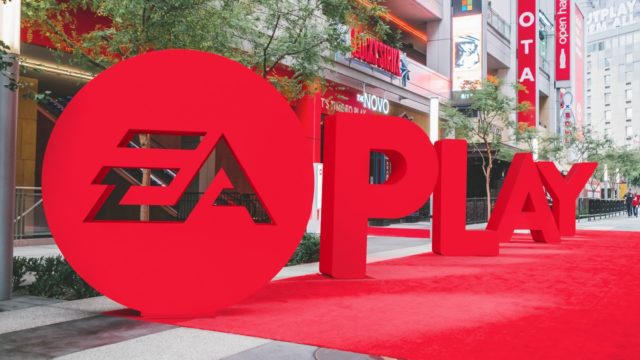
Electronic Arts has always been an annual mainstay of the E3 show floor, standing right in the middle of the South Hall with a number of big titles for users to try out. Last year, the company opted to “do its own thing,” as it were, with a private showcase held just down the street at the Novo Theater in LA Live: EA Play. It soon became clear that EA was no longer focusing on the press, but on the players. While game journalism still plays an important role in the marketing of new titles, EA’s move to abandon the convention norm is a nod to the power of influencers. The publisher continued this trend with Gamescom and Paris Games Week, opting for fan-centric events and demos over flashy press conferences. While social media stars are an effective tool for getting your brand out there, EA Play invited anyone to take part—valuing personal recommendations alongside those with thousands of followers.
On February 2, the publisher will host its inaugural EA Sports Bowl at Club Nomadic in Houston. The event will challenge pro athletes to play Madden NFL 17 and FIFA 17 against one another. Fans will also be treated to live music and “a few other surprises,” EA said in a statement.
From “Worst” To “Player First”
When your most popular games are sequels of the same franchises, how do you keep innovating? Soon after taking the reins as CEO in 2007, John Riccitiello (currently CEO of Unity Technologies) acknowledged the lack of innovation seen in the industry as a whole. “We’re boring people to death and making games that are harder and harder to play, he toldThe Wall Street Journal. “For the most part, the industry has been rinse-and-repeat. There’s been lots of product that looked like last year’s product, that looked a lot like the year before.”
Being named “Worst Company In America” two years in a row certainly didn’t help the publisher’s reputation, and neither did allegations of horrible work conditions for its developers. The company looked inward, made some changes and in 2012, EA’s games were ranked highest of all large publishers in the industry, according to Metacritic.
In a recent interview with IGN, EA’s chief competition officer, Peter Moore spoke about how the company has re-assessed what is most important as a company. “[W]e made a deliberate attempt to say, ‘Fine, how do we go forward here?’ And the mantra that we came up with was this concept of player-first,” Moore explained. “To this day . . . in meetings, questions are always asked—’what do we need to do here? When do we ship that? What type of experience does this need to be?’ Somebody will say, ‘but is that player-first?’ And that’s the moment we all stop and think,” he added. “It’s not about revenue—it’s not about what benefits EA.”
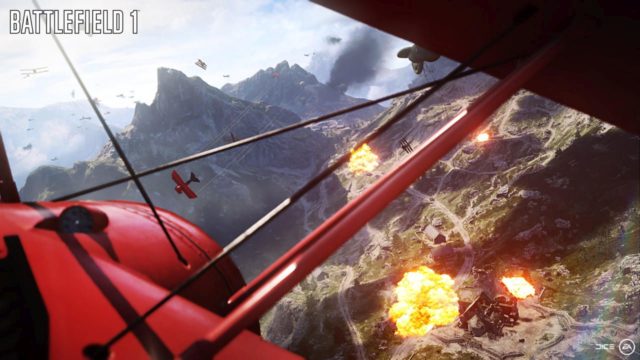
That mantra must be working, because Battlefield 1 debuted at number one in console video game sales in its first week in the UK, outselling the combined week one sales of Battlefield 4 and Hardline. Prior to launch, the game’s open beta drew in over 13.2 million total players, making it the biggest in EA’s history.
Titanfall 2—while not as financially successful as Battlefield 1—was nominated for eight awards including “Game of the Year,” and awarded “Best Online Multiplayer” at the Game Critics Awards 2016. Unlike its predecessor, Titanfall 2 was not a console exclusive, allowing more players to experience the mech-fighting adventure.
Looking To The Future
EA recognizes the future of mobile gaming by offering a number of companion apps for its most popular titles to keep players engaged. As announced during a Google I/O presentation, EA is a development partner for Google Daydream and released Need For Speed: No Limits VR last December.
Also launched this past December—EA’s new Competitive Games Division focuses not just on the best of the best, but those still climbing the championship ladder. “Our vision for competitive gaming is pretty unique,” EA’s chief competition officer, Peter Moore toldVenturebeat. “We want to make stars out of all our players. Competitive gaming is a pyramid. At the very top of that, there are several hundred players who make a full-time living playing games like DOTA 2, League of Legends, or Counter-Strike. In our case, Madden and FIFA have full-time professional players, as well as a few Battlefield players, but our real focus is going to be further down that pyramid—not just the top professionals.”
When it comes to making games for Star Wars fans—among the most passionate fan base in the world—EA wants to include everyone. “What we’re really trying to do at EA,” said Justin McCully, general manager of EA Star Wars, “is to cater to different parts of the Star Wars universe and create different game experiences that are tailor-made for those fans.”
EA is also highly active in the fight for inclusion in the workplace and beyond—including LGBTQ characters in its games, as well as partnering with equality organizations for women and those with disabilities. The company says its mission is not only to create “a welcoming workplace” but also “an inclusive gaming experience for [its] fans through programs, events, and community partnerships.”
American Greetings is using its paper card to have a tongue-in-cheek talk with techies about the importance of the most powerful messaging device on the planet—written communication.
The 111-year-old Cleveland-based greeting card company travelled to Sin City and CES for the first time earlier this month to introduce a “Device Like No Other,” a product billed as having “unlimited memory, is ultra-thin and has more powerful ways to connect than you ever thought possible.”
Spoiler alert: The device is still a greeting card, and actually an experiential marketing move to have meaningful conversations and connect with consumers in the midst of arguably the world’s most chaotic trade show.
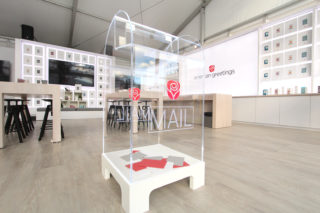
The American Greetings Connection Hub just outside of the Las Vegas Convention Center demonstrated how greeting cards still matter and do just as good of a job—if not better—in sharing a powerful message.
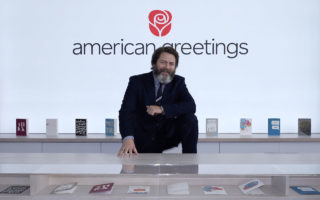
Actor Nick Offerman
Actor Nick Offerman (Parks and Recreation, Fargo) and New York Times best-selling author Randi Zuckerberg helped introduce the “Device Like No Other” and talked about the importance of cultivating relationships using the technology for the right occasions.
“I was sincerely honored to be asked to represent the venerated sentiment-delivery system known as the greeting card by American Greetings,” said Offerman. “In my family, we rely on cards to signify moments of great magnitude as well as just simple affection, a warm practice I am happy to share with my fellow Americans.”
“In this fast-paced world, the most valuable thing you can give someone is your time and creative energy. No matter how high-tech we are, there is truly nothing like receiving a handwritten card and is one of the few things in my life where I can say “there’s no app for that,’” said Zuckerberg. “That’s why I’m so thrilled to be partnering with American Greetings to remind people that tech is wonderful, but sometimes you need to unplug in order to truly connect.”
This isn’t the first time American Greetings—which generates annual revenue of approximately $1.9 billion—has crashed a tech show to say “slow down!” At SXSW in Austin last year, they left a footprint during the Interactive portion of the festival with their experiential “Analog” activation.
Alex Ho, executive director of marketing for American Greetings, sat down with [a]listdaily to discuss the brand’s approach to connecting with consumers and how they’re encouraging them to take breaks from the digital revolution.
American Greetings executive director of marketing, Alex Ho
Why was American Greetings at CES earlier this month?
We were there to do what pretty much every other company comes to CES for—which was to talk about our technology and make a product announcement in the ‘Device Like No Other.’ The punch line is that if there is a ‘Device Like No Other,’ it’s a greeting card. We were at CES to send a message and a reminder that greeting cards are complementary to all of the digital communication that’s happening right now. The environment was calm, and not noisy like most of the other booths. Consumers found a moment to take a breath and look inward. We allowed people to customize limited-edition CES greeting cards, mini gifts or 30-second shareable Instagram videos. We were very happy with our presence and consumer response. Whenever we look at our next event, we’ll have to look at it from the context of our objectives. We enjoy putting them on. We intend to do things different with the experiences. But the message remains the same.
What is the mission behind the “Device Like No Other”?
What we found out throughout consumer research is that consumers today are using greeting cards in different ways. Our business has been stable throughout the entire rise of social networking over the past 10 years. Now they have more convenient electronic devices to connect digitally, visually and frequently. Amongst that entire volume of communication, what they’re missing is the deeper, more meaningful connections that people really care about. That’s what greeting cards do.
Does your experiential marketing move hit closer to home for people who are traveling at a trade show?
The reason why the experience and space is like that is to demonstrate the importance of personalized, written communication, and what that means. We’re finding that consumers in the space are engaging with us and actually telling their own stories about greeting cards they’ve received in the past, or kept, or specifically about the people they are writing it for. It’s really raising awareness about personalized communication.
How has the American Greetings brand message evolved? How are you re-telling your story today?
American Greetings is a purpose-driven company. Our brand positioning is to make the world a more thoughtful and caring place. When we attend events, we want to make those places a more thoughtful and caring place, too. The brand message and tonality is around being real, authentic and creating meaningful connections. People are responding to us.
Although American Greetings is about advocating written communication, how are you trying to have ownership and an identity in the social space?
The interesting part about our message is that greeting cards and digital are not at war with each other—they’re complementary. While we’re asking people to actually create cards, we’re using social media for what it’s best at—sharing, reaching out and connecting with people on a digital level. With our product launch with Nick Offerman, we used Periscope and Facebook Live to broadcast our announcement. We’re also using all of the social channels that are appropriate for our heavy visual art categories. But we’re continuing to look at other emerging platforms as they develop to see if they are appropriate for our audience base.
Nick Offerman doesn’t need much of an introduction, and he’s an influencer on a grand scale. Do you have an influencer marketing strategy?
Our influencers, which in addition to Nick included Randi Zuckerberg, are authentic and have a high reach and a footprint with their established social audience. We brought them so they can tell their own stories, and why they are important in life. We’re not digital people. We’re not marketing people. We’re just people. Humanity needs that kind of connection and emotional resonance. Their audience is large because people want to hear from them. What they believe is complementary to what we believe, so that’s how we chose our influencers.
As a marketer, what are the challenges you are trying to overcome?
As all media channels mature and evolve, there is some level of plateauing. Executives are constantly looking at their media mix between display, search, native and content. We are constantly doing the same, too. Tent pole events need to be complemented by a constant stream of content and marketing every day as well in order for your KPIs and brand message not to erode.
What is the consumer feedback from the brand message you have been sharing in the last year?
People may be surprised when they see us at SXSW and CES among the hardcore, digital-centric brands and people. But the opposite is happening for people who you think might dismiss it. We’re finding that once people get the tongue-in-cheek joke about our ‘device,’ they’re really embracing it. We’re always focused on consumer insights and consumer learnings. What we’re finding is that millennials are the fastest growing segment for greeting cards. They are actually over-indexing on their fair share of buying greeting cards. When you look at that fact, combined with this idea of digitally connected people wanting to differentiate their social media friends from their real friends, it makes sense why greeting cards continue to have a role in today’s communication landscape.


 As a free-to-play game, Warframe has done some CPA (cost per action) advertising to grow its player base, but Braun admits that Digital Extremes hasn’t done a lot to reach past its core community. “We’re starting to do more, but the stuff that we can’t measure makes us very nervous. When we first started Warframe, we barely had two nickels to rub together, and that’s why we focused on community and viral marketing—it was the least costly for us. We were watching games like Hawken and Firefall do enormous brand awareness campaigns and we were very nervous because we felt ourselves being dwarfed by their awareness. But we realized that we didn’t have to do that because they did, and they’re not around anymore.