Analysts Look At Console Gaming And Digital Game Sale Trends

Virtual reality may have been a little slow to take off this year, even with the launch of PlayStation VR, but 2016 saw some huge console gaming announcements. Microsoft formally announced two high-end Xbox One consoles at E3 this year, while Sony launched the PlayStation Pro to take advantage of the growing adoption of 4K televisions.

Meanwhile, digital sales of full games have steadily grown over the past few years. This year, NPD launched its Digital Game Tracking Service in partnership with major publishers Activision Blizzard, Electronic Arts, Ubisoft, Take-Two Interactive, Square Enix, Capcom, Deep Silver and Warner Bros. Interactive Entertainment to get a better picture of this significant part of the market.

To better understand some of the major console gaming trends from the past year, particularly the growth of digital, [a]listdaily spoke to industry analysts Joost van Dreunen, CEO of SuperData Research; Peter Warman, CEO of Newzoo; and Patrick Walker, VP of insights and analytics at EEDAR, which was acquired by NPD in August. They share their insights about current trends and what may be in store for next year.

What were the most significant console gaming developments to come out of 2016?

[van Dreunen]: In 2016, we saw the adoption of full game downloads on consoles accelerate. This season the percentage of games sold this way is roughly five times greater than it was in 2012. More so, Sony has done really well with diversifying its content offering with the PlayStation Vue, for instance. Combined with its VR effort, we expect to see more like this.”

[Warman]: Console developers are slowly, but steadily, breaking down the platform’s paid model in favor of alternative approaches. By introducing different ways of selling and monetizing games, console developers are hoping to drive up revenues which, according to our own research, now lags behind PC and mobile. The first way companies are doing this is by exploring free-to-play options. Soccer games have led the way in this sector, with Konami releasing a free-to-play console version of Pro Evolution Soccer in an effort to get players into the card-acquiring myClub mode. Meanwhile, Psyonix’s Rocket League was free [for PlayStation Plus subscribers] on PS4 for its first month to get a user base. Becoming a compelling word-of-mouth success, Psyonix recently announced that the game generated $111 million in its first year, selling an impressive number of copies and themed DLC, such as the Dawn of Justice inspired Batmobile, to an engaged player base.

The other way to do this is through season passes—convincing players to buy a full version of a game as well as all scheduled DLC and some notional updates at launch day. Season passes tie players to the game longer by forcing them to make an initial investment. However, there is little financial evidence of how well season passes monetize, due partly to how well console developers conceal return on investment. But the season pass model has been used by developers of Fallout 4, Call of Duty, Batman: Arkham Knight, Star Wars Battlefront and many other leading titles, showing its appeal.

In short, console developers are slowly breaking away from the traditional “pay once and you’re in” model, though it’s proving to be slow going. Many console players have reacted negatively to the development of these models, due to their familiarity and satisfaction with the pre-existing model. With console needing to find its place in a market where PC and mobile are on the march, expect more developers to try new monetization tactics to pry the free-to-play door open.

[Walker]: The biggest change in console gaming this year was actually a sign of things to come. The launch of the PlayStation 4 Pro didn’t dramatically shake up the console landscape, but it suggests the industry is entering a new era in which the platform holders update the power of the console much more often. This will probably be the last year that the term “console generation” is appropriate.

How have digital game sales grown in 2016?

[van Dreunen]: We’re seeing healthy year-over-year growth across all digital categories. Mobile is up 18 percent YoY, digital console 15 percent and PC seven percent.

[Warman]: The digital games market generated $83.1 billion in 2016, representing 83 percent of the total $99.6 billion market. This is eight percent more than the $73.1 billion generated in 2015 and in the coming years digital revenues will continue to grow towards $110.1 billion in 2019.

[Walker]: Digital sales have grown consistently year-over-year for the past five years, and 2016 was no exception. There is an interesting seasonal relationship, where physical sales are 5-10 percent higher during the holiday, when more consumers are shopping in retail locations, but the overall trend has been steady growth in digital. There are also a lot of nuances in how different types of titles perform digitally, but at this point, we can expect that at least a quarter of a big AAA title’s sales will be digital.

Given the significant growth of digital sales, will retail remain relevant in 2017?

[van Dreunen]: Absolutely. The notion that in a few years all of gaming will be exclusively digital is naive. People will continue to go to stores to try things out and learn about content and devices. But the role of retail will shift and its dominance in the ecosystem will decline. To put it in clear terms, there’s no way that big publishers like Activision Blizzard, Electronic Arts, Ubisoft and Take-Two are going to create a channel conflict with GameStop.

[Warman]: The growth of digitally generated revenues comes not only from the fully digital mobile segment, but also from increasing digital revenues from PC and console gaming. In 2017, boxed retail games will still be very relevant with a global market estimated at $14 billion (-13 percent YoY), mainly consisting of console game revenues. However, this is 24 percent of the total revenues generated by the PC and console segments (29 percent in 2016). In the coming years, this digital transition will continue and result in boxed retail game sales of approximately $8.5 billion worldwide in 2019, or rather 14 percent of the total PC/console market and seven percent of the total global games market.

[Walker]: Absolutely. Retail sales are not only relevant, they are still hugely important. I think the shift to digital gets a lot of attention because there are recent examples of whole industries—such as music—that have switched to an almost entirely digital distribution model, and the effect on the major companies in those industries has been huge. However, the shift to digital in games has thus far been a linear trend, and holiday AAA releases from major publishers can still expect the majority of their revenue to come from retail sales. The steady growth of digital suggests that this will change eventually, but it is unlikely to change in 2017.

How do you think new hardware such as Xbox One S, PlayStation 4 Pro, Project Scorpio and Nintendo Switch will impact console game sales next year?

[Walker]: Next year is a major year in determining the shape of the next several years of the console landscape. Nintendo is betting that the market will respond to a hybrid between a console and handheld, and is riding a six-month marketing surge from Pokémon GO, the NES Classic, and Super Mario Run. The success or failure of the Nintendo Switch will have a major impact on what types of games publishers are making and the trend of physical versus digital sales. Also, Scorpio gives Microsoft an opportunity to get back into the current console race with Sony. The Scorpio’s power is necessary for high-end 4K and VR gaming, and Microsoft’s dominance in OS market share gives it an avenue to blur the lines between console and the rapidly growing PC market through cross-platform initiatives. This may give gamers a reason to jump back into the Microsoft ecosystem.

Image credit

Interactive Entertainment In 2016: The Good, The Growing And The Games

2016 was a great year to be a video game publisher, especially if your game was Pokémon GO or Overwatch. The interactive entertainment industry generated $91 billion in revenues through video games, eSports and gaming video content, according to a new report by analyst firm, SuperData. Let’s take a look back at a year of gaming filled with new tech, breakout hits and the consumer trends that will shape this industry over the coming years.

The Good . . .

At $41 billion, mobile games were by far the most lucrative form of interactive entertainment this year, surpassing retail games and free-to-play online games by $26 billion and $19 billion, respectively. With the addition of eSports and gaming video content into its revenue stream, the interactive entertainment industry is poised to have a very nice 2017.

Subsequently, the mobile games market “has started to mature,” SuperData noted, “and now more closely resembles traditional games publishing—requiring ever higher production values and marketing spend.” Gamers are downloading a lot more titles directly to their consoles, spending $6.6 billion in 2016. Digital spending is good news, according to SuperData, because it allows publishers to generate revenue through the sales of add-on content, expansion packs and microtransactions.

PC gaming earned a cool $34 billion, driven largely by free-to-play online titles and downloadable games. With the release of a new generation of graphics cards, gamers were able to enjoy a 40 percent increase in graphics power and a 20 percent reduction of power consumption, SuperData commented.

Bringing in $1.3 billion, Monster Strike was the top mobile game for 2016.
Bringing in a monstrous $1.3 billion, Monster Strike was the top mobile game for 2016.

. . . The Growing

A lot of VR tech was launched in 2016, but its first year was “sobering,” SuperData said. The analytics firm cites a high price point, the absence of a strong content line-up and difficulties with properly delivering through retail as issues that cooled consumers’ expectations of the Oculus as reasons for the underwhelming consumer response. “We expect firms with more experience in hardware manufacturing like Sony and HTC to take the lead in 2017.”

Compared to other revenue streams, eSports is relatively small at $892 million in 2016. Despite this, the competitive arena for video games is a hot spot for investors, publishers, TV executives and advertisers. “A string of investments in pursuit of connecting to a new generation of media consumers has built the segment’s momentum,” SuperData observed, “as major publishers like Activision, Riot Games, and Electronic Arts are exploring new revenue streams like selling media rights in 2017.”

. . . And The Games

The Top 5 Earning Video Game Titles Of 2016 Are:

Mobile:

  1. Monster Strike
  2. Clash of Clans
  3. Clash Royale
  4. Game of War: Fire Age
  5. Mobile Strike

Despite launching mid-year, Niantic’s Pokémon GO came in just under the top 5 games.

Free-to-Play PC:

  1. League of Legends
  2. Dungeon Fighter Challenge
  3. Crossfire
  4. World of Tanks
  5. Dota 2

Premium PC:

  1. Overwatch
  2. CS:GO
  3. Guild Wars 2
  4. Minecraft
  5. Fallout 4

Console:

  1. Call of Duty: Black Ops III
  2. FIFA 16
  3. Grand Theft Auto V
  4. Tom Clancy’s The Division
  5. Destiny

Will ‘Super Mario Run’ Be A 1-Up Or Game Over? The Experts Weigh In

Super Mario Run has jumped its way onto iOS and experts believe this will be a major “1-Up” for Nintendo. Following a wave of Pokémon fever, Nintendo has entered the mobile games market with Mario’s first title on the platform. Shortly after the game’s announcement, over 20 million iOS users asked to be notified when it became available—if all of them purchased the game, it would make Super Mario Run more popular than the last three Super Mario Bros. games combined. While experts believe the game will be a success, just how much and why (or why not) may surprise us all.

“The nostalgia factor plays a key role here,” noted Joost van Druenen, CEO of SuperData, “as an entire generation of gamers suddenly, and finally, finds itself able to play one of their childhood franchises on their phone two weeks before the holidays.” Van Druenen is confident that Super Mario Run will be a big hit, and expects the game to be downloaded around 30 million times—generating approximately $600 million in its first month. While that sounds like a lot, this estimate is much less than Pokémon GO because Super Mario Run is only releasing on iOS this week, with no word on when it will launch for Android.

Updated: Per van Druenen: “Based on the early numbers we see coming in and the response from consumers, we expect Super Mario Run to initially earn on the lower end of our forecast, around $12-15M in its first month.”

Nostalgia played a major role in the success of Pokémon GO, which has held the number one position on mobile game charts since its launch in July and brings in a cool $2 million per day. Despite an initial craze that had everyone running out the door to play, the number of players is starting to slow, which may be perfect timing for Super Mario Run. “Now that the momentum behind Pokémon GO is starting to decline,” van Dreunen told [a]listdaily, “having another strong title arriving will allow the game, and Nintendo, to do well.”

super mario run

Unlike Pokémon GO, which uses the ever-popular freemium model (free-to-play with optional purchases), Super Mario Run comes with a $10 price tag. Van Druenen doesn’t believe the price point will deter fans, however. “The only comparable title is Minecraft, which is priced lower and benefited from being an enormous pop-cultural phenomenon,” he said, adding, “I expect Nintendo to lower its price in Q1 of next year.”

Aside from price reduction, Nintendo will need to keep fans entertained and coming back for more, especially leading up to the release of Nintendo Switch in March. “Expansion packs will likely be [Nintendo’s] first tactic to keep people playing,” van Druenen said. “If demand is strong enough, there’s no reason to assume that Nintendo will cease developing more levels.”

Update: per van Druenen, “Requiring to ‘always be online’ is prohibitive and the game is still a bit too heavy-handed for quick-play on a phone.”

Findings from analytics firm, Newzoo echoes SuperData, predicting that Super Mario Run will be a hit simply because it’s Mario. According to Newzoo’s Game Franchise Tracker, the Mario brand is one of the strongest in gaming today, as the fourth-most-played gaming franchise globally in the past three months and number one in Japan. “Nearly three decades of relentlessly high-quality games of different genres have helped cement Mario’s reputation as a byword for excellence and fun,” said Newzoo in a statement. The firm added that 95 percent of people who play Mario games already play mobile games and 1.8 million of them are mobile big spenders.

Despite all this excitement, it’s not all wine and fire flowers for Mario’s mobile debut. Newzoo warns that by not launching on Android, Nintendo could leave huge revenues from 70 percent of the world’s mobile gamers behind, reminding us that a majority of Pokémon GO’s revenue comes from the Google Play Store. “With Pokémon GO, gamers could work around the US-only launch, as tens of millions of non-Americans changed their app store account settings,” observed Jelle Kooistra, head of Newzoo Mobile. “This time, the only workaround is to buy an Apple device. The immediate risk that Nintendo is taking is angering fans and increasing the chance of the game being ripped and distributed on Android illegally.”

thumbnail_newzoo_ios_android_mario-1

Peter Warman, CEO at Newzoo, predicts a more modest revenue stream at $100 million over the next few weeks, but sees Super Mario Run as part of the big picture for Nintendo rather than a standalone hit. “We anticipate that in a couple of years from now, smartphone and tablet games will account for at least half of Nintendo’s software revenues,” he said. “[December 15], Nintendo takes the first step. A small step for the industry, but a giant leap for Nintendo.”

Vicarious Visions Takes Another Spin With Crash Bandicoot

Activision used Sony’s third annual PlayStation Experience (PSX) to offer gamers a chance to get hands-on with its new Crash Bandicoot N. Sane Trilogy, which ships for PlayStation 4 and PS4 Pro in 2017. Developer Vicarious Visions has been enlisted to upgrade the original ‘90s games (created by Naughty Dog) for today’s hardware, having previously worked with the bandicoot on a pair of Game Boy Advance titles, as well as Crash Nitro Kart on PlayStation 2.

This marks a sort of resurgence for the character. He’s playable right now in Skylanders Imaginators in a new dedicated level, Thumpin’ Wumpa Islands. Crash also appears in two episodes of the new Skylanders Academy television series, streaming now on Netflix. Dan Tanguay, game director at Vicarious Visions, told [a]listdaily that the Crash games have stood the test of time because they were incredibly beautiful at the time on PlayStation 1.

“There wasn’t anything that looked like them,” Tanguay said. “They’re just a visual treat for the eyes. The second thing is the sense of humor that pervades the games. It’s zany, it’s loony, it’s irreverent and you’re always having fun dying or seeing what the characters are going to do next.”

Tanguay said the original level design was great in that they’re challenging, but compel you to want to keep coming back for more. Vicarious Visions is building the new game from the ground up with new lighting, animations, environments and 4K support. “It really allows us to capture that spirit of Crash Bandicoot that Naughty Dog was shooting for 20 years ago,” Tanguay said. “We’re really able to push more with the animation and get more personality across and really create more lush and rich environments and audio escapes.”

Tanguay said that over the course of the trilogy, Naughty Dog learned a lot and made improvements to the games. Vicarious Visions has the luxury of adding those lessons to every game. “We’re trying to put Time Trials into every single level, even though they only appeared in the third game,” Tanguay said. “We hope they’ll give fans a great reason to play the game over and over again.”

He also said the new games will also offer Easter Eggs for fans, having scoured the internet and read all the fan boards and watched the YouTube videos. “We really know what the fans are looking for and we have additional features planned for these games, which we aren’t prepared to talk more about at this point,” Tanguay said.

In addition to having worked with Crash previously, Vicarious Visions has also developed Activision’s Skylanders: Swap Force, Skylanders: Trap Team and Skylanders: SuperChargers in recent years. “Our experience with action platformers such as Skylanders has helped us hone our skills to be able to bring Crash into the present,” said Tanguay.

Activision is also tapping into the retro fad that Sony embraced at PSX, reviving classic games like Parappa the Rapper, Windjammers and Wipeout: Omega Collection. “I love it partly because I’m a bit old,” Tanguay confessed. “The games that are coming back really deserve to have a chance with a new audience. It’s just a way to keep the spirit of things like Crash alive.”

Why The White House Partnered With Gamers To Promote Healthcare

On Monday December 12, the White House partnered with Twitch to make history. The White House Competitive Gaming Event—a four-hour livestream—took place in the Eisenhower Building, featuring online celebrities ActaBunniFooFoo, Elspeth, ThatChickParker and more along with professional gamers such as NRG eSports, Rocket League team, Justin Wong and Mike Ross. They all came together to support the Affordable Care Act (ACA) and spread awareness of the Healthcare.gov Marketplace open enrollment period, which ends today (December 15).

The event was hosted by Twitch programming manager and streamer, Anna Prosser Robinson, who joined the ESL last year in creating a public service announcement to encourage gamers to get health insurance. She spoke with various members of the White House staff, including Erik Martin, policy advisor at White House office of science and technology policy, who talked about his personal history with health issues and gaming. He also remarked on the importance of engaging with young gamers directly through platforms like Twitch. Other Twitch celebrities sat down with White House staff to demonstrate use of the Marketplace and talk about video games.

The White House Competitive Gaming Event also used Twitch’s newly released AutoMod tool, which employs machine learning and natural language processing to identify and block inappropriate content from the chat—keeping the discussion civil and relevant.

brain-petrocelli
Brain Petrocelli, Twitch product marketing manager

Brain Petrocelli, product marketing manager at Twitch, spoke with [a]listdaily from the event and detailed how the partnership with the White House came together. “We did the DNC and RNC this past summer, and folks didn’t necessarily realize that we were protecting our chat with the AutoMod, which just released. So, we were able to have an amazing social video experience that was conductive to people having a great discussion about a topic. Fast forward, and people in Washington took notice and came together to figure out what we could do. We thought, what better way to host a conversation about healthcare than to talk to the independent business people that use Twitch and use the power of the White House to amplify that message to reach a hard-to-reach audience.”

When discussing how video gaming and healthcare related to each other, Petrocelli said, “most Twitch partners and eSports athletes are independent. Therefore, they have to worry about healthcare themselves. Whether you’re committing yourself to be a successful Twitch partner or committing to becoming an eSports athlete, making sure that you’re healthy and able to work as much as possible is really important. It behooves the community to discuss what healthcare options are available.”

To help promote the Marketplace, streamers spoke about their personal experiences in addition to having guest speakers come onstage to talk about the healthcare program and how to sign up. Some of the games played included a healthcare theme, particularly the board game Operation, and Trials Fusion, which features plenty of stunts and accidents.

“We wanted to reach the widest audience possible, which is why we selected some easy-to-get-into games such as Rocket League and Street Fighter,” said Petrocelli. “That’s in addition to choosing a group of broadcasters that have diverse communities that can all come together and have a good conversation.”

Petrocelli believes that a lot of people from the White House are fans of gaming, but don’t get to play as often as they would like to. However, they recognize the power that gaming has and its reach. “Considering how difficult gamers can be to reach, with their cord-cutting and only consuming content on Twitch, this is a really good opportunity to speak with them.”

Katie Hill, assistant press secretary at the White House, also spoke to [a]listdaily from the event.

Katie Hill, White House assistant press secretary

“We’re in the middle of open enrollment for the Healthcare Marketplace, Healthcare.gov,” said Hill, discussing the importance of the event. “Ever since the Marketplace opened several years ago, we have made it a point that young people in particular understand that this option is available to them. If they shop around on Healthcare.gov, most can find a plan for $75 a month or less—less than their cell phone bills. [We want to make sure] that they understand that health insurance is affordable and a good thing to have. Not only does it help you stay healthy because you can take advantage of preventive benefits the ACA covers, such as vaccines, screenings, contraception for women—but it also protects you against an unexpected illness or catastrophic accident.

She also talked about the ACA’s goals, particularly in reaching young, uninsured individuals—many of whom are gamers. “Since the ACA has passed, the number of young people who are uninsured has dropped dramatically, but we know we’ve got more work to do,” said Hill. “Of the Americans who today are still uninsured, a disproportionate share of them are young. We also know that the gaming community is disproportionately young, so it aligns nicely with the audience we’re trying to reach.”

Hill described previous efforts to encourage young individuals to purchase healthcare. “Over the years, some of the more prominent examples are the president’s interview on between two ferns, the popular BuzzFeed video the president did a couple of years ago, and we just launched a video on our Facebook page where the president and actor, Bill Murray are playing golf in the Oval Office.”

The White House has also been working with colleges and universities on an initiative called the Healthy Campus Challenge. Nearly 400 institutions are letting students and faculty know about open enrollment. “This is something that we hope will become institutionalized, even after this administration is no longer in office,” said Hill. “Come open enrollment time, colleges and universities will do what they’ve done in the past: educating their students, alumni and faculty about how quality affordable insurance is available at Healthcare.gov.”

The White House is also emphasizing the sense of independence healthcare offers young individuals. “There are a lot of folks in the gaming community who are app developers, writing code and designing games. It may be something that they would like to do full-time, but can’t because they wouldn’t have health insurance. But they can get that insurance on the Marketplace.”

When asked if she thought the White House Competitive Gaming Event could become a regular event, Hill said: “Realizing that we have a short amount of time left here in the office, our hope is that today’s event has been a success and that it could be something our partners across the country—who are doing the hard and important work of signing people up for health insurance—could possibly replicate.”

Elspeth Eastman, voice actor, composer and gamer

Among the online celebrities invited to the event was voice actor, composer and gamer, Elspeth Eastman, whose talents have been featured in games such as League of Legends and Crypt of the Necrodancer. She spoke to [a]listdaily about her experience getting healthcare, which turned out to be as short and easy as advertised.

“I needed healthcare—I knew I needed to get covered, and I went on the website,” said Eastman. “It probably took me about ten to fifteen minutes to secure a plan for myself. Once I was done, I was like, ‘That’s it?’ It was very simple. I’m covered, and I’m happy about it.”

Eastman also talked about why it was important for full-time streamers and gamers to think about healthcare. “You don’t know the day-to-day specifics of your job,” said Eastman. “Sometimes it can be tough, and you might not plan for something that comes down the road when you are streaming. You never know. So, it’s always good to look out for yourself first and get covered, even if you’re situated somewhere comfy in your house. You don’t know—you could fall down the stairs or something—and it’s something you need to think about. A lot of people don’t realize how easy it is [to get healthcare]. It’s very easy to get set up.”

However, there is a perception that young gamers generally believe that they’re invincible, and don’t put much care or thought into the topic of healthcare. To them, Eastman says, “Hey, I’ll wake up in pajama pants, and sometimes I’ll eat a bag of Cheetos and won’t feel bad about it. I’ll stay up until four in the morning and eat a plate of pizza rolls before going to bed. You take that for granted when you’re sitting there enjoying video games. But you never know what could happen to your body. You don’t really think about it. So, it’s good to get healthcare now, be protected, and have that piece of mind.”

Angela Parker (ThatChickParker), Twitch streamer

Angela Parker (ThatChickParker) is a prime example of the kind of young self-employed individuals the White House is reaching out to. She was no longer eligible for coverage under her father’s Navy healthcare plan when she turned 21 and decided to forgo college to pursue full-time streaming on Twitch.

“Gamers definitely live a more sedentary life, but it’s important to realize that anything can happen at any moment,” Parker told [a]listdaily. “One unfortunate incident could put you in debt for the rest of your life. Right now, we think we’re invincible, but we need to think about the long term.”

Professional gamer, Justin Wong, plays on team Evil Geniuses and came to the White House for an epic Street Fighter V showdown against Mike Ross and ended up winning three games in a row. Having to pay for healthcare was part of what drove him to succeed in eSports.

“Growing up, when I was 17 or 18, we went through some rough times. My family couldn’t pay for their hospital bills, so I went around the United States winning tournaments. Every time I won a tournament, I used the money that I won to pay off the debt that we owed to the hospitals.”

Wong also spoke about the importance of healthcare coverage for professional eSports athletes.

“I traveled about 40 times this year alone. The risk of being sick because of posing for pictures, shaking hands, or being around a culture of food that you’re not used to might affect your ability to play in a professional environment. Being under healthcare and having the option to go to the doctor while I’m at home before my next trip is really important.”

Justin Wong, professional eSports athlete, team Evil Geniuses

What does Wong say to young gamers who believe that they’re invincible? “I was like that once and said the same things. But when unforeseen circumstances happen, especially when you have to take care of your family because of sickness, it becomes really hard to live a regular life. Especially when you’re going to school and getting a job—and also if you want to keep trying to game. There will be less time for gaming. For me, I had to grind really hard—playing tournaments and paying the debt off—to make sure that my family could live a comfortable life in the future.


Learn everything you need to know to invest in today’s fastest-growing media channel—Competitive Gaming and eSports on 2.16.17 in Los Angeles. Go to alistsummit.com for more info.

Watch live video from on www.twitch.tv

Pocket Gems Brings ‘Pretty Little Liars’ To Mobile

Based loosely on the popular book series by Sara Shepard, Pretty Little Liars is a teen drama on the Freeform channel that follows the lives of four girls (Spencer Hastings, Aria Montgomery, Hanna Marin, and Emily Fields) in the town of Rosewood, Pennsylvania. Once close friends, their group fell apart when their clique leader, Alison DiLaurentis, was allegedly murdered. However, they are reunited when a mysterious villain named “A” torments them with knowledge of their pasts.

The TV show is in its seventh and final season, but that doesn’t necessarily mean an end to the Liars and their stories. Pocket Gems’ interactive storytelling platform, Episode (famous for its Mean Girls story and Path to Fame: Confidently Me, featuring singer, Demi Lovato) launched the first season of its Pretty Little Liars story today, developed in partnership with Warner Horizon Television and the show’s creative team.

Michael Dawson, Episode head of studio
Michael Dawson, Episode head of studio at Pocket Gems

Episode’s head of studio, Michael Dawson, spoke with [a]listdaily recently to talk about bringing Pretty Little Liars to the mobile platform, which currently boasts over 2.25 billion episodes viewed across 37,000 stories, and how the series will continue after the show ends.

Dawson explained that the partnership came together because Pretty Little Liars is one of the most popular shows among Episode’s core audience right now. Episode then talked with Warner Bros., and the showrunners thought that it would be a great way for fans to continue the story after the final season concludes.

“We worked with Marlene King, the creator of the show, and Warner Bros. to think through it (creating the experience),” said Dawson. “What we thought would be most fun for fans was letting them enter the world of Pretty Little Liars at the beginning of the story. They get to be friends with the four Liars, hang out in Rosewood, and make choices that shape the story while experiencing the mystery, fun and intrigue of their world. In order to keep it fresh, new and exciting, there are a whole set of new twists and turns—so the story won’t turn out the same way as it did in the show.”

When asked how Pretty Little Liars is special to Episode, Dawson said: “We have quite a large audience. We’ve had over two billion episodes read [and] millions of weekly active users. So, we can survey them and ask them: ‘if we were to partner with great Hollywood shows, what would they be most excited about?’ Pretty Little Liars has always come up towards the top of that list. Another thing is that it’s a wonderful world that helps us continue to expand what happens on Episode. For example, when we worked with Demi Lovato, we were able to bring music together with romance. With Mean Girls, we brought comedy in. Pretty Little Liars brings in suspense, intrigue and mystery in a way that we haven’t done as much and lets us push what’s possible.”

Dawson also explained the benefits of using the Episode platform in comparison to launching a more standalone Pretty Little Liars app to keep fans engaged. “I think there are a couple of elements,” said Dawson. “[But] one is that it (Episode) allows you to create a character that you can enter the world as, unlike the passive ways to consume Pretty Little Liars as a book or show. This is built around true interactive entertainment, where you step into the world and shape it. For a generation that has grown up entirely with smartphones and social media, where they’re used to being a participant in their stories, we’re letting them do that with Pretty Little Liars, and letting them become friends with these wonderful characters that they’ve grown up with. I think that’s something that would be really different from if it were done as a standalone app experience.”

So how does Pretty Little Liars compare to Mean Girls? “I think what’s similar about them is our approach to make them truly Hollywood-caliber stories and bringing them together with the interactive elements. With Mean Girls, we worked with Kiwi Smith, who co-wrote Legally Blond and Ten Things I Hate About You, to write it. With Pretty Little Liars, we worked with a team of great Hollywood screen writers, writers from the show, and Marlene King to ensure exceptional quality. The difference is in how we make sure the mood feels different. With Mean Girls, the mood is comedy, and here [with PLL] we had to make sure you have those kinds of edge of your-seat suspense moments that people love so much.”

Episode will work to time part of its Pretty Little Liars season with the show when it resumes in 2017. Dawson discussed how the mobile experience will also be promoted on the show’s related websites, and Episode is partnering with Snapchat to put out a range of promotions that will be targeted around schools across the US and Canada. Furthermore, there will be a launch event in New York City. Episode is “pushing out meaningful messages across marketing channels all around mobile, from Facebook to Instagram and YouTube,” said Dawson.

So, what will bring fans to Episode for more Pretty Little Liars? “It’s such a fun world to be a part of,” said Dawson. “The four Liars are like your other best friends, and you can hang out and be with them. They get to experience a heightened, phenomenal world where so many crazy things happen. Then they have to constantly be on guard while wondering what’s going to happen next. That feeling of being on the edge of your seat and not knowing what’s going to happen and being friends with the Liars are the two reasons that felt great for Episode. Here, you get to create a character and step into that world.”

But that raises the question of how suspenseful the Episode story can get, considering how Pretty Little Liars has both a popular book and TV series. Committed fans might already have an idea of what’s coming. “What’s good is, as they go through it, they will see that it’s not what they expect at all,” explained Dawson. “It is a different story, and we made some key and critical changes to make sure that they know it’s a new story—including how they’ll have to keep reading to find out who A is.”

For a new audience, who may not be familiar with the show or books, “they will get a chance to experience an amazing story, based in a high school world,” said Dawson. “It has suspense, it has intrigue, and it will let them meet four of the best friends they’ll ever have.”

Actor Alan Tudyk Discusses ‘Rogue One: A Star Wars Story’ And ‘Con Man: The Game’

Actor Alan Tudyk can notch a few more achievements off his bucket list. The Firefly actor can be heard in Disney’s latest blockbuster, Rogue One: A Star Wars Story, as the newest droid in the universe—K-2SO. Tudyk performed the motion capture for the CGI character live on set alongside the rest of the cast at London’s Pinewood Studios.

Tudyk is also a successful cross-platform creator thanks to Con Man, a hit digital comedy series he created with PJ Haarsma and Nathan Fillion. Season two is available now on the Comic Con HQ subscription service. Con Man has also been expanded to a free-to-play mobile game, which is also a hit with genre fans.

The actor, who can also be heard as Heihei in Disney’s blockbuster Moana, joined [a]listdaily to talk about the power of crowdfunding and why he’s excited about Electronic Arts’ Star Wars Battlefront VR game.

K-2SO

The thing about this movie that’s interesting is it’s an original Star Wars story, so you’re stepping back into a world that people are familiar with. What was that like for you?

I think it’s a much more personal movie. It’s a more intimate movie in that way, but it’s just a standalone story. It’s a story where we have a mission and we have to complete the mission. And it’s about how to do that. Spoiler alert—we’re successful, so it has to be a good story since you already know that we get away with it. But it’s shot in a more intimate way and it just has that—not smaller, but it’s more intimate is the right word.

Can you talk a little bit about the new U-Wing spaceship?

I think we were only interior on the U-Wing. There were portions of the U-Wing in pieces. It wasn’t like the X-Wing fighters. Several of them were just parked there. It was impressive and exciting to be like a little kid running around going, ‘oh my God, it’s real!’ And to see that smoke coming out of the bottom of them. But the U-Wings were big set pieces, almost like a room that you walked into, and the spaceship is in there. You’re inside the ship. So from our perspective you’re inside the spaceship looking out of the windows, holding onto the controls, calling down on the radio. In that way it was more practical than anything I’ve ever done. I flew a spaceship for Joss Whedon in Firefly and our spaceship never moved, really. The Star Wars spaceships move, so that was exciting.

The Rogue One movie was also the very first one to actually use virtual reality during production. Were you able to look in and see any of that stuff? 

I didn’t, I never looked at any of that.

The other VR angle is that Star Wars Battlefront is coming out with the Rogue One X-Wing VR Mission, so you’ll be able to play that on PlayStation VR once the movie launches.  What are your thoughts as someone who’s played games in the past about VR and what that opens up?

Oh my God! It opens up your schedule to getting lost. I love VR stuff. It’s amazing. I can’t wait to play it in the Star Wars universe. I think it’s going to be the future in gaming for sure. I know a lot of people who want to play games and don’t have the time to learn the controller . . . if they’re coming to it later in life. Unlike these kids, who are now born with extra joints in their hands, because they can beat me every time. I don’t know how they’re wired. But with VR, anybody can pick it up and just start playing in as many worlds as are possible. I can’t wait. I think it’s a good idea.

So, we’ll see more challenges than finding the Hawaiian-shirted driver? 

To a lot of people, it’s funny, man. I’m terrible at it. That, and finding the medicine for the sick guy is just, uh . . . you make your messes all over the place. The game really sucks you in. I’ll set up my Con real quick and collect some money and then 20-to-30 minutes later, I’m still in there typing away, killing aliens.

It’s cool to see the posters on the wall with Nerd HQ and Comic-Con HQ that tie into the real San Diego Comic-Con. Where did the idea for this Con sim game come from?

PJ Haarsma and I were taking Con Man around—before Nathan (Fillion) came on—to different production companies. We spent a lot of time during that year-and-a-half dreaming about what would be cool to do with this world. We saw it was deep, and not just the show within the show. We wanted to do comic books of the show within the show and the game, and have comic books in the game. That concept of managing a Con that you build up and manage is my game. It’s not just a game I’m playing. I still show it to people and say, ‘look this is my game.’ I’m very proud of it.

Con Man: The Game has received great reviews from players. How validating is that for you?

Frima did a great job. I couldn’t be prouder. We crowdfunded it. And one of the things that happens with crowdfunding is people get ideas that are often really great and then it takes a really long time for them to follow through on the funding—if ever. We started working on this game right after we finished the first season. We went to Comic-Con to premier the trailer for season one and that Sunday we flew to meet with Frima. We had already been choosing artwork for the game, so we sat down and flushed out a lot of other stuff. And we’ve been building it ever since. So we didn’t wait at all on anything. We just went, ‘let’s do it all at once.’ And we have. It’s a bit overwhelming, but I’m so glad it came out and it just looks so good.

Will we see the second season of Con Man impact the game world?

Absolutely. We’ve already got ideas for season two, where there’s a whole other group of stories and characters and Cons to come. Just like last season, where we had two conventions within the season. One was the Ex Con and the other one was the Ba Con. This year we have the Long Con and the Shaka Con, which is the biggest Con of all. There’s a bunch of new characters, and each character has their own history and the movies that made them stars in this world. Some of them are actual celebrities like Lou Ferrigno, who plays himself. But then Leslie Jordan, who appeared last season, was getting ready to go play a mad scientist in this first superhero movie. Now he’s made that movie and he’s become a success and he’s doing a dark origin story, so there’s that movie that can be reflected in the world. There could be fandom around that and collectibles around that. It just grows and grows and grows.

Have you thought at all about a console game?

We haven’t talked about it. I think if there’s some way to grow it within the mobile platform, I would love to do something that takes what Pokémon GO did.

With augmented reality gaming? 

Yeah. Definitely something that could build out that way. But we don’t have any immediate plans to do that. We’re focused on Con Man and then integrating those storylines for the game. And building and expanding the game as it is so that it can keep up with people’s skill level. It’s surpassed me pretty quickly.

Tapjoy Brings Rewarded Ads To The Line Messenger App

Rewarded advertisements aren’t just for gaming and music—the same concept of interacting with an ad in exchange for rewards has come to Line’s free messenger app and is now available to more than 220 million active users. Line offers free one-to-one and group messaging, voice and video calls. Line users are now able to earn “Line Points” for free by engaging with advertisements, serviced by Tapjoy. These points can be traded for premium in-app stickers, themes and other types of content on the Line messenger app to enhance the messaging experience.

Tapjoy ads employ an interactive, gamified element in which users swipe the screen to brush teeth, paint nails or drive a car, just to name a few. Tapjoy offers thousands of opt-in, rewarded ads from hundreds of big brands and trusted partners such as Lego, Starbucks, Clorox and Google. With this new partnership, Tapjoy ads will be visible in more than 200 countries and also reflects a change in how advertising is used.

sephora-rewarded-ad
In this Sephora ad serviced by Tapjoy, users earn rewards by painting a woman’s fingernails different colors. (Source: Tapjoy)

“This partnership signifies the continuing shift away from traditional, interruptive advertising and towards rewarded advertising as the preferred method for the entire ecosystem,” Shannon Jessup, chief revenue officer of Tapjoy, told [a]listdaily. “It provides yet further evidence that rewarded ads aren’t just for gaming apps, and that publishers in any category can benefit from an ad model that delivers value for users and advertisers alike.”

A major problem for advertisers, especially on mobile, is a rise in ad blockers. When a user actively seeks out an ad for the purpose of gaining rewards, ad blockers are no longer a problem.

“Video ads have performed exceptionally well on our platform,” Jessup said, “and we foresee them working just as well in a messenger environment. Videos provide a great user experience because they’re simple to engage with and they provide strong entertainment value. Those same characteristics carry over into any app type. We also expect rich media ads to do well, and we look forward to seeing how emerging ad formats like playables and even 360-degree ads perform.”

One ad format that may emerge in the near future is engaging directly with a brand via chat bot.

“We are always trying to stay one step ahead of the curve when it comes to facilitating new ad formats and new types of engagement,” Jessup explained. “We’re also always seeking ways that brands can create unique campaigns based on the context created by our publishing partners. Our platform is flexible enough that advertisers are really only constrained by their own creativity, so we’d love to see advertisers come up with a chat bot-based engagement campaign. It would certainly make perfect sense given the Line integration.”

“While this marks the first time that our ads will run in a mainstream messaging app, we have total confidence that the ads will perform very well. Line has proven itself to be one of the stickiest and most engaging app experiences in the world, so Line users will surely engage with rewarded ads in order to earn Line Points.”

Branded Content: Consumers Say “Make It Personal,” Or Forget It

Maya Angelou said, “I’ve learned that people will forget what you said, people will forget what you did, but people will never forget how you made them feel.” While this quote is inspirational as it applies to everyday interactions, it turns out this is especially true when it comes to branded content . . . but only if that content is personally relevant to the consumer.

Eighty eight percent of consumers say that personally relevant branded content positively influences how they feel about the brand, according to a joint study by OneSpot and Marketing Insider Group. More than two-thirds of consumers say that branded content is at its best when it educates or informs them, but of the 1,500 US consumers surveyed, only 17 percent named entertainment as the most important factor.

“More than ever, consumers expect and demand a personally relevant experience wherever they go and whatever they do digitally,” said Adam Weinroth, chief marketing officer for OneSpot, in a press release. “Findings from this research reinforce the need to make personalization a strategic priority for brands to remain relevant to consumers. Digital marketers who leave this irreversible trend unaddressed are missing a tremendous business opportunity and placing their brands and business results at risk.”

Source:
Source: OneSpot

Brands who produce thought-provoking content make the most impact, the study found. Consumers find content that “informs” (40 percent) and “educates” (28 percent) to be the most valuable. Surprisingly, only 17 percent say branded content that “entertains” is the most valuable while 11 percent want to be inspired.

“I really like how-to videos,” one respondent said. “Showing common and unusual uses for a brand gets me thinking about how I might be able to solve one of my own problems with the brand.”

Above all, content needs to be relevant, OneSpot warns. Forty five percent of consumers won’t spend time with branded content if it’s not relevant to their interests. This is especially true for reaching a millennial audience—51 percent of millennials are less interested in a brand’s products and services if branded content it doesn’t fit the bill. Getting it right yields plenty of rewards, though, with 88 percent of consumers responding that personally relevant content improves how they feel about a brand. Likewise, this type of content increases purchase intent for 78 percent and 50 percent say they would pay more for products and services.

When citing the most important categories for personally relevant content, consumers ranked health and wellness at the top with 72 percent, followed closely by food (71 percent) and electronics and technology (66 percent). This is interesting, because food brands have debuted quite a few branded content series this year.

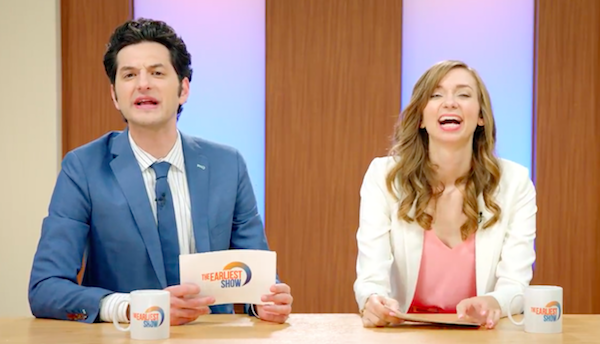
The Earliest Show
The Earliest Show, presented by Quaker, focuses on the story of a news anchor’s very public break-up while periodically promoting Cap’n Crunch through purposely zany infomercials. (Source: Quaker)

Nutella and Starbucks, for example, both decided to create inspirational content for its audiences in 2016. Nutella’s feel-good series Spread the Happy tells the stories of individuals who make the world a better place by spreading kindness to others. Starbucks began a similar campaign in September with Upstanders, an original series that aims to inspire positive change amidst cynicism in the United States.

Meanwhile, Geico and Quaker have taken the entertainment route for its customers with comedy. Geico promoted its eSports sponsorship of SoloMid with TSM’s New Neighbor—a comedy series about an obnoxious neighbor who can’t get enough attention from the professional gamers. Cap’n Crunch teamed up with Funny or Die to create a comedy series called The Earliest Show that targets millennials watching TV in the middle of the night.

If you’re wondering where consumers are discovering this type of content, 50 percent of consumers surveyed cited Facebook as a primary discovery channel, followed by email and search—both at 29 percent, respectively.

The Nobel Peace Prize VR Concert Shows How #PeaceIsLoud

The Nobel Peace Prize was awarded to Colombian President, Juan Manuel Santos, this year for his efforts to bring the country’s more than 50-year-long civil war—described as the longest-running conflict in the Western hemisphere—to an end. Santos called the prize “a gift from heaven,” and both he and his country had plenty to celebrate on Saturday night. The occasion was further marked by the Nobel Peace Prize Concert held the following evening in Oslo, Norway.

The concert, hosted by late night talk show host Conan O’Brien, featured performances by Sting, Highasakite, Halsey, Icona Pop and others. It was also livestreamed in virtual reality, which marks the first event in a multi-year partnership between Digital Domain, the Nobel Peace Prize Concert producers Gyro AS and Warner Bros. ITVP Norge AS and the Telenor Group. The 360-degree broadcast can be experienced using the Nobel Peace Prize Concert’s PeaceIsLoud VR app on both iOS and Android, on the Nobel Peace Prize Concert’s website, or its Facebook, Twitter and YouTube channels.

Digital Domain’s COO, Amit Chopra, told [a]listdaily: “The Nobel Peace Prize Concert is a prestigious event with a meaningful goal, and we’re proud to use our advanced technology to help share its message of peace with a passionate and increasingly connected global audience.”

Rich Flier, managing director of business development for Digital Domain, also spoke with [a]listdaily about its partnership to express how “peace is loud” across both real and virtual spaces.

What led to the partnership to broadcast the Nobel Peace Prize Concert in VR?

Our European partners Gyro AS, Warner Bros. ITVP Norge (Warner Bros. AS) and Telenor were looking to marry music, vision and cutting-edge technology to amplify the important work of The Nobel Institute and its celebrated laureates, so the relationship was a very good fit from the outset. It’s worth noting that these partnerships will extend to several additional immersive experiences going forward. This event is uniquely important to us, as it’s entertainment for an important cause. We’re working with our partners to amplify the Nobel Institute’s “peace is loud” message to a global audience. It’s an incredible honor to play an active role in sharing this prestigious event with the world and we cannot imagine a more worthy application of our technology and creativity.

How does the VR experience compare to a traditional broadcast?

In comparison to a traditional broadcast, 360 productions give the audience an opportunity to actively engage in an immersive experience that truly transports them to the center of the action. Viewers from around the world can experience live events in 360-degrees, as if they were a member of the physical audience—allowing them to the freedom to take in their surroundings, even if they’re watching the livestream from their living rooms halfway around the globe. Using our apps, viewers are even given the ability to change their perspective of the event by switching to different cameras, rather than watching what’s fed to them in traditional broadcasts.

How does the Nobel Peace Prize concert fit in with Digital Domain’s other VR content?

Like our livestreams of the Country Music Association’s 2016 CMA Fest and the Today Show concert series’ performance by DNCE, Digital Domain is providing the best seat in the house to technology and music enthusiasts alike. We’ve developed technologies that capture the concert’s sounds and surroundings to create a sense of presence for audiences everywhere. With our cameras and broadcasting tools, viewers now have a seamless connection to the live event.

How are you spreading awareness of this VR broadcast?

The Nobel institute and Telenor Group are the producers of the event, and therefore leading the charge in spreading awareness about the platforms available for tuning into the livestream. The artists themselves, including concert host Conan O’Brien, are participating in the cause with videos and social posts about the livestream. Our primary responsibility is to ensure the broadcast goes off without a hitch.

How do you think an event like this concert grow adoption of VR content among consumers?

Adoption of VR will be driven by the content itself. The more engaging and transportive the experience, the more consumers will immerse themselves in this technology. With a 360 livestream, we’re giving audiences around the globe the experience of actually being in the concert hall, sharing in the live event and viewing their favorite artists and entertainers in a way they cannot otherwise. It’s the next stage of evolution for the broadcasting industry, and we’re thrilled to be a part of it in these early stages.

https://www.youtube.com/watch?v=QfY5t1zJA1Q