Dell Sees Bright Future For Drone Racing

At the Dell EMC World event in Las Vegas this week, the technology company had an entire area inside The Sands Convention Center dedicated to video games, virtual reality and drone racing. Attendees were able to play Oculus Rift titles like Epic Games’ Robo Recall, HTC Vive games in front of a giant green screen so spectators could see players in the VR experience and PC and VR games connected to an Alienware gaming truck. There was also an entire dome dedicated to DR1 Racing, complete with professional drone pilots on hand to train attendees how to steer the tiny micro series drones through a Gotham City-inspired course filled with skyscrapers.

Joshua Bernstein, vice president of technology for Dell EMC, is the mastermind behind the emerging technology section of the massive Dell EMC World event, which all ties into the CODE program at the giant technology company.

Joshua Bernstein, vice president of technology for Dell EMC

“CODE is a group of passionate engineers that are dedicated to making Dell relevant in the open source community,” Bernstein explained. “We contribute to open source projects that we enjoy and that we find are popular, we support our own projects and we generally create awareness about open source with our customers inside of Dell and around the community.”

In addition to coding, the former Apple engineer, who helped create Siri, spends a lot of time flying drones. He owns 15 quads and understands the thrill of racing a drone of any size through a professional course. So, bringing DR1 Racing into Dell EMC World was a no-brainer.

“I’m a big drone racer myself,” Bernstein said. “What makes drones interesting as a sport and as a hobby is that you can’t just be athletic. I’m not very athletic, but you have to have two key talents. You have to be a good pilot and you have to practice. But the whole sport rose out of the availability of open source software, so you have to be able to consume open source software and be a part of the community in order to be an effective drone racer. You have to utilize social media. You have to read forums. You have to understand open source software. That’s the relevance between CODE and drone racing.”

DR1 Racing is the largest drone racing company in the world today, with a global television distribution network and three tiers of racing. The Micro Series drone racing is currently the most popular, as well as the easiest entry point for new pilots. The Tiny Whoop drones, which fit in the palm of your hand, are both lightweight and versatile, and they cost a fraction of the larger quadcopter drones that are used in the Champions Series.

“I love these Tiny Whoops,” Bernstein said. “I spend more time racing these around the office when I’m there. I’m traveling more than I am flying these days, so being able to take the Tiny Whoop with me on the airplane all over the globe and zip it around airports and hotel rooms is just great.”

Bernstein sees DR1 Racing has the potential to do for drones what Formula 1 did for the auto industry.

“Number one, it’s about brand recognition,” Bernstein explained. “But really, it’s about where all the research and development come into play that support a broader industry. Goldman Sachs said that drones were going to become a $4 billion industry four years from now. If you think about the more commercial aspects of drones in roof surveying, crop surveying, first responders, and all these business-oriented ideas, all of that technology comes out of drone racing and comes out of this community. That’s why it’s going to be a big deal.”

DR1 Racing was the first league to get drone racing on TV through a branded race with Mountain Dew and Dorito’s on Science Channel. The company has also used Twitch to connect with the younger fan base. But now DR1 Racing has built a global distribution network to bring the sport to the masses with partners like Europsport across multiple levels of professional competition.

“The spectator potential is tremendous,” Bernstein said. “Just like how people love NASCAR, love Formula 1 and love that technology, the ability of DR1 to present it in a way that’s consumable to the average viewer is really powerful. It’s one thing to go to a park and watch these drones zip around at 80 miles an hour outside, but to see these drones on movie sets and environments that you identify with and be able to witness it and be able to follow the racing is incredibly powerful. It has to be consumable, and I think DR1 has done a great job of that.”

The Gotham City-inspired set inside the Dell EMC World convention tied into the Dark IT Knight theme of this year’s event. Bernstein said the immediate feedback from the thousands of attendees this annual event attracts from around the globe was overwhelmingly positive.

“Customers I’ve spoken with have told me what a memorable experience this is and how different and unique it is,” Bernstein said. “To be able to provide it here in a consumable way for people to appreciate and be a part of makes it even more emotional when they get to watch it on TV and appreciate it. And unlike Formula 1, where not many of us are going to get to zip around a track in a Formula 1 car and have that experience, drone racing is unique in that anybody can experience it very easily. That’s what makes it powerful as a sport in the future.”


How Critical Force Is Building Out Mobile Esports

Finnish game studio Critical Force designed its iOS and Android mobile first-person shooter game Critical Ops with esports in mind. After amassing 10 million downloads, the company partnered with Korean game development and publishing conglomerate NHN Entertainment last September, which invested $4.3 million in the small independent studio.

Kasperi Kivistö, community manager at Critical Force, told AListDaily that the studio began experimenting with community-level Critical Ops tournaments early last year. Since then the company has focused on building a sustainable grassroots environment while working with partners to increase the players and viewership of competitive Critical Ops.

“Most of the competitions take place in North America and Europe, and it makes sense for us to focus especially on these regions,” Kivistö said. “Nonetheless we have active communities in other regions as well, and we want to offer them a chance to compete too.”

Critical Ops

Critical Force has been slowly and steadily increasing the prize money in these tournaments. Currently, the biggest online tournaments have a prize pool of 2,000, but Kivistö said the company will increase this amount in the future.

“This year we’re further establishing our roots as the competitive mobile FPS space,” Kivistö said. “Tournaments this year will be mostly online and organized by companies like Valiance and ESL. We’re also looking to organize a couple of live events to do some tests and prepare for the big push next year.”

That push will come with lessons learned from these internal and partner tournaments, as well as the larger esports and mobile esports ecosystems.

“When we first began experimenting with tournaments a year ago, we pretty much did what felt best for our game at that moment,” Kivistö explained. “Since then we’ve gotten a lot of tips and thoughts from other developers, as well as organizations that have entered the Critical Ops competitive scene.”

While formats for esports tournaments are somewhat universal, Critical Force prefers to focus on simplicity when choosing bracket types for its tournaments.

“From a general level, we follow both esports as well as traditional sports to help us create memorable stories around events and teams, and through that, develop a sustainable ecosystem for competition,” Kivistö said.

Critical Force has the original creator of Counter-Strike, Minh “Gooseman” Le, on its board of advisors and he has been helping the team with esports.

Counter-Strike was one of the first competitive FPS games on PC and has set what we consider the standard for competitive FPS gameplay,” Kivistö said. “The action in Counter-Strike is tactical and realistic, and our aim is to provide a similar experience on mobile devices.”

That connection with Counter-Strike, and the newer Counter-Strike: Global Offensive, has attracted some CS:GO gamers to the competitive Critical Ops community. In addition, the tournament organizers and their staff have experience playing CS:GO.

To date, Critical Ops has over 15 million downloads and 500,000 daily active users playing the game.

That community has bypassed Twitch in favor of Mobcrush. Critical Force does a weekly community stream on Mobcrush and on Facebook. Kivistö said tournament organizers use Mobcrush and they’ve recently started streaming on YouTube with success.

“Although we’ve not expanded to Twitch yet, it doesn’t mean we won’t be there,” Kivistö said. “We’re looking to grow our presence on Twitch in the future. We’re currently working on a content creator program to support people spreading the word about our game. Instead of doing paid promotions through influencers, we try to focus on growing our own.”

With the game still in soft launch, Critical Force is developing crucial features to support the nascent esports community. In addition to the online tournaments and a few live events, collegiate esports is something the company is focusing on, especially in the US. The first Critical Ops college events will debut later this year.

Even at this early stage, a few professional teams have already ventured to Critical Ops. The biggest teams include Team Phoenix, Hammers eSports and GankStars. Kivistö said as this competitive scene grows, the studio hopes to attract other professional gaming organizations.

Next year will be the opportunity for brands and sponsors interested in reaching Critical Ops gamers.

“Currently we’re building our competitive scene, but tournament organizers and some teams have already partnered up with their own sponsors,” Kivistö said. “It’s clear there’s a lot of interest in this game from sponsors.”

That could be because mobile as a platform is cheap and easily accessible. Mobile also is a key way esports fans consume live events and other content. This opens the door to brand new competitors in the esports space.

“Everybody has a mobile device and you don’t need an expensive gaming PC to compete in a high tier,” Kivistö said. “The small size of the devices also allows instant LAN parties with your friends.”

Look for Critical Ops to entice CS:GO fans and compete with other mobile esports titles like Hearthstone and Vainglory next year.

How Kia Is Driving Its Challenger Brand With The NBA, Chat Bots And Influencer Marketing

Kia kicked off their marketing this year with a Super Bowl ad featuring Melissa McCarthy as a hapless eco-warrior promoting the Korean car company’s newest crossover model in the Niro Hybrid.

The spot was a strong follow-up to the commercials Kia aired the two previous years with Christopher Walken’s tour of his “Walken Closet” (2016) and Pierce Brosnan for the Kia Sorento (2015).

But their eighth consecutive appearance in the Big Game this year also marked a new method of messaging and utilization of marketing technology in debuting the brand’s Super Bowl commercial on the NiroBot for Facebook Messenger.

Although the ad had its day in the sun on the Falcons-Patriots telecast, leveraging the nascent conversational bot tool as part of a multi-faceted campaign was a step in the artificial intelligence path Kia wanted to take.

Kimberley Sweet Gardiner, director of marketing communications for Kia, and Nathalie Choy, senior web marketing manager for Kia, joined AListDaily to detail how they are using martech while also leveraging their role as an official automotive partner of the NBA.

What did you learn from being the first brand bot for Messenger to debut a Super Bowl ad?

Gardiner: This was in the works for quite some time. It wasn’t just for the Super Bowl. With Niro, we wanted to try something that we can connect with customers for a brand new vehicle challenging the likes of the Toyota Prius. We’re not the first [hybrid in the field]. We knew we had an uphill battle in having people consider and learn about our new car. We realized they would have a lot of questions in how is Niro different than any other hybrid out there. We needed a nice Q&A tool anyway, so we activated around a chatbot as a perfect and unique way to have consumers familiarized on Facebook Messenger about guided vehicle discovery, expansive technical knowledge, step-by-step tutorials and test drive scheduling. We knew we could extend it to other models. It was a perfect opportunity to get customers going on that journey.

https://www.youtube.com/watch?v=1dQ9a5EFZeI

Choy: It’s basically one-to-one marketing at scale. The fact that the Niro is a smarter kind of crossover car, we wanted to use a smarter kind of technology and a marketing channel to complement that, too. Using artificial intelligence and machine learning, the chat bot gain more awareness for Kia. It’s definitely an area of which we wanted to experiment in more to elevate the Kia brand.

What are some of the insights and analysis that you can share?

Choy: It’s been going really well! Since we launched in the middle of November, as of the beginning of April, we’ve had over 765,000 engagements between the consumer and the bot and 50,000 different users. Every day that number continues to grow. We are promoting it on our Kia site, email and all of our social platforms. Popular questions range from “what’s the miles-per-gallon?” or “what kind of technology, or color, do you come in?” or “what’s your engine like?” We can then augment a link to our website that offers consumers to get a test drive. The best part is that anytime they want to speak to an actual human, we can transfer the integrations seamlessly over to a person.

How do you plan on scaling?

Choy: There definitely is plans of that. Our executives headquartered in Korea are very interested in building out this bot. Not only does it serve marketing purposes, but for consumer affairs, the team that manages all of the customer support, they’re looking at leveraging those tools for recall information, and scheduling servicing and any type of warranty issues. We’re using this to see if it’s going to perform, and it definitely has exceeded our expectations. I think we’re going to explore other models and segments within our business.

Kia_Ad_on_NiroBot

Why is it critical for brands to move forward with multi-faceted marketing campaigns?

Gardiner: I tell my team that “I don’t want to see any gaps in the customer journey.” We want to helpful. So from whatever moment somebody gets interested in a product of the brand, the next series of moves they make should all be connected together. So, in other words, if someone sees our Melissa McCarty spot and wants to know more about it, we should be designing all of those “searchable” things up front. We should be putting ourselves on stage in the consumer’s shoes to say “okay, now what? . . . And now what?” That’s where a chat bot and other things we’re working on help put that into context. We don’t want to make a customer work too hard. We want to make it really seamless and easy. We want to be in technology not for the sake of it, but for it to help you. Taking all of that into context, we created a unified experience without making people work too hard. We have a whole initiative across our departments to figure that exact thing out, and technology will kind of be the piece that brings it all together.

What are the emerging marketing trends and technologies you’re zeroing in on in order to explore and innovate the Kia brand?

Choy: We have a bunch of marketing around augmented-and-virtual reality applications that allow consumers to virtually view the interiors of our cars to make it seem as if they were there. We’re exploring artificial intelligence a lot more. In addition to the chat bot, we’re also looking at voice-enabled consumer assistants such as Alexa and Google Home to be able to reach consumers at their moments. If you think about it, traditionally, people search for a website and once they land, they have to learn how to navigate in order to learn more. Voice-enablement takes that even a step further where you don’t even need the device anymore, you could just verbally ask whatever you want. We’re looking at each of the technology capabilities and identifying where that technology can help support in the customer-buying journey.

Is there a specific product or service that you’ve identified as your primary one for consumers? 

Gardiner: For us, no, because we’re a challenger brand. We have pretty reasonably low awareness compared to some of the other brands that are out there. We’re not top of mind. We have to kind of cover a bunch of bases. We can’t be in just one space and say “that’s the one portal that we’re really going to focus on.” What we try to do is constantly look at where and what consumers are shopping for, so we’re working with a bunch of different partners to figure out what that one sweet spot for social media, search, website and mobile is. It’s different for other manufacturers. For us, we have a moment to capture your attention and keep you engaged because Kia may or may not be top of mind for you.

Will you be experimenting with influencer marketing to further gain a market share?

Gardiner: We have been doing influencer marketing for the last two years or so. We did one with IBM Watson during the Super Bowl last year. We have another one coming up in San Diego this summer around our Eco lineup, Niro, as well as a couple of other vehicles. We do them periodically. Corporate communications and our PR team jointly lead that with us. We have a super-engaged and passionate group of about 10-to-12 influencers that we work with on an ongoing basis. We need to grab people at different touch points to bring them into the conversation, so it’s not going to be just one vertical—it’s going to be multiple ones like music, art, fashion, design, lifestyle and travel across the board. The main thing that we want is for people to get to know Kia, and get really excited about working with us. From there, it’s an easy in because no matter where they’re coming from, the voice that they have is going to be genuine.

How do you find and identify influencers?

Gardiner: That’s a good question. I think for us, it’s those areas that we know are going to be important to our consumer base. So we did look at things like music, for example, as a big one. Design and travel is another one. We find that people may not have the most followers, but it’s not so much about quantity for us—it’s really more about the tone of the voice. Are they approachable? Are they easy to work with? Sometimes we find them organically, through events like Dad 2.0, Mom 2.0 and VidCon. Again, being a smaller brand, we’re much more about building relationships with our influencers. So being one-of-ten people we work with, rather than being one-of-one hundred, is a nice thing for us.

Choy: It’s about the message, too, and aligning what we are trying to achieve as a challenger brand.

Your partnership and marketing in the NBA has now reached 12 different teams. The Kia Optima is also the league’s “official vehicle.” How has Kia evolved and kept the marketing momentum running in the NBA going back to when it started in 2008?  

Nathalie: Absolutely. We all know with live sports, especially with basketball, people tend to watch it more than once per week, and they tend to be engaged. The messaging we have is about the games.

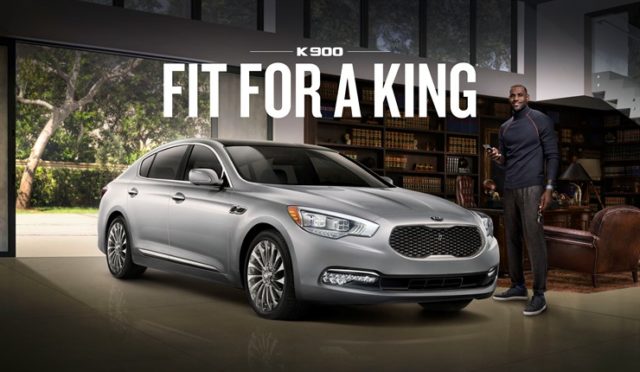
Gardiner: We’ve been in the NBA for a number of years. A cool instance was when LeBron James reached out to us and said he’d be open to an opportunity to work with us because he loved the K900 sedan. We were lucky to have him seek us out, because we don’t have big budgets, massive resources and big teams to do that on a regular basis. We also had Kia patches on the All-Star game jerseys as part of a pilot program. It’s good for us to try those things, and be some of the “firsts.” We need those moments of exposure. When people ask “is [the NBA sponsorship] worth it?” My response is “yes, it’s working because we’re able to have so many different opportunities in games, broadcasts and even vehicle activations in arenas.” It gives us a lot of touchpoints because we’re a small brand that needs a lot of exposure over a period of time with people who are engaged. We only have a 3.7 percent market share.

Will you consider being one of the 30 NBA jersey sponsors for the upcoming season?

Gardiner: No. They want too much money. It’s way more than we can pocket. Some things just get way too big, and budgets get bigger, and we can’t necessarily afford it. But for us, again, the main thing is we need grow awareness about Kia. We can’t afford to spend dollars where people are not just going to be in the moment. But we’re working with the NBA for opportunities on other fronts. . . . You start off from small moments, and you build it from there. That’s really what we’re about.

Follow Manouk Akopyan on Twitter @Manouk_Akopyan

https://twitter.com/kia/status/841812530087493633?lang=en

Citi Is Straightforward With New Spots Featuring Katy Perry

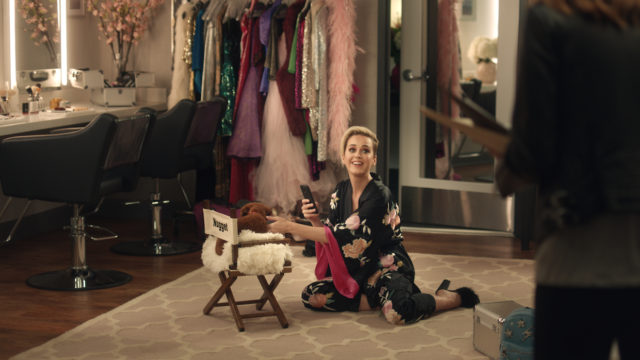
Citi is doubling down on the success of their “Double Cash” credit card campaign by continuing its longstanding relationship with Katy Perry and tapping the songstress to relay the brand’s no-punches-pulled positioning.

The new spot features Perry rehearsing for an upcoming show and highlights the disparity between what people say and what they actually mean through everyday scenarios. Citi’s messaging—which will continue later this month with Perry’s micro teacup poodle named Nugget—is simple: they mean what we say.

“I’m all about not mincing my words, so I’m excited to be teaming up with Citi for this hilarious new campaign,” Perry said. “I’m super pleased Nugget finally gets to be on TV, too.”

01_katy_perry_and_nugget_citi_double_dash_spot_2017_billboard_embed

“In today’s society, consumers have a heightened desire for a more emotional, authentic dialogue with brands,” Jennifer Breithaupt, Citi’s global consumer chief marketing officer, told AListDaily. “In a category that’s not always straightforward, we took on the elephant in the room, and it’s absolutely resonated with our audience.”

Breithaupt said they’ve used the “Double Cash” campaign to open dialogue with consumers through humor and relatable situations. And it seems to be working. Product awareness increased 2.3 times and website traffic from natural search increased by over 80 percent within the first three months of the launch of the original Effie Award-winning “Double Cash” campaign last March.

“Through proprietary research with general US consumers, we found that almost one-third of respondents described choosing a new credit card as ‘a complicated experience,” Breithaupt explained. “As the world’s largest credit card issuer, Citi is striving to remove that complication alongside selecting a new credit card.”

The ads with the pop star Perry will be appearing on ESPN, USA, E!, Discovery, Lifetime, HGTV, FX and AMC during programming like The Bachelorette, Dancing with the Stars and events like the Billboard Music Awards and NHL Stanley Cup Playoffs as well as the singer’s upcoming appearance on James Corden’s Carpool Karaoke special. A complementing social media strategy entails Facebook, Twitter and Instagram with a focus on GIFs with meme-inspired copy to further drive video views.

“With more hyper-connected consumers interacting with ads via digital and social channels, it’s imperative that any unified campaign include a full spectrum of media channels,” Breithaupt said. “As such, this campaign encompasses a robust digital and social strategy that envelopes consumers with campaign content how, and where, they want to view it. From a strong presence on Facebook and our own social channels, to the use of vertical video and non-audio assets in mobile, the campaign is an additive experience for consumers. We also look for opportunities to be in the right places in digital—for example, if consumers are viewing Katy content online, we think they would enjoy viewing our ads in addition.”

Jennifer Breithaupt
Jennifer Breithaupt, Citi’s global consumer chief marketing officer

Breithaupt, who’s worked at Citi since 1999, is fresh off of a promotion that was announced last month.

It’s early days but I’m incredibly excited about the road ahead,” Breithaupt said. “Citi’s global consumer bank and in particular, the cards business, has been on a multi-year journey to transform the business and build a world-class, highly competitive product portfolio. Today, we’re well positioned to drive growth going forward and be the bank of tomorrow and our marketing initiatives will increasingly reflect that.”

Her previous role entailed working as the managing director of media, advertising and global entertainment for Citi, where she was largely responsible for setting the Citi Private Pass program strategy and giving cardholders exclusive experiences for the more than 12,000 events that included acts like Coldplay, Lady Gaga, Madonna and Perry. Under her watch last year, total entertainment spend on the near 33 million Citi cards in the US increased almost 13 percent in 2016 compared to 2015.

Breithaupt also spearheaded several multi-year partnerships, including the Citi Concert Series on Today with NBC and Live Nation Entertainment.

Citi recently united forces with Live Nation and NextVR to produce a series of up to 10 live concerts in virtual reality, transporting fans “backstage” with an immersive VR experience with the artists.

“Without a doubt, the rise of digital and mobile as a centerpiece in consumers’ lives is impacting all industries,” Breithaupt said. “At Citi, we’re embracing it and interacting with our customers in new and exciting ways.”

Follow Manouk Akopyan on Twitter @Manouk_Akopyan

Marvel’s ‘Guardians Of The Galaxy Vol. 2’ Marketing Mix Tape

Guardians of the Galaxy Vol. 2 blasted its way to the top of the box office with $427 million in global box office sales for its opening weekend. Long before millions flocked to theaters to get their Baby Groot fix, marketers were hard at work with a galaxy’s worth of brand partnerships and sneak peaks galore.

Ever since the sequel’s teaser was revealed in October, Marvel has been slowly ramping up the hype with a Super Bowl commercial and mix tape poster reveal that announced Kurt Russell’s involvement with the film. Since then, director James Gunn has generously shared behind-the-scenes photos from his social media accounts leading up to the movie’s premiere.

It’s no coincidence that a video game, Guardians of the Galaxy: A Telltale Serieswas released last month, too, just a little over a couple of weeks before the film’s premiere. Although the game features different actors than those appearing on the big screen, the characters are designed after the 2014 film interpretation.

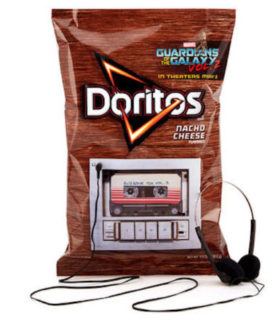
doritos-guardians-of-the-galaxy-vol-2-collab-2017-billboard-1548-616x440-1One of the most iconic elements for the Guardians of the Galaxy films is the soundtracks, and Marvel shared the tunes from Vol. 2 in a rather . . . creatively crunchy way. Marvel teamed up with PepsiCo’s Frito-Lay division and its Doritos brand to create a bag of chips with a built-in music player.

Just like Peter Quill, also known as Star-Lord, hungry fans can plug a pair of headphones into the bag’s 3.5 mm jack and enjoy the entire soundtrack of the film. The bags, initially available on Amazon’s website, sold out quickly but you can find them on eBay . . . marked up considerably.

The bags were part of Marvel and Doritos’ “Rock Out Loud” campaign. Entering codes from specially marked bags, the “Choose Your Guardian” activation offers fans a chance to win prizes ranging from tote bags to a Samsung Gear VR headset or a trip to London to live like a rock star.

Ford received a cameo appearance in the film with its all-new EcoSport compact SUV that goes on sale early next year. The car manufacturer teamed up with Marvel not only for product placement but a sweepstakes where entrants get a chance to win an EcoSport, a hometown screening of the movie, one of 150 custom illustrations by a Marvel artist depicting the fan as a galactic hero and “plenty of swag.”

In addition to the contest, the EcoSport will star alongside Groot, Star-Lord, Gamora, Drax and Rocket in a limited 500 print run comic book that will also be published digitally online for a short time.

Geico Insurance had a bit of fun with the help of Baby Groot in a TV commercial.

https://youtu.be/cthjod9awzI

M&Ms characters Red and Yellow teamed up with the raccoon in their very own commercial, then took over a New York subway train to create a “cosmic wonderland” for passengers. In honor of Guardians of the Galaxy Vol. 2‘s premiere, the confectioner made portraits of the film’s main characters out of candy across its social media channels.

On Twitter, Guardians of the Galaxy Vol. 2 has six sponsored hashtag images for fans to play with: #GotGVol2, #Gamora, #Starlord, #Drax, #Rocketraccoon and #Groot. The conversation keeps on going, especially as the intergalactic sequel nears $450 million globally.

3D cinema platform and visual technology company RealD Inc. announced Sunday that the film generated 41 percent of its worldwide gross to date ($174 million) from 3D performances of the film.

How ‘Sins Of A Solar Empire: Rebellion’ Plays The Long Game

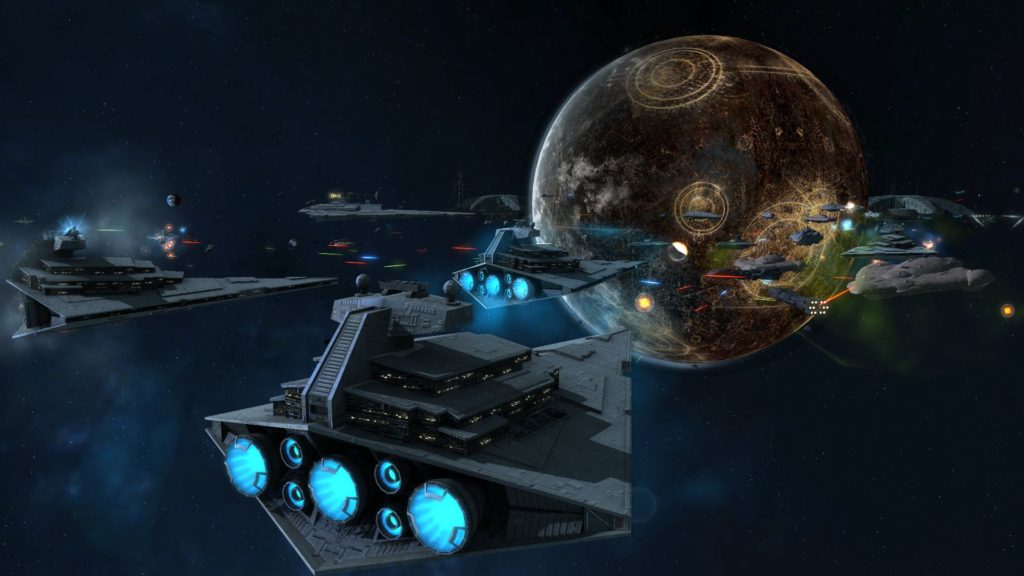
When the first Sins of a Solar Empire game launched in 2008, it was regarded by many as a creative breakthrough in gameplay. The space empire strategy title combined elements from turn-based games such as Civilization and Master of Orion with real-time action, making for faster pacing in an expansive 3D galaxy. That original game established a reputation for Ironclad games, which followed-up with Sins of a Solar Empire: Rebellion in 2012, growing the concept’s size and scope.

Despite hitting its five-year anniversary recently, support for Rebellion continues and the most recent premium DLC expansion, Outlaw Sectors, launched last summer. Digital sales remain strong on Steam, and the game has a thriving community of players and modders. Ironclad helped to mark the anniversary by releasing a “modernization update” for Rebellion, which improves the game’s graphical quality to support today’s powerful computer systems.

Blair Fraser, producer, co-owner and director at Ironclad Games spoke with AListDaily about engaging with a player community to keep a game going for half a decade and more.

How are you celebrating the five-year anniversary?

With a lot of big changes. One of the things I’ve always wanted to do was bring it up to speed with what a lot of computers are capable of now, and the community is always asking for different features and changes. I wanted to put it all into one package and say, “Look at this! Even after five years, we still have awesome new stuff coming, and it looks and runs better than it ever has before.”

Is the Rebellion community still growing?

Yes, amazingly enough. I certainly didn’t foresee it, but we still sell very well, and we still get a lot of community engagements. I get emails and private messages all the time telling me that the game is cool, that their friends still play it, and it would be nice to add this or that. There’s always a vibrancy to the community and engagement.

What is the key to engaging with an audience for half a decade, especially for a real-time 4X sci-fi strategy game?

Well, there certainly aren’t many of them, so we’ve got some default engagement there. But more than that—they wouldn’t stick around if the game was crap. To maintain it, we’re always adding new stuff and improving things. If you look at the five years of Rebellion and the ten years of the original Sins, we’ve constantly supported it through both free updates and decently priced DLC expansion that we release now and then.

Five years, in PC gaming terms, is an eternity. Why continue releasing updates and expansions instead of moving to a sequel?

If a product continues to do well, you want to continue to support it. That’s just a simple business thing for us. It still makes money, so we still put resources into it. Personally, I’m obsessed with perfection, responding to what the community is asking for, and fixing things that bug me. I do most of the work on this project on my own free time, and I enjoy doing it. We are going to release other projects at some point, and we want to be known as a company that puts the time and effort into continuing to support the games we work on. It’s not a waste because people are going to say the next thing is worth buying because Ironclad is backing it for as long as they possibly can.

Did you consider futureproofing the game for the next five years as you were putting together the modernization update?

Actually, it’s a mirror of what we were thinking in the early 2000s, when we were developing the technology, which would become the game that’s still selling now. We thought we were futureproof then, and boy were we wrong. But it was a different mindset because retail was still dominant, so our version of futureproofing was, “how long will the game last on the shelf at Walmart?” So, we looked about two or three years in advance, plus the game would be on the shelf for a few months, and then the game would never be heard of again. That was the typical life of a PC game prior to digital sales.

SinsRebellion_v19_3

How else have digital sales impacted the life of the game?

The fact that you can buy it at all is a huge difference from the days of old because it got pulled off the shelf once it passed its sales threshold. Now it’s always available. Every day, I check the Steam reviews, the Steam forums, our Sins of a Solar Empire forums and reports from Facebook, and I can see people are still playing and what the feedback is. I can also see them feeding each other by recommending the game.

The mod community has been instrumental in extending the life of Rebellion. What is it like to constantly update a game that players are changing up?

I love it, and that’s kind of how I got into games in the first place—just messing around with stuff, pushing boundaries, and changing things to the ways I wanted. I like any form of creative play, whether it’s Legos, modding or painting. I know some people say, “Don’t screw around with my baby,” but I think that’s too restrictive. Look at what music has come through remixes. Look at any artform. I’d be crazy to put the hammer down.

So, what are the steps for the next five years?

I’m still going to support Rebellion and the original Sins in my spare time, but my normal work hours are dominated by other things. You’ll hear more about that within the next five years—hopefully a lot less than that, but I’m not promising anything [laughs].

For The New York Times, The Truth Matters (And Brands Should Care)

Pitching agency executives and marketers on the depth and breadth of their pursuit of truth, The New York Times was the first media company to present at the annual Digital Content NewFronts on Monday, making a case for the importance their journalism plays at a global level.

The New York Times reported adding 308,000 net digital news subscriptions, making it the single best quarter for subscriber growth in their history, according to a Q1 earnings report released on Wednesday. While total revenues for in Q1 increased 5.1 percent to $398.8 million and with circulation driving that growth, total ad revenues fell by 6.9 percent despite digital advertising increasing by 19 percent year-over-year.

This particular NewFronts was a key platform for the media organization, who in a time of fake news proliferation, reemphasized their century-long message of building trust with readers and seeking the facts.

Focusing less on video (a common theme from this year’s presentations so far), company executives used the NewFronts stage for a two-hour presentation to showcase their journalists, produce a live podcast, discuss service journalism and flaunt T Brand Studio’s forthcoming films, virtual and augmented reality projects and Snapchat strategy. The underlying message “dared” marketers to co-create content with them.

Sebastian Tomich, senior vice president of advertising and innovation at The New York Times, joined AListDaily to detail how they are going to carry the NewFronts momentum throughout the rest of the year and use their newsroom as a launching point for branded campaigns.

18bd9e6
Sebastian Tomich, SVP of advertising and innovation at The New York Times

Why is NewFronts such an imperative event for The New York Times?

We’re all-in on the ideas business. We’re putting our chips in for winning these “winner-take-all” briefs that we see come across our desk more and more. We want to win all of them . . . For the first half of the show, we talked about our journalism and our brand broadly to get people excited. In the back half, it was more about packages, formats and case studies that we’ve done on the advertising side.

In light of the public back-and-forth with President Donald Trump, how is your strategy and message different this time from the past?

I would like to think that our NewFronts presentation was completely independent of anything to do with Donald Trump. You can say that he’s contributed to a moment right now for journalism and high-quality publishing brands like never before. We definitely want to take advantage of that. Our “The Truth Is Hard” campaign had elements that would appeal to the controversy around Trump. That’s something we also leaned in on for NewFronts in a way that we haven’t before. The “Truth+Dare” tagline was more about us saying there is value in truth. There is value in high-quality journalism. It’s about what you can do with that in a daring fashion, and what makes the things that we do with advertisers special. Those were themes that we kept reiterating throughout the entire show—we don’t market ourselves as a transactional media business, where you come to us just to make a generic VR film, video or podcast. You come to us because you want to do groundbreaking work. If you look back at the last four years, all of our investments have planted us in that direction. We believe the future of our ad business will live and die on our ability to get groundbreaking ideas off the ground. We’ve invested in the teams and capabilities for all of these new businesses, like VR and audio, in order to do that.

What are some key categories in which you’re looking to earn brand trust and advertiser spending money? 

The magic of The Times is that we get to play in so many key categories. We have a sizable Broadway and live entertainment business just as much as we do in auto. That’s exciting because you get to play in so many different verticals . . . Legacy lifestyle categories, like fine arts, live entertainment, travel, luxury and fashion skew more toward our editorial pillars, like a Sunday Travel section, versus custom. The broad message of innovation applies to everyone with big, creative ideas. In terms of the programs that we’ll launch, I think they’ll probably skew more toward auto, tech, finance and consumer packaged goods categories.

How are you positioning the T Brand Studio? Why are brands increasingly leaning toward branded content? How do you see the branded storytelling space developing?

It continues to grow significantly again this year. The advertisers that we work with continually lean on T Brand Studio to do high-quality work. By taking a premium position, we’ve been able to carve out a unique space for us. We’re not commoditized content in any way, shape or form. For some marketers that we work with, I’ve seen a trend of them having in-house studios, but they still tend to lean on us for content strategy, scripting and talent. So we still play a role and co-create together. We might just not handle the end production. The big headlines for T Brand Studio are our expansion into new lines of business like social influencers, experiential, VR and AR production, and beginning to dabble in content strategy work where we’re being engaged as a consultant to help brands think more like a newsroom. I’m really excited about that. There is so much room to grow. At NewFronts, we presented some of our best programs of the year with Tiffany, IBM and Kia, and how they took advantage of everything we have at our disposal. It’s a huge part and driver of our business.

How are you leveraging brand safety positioning in light of YouTube and Facebook’s ad issues and platform miscues?

We did a session on brand safety at NewFronts for the audience. We spoke about how JPMorgan Chase shifted from running on 400,000 sites to 5,000, and they still managed to keep performance consistent. We also talked about Facebook and Google’s earnings, and even in light of the brand safety issues, their earnings are still strong. I and many others in the industry believe Facebook and Google will be fine. They’ll continue to be facilitators for the majority of the ad business—brand safety issues or not. When we do go to market, we always talk about the power of our brand, and the fact that it’s a quality environment. But brands always knew they were already going to get that. The only place where there’s a real, tangible impact on brand safety on investment is in the programmatic space. Brands are either reaching out to work with us directly in programmatic by carving out specific pieces of inventory, or section-specific buys. The other is having some brands go out publicly and saying that “we’re not going to work with Google or Facebook on programmatic buys until they sort out some of their issues.” That’s a place where we don’t necessarily benefit from, but we have to react and work with others.

Why are podcasts now a big part of your strategy?  

It’s a place where we can take a leadership position. Lisa Tobin, The Times’s executive producer for audio, said that the challenging part of the audio space is just finding stories. We have an incredible newsroom not only today but back to the first day we started, with a trove of stories. We can lead in the space. So when we think about the audio business, Sam Dolnick, the assistant masthead editor, said at NewFronts that “when we go into a new medium, we go in to tell the same quality of stories—and we want to go big and reach millions of people.” The success of our The Daily podcast [27 million downloads], which was just expanded from five days to seven and is now available on Spotify, has galvanized the newsroom to realize the opportunities of how many other types of podcasts we can do as well. You will see more from us in the next 12-to-18 months. You’ll see it across many verticals [like S-Town and Serial podcasts] and not just news.

Why are brands, like your launch partner in BMW and Samsung too, interested in sponsoring podcasts? Is it a successful move for them?

There is a lot of interest for sure. We only have two models. You either advertise in our podcast, or we create a custom one for you. There is no such thing as product placement at The Times. There is a good amount of advertisers that just want to try the medium because there is so much interest. The founder of Spotify, Daniel Ek, said that the opportunity of getting into someone’s ear is better than the opportunity of getting in front of someone’s eyes. It’s a huge engagement opportunity. The brand-led podcast space in generally immature. Who knows where that’s going to end up. I know brands like General Electric have had success with the message, but I haven’t seen a whole lot after that. For us, most of the work we have is tried and true audio spots around our newsroom podcasts.

Last year the NYT’s big push was behind VR. How are you now scaling the platform?  

It’s like the same theme as audio—we want to tell mission-driven stories in new ways like we always have. If you look at VR, it’s almost like a variation of the same playbook. We want to scale and go big. We launched the app, and I believe we are the largest publisher VR app there is in media. The newsroom continues to do about one film a month. The next evolution for us is how to blend VR into bigger stories that we’re reporting on so that VR becomes an add-on and allows readers to experience a 1,500 story differently. You’ll see that with our upcoming piece that we’re working on about Antarctica. And then, our work with platforms. I don’t have anything to announce right now, but you can imagine that we’re going to have growing presence on VR platforms by the end of the year.

How do you plan to keep building your presence on Snapchat?

Snapchat is more unique because it’s a contained platform. It’s a walled garden, where you’re only creating content specific to that platform. Our relationship with them is a little bit more unique, where we’re actually creating a Snapchat-specific publication that runs once a day for the entire year. We saw it as a great opportunity to reach new audiences and experiment with new formats, and in some cases, tell new stories. That’s an exciting thing for us—to reach new, younger readers. I would say the biggest motivation is for our New York Times brand and just making sure that we’re in the hands of all of our future subscribers.

Follow Manouk Akopyan on Twitter @Manouk_Akopyan

Why Epic Games Is Helping Indie Games Get Funded

While open source tools make indie game development more accessible, that’s pretty much where the easy part stops. Developers must secure considerable funding, often by working on their passion projects outside of a day job and then market as best as they can—hoping and praying that someone notices. Some games make it big, but most don’t—which is why AAA publishers are stepping in to help.

Epic Games (Gears of WarRobo Recall) has teamed up with Xsolla Capital, a $50 million royalty investment fund focused on video games to encourage and fund self-publishing efforts with Unreal Engine 4 (UE4). “Together, Epic Games and Xsolla Capital plan to widen the reach of UE4 games in global markets and propel the developers behind these exciting projects to continued success,” the companies announced in a press release Wednesday.

Unreal Engine 4, an open source game development platform created by Epic Games, is free (with royalties upon game shipment). Epic’s strategic partnership will further encourage developers to use UE4 for their projects while providing additional resources to make those projects a reality—a win/win.

“Since taking Unreal Engine 4 free two years ago, we’ve seen an enormous rise in high-quality titles made by small teams, and Xsolla is able to share in that success by allowing developers to maintain creative control while receiving many of the benefits a traditional publishing arrangement would provide,” Mike Gamble, European territory manager at Epic Games, said in a statement.

“In addition to quickly building and iterating with the tools, indie teams can bring triple-A production values to their games using Unreal Engine 4,” Gamble told AListDaily. “Because we at Epic ship our own games, Unreal developers have a proven path for achieving optimal performance on their target platforms, and this mitigates risk for publishers and partners like Xsolla. As a result, these small teams gain a real competitive advantage in the market. Epic’s model is built around the success of Unreal developers, so we continually seek out the most fun, high-quality indie projects, and we support the teams behind them through numerous programs. This ultimately builds great business opportunities for everyone involved.”

Under the terms of the collaboration, Xsolla Capital will support UE4 developers with financial and marketing resources for the development of their projects in addition to covering the costs of custom Unreal Engine licensing. Xsolla also offers worldwide payment solutions, a 24/7 international customer support team, fraud protection, distribution options, data visualization and more.

“We share a belief that the developer knows how best to make the game they’re envisioning, and how to communicate with their audience, Dmitri Bourkovski, vice president of global business development at Xsolla told AListDaily. “But, a publisher’s input is also valuable in a lot of situations and Xsolla works with both publishers and developers. When developers decide to self-publish, they get access to the same set of tools and services that Xsolla provides for publishers, too.”

While not everyone offers funding, it is certainly in the best interest of game engine providers (Unity, CryEngine, UE4, etc.) to attract new licenses. Self-publishing puts control in the hands of developers, who are then free to stay true to their creative visions. Relying on the assistance of major publishers often means compromise over creativity—a major reason crowdfunding has become an indie developer’s best friend.

Indie developers can now self-publish on major consoles thanks to programs like ID@Xbox and PlayStation Network. You’d think a AAA publisher wouldn’t want to help the little guys as not to create unwanted competition, but the opposite has been true in recent years. Competition on their respective marketplaces creates an ecosystem that thrives and keeps the publishers relevant as trends come and go. Plus, audiences love a good underdog story.

Such was the case with Unravel, the charming indie title that spawned from a partnership between EA and Coldwood Interactive. Following the game’s success, EA Originals—a selective indie partnership program—was unveiled during EA Play last year. Swedish developer, Zoink (Fe) became the first participant, and Joi-Mei Games (Sea of Solitude) made the cut for 2017.

“Making games is hard. It’s a hard business,” said Patrick Söderlund, executive vice president of EA Studios in an official blog post. “These developers have taken on the risk of developing a new IP, and great games deserve to be played. So with EA Originals, we want the profits from these games to go into the hands of the studios making them. We want them to be recognized for their work, so they can keep innovating and creating, and so the players get to play more and more amazing games.”

Former NFL Star Shawne Merriman Sets To Make His Mark With Lights Out Brand

Former San Diego Chargers star Shawne Merriman made his impact felt in the NFL with a frenetic energy to get to the backfield to deliver bone-crushing hits.

Before tallying 45.5 career sacks—39.5 of which came during a three-year Pro Bowl stretch to kick off his career—the nine-year veteran pass-rusher earned the nickname “Lights Out” for his hell-raising hits when he was a sophomore in high school.

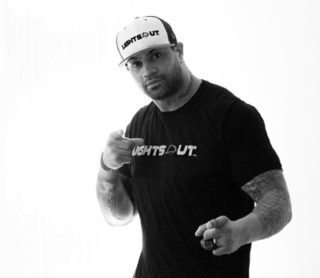
Now the former Chargers and Bills linebacker has turned that nickname into an apparel brand. The soon-to-be 33-year-old has partnered with Bellator MMA for a line of workout clothing, and he’s now taking the brand into NASCAR. Merriman is also the owner of a NASCAR K&N Pro Series West car, adorned with the Lights Out logo, driven by Jesse Iwuji.

Merriman has been a racing fan since he was a kid growing up, and watching the sport on TV. Since being the grand marshal for the NASCAR Cup race at Auto Club Speedway in California in 2008, he’s become friends with famous NASCAR drivers like Jeff Gordon and Jimmie Johnson. And now, he hopes that Iwuji, who is African-American, will work his way up the NASCAR series ladder and connect with new fans—both racing and Lights Out.

Shawne Merriman

“Bringing diversity into any sport is really going to open up the eyes of people who wouldn’t necessarily have any other direct involvement with it,” Merriman told AListDaily.

Merriman said especially in his home state of Virginia and the nearby areas of Atlanta, the cities and the communities that identify with NASCAR know what a great sport it is.

“But there’s a large audience that can’t identify with the sport because they’ve never been a part of it and have never attended a race,” Merriman said. “And hopefully these diversity programs will bridge the gap and get people exploring what racing is all about, what Lights Out is all about.”

This year Merriman is launching a line of NASCAR licensed Lights Out clothing aimed at the African-American consumer.

“I hope the Lights Out brand is able to help bridge the gap and connect the dots with new people in NASCAR,” Merriman said. “Hopefully, these clothes symbolize something greater than just putting on a T-shirt.”

Connecting with kids early could be a way for NASCAR to grow its audience. The sport has struggled of late to fill the stands at race tracks.

“Imagine if a 12-year-old Shawne Merriman gets a chance to go to a NASCAR race and sees the excitement of what goes on there?” Merriman wondered.

Merriman said the Lights Out NASCAR line will be sold across a large amount of different retail outlets, as well as online.

196856

“We’re going out there with the racing theme and what I hope that this line symbolizes is the excitement of the sport being spread across a different demographic,” Merriman said. “And that kind of excitement is what I hope connects with new fans. We have a bunch of community outreach programs lined up that I hope will have positive results for the people in the community and the cities.”

NASCAR is the second sport Merriman has embraced with his brand. The former NFL sackmaster actually used MMA to prepare his body for the grind of the gridiron when he was an active player until 2012. Merriman never played a full season and four of his campaigns lasted no longer than five games.

Last September, he signed a deal with Bellator MMA, a combat sports promotion that rivals UFC and airs on Spike TV. All fighters wear Lights Out clothing while training and during fights, which gives the brand wide exposure to MMA fans.

“One thing I’ve really concentrated on since I retired is building my Lights Out brand,” Merriman said. “We signed a partnership with Bellator MMA about nine months ago and the Lights Out brand is featured on the top of the cage and in the ring. The fighters walk in and out with the Lights Out T-shirts. It takes a lot of work because you want people to really identify with the brand and what the brand stands for. If you do it within a certain sport with the right team of guys who are really vocal, that’s what the brand is about.”

Merriman became interested in clothing design as a student-athlete at the University of Maryland. He also worked with Nike to help the brand design athletic clothing.

“The one thing about Lights Out is I don’t want to put the brand in a box and have anyone say it’s ‘this kind’ of a brand,” Merriman said. “I was a Nike athlete my entire career and I got a chance to see a great brand being built. I was always heavily involved and hands-on for what I was doing. And over the course of time I picked up a huge amount of information, and it’s helped me get to this point with Lights Out. And every day I’m still learning, which is great.”

With Bellator and NASCAR now under the brand, Merriman has lofty aspirations for the future of the Lights Out brand.

“Five years from now I want Lights Out to be out there with the other big sports brands out there, and since we’re constantly growing every single day, I expect it to get there,” Merriman said.

How Enterprise Is Driving Its Brand Evolution Through Content Marketing

Car rental company Enterprise shifted gears in brand positioning last year to better reach consumers. The turn was designed to highlight their menu of offerings beyond just car rental. The 60-year-old car rental brand wanted to be known as a total-transportation-solutions company. To support this move, a new marketing strategy surrounded by content was introduced.

Since the reposition last August, which was billed as “Moving You,” Enterprise has gone the extra mile with a content marketing mix leveraging sports, music and travel, including: experiential through a concerts partnership and video series with Live Nation, a digital magazine heavy on travel, destination and lifestyle topics (Pursuits with Enterprise), an ad campaign featuring TV and digital and most recently, the debut of The Road Through Warroad: Hockeytown USA, a long-form documentary that premiered on NBC Sports Network.

The 30-minute Enterprise-created-and-produced story marked a major milestone for the brand because the film was their first long-form piece as part of their fundamental redirection.

The made-for-TV story—originally expanded off of a four-minute short—is about Warroad, Minnesota, a town of about two-thousand people that has produced seven Olympic hockey stars, five NHL players and more than 80 Division I college athletes. The story chronicles the town’s overachieving DNA and ties in to their seven-year-strong sponsorship with the NHL and converting a group of 40 million fans and ice hockey lovers into Enterprise customers.

According to a September study from Forbes, branded content leads to 59 percent better recall than other digital advertisements, and consumers are 14 percent more likely to look for additional content from a company after a single impression of branded content. Marketers from a variety of brands like Coca-ColaStarbucksCap’n CrunchNutella and Lexus are increasingly using branded content in favor of traditional ads—which typically have a limited shelf life—to improve recall, brand perception, intent and consideration.

Lee Broughton, vice president of Enterprise North American brand marketing, joined AListDaily to explain why their passion-oriented branded approach is more than just being snackable pieces of scroll-through content and sticking to definite business boundaries.

Lee Broughton_2014
Lee Broughton, VP of Enterprise North American brand marketing

Why was content creation in the form of a documentary the next step for the Enterprise? Why was this a specific story you wanted to tell?

Creating a documentary wasn’t necessarily the next step for Enterprise. It came quite naturally out of a quest to tell the best story we could. The days of brands simply talking to customers are long gone. Today, in order to truly form a connection, brands need to move customers emotionally. Creating those connections, for us, is about bringing our brand to life in the form of compelling content. So, we are placing a big bet on storytelling. One of the stories that we felt we just had to tell was about hockey in Warroad, Minnesota. Warroad is a town with a deep passion for hockey. Everyone is connected to the game. In partnership with our creative agency of record, Cannonball, we first profiled the town in a four-minute video. But there was so much more to tell, and we needed a longer form to do it. That’s how the documentary came to be.

What are the engagement insights you can share for The Road Through Warroad: Hockeytown USA?

While ratings were significantly up year-over-year for the timeslot the documentary debuted in and the teaser videos we released on social promoting the documentary before it aired earned nearly two million engagements (views, likes and/or shares), the key component to recognize is that this was created for a specific group of hockey fans, and not broad reach. That level of targeting is something new we’re trying.

How will the documentary connect with your target audience in ways that typical brand sponsorships don’t? Do you think it will turn heads among other advertisers?

We’ve been an NHL sponsor for the past seven years. This documentary, and the other content we’re creating, is a natural facet of our marketing mix. It delivers what people want from stories—inspiration, engagement and emotional connections. We know that many of our customers are passionate about hockey. We’re excited to share this documentary with them, a piece that tells the rich story of one of the most hockey-crazed towns in America. We know they’re gravitating toward it. The thesis that we’re working on is based on the belief that we don’t want to be the brand that interrupts what you’re interested in. We want to be what you’re interested in.  

What are you trying to accomplish in the content production and storytelling space? How has your content marketing strategy evolved to what it has become today?

Our marketing team is innovating like never before. We’re focused on creating emotional connections with customers that go beyond the car rental category. Sure, we rent cars, but so do other companies. We’ll win today, and into the future, with storytelling. What do I mean by storytelling? At its core, I’m talking about compelling content that—through laughter or tears—really moves you emotionally. At the end of the day, it’s the things that move us that make the biggest difference in our lives. Making that difference is an important way for us to differentiate our brand. One of the most exciting elements of our content strategy has been the launch of a new digital magazine we call Pursuits with Enterprise. It features travel-related content that you can’t get anywhere else. This is content that may make you laugh; it may make you cry; it may do both. But ultimately, you’ll form a connection with the people and places featured in our stories. You’ll learn about what moves them, and what they’re passionate about. It’s content that explores places around the corner from your neighborhood—a car ride away—that haven’t been told, at least from the story angles we’re taking.

How does allocating a budget on something that doesn’t sell Enterprise a good marketing method to further grow your brand equity?

When you think about it, effective sales and marketing have everything to do with creating emotional connections with customers. These connections will drive brand affinity, and ultimately in our case, we believe, increase car rentals. Take the Warroad documentary as an example. In my view, it’s a natural way to develop a group of passionate hockey fans into loyal customers. You see the documentary and our passion for the game. So next time you’re taking a road trip to watch your favorite hockey team play, we believe Enterprise is in a better position to be at the top of your consideration set. We’re finding that “love of a brand” directly correlates to relevancy—and relevancy correlates to brand preference.

What has been the main learning from the change in your brand positioning campaign announced last year?

At Enterprise, we obviously rent cars—but we do a lot more. We also rent trucks and luxury vehicles. We sell cars. And we have a car-sharing arm, too. We like to think of Enterprise as the one place to go for all the places life takes you. Our new brand positioning campaign highlights our comprehensive transportation offerings beyond car rental. And our new content strategy aims to move you emotionally. So we’re a brand that has you covered at the functional level and the emotional level. As we continue on our content and storytelling journey, I think it’s important for us to keep pushing boundaries, and testing new and different approaches. There’s no one-size-fits-all approach to content.

Why is branded entertainment currently in favor over traditional ads? Why does that kind of content outperform traditional pre-roll ads?

We view branded entertainment as a part of our comprehensive marketing mix. There is no “favorite” type of marketing execution, per se. All must work in concert together. Branded monologue is of a different era.

Are advertiser-sponsored programs a sign of the future for TV?

Innovation is a constant in the advertising space, and every brand is different. Speaking for Enterprise, I can tell you that we’re focused on creating emotional connections with customers. And we will keep looking for ways to do that successfully, which is why we’re trying new things.     

What are the best content marketing practices you’ve learned? Anything you plan on building out on for this year?

Content marketing isn’t easy—there’s no silver bullet. It requires constant creation and is insatiable. The consumer is sophisticated, wants to be entertained or emotionally moved versus sold to and also wants their problems solved. In the age of experience, we don’t think there’s a destination or a finish line so much as it’s an evolutionary journey.

Follow Manouk Akopyan on Twitter @Manouk_Akopyan

https://www.youtube.com/watch?v=0BNqhtpA_7U&list=PLqyszjPfrpiM2Di4-31e_m75QQoRmMm1k&index=1