Samsung Galaxy S8 Sells 5 Million; Nintendo Tops April Game Sales

This week in marketing news, Samsung is off to a nice start with the Galaxy S8, Oculus hopes to solve a VR focus problem and Nintendo races to the top spot.

Click-Worthy

“Advanced” video advertising—with interactive elements such as overlays, clickable content and more earn a higher click-through rate, according to Innovid’s 2017 Global Video Benchmarks Report. The study compares advanced video advertising with static pre-roll ads to determine any differences in effectiveness. Mobile click-through on interactive video has the greatest click-through rate compared to any other format or device, Innovid reported, and a 57 percent lift over desktop.

Mobile Momentum

Less than a month on the market, Samsung has sold more than five million units of its new Galaxy S8 smartphone, the company confirmed. “Although we cannot provide detailed figures, the sales are going smoothly around the globe. The combined sales already are beyond five million units,” an unnamed Samsung official told Korea’s The Investor

While that’s great news for Samsung—who’s still recovering from its Galaxy Note 7 disaster—the company has a long way to go before it topples iPhone sales.

Apple shipped 21.5 million iPhone 7 units and captured six percent market share worldwide in the first quarter of 2017, according to estimates by Strategy Analytics. Global smartphone shipments reached 353.3 million units in the first quarter.

Millennials On The Move

When young consumers take a vacation, they mean it, according to research by Expedia Media Solutions. While baby boomers literally want to see the world through sight-seeing (48 percent), 57 percent of both millennials and Gen Z vacationers took “relaxing” trips last year. Relaxation was the main reason for a vacation across all generations at a total of 55 percent, followed by sight-seeing at 45 percent.

Getting A Handle On Header Bidding

Mobile channels are highly conducive to header bidding, according to PubMatic’s Q1 2017 Quarterly Mobile Index. Android delivered 71 percent of all monetized mobile app ad impressions served across PubMatic’s platform in the first quarter, up from 39 percent a year prior.

Data Insecurity

Seventy percent of consumers lack confidence that their information is private and secure, according to a recent survey by Consumer Reports. Of the 1,007 consumers polled, 92 percent think companies should be required to have their permission before sharing or selling their online data. In addition, 65 percent of American respondents do not trust the government to protect consumer interests.

Focusing In VR

The global VR content creation market is estimated to reach $41.01 billion at the end 2023, according to estimates by Occams Business Research, growing at a rate of 89.8 percent CAGR.

The complexity of the human eye presents many challenges for developers to recreate natural vision in virtual reality. Oculus Research, the VR and AR research and development division of the company, announced a new display technology called the “Focal Surface Display.” The new technology aims to improve the “vergence-accommodation” conflict that plagues VR headsets today.

Oculus Research published a paper and will present the research on the focal surface display at the SIGGRAPH conference this July.

Number One Nintendo

Total video game spending in April—including hardware, software and accessories—grew 10 percent from last year to $636 million, according to the latest NPD report. April marked the first time the video game industry experienced two months of consecutive growth since November 2015, for which it can thank Nintendo.

Mario Kart is the top-selling racing franchise in the US, and the latest title did not disappoint. Despite being on the market just two days in April, Mario Kart 8 Deluxe was the top-selling video game that month with more than 460,000 physical units sold. (With digital sales added, the total is more than 550,000 units.) Nintendo also led in hardware sales, with Nintendo Switch at number one followed by NES Classic.

Rounding out the top five on the April charts are Persona 5 in second place, followed by The Legend of Zelda: Breath of the WildMLB 17: The Show and Tom Clancy’s Ghost Recon: Wildlands.

Unsurprisingly, GTA V—coming in at number sixcontinues to hold its own among the top ten, thanks to continuous updates and an engaged following. (Note: digital sales were not included for Mario Kart 8 Deluxe, Persona 5 or The Legend of Zelda: Breath of the Wild.)

 

‘Alien: Covenant’ Marketing Taps Into Fear, Love And Creativity

Alien: Covenant invades US theaters May 19 and fans are ready to face their fears thanks to a series of creative marketing campaigns by 20th Century Fox. Appealing to a wide variety of fans, these campaigns delve deeper into the film’s story, Alien franchise lore and even makes light of the fact that most characters probably won’t survive.

The official Alien social media accounts held a death bracket, allowing audiences to vote on who they think will survive the on-screen ordeal. Unsurprisingly, Daniels (played by Katherine Waterston) and android Walter (Michael Fassbender) were voted most likely not to be turned into an alien incubator.

https://www.instagram.com/p/BSbd2MLFj5q/?taken-by=alienanthology

Daniels is the main character of Alien: Covenant, and Ripley is a hard act to follow . . . err, precede, technically. 20th Century Fox highlights this heroine’s tenacity and will to survive with a special trailer and the sponsored Twitter hashtag, #SheWontGoQuietly.

Speaking of hashtags, Alien: Covenant didn’t stop at one, but several sponsored tags leading up to the film’s premiere, each accompanied by an alien emoji. Tags range from the obvious (#AlienCovenant) to defiant (#SheWontGoQuietly) and of course, horror (#XenoEvil and #RunHidePray).

20th Century Fox celebrated Alien Day (April 26, a nod to planet LV-426 from the original film) with a free Oculus Rift and Samsung Gear VR 360-degree experience called Alien: Covenant In Utero.

Androids called Synthetics have always played a major role in the Alien universe, for better or for worse. Michael Fassbender returns as David, as well as a new model called Walter—powered by AMD, Ryzen and Radeon technology—a perfect example of product placement that fits seamlessly into a film’s lore. Those who visit MeetWalter.com can check out all 16 models ranging from therapists to teachers, marines and chefs to romantic companions.

Audi created a space exploration vehicle called the Audi lunar quattro, which received its very own short film. This little rover isn’t just a fancy prop, however, as the manufacturer has designed it for a real mission to the moon.

Reebok created a special two-pack of shoes called the Alien Stomper and is giving away a pair this summer. A stop-motion animated spot sees both shoes duking it out in the style of Ridley vs. the Xenomorph queen in Aliens.

Actor Jussie Smollett (Empire) who plays Ricks in the film took over Entertainment Week’s Snapchat and Good Morning America‘s Periscope channels to discuss the film and answer fan questions.

Snapchat received its very own, animated lens in which users can don a Xenomorph head or be attacked by a face hugger. Facebook hosted a filter of its own, in which users can pose next to an alien.

https://www.instagram.com/p/BUKFD8ZFSZZ/?taken-by=alienanthology

Influence marketing was a successful strategy for the marketing team, partnering with social media creators to celebrate the film’s release and the franchise as a whole. Adam Savage (Myth Busters, Tested) had fun trying on costumes, testing weapons and recreating blood vomit effects while cosplayer Angela Bermúdez recreated Daniel’s look from the film.

Talented photographer and cook Christine McConnel created multiple homages—highly detailed, mostly in edible form and all impressive. Dancakes whipped up some of his specialty branded pancakes and several artists contributed sponsored posts, inspired by Alien: Covenant. Even Adult Swim got in on the fun when Rick and Morty answer a distress call.

Between Alien Day, Mother’s Day and every other day, audiences have been prepped and ready to return to Ridley Scott’s universe of intergalactic terror. From what we’ve seen, they’re in for one heck of a ride.

STRIVR Labs Is Leveraging Virtual Reality To Train Sports Stars

Derek Belch is a former Stanford football player and graduate assistant coach for the Cardinal team. During his time at the university, he studied and graduated with a journalism degree and returned to Stanford after attending business school at USC to earn a masters in virtual reality.

Shortly after toiling with the revolutionary and emerging tech in school at the heart of Silicon Valley, Belch founded STRIVR Labs, a VR performance training platform that is aiming to unlock the untapped potential of athletes and businesspeople through practice.

strivr-derek-belch-virtual-reality-sports-technology
Derek Belch, founder and CEO of STRIVR Labs

Now the one-time college kicker presides as the CEO for the Palo Alto-based start-up, which has quickly developed into one of Fast Company’s 50 “Most Innovative Companies In The World,” is netting investments from sports icons like four-time Super Bowl winning signal-caller Joe Montana and is working with forward-thinking sports franchises who want to make sure their big-ticket players are in prime position to perform at optimal levels.

Teams like the Dallas Cowboys, a cavalcade of franchise players like Andrew Luck and brands like BMW are lining up to use virtual reality in order to eliminate any blind spots, and improve at their crafts.

“[Former 49ers coach] Bill Walsh used to talk about preparation all the time, and at its core, STRIVR is a preparation tool. Seeing things happen in virtual reality helps prepare you for when those things happen in real life,” Montana said in a statement when his investment was announced in March. “It doesn’t matter if you’re a quarterback or a worker on a factory floor—repetitions are important. STRIVR delivers the ability to get repetition and get experience in a way I haven’t seen before. STRIVR believes in the idea that virtual experiences can impact real world behavior. They are helping people perform better at their jobs, no matter what that job is. The opportunity in front of them is enormous.”

Belch joined AListDaily to shed light on how VR can find a foothold in training brands and sports franchises.

How is STRIVR Labs differentiating itself from other VR companies?

For the last two years, we’ve been doing a mix of training and experiential brand work. We’ll continue to do both because the ecosystem plays into each other. Long term, we want to be a leader in human-performance VR. We’re also currently working behind the scenes with three Fortune 100 companies using VR to train their employees, and almost 25 sports teams.

How are you marketing your platform?

The players don’t like for us to talk too much about what we’ve done, but Arizona Cardinals quarterback Carson Palmer came out in the media and sang our praises on how he’s incorporated VR into his practice routine. Buffalo Bills quarterback Tyrod Taylor talked about it, too. So there’s some stuff out there. I don’t like to be quoted because I don’t want to attribute their success to STRIVR Labs. We’re just one part of it. We do not have any true consumer products or an offering today, but we will eventually. We have done a lot of work with different brands, like Gatorade, Visa, Pepsi, Lowe’s and Bank of America, and how we can use VR as part of their campaigns to put it in front of consumers. Or in-arena activations like a virtual hockey goalie simulator for the Los Angeles Kings, New York Rangers and Washington Capitals. It’s not something we’re selling to put in your living room, but it’s an awesome way for teams to build fan-engagement tools through experiential marketing.

Why are major sports leagues and franchises trying to solve marketing problems through VR?

It’s a great question. Right now, it’s about staying at the forefront of technology and being viewed as innovative. Studies show that brands are viewed more positively by consumers as a result of using VR, as opposed to just watching something in 2D. Long term, we’ll be able to see how data plays out from tracking where exactly consumers are looking at. . . . We’re very friendly with brands like NextVR, but we do not do what they do. They’re trying to solve the live VR sports broadcast problem, and we’ll see where that goes over the next decade. I could see the VR lines blurring in the long term. They are a complementary component to what we do, and we complement what they do in the VR ecosystem. We talk about them very positively, and vice versa.

Why are sports franchises adopting VR with hopes of changing their fortunes?

We’re still in early adopter mode. There’s a long way to go. Less than a third of the NFL is using it. There are teams that have tapped other companies, too. We anticipate STRIVR Labs’ NFL team count to jump to 10 or 11 this year. I think the idea of using VR to get more reps from a mental standpoint is unequivocally valued across the board. Then the question is, “Do I have to change my current pattern or behavior on-and-off the field to actually integrate this?” A lot of teams just aren’t ready for that. Furthermore, especially at the quarterback position, the best signal-callers are veterans, and have been doing this for a while. They are pencil-and-paper guys. Are they really drawn to VR? Some are, and some aren’t. Over the next few years, as we see a younger wave of players come into the league, you’re going to see VR adopted even more.

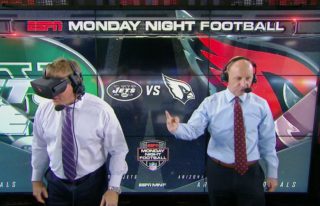
Monday Night Football hosts wear VR headsets

The NFL is already using technology with Microsoft Surface tablets on the sideline as the “official tablet and PC operating system of the NFL.” Is digital savvy being welcomed by old school regimes?

From how teams train to the ways in which they call their plays, the NFL is without a doubt a copycat league. VR in the league is something where in five years, it’s going to be everywhere. It just takes some time. You have to remember that until a decade ago, NFL teams were watching game tape and breaking down film on VHS. The digital adoption took a while. For something like VR, we’re talking about changing a player’s routine, and the way coaches coach. It’s different.

How can training and practicing in VR become the next big thing for professional athletes?

On the surface, using VR to get more practice and repetition from a first-person vantage point hasn’t evolved conceptually. Over the last year or so, we’ve had a ton of innovations under the hood at STRIVR Labs, and now we’re looking at how you can use it as a real training and assessment tool that goes beyond just watching plays in VR. One of the things our teams are going to be creating moving forward are quizzes and assessments where we can truly measure whether or not you’re doing things right or wrong, and how fast you’re reacting and learning.

How can VR be positioned as a practice replacement?

Even running a tech company, I’m still a little old school at heart. We’re never going to replace physical practice, nor should we try to. What we’ve already seen with players who are injured and can’t or shouldn’t practice, or it’s a short week for Thursday Night Football, they’re using VR to stay on top of their game. Coaches are even admitting to their players using it. Which is cool. It’s great for us. Some of our skeptics who may not be buying into it for whatever reason right now may be calling us when their players get hurt. We’ll get there. It will just take time.

Follow Manouk Akopyan on Twitter @Manouk_Akopyan

https://www.youtube.com/watch?v=l6Ynsj2YLFM

How Drone Racing Is Becoming A Global Brand Opportunity

Brad Foxhoven spent many years in Hollywood turning video games like Heavenly Sword and Ratchet and Clank into computer-generated feature films. These days, he’s running DR1 Racing, a global drone racing company that’s being positioned as a tailor-made opportunity for brands.

The company just added Dell to its list of brand partners, kicking off the relationship in Las Vegas last week at the Dell EMC World event at The Sands. That Micro Series event featured palm-sized drone racing using Tiny Whoops and goggles to pilot through Gotham-inspired skyscrapers.

DR1 Racing is turning this indoor series into a global TV production with title sponsor Air Hogs, which is releasing its own line of lower-priced, entry-level DR1 Racing drones this summer. The pilot for the series featured racing through the actual set of the cult favorite Fox TV show Firefly. The TV series will have a variety of racetrack settings that connect with fans, while also opening up new opportunities for sponsors. And the show will air pre-produced, allowing editors to bring the tiny drones to life in the best possible way—something that a live broadcast wouldn’t be able to deliver at this stage.

“The Micro Series is a great entry point for kids and families,” Foxhoven told AListDaily. “It’s not as daunting as the bigger, faster drones we feature in the Champions Series. This is something that’s a little more approachable for the kids and the parents to participate in. They can learn to fly these drones pretty quickly.”

Beginning in August, Air Hogs will have DR1 Racing drones for $40 and a first-person view version with goggles for $100. In contrast, the Tiny Whoops, which are completely customizable, cost about $200. And when you add in the goggles and controller, the cost rises between $500-to-$600, which is still a lot more affordable than the cost-of-entry for the full-sized drones.

“Our partnership with Air Hogs is multi-tiered because in addition to being a sponsor of the Micro Series, they are also a master toy license partner,” Foxhoven explained. “We’re trying to go after demographic of kids that are anywhere from 8-to-14-year-old boys and girls that are a little more tech savvy, but also want to be more exploratory in nature and pick up and fly something that’s a little bit more technologically advanced than any other product that they’re used to.”

Foxhoven sees this young drone racing demographic crossing over with esports fans.

“What you’re seeing with these kids, and this new audience, is that they want a sport of their own,” Foxhoven said. “When they look at some of these traditional sports, whether it be NASCAR or golf or tennis, those are their grandfathers’ or fathers’ sports. They’re looking at esports as something that they can have as their own that really speaks to their generation and their core, and drone racing really fits in with that. You’re wearing a set of goggles, so it’s similar to VR. You have a controller that reminds them of a game controller and you’re racing this environment that feels like you’re in a living, breathing video game with Micro Series or Champion Series. It taps into that feeling you get from competitive racing environments like Need for Speed or Gran Turismo. The people that find competitive gaming exciting and enjoyable will also look at drone racing in that same kind of way.”

Sponsors are already lining up. Out of the gate, DR1 Racing partnered with Mountain Dew and Doritos for an event. The company also worked with Buffalo Wild Wings. And now Dell and Air Hogs are on board. Foxhoven said nine-out-of-10 sponsors or partners that DR1 Racing has signed (many of which have yet to be announced) are endemics.

“We’ve had some really sizable partners that have come in and looked at this as something that allows them to reach a new audience that is kind of now finding new ways to enjoy themselves through competition in this technologically advanced world,” Foxhoven said.

Drone racing teams are already forming for DR1 Racing events. And they’re partnering with brands that will be worn on pilots’ jerseys for the televised competitions.

“You’ll see these brands on the jerseys much like esports and even like professional racing with NASCAR and F1,” Foxhoven said. “These things that are created are going to be designed for sponsors to have visibility on hats and jerseys and drones, as well as have visibility in and around the race itself.”

DR1 Racing has over 100 countries that are signed up as broadcast partners for this year and next. Foxhoven said this means that, globally, the company has the broadest reach of any drone racing organization that’s out there.

“But it’s not just the broadcast side, it’s the digital side as well,” Foxhoven said. “We certainly stream things on Twitch. We have an ecosystem that has a live component that people can immerse themselves in this world and find it wherever they are, so they don’t have to go to broadcast and find it there. They have elements that can be found on digital as well, so both sides are really important to this audience.”

Essentially, DR1 Racing is in the early stages of creating a new sport, so Foxhoven said a lot of these features need to be specifically done in a way that’s enjoyable for the audience.

“We’re trying to do a whole bunch of things to be appealing to how people are consuming content,” Foxhoven explained. “We need to approach it really strategically so we will have the live component, we will have the in-person experience and we’ll have the broadcast component later on. So those who want to consume the races live can do that, but they can also enjoy the ‘on tape’ broadcast version later on.”

With esports events already selling out NBA and soccer stadiums around the globe, Foxhoven has no doubt that drone racing will fill up stadiums in the future.

“When you go and you witness drone racing first-hand and you feel the excitement, you see the adrenaline of the pilots that are participating, and you can actually put on these goggles and see it in first-person as well, that’s an amazing experience,” Foxhoven said. “Every person that we’ve shown this to walks away saying, ‘Yeah, I would watch that again.’”

Foxhoven said drone racing does have an advantage over many esports games.

“Drone racing is easier to understand than a League of Legends tournament or a Dota 2 championship,” Foxhoven explained. “You understand how people are racing and who’s finished first and who finished last and you get to see the pilots in action. There are a lot of appealing elements that transcend traditional sports, in general, but converge with the gaming elements.”

DR1 Racing will also expand its brand into the video game realm. The company has plans to release a game that will target the mainstream audience.

“People are not familiar with drone racing on a mass level,” Foxhoven said. “They’re coming into it new, so you have a lot of education and explanation that needs to occur. People learned about skateboarding and snowboarding through games featuring Tony Hawk and Sean White. The games got them interested in trying it out in real life and going to events, so we see a video game as a great opportunity for us to educate a broader audience about the potential of drone racing.”

‘Injustice 2’ Hits Comic Con; ‘Farpoint’ Shows Off VR Controller

For this week in video game promotions, comic book heroes prepare for their esports debut, a livestream show is born and a plastic controller has everyone talking.

Injustice 2

The heroes of DC Comics collide in epic fashion with the launch of Injustice 2, and fans are ready to claim their fame. Warner Bros. Interactive Entertainment announced the Injustice 2 Championship Series with a combined prize pool of $600,000 that kicks off May 26. Partnering with ESL, Gamelta, Gamestop, Sony and Twitch, gamers will have the chance to show their stuff (and beat the stuffing out of their opponents) on the PS4 across the world.

Injustice 2 battles can be taken on the go thanks to its mobile game counterpart, Injustice 2 Mobile. Those who sign up for the mobile game during the first week of launch receive Catwoman as a special incentive. Since Injustice celebrates the heroes of the DC Universe, Warner Bros. teamed up with YouTube creator, PeanutButterGamer to interact with fans at Silicon Valley Comic Con. A livestreaming series called Bring the Reign kicked off May 8 with the popular gamer interacting with cosplayers and letting them try the mobile game.

As with the original game Injustice: Gods Among Us, DC Comics released a prequel comic to Injustice 2 that delves deeper into the story. “Superman is imprisoned, and it’s up to Batman to put the world back together,” reads the first issue’s official synopsis. “But with Superman’s iron-fisted regime eliminated, other forces rise up to fill the void. And Batman doesn’t have a lot of allies left to help stop them.” Tom Taylor returns as a writer for the second Injustice comic book tie-in series.

Farpoint

Impulse Gear’s VR first-person shooter has been the poster child for Sony’s PSVR and the biggest launch for the platform thus far. Leading up to the big launch day, Sony has been giving fans behind-the-scenes looks into the world, gameplay and, of course, its fancy new controller.

The PlayStation VR Aim controller was developed specifically for use with Farpoint, but demonstrates its immersive capabilities for future VR titles. One of the biggest draws of the FPS genre is multiplayer—so to get players hyped for an FPS in VR, Sony invited members of the press for a private showcase of upcoming PSVR titles, including Farpoint. Stories soon poured in across the internet about how immersive, fun and challenging multiplayer mode is most importantly, how well the controller works.

Singleplayer mode has been shown at previous events such as E3—but surprisingly, the multiplayer mode was not announced until a few weeks before the game’s launch. Sony offers a Farpoint bundle that includes the PSVR Aim Controller, or both game and controller may be purchased separately.

Hasbro Gaming Crate Will Deliver Fun This Summer

Hasbro is looking to liven up the summer with its Hasbro Gaming Crate service. With it, users can choose between two plans: The Party Game Crate or The Family Game Crate. Similar to subscription services such as Loot Crate and others, Hasbro will send subscribers boxes full of never-before-seen board and card games—curated by professionals to maximize the fun factor—four times a year.

Jonathan Berkowitz, senior vice president of marketing, Hasbro Gaming

In describing the service to AListDaily, Hasbro Gaming’s senior vice president of marketing, Jonathan Berkowitz said, “Hasbro Gaming is introducing the Hasbro Gaming Crate subscription service. Subscribers can choose to receive either a Party Game themed crate or a Family Game themed crate and each crate will bring consumers three curated games selected by Hasbro Gaming experts, conveniently delivered right to their door. Subscribers will receive one crate per quarter, priced at $49.99 per crate plus shipping, charged automatically when the crate ships.”

With the rise of services such as Loot Crate, Hasbro believes that this is the opportune time to launch its own crate. “Given the momentum of our gaming business and the appetite we’re seeing from consumers for trying new games, we felt the time was right to offer a subscription service for our fans,” said Berkowitz. “We wanted to make it easy for families and other game fans to receive and try new games.”

What can subscribers expect from the two subscription plans? “Subscribers will see a wide range of play styles—from card games to cooperative games to party games—all meant to bring people together for a great time. The Party Game Crate will contain games that are fun to play and entertaining for adults. Some games will have more edgy content, as they are meant for adults of all ages; college, young adults or parents who have a night off without the kids. The Family Game Crate will contain games that are fun for many members of the family. The games should be easy to understand by both kids and adults, and enjoyed by both.”

Don’t expect traditional Hasbro games such as Monopoly to appear in any of the crates. “Fans will be able to experience different types of games,” Berkowitz explained. “Each crate will include games that are new to the Hasbro Gaming portfolio that have been carefully selected by our gaming experts.” Furthermore, there currently aren’t any plans to base any of the crates on any of Hasbro’s brands such as Transformers or My Little Pony. Berkowitz said, “We currently don’t have games based on Hasbro brands, but are open to it if we identify the right game that we feel will appeal to fans of the Hasbro Gaming Crate.”

Hasbro has clearly been making all the right moves, as its stock has been doing extremely well. The company’s CEO, Brian Goldner, revealed the secret behind Hasbro’s success in an interview with Mad Money: “It’s all about engaging the consumer across storytelling and innovation, a lot of digital engagement. We do it all around the world.”

Hasbro_quote_Jonathan Berkowitz2

We asked Berkowitz how the game crate subscription service fit into this strategy and surrounded Hasbro’s audience with storytelling. “We are very connected to our consumers around the world, and everything we do at Hasbro is based in insights and learning about what our consumers want to see from us,” replied Berkowitz. “Storytelling with our games is about giving our consumers gaming experiences that are fun to play and fun to watch. Plus, each crate will be themed and curated. We look forward to subscribers sharing their stories when they unbox Hasbro Gaming Crates.”

Berkowitz then discussed how they are getting the word out about the Hasbro Gaming Crate to fans. “We will be promoting the service through digital media buys, social media and publicity starting this summer when the crate launches,” said Berkowitz.

Is this the start of a growing trend for Hasbro? Can we expect a Hasbro Toy Crate at some point in the future? Berkowitz doesn’t give a definite confirmation, but he did say, “We’re always open to expanding based on what we are hearing from our consumers and our fans, but right now we’re focused on the Hasbro Gaming Crate service.”

Wargaming’s ‘World Of Tanks’ Grand Finals Heads To Moscow

Wargaming has expanded the culmination of its two-part 2017 World of Tanks esports season to include seven days of Wargaming.net League (WGL) competition in Moscow. After holding the past three Grand Finals in Warsaw, Poland, Wargaming is moving its pinnacle event to Russia—which also happens to be the home country for the studio and the largest World of Tanks player community.

Chris Karlewicz, a former professional World of Tanks player who now heads up North American esports at Wargaming, told AListDaily that this change of venue to Moscow was to see what a major event would look like in a place with a population that’s 10 times that of Warsaw in front of the largest World of Tanks fan base on the planet. Over course of seven days, 12 teams will compete in group stages on May 23 and 24 at an offsite Moscow location before the quarterfinals, semifinals and finals move to the 12,000-seat VTB Ice Palace, which will be turning into a World of Tanks battlefield. Up for grabs is $300,000 in prize money.

“The Russian audience has millions of more players than we do in the US,” Karlewicz said. “This will be a good event for World of Tanks in general, and for WGL.”

With ESL as Wargaming’s production partner, the Grand Finals has grown over the years in Warsaw from a 750-seat movie theater to a 4,000-seat Civic Center, to a 10,000-seat arena last year. Wargaming is planning for a massive live audience by setting up a JumboTron in the parking lot outside the VTB Ice Palace to accommodate fans. There will also be real tanks stationed around the arena, which has become a tradition for the event.

Facebook and Russian telecom company Rostelecom are the two primary sponsors of this year’s Grand Finals, marking an expansion into non-endemic companies. Facebook Live will livestream the Grand Finals for the first time. There will be a dozen teams competing in the event, including Oops The Tough Giraffes (EU), DiNG (EU), eClipse (NA), Team Efficiency (APAC), Natus Vincere G2A (CIS), Kazna Kru (EU), EL Gaming (APAC), YaTo Gaming (China), Not So Serious (CIS), Tornado Energy (CIS), Brain Storm (CIS) and Elevate (NA). Karlewicz said these teams are attracting many brands, noting that some team shirts are completely full on the back with sponsors eager to target this hardcore PC gaming crowd.

Wargaming’s free-to-play game has over 150 million registered players across the globe. That fanbase turned the game, which wasn’t originally designed for esports, into a competitive game organically. “We have an interesting storyline because we didn’t come out of the gate saying, ‘let’s be an esport and fill stadiums,’” Karlewicz said. “We have a viral, sticky audience that loves what we’re doing, and this year we’ve seen new fans come over to watch WGL.”

Wargaming has been targeting the US audience with humorous television commercials, including a Super Bowl spot this year, as well as digital spots. Karlewicz said that’s helped attract new eyeballs to the game, as well as esports.

“On a whole, World of Tanks was getting the word out, and more people were finding out about the game and the esports side,” Karlewicz said. That’s also happening across the EU and CAS regions, where an audience outside of the diehard “tankers” are watching livestreams.

“We have a better understanding of how to present the league in a way that’s geared toward outsider views instead of just catering to the homegrown guys,” he continued. “We’re using Facebook Live, outside media and more social media to grow the fanbase.” During the Moscow event, viewers at home can participate in social media contests and streams, winning prizes and gifts from Wargaming and its partners.

Karlewicz said another key driver in esports engagement has been the WGL Fantasy League. For the North American audience, there’s a dedicated site designed for deep engagement. “While all of the regions have their own Fantasy Leagues, ours has a lot of stats and metadata that has built up a community of fans that play and chat and win lots of prizes,” Karlewicz said. Those prizes have ranged from in-game currency and skins, to Need for Seat World of Tanks gaming chairs, to trips to the Grand Finals.

Wargaming also changed up the rules for competitive play and added a new Attack/Defense mode that has forced players to move around. “Matches are no longer 14 guys staring at each other,” Karlewicz said. “They’re more entertaining to watch because players will flip over tanks and use them as barricades and change up their tactics and strategies.”

Those who attend the event will find more direct engagement with players than in the past with scheduled autograph sessions and Q&As. There will also be virtual reality demos for attendees to be on the battlefield during World of Tanks combat. Karlewicz said the addition of emblems in the game to represent the league opens the door for teams to have stickers in the game in the future. Wargaming headquarters is working on this initiative on a multi-level and multi-region scope. Valve, ESL and pro teams have all profited from the sale of in-game stickers in CS:GO through esports events over the years, so the groundwork for success is there.

Mobile App ‘Infield Chatter’ Strikes Social Chord With MLB Players And Fans

The Major League Baseball Players Association (MLBPA) has shortened the bridge between players and fans with its new Infield Chatter mobile social community. The platform already has over 1,000 players on board, interacting with a global fan base about baseball, hobbies and other topics. It’s been designed to streamline the interactions baseball players previously engaged with across social platforms like Facebook, Twitter and Snapchat.

The free app is available on Google and Apple devices, offering major leaguers a new social platform to share unique content to their Infield Chatter accounts, including behind-the-scenes photos and videos that offer fans a more in-depth perspective of the players they cheer for all season long. Players share snippets of who they are away from the ballparks, taking fans inside their everyday lives by sharing interests, hobbies, and personal stories.

Timothy Slavin, MLBPA chief of business affairs, joined AListDaily to talk about this new form of social interaction.

What role have you seen the growth of social media play in helping the sport of baseball grow and connect with fans around the world?

Baseball players have a grueling schedule, so social media is a great way for them to stay in touch with fans while they’re on the go. And because social posts are best when raw and not “produced,” it makes it easier for fans to see the personalities and range of emotions behind the game faces observed on the field. In terms of the reach, social media doesn’t know any geographic boundaries. That’s good for us because of the global nature of our sport. After all, almost 30 percent of our guys on Opening Day rosters are from a country outside the United States. We want all of our fans, wherever they are, to feel like they’re as close to the game as possible.

How did the idea for Infield Chatter come about?

It really came from the players themselves. They asked us to find a way for them to better connect with fans, keeping in mind their schedule and playing commitments. A social media platform was a natural fit, especially given how more fans of all ages are so closely connected to their phones.

What void do you see Infield Chatter filling that current social media platforms leave open?

Infield Chatter is specialized for baseball fans, both serious and casual. Other social platforms definitely provide fans with opportunities to talk baseball, but only when mixed into broader discussions, and rarely bringing the players themselves into the discussion. We plan to be a deeper and richer engagement compared to anyone else. Separate from that, we know people naturally gravitate to others who have similar interests or backgrounds, so we think this platform will provide a built-in social ecosystem fans will enjoy. We think we’re on the front end of a change in the way people will consume social. Just like print media (Time, Newsweek) and broadcast media (CBS, NBC, ABC) started out targeting large audiences, and later evolved to specialized content for specialized audiences (Field and Stream (print), House Beautiful (print); Food Network (TV), Animal Planet (TV)), we think social media will evolve that way, too.

How are you seeing MLB players focus on Infield Chatter while also engaging with established fan bases on traditional social media platforms?

We’ve just started, so guys are getting used to the platform. Many players will continue using other platforms for a time, but they’ll gradually gravitate to Infield Chatter as the best place to share their special and unique content with fans. A big reason we think this is because we’ve got a moderator to eliminate any trolls. It’ll come as no surprise to anyone that lots of players (and other celebrities) have concerns about the amount of trolling and negativity that happens elsewhere in social media.

What types of contests and competitions do you see Infield Chatter opening up for fans and what types of prizes do these open up?

We’ll have funniest video competitions, “double-dare-you” challenges between players, best impressions, karaoke competitions, trivia competitions. You name it. We expect to run everything from silly challenges to academic ones. Prizes can include cash, electronic devices, signed memorabilia, gift cards, “meet-the-player” opportunities, and tickets to events and games.

How are you seeing something as simple as a digital fist bump connecting MLB players with fans?

The overwhelmingly positive response from the fans to the fist bump was a surprise to many of the guys. The fans are really positive about it because they realize it means players are watching, and enjoying what they post. It makes things feel more personal, for sure. We’ve talked to a number of players about that feature, actually. They love it.

What type of real-time interactions are you seeing between baseball players and fans through this platform?

The AMAs have been great. It’s been fun to watch because the players and fans get into it. I never know what to expect from the questions or the answers!

Can you talk about the partnership with Honeycommb and how that company’s history of connecting with Lady Gaga’s global fan base has helped the MLBPA?

Sure. We selected Honeycommb as a partner because they have people with terrific experience succeeding in this space. The model proved itself with Lady Gaga’s platform, which was important for us in making the final decision to go with Honeycommb.

How was the MLBPA involved in the development of this app and its features?

We are in the trenches, but we’ve got partners who are experienced experts guiding us in the right direction. In terms of the day-to-day, the people with the relevant subject matter expertise tend to lead discussions in their respective areas, and then we try to make decisions together.

When you look at MLBAM, that tech company began with a focus on baseball and now covers multiple sports, as well as esports. What bigger picture opportunity do you see with Honeycommb?

There are tremendous opportunities to expand down the road, but we are not focused on that. We’re focused on getting this right—now. We want to walk before we run. As a start-up, we have to be patient because we understand some things take time.

How do you see this app evolving as feedback from fans is received? For example, multiple fans are asking for the ability to follow a specific player’s feed.

The good news is that we have control to make changes. If the fans want it, we intend to get it for them. For some changes, it may take a little time. For others, we can react instantaneously. And we’ll want to get the fans what they want whenever possible. After all, this whole thing started because of the fans.

Today’s youth is social media savvy. What role do you see Infield Chatter playing in introducing new fans to baseball at a young age? 

Infield Chatter meets them where they are. And through it, they’ll get everything on and off the field. They’ll have a renewed sense of how fun baseball is. And how they can get to know their favorite players much better than they will through a post-game interview or box score. We expect it’ll make going to the park that much cooler.

While the app is free, what type of revenue opportunities do you see this new social media platform opening up?

That’s not top of mind for us right now, but we’re always aware of costs. In the end, we’ve got to pay for this thing, and we know brands are asking us about commercial opportunity. So at the right time, we’ll need to consider advertising or sponsorship sales.

How do you see Infield Chatter helping the MLBPA brand as well as the brands of the 1,000 players who are active on this platform?

I don’t think it’s about the MLBPA. It’s really about the players. And they’ll feel closer from the fan perspective. Guys’ll be more human. And in some ways more relatable. That’s great for the game.

China Watched 11 Billion Esports Video Streams Last Year

This week in marketing news, we see how TV consumption has evolved, marketers turn to social media for their digital video needs and—holy Samsung, Batman—that’s a whole lot of VR headsets.

Eyeballs And Esports

Are you ready for VR? Samsung sure is. According to analyst firm SuperData, Samsung’s Gear VR headset was the most shipped VR headset in the first quarter of 2017, selling 782,000 units. Coming in a distant second is the PlayStation VR (375,000) followed by Google Daydream (170,000), HTC Vive (95,000) and Oculus Rift (64,000).

China now accounts for 57 percent of the world’s consumption of esports videos, according to research from IHS Markit. Esports is expected to become a $1 billion advertising industry by 2021, with video driving the lion’s share of revenues along with influencer marketing and sponsorship. Last year, advertising in esports totaled around $280 million globally, IHS reported. The number of video streams delivered in China totaled 11.1 billion in 2016, with the second largest market—North America—providing 2.7 billion video streams.

Trends To Watch

Consumers love their video content, regardless of what device they’re played on. Case in point—the watch time of TV channels on YouTube has increased 50 percent in the last year, YouTube revealed during its Newfronts presentation. In addition, watch time of YouTube content on TV screens has doubled year-over-year.

The Interactive Advertising Bureau released a new study on TV consumption trends in the US. The Changing TV Experience: 2017 revealed that 56 percent of US adults own a streaming-enabled TV—a 56 percent rise from just two years ago. Of those streaming-enabled TV owners, half say they prefer watching commercials over having to pay for ad-free subscriptions when streaming video on TV, up 14 percent over 2015. Forty-four percent said that commercials during digital video are less intrusive than those during traditional linear programming.

Short-form pre-roll ads may see some investment in the next few months, but not so much for livestreaming. According to April research by Trusted Media Brands, of the US agency and marketing professionals polled who are involved in digital or mobile advertising and who place digital video pre-roll ad campaigns, 58 percent said they “definitely will” use short-form pre-roll in the next six months. More than a quarter (28 percent) of respondents said they “definitely will” invest in live stream formats in the next six months, but almost as many (27 percent) said they “definitely will not.”

Socially Reliable

Sixty-eight percent of marketers believe social platforms are the most important partners for digital video campaigns, according to a new study by Advertiser Perceptions on behalf of Trusted Media Brands. According to respondents, 59 percent give social media the highest marks for delivering on engagement, ROI (39 percent) and customer service (38 percent). Advertisers plan to allocate 28 percent of their overall budgets to digital video, a three percent increase from last June.

PR, Please

We’ve all seen a few brands (who shall remain nameless) who could definitely use some good PR right about now, but companies are investing more on internal PR than external, one report shows. Findings by the Association of National Advertisers and the USC Center for Public Relations at the Annenberg School for Communication and Journalism revealed that 62 percent of respondents plan to increase internal public relations staffing over the next five years.

Twenty-five percent said they planned to increase overall spending on PR over the next five years and a full 75 percent said they planned to do the same over the current year.

Mother’s Day Marketing Gets Creative; Spending Expected To Reach $23.6B

Mother’s Day is a time to celebrate family—with gifts, of course—and spending is expected to reach a record-breaking $23.6 billion this year, according to the National Retail Federation (NRF).

Warm Greetings

Around 133 million Mother’s Day cards are exchanged each year in the US, and nearly 78 percent of NRF survey participants plan on including a card in their celebrations on Sunday.

Hallmark is making a push to drive awareness among millennials with a new campaign called “Every Mom has a Signature.” The ad, backed by Meghan Trainor’s song “Mom,” introduces Hallmark’s new Signature line complete with 24 new Mother’s Day designs. In addition, the company is rolling out a collection of premium Signature cards in Spanish.

https://youtu.be/cRjpBb2vGzQ

American Greetings took the idea of a signature even further with its campaign, “Give Meaning.” Inspired by a true story, the ad portrays a young woman getting her first tattoo. Rather than a rose or a name, the woman gets a simple, hand-written phrase—”keep shining”—which as it turns out was written by her deceased mother in a birthday card. The emotional ad drives a powerful message about the deep, long-lasting meaning a greeting card can be.

https://youtu.be/k4JSXuEfxlk

Love In Bloom

Of course, flowers are a tradition for the holiday as well, with 68.5 percent planning to shower mom with bouquets. A survey by FTD found that 76 percent of mothers prefer flowers (76 percent) over plants (64 percent), jewelry (44 percent) and candy (42 percent) if they were to choose their own gifts. Second only to Valentine’s Day, Mother’s Day is a top-selling day for florists.

Floral delivery service Teleflora is running a campaign called “Just Like Her” that focuses on all the traits we learn from our mothers. Using the hashtag #ImJustLikeHer, the company is encouraging family members to share what they’ve learned from courage to compassion or even stubbornness across Twitter through Sunday. Last year’s campaign “One Tough Mother” has been viewed over 6.8 million times.

https://youtu.be/HChogjoDOS8

Taste The Togetherness

There’s a reason people claim their recipe is “just like mom used to make”—we tie strong, emotional bonds to food, especially food prepared for us in our youth.

Kraft Macaroni and Cheese is celebrating when motherhood doesn’t always go right by teaming up with Melissa Mohr, author of Holy Sh*T: A Brief History of Swearing. “Swear Like a Mother” embraces the idea that moms sometimes need to swear, and that’s okay. Mohr offers some alternative swear words moms can use around the little ones but when it’s been one of those days—specially marked boxes of Kraft Mac ‘n Cheese include a pair of ear plugs.

https://youtu.be/jV-opIMAtD4

Mother’s Day is a great excuse to give mom a break on cooking, and the NRF found that over half (55.9 percent) of respondents plan on taking her out for a special outing such as dinner.

KFC is celebrating mom on its busiest day of the year with a spicy little romance novella called “Tender Wings of Desire.” This hilarious marketing push stars Colonel Sanders as a sailor with a mysterious past who falls into a passionate love affair with a woman named Madelyn. The 92-page book is available for free on Amazon, but 100 fans on Facebook will have the chance to win dinner and a hard copy of the book.

Moms Know Messes

Brawny teamed up with four real families and strapped Snapchat Spectacles to their children to illustrate motherhood from a child’s point of view. Over the course of four days, these kids made a lot of messes—illustrated in the ad called, “Once a Mother, Always a Giant.”

“In celebration of Mother’s Day this year, we wanted to honor the strength and resilience that mothers rely on to overcome their daily challenges,” Gary Gastel, senior brand director at Brawny, told Adweek. “As a brand that has been an icon of strength, we felt Brawny could help bring attention to that unparalleled resilience.”

Don’t Forget Dad

FTD found that only six percent of dads thought they should buy a Mother’s Day gift, compared to 47 percent of moms. However, men who do give on Mother’s Day spend an average of $54 more than their female counterparts. Of all the people (besides children) mom gets gifts from this time of year, husbands still come in at No. 1—albeit at 20 percent.

Men are also more emotionally impacted by video ads, studies show.

“Dad is about 20 percent more likely to engage with a digital video ad [compared to other consumers],” Devra Prywes, senior vice president of marketing and insights at Unruly, shared on stage at Newfronts.

Prywes also said that fathers are 52 percent more likely to share a video ad on social networks than other consumer segments.