How Universal Studios Brings Branded Horrors And Iconic Movies To Life

Universal Studios’ annual attraction in Halloween Horror Nights reaches horrific new heights this year by bringing director Ryan Murphy’s groundbreaking horror anthology American Horror Story to life by way of a maze.

The intense show’s twisted and iconic scenes and memorable characters are just the tip of the torturing fright fest the haunted theme park currently has playing out for its Hollywood and Orlando destinations.

If living through iconic horror films with a live audience, as wickedly slick scareactors with big-budget aesthetics jolt the bejesus out of you is your thing, then the attractions Universal Studios has in store this season is the place to get your scare on. 

John Murdy, creative director of Halloween Horror Nights at Universal Studios Hollywood, joined [a]listdaily to discuss how he’s unfolding disturbing and perverse storylines with his installments.


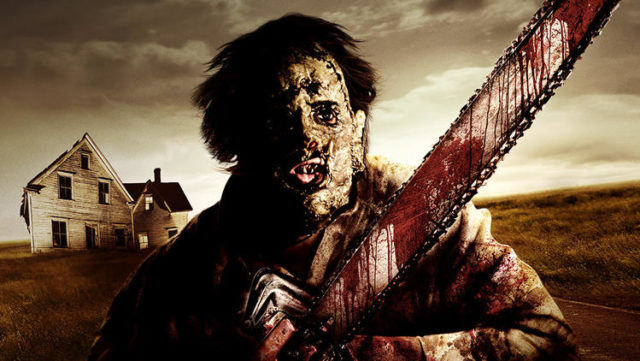
Mazes: American Horror StoryThe ExorcistThe Texas Chainsaw Massacre, Krampus, Freddy vs. Jason, Halloween.

Attractions: The Walking Dead, The Purge, Terror Tram, a show by the hip-hop dance crew Jabbawockeez, as well as Universal Studios Hollywood mainstay rides in Transformers, Revenge of the Mummy, Jurassic Park and The Simpsons.

Halloween Horror Nights runs through Nov. 5 on select nights.


la-1473028060-snap-photo

What are your goals and vision with the “Halloween Horror Nights” experience?

Going all the way back to the silent film era, Universal is the movie studio that invented the horror movie. For me, what becomes ideal is creating what I like to call ‘living horror movies,’ which is licensing some of the biggest properties in the world of horror like American Horror Story and The Walking Dead but also recent movies like Krampus and older ones like Texas Chainsaw Massacre and The Exorcist, which to me, is the scariest movie ever made. What we do is try to bring these to life for our guests with an approach as if we were making a movie. The sets, props, makeup, lighting, audio—everything. That’s always been the vision. And the reason we’re selling out virtually every single night is because the lineup is so strong. It’s the ultimate fans dream—or nightmare. It really represents the whole spectrum of horror.

How do you decide which properties, whether it be a movie of TV show, to work with? Which IPs offer the best creative freedom?

We license properties from every major studio. We’re so connected to the creative community of horror. It’s not about just going to a movie studio and ing ‘hey, we’d like to license this film.’ Often times we’re doing that with the director’s blessing. Or on the flip side having directors say ‘hey, I’d love for you to do my movie.’ These people also become our advocates. It makes the pitch process much easier. There’s nothing better than collaborating with the community. We’ve always had three things we look for: The first one we refer to as ‘awareness,’ meaning popularity. Is it a property horror fans know and like, and do they want to see it? The second is ‘environments.’ When you look at something like American Horror Story, every season of that show has a completely different story, time period and environment. So for us, it gives us a wealth of different things to choose from. And the third is ‘iconic characters.’ Being able to bring them to life with live performers is critical.

krampus

What is the process of writing, producing and shooting like? How are you reinventing and retooling storytelling each year? Where do you draw influence from?

I’ve been doing this since I was 10-years-old as a kid in my parents’ house, and entertaining the neighbors. So I have been doing this my whole life. For us, it’s a year-round thing. As the Halloween Horror Nights is going on right now, we’re already planning and taking meetings for next year with filmmakers and producers. There is an awful lot of research being done as well. I’ll request to go over all of the location photography and review thousands of pictures. Krampus, for example, had 32,000 pictures we went through. Then, an art director and I will start putting the maze together with Post-it notes. A treatment for the maze follows, which is usually around 100-pages long. If you multiply that with all of the mazes that we do, it’s like writing a novel. We also prey on all of the senses of our guests, which helps us break down the fourth wall and helps with storytelling. In addition to the narrative, there is a technical part, too, which is breaking down each scene and adding all of the layers. I would say it’s the equivalent of making about a half-dozen movies at once.

What’s one video game activation that you’d love to work on? 

Several years ago we did Silent Hill, which of course also had movies, too. To date, that’s the only time we’ve ventured into video games. I thought that one was a perfect match for us. Though right now, I’m literally staring across my desk for a video game experience that we are considering for next year. A lot of times, people will come to us and ask ‘will you consider this?’ And that’s what we have right now.
texas-chainsaw-massacre-blood-brothers

If fans have a choice between Six Flags, Knott’s Berry Farm and Disneyland, why should they choose Universal Studios?

Los Angeles is the most competitive market in the world for this kind of an event. People have a lot of choices, event with individual, stand-alone haunted houses, or elaborate home haunts for people who just do it for the love of it. What put us on the map was our vision to take these beloved horror properties and bring them to life. It feels like you’re living a movie. Another reason is Universal’s connection to the past. Our Terror Tram experience is our famous studio tour that drives through our historic back lot, but right now is the only time of the year that guests can hop off, walk through and see where all of these movies were made. The area features the Psycho House, the Bates Motel and the amazing plane crash from War of the Worlds. The extra connection to the iconic sets and environments hits home. Universal is the place where the American horror movie was born.

How do you engage and listen to your consumers?

Fans of horror movies are extremely passionate about the films that they like. What we’ve learned over the years is that you can’t go back by popular demand and do the same product. It always has to be new. We listen to our fans. We have a very faithful, rabid and obsessed community of fans for Halloween Horror Nights year after year. No matter how scary it is, they always want it scarier. They tend to push us and drive us to constantly improve it. But they also tell us what they want. I almost think of this year as a ‘fan appreciation’ year because we’re doing so many properties that they have requested over and over again. I’m at the park every night, and most guests will stop me just to say, ‘thank you.’

What is your marketing strategy to acquire new fans?

Honestly, it’s old-fashioned word of mouth, plus a little bit of social media. When you ask our fans who are attending for the first time, it’s almost always ‘a friend told me it was really cool.’ Our fans become our advocates, and that community spreads the word. Properties like American Horror Story fuel a lot of it, too. We’re very lucky to have fans that are extensions of our marketing department. It’s a very cool thing.

the-exorcist

How important is this yearly activation for the entire Universal Parks & Resorts brand?

Horror doesn’t get the love that other [film categories] get. It’s always been in the shadows of Hollywood. It’s one of the most profitable forms of filmmaking, but it’s never really gotten the respect—like being nominated for Best Picture. We do Halloween Horror Nights all over the world now in our parks. When you think of Halloween, it’s historically a very American holiday. When I was a kid, people in Europe didn’t celebrate Halloween. The whole brand of Halloween has grown so much. Now, there are Halloween tourists during this season. Hollywood is a movie industry town. Our focus is very much on branded-horrors and bringing iconic movies to life.

What’s the biggest thing you’ve learned over the years? How has Halloween Horror Nights evolved?

One of the things I’ve learned is to really study psychology because our job is to scare the daylights out of our guests. That’s what they come here for. It’s a very intense experience. You learn effective ways of scaring people, and sometimes it’s just mathematical. You realize that a performer coming at you from your peripheral vision is scarier than if they are right in front of you. I train every single one of the performers—or scareactors, as we like to call them—for Halloween Horror Nights. It’s a new show every 10 seconds for them because a new audience comes in. You have to approach it from the mental discipline of a marathon athlete. There is 28 nights, and each performer will do their act 60,000 times. If all of the performers are on the same page, it really makes for a really great product.

Follow Manouk Akopyan on Twitter @Manouk_Akopyan

https://www.youtube.com/watch?v=G2mias9SWS4

‘Civilization’ Creator Sid Meier Discusses ESports And Virtual Reality

Sid Meier is one of the few game developers left today whose name is included in the title of almost every game he makes. 2K Games and Firaxis have launched Civilization VI in tandem with the celebration of 25 successful years for the strategy franchise that has combined Meier’s own love of history with strategic gameplay and has kept players coming back for more.

Meier, who has been developing games since 1982, has seen many changes in the industry. Today, even his son, Ryan, works at Firaxis as a designer and programmer. We caught up with the game industry legend in this exclusive interview.

Sid Meier, director of creative development and co-founder of Firaxis Games

What are your thoughts are about the fact that so many people are watching games on Twitch or YouTube more than they’re playing games themselves?

Yeah, that kind of destroys my whole theory about why games are fun. It was amazing to me to watch StarCraft players, for example, and see these amazing experts who got everything figured out; every hot button and every keystroke optimized, and people watching that. What I eventually realized is that they believe that that world is interesting and they’ve had a lot of experiences in the StarCraft world. So it’s meaningful to them to see how an expert player would play.

I always thought games were interactive, you were the star, and you were creating the story, but I guess it’s become so much a part of our culture and our set of experiences that it’s interesting to see how someone else would go through that same game and you can learn from that.

You mentioned StarCraft, which has been an eSport for years. What are your thoughts just on the fact that video games today are considered a sport?

I’m skeptical. I guess it depends on your definition of sports. It used to be fresh that air was involved in sports and actual motion of all of your body parts, but it’s probably a good example of how technology is becoming more and more an integral part of our lives. I would call it e-skills. I’d be more comfortable looking at it that way that there are people who have these incredible video game skills, and to watch them play is really entertaining and enlightening. I think you can probably have a fruitful discussion about whether it’s a sport or not.

You’ve been around long enough to have seen previous iterations of VR, but what do you think about the current VR landscape with Oculus Rift, HTC Vive and PlayStation VR?

It’s more different than any other new technology that’s come around for a long time, in ways that are good and also challenging. The immersiveness of the experience is incredible. That comes with a few side effects that are cautionary, and we’re going to have to change our way of thinking about games to a certain extent to really leverage what’s special about VR. I think that will happen. Game designers are smart people, and they’ll figure things out, but it’s a fairly revolutionary kind of technology. I think it will kind of exist in a parallel path with regular computer and video games, as opposed to being tacked on. VR games will be a fairly special separate subcategory of games. And we’re in the very, very early stages of exploring what the possibilities are. The killer app, as we used to say, for VR hasn’t been created yet. It’s something that probably will be coming along and we’ll say, “A-ha, that’s how it’s going to work. Okay, we get it now.”

How have you seen the Civilization franchise evolve over the last 25 years?

We’ve really been responding to the community. They let us know what works, what doesn’t, and what they want to see. That’s what really has kept Civ alive and vibrant and new; that dialogue that we have with the community out there. They’re making mods and they’re on forums. They’re sending us information. We now have telemetry to tell what things are going out there and connecting. We’re gamers ourselves, and we can identify with the mindset of the players that are playing our game. And that allows us to stay current and it allows us to anticipate, in a lot of cases, what they’re going to want. That’s really the key to the longevity of Civ: respecting the community of players that are playing the game.

How has that community become a part of Firaxis over the years?

A lot of our designers have come from that community. When you look back through all the designers of the past games, from Soren Johnson to Jon Shafer, they came from the community. Shafer was an intern and he was a huge fan. He used to do modding for Civilization IV. A lot of these great new concepts for where we could take the franchise came from people who had grown up with the game. That’s really been effective with constantly injecting these new grand concepts into each title as new designers have come on board.

Nintendo “Switches” Things Up With A New Console And ESports Presence

Nintendo has formally announced its plans to enter the world of eSports, among other exciting news with the anticipated reveal of its NX console—now formerly called the Nintendo Switch. The new gaming platform is a hybrid console, tablet and hand held device that allows seamless transition from the TV to wherever users want to go. Although battery life and other specs were not revealed, memory-heavy games featured in the reveal trailer include Legend of Zelda: Breath of the WildSkyrim and NBA 2K17Perhaps the most significant section of the trailer, however, was Nintendo’s entry into eSports with Splatoon, a first-person (ink) shooter that was featured in a tournament during Gamescom thanks to a strategic partnership with ESL.

https://youtu.be/f5uik5fgIaI

Among a sea of next-gen consoles and virtual reality, Nintendo’s innovation takes a different approach by expanding on the many ways video games can be integrated into daily life. Rather than tethering oneself to a console or being limited with the type of games playable on a handheld device, Nintendo has combined the two, favoring functionality and user interface over shiny new graphics—although the Nintendo Switch features a large, HD display on which gamers can enjoy some very pretty games.

“Nintendo Switch allows gamers the freedom to play however they like,” said Reggie Fils-Aimé, president and COO of Nintendo of America in a statement. “It gives game developers new abilities to bring their creative visions to life by opening up the concept of gaming without boundaries.”

The new console docks as part of a user’s entertainment system and can be removed for a variety of play styles either alone or with friends. The unique versatility of the Nintendo Switch and its many controller options will translate over to developers and marketing teams to reach a more diverse range of audiences. Over 40 confirmed development partners include Telltale Games, Sega, Capcom, Square Enix, Epic Games and even Niantic of Pokémon GO fame. Although a camera was not featured in the console’s reveal trailer, the idea of augmented reality on Nintendo Switch would further add to its appeal.

Between Nintendo Switch and the company’s partnership with Apple, the company is taking a marketing approach that’s rather the opposite of virtual reality. Rather than ask what worlds Nintendo can transport you to, the Nintendo Switch allows consumers to integrate gaming into their everyday lives—free to make their own memories that lead to brand loyalty.

Oakley And Intel’s Smart Eyewear Has Its Sights On Transforming Training

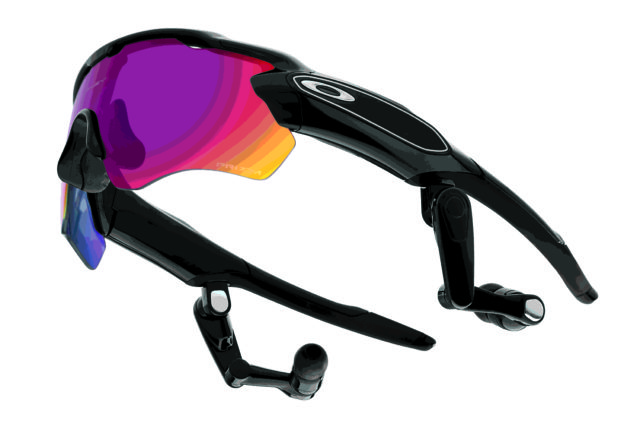
Oakley and Intel have partnered for the launch of Radar Pace, a new smart eyewear product that features a real-time voice-activated coaching system to redefine the way athletes train.

The branded innovation, retailing at $450, creates a dynamic training program, tracks performance, virtually coaches in the moment while interpreting data in real time and responds to the user’s questions, allowing people to communicate with the system in a live, natural way during a workout.

[a]listdaily was joined by Scott Smith, vice president of strategic partnerships at Luxottica, the parent company of Oakley, and Chris Croteau, senior director of business development for Intel’s headworn platform division, to discuss how the two brands are pushing the boundaries of innovation.

Intel CEO Brian Krzanich, and Oakley, introduced the Radar Pace at CES this year. Why was now the right time to release it?

Scott: CES is a great platform for the innovation industry to introduce breakthrough technology, and it was the perfect time to formally introduce the collaboration between Luxottica and Intel on Radar Pace. Since CES, the Oakley and Intel teams have been hard at work in the final stages of testing to bring this product to market on October 3—timed to a peak in training and working out and notable competitions and races for both runners and cyclists.

Why is Intel in the smartglasses business? What is the brand trying to accomplish in this space?

Chris: Our foray into smartglasses is core to our overall wearables strategy, as we continue to reinvent the boundaries of computing. We’re exploring new form factors that enable more seamless, intuitive interactions with technology that enhances consumers’ everyday experiences. Moving forward, we plan to harness leading-edge technology to continue our development of head-worn devices—both branded (under Recon) and with our external brand partners—that deliver compelling use cases and real-world benefits. This goal, coupled with a commitment to uncompromising design and usability, make Intel unique in the segment.

How is Radar Pace an experimental play that complements the brand’s other “high-tech” glasses?

Scott: Oakley has always been a technology company wrapped in design, and Radar Pace continues Oakley’s legacy of performance sports and innovation. From the early days of Thump to 3D, Airwave and now Radar Pace, Oakley has always focused on making eyewear smart, stylish, functional and fit for optimal performance.

How are you going to be branding this new vertical?

Scott: Radar Pace is being branded as a smart eyewear featuring a real-time voice activated coaching system. It is Oakley’s first foray into electronically enabled products specifically built for runners and cyclists.

What is toughest part about co-branding and co-creating a product? And how do you overcome that?

Scott: As two companies grounded in innovation, this has been a very effective partnership. We combined Oakley’s heritage in sport innovation and design and Intel’s innovation and technology expertise to create Radar Pace. Throughout the process, we of course challenged each other to push the limits of what we could create. For example, we pushed Intel to find a way to house all technology (wiring, casing, battery, etc.), while still maintaining a sleek sunglasses look that fit the Oakley design requirements. As you can see from the product, we were able to overcome that hurdle, together—all tech was outfitted into a 56 gram product which is a consistent weight for Oakley’s high-performance sport eyewear.

How will Intel’s foray into wearables help the company gain momentum against your rivals?

Chris: As the power of computing extends well beyond PCs, tablets and phones, everyday objects are becoming part of a smart and connected ecosystem that will enable complex use cases, inspire innovation and fundamentally alter our relationship with technology. Intel’s end-to-end capabilities are uniquely and strategically positioned to power not only new wearables and smart devices, but also the data centers and technology backbone for actively analyzing, sharing and acting on data in real-time.

What is the best marketing method to reach CrossFit athletes, bicyclists and marathoners—a predominant group of which is a big sample of your consumer base?

Scott: We are looking to reach athletes across sports and fitness levels. The product is for athletes of all levels looking to progress in their sport. They’re focused on pushing boundaries and setting personal goals, are data driven, competitive and social by nature, and see the value in getting the help they need to improve their performance. The product and our communication will resonate with these athletes because they understand the performance impact that Radar Pace will have on their training.

How are you envisioning the long-term direction of the product, and the future of the technology?

Scott: Today, we are completely focused on Radar Pace and giving it the support it needs in the coming months. Radar Pace was designed with the future of technology in mind, and is a product that will regularly receive updates to its operating system and improve over time.

How does wearable technology and other IoT technology fit within the overall company strategy?

Chris: Intel is focused on developing wearables that are a part of the larger intersection between data, the cloud and the Internet of Things, creating a smart and connected network of technology to enable amazing, new experiences and change the way we live. We believe that wearables have the potential to make consumers’ lives easier, challenge organizations to create new business models and enable research that addresses society’s biggest challenges. This is our vision of how IoT will work for us, with wearable devices at the core. With our deep data center experience, along with our new and exciting innovations in wearables and IoT, Intel is uniquely equipped to help make this vision a reality.

Follow Manouk Akopyan on Twitter @Manouk_Akopyan

HBO’s New Head Of Marketing; Sony Music Names New CEO

Here are some of the top personnel moves in marketing over the last week.

HBO Names Chris Spadaccini As Head Of Marketing

Chris Spadaccini has been promoted to EVP of consumer marketing at HBO, replacing Pam Levine, who joined 20th Century Fox last month. Spadaccini has been at HBO since 1999 and will oversee marketing for HBO and Cinemax. His duties include directing all branding efforts, providing oversight for program and marketing campaigns, and guiding digital platform and marketing efforts.

Rob Stringer Becomes Sony Music Entertainment’s New CEO

Sony Music announced that Rob Stringer will take over as chief executive next year while Doug Morris, the company’s chief since 2011, will become chairman. Stringer is currently the head of Columbia Records, one of Sony’s flagship labels. During his time, Columbia became the leading label with artists such as Adele, Beyoncé, Daft Punk, One Direction and David Bowie releasing hit albums.

A+E Networks Appoints Melissa Madden Head Of Marketing UK & International

Melissa Madden has been named to the newly created role of head of marketing UK & international at A+E Networks. In this role, Madden will be responsible for showcasing A+E Networks content to the international marketplace. She will also run trade and consumer marketing in addition to providing support to the A+E’s content sales division. Madden joins from BBC Worldwide, where she served as SVP of content marketing and creative, leading consumer and trade marketing strategy, global channels strategy and Masterbrand.

Mattel Creations Named Two New Execs

Cheryl Gresham has been named VP of global media & marketing, and Justin Richardson has been named vice president of global content distribution & strategy at Mattel Creations—a centralized theatrical, television and digital content division from Mattel Inc.

According to a press release, Gresham will be “responsible for leading the company’s global media team in the development and execution of its brands’ media strategies, with a focus on accelerating brand growth through increased consumer awareness and engagement.” At the same time, Richardson will “oversee Mattel’s global content distribution portfolio of iconic brands such as Thomas & Friends, Barbie, Monster High, Hot Wheels, American Girl, Ever After High and many more with distribution teams in the US, Asia, Europe, Russia, the Middle East and Africa.”

Dan Lovinger Named NBCUniversal Sports Ad Sales Chief

Dan Lovinger is stepping into the ad sales chief role at the NBC Sports Group, a position previously held by Seth Winters, who stepped down last month. Lovinger was previously the EVP for NBCUniversal’s entertainment ad sales group. In his new role, Lovinger will oversee NBCUniversal Sports’ ad sales, including major 2018 events such as the Super Bowl, the Winter Olympics and the World Cup.

Casey Shilling Named Zoës Kitchen Chief Marketing Officer

The casual Mediterranean restaurant group, Zoës Kitchen announced Casey Shilling as the company’s new chief marketing officer. Shilling joins Zoës Kitchen after almost two decades with The Container Store, where she served as vice president of marketing and public relations.

MarVista Entertainment Expands Executive Team

Independent entertainment studio, MarVista Entertainment has appointed Deena Stern, former senior vice president of marketing and digital at Esquire Network, as senior vice president of marketing and communications. At the same time, Kenny Christmas was appointed senior vice president of business and legal affairs, and Hannah Pillemer was promoted to senior vice president of development and production.

Curve Digital Dives Into VR With New Studio Head

Independent game developer, Curve Digital has appointed former Sony Interactive Entertainment London Studios executive producer Brynley Gibson as its new head of studios. In the new position, Gibson will oversee game production at Curve along with its Zöe Mode and Headstrong Games subsidiaries. He will likely use his expertise to help the studio create VR games.

Facebook Hires Former The Sims Developer As Head Of Social VR

Rachel Rubin Franklin, who previously worked at Electronic Arts to develop hit games such as The Sims will head Facebook’s Social VR branch. Franklin’s appointment comes after Facebook CEO Mark Zuckerberg announced advancements in social VR at the Oculus Connect keynote. Features include virtual meeting spaces and taking Facebook Messenger phone calls in VR.

Gregory Gopman Joins Twitter’s VR Initiative

Gregory Gopman, founder of AngelHack, has been hired as part of Twitter’s virtual reality initiative. The social media platform is working to integrate 360-degree videos and 360-degree livestreaming to its service in the coming months. It is currently unknown what Gopman’s role or responsibilities will be.

Lionsgate Appoints Gisela Asimus-Minnbergh Vice President Of Alternative Programming Sales

Reflecting the global growth of its unscripted television business, Lionsgate named Gisela Asimus-Minnbergh to the newly-created position of vice president of alternative programming sales. As stated in a press release, Asimus-Minnbergh “will be part of the team responsible for helping launch the company’s unscripted programming and format sales division globally. She will be in charge of identifying new revenue streams and business opportunities for Lionsgate’s slate of alternative programming as well as negotiating and closing format and programming deals across most European territories.”

Uninterrupted Picks Up Three New Hires

The sports-focused digital media company founded by NBA star LeBron James, Uninterrupted, has hired Matt DeMartis (former director of digital ad sales strategy at the Disney ABC Television Group) as head of marketing and brand partnerships. Additionally, Trevor McNeal, formerly HBO’s director of social media marketing, joins as director of audience development. Lastly, former ESPN producer Matt Rissmiller joins Uninterrupted as production director.

Have a new hire tip? Let us know at editorial@alistdaily.com.

Nielsen: Mobile Game Retention Hinges On New Content

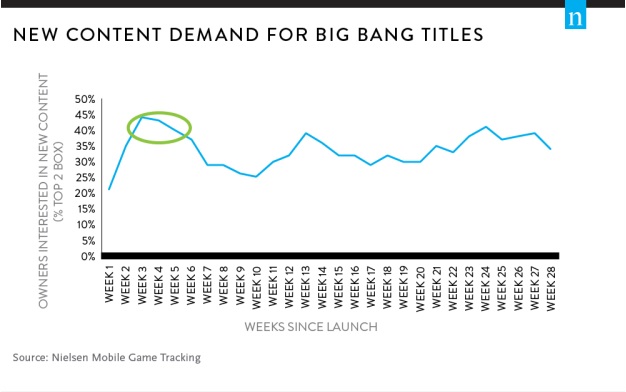
With over 656,000 active mobile games in the App Store alone, what makes players keep coming back, while others move on to the next big title? Nielsen Games set out to find the answer by analyzing several games released in the last year that fit the “big bang adoption” curve in a new report, Long Term Mobile Game Success: Beyond Awareness and Adoption. Using titles like Clash Royale, Fallout Shelter and Pokémon GOexamples of exploding downloads upon release, Nielsen studied game retention and found that unmet demand for new content is potentially the cause for fading lack of interest.

The study shows that gamers are generally content with an exciting new mobile game for about three to five weeks before they start to crave new content. Nielsen found this to be true for most titles across the board, regardless of game genre or target audience.  “For newer titles, especially those riding a wave of momentum,” Nielsen notes, “developers should plan to release new content to re-engage their early adopters during this three-to-five week window. Releasing new content while you still have your early adopters engaged not only retains their attention, avoiding the cost associated with bringing back an old consumer, but it puts your new content in the hands of consumers who have already shown a propensity to spread the news about your content, which leads to more free buzz.”

nielson-mobile-games

While new content is incredibly important for a mobile title, Nielsen also explored the main elements that engage a player to begin with. The analyst firm found that different game elements are important for male vs. female players. For instance, women value gameplay and social elements more than men. On the other hand, men prefer graphics (particularly in the sports genre) and storylines—especially when it comes to role-playing games (RPGs).

The study also examines what elements are most important across the most popular genres: matching puzzle, role-playing and sports. While gameplay and value are the most valued features in the matching puzzle and RPG genres, graphics are a top priority for sports fans.

Nielsen concluded that developers should place emphasis and more resources behind the features that are most important to their particular genre and target audience. Additional content released at pivotal times will also improve retention based on the information learned. “If developers can re-engage early adopters before they lose interest and switch to a different title,” Nielsen said, “It can prolong the momentum behind mobile games and lead to more sustained user acquisition.”

How ‘Paladins’ Could Become The Next Big ESports Game

Hi-Rez Studios, creators of the hit eSports game Smite, is out to make lightning strike twice with the free-to-play competitive first-person shooter game, Paladins, which launched its open beta on Steam Early Access in September. The game fast became a huge success, with over 100,000 new player accounts created within the first 24 hours, which grew to over 1 million within a week, rocketing the game onto Steam’s Top 10 Games by player count.

Although Paladins is still in development, Hi-Rez took full advantage of the game’s momentum. It recently announced the first ever Paladins Invitational—a global competition that will take place on January 5-8, 2017, where teams battle for a $150,000 prize. Eight teams from around the world will make their way to the Hi-Rez Expo, held in Atlanta, Georgia for the opening matches of the Paladins Invitational, and the finals will be broadcast live from the Cobb Energy Center. Global partners for the event include Level Up, Double Jump and Tencent, which will oversee regional tournaments in Brazil/Latin America, Australia/New Zealand and China respectively. To further promote the eSport, Hi-Rez has begun releasing weekly videos to keep fans informed about how Paladins is progressing.

Todd Harris, Hi-Rez Studios co-founder and chief operating officer, spoke with [a]listdaily about how Paladins is already well on its way to possibly becoming the next hit eSports game.

todd-harris
Todd Harris, Hi-Rez Studios co-founder and chief operating officer

How would you describe Paladins?

Paladins is a fantasy themed team-based first-person shooter that happens to be free-to-play. If you enjoy multiplayer shooters, enjoy free, and also want to customize each hero around your playstyle, then Paladins might be the game for you.

Why do you think Paladins has found success so quickly on Steam?

A couple of reasons, I think:

First, I think Paladins taps into what a lot of the Steam audience is looking for right now. The most popular games on Steam are multiplayer shooters or MOBAs (Multiplayer Online Battle Arenas). And Paladins actually combines elements of both these popular genres. Paladins is foremost a competitive shooter, but with some elements of a MOBA.

Secondly, Paladins is benefitting from very positive user reviews. The way new game discovery now works on Steam, it is less hand curated and more automated based on positive user feedback and overall playtime. So games that users are enjoying most will get higher visibility on the Steam store.

Paladins is benefitting a lot from that discovery process, and we’ve added an unbelievable 1 million new Paladins players in the first ten days of Steam Early Access.

There are a great number of competitive shooters on the market, including Overwatch. How does Paladins manage to stand out among them?

More customization, more progression, and more frequent content updates.

In many other hero shooters, the ability kit for each champion is fixed. You play each champion a single way with no player customization. In Paladins, we have a system of card collection and deck building that lets you customize each champion around your playstyle.

In terms of progression within the match, we have an item system similar to MOBA games but simplified because, with an FPS, the action is so much faster and the respawn time is lower. The item system allows players to counter other players in interesting ways. So during the match, I can get more resistance against different damage types, or lower my ability cooldowns, or many other stat buffs and adjustments. The item system adds depth and strategy which leads to replayability, especially among competitive players.

Finally, as we’ve learned with Smite, a free-to-play game really benefits from frequent content updates. With Paladins, we update the game with new features and content every two weeks. That schedule is pretty demanding on the development team, but it is also satisfying for us and the player community to see the game improve so dramatically every two weeks.

What convinced you to announce the Paladins Invitational now, when the game is still in open beta?

When building a competitive game, we like to solicit feedback as early as possible from competitive players. Pro player feedback helps our team tune game balance. And we get valuable feedback on the features we’ve built like Spectator Mode, player rankings, leaderboards and the Competitive Queue system.

Hosting a large international tournament like the Paladins Invitational is a great way to attract and reward the competitive players who invest their time in our game.

What lessons did you learn from promoting Smite as an eSport that you will be applying to Paladins?

It is less about promoting the game as an eSport and more about embracing a community-driven development approach, and the competitive player base is just one important segment of the overall community we engage with.

The second big lesson is a focus on sustainability versus being a flash in the pan. We ask ourselves: if a player dedicates his or her time to being the best in the world at our game right now, how are they using those skills one year later?

How did you come to partner with Level Up, Double Jump and Tencent to oversee the regional events?

Within North America and Europe, we operate Leagues ourselves, but we currently work with partners in other regions. Tencent, Level Up, Double Jump and also ESL have supported our operations in other regions with Smite, and they are supporting Paladins operations as well.

We have also recently integrated with FaceIt to put Smite PC and Smite console on their tournament platform to give amateurs a great path toward becoming professional.

What would you say is key to growing a game as an eSport?

It starts with game design. The game itself must have a high skill curve such that expert play can be distinguished from more casual play; that skill curve is a big part of why spectators tune in to watch.

Next comes the focus on sustainability. The top eSports games are basically ‘games as a service.’ The top eSports games have a publisher who is also the developer and is focused upon customer retention as the most important business metric. This retention incentive justifies investing in the game long term rather than doing a few one-off marketing events to drive sales upon initial game release with no follow-up activities. Players have plenty of competitive gaming choices these days. If the publisher is not invested in the game long term, why would a player invest the time and energy to master that game and compete professionally?

World Wars Are Battled With Livestreams And Giveaways In This Week’s Game Promos

It’s all about nations battling it out, and few games capture that struggle better than Battlefield and Sid Mier’s Civilization. This week, we take a look at how EA and 2K Games got fans ready for battle.

Battlefield 1

Since its wildly popular trailer in May and subsequent unveiling at E3, EA has carefully laid the groundwork for the launch of Battlefield 1 on October 21 with its Road to Battlefield 1 livestreams. These streams offer a behind-the-scenes look at the game, during which downloadable content (DLC) for previous Battlefield titles were offered free for a limited time. These interactive livestreams started months in advance of the game’s launch, appealing to the hardcore fans and curious alike. Unlike some popular game titles that focus on one console or another, EA has created a number of partnerships across the spectrum with PlayStation 4, Xbox One and the PC. Although you can’t play the game on mobile, a companion app has been launched for fans to keep track of progress and customize their load outs.

During Electronic Arts’ Investor Day, investor relations vice president, Chris Evenden explained that despite the popularity of Battlefield on PlayStation, partnerships with Xbox would only stand to increase the game’s fan base. “You know, I think this is a game for PlayStation as much as it is for Xbox as much as it is for PC,” he said. “I think what DICE has done and the game that they’re building is going to satisfy the Battlefield core that continues to play Battlefield 4 and Hardline, and it’s actually gonna bring a lot of additional players into the battlefield franchise.”

battlefield-monster

Those who pre-ordered the game on Xbox One, for example, receive early access to a new map releasing later this year, the Harlem Hellfights DLC pack and an entire month of free EA Access membership. Microsoft is also offering a special Xbox One S Battlefield 1 Bundle. PlayStation fans will receive a PS4 dashboard theme, the DLC and early access to the aforementioned map a week before it releases publicly.

PC gamers, meanwhile, were offered some pretty sweet perks in partnership with MSI. Those who purchased select MSI laptops could choose to receive either Battlefield 1 or Titanfall 2 for free and purchases of an MSI Radeon RX 480 Graphics Card came with an Early Enlister Deluxe Edition upgrade code, which provided additional content and early access beginning October 18.

Battlefield is headed to TV thanks to a deal with Paramount Television and Anonymous Content. Although there are no details yet on a release date or even subject matter, Paramount expressed plans to remain faithful to the fans. “Battlefield has a tremendous built-in, engaged fan base, making it a highly coveted piece of IP primed for long-form adaptation,” Anonymous Content partner Michael Sugar said. “Together with EA and Paramount TV, we’ll develop the Battlefield TV series with the same commitment to robust storytelling that has made the game such a runaway success for nearly 15 years.”

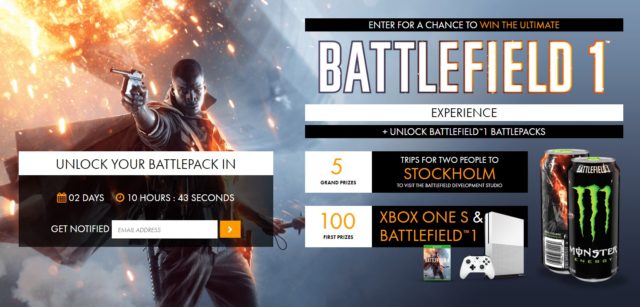
To stay sharp for all that combat, specially-marked Monster Energy drinks are giving away Battlefield 1 Battlepack codes, plus a chance to win a trip for two to Stockholm to either visit the Battlefield development studio or receive a free Xbox One S along with a copy of the game.

Civilization VI

2K Games is celebrating the 25th Anniversary of its award-winning Civilization series with a special edition—complete with art book, Aztec pack pre-order bonus and even a commemorative coin set. On Twitter, the publisher has been appealing to history buffs with facts and news, while getting players hyped with how-to tutorials and livestreams. There are many civilizations to control in the game, so to find out which is the best, 2K is hosting a Battle Royale on Twitch October 19. Viewers can watch eight AI-controlled civilizations duke it out while the game’s developers offer live commentary. For those who love behind-the-scenes, fans were treated to a video with the series’ Grammy-award-winning composer, Christopher Tin about his new musical score for the game.

Op-Ed: Making History With ‘Battlefield 1’

The Battlefield franchise has been something of a fixture lately, despite not being an annual release as its main competitor, the Call of Duty franchise, is. The Battlefield brand that has been reinventing itself since the first game (Battlefield 1942) launched 14 years ago. While its chief rival has continued to expand into futuristic sci-fi settings, Battlefield has experimented with various spin-offs that take advantage of large-scale combat, including the urban Cops-vs.-Robbers theme of last year’s Battlefield Hardline and using The Force in Star Wars: Battlefront. However, few games in the franchise gained as much immediate attention as Battlefield 1 when it was first announced.

Despite having details about the game being leaked before its official announcement in May, the Battlefield 1 trailer quickly gained over 2 million likes, making it the most-liked video on YouTube for its time. Similarly, the latest trailer that shows the single-player campaign has drawn over 9 million views in two weeks, and EA continued to build momentum for the game’s launch this week by offering Origin Access and EA Access subscribers a 5-day head start, and with a series of livestreams called Road to Battlefield 1, where streamers and developers presented gameplay details and tips.

An open beta was held last month, and it drew in over 13.2 million total players, making it the biggest in EA’s history. Although open beta numbers aren’t always an indicator of potential sales, the number dethrones the record set by Star Wars Battlefront’s beta, which pulled in over 9 million players and went on to sell over 14 million copies across all platforms—even amid complaints that there wasn’t enough content at launch. An EA exec even admitted in an interview that the game lacked depth for hardcore fans. Nevertheless, Battlefield 1 is already being described by some critics as the best Battlefield game since the beloved Bad Company series, and EA expects it to sell 14 million copies within its first year.

Quite a turnaround, considering how SuperData’s Joost van Dreunen wrote last year (prior to Battlefront’s release) that the franchise was seeing sharper post-launch sale declines. Given how the game was in direct competition with massive franchises that included Call of Duty: Black Ops III, Halo 5: Guardians and Fallout 4, it had a great deal to overcome. Granted, Battlefront released when Star Wars: The Force Awakens was coming to theaters, which generated an incredible amount of promotion for the IP. Battlefield 1 won’t enjoy that benefit, but judging from the early response and how EA expects it to match or surpass Battlefront, it might not matter.

Much of the enthusiasm centers around how the game takes place in a World War I setting—an era with brutal combat that is often overlooked by video games, especially after the Call of Duty franchise revealed that its next game, Infinite Warfare was heading to the far future with outer space combat. There’s also how the game is developed by the franchise’s originators, DICE, so the hardcore audience (especially the ones that loved Battlefield 4) expect a rich experience. This was reinforced by the E3 presentation at the first ever EA Play public event, showed the three main pillars of exciting gameplay. Following the presentation with a livestreamed 64-player multiplayer match, featuring celebrities Jamie Foxx and Zack Efron alongside prominent YouTube and Twitch streamers must have also helped the game’s popularity.

However, the long-term success and growth of Battlefield will mean getting new players and continually engaging with existing fans. That means the latest game will need to extend beyond its brand recognition, developer reputation and novel setting to sustain the franchise. That’s the lesson EA learned from the release of Battlefield 4 and treating games as a service.

According to Peter Moore, EA’s executive vice president and chief competition officer, Battlefield 4 still had 9 million players fighting online in Q4 2015—two years after the game first released. At least with the Battlefield games, the era of riding a game’s popularity for a year after launch with add-on content is long past. Battlefield 1 is a first-person shooter that’s expected to retain a player base for a long time to come, with EA doing all that it can to keep the game relevant, particularly through eSports and reaching out to players through public events, similar to its strategy with Madden 17. The strength and persistence of the franchise will be told over a matter of years, not just the holiday months immediately following Battlefield 1’s launch.

Twitch Isn’t Just For Gaming, And That Goes For Ads Too

“For the first time ever, gamers now finally have a true social network suited for them,” reads the Twitch website. While gamers are a highly-interactive and lucrative, millennial-filled market, Twitch advertisers aren’t always video game-related. A growing list of brands are purchasing advertising space in the way of pre-mid-and-post-roll videos including Coke, Pepsi, Bud Light, Totino’s and Red Bull, just to name a few.

Brands are also turning to the platform to broadcast its own content, such as interactive scare sessions for Stranger Things and The Magnificent Seven. “We’re having tremendous success with nonendemic brands. The most significant shift we’ve seen is that gamers are now becoming an extremely attractive target,” Anthony Danzi, Twitch’s senior vice president of client strategy told The Wallstreet Journal.

Finding a balance between successful marketing on the platform and getting shut down altogether can be a real challenge for brands. Gamers and their fans aren’t thrilled to have their broadcasts interrupted, after all, which is why Twitch Prime was introduced for subscribers of Amazon. It’s worth a shot for many brands, however, as Twitch hosts 10 million daily active users globally, and those users spend a whopping 106 minutes per person per day on the site on average. Almost 500,000 new subscriptions have signed up since Twitch Prime was announced, according to Justin Wong, VP of Twitch eSports.

Could Twitch be a sleeping giant for advertising dollars? While Twitch doesn’t yet share the same visitor count as Facebook or YouTube, sometimes quality over quantity yields the best results. Twitch claims that 75 percent of its users are male, with 73 percent of them between the ages of 18 to 49, and that the service reaches 50 percent of US millennial males. Studies show that gamers are more interactive and loyal when it comes to brands—a huge reason why non-traditional brands, particularly sports leagues have taken notice.