Final Fantasy XII: The Zodiac Age is a high-definition remaster of the game Final Fantasy XII International Zodiac Job System, originally released in 2007. To celebrate the return of its award-winning title, Square Enix brought fans behind-the-scenes with developer interactions and even adopted some rabbits.
A decade after its initial release, Final Fantasy XII: The Zodiac Age is available now exclusively on PlayStation 4. In addition to updated graphics, the remastered title now includes trophy support, a newly recorded and arranged soundtrack, new music tracks and improved technical performance. The remastered version also allows players to assign up to two jobs per character for the first time.
Leading up to the game’s release, Square Enix has been active on social media—Twitter and Twitch, especially—to get the fans excited. Final Fantasy fans and newcomers alike have been treated to behind-the-scenes looks at the development, character profiles and weekly excerpts from the newly-recorded soundtrack.
Moogles (aka mogs)—creatures that resemble rabbits with bat wings—are iconic creatures that appear throughout the Final Fantasy universe. Square Enix enlisted the help of fans to welcome five “real life” moogles (rabbits) to their family . . . well, to a rabbit rescue farm, at any rate. The promotion featured a week-long “Moogle Watch” on Twitch, during which fans could watch a livestream of Square Enix’s rabbits doing cute little rabbit things inside a branded enclosure. Viewers at home were encouraged to vote on topics like rabbit names and what to feed them. The campaign has garnered over 2.6 million views as fans tweeted #MoogleWatch and #MoogleName across Twitter to share their delight, especially when rabbits stuck their heads through the moogle cutout.
Final Fantasy is a huge world, and Zodiac Age has a collector’s edition to match. Available only on the Square Enix online store, the Final Fantasy XII: Zodiac AgeCollector’s Edition includes an exclusive Judge Magisters mini bust set, selection of soundtrack music, six art cards, a collectible steelbook and more. Those who pre-ordered the regular version of the game through Amazon received an exclusive Prima digital mini-guide.
Leading up to the launch, Square Enix took fan questions, which were answered by game developers—ranging from the game’s new treasure chests to how to have a social life once the game is finished.
Final Fantasy XII: Zodiac Age arrives just in time for the franchise’s 30-year anniversary celebration. Square Enix maintained a large presence at Anime Expo, where it hosted autograph sessions, giveaways, a party and a charity auction. Fans were invited to stop by the Final Fantasy 30th Anniversary Lounge to record a message that will be included in a special tribute video.
A special anniversary portal site has been created to keep fans abreast of events and announcements as they take place throughout the year, such as real-life escape challenges and the 68th annual Sapporo Snow Festival, during which an impressive scene from Final Fantasy VII was created featuring characters Cloud and Sephiroth.
The Total War series is best known for recreating epic-sized historic battles while Wargaming specializes in high-action vehicle combat with games such as World of Tanks. The two come together for the first time to produce a free-to-play multiplayer game Total War: Arena, where 20 players battle each other in 10v10 combat.
Total War: Arena is the first game to be published under the Wargaming Alliance label, which officially launched last fall with the goal of bringing Wargaming’s knowledge and player network to third-party developers that are looking to break into the free-to-play space.
Although previous Total War games included multiplayer, that was not their focus. So, a lot of fans cried out for a multiplayer-only game, and that’s where Total War: Arena came from. “We thought it was a good partnership—joining up with Wargaming—with their free-to-play knowledge and the expertise in that market,” Rob Farrell, Creative Assembly’s lead artist for Total War Arena, told AListDaily. “Since we’re in the historical strategy genre, we thought it would be a great fit.”
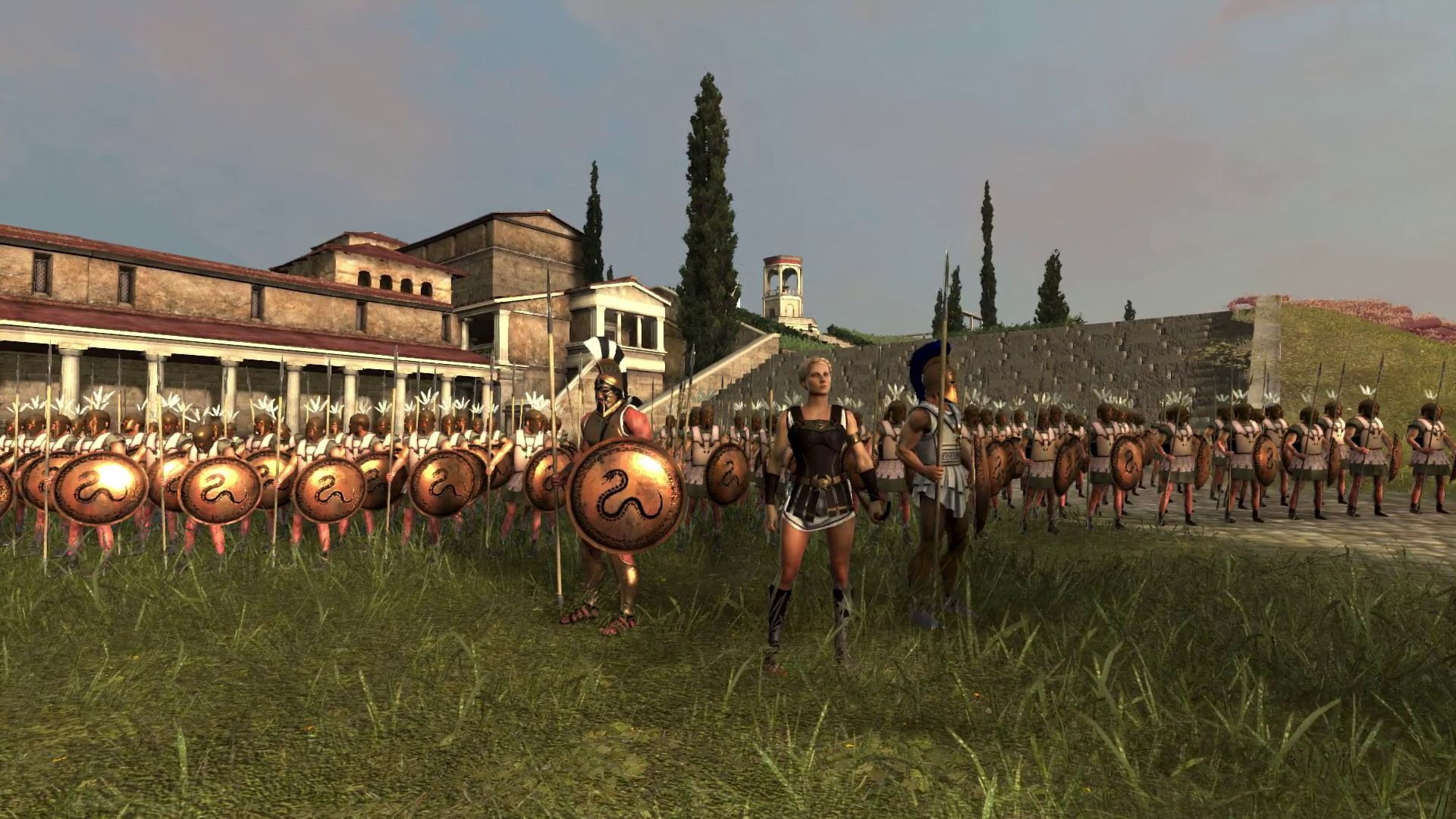
Arena will include three factions at launch: Romans, Greeks and Barbarians, with each featuring one of history’s greatest commanders that players can customize to suit their style of play. At E3, Creative Assembly announced Boudica, queen of the Iceni tribe, who wants to get revenge on the Romans. Each player controls three units, and many maps based on historical events. To win, teams must either wipe out the opposing army or capture their enemy base, which is much more difficult than it might sound. Players have to keep in mind multiple strategic variables, flanking positions, terrain and their army’s morale among other aspects. These are some of the features that have made up the core Total War experience in the past, and now they’re being translated to a free-to-play audience.
“There are many differences between a [traditional] Total War title and Total War: Arena,” explained Elliott Lock, the lead battle designer, emphasizing how traditional Total War games focus on the grand campaign, while Arena does away with the campaign altogether. “Total War, as a boxed product, is about the single-player experience, while Total War: Arena is about how you work as a team with everyone else to defeat the enemy.”
Given the relative complexity Total War games are known for, how Arena only lets players control three units each, and that there’s no campaign, we asked Creative Assembly what audience it was trying to reach with Arena.
“To be honest, we really want to make sure the game is accessible,” replied Farrell. “When you come in as a new player, strategy games—never mind Total War games—are a lot for some people to take on, especially if they’re casual players. Even if you’re coming from World of Tanks—that’s a point-and-click game with a first-person perspective. So, we’re looking at ways to introduce people and make the game more accessible with a gentle learning curve. We want to bring more people into Total War and make history cool. That’s kind of our thing. We don’t want it to be a lecture about history.
“It’s like when you see heroes in other games. Commanders were heroes. It’s all there, and we want to bring it out. History is our lore.”
“It’s one of the reasons we joined with Wargaming,” Lock added. “It’s free for everyone. Total War is technically kind of niche, but we still want to keep our fans happy, which is why we have a lot of depth. At the same time, partnering with Wargaming allows us to hit a free-to-play market where more people can enjoy Total War, understand history, and enjoy it. That’s what we’re about.”
Farrell also commented on how difficult it is to control three different units in a multiplayer game, thus keeping with Total War’s reputation for challenging strategic gameplay. As the game grows, competitors will truly see players’ cunning come into play. “You’ll start to see player skill—and I feel like it’s the first time Total War has player skill that you can genuinely see,” he said. “We’ve lowered the floor in terms of accessibility, but we’ve raised the ceiling in terms of skill.”
The game will focus on Ancient Rome at launch, and Creative Assembly plans to focus on this era for the time being. However, Farrell said that other factions and eras aren’t being ruled out. Furthermore, the development team is finishing out the core gameplay before focusing on aspects such as monetization.
“[Monetization] isn’t something that we’re focusing on now because we’re in alpha and we’ve got a great group of core players called the Praetorians, who we listen to for feedback to make sure the game and the abilities are bang-on,” said Farrell. “It’s all about the game right now.”
“It’s about servicing the game, getting feedback, and collaborating with the Praetorians,” Lock added. “We’re seeing what people don’t understand and don’t like, but we’re still making a game that we want to make.”
Creative Assembly relies heavily on its forums to communicate with its community, in addition to releasing developer diaries on YouTube. “The game is powered by the community,” said Lock. “They’re very important to us, and it will continue to be driven by them. What they say matters and we do tell them that. They can be very honest with us, which is great because we listen to them and make changes.”
As for the transition from single release games to developing a Total War game as a 24/7 service, Lock said that “it’s definitely been an interesting challenge. With Total War: Arena, it’s not necessarily about becoming a service, but it’s about producing a game that everyone can enjoy. But with a 24-hour service, one of the difficulties is how we can listen and get everyone on board. That’s what Wargaming is there for. The partnership allows us to collaborate in those difficult moments players have so we can fix their problems and get them back playing.”
Lock explained how the Total War brand was all about epic-scale infantry battles, historical warfare and historical authenticity, which echoes much of what Wargaming sought to accomplish with vehicular combat games such as World of Tanks. In other words, it would be difficult to find two brands that complement each other so well. He also said that Wargaming’s experience running its games a service will be invaluable to developing Total War: Arena.
But in addition to its free-to-play expertise, Wargaming is also known for big esports events such as the World of Tanks Grand Finals, which took place in Moscow in May. Although Lock described Total War: Arena as a kind of “slower MOBA,” in the same way Counter-Strike might be considered a slower-paced shooter compared to Unreal Tournament, he stated that fostering esports isn’t an immediate priority.
“We’re interested in competitive gaming, but at the moment, we’re focused on getting enjoyable battles,” said Lock. “Esports could be a possibility in the future, but it’s not at the top of our list right now. We want to make sure we’re producing a game that people enjoy.”
Nintendo is on a roll with its Nintendo Switch and Nintendo 3DS consoles. Although some in the industry had counted the Japanese game maker out after Wii U failed to build on the Wii’s global success, they’re singing a different tune now that the company can’t keep up with demand for the Switch.
Nintendo was one of the first game companies to successfully expand its game franchises to merchandise, which has helped the company attract new gamers. Doug Bowser, senior vice president of sales and marketing at Nintendoof America, explains to AListDaily how the company continues to market games through multiple touchpoints.
Who is Nintendo targeting today when marketing the Switch?
We continue to target a couple of audiences. We have our Nintendo fans, the active gaming group, and then we have kids and parents. If you look at the copy that we’ve created thus far, the spots have a different tonality and a different look and feel. Some will incorporate more kids and family-oriented games like Arms and Mario Kart together as an example, and others will include more active or core gaming. We’re trying to balance the messaging that way because we believe Nintendo Switch can appeal to a broad audience. If you look at the software that’s coming onto the platform, it runs the gamut in terms of genres. Now our job, from a marketing perspective, is to make sure that each one of those key audiences understands how those titles fits their needs.
What opportunities have social media platforms and livestreaming opened up as marketing vehicles for Nintendo?
We’re still very active in television, but we also have used things like the Directs as a powerful medium. Then we use our social media space to amplify those messages. They become really beneficial for the amplification of the other messages. What you can do with that draw consumers back in to spend more time watching one of those Directs or one of those feeds and learning more about the content itself.
When so many people know Mario, Link and other Nintendo characters, what are the challenges of getting audiences to pick up a Switch?
First of all, the content, even if they know a Mario, it’s got to be a unique Mario experience on Switch. You can see what we’ve done with Super Mario Odyssey—it’s very, different Mario game than we’ve seen in the last few iterations.
Legend of Zelda: Breath of the Wild is a great example. People knew Link and the core came quickly, but what’s been amazing is the word-of-mouth perspective of people who have played the game and engaged. The word-of-mouth has expanded so people that have never played a Zelda game before, myself included, are now diving in and embracing the gameplay. There’s always a chance to engage and bring new consumers into your franchises.
How do older generations, who grew up playing Nintendo consoles and now have kids themselves, impact your marketing?
When I talked about the kids and parents campaigns, some of the communications we have is to parents that may not have gamed before. But there’s a bit of nostalgia in some of our advertising for those parents that grew up gaming and now want to introduce it to their kids. It’s another great catalyst to get them to jump in and start bringing their kids to games. What we love about our properties is that so many of them are family and kid friendly, and it’s a great place for parents to engage in gaming with their kids.
How have you seen the success of Nintendo games on mobile devices impact the business, especially since some people thought mobile releases would cannibalize Nintendo 3DS sales?
The 3DS business continues to be strong. It was the only platform last year that grew year-over-year across all platform developers. What we’ve seen is that they’re complementary. When we launched Pokémon GO with Niantic, there was a direct impact on Pokémon hardware and software sales increasing. Mobile games actually bring new players into the franchises. They engaged in that content and wanted more of that experience, so their next purchase was more of the dedicated handheld and software side.
It seems like there’s more Nintendo merchandise out now than ever before. What role does retail merchandizing featuring Nintendo characters play for the brand today?
There’s a bit more. We’re making a conscious effort at retail right now to really improve our footprint overall because that’s a great touchpoint. For us, it’s a marketing touchpoint. It’s a chance for consumers to learn more about Nintendo properties and help our retailers sell Nintendo content. One thing we are trying to do when you say you see more is we are trying to bring together hardware, software, our accessories and even other licensed goods, because there are other licensed goods in the stores. Products like t-shirts, backpacks and other properties that we’re trying to bring into that section allow people to experience more of Nintendo and it exposes the brand a little bit better at retail.
The last few Nintendo E3 booths have been like theme parks. What impact do you see the Universal Studios Nintendo theme parks having on the brand?
One of our goals is to increase the amount of touchpoints that consumers have with Nintendo. That’s how you drive and grow the franchise and bring more people into our various forms of gaming. Universal is going to be a great example of that with the number of people that walk through a Universal theme park every year. A lot of them are younger kids who may not have picked up a 3DS yet, may not have a Switch at home, or may not have played on the mobile device. It introduces that IP and those characters to them and they embrace that. Then it helps us to expand that ecosystem, so they start coming more into our dedicated gaming business or into our mobile business.
This week in marketing statistics, we take a look at cord-cutting behavior, artificial intelligence as it relates to marketing and how an emoji can affect email open rates.
Uber Remains Über
Despite a string of company controversies, Uber’s public opinion among millennials has improved the most, according to YouGov’s BrandIndex. The new report ranks brands that saw the biggest gains in converting millennial consumers into current customers. (“Customer” is defined as one who has bought a product or visited the brand’s website within the last 30 days.) Rounding out the top five are Instagram, Lyft, Snapchat and TLC.
The Emoji Email Effect
Emoji may be a fun tool to communicate with friends and family, but email marketing consultant Return Path found that certain emoji result in higher email open rates. The firm reviewed using global consumer data consisting of over 17,000 commercial senders, two million consumer panelists and 5.4 billion commercial email messages sent to Microsoft, Google, Yahoo and AOL users between March 1, 2016 and March 31, 2017 to determine which emoji were most effective, if at all.
Adding a hamburger emoji to marketing emails for Independence Day resulted in a read rate of 25 percent, compared to an American flag and fireworks at 21 percent each.
Virtual Barriers
Entry-level augmented-and-virtual reality is available and affordable, so what is the biggest barrier to consumer adoption? According to a study of 3,000 consumers across the US, UK and Germany by marketing firm Vibrant Media, the biggest barrier is the need for additional software, apps and hardware.
The second biggest barrier, according to the study, is lack of awareness of where to find AR/VR content. Fear of drain on a user’s internet allowance was the third-biggest concern among respondents. If they were to experience AR/VR, exploring travel and holiday destinations came out on top of the respondent wish list, followed by events such as concerts or sporting events.
Spending Time With OTT
OTT programming is changing the way consumers watch television. ComScore’s “State of OTT” report reveals that half of US wi-fi households stream an average of one hour and 40 minutes per day of OTT content like Netflix. In fact, Netflix accounts for 40 percent of this activity, comScore reports, followed by YouTube (18 percent), Hulu (14 percent) and Amazon Video (seven percent).
Making An AI Impact
More than half of marketers agree that AI will have a substantial effect on their efforts over the next five years, according to a study by CRM technology provider SalesForce. Fifty-nine percent of respondents said they expect AI will improve the efficiency of campaign analytics, digital asset management and the collection of business insights across data and systems.
US: Home Of The Smart Home
According to Futuresource, the United States has the highest smart home penetration, with 38 percent of survey respondents saying they had at least one. The firm’s survey of more than 4,000 people across the US, UK, France and Germany also found that home security devices are the most popular type for first-time installers.
Political Distraction
If you noticed a surge of fake or inflammatory news appearing alongside President Trump’s visit to Poland Thursday, you’re not alone. Major news days are a haven for such content. In March, digital media authentication service DoubleVerify blocked over 85 million ads from serving adjacent to inflammatory news—a 250 percent increase from January 2017. The company works with sites like Facebook and Snapchat to moderate the viewability of questionable content.
DoubleVerify reports that the volume of fake news more than doubled in France during its 2017 presidential election, and Italy saw a 75 percent increase in fake news around major political or terrorist-related events.
Fan-made games help build awareness around IPs, but publishers must draw the line between free promotion and piracy. Sixty-nine percent of millennials named brand recognition as the most important driver of brand loyalty, according to a study by NewsCred, so learning about a brand through its fans couldn’t hurt . . . could it?
Halo certainly doesn’t need help with brand awareness, but that didn’t stop developer 343 Industries from allowing a fan game to continue undaunted.
Installation 01 is an “artistic tribute” to Halo that aims to recreate classic multiplayer experiences for Windows, Mac, and Linux players. The creative team behind the project has been especially careful to follow Halo‘s Game Content Usage Rules to the letter—something that, for now, has garnered legal approval from 343 Industries.
“We’re going to say that [343 Industries] support[s] us as potential fans just as you all support the project right now,” the Installation 01 team shared on the project website. “They like what they see from the project, and they are certainly open to playing with us.”
While Half-Life fans dream of a third installment to the series, Valve has approved an unofficial spin-off called Prospekt in the meantime. Developed first as a job application by fan Richard Seabrook, the project was officially green-lit by Half-Life developer and Steam proprietor Valve for publication last year. But unlike Installation 01, however, Seabrook and his team are allowed to earn money.
“They said, yep, this is all yours,” Seabrook told Wired. “The only thing I couldn’t use was the voice acting. But they said, yep, go for it, you can use all the IPs, you can take stuff from multiple IPs, you can do whatever you want.”
Video games inspire fans to express themselves in a myriad of ways from cosplay to fan art, music, film and (of course) games. While publishers appreciate and encourage most tributes, playable games fall into a legal area that may promote and threaten an IP at the same time.
Nintendo will not hesitate to defend its famous games and characters, as it did with Project AM2R, a fan-created remake of Metroid 2. After working on the title for eight years, a cease and desist letter brought the project to a grinding halt.
During E3 this year, Nintendo announced an official remake of Metroid 2 called Metroid: Samus Returns. When asked about the since-canceled fan project, Nintendo president, Reggie Fils-Aimé explained the company’s reasoning.
“I think there needs to be clarity in what the line is, and, in our view, the line is when an initiative crosses from being an homage to something that is monetizing our IP,” Fils-Aimé told Vice. We allow homages to exist in a variety of different ways. And, for me personally—as a fan before I was an executive, I understand the attraction that you could have to our IP. But, when it transitions to something that . . . you’re trying to profit off of, that is what broaches or breaks through that line for us, where we have to claim our IP protection.”
Similarly, Square Enix pulled the plug on a number of Chrono Trigger fan projects, and Activision Blizzard issued a cease and desist letter to one fan over a Starcraft MMO mod.
Modifications, or “mods,” use an existing game’s framework to change elements or even create a whole new game. Some of the most popular games fans have modified and shown on livestreams include Grand Theft Auto V, Minecraft and Unreal Tournament.
Epic Games, the developer behind Unreal Engine 4 and Unreal Tournament, the engine’s namesake, not only allows modding but encourages it.
“There is no limit to what you can do,” Stacey Conley, community manager for Unreal Tournamenttold AlistDaily. “Modding also offers a sense of community to those who love games, and are interested in how they are made, learning by using actual development tools like Unreal Engine 4. Teams form, and some go on to create their own games.” To underscore the point, some of today’s most prominent games, particularly Counter-Strike, Dota and even PlayerUnkown’s Battlegrounds started as mods.
Analyst Joost van Dreunen, CEO of SuperData, agrees in the value of allowing fan creativity.
“Fan-created video games are a key component in the way that an IP-holder will create value today,” he told AListaily. “If you look at titles like Minecraft, it is immediately clear that ‘opening’ things up to players and fans ultimately benefits everyone. However, the traditional mindset among publishers has been to aggressively protect their IP from dilution, and in the traditional capital intensive product-based business that made sense. But that has changed with the popularization of games as a service.”
A group of passengers, each with different backgrounds and skill sets, are quietly riding a passenger train when they are suddenly transported to a strange world where human civilization and technology doesn’t exist. Instead, they’re surrounded by untamed jungle filled with roaming dinosaurs. These people must learn to forage, rediscover technologies, and build up their defenses in order to survive.
This might sound like the plot for a new sci-fi movie or show, but it’s actually the premise for Durango, an upcoming open world MMORPG (massively multiplayer online role-playing game) from Nexon M, designed specifically for mobile devices.
Mike Tekle, associate director of product at Nexon M
Mike Tekle, associate director of product at Nexon M, explained to AListDaily that time travel isn’t necessarily involved in Durango. Rather, players are transported to an alternate world and they must learn to survive and pioneer the land against a multitude of carnivorous dinosaurs.
Durango was officially announced in June and was shown for the first time on the E3 show floor where attendees could try the game out. Nexon had a Durango kiosk set up, and players got a taste of the game as a guide stood nearby to present background and tips. Nexon has also been promoting the game extensively via its Facebook and Twitter channels.
Having released hits such as Maple Story, Vindictus and many others, Nexon is no stranger to MMO games. However, this is the first MMO the company is releasing for mobile platforms. When asked what inspired the development of a free-to-play dinosaur-themed survival MMO for mobile, Tekle said, “The development team at What! Studio, one of the top studios in South Korea, and their director Eunseok Yi have a lot of experience in the MMORPG space. Mabinogi and Vindictus are a couple of the titles that Yi led. They saw that the MMORPG landscape was pretty similar where high fantasy themes were concerned and felt that coming in with a unique theme like this would resonate globally. Humans interacting with dinosaurs crosses cultural barriers, and that’s what they wanted to strive for.”
However, both Mabinogi and Vindictus are PC games. So, we asked Tekle why Yi and his studio decided to develop an MMO game for mobile devices.
“We want to be pioneers in the MMORPG space on the mobile front,” said Tekle. “We feel like there’s plenty of opportunity on the mobile side, and it’s just a matter of coming in with the right concept, an intuitive interface and gameplay that’s bite-sized enough for mobile players to enjoy in short sessions—or they can sit down with it for hours. Again, there’s plenty of opportunities, and we feel like Durango is the one that will occupy the space.”
Tekle detailed how Nexon was growing the player community in the lead-up to the game’s launch later this year. “Part of our initiative right now is pre-awareness, which is one of the reasons why we were at E3,” said Tekle. “We’re spreading the word around and we had a press release announcing that the game would be launched in Q4 [2017]. So, we’re strategically planting the seeds over the next few months so that the fans who have already played and know about Durango can organically spread the message to their friends—letting them know that this awesome and unique game is coming out soon. We expect that with our efforts combined with the fans spreading the word that the word will get out.”
“On the mobile space, we’re going to heavily rely on our community to help grow our efforts by engaging them through Facebook, Twitter, our website and forums, to have them be evangelists for the game. That’s one of the ways to help spread the word for mobile games. [On mobile] it’s about, ‘are your friends playing it and are they evangelizing it?’ If they are, then the game will grow organically and globally,” said Tekle.
“We’ve been posting pictures from E3 [and other events] on social media, and teasing players by saying that we’re launching soon so they can be prepared. We’re also encouraging them to be part of the upcoming beta test if the game is available in their regions. The community has already been very supportive, and they’re looking forward to the launch.”
In addition to presenting Durango at public events like E3, the upcoming beta is the perfect opportunity to give players an early look at the game. “There will be a limited beta test scheduled relatively soon,” said Tekle. “It will be confined to a few territories and the goal is to refine the game, make sure it will scale as needed, and get feedback from users about what we can do better to prepare for the global launch.”
So, does Nexon’s experience with publishing MMO games for the PC help with growing a new game in the mobile space? “I think there are a lot of lessons to be learned,” said Tekle. “There are differences between PC and mobile, but I don’t think that they’re differences that can’t be overcome. Essentially, creating a fun experience on the platform that the game is intended for is key. With PC MMORPGs, most people will expect a mouse and keyboard or controller to interact with. Durango’s interface is smooth and intuitive [for mobile], so those types of things cross paths. We expect that this game will feel right for mobile.”
“An ideal MMO on mobile has a persistent world where users can see what others are doing,” he replied. “Players can play bite-sized chunks if they want to. The idea is having a game you can play on the go when you have a couple of minutes here or there. But if you want to sit down and play for hours, you can also do that and have fun. Having a game that’s on-the-go and massive is something we think mobile users will enjoy.”
As with all of Nexon’s mobile games, Durango is being designed with a 10-year service plan in mind. “With all of Nexon’s games, we plan for five or ten years of success,” Tekle explained. “That’s been a staple with Nexon going back to Maple Story and a lot of other games. We don’t look at things from a short-term perspective—we expect that games will be services for many years to come.”
Panasonic will soon celebrate its centennial with a brand repositioning that’s shifting their strategy from a basic consumer electronics products provider to one bringing business-and-government integrated technology solutions.
The multinational Japanese electronics corporation runs an $11 billion business portfolio in North America, but if you have plans of purchasing a Panasonic TV, think again, because they have exponentially expanded their non-consumer business, specifically under the following four categories: automated supply chains, sustainable energy, immersive entertainment and connected world.
Panasonic created the taxonomy and solution categories to better share stories about their brand evolution under its latest marketing message, “Technologies That Move Us,” hoping their experience in the consumer market will help its other lines of business begin to boom.
Lauren Sallata, Panasonic USA’s chief marketing officer and senior vice president, who leads the corporation’s digital, brand, content and advertising efforts, joined AListDaily to detail how they’re repositioning the company.
Lauren Sallata, Panasonic USA’s CMO and SVP
How do you introduce the Panasonic brand today?
Being a basic consumer electronics products provider is at the bottom of our value pyramid’s hierarchy. The messaging up the food chain, or up the pyramid, so to speak, is around what we’re truly doing, which is integrated technology solutions. That said, this is a tremendous time in our company’s history. We’re a very mission-driven brand. We have a set of business principles that were created by our founder, Kōnosuke Matsushita, 100 years ago—leading with contribution to society first, and supporting employees. I think that’s very much a part of our culture. As we rebuild our brand, and leverage our heritage, we’re just reaching consumers in a different way then we have been in the past—as an enabler through business and government. I think we still have the end user in mind, which is the consumer, it’s just at a slightly different framework and go-to-market approach.
What are the products that Panasonic is marketing and positioning in North America?
We’re very much a holistic provider to consumer businesses and government. We’re still in North America, but we’re not selling televisions anymore at this time. We discontinued sales of TVs about two years ago as part of our transformation. We’re still very much in the consumer business in the US and in Canada with cooktops, cameras, microwaves and grooming products. There’s still very much a base in business consumers. If you look at our capability categories, we’re really more into things like sustainable energy. That means looking at ion batteries for Tesla, or Toyota . . . solar installations, micro-grids, and the like. In the category of the connected world, we’re doing integrated vehicle-to-vehicle technology and vehicle-to-X technology, and connected worlds in places like Denver, Colorado.
How is Panasonic engaging and starting conversations with consumers to spread the word about your brand ethos? How are you reintroducing a legacy brand in the marketplace?
Right now we’re very much in awareness-building. We did a lot of research to optimize, and first and foremost, we needed to tell our business story, because that’s 80-plus percent of the revenue for us in North America. It’s actually business-to-business, and business-to-government. Our consumers represent about 20 percent of our business in North America. We did a lot of research into our buyer set, created those personas and then we matched the media buy, very specifically, to how consumers get information. We landed in a lot of tech, news and sports media outlets. We were heavy on video. We’re seeing a lot of people signing up for newsletters and for more information, which we kind of officially haven’t gotten into as part of the campaign. But we’re seeing early engagement there. . . . The next phase of work we’re doing is bringing it down into the business levels and working and making sense of it for everybody’s different particular market space.
You mention going heavy on video. What have you experimented with?
We’re making 60-30-and-15-second videos on paid social. We skew very heavily with our buyer personas, believe it or not, on Facebook. We’re getting a lot of really good traction there. We’re doing programmatic as well.
What is your marketing approach on social media?
We absolutely are heavy on social, both organic and paid. Right now we’re putting together a pilot program for social selling to bring that into the fold as a strategic growth program. Influencer marketing is absolutely something that’s within the business units—you’ll see a lot of that going on. We’re covered by different influencers and industry analysts, sort of at the business-unit level. We have 10-plus business units in North America, and each of those business units has their own small marketing team. We employed that strategy at the previous two CES [in Las Vegas] just to engage with influencers and bring forward the real story and reality of our company. We’re seeing a lot of lift in engagement and shares when we do use those strategies. I think we do it very surgically.
The Denver Smart City project is one of the projects that aligns with your four categories. What insights can you share?
It’s going well. We’re continuing to deliver on the commitments that we made for Denver. Most of our development is focused around Peña Station, which is a light rail line going from the Denver International Airport to Union Station in the center of Denver. This 400 acre-development area is like a test bed for the technologies that will be implemented in the smart city. And we have a micro-grid that we’re working on with our partner, Xcel Energy. We’re also implementing other technologies, like smart street lights, which do more than just illuminate, but also providing security and pointing out parking spaces, and a lot of other added value, smart city features.
How is Panasonic empowering creators and inviting them to share their work?
Panasonic plays, invests or sells in some version in nine-of-the-top-12 disruptive technologies—things like robotics, artificial intelligence and energy. We put our $5 billion research and development investment into play every year. There are a number of initiatives being driven out of our parent corporation to engage entrepreneurs and innovators that are largely targeted for millennials. We’ve set up what we call the Wonder Lab, and it’s in Osaka, Japan. It invites incubation, and brings in projects with some level of funding. We recently announced a partnership with the Parsons School of Design to do a collaboration for students that are inventing the next generation of wearable technology pieces and experiences that address wellness needs. Panasonic is holistically focused on the future. Next year will be our 100-year anniversary, so there’s a lot of interest in what the next 100 years after that are going to look like.
What marketing activations can we expect for the centennial birthday? Will this be the opportune time to bring that brand repositioning forward?
Definitely. We’re going to have some big things up our sleeve for CES in January 2018. We’re making these types of investments in the next generation that’s influencing technology and new solutions and new ways to go to market.
You were also a global partner for the Rio Olympics last summer. What were the results that continuing sponsorship yielded?
I think it’s been a successful partnership for us. It’s been ongoing since the 1988 Games. We have an ongoing relationship and it continues with an eye toward Tokyo in 2020, and beyond. We received a lot of very positive feedback last year from the opening and closing ceremonies and the work that we enabled for both. We’ll absolutely continue that relationship. Collectively we felt that Rio was a success.
You’ve been with Panasonic for a little over a year now, after working four years with Xerox before that. What are some of the big marketing shifts that you’re experiencing in the industry?
I think it’s tact, platforms and programs. All of that is constantly changing. There’s a constant drum beat of marketing technology coming onto the scene. As a marketing leader, you have to understand all of the possibilities, and make decisions about expensive martech purchases. Your tech strategy is also a constant piece of the puzzle, and I don’t think that will be stopping any time soon. Breaking through and getting to your buyer set in a compelling and engaging way is always big. I see the frenzy of marketing automation still very relevant. There are techniques like account-based marketing that are also emerging as more strategic and targeted, especially at a B-to-B or B-to-G level. There’s also a tremendous opportunity with the new programs that LinkedIn is launching since it was acquired by Microsoft last year. I see that as an incredible marketing platform, especially in B-to-B and B-to-G. . . . How do you enable the best possible result? What is that platform or tool? What are the processes and teams that you have to put in place? Where do you double down with your budget? How do you make those difficult choices? . . . You have to figure these things out, get the right tools and processes in place to succeed and know where to best place your bets that align with your marketing strategy.
Having served as the president of PepsiCo and CEO of Apple during his career, John Sculley has been responsible in helping build out some of the best known brands in the world today.
After introducing the world to the Pepsi Challenge in 1975 during his 15-year stint for the soft drinks company that started in 1967, Sculley helped Steve Jobs grow Apple from $800 million in sales to over $8 billion throughout his tenure from 1983 to 1993.
The established executive joined AListDaily to explain that there are marketing lessons to be learned from past successes.
“In the days of the cola wars, Pepsi was outsold in the early 1970s by 10-to-one in 50 percent of the country. We realized Coca-Cola was the most valuable brand in the world at that time and they had almost unlimited marketing dollars. So, they owned reality,” said Sculley. “We decided we had to own perception if we had any chance of gaining share in the market on them, and so we created what at the time I called experiential marketing with the Pepsi Challenge.”
That’s what motivated Jobs to lure Sculley to Apple. Jobs wanted to learn all about experiential marketing, which was deeply imbedded in the high-tech world in the end-user experience.
“Jobs was designing the Macintosh for non-technical people to do creative things, an idea that seemed outrageous in the early 1980s, but obviously we take for granted today,” said Sculley. “Those fundamental principles of experiential marketing are still here today. In fact, they are even more relevant today as you see companies like Amazon develop what’s now being called the 360-degree experience with Amazon Prime. You see it with the new technologies like augmented reality and eventually virtual reality.”
When it comes to new technology, Sculley is more optimistic about AR than VR.
“When you can take things like Microsoft HoloLens—and other companies will have their versions of that—and superimpose digital things into the real world, that feels much like the way that desktop publishing became a mainstream application in the 1980s when we first were showing it experimentally,” Sculley said. “People asked why anyone would want to do that, and now everyone knows what a PowerPoint presentation is and we just take it for granted that it’s always been here. My sense is AR will follow an adoption pretty similar to desktop publishing. VR is hard to know—it’s so early in the game. We still don’t have much content with VR that’s really caught on in a mainstream way.”
Back when Sculley was building underdog brands like Pepsi and Apple, there were a lot less opportunities for marketers—and a much easier path to connecting with young audiences.
“It’s all about signal-to-noise ratio,” Sculley said. “There’s an awful lot of noise. So how do you break through the noise and get the signal that will connect? Obviously, personalization is a fundamental factor. We never had personalized marketing back in the days when I was at Pepsi, or even at Apple. It wasn’t technically possible, but now personalized marketing—where you can actually make adjustments based on behavior by looking at thousands of data points per individual—is something that is mainstream now. That means how work gets done in marketing is radically different than the way it got done even a decade ago, and it will continue to change. But the question is who is in control? Who has power?”
With social platforms like Facebook reaching 2 billion people a month, messaging is no longer a one-way street. In addition, new livestreaming technology like Facebook Live is enabling content creators, including influencers, to connect with audiences.
“There’s been a big change in what the roles are,” said Sculley. “In some cases it means that there will be lots of little entrepreneurial companies, even individuals, who can create things things at a very high production level of quality—even at their own desk. On the other hand, you’re going to see massive controls continue to expand with Facebook, Google and Amazon and other companies that have crossed borders to dabble into a little bit of everything.”
One constant in the field of marketing that Sculley hasn’t seen change in over 40 years is starting with an insatiable curiosity.
“Everyone that I ever worked with who made breakthrough changes in marketing always was a curious and hardworking person that wasn’t afraid to take risks,” Sculley said. “You have to be a risk-taker if you’re going to be a really good marketer. You have to be prepared to make mistakes and fail, and you just pick yourself back up and try to figure out what you learned and try it again. Those are identical characteristics in what you see with the best entrepreneurs. That makes sense because entrepreneurs by instinct and design are creative people, and marketing is a creative endeavor. So there’s a natural alignment between the personality of an entrepreneur and the personality of a great marketer.”
In anticipation of the upcoming film Spider-Man: Homecoming, Dell collaborated with Sony Pictures for a virtual reality experience that serves as part of a multi-platform marketing deal for both of the brands.
The experience, created on Dell Precision workstations, gives consumers a chance to suit up as the comic book character and icon to hone their web-shooting skills and sling high above Gotham City in pursuit of the Vulture.
It is paired with an experiential ploy at select Cinemark theaters in the US, where moviegoers can experience Dell’s PC line of VR-ready products firsthand.
Gary Radburn, Dell’s global head of virtual and augmented reality, joined AListDaily to share some insights on how they are approaching the immersive vertical.
On Dell’s positioning for professional-and-consumer-focused VR . . .
I feel that we’ve got the largest range of VR-ready products out there. We do a lot of internal testing with our products as well. We ensure that the consumer and the commercial sectors get the best experience they possibly can when they use VR. The worst thing that can happen is somebody uses a system, they have a bad experience and they don’t come back to it for a long time. We’ve taken all of that legwork out by introducing systems that go above and beyond in terms of VR testing and the experience. We invest in the commercial space with VR centers of excellence at some of our solution centers, where we invite customers in as a free-of-charge service to actually experience their industry, or their vertical, in a VR environment. It allows them to associate the goodness that VR can bring, the shortening of time cycles and the increase of monetization because of it. From the consumer’s point-of-view, just really giving people the best so they can blow away their friends with the experiences they’re receiving. We’ve traditionally had all the graphics power inside the tower systems, both in consumer and in the professional space. Now with the advent of the new chip sets that are there with the power that’s available inside a mobile platform, we’ve really reached that point in the industry where mobile becomes pertinent. We have the 13-inch Alienware with 1060 graphics inside of it that can really drive VR in a small platform. On the professional side, we haven’t had a platform before that’s been able to drive VR with the chip set. With the Dell Precision 7720, the chip set inside of there, the P500 from NVIDIA, really allows you to drive VR in a degree we haven’t seen before inside of commercial space.
On marketing content in new ways . . .
Currently, you can use techniques like audio and visual cues of getting the audience to watch particular things. In a 360 video, that becomes a bit more complex. But you can be clever—like if the action is taking place in front, you can actually put audio and visual cues in the 360 space. Then using social media, you can say, “Did anyone see what happened in the scene, five minutes in at 270 degrees?” Those people are going to go back and re-watch the film, but from a different perspective. From a marketing angle, you’re now getting more eyeballs on the film because people are going to want to watch that experience more than once.
In terms of the marketing, the whole idea of making a film is to get eyeballs on it. Story experiencing as we’re seeing in the 360 and immersive video space is really helping people connect. You’re now being put inside an immersive environment. We’re seeing pieces being written where you’re actually a central character, and seeing VR from a different point of view. You get more of an emotive connection, and you get more empathy with what’s actually trying to be expressed. Because of the impact, you feel like you’re actually there. You can look around, immerse yourself in that space. It really helps you understand more than a potentially flat film, and takes it to a next level.
On confusion in the space slowing down adoption . . .
I feel that VR is very much like the wild west at the moment. There’s a lot of people saying “this” is VR, but VR encompasses so many different mediums at the moment. We’ve got 360-degree video, which could be an immersive video. You’ve got photogrammetry. You’re then moving into VR itself with six degrees of freedom—augmented reality, mixed reality, and then people are using this over-arching concept of “we do VR.” There’s no division. There’s no context of what people are actually doing, so consumers get confused. Confusion then slows down adoption. We need to actually start using terms that the entire industry can use, and everybody agrees to. For example, when we say we’re doing 360 video, which is the entry point to VR, we can say that’s an “immersive video piece.” With 360 video, it’s a low cost of entry for doing that inside of a piece.
On the democratization of VR . . .
We’ve got a huge gamut of products at different price points for different needs. Not everyone needs the fastest, the best, the top end. So now we’ve got different price points along the way. You can then decide on what your end result is going to be, on the power of the system that you need to be able to drive that, and there will be something at a price point that can suit you. So basically, the democratization of VR is starting to happen. It’s not for the largest wallets in the land anymore. We’re now trying to bring VR to more and more people because VR is very exciting. It used to be deemed as a high cost of entry. That’s now changing over the period of time. We’ve all seen the shop videos on YouTube of people trying it for the first time, like older family members and being absolutely in awe. Younger generations just take it in stride and say this is the norm. But where do we move from there?
InnoGames was founded by two brothers with their friend to create a game they wanted to play with their friends. Its first game, Tribal Wars, which released for browsers in 2003, grew so quickly that it prompted the trio to officially found InnoGames in 2007. The German company now has two studios, one in Hamburg and the other in Düsseldorf, with the latter dedicated to developing mobile games. Although InnoGames has released multiple browser and mobile games since its founding while still maintaining the Tribal Wars franchise, the company’s most successful game to date is Forge of Empires, which released in 2012 and now boasts over 50 million registered players with a lifetime revenue of EUR 250 million (about $283.4 million US). Last year, InnoGames brought in EUR 130 million ($147.4 million US), which is a 25 percent increase in revenue over the previous year.
Its success did not go unnoticed, and last year it became the first video game company to be acquired by the Nordic TV broadcaster Modern Times Group (MTG), which currently owns 51 percent of InnoGames’ shares. The timing coincides with the gaming company’s strategy to put increased focus on mobile gaming, but it hasn’t forgotten about its browser-based roots. Almost all of its games, including Forge of Empires, can be played cross-platform—meaning that users can switch between playing from their computers and mobile devices at any time. That said, the history-themed strategy game is seeing more mobile installations than ever, which may be spurred by its weekly content updates, promotions that include television commercials, and audience engagement through a web series called InnoGames TV.
Armin Busen, chief product officer at InnoGames, spoke with AListDaily about the company’s continued growth and how it engages with a global audience between two gaming platforms.
Armin Busen, InnoGames chief product officer
How would you say Forge of Empires compares to other mobile strategy games?
Forge of Empires stands out as a long-running successful game. It has a total of 5.8 billion game sessions and a total worldwide playtime of 136,984 years. Compared to its competitors, we continuously rank high across app stores and maintain our steady growth. We recently reached a lifetime revenue of EUR 250 million and celebrated our fifth anniversary. On top of that, we have had many past successes with the game, including winning Google’s “Best of Games 2015” and was named the “Best Browser Game 2013” at the German Computer Game Award (Deutscher Computerspielpreis).
Is there a lot of audience crossover when going from web-based browser games to mobile?
Next to browser, Forge of Empires is also available cross-platform for iOS and Android devices. This allows our players to play across platforms which extend their play time and increase their overall experience. Therefore, we see different levels of platform adoption across markets, with some markets preferring mobile over browser.
While we are strongly focusing on mobile, browser is and will continue to be important for our company. The revenue we see on browser combined with the number of players that are active on it is a clear sign the platform is still strong.
What is the key to discoverability when it comes to the mobile space and how does it compare to browser-based gaming?
Our strong marketing strategy plays a crucial role when it comes to discoverability. As a lot of marketers know, most of the media consumption has switched in the recent years to mobile. Yet, despite these trends, InnoGames has diversified its strategy to be able to reach potential players on every facet of the sales funnel.
Discoverability focused on browser-based gaming is normally based on game portals, while on mobile it is through the app stores. Since our games are cross-platform we have the greatest success through TV advertisement as it reaches all platforms. Our marketing department is also a forerunner in the field of social networks, with campaigns that have been used as case studies for Facebook. Overall, our approach to marketing is innovative, we try to test and gather as much information as we can while maintaining a high-quality approach.
How well would you say InnoGames’ television commercial marketing has worked?
At InnoGames, we mainly see TV campaigns as a complementary addition to our online ones, especially since our goal is to reach customers across platforms. Through our commercials, we capitalize on the growing number of individuals who use a tablet or smartphone as a second screen while watching shows.
Our marketing strategy allows us to use the best of both worlds: TV’s immense reach and the specialized targeted reach of online campaigns. Imagine you are browsing through your Facebook feed, and you see an ad telling you to play Forge of Empires. You later browse a website and see a banner, then later that night as you sit in your living room, you see an ad for the game. As you can see, combining TV and online campaigns allows us to increase the reach of awareness with our customers—with viewers seeing the same message across different platforms and experiences.
What led to the acquisition by MTG and what does it enable InnoGames to do with its games?
InnoGames’ position within the gaming industry combined with its strong yet continuous growth influenced MTG’s decision about the acquisition. Through this partnership, we aim to carry our titles to even larger audiences around the world by utilizing MTG’s international presence, their strong media network and their understanding of storytelling. MTG’s culture of empowering entrepreneurial spirit is exactly what we were looking for as we move into the next chapter of our story. The team could not be more excited about further boosting our future potential and performance.
How does the InnoGames brand align with MTG’s?
While we have joined the MTG family, we are still an independent family with its own goals and schedules. We are collaborating with MTG on projects that are mutually beneficial. For example, we already collaborated with them on a project called MTGeneration. They recently visited our offices to shoot a special season highlighting our employees and our work. Despite this or any future projects, our focus will always be our games.
What would you say is the key to long-term engagement on the mobile platform?
In the case of all our long-running games, the key is to run our games as a service compared to a product and continue to relentlessly improve and innovate on every aspect of the game development. We provide meaningful social content that keeps our players engaged and motivated to play. For example, in Forge of Empires, we offer new content on a weekly basis, we incorporated Guild Expeditions, which is a cross-platform cooperative feature, and we continue to update our late game with new Ages.
What led to the creation of the InnoGames TV series and how do they contribute to continued audience engagement?
At InnoGames, we pride ourselves on having a diverse, qualified and interesting team that works on our games. Not only are they an asset to our company, but they are the reason our games run so successfully. When we first started our YouTube series, we saw two needs that we were not yet meeting: having information in an engaging format and a way to highlight our employees. We wanted our players to get a glimpse of what it is like to work at InnoGames while being as genuine as possible. Therefore, we started InnoGames TV at the end of 2013 to address this.
This format also gives us content for our individual game channels which feature the content in forums, CRM campaigns and announcements.
The purpose of InnoGames TV is to keep our current players updated on the current news. We have consistently achieved a high number of organic views, consistently hitting over 200K, including Facebook views. In this regard, InnoGames TV achieves its purpose while also helping us build our brand image.
 Creative Assembly relies heavily on its forums to communicate with its community, in addition to releasing