Outside experience plays a major role in the consumer journey for women, with 96 percent likely to seek out opinions and recommendations from others, according to the latest research from Influence Central. This study, conducted over the summer, analyzed the purchasing habits of over 400 US women and a definite trend emerged—women rely heavily on social media to make informed buying decisions.
Ask Mom
When asked which sources consistently give them useful recommendations for making purchasing decisions, consumers named close friends and family as the number one go-to. “Other moms” was listed as the second most-useful source of information, followed by web searches and social media communities. This is important to note when a brand leans toward frontline marketing and chooses an influencer to partner with or when targeting a female demographic.
Eighty percent say they often seek peer opinions while 59 percent turn to experts, and women value firsthand experience over any other reason for the recommendations they receive. While a vast majority of women reach out on social media channels for help, the offer goes both ways. Seventy-two percent of women consumers often share their own opinions, advice and recommendations via social media, as well.
Social Smarts
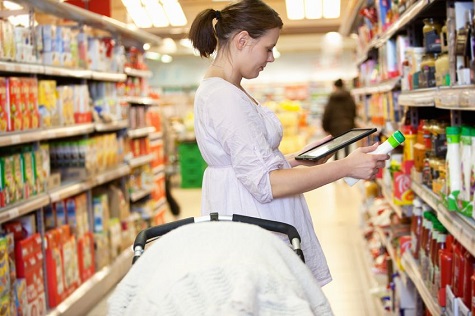
Eighty-six percent of women surveyed turn to social media outlets for opinions, advice and recommendations while 72 percent connect with their social media community “frequently” to help make everyday purchasing decisions. When asked why this is, 45 percent indicated the simple fact that they are more active on social media now than in previous years. Ninety-three percent of women consumers said they seek out more types of information more often now that it’s easier to access. Mobile access is also incredibly important, too, with 83 percent agreeing that they “couldn’t get nearly as much accomplished in life” without a smart phone.
You’d think the answer for marketers would be to jump on social and offer opinions, but it’s not that easy.
The women surveyed are confident in their ability to make informed decisions. Ninety-three percent describe themselves as skilled at determining which information to trust, but only 56 percent say their level of trust has increased thanks to the growing information available through search engines and social media.
“Haters are gonna hate . . . until they have to bake,” dairy farmer Dave Hardy says in a promotional video for Organic Valley.
After about 60 years of bad reputation, butter is back in style and Organic Valley (as well as taste buds everywhere) are celebrating. The farmer-owned cooperative of more than 1,800 organic family farms has launched a holiday campaign in defense of the creamy but long-thought unhealthy dairy product—just in time for Thanksgiving cooking.
You see, butter was deemed unhealthy in the 1950’s, but more recent studies have found no connection between the saturated fats in butter and cardiovascular disease, as the public was told. Now, butter is making a comeback as a health food, differentiating all-natural “healthy” fats in favor of trans fat and artificial ingredients found in butter substitutes.
Organic Valley has taken a unique approach to this marketing campaign, immortalizing “Heroes of Butter” by sculpting their faces in—you guessed it—organic butter. The “brave men and women that never gave up” on that delightful yellow stuff can be nominated by friends and family on Twitter, then encourage votes on the “War On Butter” website. Those with the most votes have been immortalized daily in gooey gold by expert food sculptors Marie Pelton and her husband Jim Victor via livestream.
The first person to be sculpted was George Siemon, the founding farmer of Organic Valley. “Every material we use is a bit different,” said Pelton in one of the promotional videos, “and Organic Valley is a really dense butter that has a lot of body and a beautiful, golden color.”
The Pennsylvania couple has sculpted some intricate pieces for special events in the past made of chocolate, caramel, cheese and even bacon.
In addition to watching butter sculptures come to life each day on livestream, the “War On Butter” website also features recipes, coupon offers and even tells viewers where the nearest participating dairy farm is located.
This isn’t the first time Organic Valley has taken a fun approach to marketing. Last year, the dairy co-op produced a series of “Brononomous Hotline Intervention” videos that encouraged gold-wearing, weight-lifting, protein-chugging bros to lose the chemicals and reach for Organic Fuel instead. Armed with its own hashtag and “Save The Bros” website, the original campaign video has garnered over 2.5 million views to date.
From its playful #SaveTheBros outreach to creating videos for coffee lovers, animal lovers and lovers of all things organic, it seems that the co-cop has a campaign for everyone.
Nom is a food-focusing livestreaming social platform founded by former YouTube CTO, Steve Chen and former YouTube engineering lead, Vijay Karunamurthy. Chen helped create YouTube and Karunamurthy worked for many years building the team that worked on the user experience. One of the things the two found most inspiring about YouTube was how the platform helped connect people and gave them a means of expressing themselves in new ways, ultimately building a new category of creators.
After YouTube, Chen and Karunamurthy moved to Google Ventures, where they were brainstorming startup ideas. It was in a café at Google, where a new chef was brought in every month, that the concept for Nom came into being. They were more interested in talking about the food, ingredients and what they were going to eat than startup tech ideas.
“I think there’s a new energy around food and cooking for a young audience,” Vijay Karunamurthy, now CEO of Nom, explained to [a]listdaily. “It’s kind of a new world of exploring different cultures, different stories and different parts of people’s lives through the world of food and cooking.”
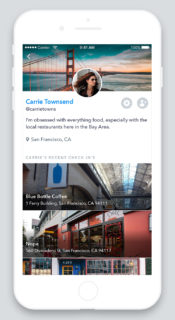
To make Nom come to life, they first had to think about mobile devices and how people relate to video on them. “It’s important to connect what people do when they’re on a smartphone with what they want to do in real-life,” said Karunamurthy. “By the fact that you’re interested in a cappuccino video and photos shared by a barista around the corner, we might be able to suggest to you a great coffee bar here or in Tokyo (if you’re traveling out there) and encourage you to go out and explore things on your own.”
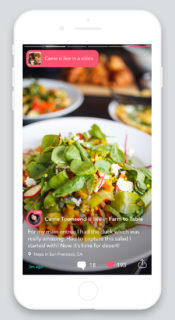
The app, which launches today, recommends content by learning the user’s tastes through the types of ingredients, recipes and restaurants they swipe on. If a user selects a lot of vegan or vegetarian recipes, the app is not likely to recommend a charcuterie place. The aim is to connect users with great food that’s relevant to them, which could include everything from local restaurants to eateries in other countries, using photos, video clips, and livestreaming videos featuring food lovers talking about what they’re excited about.
In addition to restaurant discovery, Nom can also provide tips around the kitchen using special ingredients. A passionate community, with its own language and rhythms, is also a very important aspect to the platform. So, Nom will have professional chefs share recipes or give behind-the-scenes looks at their kitchens. The platform has partnered with ABC’s The Chew and Vice Munchies in addition to DIY food bloggers to engage with the community by answering questions about ingredient substitutions and more.
Karunamurthy talked in-depth with [a]listdaily about how Nom could become a powerful and engaging platform for the food community.
Vijay Karunamurthy, Nom co-founder and CEO
How does Nom differ from existing food-themed apps and communities on Facebook, Twitch and YouTube?
It doesn’t much resemble a lot of food apps, where we see a lot of text recipes or text reviews of restaurants. When you go out, we hope that you share a couple photos, a video clip, and really engage with the audience rather than writing a review of the restaurant.
It relates to how people want to communicate today. People use social media to share a beautifully crafted photo of a dish that they made last night. Our hope is that we give you a way to express yourself through stories in a way that you bring the audience into the act of making a meal or eating out at a restaurant. What I mean by that is that you can see the art of creation or go behind-the-scenes of what chefs do in a new way that existing social media platforms aren’t really built for.
How is Nom using influencers to grow the community?
One of the things that got us excited about food and cooking is the huge diversity of voices you can find. We’ve got content from influencers who know the best coffee shops in San Francisco, and hearing their voices on video is pretty special because some of these people have built huge followings across other social media channels, but they’ve never had that one-on-one connection with audiences.
We also have top-tier Michelin star chefs—folks like Corey Lee at Benu, the first Michelin three-star restaurant in San Francisco. And Timothy Hollingsworth in LA; he opened Otium after working at French Laundry for many years and has a cool perspective on the Downtown LA food scene and everything being revitalized around there. Being able to share their voices as top-tier chefs is very important to us and it relates to the content we’re getting from ABC Disney and other media partners with their celebrity chefs. There’s a huge range of how those experiences are shared and what you expect to see from either a rock star celebrity chef or one that just opened an amazing restaurant around the corner from you. Having that full range of content is very important.
Were you inspired by the growing popularity of Korean muk-bang videos?
The muk-bang videos in Korea are super popular now, and we have an investor—Psy from the Gangnam Style video. He has a strong background in cooking in Korea because his grandmother owned a chain of noodle shops there. He can walk into a restaurant in Koreatown in LA and order a whole bunch of fishes, pickles and other ingredients to make his own noodle dishes at the table. So, we’re excited to have him advise us on how we can share that celebrity angle of how food and cooking can connect with the audience.
Sometimes, people want to have as much fun watching a food video as they want to learn something. We’ve been thinking about that as we approach the angle of educating and entertaining at the same time—sharing a few clips from Psy and photos of ingredients that go into a recipe. I think the muk-bang videos are an interesting social angle, where people want to connect over the food they’re eating. Sometimes just viewing someone livestream eating is enough to spark that connection.
Will Nom remain exclusive to mobile devices, or is there consideration being given to platforms like desktop computers, Roku or Amazon Fire TV?
There’s something special about mobile, where you have the phone in front of you and get an immersive, engaging experience. You have to accommodate short attention spans, so you don’t have ten- or twenty-minute long videos. But you can also connect with people who are out and about and doing things. If someone is viewing a restaurant video, we want to provide a chance for them to book a table at that restaurant, and get people out there doing things. That’s a special opportunity when you’re on mobile, and we think that’s what everyone is trying to figure out right now. They’re trying to figure out the right format for video, live video and engagement. We think the community angle of food and cooking ties it all together.
We’re looking at other platforms in the future, but we’re focusing on mobile right now. A Roku or Apple TV could be a very different mindset or environment for how you want to think about video—when you’re on your couch as opposed to being in your kitchen.
How did The Chew and Vice Munchies become involved with Nom?
One of the things we wanted to figure out, launching this week, is: who are the people who have figured out the right format for storytelling and content? Because they’re connecting with the audience already. Both The Chew and Vice connect with a huge audience right now.
With The Chew, if you go to a live taping, the audience members get really into being there with Mario and Carla, and they interact with the audience behind-the-scenes as they go along. We wanted to bring that energy to the mobile audience by showing what’s happening in the middle of filming, or more about the recipe.
Vice Munchies has a global perspective on the world of food and cooking. They’ve reached the millennial audience by focusing on human stories of these chefs and ingredients like king crab in Asia. Getting a different perspective, seeing upcoming shows, and behind-the-scenes clips are important for us because they capture the social energy around food.
Are you going to integrate brand sponsorships into some of the content?
One of the things that was special about YouTube, from the very early days, is that we focused more on the user experience than we did on advertising. I think that YouTube has the global impact that it has today because of that relentless focus on a great user experience and encouraging users to create more great content—even while other folks were thinking about advertising earlier than us.
With Nom, we think there are opportunities but also huge challenges for advertising with the community and live engagement. We don’t want to get in the way of a great user experience. So, for the time being, you’re not seeing any advertising on there. What we want to do is connect people with what they want to do in real-life. So, if we know you’re chatting about a restaurant in the app, we want to suggest booking a table there. If you’re chatting about a Sicilian pasta recipe, we can suggest having pasta delivered to you.
Connections are more important to us than trying to just make money or revenue off advertising because they help you, as a user, do things that you wouldn’t be able to do if you didn’t know about them.
What do you think it is about food and eating that relates so well with social connection?
Two things. One is how food is a universal passion for people. A lot of people spend their lunch break thinking about what they’re going to get for dinner. When shopping for groceries, they think about fun new recipes they could try. There’s a renewed focus on how food is a fun, interesting, exciting and social part of people’s lives that we’re excited to tap into.
Second is that it’s something that everyone can appreciate and do. A lot of people who watch music videos might not necessarily know how to play a guitar, but people can watch a recipe video or see a dish at a restaurant and try it out at home. It has become a very participatory way for people to express themselves. We’re excited about this angle of the community, where it’s more than just passively watching—it’s doing things. That creates a new category of creators, how people connect over mobile video, and a new way of thinking about live video.
Snapchat’s disappearing photos and videos bring the “fear of missing out” to an engaged audience consisting mostly of millennials. Despite rising competition from Instagram, the “ghost” is still a strong platform for reaching over 100 million users who watch over 10 billion videos per day. Video game brands know this and they are getting creative when it comes to reaching audiences.
The most obvious and unique feature on Snapchat is the sponsored lens—transforming selfies into characters from a game or transporting them to fictional worlds. For the launch of Dishonored 2, Bethesda offered a Snapchat filter that superimposed either Corvo’s iconic mask or Emily’s decorative bandanna pulled over the nose and mouth.
Microsoft, meanwhile got fans ready for Gears of War 4 with a special lens that transformed users into Marcus Fenix, the game’s protagonist. Even women got in on the action, stubble and all. Activision celebrated the launch of Call of Duty: Infinite Warfare zombie mode, Zombies In Spaceland by offering a unique twist on the Snapchat filter—not only did it transform users into a zombie dressed in 1980s-inspired garb, but the zombie sang “Relax” by Frankie Goes To Hollywood.
Activision Blizzard also released a sponsored filter to promote Overwatch featuring characters from the popular game. Last year, Nintendo purchased a sponsored geofilter that superimposed a holiday theme as gamers did their seasonal shopping.
Filters aren’t the only way for gaming brands to engage their fans. The sense of urgency that comes with disappearing posts means that companies can offer limited time exclusives or first looks. Bungie, for example, released a trailer for its Destiny: Rise of Iron expansion over Snapchat in June. The trailer was accidentally posted ahead of the official announcement, which worked to get fans that much more excited.
Trailers, behind-the-scenes looks and special promotions make Snapchat the perfect place to offer limited-time campaigns. Plantronics hosted an Easter Egg hunt giveaway on the platform in April, offering fans a free RIG headset. As always, social networks like this are perfect for Influencer partnerships. When Flaregames debuted its mobile title, Nonstop Knight in June, the company teamed up with four influencers to promote a contest. Snapchat users were invited to submit creative videos using the fast forward option and tagging it with #NonstopKnight. The winner took home a filming drone worth around $1,400. When the developer added pets to the game, it was a great excuse to raise brand awareness through an animal-based competition. Four more Snapchat influencers competed for votes to raise awareness and funds for the animal charities of their choice.
The National Football League has partnered with Whistle Sports in a collaboration that offers companies an opportunity to participate and engage with sports-themed content to reach social-first, millennial fans around the world through brand integrations.
Whistle Sports, a digital sports media company that delivers sports content for fans and brands across multiple platforms and has already negotiated $60 million in investment, will regularly create content for the NFL that ranges from short-form comedic takes, impersonations, fan subculture documentaries, workout and training videos, skill competitions, alternate histories, trick shots and eSports face-offs.
“Our fans continue to demonstrate an insatiable appetite for NFL digital video content,” Julie Moeller, vice president of media strategy for the NFL, said in a statement. “We’re looking forward to working with Whistle Sports and its creators to develop and distribute this exciting new content across a broad range of social media platforms, providing another key touch point for our fans and sponsors to participate in NFL conversation online.”
NFL games almost always dominate every single one of the 30 most-watched TV time slots, but this season they’ve dealt with a surprise decline in TV ratings largely due to the presidential election, and more obviously, lukewarm matchups in primetime slots.
The nation’s most powerful sports league—who earlier this year banned all 32 teams from posting videos and GIFs—is now blitzing forward to a second-screen stronghold on social media. Earlier this season, the NFL became the first pro sports league to begin livestreaming games on Twitter, and to launch a Snapchat Discover channel. Last week, they also announced an original, nine-part virtual reality series for YouTube and Google Daydream. Even NFL’s broadcast partners are taking notes. NBC Sports launched a millennial-driven marketing campaign today that highlights custom content from their top primetime shows to drive young viewers viewers to its programs.
Given the demographic of Whistle’s reported network of 257 million fans and followers across social platforms, their partnership is yet another move and opportunity for the NFL to reach and capture younger fans who are cutting the chord by the minute and turning to mobile for content consumption. Reaching a younger demographic and fan base is a growing problem franchises like the Los Angeles Rams are currently facing.
Whistle Sports president Jeff Urban, who previously worked for eight years as a senior vice president of sports and event marketing at Gatorade, joined [a]listdaily to discuss how they’re enabling brands to leverage social content.
Jeff Urban, president of Whistle Sports
Why is it important for brands and advertisers to activate around NFL-themed content to reach their audiences?
Football fans are fanatics about their sport and incredibly loyal to their teams and favorite players. The brands that are part of that conversation get the benefit of that passion. Those that are not get left out. This effect gets magnified even more as you migrate from linear TV to social platforms where the content lets fans stamp it with their own opinions and share it.
What do you think is the most highly effective way to engage sports fans on social channels?
We are data-driven in everything we do, so research informs so much of our content decisions before anything goes up and goes live. But whether it’s a single post on Instagram or a longer-form series on a different platform, the same question guides the creative team: ‘Is this something people react to emotionally and feel the need to share?’
What makes Whistle Sports such a unique vertical? What are you doing better than the rest?
We’ve grown into a global sports media company with an aggregate audience of over 250 million that specializes in content creation and distribution across social platforms. This content lives across Whistle Sports Media. We combine the incredible passion sports fans bring to the game with our data-first approach to content and a unique combination of pro leagues, broadcast partners, multichannel coverage and a creator network.
Why are your top-notch list of investors so interested in your company? What has captivated the likes of Peyton Manning and Derek Jeter?
Derek and Peyton got involved years before our formal launch because they saw the potential to engage fans in a way that others had not, and built a company that stayed true to the same kinds of values and principles that they brought to the field every time they played. We remove ‘no’ from our vocabulary. We are one team. We move fast to change the game. These were the values we launched with and guide our growth.
How are you tracking your goals? CTAs, EMV or CPM?
Different brands bring different requirements and approaches to how they want to measure the success of their collaborations. The best part for us, and brands, is that starting with social means it becomes very clear, very quickly, on what’s working, and how to make sure everything outperforms.
How are you positioning the company specifically for eSports? What does this vertical offer brands, and how can they reach a somewhat finicky audience?
We have an audience of over 24 million aggregate fans and followers dedicated specifically to eSports. We have a very narrow focus on sports like FIFA that you can play on your console and then head to a stadium to see in person. Top FIFA players have become celebrities in the space with fans who spend hours watching their games on platforms like Twitch, and turn to them for advice and guidance on the brands they use as part of their daily lives.
What do you think is the secret sauce for building a sports network for the YouTube age?
Build a great team of focused, driven and positive people that love to work with each other and bring top talent to the game. Let data drive your decisions to maximize your chances of success. Make your core values clear and ensure the partners you work with share them. Make sure you’re talking with, learning from and serving your target audience every minute of every day. Most importantly—make compelling content.
Facebook is making the process of monetizing its messenger platform easier and more productive with the launch of version 1.3. Now that the site’s News Feed favors friends over businesses, reaching a brand’s audience will be a lot harder to do organically. To combat this, the new update integrates News Feed ads that launch a Messenger conversation, where users can interact directly with the brand.
Absolut Vodka, who has been testing the new monetization option, has Joao Rozario, the company’s vice president of marketing, singing its praises. He says that the News Feed ads are a “call to conversation, which ultimately leads to a conversion. So far, our activation rate has exceeded execution benchmarks by two times and we’re looking forward to continued increases in activations driven by News Feed ads over the key holiday period,” Rozario said on Facebook’s blog.
A Facebook user who leaves a conversation open is an opportunity to re-engage, and this is where sponsored messages play a role. Sponsored messages give businesses the ability to send targeted updates, information about promotions, reminders and other relevant messages. Facebook has been testing the sponsored message idea since April and its goes live with Messenger 1.3.
Now, more than a billion people use Facebook Messenger every month. For brands who utilize Facebook Messenger bots, the new update also offers valuable insight into entry points and traffic. “Another great use case the parameter enables is creating dedicated entry points to specific features or flows within a bot,” explained David Marcus, Facebook’s vice president of messaging products. “You can now easily implement a coupon program, enhance/track virality with a referral program and much more.”
This latest roll-out of updates continues a string of moves by Facebook to seamlessly integrate social conversations into revenue for brand partners. The “recommendations” feature, for example, allows users to ask friends and family advice about where to go, what to do and what to buy. Those comments are then mapped out and stored in a special tab for later access.
The internet experienced a 29 percent increase in mobile conversion rates in the past year, according to Google, and 45 percent of shopping trips include some mobile shopping, according to a Facebook IQ study conducted last year of US internet users.
Mobile users turn to their phones for everything from conversations to shopping, and Facebook’s new updates could effectively combine these two past times into a one-stop shop.
Instagram shares a common appeal with video games, in that they are both visual mediums that appeal to social-savvy millennials. Emarketer predicts that by 2019, nearly two-thirds of all millennial smartphone users will use Instagram and a recent study by Newzoo suggests that 65 percent of eSports enthusiasts actively use the platform as well.
For the big launch of its PlayStation 4 Pro, Sony took to Instagram Stories on Wednesday evening to share videos of the long, cheering line and launch party culminating in the opportunity for some to purchase the new console at midnight. Sony even took the time to highlight Joey, a fan who was first line for the PS4 when it launched in 2013 and showed up first again for the Pro on Wednesday.
Instagram’s ease of use help keep gaming brands “in the know” and able to react in real-time. When the latest video trend in the #MannequinChallenge started making the rounds this week, Titanfall 2 answered the call with its own “frozen in time” video that garnered over 11,000 views in just two days.
Naturally, the most obvious way for gaming brands to use Instagram is by promoting games through organic and sponsored posts. Last fall, game publishers accounted for more than one-quarter of Instagram ads and Facebook’s targeted options make it easy to get messages in a gamer’s feed. Blizzard ads were spotted this week offering discounts in honor of BlizzCon, as well as an organic post for Watch Dogs 2 as part of its “Selfie Reveal” campaign—allowing users to “data mine” their own selfies for what “Big Brother” might see.
While AAA console titles interact with fans on the platform, mobile game publishers have found tremendous success thanks to Facebook’s targeted ads. A week before the launch of SuperFantasyWar, Nexon created an ad campaign on Instagram to raise brand awareness and encourage pre-registration. The sponsored post resulted in 20 percent more registrants than targeted and a 5.2 times link click rate, all while enjoying a 37 percent decrease in cost-per-click.
Influencers play an important role for gaming brands, too. Bejeweled created a hashtag called #shinyplace and enlisted the help of Instagram stars like David Lopez and Koya Webb to promote the game. According to AppAnnie, Bejeweled’s ranking rose 520 places after the app’s Instagram campaign.
https://www.instagram.com/p/BFpLDuwupEr/
Gamers gotta game, and a whole lot of them are on Instagram looking at gaming company profiles or products. According to Instagram Advertiser statistics, 50 percent of Instagram users follow at least one business, 60 percent say that they learn about a product or service on the platform and 75 percent of Instagram users take action such as visiting a website after looking at an Instagram advertising post. Custom hashtags and Facebook metrics make this social media platform an effective place to measure return on investment and keep those players engaged.
As the world tuned in to social media livestreams of the presidential debates and Election Day coverage, it’s amazing to think about how accessible and interactive the medium has become. The New York Times, who has been an early adopter of livestreaming and virtual reality journalism, set up at a voting center in Jackson Heights, New York on Tuesday and asked viewers on Facebook to ask questions for those standing in line.
Comments poured in from not only across America as voters waited anxiously for results, but from other countries, too to discuss issues like immigration and universal health care. The ability for viewers to become a part of the news as it unfolded made this stream a success, garnering over half million views and nearly six thousands comments. While live, on-the-street journalism is far from new, the ability for viewers to direct the course of programming in real-time certainly is.
For brands venturing into the world of livestream, many find success not in production value but interactivity and entertainment. Seventy-two percent of Americans now own smart phones, making it possible for 72 percent of America to create, watch or participate in a livestream at any given time.
Tapping into the spontaneity of the moment and inviting viewers to become a part of said moment is helping brands find success by placing control into its audience’s hands.
Initial data from Facebook revealed that people comment 10 times more on Facebook Live videos than on regular videos.
With the advent of Facebook Live, major restaurant chains including McDonald’s, Burger King and Popeye’s have hosted low-budget, but highly interactive livestreams that encouraged audience participation through games, trivia and giveaways. Recently, Carl’s Jr. literally acted out commercials during a live Twitch stream hosted by Vice for their new gaming-dedicated site Waypoint. The ability for the audience to participate and interact with the restaurant’s star mascot made viewers feel engaged and delighted to be a part of the action.
Unlike static video, livestreams capitalize on the “fear of missing out” phenomenon and excitement of seeing it first or “being there.” Monetary investment involves little more than a camera and internet connection, allowing brands to tell stories in an engaging way.
The two advertising titans in Facebook and Google both continued to show strong growth in revenue due to the increasing power of mobile advertising. Mobile ads are dominant, and these two behemoths are pulling the world along with them as they demonstrate the marketing force behind mobile.
Mobile has become the most popular way to access the internet worldwide for the first time, surpassing desktop computers, according to data released by StatCounter. Their figures show that 51.3 percent of all web visits came from mobile devices, compared to 48.7 percent of web visits from desktop devices. The balance is still with the desktop in the US, though, with 58 percent of visits from desktops versus 42 percent from mobile. Still, it’s easy to see that as the trend continues, mobile will become the primary way to access the internet even in the US.
Facebook delivered extraordinary results for its third quarter, with $7.01 billion in revenue and a very impressive $2.379 billion in profit. Comparing the results to the same quarter last year, Facebook saw revenues go up 59 percent, with profits up 160 percent over the same quarter last year. Of that total revenue, $6.8 billion came from advertising, with 84 percent (or $5.7 billion) from mobile.
Compare this to the Facebook of days gone by, when revenues from games like Zynga’s social games made up the bulk of Facebook’s revenue. Facebook successfully transformed itself into an advertising engine, first on desktop and now on mobile. The company has compiled over $26 billion, plenty to fund its research efforts on things like Oculus, and providing inexpensive internet access to the world (over 40 million people have now connected through Internet.org).
Facebook accomplished all this with its 1.79 billion monthly users, which has grown 16 percent since last year (and nearly 5 percent this last quarter). Daily active users were up 17 percent over last year to 1.18 billion. On mobile, Facebook is doing very well: 1.66 billion mobile monthly active users, up 5.7 percent from last quarter, and 1.055 billion mobile-only users.
One other notable fact for marketers about Facebook’s results is that desktop ad revenue grew 18 percent from the same quarter last year due to Facebook’s success in thwarting Adblock Plus and other ad blockers.
Facebook’s chief financial officer David Wehner said, “On ad blocking, in terms of the impact I would just point out that this quarter we had 18 percent year-over-year desktop revenue growth. If you look at recent quarters, it was about half of that growth rate on a year-over-year basis. So that increment, that acceleration in desktop revenue growth is largely due to our efforts on reducing the impact of ad blocking. So that’s what led to the acceleration of desktop revenue growth.”
Meanwhile, Google, now known formally as Alphabet, also turned in impressive financial results. Overall, the company reported revenue of $22.4 billion, up 20 percent over the same quarter last year, with net income of $5.06 billion. Both numbers handily beat analyst estimates, with the net income 27 percent higher than the previous quarter.
Clicks on Google ads increased 33 percent over last year’s quarter, the fastest growth in the last four years. Mobile is driving these strong results, where Google controls 95 percent of mobile search results (compared to 78 percent on desktop PCs), according to Merkle. Analysts estimate that more than half of Google’s revenue comes from mobile ads. Cost-per-click, though, fell 11 percent year-over-year, while paid clicks grew by 33 percent. Cost-per-click is dropping, but Google is boosting the number of clicks—and analysts wonder how long both of those trends can continue.
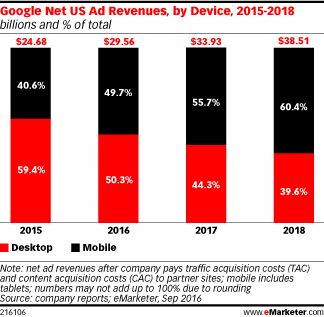
Google’s shift in revenues from desktop to mobile was a sharp one—eMarketer estimates that last year about 60 percent of Google’s ad revenues came from desktop, while this year it’s about 50/50. By 2018, eMarketer expects that Google will drive 60 percent of its revenues from mobile ads, at least in the US. On a worldwide basis, Google is already getting nearly 60 percent of its advertising revenues from mobile.
Google is also seeing strong growth in YouTube ad revenues, with growth this year expected to top 30 percent to hit over $5.5 billion worldwide. “Google’s accelerating ad revenues have been driven by capitalizing on usage and marketing trends like mobile search, YouTube’s popularity and programmatic buying,” said eMarketer senior forecasting analyst Martín Utreras.
Google’s essential appeal to advertisers “is simple and is resonating: our mobile properties like search, YouTube, maps and Google Play are where people turn when they’re actively interested in something,” said Google CEO Sundar Pichai during the earnings call. Pichai characterized Google’s position in the online world to the glory years of network television. “Our services are prime time for the mobile world.”
While the digital ad business is growing handily for Google and Facebook, Re/Code reports that the rest of the digital ad business is shrinking, as noted by Jason Kint of Digital Content Next, a trade group for digital publishers. He estimates that Google had 60 percent of the ad market’s growth over the past year, and Facebook had 43 percent—adding up to 103 percent, meaning the rest of the market got smaller. Those numbers are taken from Facebook and Google’s public statements and IAB’s numbers from a survey.
Mobile is becoming the key path for people going online, especially around the world. As the smartphones are dropping in price, their appeal is reaching the billions who could not afford more expensive devices—and had never dreamed of owning a computer. The growth in mobile is happening in India, in Southeast Asia, in Africa—and that’s driving the growth in the advertising business as well.
Marketers are gaining unprecedented reach for their goods and services, with incredible amounts of data along with that reach. Increasingly, access to those markets is running through Google and Facebook, though other players like Snapchat seem to be doing well. Google is best at capturing purchase intent with search, while Facebook is best at the other end of the marketing funnel generating brand awareness.
Marketers should focus on these two ad leaders for the foreseeable future, unless some serious changes start to shake down.
Instagram is social, influential and already a place for users to find inspiration on purchases. But how do you encourage Instagram users to shop without turning the app into a catalog? The Facebook-owned app is experimenting with the idea of tagging products like someone would tag a friend.
Partnering with 20 brands including Warby Parker, Kate Spade and J. Crew, the experiment will attempt to close the gap between inspiration and purchase.
Tapping on the item will bring up an information page that allows users to research the product without leaving the app. Studies have shown that more than half of consumers research purchases online before committing, and around 25 percent utilize YouTube for the same purpose. Instagram’s product information page will have a link to the retailer’s site when they’re ready to buy.
“It’s been a little frustrating to us in the past to not be able to have people purchase on Instagram,” said Jenna Lyons, J. Crew’s president and creative director, per Bloomberg. “Not only has it become a place for people to get influenced by their friends, but they’re walking into our stores with their phones and saying, ‘do you have this?'”
For Warby Parker, it would be nice to create a seamless buyer’s journey from inspiration to purchase. “Right now, there isn’t a simple, clean way for us to share details about the products featured within our posts,” Dave Gilboa, co-founder and co-CEO of Warby Parker commented on the Instagram post. “Customers often have to ask us, which creates a bulky experience on both sides.”
The product-tagged posts will roll out across a select group of US iOS accounts beginning next week. The move is just one of many in recent months by social media brands trying to implement purchases directly into their platforms.
Facebook, for example, has partnered with brands like Fandango along with local businesses to turn conversations into revenue. Pinterest, meanwhile has introduced buyable pins that feature calls to action, allowing users to purchase inspiring products directly from the app or website.


 Will Nom remain exclusive to mobile devices, or is there consideration being given to platforms like desktop computers, Roku or Amazon Fire TV?
 Are you going to integrate brand sponsorships into some of the content?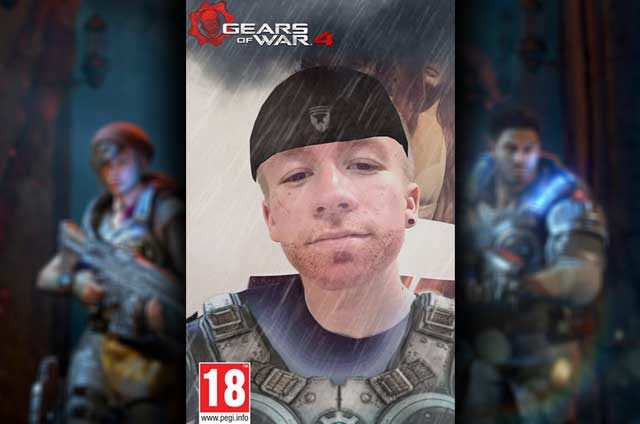

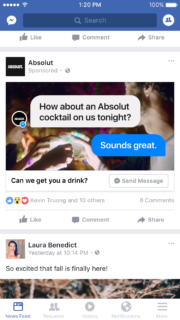 Absolut Vodka, who has been testing the new monetization option, has Joao Rozario, the company’s vice president of marketing, singing its praises. He says that the News Feed ads are a “call to conversation, which ultimately leads to a conversion. So far, our activation rate has exceeded execution benchmarks by two times and we’re looking forward to continued increases in activations driven by News Feed ads over the key holiday period,” Rozario said on
 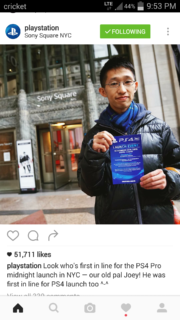 For the big launch of its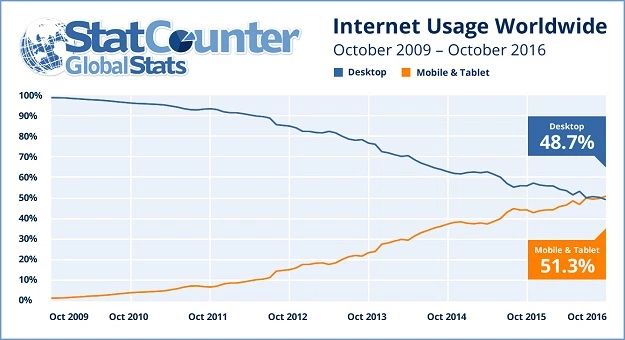
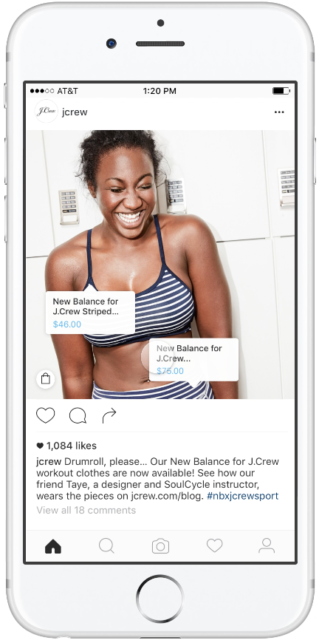 Tapping on the item will bring up an information page that allows users to research the product without leaving the app.
